Airbus targets voluntary job cuts before any wider staff layoffs #ศาสตร์เกษตรดินปุ๋ย

#ศาสตร์เกษตรดินปุ๋ย : ขอบคุณแหล่งข้อมูล : หนังสือพิมพ์ The Nation.

Airbus targets voluntary job cuts before any wider staff layoffs

Corporate

Jun 21. 2020

By Syndication Washington Post, Bloomberg · Charlotte Ryan, Siddharth Philip · BUSINESS, WORLD, TRANSPORTATION, EUROPE 

Airbus plans to pursue voluntary job cuts before seeking forced reductions, as it aims to bring down costs without inciting a political uproar in France and Germany, according to people familiar with the matter.

The European planemaker will mandate redundancies only as a last resort after looking at voluntary layoffs and early retirement across its manufacturing operations, said the people, who asked not to be named because deliberations are ongoing. The total is likely to range between 12,000 and 16,000 employees, estimates George Ferguson, a Bloomberg Intelligence analyst.

Caught in a demand downturn that could last as long as five years, Airbus must scale back quickly to stop cash outflows and regain its financial balance by year-end, Chief Executive Officer Guillaume Faury warned in his latest letter to staff, seen by Bloomberg.

The magnitude of the crisis calls for “heart-wrenching decisions,” Faury said. “What this means in reality is a necessary downsizing of our business.”

Airbus has raised liquidity, slashed production and put factory workers on rolling furloughs since the coronavirus spread across the globe earlier this year. The Toulouse, France-based company has yet to put in place a plan for permanent job cuts.

It would be a first for a company that has only grown for decades, and the task is complicated by political sensitivities in its home countries of France and Germany, which have committed massive amounts of virus-response aid to aerospace and major airlines like Air France-KLM and Deutsche Lufthansa AG that are big customers.

“We’re striving as a management team to find the right balance,” Faury said.

The letter, following a communication in late April that struck a similar tone, is part of constant dialog with employees, said Stefan Schaffrath, a spokesman for Airbus in Toulouse. He declined to discuss specifics.

The company expects to give more detailed guidance to employees by the end of July, Faury said in the letter, reported earlier by La Tribune.

France and Germany are Airbus’s biggest shareholders, and political pressure in those two countries — along with the potential for labor unrest — will factor into Airbus’s decisions. French Finance Minister Bruno Le Maire has already said that forced staff reductions are a “red line” at Air France, which will make it tougher for the airline to regain its financial footing.

At Airbus, “I would expect cuts to be similar to the drop in build rates, so would expect they need to cut close to 30% to maintain profitability,” Ferguson said. “But that will be politically untenable and they will look to the need for more workers as the market recovers, and probably land closer to 15-20%.”

France’s 15 billion-euro ($17 billion) package of support for the country’s aviation sector also includes measures to help finance plane sales by Airbus. In Germany, a state bailout of Lufthansa, Europe’s biggest airline, is shaping up to top 9 billion euros.

Airbus has also taken advantage of government-subsidized furlough programs across Europe, buying time with temporary measures that were recently extended in the U.K. and Spain.

In the letter, Faury warned staff that air traffic is unlikely to reach 2019 levels before 2023 at the earliest and potentially not until 2025. “After decades of growth, this comes as a significant shock,” he said.

The significance of the drop underscores the additional challenge, of keeping Airbus’s supplier network healthy for the downturn.

The 40% cut in output announced in April — a measure based on the labor that goes into making a single-aisle plane — so far “seems to be enough,” Faury said. He warned, however, that if air traffic recovers more slowly than expected in the second half of the year or next year, the company could be forced to cut production even further, “pushing down output to perilously low levels.”

Airbus had almost 81,000 workers in its commercial aerospace division at the end of 2019, the unit hardest-hit by the downturn.

“No company can cut headcount in line with output,” said Richard Aboulafia, an analyst at Teal Group. “It’s further complicated by the fact that Airbus has no experience dealing with downturns, they’ve only been moving up for over 30 years.”
SET dips after BOT orders banks to delay dividend payments #ศาสตร์เกษตรดินปุ๋ย

#ศาสตร์เกษตรดินปุ๋ย : ขอบคุณแหล่งข้อมูล : หนังสือพิมพ์ The Nation.

SET dips after BOT orders banks to delay dividend payments

Econ

Jun 22. 2020

By The Nation

The Stock Exchange of Thailand (SET) Index closed at 1,352.18 today (June 22), down 18.64 points or 1.36 per cent. Total transaction volume was Bt65.772 billion with an index high of 1,367.98 and a low of 1,347.60.

In the morning session, a stock analyst at Krungsri Securities projected the index would fall to 1,350-1,355 points before rebounding.

“Commercial banks and non-banking-entity stocks were under pressure from the Bank of Thailand’s order to hold off payment of interim dividends and buyback of shares to strengthen their capital ratio in response to the Covid-19 fallout,” the analyst said.

“Meanwhile, investors were worried about a second wave of Covid-19 after the number of new cases rose sharply, especially in Brazil, the US and India.”

He said the index would rebound as energy and petroleum stocks gained positive sentiment from the rising crude oil price and mass buy-offs in super savings funds for tax deduction.

“The price of crude oil rose almost US$40 [Bt1,238.82] per barrel after the number of active oil rigs in the US dropped by 10 to 189, while the Opec+ grouping is working on cutting oil production,” the analyst said.

The 10 stocks with the highest trade value today were KBANK, BBL, SCB, PTTEP, BAM, CPF, CPALL, AOT, PTT, and STA.

As of 4.30pm, the price of crude oil was unchanged at US$39.75 per barrel, while gold rose by $9.10 or 0.52 per cent, to $1,762.10 per ounce.

Changes in other Asian indices were as follows:

Japan’s Nikkei Index closed at 22,437.27, down 41.52 points, or 0.18 per cent.

China’s Shang Hai SE Composite Index closed at 2,965.27, down 2.36 points, or 0.08 per cent, while Shenzhen SE Component Index closed at 11,702.44, up 34.31 points, or 0.29 per cent.

Hong Kong’s Hang Seng Index closed at 24,511.34, down 132.55 points, or 0.54 per cent.

South Korea’s KOSPI Index closed at 2,126.73, down 14.59 points, or 0.68 per cent.

Taiwan’s TAIEX Index closed at 11,572.93, up 23.07 points, or 0.20 per cent.

SET expected to rebound ‘June-end’ as investors go in for ‘window dressing’ #ศาสตร์เกษตรดินปุ๋ย

#ศาสตร์เกษตรดินปุ๋ย : ขอบคุณแหล่งข้อมูล : หนังสือพิมพ์ The Nation.

SET expected to rebound ‘June-end’ as investors go in for ‘window dressing’

Econ

Jun 22. 2020

By The Nation

The Stock Exchange of Thailand (SET) Index is expected to rebound by the end of June as institutional investors are likely to buy up stocks as “window dressings”, experts said.

Window dressing is a strategy used by mutual-fund and other portfolio managers close to the year end or quarter end to improve the appearance of a fund’s performance before presenting it to clients or shareholders.

Asia Plus Securities research manager Paradorn Tiaranapramote said that in the past ten years, the SET Index has risen approximately 0.63 per cent during the last ten days of June, predicting that the index will rise to 1,380 points by the end of this month.

“In the past ten years, institutional investors have bought stocks as window dressings at the end of June and December,” he said. “Capital approximately worth Bt8.4 billion and Bt14 billion have flowed into the stock market in June and December, respectively,” Paradorn said.

He expected more capital to flow into the market because from June 1 to 18, institutional investors bought stocks totalling Bt1.48 billion, lower than the previous five months and lower than the original average of Bt8.4 billion.

“The market would gain positive sentiment from mass buy-offs in super saving funds for tax deduction, sales of which will end on June 30,” he said. “Meanwhile, we expect institutional investors to buy large-cap stocks, with prices rising more than the market.”

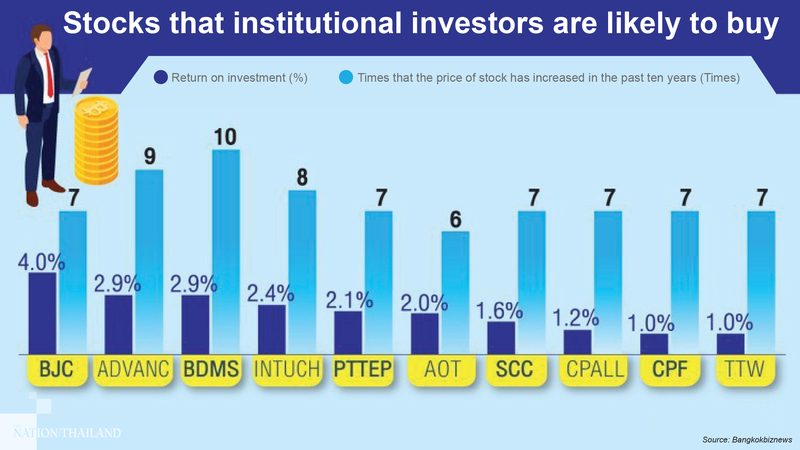
He recommended ten stocks institutional investors would buy – Berli Jucker (BJC), Advanced Info Service (Advanc), Bangkok Dusit Medical Services (BDMS), Intouch Holdings (Intuch), PTT Exploration and Production (PTTEP), Airports of Thailand (AOT), Siam Cement (SCC), CP All (CPAll), Charoen Pokphand Foods (CPF), and TTW.

Meanwhile, Tisco Securities senior strategist Apichat Poobunjirdkul said that according to a study on the movement of the Thai stock market at the end of every quarter since the global financial crisis in 2009, the chance that institutional investors will go in for a window dressing in the first quarter is 67 per cent, and 64 per cent in the second, third, and fourth quarters.

“Returns from window dressing in the first quarter are approximately 1.2 per cent and 1.4 per cent in the second quarter, contracting 0.5 per cent in the third quarter, and 0.0 per cent in the fourth quarter,” he said.

Gold price boosted amid second Covid-19 wave abroad #ศาสตร์เกษตรดินปุ๋ย

#ศาสตร์เกษตรดินปุ๋ย : ขอบคุณแหล่งข้อมูล : หนังสือพิมพ์ The Nation.

Gold price boosted amid second Covid-19 wave abroad

Econ

Jun 22. 2020

By The Nation

The price of gold rose by Bt150 per baht weight in morning trade today (June 22), the Gold Traders Association reported.

As of 9.27am, the buying price of a gold bar was Bt25,600 per baht weight and selling price Bt25,700, while gold ornaments were priced at Bt25,135.28 and Bt26,200, respectively.

At close on Saturday (June 20), the buying price of a gold bar was Bt25,450 per baht weight and selling price Bt25,550, while gold ornaments were priced at Bt24,998.84 and Bt26,050, respectively.

The Gold Spot Index price this morning moved to around US$1,755 (Bt54,389) per ounce after the price rose by $21.9 to $1,753 per ounce at close on Friday.

Investors bought gold as a safe haven asset due to uncertainty following the second wave of Covid-19 infections in the US and China.

BOT move, second virus wave cast shadow on SET #ศาสตร์เกษตรดินปุ๋ย

#ศาสตร์เกษตรดินปุ๋ย : ขอบคุณแหล่งข้อมูล : หนังสือพิมพ์ The Nation.

BOT move, second virus wave cast shadow on SET

Econ

Jun 22. 2020

By The Nation

The Stock Exchange of Thailand Index dropped by 10.61 points, or 0.77 per cent, to 1,360.21 this morning (June 22).

A stock analyst at Krungsri Securities expected the index to fall between 1,350 and 1,355 points before rebounding.

“Commercial banks and non-banking entity stocks were under pressure from the Bank of Thailand’s order to hold off paying interim dividends and buying back shares to strengthen their capital ratio in response to the Covid-19 fallout,” the analyst said.

“Meanwhile, investors were worried about a second wave of Covid-19 after the number of new cases rose sharply, especially in Brazil, the US and India.”

He said the index would rebound as energy and petroleum stocks gained positive sentiment from the rising crude oil price and mass buy-offs in super savings funds for tax deduction.

“The price of crude oil rose almost US$40 [Bt1,238.82] per barrel after the number of active oil rigs in the US dropped by 10 to 189, while the Opec+ grouping is working on cutting oil production,” the analyst said.

He recommended investors buy the following stocks:

▪ Energy stocks that benefit from the rising crude oil price, such as PTT, PTTEP, TOP, PTTGC, IRPC, SPRC, and IVL.

▪ Stocks whose second-quarter performance will improve, such as CKP, Tasco, STA, and RS.

▪ Marine shipping stocks that benefit from the rising freight rate, such as PSL, TTA, AMA, and PRM.

The SET Index dropped by 2 points on Friday (June 19), or 0.16 per cent, closing at 1,371 due to the FTSE All World move to reduce the weight on Thai stocks. Total transactions amounted to Bt63 billion.

Net sale by foreign investors amounted to Bt4.037 billion in stocks and Bt2.131 billion in bonds. There were 9,418 net short TFEX SET50 contracts.

U-Tapao stays on course to becoming aviation hub in future #ศาสตร์เกษตรดินปุ๋ย

#ศาสตร์เกษตรดินปุ๋ย : ขอบคุณแหล่งข้อมูล : หนังสือพิมพ์ The Nation.

U-Tapao stays on course to becoming aviation hub in future

Econ

Jun 22. 2020

By The Nation

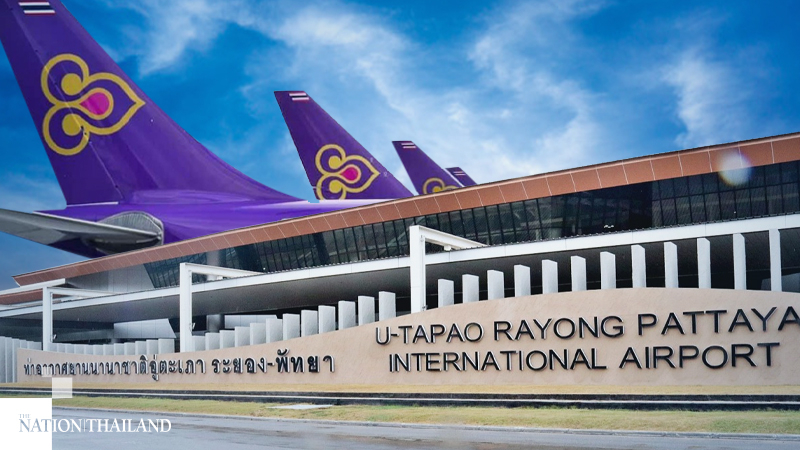
The development of U-Tapao Airport and Eastern Aviation City is set to take off after U-Tapao International Aviation Co Ltd (BBS Group) signed a joint investment agreement with Eastern Economic Corridor Office of Thailand (EECO) on June 19, with the goal of making U-Tapao an aviation hub.

EECO has revealed that the Covid-19 outbreak has had only a slight impact on the aviation city project. Experts in the aviation industry who are advising the office said that regardless of what people say travel is an inevitability.

Many parties estimate that within two years from now, air travel will return to normal. At the same time, transportation is becoming more important and air transportation will return soon, so the aviation city is still important.

The development of the U-Tapao Airport will take four years. When the construction is completed, it will be a time when air travel would be expanding, an important opportunity for the aviation city.

The crisis of Covid-19 will make the aviation business model change from using very large aircraft to the use of medium-sized jets with more flying frequency. So, the airport’s detailed design may be adjusted based on the frequency, the size of the plane and changing customer behaviour.

Meanwhile, there have been no bids for the proposed maintenance, repair and overall centre in the first round yet, but Thai Airways International plc has to build this aircraft repair centre since it has demolished the old Map Ta Phut to enlarge the runway area of the airport.

However, in the EEC, there will be other aircraft repair centres that will be open for bidding. There are still many private companies interested. From the analysis, it is seen that air travel must return to normal and Thailand will be an important aviation link in the region. The growth of the aviation industry in the Asia-Pacific region will make maintenance in the region more valuable than returning to Europe or the United States. However, the plan may be somewhat delayed due to the virus.

In terms of attracting investment in high-tech industries, although Thailand has many strengths such as infrastructure, communications infrastructure in technology, 5G network that will be used in 50 per cent of the EEC in 2021 and accelerating the development of highly skilled personnel, there is a weakness in international trade and investment agreements that are less than competitive, especially the Comprehensive and Progressive Agreement of Trans-Pacific Partnership and the Thai-European Free Trade Area.

The EECO officer said that Investors asked a lot about the time frame of action, especially on the EU FTA because it is a very important market and Vietnam has already signed these agreements

According to discussions between EECO and investors coming into the target industry, they want to know about highly skilled workers to support advanced technology. Thailand has started to develop skilled labour to support future investments. The free trade area is a secondary issue that investors asked about.

The 4-5 industries that came to consult with EECO are mostly in the biological industry and the new advanced material technology industry, such as the use of sugarcane to produce fibres for durable use in the high-tech industry, which involves high technology..

In addition, EECO has worked with Japanese high-tech companies who are going to move out of China while the Board of Investment has constantly revised the package to pull more investment.

AOT to cut costs at Suvarnabhumi after THAI downsizing #ศาสตร์เกษตรดินปุ๋ย

#ศาสตร์เกษตรดินปุ๋ย : ขอบคุณแหล่งข้อมูล : หนังสือพิมพ์ The Nation.

AOT to cut costs at Suvarnabhumi after THAI downsizing

Econ

Jun 22. 2020

By The Nation

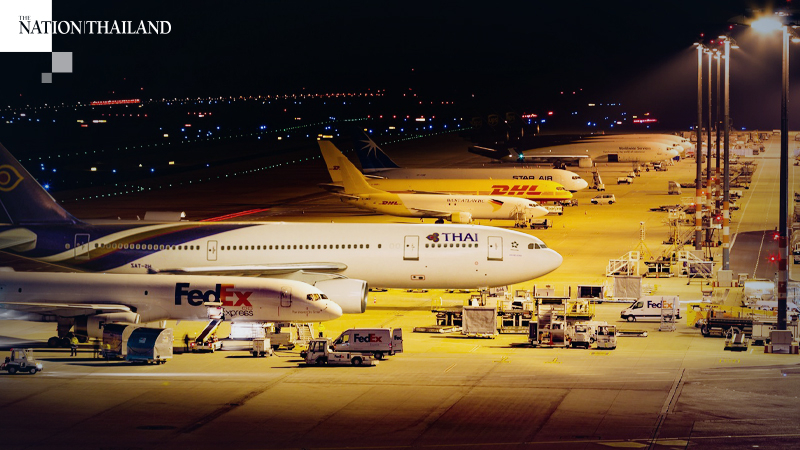
Suvarnabhumi Airport plans to reduce the number of check-in counters and hangar space to cut cost following the downsizing by national flag carrier Thai Airways (THAI).

Airports of Thailand Pcl (AOT), which runs Suvarnabhumi Airport, is preparing to close about 50 per cent of the check-in area as THAI has now entered into business rehabilitation through the Central Bankruptcy Court. Under the rehabilitation plan, THAI will also reduce the size of its fleet and flights, requiring fewer check-in counters and hangar space.

“In the past, Thai Airways used to be a large service user due to the number of flights, accounting for up to 20 per cent of traffic at Suvarnabhumi Airport.

AOT said it would use the additional check-in counters to manage other airlines, a source said.

AOT is also preparing to retake possession of parts of the aircraft hangar as THAI would need less space due to the reduction of aircraft by the airline.

AOT said the concourse will be managed to maximise efficiency and reduce management costs.

The source said that the pandemic had a direct impact on the administration of Suvarnabhumi Airport as commercial airlines are not able to fly on international routes while the number of passengers and tourists from around the world is decreasing. It is estimated that by 2021 Suvarnabhumi Airport will see 126,000 flights, down 66 per cent, compared to 370,000 in 2019.

TAT plans campaigns to woo premium foreign tourists #ศาสตร์เกษตรดินปุ๋ย

#ศาสตร์เกษตรดินปุ๋ย : ขอบคุณแหล่งข้อมูล : หนังสือพิมพ์ The Nation.

TAT plans campaigns to woo premium foreign tourists

Econ

Jun 22. 2020

By THE NATION

The Tourism Authority of Thailand (TAT) plans to launch two campaigns targeting premium foreign tourists, said TAT Governor Yuthasak Supasorn.

The two campaigns are: “Thailand, Medical and Wellness Resort of the World” and “Thailand, World’s Shopping Paradise”.

Foreign tourists reportedly account for 60 per cent of the country’s tourism income.

TAT will also launch a two-month Amazing Thailand Grand Sales 2020 from July 15 to September 15 in five provinces — Bangkok, Chiang Mai, Phuket, Hat Yai and Pattaya — featuring 10,000 offline and online businesses, to encourage local and foreign tourists to part from their money.

The campaign will also bolster Thailand’s image as a shopping destination.

He added that the fair is expected to generate cash flow of Bt1.5 billion into the economic system, higher than last year’s Bt1.4 billion.

Govt trailing critics of trans-Pacific partnership in the communications game #ศาสตร์เกษตรดินปุ๋ย

#ศาสตร์เกษตรดินปุ๋ย : ขอบคุณแหล่งข้อมูล : หนังสือพิมพ์ The Nation.

Govt trailing critics of trans-Pacific partnership in the communications game

Econ

Jun 22. 2020

By Preechapak Tekasuk

Special to The Nation

More than half a decade after abandoning the US-led multilateral programme, Trans-Pacific Partnership (TPP), Thailand has finally got back on track to joining the grouping again.

On the initiative of Deputy Prime Minister Somkid Jatusripitak, Thailand began the negotiations in early 2020. The new TPP, however, was remodelled as the Comprehensive and Progressive Agreement on Trans-Pacific Partnership (CPTPP) spearheaded by US  ally, Japan, in March 2018. 

The hope is that it might offer Thailand a broader economic and strategic opportunity, and most importantly grant Bangkok an ability to compete with its rising neighbours — Malaysia and Vietnam — who joined the talks in 2008 and 2010 respectively.

Unfortunately, the move by the Thai government has faced a chronic backlash from the public since the end of April 2020. Prominent civil-society groups interpret the CPTPP as benefiting only a small circle of Thai elites and their business conglomerates. But it grants almost zero benefits to those from the middle-class and the working class who form the majority of the country. Built on a hashtag campaign in early June, “#NoCPTPP”, on Twitter, the opposition has successfully managed to instill and flood various types of colourful infographic images into the hashtag, which has resulted in a large public disagreement on social media on joining the controversial trade deal for more than a week. This immediately led to Bangkok’s decision to stall the move and pass it to the legislative body in order to avoid popular protests.

The secret sauce to this success was undeniably simple. Thai civil-society groups used a down-to-earth strategy of making every information consumable. They converted all the scattered information about CPTPP into provocative, straightforward and reader-friendly messages, and spread them on social media platforms. When the messages are already over-simplified, it is a plain-sailing task for the groups to broaden their audiences across the board. Thus, the problem lies not with the audiences, but the messages themselves. The groups took advantage of their widespread trend of CPTPP and manipulated the public to rage on the issue, by emphasising only a few life-threatening agendas:  patents on plants and seeds, pharmaceutical patents, and small and medium-sized enterprises.

Though a handful of agendas could not fully represent the entire CPTPP package, it was more than enough for the civil-society groups to whip up  public opinion against the government as it was deemed that Thai society still remains largely dependent on the  agricultural and farming sector. Those agendas were cunningly made to be seen as jeopardising the old and prosperous livelihoods of all Thais. Hence, it was not too hard for the public to automatically believe in the civil-society groups’ provocative narrative. And, that is essentially where the information war began, and the government is likely to lose its ability to shape public opinion. Obviously, the government is not putting enough effort into advocating the trade deal.

The reasons why the government and its decision-making bodies appear to be non-responsive to the CPTPP issue remain unclear. Nevertheless, one thing that is utterly clear is that it did not effectively arrange a proper channel of communication to transparently persuade the public into trusting it. Therefore, it could not make the masses feel secure enough about its ambitious scheme. The Department of Trade Negotiations, and its parent organisation, the Ministry of Commerce, who have direct responsibility in dealing with the CPTPP issue, did not prove to be adequately proactive in communicating with the public.

A coalition of civil-society groups has its glowing infographic, leaflets spread throughout both Twitter and Facebook platforms in which most of them are online-based, by far the simplest approach to reaching its audiences. In contrast, the governmental bodies’ approach relies on limited channels of communication, paper-based leaflets, press conferences, press releases, official website-based reports, and information-overloaded conference papers. Such channels are seen either as too traditional or too informative which is not highly applicable for mass mobilisation and public support on social media.

To be fair, the government has its own social media channels too, but an old-fashioned method of communication with the public remains a major obstacle. The infographic pamphlets provided on their Facebook pages and official websites are often criticised as uninspiring, and unimaginative, since they roughly put all the information into the template at once. And that does not appear to be sufficiently persuasive. On the contrary, it drives the audiences away as the information published within the pamphlets is too incomprehensible and not reader-friendly. The masses definitely prefer messages that are easy to understand. The government has to basically understand that in order to better communicate with the public, it needs to consider the comprehension of its audiences. This is where the Thai civil-society holds its high ground over the government.

As a matter of fact, the government is strategically the sole actor who holds most of the information about the CPTPP. It had previously hired a consulting firm, Bolliger & Company, to conduct an intensive research about both costs and benefits of the CPTPP to the Thai nation. 

Apart from a 500-page research report produced by the prestigious consulting powerhouse, the government, during the past years, also had obtained a wide-ranging view from several like-minded agencies. For example, public policy-oriented Thailand Research Development Institute (TDRI), the Thai Ministry of Foreign Affairs, the Thai Ministry of Agriculture and Cooperatives, Singapore-based ISEAS-Yusof Ishak Institute, as well as leading Thai university scholars.

The public policy community, stated above, had often organised straightforward  conferences, and published newspaper commentaries about the nationwide benefits and advantages of the CPTPP, in support of the government’s move. To this extent, it could be said that the government is absolutely holding a greater power of knowledge to shape public opinion, but it is signalling the failure to do so. It need not rely merely on an old-fashioned communication approach, and should make more attempts to educate the public about the issue. The inadequacy in public relations will certainly cost the government more of its future moves should it fail to demonstrate the brighter side of that troublesome trade deal. The government must soon readjust its domestic strategy in order to bridge the gap between itself and the public, or else all the endorsements from the policy community will be worthless

Debtors hit by Covid-19 get relief from second slew of BOT measures #ศาสตร์เกษตรดินปุ๋ย

#ศาสตร์เกษตรดินปุ๋ย : ขอบคุณแหล่งข้อมูล : หนังสือพิมพ์ The Nation.

Debtors hit by Covid-19 get relief from second slew of BOT measures

Econ

Jun 20. 2020Ronadol Numnonda, BOT Deputy Governor of Financial Institutions StabilityRonadol Numnonda, BOT Deputy Governor of Financial Institutions Stability

By The Nation

The Bank of Thailand (BOT) has issued the second phase of measures to help debtors suffering from the Covid-19 impact, Ronadol Numnonda, BOT deputy governor of Financial Institutions Stability, said on Friday (June 19).

He explained that the BOT had discussed with financial service providers to implement the second phase of measures to help debtors:

1 Reducing the interest rate ceiling for credit cards and personal loans by 2 to 4 per cent per year, starting from August 1.

The interest rate ceiling for credit cards will be cut to 16 per cent per year from 18 per cent per year; 25 per cent per year from 28 per cent per year for revolving loans and instalment loans; and 24 per cent per year from 28 per cent per year for car cash.

2 Increasing credit card, revolving loan, and instalment loan limit from 1.5 times of debtors’ income to two times of debtors’ income for debtors who have shown good behaviour and have income lower than Bt30,000 per month, starting from August 1 this year to December 31 next year.

3 Provide alternative measures to help debtors hit by the Covid-19 who do not have non-performing loans.

Financial service providers must provide alternatives to debtors, such as reducing the minimum payment rate depending on debtors’ ability to pay debt, changing term loan, reducing instalment rate, and postponing the payment.

In addition, financial service providers must provide information for debtors, such as debt repayment plan, number of instalments, and additional interest that debtors have to pay after the postponement.

Moreover, financial service providers cannot call for prepayment fee or other charges on debtors because alternative measures are not considered a default in payment.

Debtors who are interested can contact financial services providers via smartphone application, website, call centre, or SMS message from July 1 to December 31 this year.

4 Financial service providers must restructure debt, focusing on their ability to pay debt in order to relieve debtors’ burden, such as extending the repayment period, changing the term loan, postponing payment, cutting interest, and delaying confiscation.

“The BOT believes that the second phase of measures will help relieve debtors’ burden and reduce the cases of default in payment,” Ronadol said.

“Meanwhile, this measure will help financial services providers to manage risks and treat debtors equally.”

He added that BOT will monitor the situation closely.