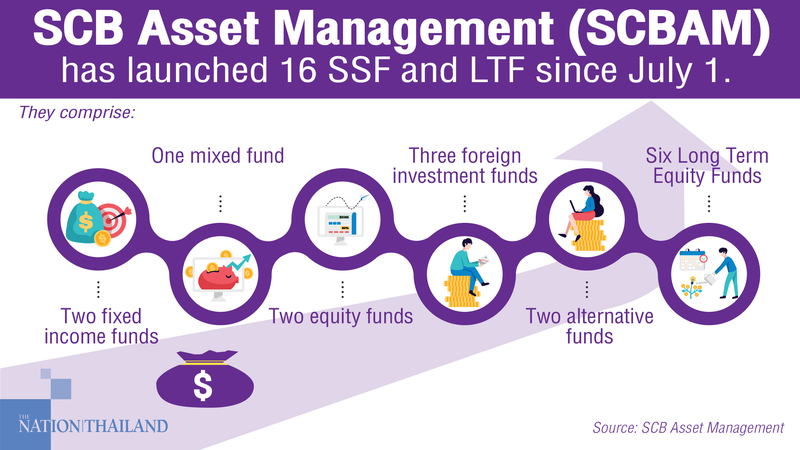
SCB Asset Management (SCBAM) has launched 16 Super Savings Funds (SSF) and long-term equity funds (LTF), covering investment in all assets since July 1 this year.
Narongsak Plodmechai, chief executive officer at SCBAM, said that this move aimed to provide a variety of investment options for several investors.
He said the 16 SSF and LTF funds are:
Two fixed income funds
▪︎ SCB Short Term Fixed Income Plus Fund (Super Savings Fund): This fund invests in deposits, government bonds and debt instruments, both domestic and offshore in the short term.
▪︎ SCB Fixed Income Plus Fund (Super Savings Fund): Invests in deposits, government bonds and debt instruments both domestic and offshore within one to three years.
One mixed fund
▪︎ SCB Smart Plan 2 Open End Fund (Super Savings Fund): Invests in stocks and debt instruments. The target volatility is approximately 5 per cent per year.
Two equity funds
▪︎SCB Selects Equity Fund (Super Savings Fund): Invests in 30 Thai stocks that have strong fundamentals to generate outstanding returns.
▪︎SCB Dividend Stock Open End Fund (Super Savings Fund): Invests in Thai stocks that pay dividends regularly.
Three foreign investment funds
▪︎ SCB Global Strategic Investment Fund (Super Savings Fund): Invests in debt instruments of foreign private sectors, managing by PIMCO, the world-class fund manager.
▪︎ SCB US Equity Fund (Super Savings Fund): Focuses on generating returns similar to the S&P500 Index, the most valuable index in the US.
▪︎ SCB Low Volatility Equity Fund (Super Savings Fund): This fund invests in stocks worldwide that have good fundamentals and low volatility.
Two alternative funds:
▪︎ SCB Gold THB Hedged Open-End Fund (Super Savings Fund): Focuses on generating returns similar to the gold bar price in the global market.
▪︎ SCB Property and Infrastructure Flexible Fund (Super Savings Fund): Invests in property and/or infra units, including real estate investment trust, registered both domestic and foreign.
Six Long Term Equity Funds (LTF): These existing funds will enable investors to avail investment opportunities.
Aeon Thana Sinsap (AEONTS) reported a 46-per-cent plunge in net profit for the first quarter ended May 31 despite revenue increasing by 3 per cent.
Aeon Thana Sinsap (AEONTS) reported a 46-per-cent plunge in net profit for the first quarter ended May 31 despite revenue increasing by 3 per cent.
The company had a net profit of Bt530 million on revenue of Bt5.65 billion.
Aeon was the first non-bank organisation to announce its financial results after being impacted by the Covid-19 crisis.
The decrease in profit was attributed to higher provision for bad debt and doubtful account, which had increased by 72 per cent to Bt2.39 billion.
Korakot Sawetkruttamat, Kasikorn Securities’ assistant director, said that the performance of Krungthai Card (KTC) would be like AEONT’s, since the two companies were similar to each other.
In the second half of this year, Korakot predicted that the stocks of those credit companies would not recover to their previous level, which will affect profits, especially KTC and Srisawad Corporation that previously charged high interest.
“The performance of credit company stocks will tend to be weak in the next one to three years” he added. “The high coverage ratio of AEONTS reflected that the corporation has prepared itself to deal with the non-performing loan [NPL], which will be heightened in the future. AEONTS’ NPL would rise from the present 3.7 per cent to at most 10 per cent in the worst case”.
However, the stock price of AEONTS on Wednesday (July 8) could return to positive zone, due to its NPL information that would increase investor confidence.
MCOT does not need a rehabilitation plan despite recording a Bt877-million loss in the first quarter, the Ministry of Finance said.
The State Enterprise Policy Office (Sepo) has said that MCOT Pcl is suffering from lack of liquidity, but it is still at a manageable level, a source at the ministry said. MCOT is therefore not on the list of state enterprises that require Sepo’s rehabilitation programme.
“MCOT’s liquidity problem stemmed from the auction of digital TV channels and losing programmes that Chanel 3 used to produce for it, now scrapped due to MCOT’s restructuring of its TV business,” said the source. “Furthermore, several business partners are late in paying advertising fees to MCOT due to the economic impact of Covid-19.
“MCOT’s executives are discussing the problem and should be able to come up with a plan soon, as MCOT’s problem is more manageable than that of Thai Airways International, which has substantial debt on top of lack of liquidity,” added the source.
MCOT reported an Bt870-million loss in the first quarter of 2020, a steep rise from a Bt32-million loss in the same period last year. Revenue in the first quarter was Bt467 million, down 21 per cent year on year. MCOT’s most profitable businesses are radio (29 per cent of revenue), TV (24 per cent), concession contract (22 per cent) and services for digital TV network (19 per cent).
By The Washington Post · Lori Aratani · BUSINESS, TRANSPORTATION, US-GLOBAL-MARKETS, CAREER-WORKPLACE
United Airlines announced Wednesday that despite receiving billions in federal aid, it may furlough nearly 36,000 employees Oct. 1, a scenario one union official called a “gut punch.”
The number represents nearly 40 percent of the Chicago-based airline’s workforce.
Government grants received through the $2 trillion Cares Act require airlines to keep front-line workers on the job through Sept. 30. In addition to receiving $4.9 billion in grants, United signed a letter of intent this week to accept roughly $4.5 billion in loans through the law. But executives said that with demand for air travel unlikely to return in 2020, they have no choice but to warn employees of layoffs.
“The reality is that United simply cannot continue at our current payroll level past October 1 in an environment where travel demand is so depressed,” the airline said in a memo sent to employees. “And involuntary furloughs come as a last resort, after months of companywide cost-cutting and capital-raising.”
Under the Worker Adjustment and Retraining Notification Act, most firms with 100 or more employees must give them 60 days’ notice of mass layoffs or plant closings. What is happening at United will probably be repeated as carriers struggle to survive the worst economic crisis in the industry’s history. Airline executives have already signaled they expect to emerge from the crisis with smaller workforces.
In a message to employees in March, Oscar Munoz, then United’s chief executive, and Scott Kirby, then the airline’s president, said that while taking care of employees would be their top priority, “if the recovery is as slow as we fear, it means our airline and our workforce will have to be smaller than it is today.”
Still, Wednesday’s announcement was a blow to employees.
“The United Airlines projected furlough numbers are a gut punch, but they are also the most honest assessment we’ve seen on the state of the industry,” said Sara Nelson, president of the Association of Flight Attendants-CWA, which represents nearly 50,000 flight attendants at 19 airlines, including United.
United employs roughly 95,000 people worldwide. The number of furloughs could be fewer depending on how many employees accept early retirement, voluntary separation or other programs, executives said. Already, more than 20,000 United employees have taken voluntary unpaid leaves of absence. The airline has also cut other costs, but officials said it is burning through $40 million a day.
Demand for travel has increased slowly but remains far below 2019 levels. In its June forecast, the International Air Transport Association estimated that carriers worldwide would lose $84.3 billion in 2020. Revenue is expected to fall 50 percent, from $838 billion in 2019 to $419 billion this year.
United said even though it has begun to add flights, capacity is expected to be down 75 percent in July compared with the same month last year. Some growth is anticipated in August, but the numbers are still projected to be down 65 percent compared with last August.
The recent spike in coronavirus cases in numerous states, including California, Florida, Texas and Arizona, is further diminishing hopes of a recovery, with many saying demand probably won’t return to normal levels until treatments or a vaccine become widely available. On Wednesday, the number of confirmed infections in the United States surged past 3 million, according to data tracked by The Washington Post, and there have been more than 129,00 deaths.
The AFA and other unions have called on Congress to extend payroll support offered through the Cares Act, warning that layoffs in aviation will ripple through the entire economy. U.S. airlines and cargo carriers directly employ an estimated 750,000 worldwide.
“Should October 1 arrive without extending the [Payroll Support Program] grant job program mass layoffs are inevitable, as airline executives have acknowledged. Hundreds of thousands of workers will lose their jobs and health insurance – not only in aviation, but across our entire economy,” union officials said in a letter last month to Democratic and Republican leaders on Capitol Hill. “Airline industry employment cannot simply be put back together overnight, and mass layoffs will do great damage to the sector, with potentially irrevocable consequences.”
Added Nelson on Wednesday: “Congress must extend the PSP in order to avoid hundreds of thousands of layoffs from an industry that normally drives economic activity for every other sector and supports more than 11 million jobs. Failing to maintain this successful jobs program will have a ripple effect across the economy. Conversely, a clean extension of the program helps prime us for economic recovery.”
Joe DePete, president of the Air Line Pilots Association, International – which represents more than 63,000 pilots at 34 airlines in the United States and Canada said: “The economic impact COVID-19 has had on the airline industry has been profound for the workers who keep our skies safe and our world connected. Unfortunately, in the past few weeks, thousands of pilots and crew members have received furlough notices and, absent congressional action, it is likely that there will be more to come.”
On a phone call with reporters Wednesday, United executives said they were aware of the unions’ push for an extension to the payroll support program, and while they would continue to engage with leaders in Washington, they were not counting on Congress to act.
“We don’t feel like we can count on additional government support,” a United executive on the call said.
At least one lawmaker signaled support for an extension.
“United’s announced furloughs are a canary in the coalmine for the industry,” Sen. Richard Blumenthal, D-Conn., said in a statement. “It’s clear that an extension of the Payroll Support Program is necessary to help airline workers keep their jobs and health insurance in the months ahead. I will continue to push for additional aid that puts workers and consumers first – and keeps airlines accountable.”
Of the 36,000 United employees who could be affected, roughly 15,000 are flight attendants, and 11,000 are customer service or gate agents. About 1,800 catering workers, 1,000 contact center employees, 5,500 technical operations employees and 225 network operations workers also could be affected. Among pilots, 2,250 could be harmed.
“Furloughing employees is corporate triage with a terrible impact on thousands of United families,” said Todd Insler, chairman of the United Master Executive Council of the ALPA. “This is a direct result of the global pandemic which has affected millions around the world and nearly grounded our industry. ALPA is doing everything we can do to support our fellow pilots, and we expect to have final agreement on several voluntary programs which will mitigate these furloughs.”
Earth Tech Environment (ETC), a subsidiary of Better World Green (BWG), will be listed on the Market for Alternative Investment (mai) and launch its initial public offering (IPO) in August.
The funds will be used to construct additional garbage power plants, expecting the government to open additional electric power bidding over 400 megawatts this year.
This move followed the BWG shareholders’ resolution.
Aekkarin Luengviriya, ETC president and chief executive officer, said that the company’s registered capital was Bt1.120 billion, while there are 2.240 billion shares with par value of Bt0.50 per share.
“The company will sell 600 million shares of which 60 million shares, or 10 per cent, have greenshoe option to gain confidence among investors during market volatility,” he said.
He added that to reward the current BWG shareholders and increase the value of BWG shares, the company will allow current BWG shareholders to subscribe to ETC’s 95.8 million newly issued ordinary shares.
“Shareholders who hold 40 BWG shares can subscribe for one new ETC ordinary share,” he added.
Currently, ETC’s main business is the garbage power plant, while the company will recognise revenue from three power plants with production capacity totalling 16.5MW by this year. The company’s electricity charge rate was between Bt5.83 and Bt6.83 per unit.
ETC’s parent company will be responsible for the distribution of refuse-derived fuel, a material for producing electricity, while subsidiaries will be responsible for the construction of power plants.
Meanwhile, ETC’s earnings before interest, tax, depreciation and amortisation (EBITDA) was Bt25 million per megawatt, higher than other types of power plants.
ETC also gained support from the Board of Investment (BOI) for eight years and the company can ask for BOI’s assistance for another five years.
ETC reported revenue of Bt362.39 million in 2019, up from Bt325.24 million in 2018, while the company’s EBITDA was Bt202.90 million, down from Bt224.40 in 2018 due to expenditure incurred in the construction of two additional power plants.
Meanwhile, ETC’s net profit in 2019 was Bt57.55 million, down from Bt66.96 million in 2018.
The company’s revenue and net profit in the first quarter of this year was Bt134.90 million and Bt24.18 million respectively.
Petrochemical firm IRPC said its performance in the second half should improve since its profit margin will rise in line with the increasing price of petroleum and petrochemical products.
Noppadol Pinsupa, director of IRPC, said the company’s refinery should be able to produce 205,000 barrels per day, and its primary profits should be between US$9 and $10 (Bt281 and Bt312) per barrel, rising from $8.7 per barrel last year.
However, he said, this depends on the direction the crude oil takes, adding that the price of crude oil for the rest of this year should hover between $40 and $50 per barrel, versus $60 per barrel last year.
Noppadol added that IRPC should do better than it did in the first quarter, when it was at a deficit of Bt8.91 billion, after the market GIM had increased to $8 or $9 dollar per barrel.
Also, due to several improved factors, its earnings before interest, taxes, depreciation and amortisation (EBITDA) should not contract in the second quarter, like it did by Bt6.44 billion in the first quarter.
In addition, IRPC has launched a five-year (2020 to 2025) strategy called “Strengthen IRPC” in a bid to cope with the Covid-19 fallout. Under this strategy, its EBITDA should reach Bt20 billion in 2025 and Bt30 billion in 2030. The firm’s EBITDA was Bt5.94 billion in 2019, the director added.
IRPC’s new strategy focuses on increasing specialised products as well as the expansion of sales channels. The strategy was relevant to the stock-and-cost management and the total budget spent in each aspect of “Strengthen IRPC” added up to Bt2.18 billion.
Noppadol added that IRPC holds a 50 per cent state in Mytex Polymers, the manufacturers of PP compound plastic. He said this investment will help the corporation expand into the automobile industry at a faster rate.
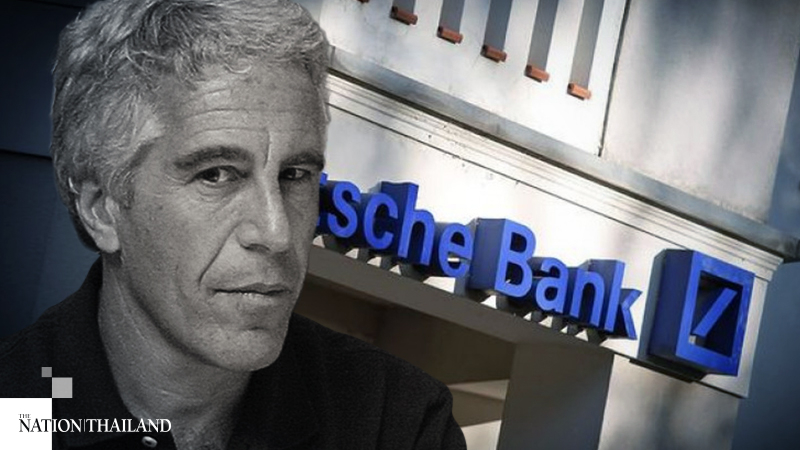
By The Washington Post · Renae Merle, Taylor Telford · BUSINESS, WORLD, US-GLOBAL-MARKETS Deutsche Bank has agreed to pay $150 million to settle allegations that it maintained weak internal controls, including processing hundreds of transactions for Jeffrey Epstein despite the billionaire’s troubled history.
The penalty announced Tuesday by New York State Department of Financial Services marks the first time regulators have punished a bank for its relationship with Epstein, a convicted sex offender.
Despite knowing Epstein’s “terrible criminal history,” the bank “inexcusably failed to detect or prevent millions of dollars of suspicious transactions,” Linda Lacewell, the superintendent of financial services, said in a statement.
The settlement comes almost exactly a year after Epstein was arrested on accusations he had abused women and girls for decades, and enlisted his victims to recruit others. Prosecutors said Epstein preyed on the financial needs of his victims by promising them career opportunities and educational assistance, and used a convoluted web of shell companies to conceal the trafficking and abuse. He allegedly used private planes, helicopters, boats and cars to transport them to his secluded islands.
Epstein, 66, hanged himself last summer in his cell at the Metropolitan Correctional Center in Manhattan.
Epstein’s longtime confidant Ghislaine Maxwell – daughter of the late media tycoon Robert Maxwell – was arrested July 2 in New Hampshire on charges she recruited and groomed underage girls for abuse by her then-boyfriend. Starting in at least 1994, a grand jury indictment alleges, she “enticed and groomed multiple minor girls to engage in sex acts with Jeffrey Epstein, through a variety of means and methods.”
Deutsche Bank expressed regret for its relationship with Epstein in a statement. “Our reputation is our most valuable asset and we deeply regret our association with Epstein,” said company spokesman, Daniel Hunter.
The German bank’s ties to Epstein began in 2013, years after the billionaire pleaded guilty to two prostitution charges in Florida, according to the consent decree filed by the New York regulator. Deutsche Bank knew about Epstein’s past, classifying him as a “high-risk” client, but also considered the relationship potentially lucrative – $100 million to $300 million in revenue over time.
In 2014, the bank’s anti-financial crime unit grew concerned about Epstein after new reports emerged about his alleged victims. Deutsche Bank executives met with Epstein at his New York home and asked about the veracity of the allegations.
The bank ultimately decided to continue doing business with Epstein but established new safeguards, which were largely ignored, according to the consent decree.
“The Bank’s fundamental failure was that . . .[it] failed to scrutinize the activity in the accounts for the kinds of activity that were obviously implicated by Mr. Epstein’s past,” the consent decree says.
Deutsche Bank processed more than $7 million in settlement payments to Epstein’s alleged co-conspirators, as well as more than $800,000 in suspicious cash withdrawals, the regulator said. But it didn’t inquire or block the transactions with “named co-conspirators” or ask what Epstein was spending $200,000 per year in cash on.
Instead of monitoring his accounts for “all potential crimes and suspicious activities,” one of the bank’s anti-financial crime official, for example, simply searched the Internet to verify that transactions didn’t involve girls younger than 18.
Deutsche Bank should have known Epstein’s transactions were suspicious but suffered from “a series of procedural failures, mistakes, and sloppiness” in how it oversaw his accounts, according to a statement from the New York regulator. The bank didn’t end its relationship with Epstein until 2018, a month after the Miami Herald published damaging details about an Epstein plea deal.
“For years, Mr. Epstein’s criminal, abusive behavior was widely known, yet big institutions continued to excuse that history and lend their credibility or services for financial gain,” New York Gov. Andrew Cuomo said in a statement.
Deutsche Bank said it cooperated with the investigations, spent $1 billion to improve its internal compliance systems, and tripled the size of its anti-financial crime team to 1,500. The state regulator credited the bank for its “exemplary cooperation” with investigators.
“We all have to help ensure that this kind of thing does not happen again,” Christian Sewing, the bank’s chief executive, said in a note to the company’s employees. “It is our duty and our social responsibility to ensure that our banking services are used only for legitimate purposes.”
The $150 million penalty also covered Deutsche Bank’s conduct in two money laundering cases. The New York Financial Services Department said Deutsche failed to properly monitor the activities of two foreign bank clients, Danske Estonia and the Federal Bank of the Middle East, or FBME. The bank ignored red flags in its relationships with the financial institutions, including Danske Estonia, which is at the center of one of the world’s largest money laundering schemes.
Deutsche Bank is also at the center of another high-profile, legal fight.
The U.S. Supreme Court is considering whether the House Financial Services and Intelligence committees can subpoena documents related to President Donald Trump’s finances – many of which are held by Deutsche Bank, the only major lender to do business with him in recent years. The bank remains his biggest creditor, having loaned him more than $2 billion, the New York Times reported.
The share price of packaging and food supply companies skyrocketed by more than 100 per cent because these businesses were left unscathed by the Covid-19 impact.
The shares of Polyplex (Thailand) (PTL), AJ Plast (AJ), Starflex (SFLEX) and R&B Food Supply (RBF) rose by 132 per cent, 170 per cent, 166 per cent, and 283 per cent, respectively.
PTL managing director Amit Prakash said now that the company has started producing polyester plastic beads, it expects sales in Indonesia to rise by up to 16 per cent during the April 1, 2020 to March 31, 2021 period. He added that the production of polyester beads is currently 90 per cent, which should shift to 100 per cent soon.
“PTL has benefited from the pandemic because demand for flexible packaging has risen,” he said.
Meanwhile, SFLEX executives expect the company’s revenue and profits to rise this year, adding that the firm will soon start producing rice bags and sachet to expand its customer base.
“The company’s aims to boost this year’s revenue by 15 to 20 per cent year on year, while it is targeting a 21 to 23 per cent rise in gross profit,” the executives said. “Meanwhile, we aim to raise funds by launching initial public offerings to build a new factory so production can be expanded by another 30 per cent.”
A stock analyst at DBS Vickers Securities said RBF’s revenue in the next two years is expected to increase by approximately 30 per cent per year as the company’s sales continues to rise, and the company has also successfully managed to control costs.
“Projects that will help boost the company’s growth are new breadcrumb factories in Vietnam and Indonesia, the procurement of new machines to boost efficiency and a new factory in Indonesia’s Surabaya.”
Jul 08. 2020Paiboon Nalinthrangkurn, chair of the Federation of Thai Capital Market Organisations (Fetco).
By The Nation
Even though the Stock Exchange of Thailand (SET) Index experienced large negative returns of minus 13 per cent, bank shares have suffered a sharp 34 per cent downfall from early this year.
Paiboon Nalinthrangkurn, chair of the Federation of Thai Capital Market Organisations (Fetco), said that though investors are regaining their confidence, they are still neutral where SET Index is concerned.
If broken down, retail investors remain negative, while brokerage accounts and institutional investors have shifted to neutral from negativity about the market. Only foreign investors are positive.
“It is interesting to see that different investors now have contradictory views compared to the past few months, when almost everyone believed the market would rebound. Since the market has rebounded to a range of 1,300 to 1,400 points, we have witnessed some share selling. However, I personally don’t think the index will rise any higher, unless we have a clearer picture of the economic situation,” Paiboon said.
Most investors are not interested in bank shares even though the price has gone down by 40 per cent, he said, adding that they are more interested in shares in the food and beverage category.
Jeff Suteesopon, mutual fund manager at Bualuang Fund, said the Covid-19 fallout is expected to drive up banks’ non-performing loans (NPLs), while the interest rate is on a decline. These factors are putting banks’ profits under pressure, though they are doing better in terms of lending. Loan growth is expected to be 4 per cent this year, compared to just 2 per cent last year, because businesses require more liquidity.
The central bank’s debt moratorium for businesses has eased the possibility of bad debts, otherwise the banking sector would have been hit hard by bad debts in the second quarter.
Debt repayment has been suspended for a combined Bt6.8 trillion or 37 per cent of total loans. Under the assumption that 40 per cent of loans have to be restructured, then NPLs could rise to 4.5 per cent this year and 5 per cent next year, he said.
On the positive side, however, banks may not need to boost their capital as they have large reserves against risk assets now.
Though no cash is flowing into banks during the debt moratorium period, it is doing so in accounting practice. So, if debtors are unable to pay their debts after the moratorium, then banks will have to write off this supposed revenue.
Bank profits are expected to drop by 45 per cent, or from a combined Bt200 billion in profits last year to Bt120 billion this year. This is largely because banks need to set aside large reserves worth about Bt250 billion, up from Bt160 billion last year.
Return on equity (ROE) is also expected to drop to 5 per cent from 10 per cent.
On the positive side, since bank shares have fallen sharply, the risk of a further downturn is low. Though bank shares may not be attractive in the short term, they are fine for two- to three-year investment, he said.
Worawat Saisuphatphol, an analyst at UBS Securities (Thailand), said bank profits in the second half of this year will be lower than the first half as banks have to boost their already large reserves.
According to UBS studies conducted over the past 10 to 15 years, banks’ shares generally rise during three or four quarters before bad debts peak. This means share prices rise before profits can increase, he added.
Oil and gas conglomerate PTT Plc has conducted a feasibility study on restructuring its electricity generation business to futher boost growth and ensure it keeps pace with global energy trends, chief executive officer Auttapol Rerkpiboon said.
PTT’s electricity business includes electricity generated from conventional sources, such as natural gas or coal, and that generated by what he calls “the new energy” such as renewable energy and also an energy storage system.
He added that Global Power Synergy Plc is still PTT group’s power business flagship.
PTT has also assigned other companies in its group, such as Thai Oil Plc, PTT Global Chemical and IRPC to jointly study the possibility of supporting PTT’s new energy business.







 Paiboon Nalinthrangkurn, chair of the Federation of Thai Capital Market Organisations (Fetco).
 PTT CEO Auttapol Rerkpiboon
