Amazon sales soar as coronavirus-worried consumers shop from home, but costs rise #ศาสตร์เกษตรดินปุ๋ย

#ศาสตร์เกษตรดินปุ๋ย : ขอบคุณแหล่งข้อมูล : หนังสือพิมพ์ The Nation.

https://www.nationthailand.com/business/30387093?utm_source=category&utm_medium=internal_referral

Amazon sales soar as coronavirus-worried consumers shop from home, but costs rise

May 01. 2020
By The Washington Post · Jay Greene · BUSINESS, TECHNOLOGY, US-GLOBAL-MARKETS

SEATTLE – The massive shopping surge fueled by the coronavirus pandemic caught Amazon unprepared, even as it drove a 26 percent jump in first-quarter revenue, the company said Thursday.

Now, Amazon plans to spend at least $4 billion in the current quarter to add warehouse and delivery workers, test its staff and provide them with personal protective gear so it can unclog its network that still struggles to meet customer demand for household staples such as toilet paper and bleach.

“If you’re a shareowner in Amazon, you may want to take a seat, because we’re not thinking small,” Amazon chief executive Jeff Bezos said in a statement.

Bezos owns The Washington Post.

Sales soared to $75.5 billion in the first quarter, up from $59.7 billion the same quarter a year ago, the company reported Thursday. But profits fell 29 percent to $2.5 billion.

Normally, the company might generate $4 billion in operating profit in the current quarter, Bezos said.

“But these aren’t normal circumstances,” Bezos said. “Instead, we expect to spend the entirety of that $4 billion, and perhaps a bit more, on COVID-related expenses getting products to customers and keeping employees safe.”

Even with that spending, Amazon is still not sure when its regular services, such as its one-day shipping promise to its Prime members, will resume.

“Right now things are still so up in the air that I can’t really project when that day will be,” Amazon finance chief Brian Olsavsky said during a call with financial analysts.

The new expenses drove Amazon’s shares down 4 percent to $2,383, in after-hours trading. During regular trading, the stock closed at a record high of $2,474.

In a media call, Olsavsky said “a large portion” of the money will be spent on hiring workers. Another large piece will be paying for the protective gear for those workers. But the threats to Amazon’s warehouse and delivery staff from the coronavirus leave Amazon with little alternative but to spend the additional money, he said.

“There’s no choice. They have to make this move,” said Brent Thill, an analyst with Jefferies.

Nonetheless, Thill said, the heavy spending slashes expectations for the current quarter.

“The biggest fear came out,” Thill said.

At the end of the past quarter, Amazon employed 840,000 workers globally. Olsavsky said it has added another 95,000 employees since then.

Amazon joins Microsoft, Alphabet-owned Google and Facebook in reporting solid financial results this week in the wake of the pandemic. Like those rivals, Amazon is poised to weather the storm and emerge stronger, a sign that the economic fallout from the novel coronavirus is helping the biggest tech giants consolidate their power.

And while Amazon has some exposure to the declining advertising market that raised some concerns for Google and Facebook, its retail and cloud-computing businesses leave it less vulnerable.

The stay-at-home orders are proving devastating to Amazon’s brick-and-mortar-focused rivals. Macy’s shuttered all of its 775 stores in March and furloughed most of its 125,000 workers. Other retail mainstays, such as Neiman Marcus, are edging toward bankruptcy, analysts say.

Amazon continues to struggle to meet the huge demand from Americans and from international customers, many of whom have remained at home for more than a month as the coronavirus pandemic spreads. To unclog its network, Amazon has prioritized stocking and delivering items deemed most essential and raced to hire 175,000 U.S. workers in the span of a few weeks, hiring it completed this week, Olsavsky said.

“What’s really happening is the delays in the warehouse of handling the volumes, and picking and packing and getting it to shipment is really what’s causing delays right now,” Olsavsky said. “We’re still shipping very fast at the end.”

In an unusual move, Amazon spent much of its quarterly earnings release Thursday highlighting its efforts to address the pandemic for both employees and customers. It repeated announcements from earlier that it has made 150 “significant process changes” to help ensure its teams stay healthy, as well as procuring 100 million face masks that are now required for workers.

It also said it was testing a new coronavirus testing process with front-line workers. On the media call, Olsavsky said the company expects to spend $300 million on testing in the current quarter. If Amazon is successful in developing the program, those costs probably will hit $1 billion over the course of this year, he said.

“We’re not sure how far we’ll get in the relevant time frame, but we think it’s worth trying, and we stand ready to share anything we learn,” the company said when it announced the pilot.

Amazon has had to confront restive warehouse and delivery workers who have raised concerns that the company hasn’t done enough to protect them from contracting the virus. As employees at dozens of its facilities have tested positive for covid-19, the disease caused by the coronavirus, the outbreak hit the company’s U.S. warehouses and some workers complained about Amazon policies that push them to meet the per-hour rate at which the company wants orders fulfilled, fearing the practice discourages safe sanitary practices such as washing hands after a cough or sneeze. Other employees complained about “stand-up” meetings, where workers stand shoulder-to-shoulder at the start of each shift.

Since then, Amazon has modified policies, ending the stand-up meetings. It also has begun to hand warehouse staff face masks and check their temperatures at the start of shifts, sending workers home for three days if they register 100.4 degrees Fahrenheit or higher.

Amazon said in its release that it purchased more than 31,000 thermometers and more than 1,000 thermal cameras.

Amazon has repeatedly defended its treatment of workers, saying it has ramped up cleaning its facilities and procuring personal protective equipment, and it has noted that the vast majority of employees continue to show up for work every day.

Amazon has fired some of the activists, while workers continue to press for better benefits and improved conditions. It also has begun airing commercials, lauding its warehouse and delivery staff as front-line “heroes” in the pandemic crisis.

The company on Thursday also highlighted its efforts in cloud computing-arm Amazon Web Services, which it said is helping researchers and health officials to better understand covid-19 through providing a “centralized repository of curated, up-to-date, pre-processed, and publicly readable data sets focused on the spread and characteristics of the virus.” It includes data from Johns Hopkins University, Definitive Healthcare and Carnegie Mellon’s Delphi Research Group.

AWS is also supporting the White House’s High Performance Computing Consortium, Amazon said, as well as providing resources to help schools transition to online learning.
More airlines move to make masks mandatory #ศาสตร์เกษตรดินปุ๋ย

#ศาสตร์เกษตรดินปุ๋ย : ขอบคุณแหล่งข้อมูล : หนังสือพิมพ์ The Nation.

https://www.nationthailand.com/business/30387091?utm_source=category&utm_medium=internal_referral

More airlines move to make masks mandatory

May 01. 2020
By The Washington Post · Lori Aratani · NATIONAL, BUSINESS, WORLD, HEALTH, TRANSPORTATION, TRAVEL

Momentum is growing behind the push to require passengers to wear masks when they fly, in hopes of providing an extra layer of protection against the spread of the novel coronavirus.

On Thursday, American, Delta, Frontier and United announced that starting this month, passengers would be required to wear masks or facial coverings when they fly. The shift comes after JetBlue announced a similar policy Monday.

Crew members also will be required to wear masks, the airlines said.

Amid reports that more than 500 employees, including screeners at the Transportation Security Administration, have been diagnosed with covid-19, union leaders said travelers should be required to wear masks when passing through security checkpoints as well.

“TSA should require that all passengers wear a mask in order to enter the security process,” said Everett Kelley, president of the American Federation of Government Employees, during at virtual forum Thursday on the impact of covid-19 on TSA workers.

At the session, held by members of the House Committee on Homeland Security, Kelley said that at least five TSA workers have died of the virus.

Rep. Lou Correa, D-Calif., pointing to mask requirements in some supermarkets, said people need to change their behavior to protect “front-line warriors” at TSA who are working to keep the nation safe.

“It’s a change that has to be drilled down into each individual, that you got to change the way we do business, at least in the short term,” he said.

TSA would not say whether it supports a mask requirement. The agency noted in a statement that “several jurisdictions have regulations in place that make it mandatory for individuals to wear masks in public.”

Are you flying during the pandemic? We want to hear from you

All this comes the same week that Rep. Peter DeFazio, D-Ore., chairman of the House Transportation Committee, urged the Federal Aviation Administration to make face coverings mandatory for commercial travelers.

“As our Nation confronts this devastating public health crisis, it is incumbent on every Federal agency to provide clear, consistent requirements that put the health and well-being of all Americans first,” DeFazio said in a statement issued Wednesday. “Accordingly, today I urged FAA Administrator [Steve] Dickson to require masks or other face coverings for all crew members and passengers on U.S. flights.”

Even so, the FAA has so far resisted calls to require masks, reiterating that it sees its role as a regulatory agency that oversees safety, not health.

“The FAA has statutory authority and responsibility to promote the safe operation of civil aircraft,” the agency said in a statement. “The FAA is not a public health agency, but we are lending our aviation safety expertise to federal public health agencies as they issue health guidance for crew members, including health monitoring, screening protocols and aircraft cleaning.”

Scientists know how to stop viruses from circulating on planes. Unfortunately, they are too late for this pandemic

FAA spokesman Lynn Lunsford added that Dickson welcomed the opportunity to speak with DeFazio about his concerns and that the agency would continue to work with air carriers “to ensure they have processes in place for addressing public health risks for their crews and passengers.”

Earlier this week DeFazio and other Democratic and Republican leaders of the Transportation Committee made an appeal to Nicholas Calio, chief executive of Airlines for America, a leading industry trade group, to help address a number of issues related to air travel and the pandemic. They strongly urged him to encourage member airlines to develop “clear, enforceable policies” to require passengers to wear masks or face coverings.

Airlines for America declined to say whether it would support such a policy, saying only in a statement: “The safety and well-being of passengers and employees is the top priority of U.S. airlines. U.S. carriers have worked since the early stages of this outbreak to increase communications with passengers and implement travel policies to provide flexibility for customers. U.S. airlines remain committed to making accommodations that are responsive to travelers’ needs during this unprecedented time.”

According to estimates from employee unions, more than 600 flight attendants have been infected and at least five have died of the coronavirus. Among pilots, there have been at least three deaths and more than 230 infections.

“We’re happy to see airlines taking action to require masks or face coverings for passengers, crew and other front line employees,” Sara Nelson, international president of the Association of Flight Attendants-CWA, said in a statement. “We continue to call on the federal government – whether it be DOT, FAA, HHS, CDC – to require masks for crew, front line employees and all passengers.”

As part of its new policy, American Airlines said it would begin providing masks as well as hand sanitizer and wipes to passengers beginning in early May, with the goal of offering them to passengers on all flights when supplies become available.

The GAO told the government in 2015 to develop a plan to protect the aviatAsion system against an outbreak. It never happened.

In addition to requiring that all passengers wear masks beginning May 8, Frontier Airlines said travelers also will have to fill out a health acknowledgment form before check-in, certifying, among other things, that no one in their household has exhibited covid-19-related symptoms in the past 14 days. Very young children, who are unable to wear a face covering, are exempt from the policy, the airline said.

“We want our passengers to feel comfortable when flying with us by protecting themselves and their fellow travelers as we all navigate the Covid-19 pandemic,” said Barry Biffle, Frontier’s chief executive officer. “This new measure is aligned with CDC recommendations and those of many municipalities within the U.S. that include wearing a face covering when out in public.”

PTTEP reports drop in earnings #ศาสตร์เกษตรดินปุ๋ย

#ศาสตร์เกษตรดินปุ๋ย : ขอบคุณแหล่งข้อมูล : หนังสือพิมพ์ The Nation.

https://www.nationthailand.com/business/30387076?utm_source=category&utm_medium=internal_referral

PTTEP reports drop in earnings

Apr 30. 2020
By THE NATION

PTT Exploration and Production Public Company Limited (PTTEP) has adjusted its investment plans after its net income stood at US$275 million (Bt8.88 billion) in the first quarter amid the oil price crisis and the Covid-19 outbreak in order to sustain long-term growth.

Phongsthorn Thavisin, PTTEP’s president and CEO, said the firm recorded total revenue of $1.77 billion (about Bt55 billion) in the first quarter, marking a 4 percent drop from the last quarter of 2019.

This softening of revenue came from drop in sales at 363,411 barrels of oil equivalent per day (BOED), compared to 395,028 BOED in the previous quarter, owing to low gas nomination from projects in the Gulf of Thailand.

Additionally, the average selling price dropped to $44.81 per barrel of oil equivalent (BOE), against $48.28 per BOE reported in the last quarter of 2019.

On the other hand, PTTEP gained $222 million this quarter on financial instruments, mainly from oil price hedging contracts.

The unit cost was maintained at $31 per BOED. However, the company had to pay $225 million in income tax due to the depreciation of the Thai baht against the greenback.

Taking all the aforementioned factors into account, PTTEP announced a net profit of $$275 million in the first quarter, marking a drop of 28 percent from $384 million in the last quarter of 2019.

The company’s operating cash flow stands at $981 million with a 72 percent earnings before interest, taxes, depreciation and amortisation (EBITDA).

Phongsthorn explained that the drop in domestic energy demand from the Covid-19 outbreak as well as the oil price crisis contributed to the drop in earnings.

PTTEP has revised its estimated sales volume for 2020 to 362,000 BOED, recording a 7 percent slump from the previous target of 391,000 BOED and will also reduce its expenditure for the year by 15 to 20 percent.

Its major spending cuts will come from the deferral of some exploration activities and a cut in non-operation related expenses, while maintaining its capital expenditure to ensure a continuity of energy supply in the country.

PTTEP will continue with its investment in development projects overseas, such as in Mozambique and Malaysia, to ensure production in these projects begins in the next three to four years as planned.

“The exploration and production business is being challenged by the oil price crisis once again. During the last downturn four or five years ago, the company restructured its costs, so now its current costs are low and competitive compared to those of our peers. However, the challenges we are facing today are not just about the price of oil, but also a global downturn that is affecting the business sector more extensively.

“In order to foster growth and sustainability of the company, rather than only lowering unit costs, we need to focus on organisation and culture transformation to be agile and adaptive to disruption. This transformation will ultimately make the future cost structure of the company more resilient and able to surpass any challenging situations,” he said.

Lyft to lay off 17% of staff #ศาสตร์เกษตรดินปุ๋ย

#ศาสตร์เกษตรดินปุ๋ย : ขอบคุณแหล่งข้อมูล : หนังสือพิมพ์ The Nation.

https://www.nationthailand.com/business/30387041?utm_source=category&utm_medium=internal_referral

Lyft to lay off 17% of staff

Apr 30. 2020
By The Washington Post · Faiz Siddiqui · BUSINESS 

Lyft is laying off 17% of its staff, the company announced Wednesday, after the coronavirus crisis wrought havoc on the ride-hailing business and cut substantially into its revenue.

The layoffs will amount to nearly 1,000 jobs. In an email to the company’s thousands of employees, chief executive Logan Green announced the “difficult news,” including the furloughing of 5% of the staff and reducing salaries for three months.

“The COVID crisis has taken an enormous toll on the entire world,” he wrote. “Our guiding principle for decision-making is to ensure we emerge from the crisis in the strongest possible position to achieve the company’s mission.”

Lyft, which went public a year ago on the promise of creating a one-stop-shop transportation app, said it made the decision in the best interest of its financial health.

“It is now clear that the COVID-19 crisis is going to have broad-reaching implications for the economy, which impacts our business,” Green said in a statement. “We have therefore made the difficult decision to reduce the size of our team. Our guiding principle for decision-making right now is to ensure we emerge from the crisis in the strongest possible position to achieve the company’s mission.”

Employees were receiving individual emails Wednesday morning to learn what would happen with their jobs. Lyft said in a financial filing that 982 employees would be affected. The company was set to hold a virtual all-staff meeting later Wednesday morning.

One email viewed by The Washington Post advised the laid off employee, “We regret that we have to deliver this news this way – but for the sake of clarity, I need to let you know that there’s no longer a role at Lyft for you.”

Lyft said pay cuts would be tiered so senior executives forgo 30% of their salary, vice-president-level employees give up 20% and other salaried employees see a 10% drop in pay.

Ride-hailing companies were already on shaky financial footing after going public last year, as their stock debuts increased pressure to trim costs and cut down on heavily subsidized financial incentives used to gain riders. In many cities, the coronavirus means residents sheltering in place couldn’t use the services at all unless they were conducting essential travel.

Uber also is considering how to respond to the crisis after the novel coronavirus has cut into ride-hailing by as much as 80% in some markets, the company told employees this week.

“As you would expect, the company is looking at every possible scenario to ensure we get to the other side of this crisis in a stronger position than ever,” Uber spokesman Noah Edwardsen said in a statement.

Boeing plans to slash 10 percent of its workforce amid pandemic fallout, Max grounding #ศาสตร์เกษตรดินปุ๋ย

#ศาสตร์เกษตรดินปุ๋ย : ขอบคุณแหล่งข้อมูล : หนังสือพิมพ์ The Nation.

https://www.nationthailand.com/business/30387038?utm_source=category&utm_medium=internal_referral

Boeing plans to slash 10 percent of its workforce amid pandemic fallout, Max grounding

Apr 30. 2020
By The Washington Post · Aaron Gregg · BUSINESS, US-GLOBAL-MARKETS

Boeing said Wednesday it plans a 10 percent staff reduction – more than 14,000 jobs – as the continued grounding of its signature jet combined with a global halt in air travel saps billions from its once-profitable commercial jet division.

The company, which reported a loss of $1.7 billion for the first quarter Wednesday, employs more than 140,000 people globally and said it plans to cut approximately 10 percent of its total workforce. Boeing executives said job cuts would likely focus on commercial aircraft factories in the Seattle area, the company’s 787 Dreamliner facility in South Carolina, and smaller aircraft services facilities across the United States. The job cuts would affect at least 14,000 based on recently reported employment figures.

The 737 Max crisis amplified by the pandemic has cost Boeing, once a Wall Street favorite, a total of $5 billion, the company reported Wednesday.

Chief Executive Dave Calhoun said in a video message to employees that the losses would be steeper in the commercial airplane division, based in the Puget Sound region of Washington State.

“Please know that we will do everything we can to minimize that impact, and as we take these steps, we will be as fair and transparent as possible – and absolutely honest and respectful,” Calhoun said in the video.

While the company can take advantage of a government aid program designed to help companies critical to national security, Boeing is riding out the crisis for now without government support. The company has until Friday to seek a cut of the $17 billion Treasury Department fund.

In conversations with reporters and investment analysts Wednesday, Boeing executives declined to offer details on potential government support. Showing a hint of optimism in an otherwise sobering earnings call, Boeing chief financial officer Greg Smith said economic conditions have improved drastically since the initial coronavirus market crash.

“We now have an ability to take a balanced approach because the capital markets are in much better shape than they were even two weeks ago,” Smith said.

The Boeing job cuts will put added strain on an economy already reeling from more than 26 million jobs lost because of the pandemic. The federal government reported Wednesday that fallout from the deadly coronavirus caused the U.S. economy to contract 4.8 percent from January through March. That’s the steepest drop since the financial crisis more than a decade ago.

Analysts said Boeing’s decision to cut the workforce underscores not only the severity of the crisis, but also hints at a potentially rocky, unsatisfying recovery. As the twin crises at Boeing deepen, executives and industry analysts are pointing to a more permanent realignment in Boeing’s business.

“These layoffs are permanent,” said Mike Boyd, an aviation planning consultant who heads Boyd Group International. “Boeing has to shrink in size. The marketplace that they were selling to last year doesn’t exist anymore and it won’t exist for three years or more.”

The company’s 737 Max commercial jetliner has been grounded for more than a year after flawed flight control systems played a role in two deadly crashes that killed 346 people. The federal government launched criminal and civil investigations following the crashes, including an investigation into whether Boeing misled airlines about the training needed to fly the Max.

Boeing has been working on changes to the Max, including software fixes and an updated pilot training program, to win approval from the Federal Aviation Administration to return the plane to service. The company has said it expects that to happen during the third quarter of 2020, while emphasizing that regulators control the timeline.

The company fired its chief executive, Dennis Muilenburg, in December and stopped production of the Max in January. Still reeling from the Max crisis, the company took a hit months later as the pandemic caused a steep drop-off in air travel, leading to billions of dollars’ worth of canceled orders for Boeing jets.

Boeing had to close several of its plants across the country as employees began to fall ill from the virus. Last week, 27,000 Boeing employees returned to work in the Puget Sound region. A few thousand more returned to defense plants outside Philadelphia and Columbus, Ohio.

Bank of America aerospace analyst Ron Epstein said he thinks global air traffic probably won’t return to its previous peak until 2023 at the earliest. Air traffic within the country is down 95 percent, according to data maintained by the Transportation Security Administration, far outstripping even the period after the September 11, 2001 terrorist attacks.

Boeing will have to downsize even if it gets substantial government support, Epstein said.

“You have an end market that has been impacted in ways no one ever would have imagined,” Epstein said, “and Boeing is in the eye of the storm.”

Boeing executives estimate it will take two to three years for the company to recover from the covid-19 economic crisis. Even then, a global surplus in used jetliners could make airlines less eager to purchase new ones.

The company’s first-quarter financial report showed the toll of the combined losses from the Max grounding and the widespread impact from the coronavirus. Along with the quarterly loss of $1.7 billion, the company reported first-quarter revenue of $16.9 billion, 26 percent lower than the previous year.

With the dramatic decline of Boeing’s commercial aircraft division, government contracts have suddenly become the largest source of revenue for Boeing, a major shift from previous years. A new Boeing business unit focused on aircraft repair and technical services has held steady as the pace of government contracts has sped up, driven in large part by new Pentagon spending.

The company’s Arlington, Virginia-based defense, space and security division was also resilient, although there are problems there to. That division also experienced a slight revenue decline due to a $827 million charge for the KC-46A Tanker, the latest of several such charges. The company also fell behind schedule on its contract for the Air Force One presidential airplane, which executives attributed to challenge with having some engineers work remotely.

The company also announced production cuts across its commercial division to align resources more closely with expectations for significantly lower post-pandemic demand. Production of the 787 Dreamliner, which occurs at Boeing factories to the north of Charleston, South Carolina, will be scaled back from 14 per month to 10 per month, then gradually reduced to seven per month by 2022.

Calhoun noted the gravity of the news during a global pandemic that has cost millions of U.S. jobs.

“I know this news is a blow during an already challenging time. I regret the impact this will have on many of you. I sincerely wish there were some other way.”

What hotels are doing to sanitize rooms during the pandemic #ศาสตร์เกษตรดินปุ๋ย

#ศาสตร์เกษตรดินปุ๋ย : ขอบคุณแหล่งข้อมูล : หนังสือพิมพ์ The Nation.

https://www.nationthailand.com/business/30387026?utm_source=category&utm_medium=internal_referral

What hotels are doing to sanitize rooms during the pandemic

Apr 30. 2020
Photo credit: freepik

Photo credit: freepik
By The Washington Post · Natalie B. Compton

In response to the coronavirus pandemic, the travel industry is adapting to meet new health and safety concerns. Airlines are starting to require passengers to wear masks on flights. Airbnb has introduced mandatory vacancy periods between guest stays. Cruising is on hold, thanks to a no-sail order from the CDC.

Hotels, too, have begun dealing with covid-19 on a number of fronts. Changes are being made to housekeeping procedures, food safety, and guest check-in and check-out.

Industry giants Hilton and Marriott both announced new efforts over the past week at their combined 48 brands, spanning more than 100 countries, to consult with experts and implement new ways to enhance guest safety. Hyatt, for its part, had already set up “cross-functional, global response teams” to supply guidance on cleanliness and health issues, according to its website.

As with most global restrictions right now, we don’t yet know whether these changes will be temporary or stay in effect long term. But here’s a look at what hotel brands are doing to take extra precaution for now.

– Enhanced disinfecting protocols

The most basic (and expected) changes that hotels are implementing? More cleaning.

Marriott’s new Global Cleanliness Council, for instance, is requiring the use of “hospital-grade” disinfectants in public spaces and guest rooms. Among the proposals for Hilton’s program, a partnership with the Mayo Clinic and Lysol maker Reckitt Benckiser that’s launching in June, are requirements that public spaces and 10 specific “high-touch” areas be cleaned even more frequently.

Beyond that, hotels are experimenting with new sanitation technology, too.

Both Hilton and Marriott are in the process of introducing equipment like electrostatic sprayers and testing ultraviolet-light technology on hotel items. In Texas, the New York Times reported, the Westin Houston Medical Center is using “LightStrike Germ-Zapping Robots.”

– Making cleaning clearer

Some hotels now may be more visible in their cleaning procedures as well.

“We’ve heard this idea of ‘housekeeping theater,'” said Phil Cordell, Hilton’s global head of new brand development. “You go to a Benihana and they’re cooking the meal right in front of you. So maybe it’s not that dramatic, but customers want to feel like they can sense what’s up. They walk through the commercial area of a hotel and they see the frequent cleanings with a well-known product of high-touch areas in the lobby.”

As part of that push for more transparency, the Hilton housekeeping procedures will include the placement of a room seal on the door to indicate that a room has been cleaned and left vacant since.

– More sanitizing tools for guests

Marriott is stocking guest rooms with disinfecting wipes and installing more hand-sanitizer stations in communal areas of its hotels.

“Marriott is also evaluating adding partitions at front desks to provide an extra level of precaution for our guests and associates and is working with supply chain partners to make masks and gloves available to associates,” a company statement said.

Hilton is adding stations of disinfecting wipes in “key high traffic areas,” including at elevators. But it’s also strategically subtracting: Hotels will remove pens, paper and the guest directory from rooms, with digital alternatives “available upon request.”

– Contact-free check-in and room access

With social distancing so pivotal in preventing covid-19’s spread, reducing contact with others is a priority. For hotels, that means tweaks to the check-in process are, too.

More than 3,200 Marriott hotels are offering guest check-in and room access through their smartphones. Those guests can also use their phones to order room service or make other hotel requests.

Hilton, meanwhile, is expanding its Digital Key service, allowing guests to check in and enter their rooms using their smartphones.

– Employee health precautions

Under its new initiative, Hilton workers will “be provided with personal protective equipment and enhanced training,” the chain said. Marriott says it is “working” to provide masks and gloves to its own employees; as an extra barrier for staff and guests alike, it is also looking into adding partitions atop its front desks.

As for other countries? Hotels in Singapore, for one, are abiding by the government’s “SG Clean” certification program, which mandates temperature and health screenings for employees. At the moment, no major stateside hotels are considering the same.

Google starts giving away Meet video chat to catch up to Zoom #ศาสตร์เกษตรดินปุ๋ย

#ศาสตร์เกษตรดินปุ๋ย : ขอบคุณแหล่งข้อมูล : หนังสือพิมพ์ The Nation.

https://www.nationthailand.com/business/30387023?utm_source=category&utm_medium=internal_referral

Google starts giving away Meet video chat to catch up to Zoom

Apr 29. 2020
By Syndication The Washington Post, Bloomberg · Mark Bergen

Google wants people using its video chat software so badly, the company is now giving it away.

Starting Wednesday, Google Meet, the Alphabet company’s teleconferencing app, will be available at no cost. Currently Meet is part of Google’s paid workplace software suite. People can use the service for calls with as many as 100 participants. Google said it will cap free calls at 60 minutes, but won’t begin enforcing that time limit until the end of September.

The free offer is permanent, according to Smita Hashim, director of product management for Google Meet. “It’s going to last going forward, just like Gmail,” she said. “Video conferencing has pretty much become an essential service.”

Indeed, video calls are exploding globally as work and personal interactions move online during stay-at-home ordinances. Google’s offering has grown — the company said Tuesday that more than 100 million people a day use Meet now. But it has ceded ground to rivals like Zoom, which reported 300 million daily participants last week. Facebook also recently released a free video chat service.

Google has tried to get a foothold in messaging many times, and mostly failed, despite its dominance in email and mobile phone software. To date, Google has packaged Meet with its G Suite service, which charges companies from $6 to $25 per user. For the first quarter, Google reported $2.78 billion in cloud-computing revenue, but it doesn’t disclose G Suite sales.

The video conferencing apps from Zoom and Google have been criticized for lax privacy and security measures, particularity in schools. Hashim said Meet is “very secure, very reliable and very easy to use,” and will continue to add security features.

To use the free service, the company requires that people have a Google account.

THAI offers triple mileage to mark 60 years #ศาสตร์เกษตรดินปุ๋ย

#ศาสตร์เกษตรดินปุ๋ย : ขอบคุณแหล่งข้อมูล : หนังสือพิมพ์ The Nation.

https://www.nationthailand.com/business/30387015?utm_source=category&utm_medium=internal_referral

THAI offers triple mileage to mark 60 years

Apr 29. 2020
By THE NATION

Thai Airways International (THAI) is marking its 60th anniversary by offering triple mileage to Royal Orchid Plus members.

The triple mileage will be offered on both domestic and international THAI and THAI Smile flights booked online between May 1 and 2 for travel between December 1, 2020 and March 31, 2021.

Wiwat Piywiroj, THAI’s executive vice president for commercial operations, said the promotion was launched to mark the national carrier’s 60 years in the industry on May 1.

Laem Chabang Port one step smarter with arrival of autonomous Q-trucks #ศาสตร์เกษตรดินปุ๋ย

#ศาสตร์เกษตรดินปุ๋ย : ขอบคุณแหล่งข้อมูล : หนังสือพิมพ์ The Nation.

https://www.nationthailand.com/business/30387011?utm_source=category&utm_medium=internal_referral

Laem Chabang Port one step smarter with arrival of autonomous Q-trucks

Apr 29. 2020
By THE NATION

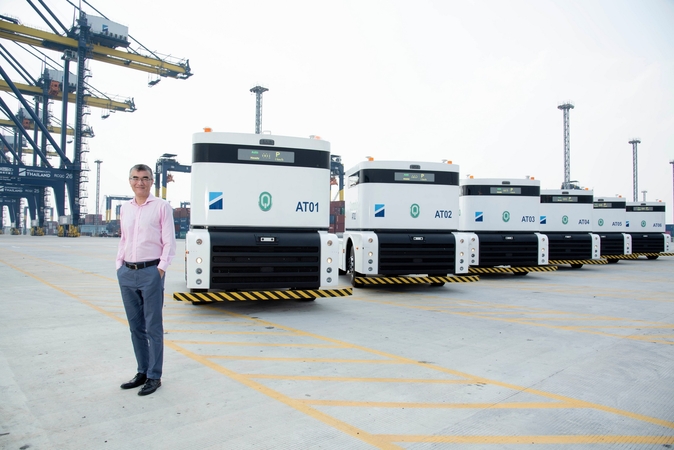
Hutchison Ports Thailand, the nation’s largest container terminal operator and the innovator of “smart port” development, announced on Wednesday (April 29) that it is among the world’s first port operators to acquire and test autonomous trucks at its Terminal D in Chonburi’s Laem Chabang Port.

This marks a huge step forward for the development of “smart” infrastructure in the Eastern Economic Corridor (EEC), with the autonomous “Qomolo” trucks promising to improve efficiency and safety in its operations at Terminal D.

The six battery operated Qomolo or Q-Trucks arrived from Shanghai on April 26 and will be tested for one year.

These trucks will be integrated with the existing fleet of conventional trucks used to transfer containers between the quay and the yard.

Equipped with advanced technology and a wireless charging system, a Q-Truck can operate non-stop for more than 24 hours. These trucks use the advanced LiDAR light and range detection technology, with which it can accurately detect and survey its surroundings and generate a precise 3D map enabling it to avoid all obstacles and collisions.

The operation of the trucks will be integrated into and controlled by Hutchison Ports’ Next Generation Terminal Management System, which works in conjunction with other innovations – such as remote controlled-cranes.

“The autonomous ‘Q-Trucks’ utilise the latest technology and innovation, and are part of our ongoing plan to transform Terminal D into the most technologically advanced and efficient container terminal in the region,” said Stephen Ashworth, managing director of Hutchison Ports’ Thailand and Southeast Asia operations. “The Q Truck continues to push the envelope for port innovation and along with our other already and soon-to-be implemented innovations, such as remote controlled crane-technology, online e-tracking services, gate automation and blockchain technology, we are rapidly approaching our goal of becoming the nation’s first fully-developed ‘smart port’.”

Google revenue is up, but coronavirus crisis is already taking a toll #ศาสตร์เกษตรดินปุ๋ย

#ศาสตร์เกษตรดินปุ๋ย : ขอบคุณแหล่งข้อมูล : หนังสือพิมพ์ The Nation.

https://www.nationthailand.com/business/30386958?utm_source=category&utm_medium=internal_referral

Google revenue is up, but coronavirus crisis is already taking a toll

Apr 29. 2020
By The Washington Post · Rachel Lerman · BUSINESS, US-GLOBAL-MARKETS 

Google’s parent company experienced a “tale of two quarters,” said Alphabet chief executive Sundar Pichai on Tuesday, as first-quarter revenue increased 13 percent despite a drop off in ad sales as the coronavirus pandemic hit.

The first two months of the year started strong, Pichai said. But as the economy started to shut down, consumers started to limit spending and companies started laying off employees and slashing costs. Google’s core business – digital advertising – suffered an “abrupt decline,” particularly as key customers like travel websites slashed ad spending.

Still, people are using Google’s services more than ever, Pichai said. And many businesses are moving toward cloud computing, which allows companies to rent space from Google’s servers.

“We see businesses thinking deeper about the shift to digital,” he said. As Google shifts resources during the crisis, “part of this is making sure our investments deliver value with respect to that shift.”

Alphabet reported revenue grew to $41.2 billion in the first quarter, up from $36.3 billion the same year ago. Profits were also up slightly to $6.8 billion.

The next quarter, which started April 1, is expected to show a fuller picture of the extent of the advertising slowdown. Google’s stock price ticked up 9 percent in after-hours trading Tuesday to $1,344.67, a sign that investors haven’t lost confidence in the powerful company’s ability to make it through the slump.

Alphabet was the first of the tech giants to report earnings this week, a foreshadowing of potential consequences for the broader industry as companies brace for the biggest economic downturn since the Great Depression. Still, the biggest tech companies are expected to be some of the companies to make it through the crisis largely unscathed thanks to huge cash reserves and new consumer tech habits.

Amazon in particular is expected to report a big uptick in revenue Thursday when it reports earnings, thanks to a surge in online orders as people stay home. (Amazon chief executive Jeff Bezos owns The Washington Post.)

Google makes the bulk of its money from selling online advertisements across search, YouTube and other products – a business that has been steadily growing for years as more advertisements moves online. But as businesses cut marketing budgets and consumers close their wallets amid the coronavirus crisis, analysts expect Google’s core business to feel the pain and serve as a bellwether for other digital advertisers.

Google’s first quarter financial results were not as bad as some investors had feared and analysts believe the company is well positioned.

“Google is in a fine financial position to be able to weather a storm,” said eMarketer analyst Nicole Perrin, noting its results indicate the impact of the pandemic on digital advertising might not be bad as it could have been.

Facing that reality, Google announced during its call it is taking cost cutting measures such as slowing hiring for the year, backing off from earlier plans in which it intended to hire about 20,000 people during 2020. It will also pause most construction of office space and reduce marketing budgets.

Pichai promised staff in an email early this month that no major layoffs were coming.

Still, the company and its huge cash reserves is better positioned than smaller rivals.

On the call, Pichai emphasized the company’s cloud computing business, which is working with New York state on its unemployment website and online retailers such as Wayfair. As more companies evaluate an increasingly digital world, he believes the cloud business is poised to pick up customers.

The company’s video streaming service YouTube is also seeing a spike in usage as people spend more time watching videos online.

Google is also benefiting from a slowdown in dozens of regulatory probes launched last year to investigate potential antitrust behavior. In fact, both Google and Apple are partnering with the government to help trace potential cases of covid-19.