Covid-19 insurance policies see hot sales #ศาสตร์เกษตรดินปุ๋ย

#ศาสตร์เกษตรดินปุ๋ย : ขอบคุณแหล่งข้อมูล : หนังสือพิมพ์ The Nation

https://www.nationthailand.com/business/30383930?utm_source=category&utm_medium=internal_referral

Covid-19 insurance policies see hot sales

Mar 12. 2020
By THE NATION

Insurance companies are witnessing overwhelming responses to their Covid-19 medical policies as fears grow over spread of the new coronavirus in Thailand.

Bangkok Insurance Public Company Limited (BKI)’s chief executive officer Apisit Anantanatara said the company had sold more than 100,000 Covid-19 insurance coverage last week with a total premium of over Bt10 million as sales continued to grow.

Kriangsak Potikasame, Assistant Managing Director of Viriyah Insurance, said the company saw wide interest to its Covid-19 insurance policies, especially from existing car insurance policy holders.

The company made available the policy on February 27 and is evaluating the amount premium it would gain from the package.

TQM Corporation’s chief executive officer Napassanun Punnipa said the company had seen brisk sales of its Covid-19 policy with many people making contact via various channels to make inquiries of the coverage and prices.

The first U.S. layoffs from the coronavirus are here #ศาสตร์เกษตรดินปุ๋ย

#ศาสตร์เกษตรดินปุ๋ย : ขอบคุณแหล่งข้อมูล : หนังสือพิมพ์ The Nation

https://www.nationthailand.com/business/30383899?utm_source=category&utm_medium=internal_referral

The first U.S. layoffs from the coronavirus are here

Mar 12. 2020
File photo

File photo
By The Washington Post · Abha Bhattarai, Heather Long, Rachel Siegel · NATIONAL, BUSINESS, HEALTH

The coronavirus outbreak is taking a deep toll on the U.S. economy, prompting hundreds of layoffs over the past week alone and halting a historic 11-year bull market in stocks.

Strong job growth and soaring financial markets have fueled the U.S. economic expansion over the past decade. Now the rapid market decline and initial layoffs are heightening fears that the longest economic expansion in U.S. history could come to a sudden end, just a month after unemployment stood at a half-century low.

The Dow Jones industrial average lost 1,465 points, or 5.9 percent, Wednesday with every sector slumping after the World Health Organization designated the coronavirus a pandemic. The Dow closed in bear market territory, meaning it had shed more than 20 percent from its high less than a month ago.

Airlines, hotels, travel agencies and event companies have all been suffering, but interviews with more than two dozen firms and workers reveal that the pain is now translating into layoffs in a wider circle of industries, including a bakery and a chain restaurant.

At the Port of Los Angeles, 145 drivers have been laid off and others have been sent home without pay as massive ships from China stopped arriving and work dried up. At travel agencies in Atlanta and Los Angeles, several workers lost their jobs as bookings evaporated. Christie Lites, a stage-lighting company in Orlando, Florida, laid off more than 100 of its 500 workers nationwide this past week and likely will lay off 150 more, according to chief executive Huntly Christie. Meanwhile a hotel in Seattle is closing an entire department, a former employee said, and as many as 50 people lost their jobs after the South by Southwest festival in Austin got canceled.

Economists fear more layoffs in the coming weeks as supply chains come to a halt and people stay home and spend less.

“We will definitely see an effect on jobs from the coronavirus, and it could be pretty large in leisure and hospitality,” said Julia Pollak, labor economist at ZipRecruiter. “The first thing we’ll see is a reduction in hours. We hear many reports of employers canceling staff everywhere except in health care.”

Monday in Los Angeles, Sam Creighton and about 20 colleagues were fired from the China Visa Service Center. Creighton helped Americans get travel documents to China, but business plummeted as groups and individuals canceled trips to Asia out of virus fear. The company processed around 400 visas a month; in February, that number fell to 22. The visa center did not return a request for comment.

“This job was my paycheck,” said Creighton, 27, who worked at the company for about three years. “I really don’t know what to do next.”

Baiden King lost her job at Carson’s Cookie Fix bakery in Omaha, Nebraska, on Tuesday because online sales and customer traffic dried up dramatically – especially after the state’s first case of covid-19 was reported nearby. The company didn’t return a request for comment. King said her manager told her when she showed up for her shift that morning she had no choice. King made $11 an hour.

“If my job’s laying off people, I can only imagine other employers are as well,” said King, who is preparing to move back in with her parents. “I’m not sure anyone will be hiring.”

These early coronavirus-related jobs cuts appear to have mostly affected younger, entry-level employees and gig workers. Workers receiving pink slips said they have no idea whether these layoffs will be permanent and that it is nearly impossible to look for another job right now, with many companies instituting hiring freezes. Uncertainty is high, and as people lose jobs – or fear losing jobs – they typically scale back spending even more, which has a ripple effect on local economies.

For example, the Port of Los Angeles, the busiest port in the United States, has become a “ghost town,” four workers said. They said the port has never been this quiet, not even during the Great Recession.

The ongoing lack of cargo prompted Shippers Transport Express to send layoff notices at the end of February to 145 drivers who transport containers from the port to corporate warehouse hubs. The company told workers there is a “near shutdown” of its operations at the port “for the foreseeable future.” Many factories closed in China, stunting shipments to the United States.

“I’ve been working the ports for 13 years, and I’ve never seen anything like this,” said Randy Williams, a trucker for Shippers Transport Express. “I’m glad I didn’t buy a house yet.”

He said the port typically handles over 1,000 containers a night at his part of the operation, including some Walmart products, but is down to 200. He didn’t work at all last week and it’s been spotty this week.

Williams has dipped into his savings, and money is tight with a son in college. But he has union benefits and is applying for unemployment insurance. He also saved from years of $29-an-hour pay. Not everyone at the port has that situation.

Josue Alvarez drives for another company operating at the port, XPO Logistics, but is classified as an independent contractor, meaning he gets no vacation, sick days or health insurance. He pays for his truck and all related expenses. He typically makes $2,000 a week, but since mid-February has made $300 a week, an income he cannot survive on for long.

“There’s a lot of uncertainty right now. My dispatchers say it will get worse before it gets better,” said Alvarez, who is 26 and lives with his parents. His father is also a trucker at the port. They show up early every day hoping for work but in the past two weeks almost always get sent home with no pay.

“The disruption to trade will be felt well beyond the dock workers,” said Stephen Levy, senior economist at the Center for Continuing Study of the California Economy. “Half of China’s goods come to the Port of Los Angeles. That will be felt by warehouse workers, truckers and people in the wholesale trade.”

The slowdown of goods moving across the country is hitting United Parcel Services hard, as drivers in Los Angeles have had their hours and pay scaled back. Ron Herrera, director of the Teamsters Port Division, the union representing UPS drivers, cited a decline in shipments because of coronavirus. A UPS spokesman said it was a “routine” staffing adjustment and that those drivers “are allowed to work at either a full- or a part-time” UPS facility.

Major airlines, weathering a massive decline in travelers, have not started layoffs, but nearly all have canceled routes and many have put on a hiring freeze, said Sara Nelson, international president of the Association of Flight Attendants-CWA, AFL-CIO, which represents about 50,000 flight attendants at 20 airlines.

“It’s just like a factory,” Nelson said. “When it slows down, and they cut all of the overtime hours, that is a massive pay cut for people right off the top.”

As consumers and businesses begin to pull back on spending, gig workers and independent contractors are having a particularly tough time. They are caught in limbo: Work is drying up, meaning they are effectively laid off, but they do not get to collect unemployment insurance. A payroll tax cut President Donald Trump has proposed would not help them.


“It’s kind of like I’m laid off but I’m not,” said Chad Denick, 35, who was told Monday he no longer needed to report to his job as a catering contractor for a tech company because employees would be working from home for the rest of the month. “But this is what I know: I don’t have a job at least until April.”

Denick stopped going out to restaurants and scaled back on purchases, like the $20 phone-charging mat he picked up a few days ago.

Spending behavior changes like that are one of the reasons, restaurant chains are starting to feel the crunch. Buca di Beppo, the Italian restaurant chain owned by Planet Hollywood, has begun laying off sales managers around the country, according to a former employee. Neither Buca di Beppo nor Planet Hollywood responded to a request for comment.

The cancellation of major conferences, including South by Southwest, Austin’s annual tech, music and film festival, also has created ripple effects of lost gigs. For Elle Mahoney, a freelance stage manager and producer, the South by Southwest cancellation knocked out 10 percent of her income. She just got engaged but is not planning or picking a wedding date.

“Everything is just on hold,” said Mahoney, 35, who is reaching out to people she used to nanny for to help make up lost pay. “It’s just really hard for us to depend on money from gig to gig.”

The economic strain is also starting to slow down and even freeze hiring that was in the works. In Kansas City, Mo., Sherry Caserta owns Travel Employment Agency, and she’s fielding a flood of phone calls, telling potential applicants their chances of landing a new job “are limited right now” as job postings are evaporating.

“The layoffs are already happening,” she said. “Most of these are last-hired, first-fired situations, but I’m really seeing it pick up this week in big cities: Atlanta, New York, Chicago.”

The travel industry layoffs reached Alex Brown, who was shocked at how quickly it all happened. Brown made $12 an hour overseeing marketing for a boutique travel agency in Atlanta. She learned on Monday she was being laid off because of nosediving sales and a falling stock market. Her boss told her he would get in touch “when this all blows over.”

“Even with that, I really wasn’t expecting to get laid off so soon,” she said.

Brown, 22, is not sure where to find new work. She emailed her former manager at an upscale restaurant and plans to talk to her boss at a gelato shop, where she works one shift a week, to see whether she can get more hours. She is afraid those places will be struggling soon, too.

“I don’t even know where I should be looking,” Brown said. “Which businesses are actually going to be hiring long-term for this strange year ahead of us? Everyone is cutting back.”


Goldman Sachs will vote against directors when boards lack women #ศาสตร์เกษตรดินปุ๋ย

#ศาสตร์เกษตรดินปุ๋ย : ขอบคุณแหล่งข้อมูล : หนังสือพิมพ์ The Nation

https://www.nationthailand.com/business/30383887?utm_source=category&utm_medium=internal_referral

Goldman Sachs will vote against directors when boards lack women

Mar 11. 2020
A Goldman Sachs sign on the floor of the New York Stock Exchange in New York on May 30, 2017. MUST CREDIT: Bloomberg photo by Michael Nagle.

A Goldman Sachs sign on the floor of the New York Stock Exchange in New York on May 30, 2017. MUST CREDIT: Bloomberg photo by Michael Nagle.
By Syndication Washington Post, Bloomberg · Emily Chasan · BUSINESS, US-GLOBAL-MARKETS, CAREER-WORKPLACE 

Goldman Sachs’s fund-management unit wants a woman on every corporate board, and the Wall Street firm said it’s now willing to vote that way across the globe.

In a first-of-its-kind global policy, Goldman Sachs Asset Management said it will vote against nominating committees anywhere in the world that fail to include at least one woman on the board. In the U.S., more than 20% of corporate board members are women, so the policy may have a more significant impact in places like Japan where a much smaller percentage of companies have female directors.

“We really believe diversity of thought on boards drives better outcomes,” Katie Koch, who leads Goldman’s global stewardship team, said in an interview.

Goldman casts more than 11,000 proxy votes a year. In 2019, the New York-based firm voted against board members leading the nominating committee at 214 U.S. companies with all-male directors. Since then, 79 of those companies added a female board member.

The move to overhaul proxy voting globally comes after Goldman said in January that it will only take companies public if they have a female or diverse director on their board.

Asset managers have pushed broadly as a group to get U.S. boards to include more female directors, and many ESG-focused investors have been voting against nominating committees that lack enough diversity.

BlackRock Inc. began writing letters to companies without two women on their boards in 2018, asking them to explain the reasoning. State Street Corp. said 681 public companies with previously all-male boards have added females since the company installed its Fearless Girl statue three years ago on Wall Street.

Last year marked the first time that every company in the S&P 500 had a woman on their boards.

Globally, the rise of women on boards has been uneven. Countries including Israel, Norway, France, Belgium, Italy, India and Australia have national quotas aimed at increasing representation. Boards in the Asia-Pacific region, particularly those in Japan, South Korea and Hong Kong, have lagged behind, with less than 10% of members in those regions being female, according to Corporate Women Directors International.

Goldman also plans to press corporate boards globally on including a variety of diverse board members, and sometimes more than one woman, in its engagement plans. It also will connect companies with women in its network that it believes would be good board candidates.

“We know diversity drives better performance,” Koch said. “We’ve seen it in our own business, therefore we are demanding it of our portfolio companies .”

SCB gears for repurchase of a maximum of 135.96m shares #ศาสตร์เกษตรดินปุ๋ย

#ศาสตร์เกษตรดินปุ๋ย : ขอบคุณแหล่งข้อมูล : หนังสือพิมพ์ The Nation

https://www.nationthailand.com/business/30383879?utm_source=category&utm_medium=internal_referral

SCB gears for repurchase of a maximum of 135.96m shares

Mar 11. 2020
SCB CEO Arthid Nanthawithaya

SCB CEO Arthid Nanthawithaya
By THE NATION

Siam Commercial Bank’s Board of Directors approved a share repurchase programme to further improve its capital efficiency at a meeting today (March 11).

Under this programme, the bank shall use a maximum amount not exceeding Bt16 billion to repurchase shares not exceeding 135.96 million shares (equivalent to 4 per cent of paid-up shares). The share repurchase will be conducted through the Stock Exchange of Thailand during a period of six months from April 20,2020 to October 19, 2020.

Given its current market valuation, strong financial position, intrinsic earnings capabilities and lack of short-term investment opportunities the bank intends with this program to improve shareholders’ return by 1) increasing Earnings per share (EPS), 2) Dividend per share (DPS), and 3) Return on Equity (ROE).

This programme is also expected to help the bank’s stock price to better reflect its intrinsic value.

At the same time, given the option to sell back the shares after six months, the programme also provides the needed flexibility to explore and capitalise on new growth opportunities in the medium term which will yield appropriate shareholder returns. In the absence of those investment opportunities the bank has the option to retire the repurchased shares which again will drive better shareholders returns.

Chairman of the Executive Committee and CEO, stated:

“At SCB, we continuously drive for quality growth and enhance the bank’s earning capabilities to drive long-term sustainable shareholder returns. At the same time, we are mindful of short-term return expectations especially with the impacts from the outbreak of the coronavirus disease. Given the fragility and high volatility of the external environment, short term investment opportunities might be challenging while in the medium term, even more situations might open up to deploy our capital productively. This significant programme gives us the flexibility to increase shareholder returns while maintaining our strategic flexibility. Given our strong capital position and earnings prospects we are confident that we have the funds to fully execute such an ambitious programme”.

Nike to review supply chains in China after reports Uighurs forced to make shoes #ศาสตร์เกษตรดินปุ๋ย

#ศาสตร์เกษตรดินปุ๋ย : ขอบคุณแหล่งข้อมูล : หนังสือพิมพ์ The Nation

https://www.nationthailand.com/business/30383873?utm_source=category&utm_medium=internal_referral

Nike to review supply chains in China after reports Uighurs forced to make shoes

Mar 11. 2020
By The Washington Post · Anna Fifield · BUSINESS, WORLD, US-GLOBAL-MARKETS, RETAIL, ASIA-PACIFIC
Nike said it was reviewing its suppliers’ hiring practices in China, after The Washington Post and an Australian think tank reported that members of the Uighur Muslim minority were making shoes for the American brand in conditions that suggested they were coerced.

One of its biggest suppliers in the world, the South Korean-owned Qingdao Taekwang Shoes Co., was now looking for ways to end the contracts of Uighur workers making Nikes in its factory, the American company said in a statement posted on its website.

Nike had been “conducting ongoing diligence with our suppliers in China to identify and assess potential risks related to employment of people from” Xinjiang, the statement said.

“Nike remains dedicated to ethical and responsible manufacturing and we are deeply committed to ensuring the people who make our product are respected and valued,” it said.

The Post reported earlier this month on labor practices at the Taekwang factory, which has been a Nike supplier for more than 30 years and produces about 8 million pairs of athletic shoes annually.

About 700 of the factory’s workers are members of the Uighur ethnic minority from the western region of Xinjiang, where the Chinese government has been on a campaign to strip the mostly-Muslim population of their culture, language and religion.

More than 1 million Uighurs have been put through reeducation camps aimed at “deradicalizing” them, according to Chinese authorities, and have now “graduated” from the camps.

In what appears to be the latest iteration of that campaign, at least 80,000 Uighurs have been dispatched in groups of 50 to work at factories across the country, the Australian Strategic Policy Institute wrote in a report published this month.

Chinese state media contains numerous reports about sending groups of young people away to work at factories where they live in dormitories and attend ideological training at “Pomegranate Seeds” schools – so called because Chinese leader Xi Jinping wants all ethnic groups to stick closely together.

On the Chinese Internet, middlemen advertise the workers like chattel.

“They will be under semi-military style management, and the staff turnover rate is low,” said one middleman who posted on Tieba, a forum like Reddit. Another notice asked: “Do you want Xinjiang Uighurs? One year contract. Government management with police stationed at factories.”

A Post reporter who visited the Taekwang factory saw dozens of Uighur workers, mostly women in their early 20s, walking around the factory area. The women were too afraid to talk, but local residents who interact with them said that they did not come to the factory freely but were sent there.

While ASPI could not categorically confirm that the labor was forced, their report said there was clear evidence of “highly disturbing coercive labor practices” that was consistent with the International Labour Organization’s definition of forced labor.

When first contacted by The Post, Nike said that its suppliers are “strictly prohibited from using any type of prison, forced, bonded or indentured labor.” Taekwang said the workers offset local labor shortages and it was not aware of any requirements that the workers undergo ideological training.

In a new statement, Nike said that Taekwang’s Qingdao facility had not recruited new employees from the Xinjiang region since last year.

Taekwang “is currently seeking expert advice on the best and most responsible approach to conclude the employment of remaining employees” from Xinjiang, it said.

“Taekwang has confirmed that their employees from [Xinjiang] have the ability to end their contracts at any time without repercussion, and historically many have chosen to do so,” Nike continued.

On Tuesday, Sen. Robert Menendez, D-N,J., accused American companies were deliberately turning a blind eye to “horrific” forced labor conditions in China’s Xinjiang region. This related to companies that use workers inside the region, not to labor exports like to the Nike supplier.

This is a particular problem for clothing and garment manufacturers because 84 percent of Chinese cotton comes from Xinjiang, Menendez wrote in a letter to Commerce Secretary Wilbur Ross.

“There are consistent reports that U.S. companies fail to undertake basic labor and human rights assessments in Xinjiang, in essence willfully ignoring the horrific conditions of forced labor in Xinjiang,” he wrote.

“In failing to uphold their responsibilities to vet their supply chains, these companies may be complicit in the mass repression of Uighurs, ethnic Kazakhs, Kyrgyz, and members of other Muslim minority groups,” he said.

Asked about Menendez’s letter, Chinese Foreign Ministry spokesman Geng Shuang said that “there is no such thing as forced labor in Xinjiang.”

“We hope certain people in the U.S. will take off their tinted glasses, and keep normal economic cooperation and trade between the two countries in perspective,” Geng told reporters in Beijing Wednesday.

Verso, Bangkok’s biggest international school, nears completion #ศาสตร์เกษตรดินปุ๋ย

#ศาสตร์เกษตรดินปุ๋ย : ขอบคุณแหล่งข้อมูล : หนังสือพิมพ์ The Nation

https://www.nationthailand.com/business/30383860?utm_source=category&utm_medium=internal_referral

Verso, Bangkok’s biggest international school, nears completion

Mar 11. 2020
By THE NATION

Construction of Verso International School at a 168-rai site near Thana City in Bang Na district is 90 per cent complete, on schedule for the facility to open in August.

Applications are now being accepted for Early Years 2-Grade 8. Grades 9-12 will be open next year.

Piyaporn Phanachet, chief executive at U City, an affiliate of infrastructure developer BTS Group Holdings, which has partnered with Fortune Hand Ventures of Hong Kong to build Verso, said it will be “a new educational innovation hub”.

U City is ready to offer strong and continuing support for Verso as it enrols 100-200 students for the first academic year using online and offline channels, including workshops for interested families and open houses.

Verso is offering a limited number of student grants to founding families, equivalent to 20 per cent of the tuition fee for a four-year consecutive period. It’s available to families who apply by March 31.

“The Thana City area is known for its convenient access to amenities and transportation links,” Piyaporn said. “Verso will further drive the growth in the area and in turn ensure a better quality of life for residents, students and families, fostering an integrated live-work-play community.”

Verso will be the largest international school in the Bangkok metropolitan area, boasting a capacity for 1,800 students.

It’s four kilometres from Suvarnabhumi Airport and will be near Light Rail Transit on the future Brown Line.

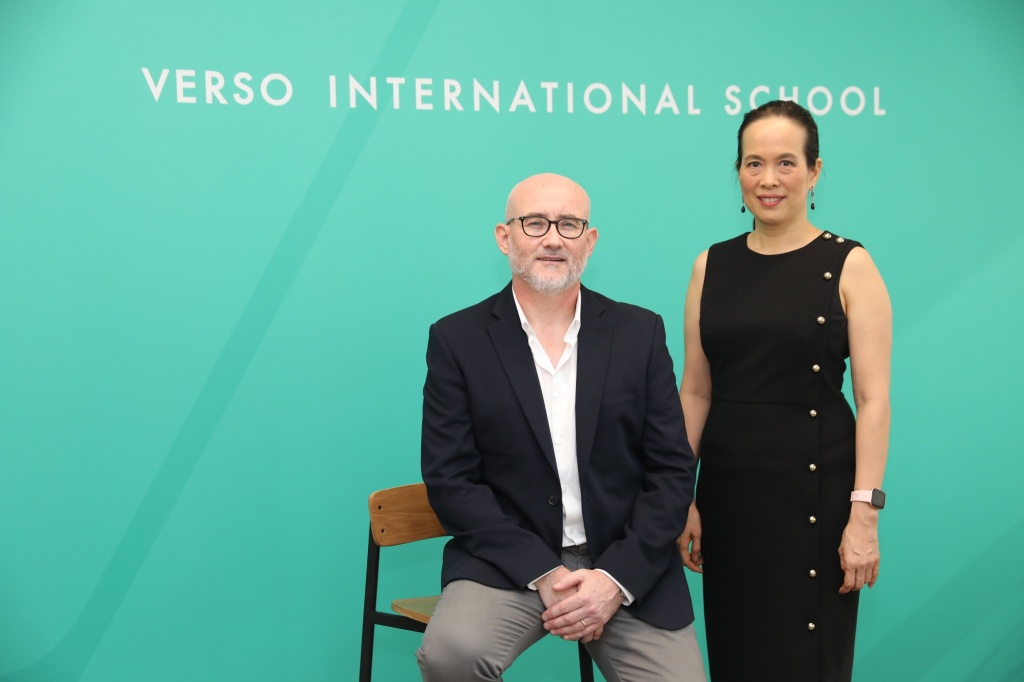
Cameron Fox, left and Piyaporn Phanachet

Cameron Fox, left and Piyaporn Phanachet

“Now that our buildings and programmes are close to completion,” said founding head of school Cameron Fox, “our learning designers [teachers] are getting really excited about meeting our founding students and helping them take the first steps on an incredible journey together.”

The school will use an American curriculum model aligned with New York State education standards. Learning will be interdisciplinary, project-based and highly personalised for every student.

“We’ve all experienced the limitations of a one-size-fits-all approach to learning,” Fox said. “At Verso we want to look at the school experience differently. Research shows us that young people learn best when they are actively engaged, creating and solving problems they care about. That’s our starting point.

“Two years before the school opened, we recruited 12 highly qualified foreign educators to form a Learning Design Team. This team shares a common desire to make school a place where every student discovers who they are and develops the confidence and skills needed to lead their own journey.”

Verso partnered with San Francisco-based design company Ideo to consider inspiring examples of school innovation from around the world to Bangkok, testing the ideas with students, teachers and families living in Bangkok, the United States, Singapore and Hong Kong.

“At Verso, we think and behave like designers,” said Fox. “Working with Ideo, we found out what families in Bangkok wanted most from an international school. That’s how we identified Verso’s three founding beliefs. We learned that students need to develop a strong sense of personal and cultural identity, they need to know how to actively engage with the world around them, and they will flourish if they have the confidence to lead their own journey.”

Verso will be fully accredited by the Western Association of Schools and Colleges, which ensures quality and validates the school’s certificates, diplomas and transcripts acceptable for university admissions worldwide.

Foresight Energy is latest U.S. coal miner in bankruptcy #ศาสตร์เกษตรดินปุ๋ย

#ศาสตร์เกษตรดินปุ๋ย : ขอบคุณแหล่งข้อมูล : หนังสือพิมพ์ The Nation

https://www.nationthailand.com/business/30383825?utm_source=category&utm_medium=internal_referral

Foresight Energy is latest U.S. coal miner in bankruptcy

Mar 11. 2020
By Syndication Washington Post, Bloomberg · Steven Church, Will Wade, Jeremy Hill · BUSINESS

Foresight Energy filed for bankruptcy with plans to hand ownership to its creditors, becoming the latest coal company to fail as power generators switch to cleaner and cheaper fuels.

The filing in U.S. Bankruptcy Court for the Eastern District of Missouri is another sign that efforts to stem coal’s decline aren’t working. A wave of U.S. miners have filed for Chapter 11 in recent years, including Murray Energy, which owns a controlling stake in Foresight. Its owner, Robert Murray, is an outspoken supporter of President Donald Trump, who has pledged to save the industry.

Foresight listed between $1 billion to $10 billion in assets and liabilities in the same range in Chapter 11 documents filed with the court. The restructuring plan, which allows the company to stay in business, would cut debt by about $1 billion by swapping $1.33 billion of debt for equity. The plan would leave Foresight with just $225 million in new secured debt, Chief Executive Officer Robert Moore said in a court declaration.

Moore, who is also the CEO of Murray Energy and is Robert Murray’s nephew, would remain the chairman of Foresight, according to a company statement.

Foresight, founded by the late billionaire Christopher Cline, signaled it was in trouble when it suspended its quarterly dividend in May, and again on Oct. 1 when it missed a $24.4 million interest payment. It hasn’t posted an annual profit since 2014, and matters were made worse by 2019’s unusually heavy rains, which made rivers so high and swift that coal vessels had trouble delivering to power stations.

While Foresight has been struggling for years, its bankruptcy filing comes as investors have become skeptical about the credit quality of U.S. energy companies after a crash in oil prices. More than 400 energy-related companies went bust between 2015 and the end of 2019, according to law firm Haynes & Boone.

Holders of 69% of Foresight’s first-lien loans and 82% of its second-lien notes have agreed to support Foresight’s bankruptcy plan, Moore said. In addition, existing lenders agreed to provide $100 million in new money to finance Foresight’s operations in bankruptcy, subject to court approval. Without access to that new money, Foresight would likely run out of cash needed to run the business within a week, Alan Boyko of FTI Consulting said in a court declaration.

Despite the White House efforts to save coal, the industry continues to decline as utilities forsake the fuel for cheap natural gas, wind and solar. Fifteen years ago, coal accounted for more than half of all U.S. power generation. Today it’s less than 25%.

St. Louis-based Foresight’s bankruptcy also follows Chapter 11 filings last year by Cloud Peak Energy, Cambrian Coal, Blackhawk Mining and Blackjewel.

Cline, a mining tycoon born into a coal-mining family, died in a helicopter crash in July. He founded Foresight in 2006 and has been credited with reviving the industry in the Illinois basin. The company has been recognized for efficient production, but that wasn’t enough to compensate for slumping demand and prices. Cline stepped down as chairman in 2017 but remained one of the company’s top shareholders, according to data compiled by Bloomberg.

Murray Energy acquired a stake in Foresight 2015 and gained a majority voting position in its general partner two years later. Robert Murray himself ranks among Foresight’s biggest shareholders. He also serves on the general partner’s board of directors, which controls decision-making at Foresight, along with Moore, three independent directors and an affiliate of The Cline Group LLC, according to court papers.

The case is Foresight Energy LP, 20-41308, U.S. Bankruptcy Court for the Eastern District of Missouri (St. Louis).

Walmart, Apple, Olive Garden are among major employers updating sick leave policies as coronavirus cases spread #ศาสตร์เกษตรดินปุ๋ย

#ศาสตร์เกษตรดินปุ๋ย : ขอบคุณแหล่งข้อมูล : หนังสือพิมพ์ The Nation

https://www.nationthailand.com/business/30383824?utm_source=category&utm_medium=internal_referral

Walmart, Apple, Olive Garden are among major employers updating sick leave policies as coronavirus cases spread

Mar 11. 2020
By The Washington Post · Abha Bhattarai · BUSINESS, CAREER-WORKPLACE

The coronavirus outbreak that is quickly spreading throughout the country is forcing major American companies to rethink how they approach paid sick leave. More than 30 million U.S. workers – many of them low-wage service employees at restaurants, stores and airports – lack access to sick pay, raising fears that the epidemic could escalate if symptomatic workers do not feel that they can afford to take time off.

Vice President Mike Pence on Monday hinted that the Trump administration may soon introduce an economic package that would provide paid sick leave to workers affected by the virus, though he did not specify what such a plan would look like or how it would be enforced.

In the meantime, companies such as Walmart, Uber and Apple are among those announcing new policies that they say are designed to keep employees and customers safe from the coronavirus. Here is a look at major employers that have so far adapted their leave policies.

– – –

Walmart

Retail giant Walmart said Tuesday that it will not penalize workers who call in sick after an employee at a Kentucky store tested positive for the coronavirus. Employees who are diagnosed with covid-19 or placed in quarantine will receive up to two weeks of pay and will not be asked to dip into their paid leave during that time, the company said.

“If they’re not able to return to work after that time, additional pay replacement may be provided for up to 26 weeks for both full-time and part-time hourly associates,” Walmart said in a memo to its 1.5 million U.S. workers Tuesday. The retailer, based in Bentonville, Arkansas, is the country’s largest employer.

The store in Cynthiana, Kentucky, where the worker tested positive, has been sanitized and remains open. The employee is receiving medical care and her condition is “improving,” Walmart said.

– – –

Darden Restaurants

The parent company of Olive Garden and Eddie V’s said Monday that it would begin offering up to 40 hours of paid sick leave annually to all hourly employees, making it one of the only major restaurant chains to do so. Executives said they had been considering the benefit for a while, but sped up the timeline because of the growing threat of the coronavirus.

Workers at Darden’s eight restaurant chains – which include LongHorn Steakhouse, Bahama Breeze and the Capital Grille – will accrue one hour of sick leave for every 30 hours they work. Current employees, the company said, will receive paid sick time for the hours they’ve worked over the past six months. The Orlando-based company has 180,000 employees.

“As we continue to make investments in our employees, we strengthen our greatest competitive edge – because when our team members win, our guests win,” Gene Lee, Darden’s chief executive, said in announcing the new policy.

– – –

Uber and Lyft

Ride-hailing companies Uber and Lyft were among the first to announce coronavirus-related sick pay for affected drivers, who are technically independent contractors and have not previously qualified for paid leave or benefits. Uber this weekend said it will provide 14 days of sick pay for any drivers or delivery workers who are sick with the coronavirus or are required to be isolated, though it did not offer details on how it could calculate that pay.

“We are supporting drivers and delivery people who are diagnosed with COVID-19 or placed in quarantine by a public health authority,” Andrew Macdonald, a senior vice president at Uber, said in a statement announcing the policy Saturday. “We believe this is the right thing to do.”

Lyft, meanwhile, says it will “provide funds to drivers” who become ill with the virus or are put under quarantine, but did not elaborate. “This helps support drivers financially when they can’t drive, while also protecting our riders’ health,” the company said on its website.

– – –

Apple

Apple this week said it will begin providing unlimited paid leave to hourly employees, including those at its retail stores, who become sick with cold or flu symptoms similar to covid-19. The company is also urging corporate employees to work from home, and said it has “increased cleaning protocols” at its stores.

A worker at Apple’s European headquarters in Dublin tested positive for the coronavirus Tuesday. That employee has been quarantined, and some others have been asked to stay home, the company said.

– – –

Instacart

App-based grocery delivery service Instacart said it would offer up to 14 days of paid leave for any employee or contractor diagnosed with covid-19 or under mandatory quarantine by public health authorities. The company has more than 200,000 shoppers around the country, the vast majority of them independent contractors, who do not qualify for other types of paid sick leave.

The company said it will also begin offering sick pay to its in-store shoppers – a small segment of its workforce that picks groceries but does not deliver them. Those workers, the company said, can earn one hour of sick pay for every 30 hours they work.

“To the best of our knowledge, no one in our community has contracted COVID-19, but we believe this is the right thing to do for our employees and shoppers,” Instacart said in a blog post announcing the new policy.

An Instacart shopper in Portland, Oregon, told The Washington Post this week that she routinely works while sick – with the flu, pulled muscles, even after spells of vomiting – because she cannot afford to take a day off. She works up to 50 hours a week, but does not qualify for paid sick leave because she an independent contractor.

Airbnb tweaks its refund policy amid virus spread #ศาสตร์เกษตรดินปุ๋ย

#ศาสตร์เกษตรดินปุ๋ย : ขอบคุณแหล่งข้อมูล : หนังสือพิมพ์ The Nation

https://www.nationthailand.com/business/30383822?utm_source=category&utm_medium=internal_referral

Airbnb tweaks its refund policy amid virus spread

Mar 11. 2020
By Syndication Washington Post, Bloomberg · Olivia Carville, Eric Newcomer · BUSINESS

Airbnb is making adjustments to its refund policy in an attempt to balance the needs of hosts and guests on its home-sharing site amid the global coronavirus outbreak that has severely reduced travel demand.

Because Airbnb operates as an online platform — connecting people who want to rent out all or part of their home with travelers seeking accommodations — it’s choosing to take a lighter touch with hosts.

The San Francisco-based startup said it will reward hosts who are more flexible or generous on offering refunds. The company will offer promotions for those listings to drive new bookings and will waive the standard 3% host fee on new reservations for those listings through June 1.

“When a crisis like coronavirus hits, we know both hosts and guests are affected,” Airbnb said in a statement Tuesday. “Hosts lose earnings that they rely on to make ends meet. Guests are losing hard earned vacation savings.”

Airbnb’s policy is that all reservations are able to be canceled within 48 hours of booking for a full refund. Beyond that, it’s up to hosts to determine the refund policy, which are stated on the listings and range from flexible to strict.

Since the Covid-19 virus became more widespread Airbnb has been granting full refunds to people traveling to China, South Korea and Italy.

Airbnb also announced some changes Tuesday meant to encourage people to keep booking trips on its platform. The company will return the service fee guests pay to Airbnb as a coupon for future reservations if people cancel their trips on bookings made from now through June 1. That doesn’t guarantee that hosts offer a refund and it doesn’t help people who already booked their trips.

“While it is clear that the coronavirus will have an impact on the entire travel and tourism industry, we believe travel will recover in the long run,” Airbnb said.

JPMorgan, Citigroup feast on equity derivatives in virus panic #ศาสตร์เกษตรดินปุ๋ย

#ศาสตร์เกษตรดินปุ๋ย : ขอบคุณแหล่งข้อมูล : หนังสือพิมพ์ The Nation

https://www.nationthailand.com/business/30383819?utm_source=category&utm_medium=internal_referral

JPMorgan, Citigroup feast on equity derivatives in virus panic

Mar 11. 2020
By Syndication Washington Post, Bloomberg · Donal Griffin · BUSINESS 

The historic panic in global stock markets has spawned a fortune for some of the world’s biggest investment banks.

JPMorgan Chase & Co. and Citigroup have added about $500 million in revenue from equity derivatives trading year-to-date compared with the same period in 2019, people familiar with the matter said. Trading surged as investors rushed to bet on stock moves and protect their holdings.

The spreading coronavirus has killed thousands, roiled the global economy and forced Italy to announce a nationwide lockdown. But for Wall Street’s trading desks, which rely on volatility to generate profit, the turmoil is an opportunity after investment banks long bemoaned the calmness of markets in recent years.

Patrick Burton, a spokesman for JPMorgan in London, declined to comment, as did Edwina Frawley-Gangahar, a spokeswoman for Citigroup.

JPMorgan has generated about $300 million of additional revenue so far this year, including about $50 million in one trading day in late February, according to the people, who requested anonymity as the details are private. Citigroup has made between $150 million and $200 million, the people said.

Recent swings in U.S. stock prices rank among some of the biggest in market history as investors struggle with the fallout from the coronavirus and an oil price war. That’s triggering a surge in demand for equity derivatives, which allow investors to make complex bets on shares and volatility in stock markets and protect against losses.

Trading in options linked to the S&P 500 Index, among the most popular equity derivatives, surged to a record high of more than 3.5 million contracts in February. The CBOE Volatility Index jumped to the highest since 2008 on Monday.

The stock market chaos means equity derivative revenue may snap back from last year’s drop. Wall Street banks generated about $12 billion from equity derivatives in 2019, a 17% decline from the previous year, according to research firm Coalition Development Ltd.

“It’s been a good start to the year,” said Amrit Shahani at Coalition in London. “Our expectation is it will be better than 2019.”

The S&P 500 gained as much as 3.7% in early New York trading — after a plunge on Monday — as President Donald Trump said he would announce “substantial” economic measures on Tuesday in response to the virus. The rebound faltered as signs mounted that the stimulus is not imminent.

While traders desire volatility, sudden swings can lead to losses for banks as well. BNP Paribas SA, the biggest French bank, lost about $80 million on equity-derivative trades over a few days in December 2018 after markets were whipsawed by trade tensions between the U.S. and China.

JPMorgan, based in New York, is the world’s biggest player in equity derivatives, Coalition data show.