Telco giants make payments for 5G spectrum licences #ศาสตร์เกษตรดินปุ๋ย

#ศาสตร์เกษตรดินปุ๋ย : ขอบคุณแหล่งข้อมูล : หนังสือพิมพ์ The Nation

https://www.nationthailand.com/business/30382557?utm_source=category&utm_medium=internal_referral

Telco giants make payments for 5G spectrum licences

Feb 21. 2020
AIS chief executive officer Somchai Lertsutiwong, third right, pays the first instalment for the

AIS chief executive officer Somchai Lertsutiwong, third right, pays the first instalment for the
By THE NATION

Advanced Info Service (AIS) and Total Access Communication (dtac) on Friday (February 21) made payments for the licences they acquired in the auction last Sunday.

AIS paid the first instalment of Bt2.093 billion (including Value-added Tax) of the 2600MHz licences out of the total upfront of Bt20.930 billion (including VAT) to the National Broadcasting and Telecommunications Commission (NBTC) on Friday morning.

It also handed over a guarantee amount of Bt18.837 billion for the remaining upfront value of the licences to the watchdog.

According to AIS’ filing to the Stock Exchange of Thailand on February 19, its preliminary investment budget for providing 5G service in key areas is approximately Bt10-15 billion within the next 12 months.

AIS subsidiary Advanced Wireless Network (AWN) clinced one licence of 700MHz, 10 licences of 2600MHz and 12 licences of 26GHz from the auction.

The payment for 2600MHz is divided into seven instalments. The first instalment equals 10 per cent of the total value, and 15 per cent each from the second to seventh instalment (the fifth year to the tenth year).

The licence holders are required to install the 2600MHz network to finish covering 50 per cent of the Eastern Economic Corridor within one year.

In addition, they will have to cover at least 50 per cent of the population of key city areas within four years from the date of the awarding of the licence to drive infrastructure development for a smart city.

DTAC TriNet obtained two licences of 26GHz from the auction. On Friday it made a one-off payment of Bt974.128 billion (including VAT) for the licences.

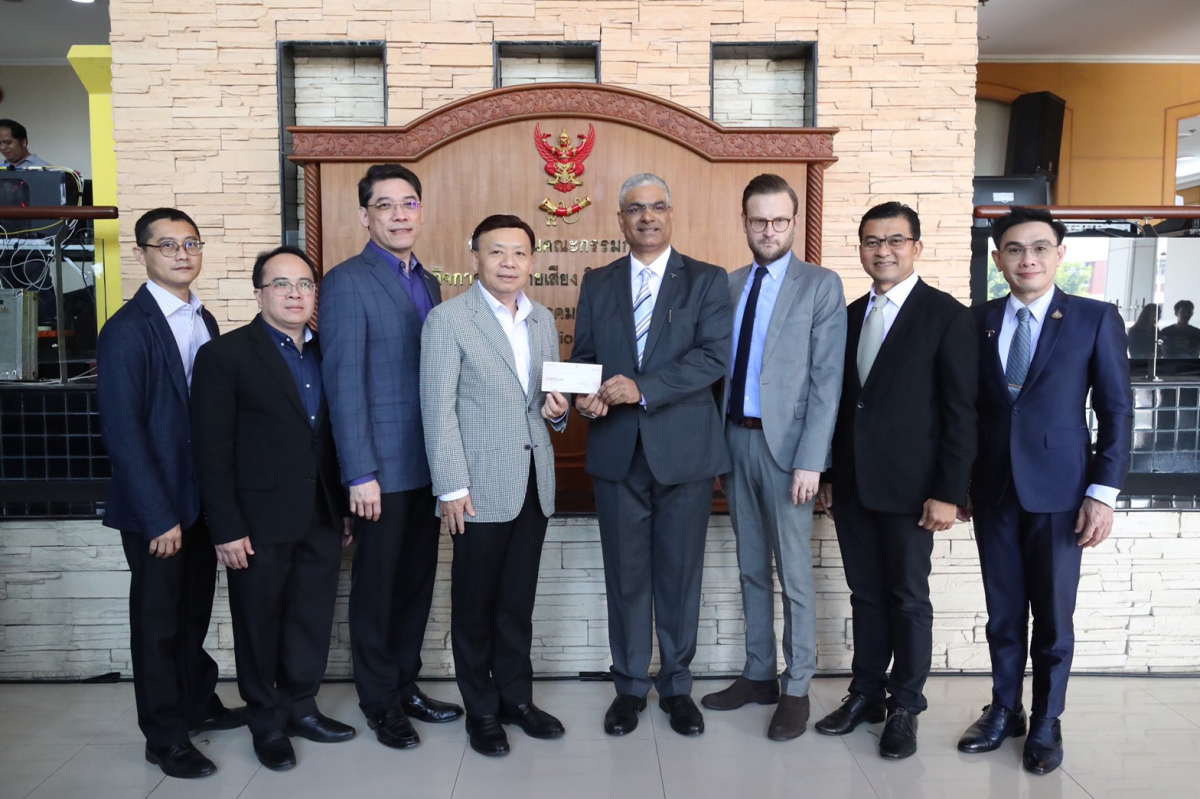
DTAC chief executive officer Sharad Mehrotra, fourth right, hands over a cheque of Bt974,128,001.07 to NBTC secretary-general Takorn Tantasith for two licences of the 26GHz spectrum band acquired in the recent multi-band auction.

DTAC chief executive officer Sharad Mehrotra, fourth right, hands over a cheque of Bt974,128,001.07 to NBTC secretary-general Takorn Tantasith for two licences of the 26GHz spectrum band acquired in the recent multi-band auction.

The winning bidders of this licence are obliged to pay the one-time upfront amount within 90 days after being informed officially as the winner.

The NBTC on Friday will also award the 2600MHz licences to AWN, while DTAC TriNet is expected to pick up the licences early next week.

The other winning bidders are CAT Telecom, True Corp, and TOT.

CAT clinched two 700MHz licences, while True grabbed nine licences of 2600MHz and eight licences of 26GHz. TOT obtained four licences of 26GHz.

UBS names outsider Hamers in surprise to succeed CEO Ermotti #ศาสตร์เกษตรดินปุ๋ย

#ศาสตร์เกษตรดินปุ๋ย : ขอบคุณแหล่งข้อมูล : หนังสือพิมพ์ The Nation

https://www.nationthailand.com/business/30382544?utm_source=category&utm_medium=internal_referral

UBS names outsider Hamers in surprise to succeed CEO Ermotti

Feb 21. 2020
Ralf Hamers has been named CEO of UBS Group. MUST CREDIT: Bloomberg photo by Alex Kraus

Ralf Hamers has been named CEO of UBS Group. MUST CREDIT: Bloomberg photo by Alex Kraus
By Syndication Washington Post, Bloomberg · Marion Halftermeyer, Ruben Munsterman · BUSINESS 

By naming ING Groep’s Ralph Hamers as its next chief executive officer, UBS Group turned to an outsider with a record of pushing digital banking but who has been vilified in the Netherlands over a money-laundering scandal.

The choice of Hamers, 53, to succeed Sergio Ermotti surprised analysts, investors and even insiders because of his limited experience in wealth management and investment banking, UBS’s core businesses. Shares in both UBS and ING rose.

Hamers “is the person to lead UBS’s continued transformation and build upon its successful strategy,” Chairman Axel Weber said in a statement. He’s “a seasoned and well-respected banker with proven expertise in digital transformation.”

Hamers is a relative stranger to the rarefied world of Swiss private banking after a nearly three-decade career at ING, most of whose business is retail banking. He climbed the ranks through a series of roles including head of the Dutch and Belgian units and the firm’s global commercial lending division. He’s been CEO since 2013, leading a digital banking push in an effort to win customers while trimming costs.

“The appointment is definitely a surprise,” said Rahul Sen, the global leader of wealth management and private banking at Boyden Executive Search.

– – –

More recent troubles made Hamers a target of criticism at home. After getting caught up in a scandal involving Russian dirty money, ING agreed in 2018 to pay about $900 million to settle a Dutch investigation into corrupt practices by former clients. The chief financial officer subsequently resigned, and the Dutch central bank said ING needed a “prolonged and intensive process” of improvement to fulfill its role as a gatekeeper of the nation’s financial system.

Last year, the Bank of Italy ordered the lender to stop taking on new customers in that country after it found shortcomings in money-laundering checks.

Weber said Finma, the Swiss regulator, cleared Hamers after interviewing him and that UBS did its own due diligence. They concluded that he had no personal role in the money laundering.

“Am I surprised by this appointment? Yes, I am surprised after this huge scandal in the Netherlands for which Hamers carries overall responsibility as the CEO,” said Paul Vlaanderen, the chair of Transparency International Netherlands, the Dutch arm of the global anti-corruption group.

Investors in both banks reacted positively. UBS rose as much as 2.4% in Zurich, while ING added as much as 3% in Amsterdam.

– – –

UBS joins European finance firms in handing over the reins to the next generation. Societe Generale and HSBC Holdings are among those also looking for new chiefs and Credit Suisse Group replaced CEO Tidjane Thiam last week.

Ermotti’s final year, his ninth, leading UBS was marred by huge legal fines, questions about succession planning and a deepening slump in the share price. Ermotti and Weber last year signaled that the firm had started planning for succession.

Ermotti cemented his legacy early in his tenure, responding to the financial crisis by largely getting rid of the fixed-income businesses and increasing the focus on managing money for the rich. It’s a strategy that competitors, notably Credit Suisse, have emulated. The last few years of Ermotti’s tenure were marred by a $5 billion fine for a tax-evasion case in France and the departures of two potential future leaders of the bank.

UBS shares have gained 20% since his appointment in mid-November 2011 – they’ve shed 27% the past two years. By contrast, Credit Suisse has declined 33% during the almost nine-year period.

UBS, like many of its European peers, has dialed back its ambitions amid negative interest rates and muted client activity. Ermotti recently cut the bank’s financial targets for a second time in as many years against that backdrop.

The firm in October brought in wealth executive Iqbal Khan from Credit Suisse, who was widely seen as an eventual contender for the top role. But Khan’s run-in with Thiam – which became tabloid fodder in Zurich – dimmed his standing with UBS board members, according to people familiar with the matter.

At ING, Hamers has been trying to cushion the blow of negative interest rates – which are particularly damaging for a lender that gets two-thirds of its revenue from retail banking – by adding millions of customers and moving more to digital platforms. He’ll depart the Dutch bank at the end of June.

Hamers lost his annual bonus for 2018 after the firm was hit with one of the biggest fines ever for a Dutch bank in a criminal case. ING has paid him about $2.16 million annually in recent years, including salary and a relatively small variable award, regulatory filings show.

By comparison, Ermotti received about $9 million in compensation in 2012, his first full year leading the bank, and roughly $14 million for 2018.

Hamers has been a frequent target of Dutch politicians, newspaper columnists, and financial activists – one of whom has sought to have him jailed for his alleged role in the bank’s money laundering issues, an accusation that ING has rejected.

Still, Hamers has shown the ability to boost revenue amid the headwinds. While his direct predecessor, Jan Hommen, was credited with cleaning the balance sheet after the crisis and government bailout, Hamers focused on growth. During his tenure, Hamers added millions of retail clients outside the Netherlands by rolling digital services in Italy, France and Germany. Earnings per share rose to 1.4 euros last year from 0.85 euros in 2013.

ING shares under Hamer’s appointment October 2013 added 23%, even after dropping 30% the past two years.

AOT faces plunge in passengers, impact from relief measures #ศาสตร์เกษตรดินปุ๋ย

#ศาสตร์เกษตรดินปุ๋ย : ขอบคุณแหล่งข้อมูล : หนังสือพิมพ์ The Nation

https://www.nationthailand.com/business/30382524?utm_source=category&utm_medium=internal_referral

AOT faces plunge in passengers, impact from relief measures

Feb 21. 2020
By THE NATION

The total  number of passengers at the  six airports under  Airports of Thailand (AOT) might contract by 10 per cent if the novel coronavirus outbreak drags on further, said president Nitinai Sirismatthakarn on Thursday (February 20).

As of February 16, the total passenger number posted a negative growth of between 2.5 per cent and 2.6 per cent.

AOT board on February 19 approved relief measures for business operators at the six airports.

Topping the measures is  a 20- per cent reduction on  fixed monthly fees from February 1 2020 to January 31,  2021.  AOT will review the measure  next year  in line with the situation at the time. It only applies to operators under contracts of  fixed revenue sharing.

The measure for  non-fixed revenue sharing includes waiving  collection of the annual and monthly minimum guarantee during February 1, 2020 to March 31, 2022. It will collect only the per cent-based fee.

However,  AOT reserves the right to make changes, corrections, cancellations of conditions of assistance measures  for operators  whenever appropriate, in accordance with the situation and impacts  from the COVID-19 outbreak.

Nitinai said that AOT had considered these relief measures carefully.

By easing the financial burden of  business operators during the virus crisis, they will be able to continue their operations.

If not offering  any help at all, they will soon be asking AOT to terminate their contracts.  AOT will have to call a fresh bid to bring in new operators and no one can guarantee if any company will be interested to enter the bid at this time.

Some securities houses have revised downward their forecast of AOT net profit this year on the assumption that the  relief measures might hit its financial performance.

AOT share price on Thursday (February 20) plunged 4.80 per cent to close at Bt64.50.

EXAT, BEM settle dispute with new contracts #ศาสตร์เกษตรดินปุ๋ย

#ศาสตร์เกษตรดินปุ๋ย : ขอบคุณแหล่งข้อมูล : หนังสือพิมพ์ The Nation

https://www.nationthailand.com/business/30382513?utm_source=category&utm_medium=internal_referral

EXAT, BEM settle dispute with new contracts

Feb 21. 2020
By THE NATION

The Expressway Authority of Thailand (EXAT) and Bangkok Expressway and Metro Public Company Limited (BEM) on Thursday  (February 20) signed the  amended contracts for two  BEM expressways, which extended the company’s concession terms, said EXAT chairman Surong Bulakul.

The move was  in line with the recent Cabinet’s approval of a Transport Ministry proposal to extend the expressway concessions for both to expire at end of  October 2035, in exchange for BEM dropping 17 legal complaints against EXAT.

One contract involves the Si Rat Expressway, also known as the Second Stage Expressway, and its Sectors A (Rama 9-Ratchadapisek), B (Phayathai-Bangkhlo), C (Ratchadapisek-Chaeng Watthana) and D (Bang Pa-in-Pakret).

Concessions for Sectors A, B and C were originally scheduled to expire at the end of this month and for Sector D in April 2027.

The second contract involves the Udon Ratthaya Expressway (Bang Pa-in-Pakret Expressway), with the original concession ending in 2026.

Domino’s jumps 29%, most on record, on sustained sales growth #ศาสตร์เกษตรดินปุ๋ย

#ศาสตร์เกษตรดินปุ๋ย : ขอบคุณแหล่งข้อมูล : หนังสือพิมพ์ The Nation

https://www.nationthailand.com/business/30382532?utm_source=category&utm_medium=internal_referral

Domino’s jumps 29%, most on record, on sustained sales growth

Feb 21. 2020
A employee moves pizza boxes before a delivery at a Domino's Pizza restaurant in Chantilly, Va., on Feb. 20, 2018. MUST CREDIT: Bloomberg photo by Andrew Harrer.

A employee moves pizza boxes before a delivery at a Domino’s Pizza restaurant in Chantilly, Va., on Feb. 20, 2018. MUST CREDIT: Bloomberg photo by Andrew Harrer.
By Syndication Washington Post, Bloomberg · Leslie Patton · BUSINESS, RETAIL

Domino’s Pizza jumped the most on record after reporting U.S. sales growth that outpaced expectations in the latest quarter — a sign the pizza chain’s ongoing investment in delivery and carryout is paying off.

U.S. same-store sales climbed 3.4% in the fourth quarter that ended Dec. 29, the company said Thursday, topping analysts’ average estimate for 2.1% growth, according to Consensus Metrix. Domino’s also reported profit and revenue that beat estimates, and its operating margin expanded from a year earlier.

Growth in the U.S. restaurant industry doesn’t come easy these days, and Domino’s already has 6,000 locations in a market that’s overly saturated. Still, Domino’s has been quickly expanding — pouncing on the so-called fortressing strategy — to offer easier carryout and faster delivery than rivals. It added a net 141 units last quarter in the U.S.

The report may be giving investors confidence in the company’s ability to recapture same-stores sales growth and market-share gains, MKM Partners analyst Brett Levy said in a research note.

On a call with analysts, company executives said that the results were bolstered by its popular carryout options and new locations. The company cited increasing competition with delivery specialists like Uber Eats and GrubHub, however.

Excluding some items, profit was $3.13 a share last quarter, compared with estimates for $2.98. Still, the company is facing some pressure from higher food and labor costs.

Like other restaurant companies with exposure to China, the chain may see an impact from the coronavirus outbreak there. It said last month that its franchisee in China is taking extra precautions. While Domino’s has just 274 locations there now, it has named the market as one of its key growth areas. Domino’s international same-store sales rose 1.7%, short of the 2% growth analysts had projected.

The stock rose as much as 29% to $381.86 — the most since the company went public in 2004 and a record high. The company has posted annual stock gains for 11 straight years headed into 2020.

Virus spurs record Korea Inc. bond sales in hunt for yield #ศาสตร์เกษตรดินปุ๋ย

#ศาสตร์เกษตรดินปุ๋ย : ขอบคุณแหล่งข้อมูล : หนังสือพิมพ์ The Nation

https://www.nationthailand.com/business/30382530?utm_source=category&utm_medium=internal_referral

Virus spurs record Korea Inc. bond sales in hunt for yield

Feb 21. 2020
By Syndication Washington Post, Bloomberg · Kyungji Cho · BUSINESS, US-GLOBAL-MARKETS 

The spread of the coronavirus is sparking a boom in sales of safer South Korean corporate bonds amid expectations the central bank will cut interest rates to support a weakening economy.

Even as concerns mount that the virus could derail a hoped-for export recovery in Korea, firms have issued 41.4 trillion won ($35 billion) of securities this year through Tuesday, the most ever for the period, Bloomberg-compiled data show. Among the issuers was SK Hynix, which sold the biggest-ever won denominated notes for a Korean company that went through the bookbuilding process.

While an economic slowdown could mean more pain for Korea Inc., investors are focused on the extra yield they can earn on debt of high-rated companies that face little risk of default. Even with coronavirus cases climbing, bond funds that invest in both company and sovereign debt saw 1.1 trillion won of net inflows in the week ended Feb. 7, the most in about six months, according to data from Korea Financial Investment Association.

“With government yields plunging after the coronavirus outbreak, there’s plenty of demand for bonds that provide some extra yield compared with government debt,” said Kim Min-Jeong, credit analyst at Hanwha Investment & Securities in Seoul. The favorable funding environment for companies will probably continue, she said.

Korean note funds had net inflows for a fifth consecutive week in their longest streak of increases since August, according to KFIA. Underscoring how borrowing costs are falling for the nation’s issuers, the average yield on AA- rated three-year corporate notes, the benchmark, has dropped 50 basis points in the past year.

Although demand for Korean bonds remains strong, there are signs that the debt quality of companies is worsening due to the economic slump. Korean companies’ downgrades will probably continue to exceed upgrades in 2020 with no sectors having a “positive” outlook, according to Korea Ratings.

But credit scores don’t appear to be a major concern for investors now unless there’s the risk of default. LG Chem, for example, priced a big bond deal recently even though its rating outlook was changed to negative.

“With the economy and corporate earnings slowing, you have to be more selective in your purchases,” said Shin Jae-Hoon, Seoul-based head of the fixed-income team at Mirae Asset Global Investments. “That said, unless there’s a significant economic slump or crisis, demand for credits will remain solid due to their attractiveness” relative to sovereign yields.

Morgan Stanley buys E-Trade in $13 billion shakeup to brokerage market #ศาสตร์เกษตรดินปุ๋ย

#ศาสตร์เกษตรดินปุ๋ย : ขอบคุณแหล่งข้อมูล : หนังสือพิมพ์ The Nation

https://www.nationthailand.com/business/30382520?utm_source=category&utm_medium=internal_referral

Morgan Stanley buys E-Trade in $13 billion shakeup to brokerage market

Feb 20. 2020
By  The Washington Post · Taylor Telford · BUSINESS, PERSONAL-FINANCE, US-GLOBAL-MARKETS

Morgan Stanley is buying E-Trade in a $13 billion, all stock deal, the bank announced Thursday, bringing more consolidation to the brokerage market and giving Morgan Stanley a foothold with middle income customers.

The deal, which is the biggest takeover by a major U.S. bank since the 2008 financial crisis, combines Morgan Stanley’s prowess and client-facing resources with E-Trade’s more than 5 million customers, with over $360 billion in retail trade assets, the companies said in a news release. Morgan Stanley boasts more than 3 million clients with $2.7 trillion in assets under management.

“Wall Street banks continue to covet Main Street customers,” Greg McBride, chief financial analyst for Bankrate.com, said in comments emailed to The Post. “Morgan Stanley’s acquisition of E-Trade gives them access to brokerage customers, employees with company stock, and the lifeblood of financial services – low cost retail bank deposits.”

Morgan Stanley’s shares slumped more than 4.7 percent in premarket trading after the deal was announced. E-Trade’s shares skyrocketed more than 22 percent.

Expected to close in the final quarter of 2020, the deal comes on the heels of the $26 billion merger announcement of Charles Schwab and TD Ameritrade in November, which joined the discount brokerage giants who had revolutionize the industry by making stock trading more affordable and accessible to the masses. It signaled the industry’s shift from a commission-heavy revenue stream to one more reliant on interest income and client services, and raised questions about how E-Trade would survive now that it was outmatched by its newly-combined competitors. The Schwab and Ameritrade merger could still be stalled by anti-trust issues. If it wins approval, it is expected to close late this year.

Some analysts had predicted the digital broker would become a target for Morgan Stanley and Goldman Sachs. Founded in 1991 as a digital brokerage startup, E-Trade has been a leading force in the industry for decades, while enjoying household recognition thanks to its goofy commercials. In addition to its trading services, E-Trade also provides a full suite of digital banking services, including direct integration with brokerage accounts and checking and high-yield savings accounts. E-Trade brings with it roughly $56 billion in low-cost deposits each year, a major bonus for Morgan Stanley as moves into consumer finance.

“E-Trade’s products, innovation in technology, and established brand will help position Morgan Stanley as a top player across all three channels: Financial Advisory, Self-Directed, and Workplace,” James Gorman, chairman and chief executive of Morgan Stanley said in a news release. “In addition, this continues the decade-long transition of our Firm to a more balance sheet light business mix, emphasizing more durable sources of revenue.”

The brokerage industry has been dramatically re-shaped by the race to zero commissions, which started last October when Schwab slashed its online commission fees. Fidelity and E-Trade soon followed suit, raising questions about how the industry would pivot from its commission-driven business model. The competition has been heightened by retail investors choosing low- and zero-cost index funds and leaving the stock-picking market.

“Between zero trading commissions and competitive yielding savings accounts and cash management products, the competition for consumers’ cash and investments is as fierce as ever,” McBride said. “And this reaches a broad spectrum of households, it isn’t just the ultra wealthy that are in demand.”

Mike Pizzi, E-Trade’s chief executive, will stay on after the merger to helm E-Trade within the Morgan Stanley franchise.

“Since we created the digital brokerage category nearly 40 years ago, E-TRADE has consistently disrupted the status quo and delivered cutting-edge tools and services to investors, traders, and stock plan administrators,” Pizzi said in a news release. “By joining Morgan Stanley, we will be able to take our combined offering to the next level and deliver an even more comprehensive suite of wealth management capabilities.”

E-TRADE stockholders will receive 1.0432 Morgan Stanley shares for each E-TRADE share, a per share consideration of $58.74 based on Morgan Stanley’s share price at close Wednesday.

CIMB Thai launches bond subscription service on banking app #ศาสตร์เกษตรดินปุ๋ย

#ศาสตร์เกษตรดินปุ๋ย : ขอบคุณแหล่งข้อมูล : หนังสือพิมพ์ The Nation

https://www.nationthailand.com/business/30382510?utm_source=category&utm_medium=internal_referral

CIMB Thai launches bond subscription service on banking app

Feb 20. 2020
By THE NATION

CIMB THAI Bank has launched a new feature of it ‘s mobile banking application, enabling customers to subscribe corporate bonds under its distribution on their mobile devices.

Dusanee Klewpatinontha, the bank’s Executive Vice President, Head of Wealth Management & Segments, said those interested in using the new feature must have a deposit account with the bank. They have to dowload CIMB THAI Digital Banking app into their devices.

There they will find namelists of companies issuing bonds and their prospectus books. They can subscribe to the bonds and pay via the app, with no subscription fee.

The customers have to make sure their accounts have enough money to pay for their desired bonds. Initially the bank caps the value of the bonds they can subscribe at a maximum Bt10 million per day.

She added that at this phase, the service serves only primary bonds before expanding to cover secondary bonds later.

Konthee Prasertwongse, Executive Vice President, Head of Capital Markets of CIMB THAI Bank, said the first debentures customers will be able to subscribe via the app are those of Sansiri Plc.

The debenture carries a term of 3 years 8 months at a fixed interest rate of 3.75 per cent per annum. The debentures will be on offer to institutional investors and / or large investors.

They can make subscriptions at CIMB branches or via the app during February 24-26.

Total value of corporate bonds issued last year hit a record of Bt1.02 trillion, of which Bt660 billion were for repaying those reaching maturity while the rest were new bonds.

This year, the value of the debentures reaching maturity is Bt700 billion.

Hatchet buried with expressway concession extensions #ศาสตร์เกษตรดินปุ๋ย

#ศาสตร์เกษตรดินปุ๋ย : ขอบคุณแหล่งข้อมูล : หนังสือพิมพ์ The Nation

https://www.nationthailand.com/business/30382494?utm_source=category&utm_medium=internal_referral

Hatchet buried with expressway concession extensions

Feb 20. 2020
By THE NATION

The Expressway Authority of Thailand (EXAT) and Bangkok Expressway and Metro Public Company Limited (BEM) will likely formalise an extension of two BEM expressway contracts this week, EXAT chairman Surong Bulakul said on Wednesday (February 19).

The Cabinet on Tuesday approved a Transport Ministry proposal to extend the concessions so they expire at the same time, at the end of October 2035, in exchange for BEM dropping 17 legal complaints against EXAT.

One contract involves the Si Rat Expressway, also known as the Second Stage Expressway, and its Sectors A (Rama 9-Ratchadapisek), B (Phayathai-Bangkhlo), C (Ratchadapisek-Chaeng Watthana) and D (Bang Pa-in-Pakret).

Concessions for Sectors A, B and C were originally scheduled to expire at the end of this month and for Sector D in April 2027.

The second contract involves the Udon Ratthaya Expressway (Bang Pa-in-Pakret Expressway), with the original concession ending in 2026.

Charoen, wife sell 30 million Berli Jucker shares #ศาสตร์เกษตรดินปุ๋ย

#ศาสตร์เกษตรดินปุ๋ย : ขอบคุณแหล่งข้อมูล : หนังสือพิมพ์ The Nation

https://www.nationthailand.com/business/30382481?utm_source=category&utm_medium=internal_referral

Charoen, wife sell 30 million Berli Jucker shares

Feb 20. 2020
By THE NATION

Thai billionaire Charoen Sirivadhanabhakdi and his wife Khunying Wanna offloaded a combined 30 million shares of the SET-listed Berli Jucker at Bt39.50 per share.

According to the Securities and Exchange Commission’s report on the results of sale of securities on February 19, their transaction, which was worth Bt1.185 billion, took place on February 18.

Charoen is chairman of Berli Jucker’s board, while Khunying Wanna is vice chairman.