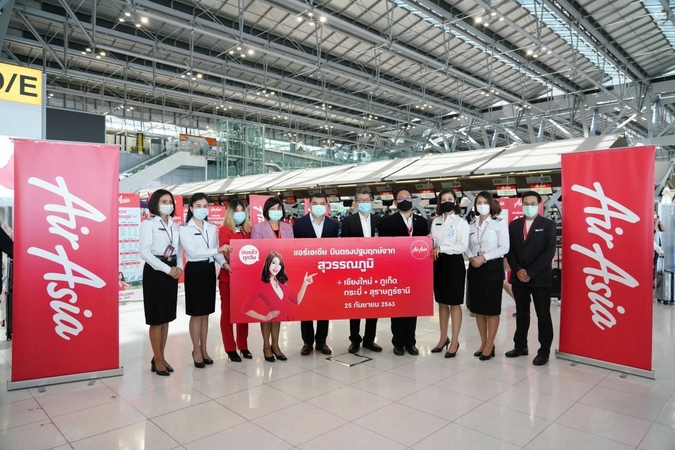
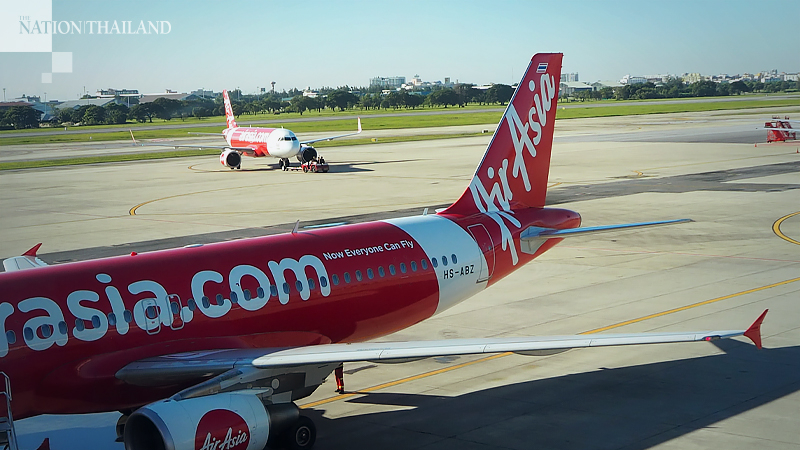
AirAsia became the only budget airline to fly from both Don Mueang and Suvarnabhumi airports in Bangkok when it announced four new routes connecting the capital to Chiang Mai, Phuket, Krabi and Surat Thani on Friday (September 26).
As of Friday, there will be five daily flights from Suvarnabhumi to Chiang Mai, three daily flights to Phuket and two daily to Krabi and Surat Thani.
Apart from ramping up its domestic service in Thailand, AirAsia has also expressed readiness to resume international connections in the near future to cater for both business and leisure travellers once conditions improve and restrictions are lifted.
Santisuk Klongchaiya, AirAsia Thailand’s chief executive officer, said: “While the overall tourism industry is slowly recovering, we are proud to announce additional service from Suvarnabhumi Airport apart from existing flights from Don Mueang Airport. We are very pleased with the response thus far with load factors averaging over 70 per cent for all the four new routes, signifying a great start and healthy future growth for us at Suvarnabhumi.
“Suvarnabhumi is a great airport and one that is familiar to us, as we used to operate from there as well. The utilisation of both airports in Bangkok will not only benefit guests with more choices for easy and low-cost connections, but also the economy as a whole especially when the Covid-19 situation improves and Thailand is ready to welcome international visitors once again.”
The Thai Bankers’ Association and its members place great importance to strict compliance of the law and guidelines to combat money laundering, its chairman Payong Srivanich said.
His remark came in response to the International Consortium of Investigative Journalists (ICIJ)’s allegation that banks in some countries, including four in Thailand, were involved in suspicious transactions.
He added that all local banks follow a strict process of verifying clients and have name lists of the countries they are prohibited from doing transactions with.
The banks also constantly examine clients’ transactions to see if there is anything suspicious. If suspicious transactions are found, they will be reported to the Anti-Money Laundering Office as per normal.
The ICIJ published a report based on leaked reports of suspicious activities submitted to the US Treasury Department’s Financial Crimes Enforcement Network (FinCEN).
The investigation was led by 108 international media outlets from 88 countries. In Thailand, the ICIJ found 92 transactions involving four Thai banks, comprising US$9.6 million in receipt and $31.75 million in remittance between 2000 and 2017, which were flagged as suspicious.
The four Thai banks named in the report are Bangkok Bank, Kasikornbank and state-owned Krungthai Bank and Export-Import Bank of Thailand.
Recently the Export-Import Bank of Thailand (Exim Thailand) issued a statement, dismissing the allegations.
The ICIJ report also provided information about US-based correspondent banks that facilitate transactions in US dollars in more than 150 countries. The records include more than 2,100 suspicious activity reports filed by nearly 90 financial institutions to FinCEN.
The transactions do not necessarily establish any criminal conduct or other wrongdoings. The data offers an overview of how money flagged as suspicious, and in some cases linked to corruption, fraud, sanctions evasion or other crimes, flows around the globe via networks of correspondent banks, according to the ICIJ.
SCG Packaging (SCGP), a subsidiary of Siam Cement (SCC), will launch an initial public offering (IPO) to raise approximately Bt45 billion of capital.
SCGP will sell not more than 1.12 billion IPO shares, accounting for 26.5 per cent of company stock. The firm may allocate another 169.1 million over-allotted shares.
The IPO share price is between Bt33.5 and Bt35, accounting for a price-to-earnings ratio (P/E) of 23 times, while the company will allow investors to request an IPO share subscription from September 28 to October 7 this year.
SCGP Chief Executive Officer Wichan Jitpukdee said Bt27 billion from this fundraising will be used for business expansion, of which Bt8.2 billion will go to increase the company’s production capacity in Thailand, Vietnam, the Philippines and Indonesia.
Wichan said Bt13 billion will go for repaying debts to financial institutions and Bt4.5 billion will be used as circulating funds.
“This fundraising will help expand SCGP’s business in Asean countries, especially in Thailand, Vietnam, Indonesia, the Philippines and Malaysia,” he said.
The SCGP shares are considered large-cap shares, with the firm’s market capitalisation after IPO sales being Bt140 billion, with a listing in the SET50 Index, Chief Financial Officer Kulachet Dharachandra said.
“SCGP’s business was able to escape volatility as company sales from 2016 to 2019 increased by 6.1 per cent yearly to Bt89 billion, while sales in the first half of this year increased by 10.5 per cent to Bt45.9 billion,” he said.
Merchant Partners Asset Management senior director Prakit Siriwattanaket believes there is a possibility institutional investors will reduce their investment in stocks to buy SCGP shares because the company’s business is growing.
He said Bangkok Commercial Asset Management shares would face mass sell-offs because institutional investors were holding a large proportion of these shares.
“There are 16 institutional investors who have the right to buy 600 million SCGP shares worth Bt21 billion,” Prakit added.
CorporateSep 23. 2020Group CEO Jareeporn Jarukornsakul, right
By The Nation
WHA Corporation (WHA Group) forecasts a two-digit growth in revenue next year as conditions improve, said its group chief executive officer Jareeporn Jarukornsakul.
She also revised down the group’s revenue forecast this year to around Bt10 billion, matching last year’s total, from the original projection of 15 per cent growth.
The revision is in response to the Covid-19 outbreak, which has prevented potential investors from travelling to Thailand for business talks, she said.
The group is expected to set aside a 2021 investment budget of Bt10 billion for its four core businesses – Bt3 billion each for logistics, industrial estate development, and utilities and power, and the remaining Bt1 million for its digital platform.
She added that the group seessigns of a recovery across its four core businesses by the end of this year, despite the challenging situation.
CorporateSep 23. 2020The Oriental Pearl Tower in the Lujiazui district of Shanghai in 2015. MUST CREDIT: Bloomberg photo by Qilai Shen
By Syndication Washington Post, Bloomberg · No Author · BUSINESS, WORLD, ASIA-PACIFIC A battle for financial talent is intensifying in China, one of the few places worldwide where global banks are firmly in hiring mode.
Credit Suisse Group this month hired a dozen analysts in China, almost half of whom used to work at UBS, which has scooped up more than 40 people from global and local firms. Morgan Stanley has moved a team to the mainland and hired about 20, but also saw six bankers walk out the door, some to local brokers. Along with Goldman Sachs, most foreign firms are seeking to double their headcounts over the next few years.
The hiring follows China’s historic opening of its financial sector and stands in contrast to much of the world, with global banks announcing jobs cuts this year exceeding 63,000, on track for the deepest retrenchment since 2015. The industry’s biggest players are betting there’s billions to be made in China on products from merger advice to stock underwriting and trading – if they can find the right people.
“There’s definitely a talent war between some of the big global banks,” said Sid Sibal, a Hong Kong-based regional director at recruitment firm Hudson. “In China, there’s a finite amount of talent that one can poach from big investment banks, so they’re going to have to think out of the box.”
Credit Suisse has hired top ranked analyst Alex Liu and Tracey-Ruth Sun from UBS to lead its research operations. Last year it snapped up UBS’s head of research, Erica Poon Werkun. The firm pushed out about 30 bankers at the joint venture in July to make room for fresh talent, a person familiar has said.
Beefing up research is becoming crucial as China opens its markets to lure more foreign inflows. It last year scrapped limits on overseas purchases of stocks and bonds and eliminated approvals for quotas. Foreigners hold 4.7% of Chinese stocks in circulation, way below the more than 30% in markets such as Japan’s and South Korea’s, according to the China Securities Regulatory Commission.
UBS is also on the prowl. The Swiss bank has recruited about 200 people this year, including 44 bankers, analysts and support staffers from at least five brokerages, including Credit Suisse, a spokesman said. UBS transferred managing director Grace Chen from Hong Kong to Beijing to head technology, media and telecommunications banking.
U.S. behemoth Morgan Stanley has seen a churn of bankers. After flying executives in and out of Shanghai over the past years to right its money-losing joint venture it has installed its own personnel in top positions. The firm this year moved seven executives to its China venture, in addition to hiring 20 bankers and research analysts, a person familiar said.
– – –
But it was also hit by departures, with some leaving for China International Capital, underscoring the difficulties foreign banks face. Morgan Stanley lost six bankers at its China venture recently, including two executive directors and another banker who worked on its biggest deal this year, people familiar said. That was in part after it failed to pay bonuses to some executives and bankers but also due to lower deal flows, problems faced by its global rivals as well, the people said.
Morgan Stanley this year ranks first among foreign brokers in China after helping arrange the initial public offering of Semiconductor Manufacturing International the largest ever on Shanghai’s Star board, but it lags far behind local rivals such as CICC.
Spokeswomen for UBS, Morgan Stanley and Credit Suisse declined to comment.
Analysts and bankers say that Chinese brokers offer a faster chance at advancing. While an analyst with three years of experience could become a sector chief at a local broker, it takes much longer to climb the ladder at a foreign firm, according to one executive who has worked for both. Stricter compliance at foreign banks is another hurdle. Local brokerages, for example, are allowed to co-invest in Star Market deals they handle, a potentially lucrative practice that is heavily scrutinized at foreign firms.
While it’s still hard to compare compensation difference between local and foreign firms, in part because global banks are just getting started, the newcomers are offering at least a 20% bump up to lure candidates for senior roles, said Eric Zhu, head of financial services recruitment at Morgan McKinley. Campus recruitment by foreign firms has grown by double-digits from two years ago, he said.
Some local firms are taking note and adjusting their compensation structure to be more in line with global practice by offering a greater part in fixed salary to graduates and junior hires, he said, but cautioned that recruiting in China is about more than just pay.
“Compensation isn’t the most important factor,” he said. “Foreign companies don’t have much status here; you have to tell a very compelling story for people to be interested.”
– – –
There’s also the lure of work outside banking. A senior banker who left Morgan Stanley’s joint venture this year said he was headhunted by about four corporates. Demand for bankers is climbing as China loosens rules in its capital markets, making it easier to raise funds and go public. While compensation is not as high, the lure of stock options is enticing, he said, declining to be named because he was not authorized to discuss the matter.
But global banks are now betting their expanding investments and increased control will translate into climbing market share, making them a bigger magnet for talent.
Thomas Fang, head of China global markets at UBS, estimated this year that China’s brokerage industry will generate revenue of $100 billion by 2025, with foreign capital grabbing 25% of the pie.
Just based on the stated hiring plans by Goldman, UBS and Japan’s Nomura Securities, they will need to find at least a 1,000 people over the next few years. JPMorgan Chase has been quiet about its hiring plans, but is expanding by a third its office space in China’s tallest skyscraper in Shanghai’s business district. Credit Suisse CEO Thomas Gottstein said on Tuesday that the bank plans to double its number of relationship manager in the Asia, as it’s rolling out onshore wealth management in China.
“It’s not 10, 20 staff anymore,” said Sibal. “When you have that level of demand you have to broaden your search.”
Thai central bank studies option of virtual banking licences
CorporateSep 23. 2020Bank of Thailand’s deputy governor Ronadol Numnonda
By The Nation
Bank of Thailand’s deputy governor Ronadol Numnonda said the central bank is studying the pros and cons of virtual banking now that central banks in other countries have granted licences for digital banking.
Banks in Europe, Singapore and Malaysia already offer customer services via virtual banking platforms.
Though Thai banks provide several services via mobile banking and have cut down on physical bank branches in response to consumer demands, the services provided online are still limited.
Ronadol said both local and foreign banks have discussed the prospect of virtual banking operations in Thailand with the central bank.
However, he added, the central bank wants to make sure that the new digital banking service answers the needs of both customers who live in large cities as well as those who are upcountry. The virtual banking operation must also ensure customers’ safety, he said.
Thaweelap Rittapirom, executive vice president of Bangkok Bank, said banking services have changed a lot because now people prefer using mobile banking options and have cut down on the use of ATM machines. Hence, he said, there is a great possibility that virtual banking will arrive in Thailand soon.
Amorn Suvachittanont, first senior vice president at Kasikornbank, suggested that other key developments such as a wider use of digital currencies may take place before virtual banking materialises in Thailand.
WHA Group positions itself for growth despite fallout of Covid-19
CorporateSep 22. 2020“Despite the challenging situation, we are confident we can consolidate and grow across our four business hubs, and prepare to capture opportunities for sustainable growth both in Thailand and in Vietnam,” said Jareeporn Jarukornsakul, Group CEO of WHA Corporation Public Company Limited.
By The Nation
WHA Corporation Public Company Limited (WHA Group) said it sees signs of recovery across its four core businesses by the end of this year.
“Despite the challenging situation, we are confident we can consolidate and grow across our four business hubs, and prepare to capture opportunities for sustainable growth both in Thailand and in Vietnam,” said Jareeporn Jarukornsakul, Group CEO of WHA Corporation Public Company Limited.
With the anticipated return of foreign investors, the group expects to conclude several warehouse and factory rental contracts and land sale deals, as well as see an increased demand for water, electricity and digital platform services, she added.
WHA Logistics has also been doing well thanks to fast-growing demands in the e-commerce sector. It has also signed deals for ready-built factories and warehouses, and has several in the pipeline with customers in the e-commerce, food processing and third-party logistics sectors.
Meanwhile, WHA Industrial Development (WHAID) has affirmed its leadership in Thailand by completing the 2,200-rai WHA Eastern Seaboard Industrial Estate 3.
The construction of the group’s 11th industrial estate in Thailand – WHA Rayong 36 – will start in the fourth quarter of this year.
With more land available in the Eastern Economic Corridor, WHAID is getting ready to welcome customers who want to relocate due to the US-China trade tensions or other supply chain disruptions.
Expansion plans of the industrial estates in the Eastern Seaboard and Saraburi are scheduled to commence as planned.
In response to the fallout from Covid-19, the group has revised its industrial land sales target this year to 900 rai, comprising of 600 rai in Thailand and 300 rai in Vietnam.
Last month, WHAID signed a joint venture with Bangkok Industrial Gas (BIG) as part of its strategy to partner with industry experts. The new BIG WHA Industrial Gas will initially build a gas-separation plant and a pipeline to supply nitrogen to the Eastern Seaboard Industrial Estate and the adjacent WHA Eastern Seaboard Industrial Estate 1. In the long term, the venture will seek to serve the industrial gas demands in other WHA industrial estates.
WHAID has also established WHA TUS, a new joint venture with China’s Tus-Holdings, a leading science and technology park developer. WHA TUS will build TusPark WHA, an innovation and incubation centre for start-ups, which will promote science and technology cooperation between China, Thailand and other Asean countries. The park will be located in the Chulalongkorn University campus.
The WHA Industrial Zone 1 – Nghe An in Vietnam is also gaining strong traction with new customers from China, Japan and Thailand.
WHA Utilities and Power (WHAUP) also foresees an improvement by yearend driven by an improved drought situation, gradual resumption of manufacturing as well as incremental consumption from new customers.
WHAUP will continue to launch and offer high-value solutions such as wastewater reclamation, demineralised water, as well as develop renewable energy solutions.
By the end of this year, WHAUP should have a total installed equity of 592 megawatts, divided between conventional power 547MW, solar rooftops 42MW and 3MW generated using industrial waste at the Chonburi Clean Energy plant.
WHA Digital Platform will also continue offering fibre optics (FTTx) in all 10 of its operating industrial estates in Thailand.
Another key milestone is the completion of the 25-storey WHA Tower on Bang Na-Trat KM 7, which will be ready for occupancy in December. The office building will offer 52,000 square metres of flexible office space for corporates, multinational corporations, SMEs and start-ups.
The top executives of four Thai banks are holding talks on Tuesday on their response to allegations of suspicious transactions revealed by the International Consortium of Investigative Journalists (ICIJ).
The ICIJ reports are based on leaked files, comprising so-called suspicious activity reports by the Financial Crimes Enforcement Network (FinCEN) in the United States.
The Thai banks may issue a joint statement shortly, a source in the banking industry told the Nation.
The ICIJ found 92 transactions involving four Thai banks receiving $9.6 million and remitting $31.75 million between 2000 and 2017 that were flagged by financial institutions as suspicious to the US authorities.
The four Thai banks named in the report are: Bangkok Bank, Kasikornbank, and two state-owed banks — Krungthai Bank and Export-Import Bank of Thailand.
The data involving Thai banks represents only a small fraction of the more than $2 trillion worth of transactions found in the FinCEN files, according to the ICIJ.
The data map also provides information about US-based corespondent banks that allow financial institutions in more than 150 countries and territories to process payments in US dollars, says the ICIJ.
The records include more than 2,100 suspicious activity reports filed by nearly 90 financial institutions to FinCEN.
The transactions do not necessarily establish any criminal conduct or other wrongdoings. The data offers an unprecedented overview of how money flagged as suspicious, and in some cases linked to corruption, fraud, sanctions evasion or other crimes, flows around the globe via networks of correspondent banks, according to the ICIJ.
The Government Savings Bank (GSB) is planning to offer soft loans with annual interest of 2 per cent to airlines hit by the Covid-19 fallout. The loan term will be 60 months.
The package will be sent to the Cabinet for approval soon, said GSB chairman Patchara Anuntasilpa. The move would help revive Thailand’s tourism industry, seen as vital for economic recovery, he added.
The loans will be offered via the Export-Import Bank of Thailand.
Meanwhile the airline industry is getting more support after the Excise Department decided to extend the jet-fuel tax cut for low cost airlines. The tax cut of 20 satang per litre will be extended for another six months from the end of September. The department is also considering whether to waive the tax entirely, said Patchara, who is also director general of the Excise Department.
Airlines have reduced their number of flights by 20 per cent from pre-Covid levels. Previously, excise tax revenue from aviation fuel was about Bt1 billion per year. A tax exemption would not cost much in lost revenue, Patchara assured.
Excise tax collected in the first 11 months (October 2019 to August 2020) of fiscal 2020 totalled Bt503 billion, down 6.53 per cent on last year. The top five tax revenue earners were oil and oil products (Bt206 billion), cars (Bt77.7 billion), beer (Bt73.3 billion), liquor (Bt56.6 billion), and cigarettes (Bt58.1 billion).
The department estimates total tax collected for fiscal year 2020 will be Bt520 billion, higher than the revised target of Bt501 billion following the virus fallout, but lower than the original target of Bt585 billion.
For the next fiscal year, the department expects to collect a total of Bt534 billion.
CorporateSep 21. 2020Thepparat Theppitak, EGCO Group’s president, fourth from left, jointly signs financial agreements for the extension of the Northeast petroleum pipeline (Saraburi to Khon Kaen) at The Bangkok Club, Sathorn, on Monday.
By The Nation
The Electricity Generating Group (EGCO) on Monday reached financial agreements to extend its petroleum pipeline in the Northeast.
Thepparat Theppitak, EGCO Group president, said that the Thai Pipeline Network Company (TPN), in which EGCO owns a 44.6 per cent stake, reached agreement with Bangkok Bank and China Development Bank for Bt7.8 billion over a 14-year tenure to construct a 342.8-kilometre underground pipeline with annual transport capacity of 5,443 million litres, potentially increasing to 7,330 million litres in the future.
The project will connect the Thai Petroleum Pipeline Co (“Thappline”) terminal in Saraburi to TPN’s owned terminal with storage capacity of 142 million litres in Khon Kaen.
Currently, the project is 48.11 per cent complete and expected to start operating in the fourth quarter of 2021.
 Payong Srivanich
 Group CEO Jareeporn Jarukornsakul, right
  The Oriental Pearl Tower in the Lujiazui district of Shanghai in 2015. MUST CREDIT: Bloomberg photo by Qilai Shen
  Bank of Thailand’s deputy governor Ronadol Numnonda
  “Despite the challenging situation, we are confident we can consolidate and grow across our four business hubs, and prepare to capture opportunities for sustainable growth both in Thailand and in Vietnam,” said Jareeporn Jarukornsakul, Group CEO of WHA Corporation Public Company Limited.
 Thepparat Theppitak, EGCO Group’s president, fourth from left, jointly signs financial agreements for the extension of the Northeast petroleum pipeline (Saraburi to Khon Kaen) at The Bangkok Club, Sathorn, on Monday.
