King Power lone bidder for duty-free concession at Don Mueang International Airport

#ศาสตร์เกษตรดินปุ๋ย : ขอบคุณแหล่งข้อมูล : หนังสือพิมพ์ The Nation

https://www.nationthailand.com/business/30379311?utm_source=category&utm_medium=internal_referral

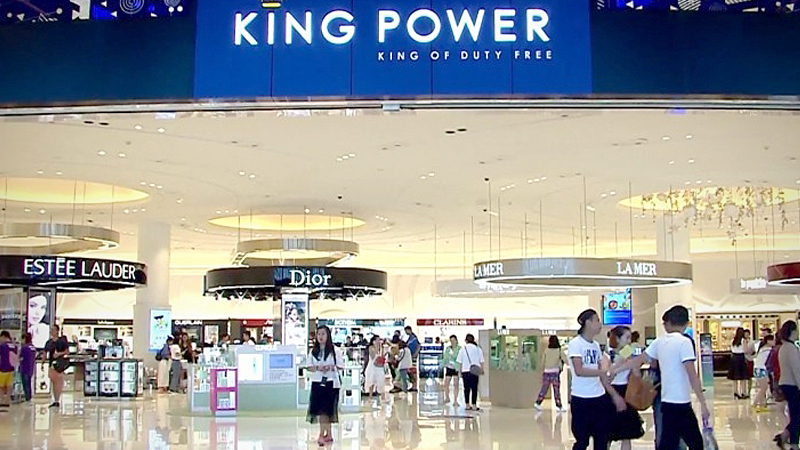
King Power lone bidder for duty-free concession at Don Mueang International Airport

Dec 11. 2019
By THE NATION

1,245 Viewed

King Power Duty Free of King Power Group was the only company submitting a bidding price for duty-free concession at Don Mueang International Airport, a senior official of Airports of Thailand said today (December 11).

Wichai Bunyu, AOT senior executive vice president/Business Development and Marketing, said today that only King Power had submitted a price since the bid was called.

The Mall Group, which had picked up the term of reference earlier, did not participate.

AOT asked King Power to present details of the bid on December 13 and will open its bid letter on December 16. The bid winner is obliged to guarantee a minimum revenue sharing of 20 per cent of total revenue with AOT.

In a related matter, AOT is selling term of reference document for the bids to operate duty free pick-up counter service at Don Mueang Airport and Suvarnabhumi Airport under concessions

King Power group and Bangkok Airways Public Company Limited have picked up the document.

AOT will stop selling the TOR on December 13, after which bidders must submit their bidding prices on January 17 next year.

Krungsri Bank’s new chief strategy officer named

#ศาสตร์เกษตรดินปุ๋ย : ขอบคุณแหล่งข้อมูล : หนังสือพิมพ์ The Nation

https://www.nationthailand.com/business/30379295?utm_source=category&utm_medium=internal_referral

Krungsri Bank’s new chief strategy officer named

Dec 11. 2019
 Pairote Cheunkrut

Pairote Cheunkrut
By THE NATION

1,159 Viewed

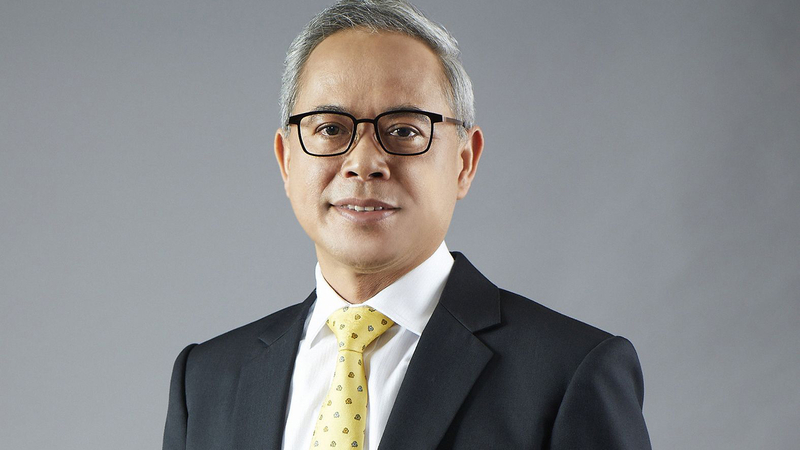
Krungsri (Bank of Ayudhya), a member of Mitsubishi UFJ Financial Group (MUFG), has appointed Pairote Cheunkrut as Chief Strategy Officer, effective January 1.

He will hold management responsibility for the bank’s business strategic direction and support across nine divisions under Krungsri’s Corporate Strategy and Planning Group, namely Corporate Planning, Business Transformation, Customer Experience Management, Corporate Branding and Marketing, Finance and Risk Project Management, Business Process Planning and Management, Research, Central Administration, and Environmental, Social and Governance.

“Khun Pairote has solid management experience and deep technical strength that will surely contribute to the bank’s strategy in advancing to the next level,” said Seiichiro Akita, Krungsri president and CEO.

“His accomplishments at Krungsri Auto have helped Krungsri’s ‘Think Digital First’ and financial inclusion strategies come to fruition, while driving the Bank towards its ambition to be a top-tier financial group in Thailand.”

Prior to this appointment, Pairote was Head of Krungsri Auto Group. He brings with him 24 years of experience in consumer finance and management at Krungsri Auto, GE Capital Auto Lease and GE Money Thailand.

Tax relief approved for govt housing scheme

#ศาสตร์เกษตรดินปุ๋ย : ขอบคุณแหล่งข้อมูล : หนังสือพิมพ์ The Nation

https://www.nationthailand.com/business/30379318?utm_source=category&utm_medium=internal_referral

Tax relief approved for govt housing scheme

Dec 12. 2019
Government Spokeswoman Narumon Pinyosinwat

Government Spokeswoman Narumon Pinyosinwat
By THE NATION

700 Viewed

The Cabinet on December 11 approved the waiver of personal income tax on Bt50,000 cash rebate people will gain from the “Baan Dee Mee Down” government housing purchase campaign.

Government Spokeswoman Narumon Pinyosinwat said that this means those who will get the Bt50,000 cash rebate from the campaign would not have to take the amount into calculation for tax payment.

The Cabinet announced this campaign last month to reduce home-purchase costs.

To be eligible, the buyer must have a monthly salary not exceeding Bt100,000 and included in the Revenue Department’s tax database of around 100,000 individuals under this category.

The campaign will end on March 31, 2020.

According to Finance Ministry spokesman Lavaron Sangsnit, the number of people registering for the privilege in the Baan Dee Mee Down project yesterday (December 11) was 40,906. Wednesday was the first day of registration.

Early this month the Cabinet approved the Finance Ministry’s proposed regulations to waive personal income taxon the financial privilege given to registered consumers, under the government’s economic stimulus package “Eat, Shop, Spend”.

This means the Bt1,000 handout and the ‘cash-back’ amount will not come into calculation for tax payment.

Economy to pick up on state enterprises’ investment

#ศาสตร์เกษตรดินปุ๋ย : ขอบคุณแหล่งข้อมูล : หนังสือพิมพ์ The Nation

https://www.nationthailand.com/business/30379320?utm_source=category&utm_medium=internal_referral

Economy to pick up on state enterprises’ investment

Dec 12. 2019
By THE NATION

813 Viewed

State enterprises’ investment of around Bt100 billion in the current quarter will spur the local economy, said Finance Minister Uttama Savanayana yesterday (December 11) at an event hosted by Thansettakit newspaper.

He said that the Thai economy would not enter into a recession and could continue its growth momentum. The ministry has forecast a 3-per cent growth next year.

He added that state enterprises had been told to accelerate budget spending in the last quarter.

If needed be, the government is ready to introduce additional stimulus packages next year, he said.

The Prayut Chan-o-cha administration has launched stimulus packages for many sectors, from real estate to tourism.

He said  the key factor in boosting the economy was to raise the confidence of consumers and investors.

In a related matter, S&P Global Ratings on December 11 revised its outlook on Thailand’s sovereign credit rating to positive from stable.

At the same time, it affirmed its ‘BBB+’ long-term and ‘A-2’ short-term foreign currency sovereign credit ratings, and its ‘A-‘ long-term and ‘A-2’ short-term local currency ratings on Thailand.

ECB policymakers said to discuss central bank digital currency

#ศาสตร์เกษตรดินปุ๋ย : ขอบคุณแหล่งข้อมูล : หนังสือพิมพ์ The Nation

https://www.nationthailand.com/business/30379328?utm_source=category&utm_medium=internal_referral

ECB policymakers said to discuss central bank digital currency

Dec 12. 2019
The stars of the European Union (EU) sit on banners flying outside the European Central Bank (ECB) headquarters in Frankfurt, Germany, on Nov. 27, 2019. MUST CREDIT: Bloomberg photo by Peter Juelich.

The stars of the European Union (EU) sit on banners flying outside the European Central Bank (ECB) headquarters in Frankfurt, Germany, on Nov. 27, 2019. MUST CREDIT: Bloomberg photo by Peter Juelich.
By Syndication Washington Post, Bloomberg · Jana Randow, Paul Gordon, Carolynn Look 

856 Viewed

European Central Bank policymakers meeting in Frankfurt this week will discuss the prospect of launching their own digital currency, according to euro-zone officials familiar with the matter.

Governing Council members expect to talk about the topic informally at dinner on Wednesday, a day before their policy meeting under new President Christine Lagarde, the people said, asking not to be named as such deliberations are private. An ECB spokesman declined to comment.

While there’s no expectation of an imminent decision, the symbolism of the debate on the eve of Lagarde’s first interest-rate decision shows how far she is willing to shake up the ECB by embracing modern-day challenges, as she has with climate change. It’s another signal that her upcoming strategic review could augur a radical overhaul of the two-decade-old institution.

Lagarde has long argued that central banks should consider the merits of issuing their own digital currency. In her previous job as head of the International Monetary Fund, she said it could support public goals such as financial inclusion, consumer protection and payment privacy.

The idea has gained momentum in recent years, spurred in part by the rise of cryptocurrencies such as Bitcoin. Facebook Inc.’s plans this year for a global digital currency sparked a backlash among governments, but also fueled the debate that public authorities risk being left behind as consumers turn to private-sector initiatives that skirt the traditional banking system.

The ECB said last week that it’ll develop its own digital currency if the private sector can’t make cross-border payments faster and cheaper, arguing that technological innovation is quickly transforming how retail payments are made. In a document prepared for the European Parliament, the central bank said it is analyzing the situation and will be ready to respond if needed.

The People’s Bank of China is already working on a digital currency and the Bank for International Settlements, a hub for monetary cooperation, published a survey this year showing most central banks are considering the implications of doing so. BIS head Agustin Carstens said last week that they “have a responsibility to be at the cutting edge of the debate.”

Bank of England Governor Mark Carney has gone so far as to suggest that a global central bank digital currency might one day replace the dollar as the international reserve currency.

Still, there’s also plenty of skepticism. U.S. Treasury Secretary Steven Mnuchin said only last week that he and Federal Reserve Chairman Jerome Powell don’t see a need to create a Fed digital currency for at least the next five years. Powell previously told a lawmaker that the Fed is studying the costs and benefits of such a move.

Within the euro zone, the Dutch central bank carried out two cryptocurrency experiments in 2015, finding that drawbacks included industry fragmentation and self-interest among financial incumbents. In 2016, Germany’s Bundesbank and the stock exchange tested blockchain — the technology underlying cryptocurrencies — for transferring and settling securities and cash, concluding that the process was too expensive and slow.

Bundesbank President Jens Weidmann has said there is no need for a central bank digital currency for the broad public. He warned it could even weaken financial stability, as people might cause a bank run in a crisis by rapidly shifting their cash to the safer home of a central-bank account.

Thai sovereign credit rating raised to positive

#ศาสตร์เกษตรดินปุ๋ย : ขอบคุณแหล่งข้อมูล : หนังสือพิมพ์ The Nation

https://www.nationthailand.com/business/30379319?utm_source=category&utm_medium=internal_referral

Thai sovereign credit rating raised to positive

Dec 11. 2019
By THE NATION1,081 Viewed

S&P Global Ratings revised its outlook on Thailand’s sovereign credit rating to positive from stable.

It also affirmed our ‘BBB+’ long-term and ‘A-2’ short-term foreign currency sovereign credit ratings, and its ‘A-‘ long-term and ‘A-2’ short-term local currency ratings on Thailand, according to its statement issued on Wednesday.

Its transfer and convertibility assessment remains ‘A’.

The positive outlook reflects its assessment that political uncertainty in Thailand has begun to ease with the return of an elected government.

With progress in implementing national reforms and strategy plans, it believes policy continuity and political stability will improve.

It may raise the rating over the next 24 months if there are clearer signs the key political players are committed to the current political framework and that abrupt and unexpected political changes become unlikely.

In this scenario, it expects the government will continue to implement key reforms and strategies according to national plans, despite the complexities of operating in a multiparty parliamentary democracy.

It could revise the outlook to stable if pressure on the current political process builds substantially, resulting in increasing social tensions and uncertainty that raise the likelihood of abrupt political changes.

In addition, if growth is persistently weaker than what it has currently forecast, it could also revise the outlook to stable.

Chocky soars to the top in China’s ‘Double 11’ shopping fest

#ศาสตร์เกษตรดินปุ๋ย : ขอบคุณแหล่งข้อมูล : หนังสือพิมพ์ The Nation

https://www.nationthailand.com/business/30379307?utm_source=category&utm_medium=internal_referral

Chocky soars to the top in China’s ‘Double 11’ shopping fest

Dec 11. 2019
By The Nation

943 Viewed

Thai brand Chocky was the top-seller in the wafer category during China’s “Double 11” shopping festival, which ended recently.

Apart from the usual fierce competition from local businesses, the festival found growing consumer interest in high-quality imported foods. Thai brand Chocky, which has partnered with Beijing Tian Fu Ying International Trade Company, emerged the No 1 seller in the wafer category of Tmall from October 21 to November 11.

According to Frost & Sullivan, the sales volume of China’s snack food industry reached Bt4.4 billion in 2018.

According to the General Administration of Customs China, the sales volume of imported foods in China grew at a compounded annual growth rate of 17.7 per cent from 2009 to 2018, and reached Bt2.15 billion last year.

With the continuous growth of Thailand’s tourism market, Thai snacks have become the dark horse in 2019 “China Double 11”. There are three reasons why Thai food represented by Chocky is widely loved by Chinese consumers. Firstly, Thai enterprises focus on food quality in export. Secondly, many enterprises are Chinese descendants, so they know how to customise their products based on Chinese taste while retaining Thai food’s distinguished features. Thirdly, Chocky has partnered with Tian Fu Ying International Trade Co, who has been deeply engaged in the food market for over 10 years, and continuously promoted Chocky online and offline during the past two years — this is a key factor in this old Thailand snack brand becoming popular in China.

The rapid growth of Chocky in China reflects the growing demand for quality imported food. According to Supra, director of the Guangzhou office of the international trade promotion office of the Ministry of Commerce of Thailand, the Chinese snack market has great potential and Thai enterprises should fully seize the opportunity. With the Belt and Road Initiative and strong online e-commerce channels in China, China-Thailand trade will be further strengthened in the future.

ADB trims growth forecasts as Asia’s biggest economies slow

#ศาสตร์เกษตรดินปุ๋ย : ขอบคุณแหล่งข้อมูล : หนังสือพิมพ์ The Nation

https://www.nationthailand.com/business/30379300?utm_source=category&utm_medium=internal_referral

ADB trims growth forecasts as Asia’s biggest economies slow

Dec 11. 2019
By THE NATION

1,494 Viewed

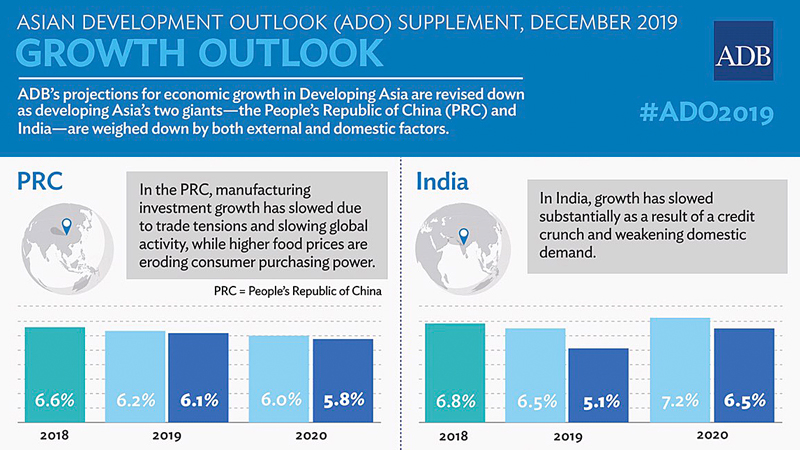
The Asian Development Bank (ADB) has trimmed its forecasts for economic growth in developing Asia this year and next year as growth in the People’s Republic of China (PRC) and India remains weighed down by both external and domestic factors.

In a supplement to its Asian Development Outlook 2019 Update released in September, ADB now expects gross domestic product (GDP) in the region to expand 5.2 per cent in both 2019 and 2020, down from the September forecast of 5.4 per cent growth this year and 5.5 per cent next year.

+++

“While growth rates are still solid in developing Asia, persistent trade tensions have taken a toll on the region and are still the biggest risk to the longer-term economic outlook. Domestic investment is also weakening in many countries, as business sentiment has declined,” said ADB chief economist Yasuyuki Sawada. “Inflation, on the other hand, is ticking up on the back of higher food prices, as African swine fever has raised pork prices significantly.”

The supplement forecasts inflation of 2.8 per cent in 2019 and 3.1per cent in 2020, up from the September prediction that prices would rise 2.7 per cent this year and next.

In East Asia, growth in the PRC is now expected at 6.1 per cent this year and 5.8 per cent next year due to trade tensions and a slowdown in global activity coupled with weaker domestic demand, with family wallets being hit by pork prices that have doubled relative to a year ago. Growth could accelerate, however, should the US and the PRC come to an agreement on trade, the report says. In September, ADB forecast GDP growth of 6.2 per cent in 2019 and 6.0 per cent in 2020.

Hong Kong, China, already in technical recession, will see severe downward pressures persist possibly into 2020. The economy is now expected to contract 1.2 per cent this year and grow 0.3 per cent next year.

In South Asia, India’s growth is now seen at a slower 5.1 per cent in fiscal year 2019 as the foundering of a major non-banking financial company in 2018 led to a rise in risk aversion in the financial sector and a credit crunch. Also, consumption was affected by slow job growth and rural distress aggravated by a poor harvest. Growth should pick up to 6.5 per cent in fiscal year 2020 with supportive policies. In September, ADB forecast India’s GDP to grow 6.5 per cent in 2019 and 7.2 per cent in 2020.

In Southeast Asia, many countries are seeing continued export declines and weaker investment, and growth forecasts have been downgraded for Singapore and Thailand. GDP growth is expected to slow in the Pacific with activity in Fiji, the sub-region’s second largest economy after Papua New Guinea, expected to be more subdued than previously anticipated.

Central Asia is the only sub-region where prospects look a little brighter now than in September, largely thanks to increased public spending in Kazakhstan, the region’s largest economy. Central Asia is now forecast to grow 4.6 per cent in 2019, up from the previous prediction for expansion of 4.4 per cent . The forecast for 2020 is for growth of 4.5 per cent . Kazakhstan’s economy is seen expanding by 4.1 per cent this year and 3.8 per cent next year.

ADB is committed to achieving a prosperous, inclusive, resilient, and sustainable Asia and the Pacific, while sustaining its efforts to eradicate extreme poverty. In 2018, it made commitments of new loans and grants amounting to $21.6 billion.


Lucky times in Hua Hin

#ศาสตร์เกษตรดินปุ๋ย : ขอบคุณแหล่งข้อมูล : หนังสือพิมพ์ The Nation

https://www.nationthailand.com/lifestyle/30379286?utm_source=category&utm_medium=internal_referral

Lucky times in Hua Hin

Dec 11. 2019
By The Nation

125 Viewed

Centara Grand Beach Resort & Villas Hua Hin brings its popular Chokedee Winter Market (Lucky Winter Market) back to town on December 26 and this year it is offering an even bigger and better line up of festive food, fun activities, fabulous merchants and free entertainment with a festive flair.

Shoppers can dine on a wide selection of specialities from Hua Hin’s best eateries and famed food trucks including BBQ pork spare ribs, seafood skewers, phad Thai and green papaya salad with grilled chicken, along with sweet classics like Thai stir-fried ice-cream and mango with sticky rice plus all kinds of festive delights from baked treats such as chocolate brownies, classic fruitcakes, and gingerbread cookies, to fashion items, fabulous gifts and knick-knacks.

There will be exciting games and festive activities to enjoy and Hua Hin’s well-known singers and local bands will take to the stage from 6.30 pm onwards for everyone wishing to show off their moves to the happy Christmas tunes.

The Chokedee Winter Market at Centara Grand Beach Resort & Villas Hua Hin takes place on December 26 from 5.30pm. Admission is free.

KBank turns cautious in lending to SMEs amid rising bad loans

#ศาสตร์เกษตรดินปุ๋ย : ขอบคุณแหล่งข้อมูล : หนังสือพิมพ์ The Nation

https://www.nationthailand.com/business/30379272?utm_source=category&utm_medium=internal_referral

KBank turns cautious in lending to SMEs amid rising bad loans

Dec 11. 2019
 Wirawat Panthawangkun, Kbank's senior executive vice president  was concerned that NPL level of SMEs might rise from the current 5 per cent to 6 per cent of its portfolio.

Wirawat Panthawangkun, Kbank’s senior executive vice president was concerned that NPL level of SMEs might rise from the current 5 per cent to 6 per cent of its portfolio.
By The Nation

1,138 Viewed

Kasikornbank is taking a cautious approach on loans to small and medium-sized enterprises in fear of rising bad debts, said senior executive vice president Wirawat Panthawangkun.

The bank’s credit growth to SMEs is forecast at a mere 1 per cent this year, compared to the year’s target of 2-4 per cent, resulting from a slowdown of the global economy, the US-China trade war and strengthening of the baht. The negative factors led to drops in sales and revenues in the first nine months of this year.

In the first three quarters, credit to SMEs grew 0.4 per cent year on year, with Bt664 billion in outstanding non-performing loans (NPL).

Wirawat was concerned that NPL level of SMEs might rise from the current 5 per cent to 6 per cent of its portfolio. SMEs in the agriculture and export businesses have been adversely affected by the economic deceleration and fast appreciation of the Thai currency.

To reduce exposure to bad loans, the bank has been careful in granting new loans, particularly for working capital and new investments to SMES, he said

“We have not seen an improvement in NPLs for a long time. They are still rising and might climb from 5 per cent to 6 per cent by the end of this year,” he said.

Other banks did not lend much to SMEs, he said, adding that Kasikornbank will also be careful in lending to new SME clients.

Growth in SME credit next year is expected to be flat, or about 1 to 2 per cent, due to weak consumers’ spending especially among farmers who have been hit by falling prices of farm products, drought and the strong baht, he said.

Next year, The bank will look into SMEs operating online trade and will apply big data to evaluate their business outlook and loan prospect.

Online trade is still growing and expected to continue expanding by over 10 per cent a year, he said.

The bank will also monitor companies involved in construction as they may benefit from the government’s infrastructure investments, Wirawat added.