BBL concerned that clients might be affected by GSP suspension

ศาสตร์เกษตรดินปุ๋ย : ขอบคุณแหล่งข้อมูล : หนังสือพิมพ์ The Nation

https://www.nationthailand.com/business/30377834

BBL concerned that clients might be affected by GSP suspension

Oct 29. 2019
By The Nation

959 Viewed

Bangkok Bank is concerned after the US announcement of a suspension of its Generalised System of Preferences (GSP) to numerous Thai products currently enjoying duty-free treatment, said Deja Tulananda, the bank’s chairman of the Board of Executive Directors.

The upcoming suspension might have an impact on their businesses, both in sales and use of loans.

Banks must keep a close watch on the situation and offer prompt assistance as it may affect their ability to repay debts.

Deja hopes the issue will come up for discussions at the 35th Asean summit, hosted by Thailand between October 30 and November 5.

In the first nine months of the year, the bank recorded a drop in loan growth to 3.9 per cent. The bank will hasten lending in the remaining 2 months of the year to reach the 4-per cent growth target set for 2019.

He said the bank would face further challenges next year as the global economic slowdown is expected to continue amid the on-going US-China trade disputes.

Thailand’s GDP is forecast to grow 2.5 per cent next year, compared to 3 per cent in bank loans.

“The Thai economy has been softening, partly due to the GSP declaration dragging down growth. It is hard time for businesses. We have to monitor our customers for any sign of troubles. Requests for loans are expected from large companies which have signed up for the government’s mega projects, such as the Sky train and the high-speed rail route connecting three major international airports,” Deja said.

The ratio of Non-Performing Loan (NPLs) tends to increase in the last quarter of the year. The bank will try to keep NPLs at the current level of 3.4 per cent with the focus on corporate customers. This will help stem a rise in NPLs, he said.

“We might see an upward trend in NPLs. However, we are quite lucky that we have approved a few retail loans. To prevent a spread in NPLs, We need to look after our customers more closely and talk to them before the problem occurs,” said the chairman.

Finance Ministry slashes economic growth forecast but predicts brighter 2020

ศาสตร์เกษตรดินปุ๋ย : ขอบคุณแหล่งข้อมูล : หนังสือพิมพ์ The Nation

https://www.nationthailand.com/business/30377826

Finance Ministry slashes economic growth forecast but predicts brighter 2020

Oct 28. 2019
By The Nation

1,520 Viewed

Lavaron Sangsnit, director of the Fiscal Policy Office, announced on Monday (October 28) that the Finance Ministry has cut its growth forecast to 2.8 per cent from 3 per cent previously estimated.

The major impact on growth is the contraction of exports, which is estimated to be 2.5 per cent this year, compared to the 0.9 per cent contraction predicted earlier. The impacts of the US-China trade war and the global slowdown have been blamed for the contraction.

The ministry is however optimistic that exports next year will bounce back and expand 2.6 per cent year on year.

IMF calls for further easing of monetary policy, more govt spending amid slow growth

The recent government stimulus package is expected to expand the economy by 3.1 per cent in the final quarter of this year and by 3.3 per cent in 2020, compared to 4.1 per cent growth last year, he said.

However, the impacts of the trade war and the slowing down of the global economy remain major risks for Thailand.

Household consumption is expected to grow by 3.8 per cent this year and 3.5 per cent next year while private investment is expected to expand by 2.7 per cent this year and 4.6 per cent next year. Public investment is projected to grow by 1.4 per cent this year and 6.6 per cent next year. Headline inflation remains very low at 0.8 per cent this year due to falling crude oil prices and sluggish economy.

Lavaron said that projected growth rate of 3.1 per cent in the second half this year was higher than in the first, which saw a growth rate of 2.6 per cent, and was due largely to the government stimulus package, which has injected about Bt60 billion into the economy. Of this amount, some Bt51 million is being used as an income guarantee for farmers and as cash handouts for the poor. The Eat, Shop and Spend scheme to promote domestic tourism is expected to inject about Bt10 billion into the economy, he added.

Pisit Puapan, director of macro-economic analysis division, said that the new forecast is based on the assumption that the economic growth of major trading partners would expand at 3.3 per cent, decelerating from 3.5 per cent previously estimated due to impact of slower growth in China and the US.

The value of the baht this year is Bt31.1 per dollar on average, up 3.8 per cent from last year. The baht is expected to strengthen to Bt30.75 next year, 1.1 per cent up from this year. The baht has appreciated 5.6 per cent since early this year, which is expected to rise to 6.2 per cent by the end of this year.

Average Dubai oil price is expected to be US$62.7 per barrel, down from previous forecast of $65.5. The oil price next year is expected to drop to $61.2 per barrel.

The number of tourist arrivals, meanwhile is forecast at 39.8 million, down from 40 million predicted earlier, largely due to slowdown of Chinese tourists in the first half of 2019. The Number of foreign tourists next year is expected to grow by 4.1 per cent to 41.5 million.

Public spending remains an economic driver as disbursement of current spending and capital spending is projected to be 98 per cent and 70.3 per cent respectively, he added.

Connecting Asean DEPA launches “Digital Thailand Big Bang 2019: Asean Connectivity”

ศาสตร์เกษตรดินปุ๋ย : ขอบคุณแหล่งข้อมูล : หนังสือพิมพ์ The Nation

https://www.nationthailand.com/business/30377820

Connecting Asean DEPA launches “Digital Thailand Big Bang 2019: Asean Connectivity”

Oct 28. 2019
Prime Minister Prayut Chan-o-cha

Prime Minister Prayut Chan-o-cha
By The Nation

1,347 Viewed

Prime Minister Prayut Chan-o-cha was the guest of honour at the recent launch of the “Digital Thailand Big Bang 2019: ASEAN Connectivity,” an international digital technology symposium that on the concept of ASEAN Connectivity organized the Digital Economy Promotion Agency (depa) as part of the activities marking Thailand’s chairmanship of the ASEAN Summit.

The premier formally opened the event and gave the keynote speech on the role of Thailand in ASEAN Connectivity before presenting the Prime Minister’s Award. He also took part in the signing ceremony of a memorandum of understanding (MOU) on international collaboration in the digital economy and society. The four-day event is being held at BITEC Bang Na and stretches over three exhibition zones covering 40,000 sqm offering a variety of digital-driven activities.

The Prime Minister reminded participants that the government’s Thailand 4.0 policy emphasizes the adoption of advanced digital technologies and taking advantage of the government’s big data in order to develop human capital, society and key business segments, including farmers and small and medium enterprises (SMEs), which represent the largest proportion of the country’s population. Through the use of digital technology, the Thailand 4.0 economic development model will help leverage incomes across segments of society. If the policy is successful, the problems of inequality and disparity will be solved and Thailand will move forward to become an advanced country in accordance with the national strategic plan.

The premier added that the “Digital Thailand Big Bang 2019” was being hosted as part of to match Thailand’s ASEAN chairmanship, adding that its objective was to create an ecosystem that benefits the digital economic development in collaboration with ASEAN member countries. The event demonstrates Thailand’s readiness for the digital transformation, increasing the efficiency of high-speed internet, creating skilled digital manpower through the lifelong-learning approach, the development of digital or electronic payment systems and enhancing the efficiency of logistics to drive the growth of the e-commerce industry. By stressing the ASEAN Connectivity concept, the event will solidify the collaboration between the public and private sectors to facilitate economic development within ASEAN under efficient regulatory frameworks and standards. It will also help strengthen and improve such digital-related aspects as cybersecurity, electronic transactions, personal data protection and global data traffic.

“All factors in the digital transformation will help steer the digital economic development of ASEAN to flourish in a sustainable way. The arrival of digital technology presents opportunities for people to get access to its benefits and advantages. If people help develop a collaborative network to capitalize on the advanced technologies and innovations, ASEAN will grow and prosper with sustainability,” said the prime minister.

Buddhipongse Punnakanta, Minister of Digital Economy and Society, added that he regarded Digital Thailand Big Bang 2019 as integrated bridge created to connect the public and provide people with opportunities to experience a range of digital technologies, which they can adopt and further develop in the future to drive the country’s economic and social development sustainably. The event underlines Thailand’s readiness for digital transformation, which will boost business confidence and attract foreign investments to the country.

Prime Minister Prayut Chan-o-cha also presented the Prime Minister’s Award to young innovators, digital communities, digital entrepreneurs, digital startups and digital organizations with outstanding digital innovations. The Award is divided into five categories, namely Digital Youth of the Year, Digital Community of the Year, Digital Startup of the Year, Digital Organization of the Year and Digital Entrepreneur of the Year. He also witnessed the signing of an MOU on international collaboration in digital economic and social development between the depa and the State Government of Victoria, Australia Web Summit, Microsoft (Thailand) and Ananda Development. Depa also signed a second MOU with CAT Telecom and the Public Health Ministry.

Digital Thailand Big Bang 2019 brings digital enthusiasts together. The event features a wide range of digital technologies and digital-driven activities divided into three exhibition zones: Digital Economy, Digital Society and Creativity. The “Digital Economy” zone showcases the development of the urban digital economy and the technologies that are anticipated to dictate the future such as artificial intelligence (AI), the Internet of Things (IoT) and Big Data. The “Digital Society” zone presents the importance of digital skills for moving Thailand forward to the digital era in a sustainable manner, especially the digital technologies used to elevate the quality of lives of people in the agricultural sector. The “Creativity” zone, meanwhile, features an array of innovative technologies used for creative industries from various startups and game developers.

The highlights of Digital Thailand Big Bang 2019 are as follows;

● The adoption of unmanned aerial vehicles or drones for use to benefit society such as Rescue Drones, which are increasingly used for emergency services. Visitors can have hands-on experience in riding the passenger drone.

● Visitors can experience Thailand’s first journey to the future with the “Hyperloop”, which aims to break the barriers of distance and time.

● A surprising concert by Robot KUKA and artists from independent music label Smallroom

● Gathering of world-class digital gurus and famous speakers in the digital world such as The Next Web, the largest tech conference organizer in Europe from the Netherlands; Mike Walsh, a futurist speaker; Javier Sobrino, the man who pulled the strings behind the development of FC Barcelona; Ines Caldeira of L’Oreal Thailand; Ray Chan from 9GAG.com; Yasushi Ishihara from Konami as well as representatives from BuzzFeed, AirBNB and other high-profile organizations.

● Startup ASEAN Pitching: Runway to Web Summit Thailand by Web Summit, the organizer of startup expo from Portugal.

● A wide range of solutions for smart city development at Smart City Solution Week 2019 by Messe Frankfurt, one of the world’s leading trade exhibition organizers from Germany.

● Gathering of Thailand’s top speakers at “Creative Talk” show, including the chance to meet with administrators of famous web pages such as Little Monster, Just Doo It (JUSTดูIT), Ad Addict and much more.

● ASEAN Startup HACKATHON brings experts in technology together for brainstorming more creative solutions to the sustainable development of smart city.

● Visitors can also enjoy a wow experience in the E-Edutainment zone and witness the technical advancement of digital media created to promote learning and generate digital manpower. They can play and develop gaming content like professionals, learn how to fix smartphone-addiction problems and transform an unproductive smartphone addiction into a beneficial smartphone addiction for a brighter future.

● ROV e-Sports tournament

● Coding Arena for improving digital skills

● Hebocon robot contest

Digital Thailand Big Bang 2019 is free to the general public and runs until October 31 at Hall EH98 – 104 at the Bangkok International Trade and Exhibition Center (BITEC), Bangna, Bangkok. For more information, visit www.facebook.com/digitalthailandbigbang

SET slumps after US move to suspend GSP

ศาสตร์เกษตรดินปุ๋ย : ขอบคุณแหล่งข้อมูล : หนังสือพิมพ์ The Nation

https://www.nationthailand.com/business/30377808

SET slumps after US move to suspend GSP

Oct 28. 2019
By The Nation

2,649 Viewed

The Stock Exchange of Thailand Index opened at 1,591.64 on Monday morning, decreasing 1.64 points, or 0.1 per cent, and subsequently slumping 14.15 points, or 0.88 per cent.

The most-sold stocks were Charoen Pokphand Group (CPF) and Thai Union Group (TU), with a 4 per cent decrease.

TU president and CEO Thiraphong Chansiri said the company has not felt any negative impact from the United States suspending some trade preferences for Thailand. This included cancelling acceptability of some seafood products covered by the Generalised System of Preferences (GSP). TU’s seafood exports are not under the GSP, Thiraphong added.

Asia Plus Securities said only 573 export products were on the suspended GSP list, so this might affect just 0.01 per cent of total exports. However, amid a weak economic situation, the government needs to issue stimulus measures continually, it added.

The GSP suspension will take effect on April 25, 2020, after the US on Friday suspended preferred treatment for Thai products worth around US$1.3 billion (Bt39.2 billion), citing the kingdom’s failure to improve its labour rights to meet international standards.

The Trade Policy and Strategy Office estimates the costs of exports and imports will increase by 4.5 per cent, while products which will not continue to receive GSP privilege will see a loss of $30 million – 0.1 per cent of export value to the US, or 0.01 per cent of Thailand’s total international exports.

European countries had suspended GSP status for Thai goods in 2015. However, exports that year remained the same, at $23 billion, and now currently stand at $28 billion in 2019.

Govt cutting property transfer, mortgage fees might not be as effective as expected

ศาสตร์เกษตรดินปุ๋ย : ขอบคุณแหล่งข้อมูล : หนังสือพิมพ์ The Nation

https://www.nationthailand.com/property/30377789

Govt cutting property transfer, mortgage fees might not be as effective as expected

Oct 27. 2019
By The Nation

523 Viewed

The government has launched a new economic stimulus measure to boost the real estate business by lowering property transfer fees from 2 per cent to 0.01 per cent and mortgage fees from 1.0 per cent to 0.01 per cent for buying condominium units priced at not over Bt3 million.

Also, the Government Housing Bank will offer loans for the purchase of real estate with a total limit of Bt50 billion. The interest will be stable at 2.5 per cent in the first three years, will rise to 4.625 per cent between the fourth and fifth years, and will have to be repaid with up to 1 per cent of Minimum Retail Rate (MRR) for people with welfare or 0.75 per cent for retailers, which will be 6.625 per cent a year from December 24, 2020.

Sopon Pornchokchai, president of the Agency for Real Estate Affairs, who are independent property consultants, said the measures had their pluses and minuses. The good news was that the measure allowed customers to repay at a lower rate and the bad news is it might be a trap for real estate buyers because even though the measure seemed to help people with low or average incomes trying to buy affordable houses, it actually supported land developers as it only allows customers to buy houses from developers, not second-hand houses.

He said the Bt50-billion loan limit might cover only 1.7 per cent of the total value of new property and might not be as effective as expected. In the first three years, even though the interest was low, the customers did not repay the principal amount and in the sixth year, the bank can adjust the MRR to any rate which could be higher helping the bank to collect more fees.

Lowering the transfer and mortgage fees may encourage people to buy houses but may also cause loss of revenue in a developing country. “We need to raise awareness of the importance of paying taxes for buying houses at the full price and 1.5 per cent interest, which would allow the government to have a higher capital budget,” said Sopon.

Chiang Mai’s Mae Chaem eyed for first community power plant

ศาสตร์เกษตรดินปุ๋ย : ขอบคุณแหล่งข้อมูล : หนังสือพิมพ์ The Nation

https://www.nationthailand.com/business/30377743

Chiang Mai’s Mae Chaem eyed for first community power plant

Oct 28. 2019
By Natichai Donsuwan
THE NATION
822 Viewed

The Electricity Generating Authority of Thailand (Egat) will build the first model community power plant in Chiang Mai’s Mae Chaem district, the agency’s deputy governor for strategy Patana Sangsriroujana said.

He added that Mae Chaem district had good potential as a location because it has plenty of raw materials to feed the plant. The district has up to 100,000 rai devoted to corn plantations, which can yield 45,000 tonnes of corn cobs and corn husk per year, as well as a similar amount in corn trunks. The district also has 50,000 rai of rice farms, which can yield tonnes of rice husks and straw daily.

Patana said the one-megawatt power plant will cost Bt100 million to build and should offer returns of 8 to 10 per cent, adding that Egat was currently looking for a suitable site.

Energy Minister Sontirat Sontijirawong also visited the district recently to check on its potential as the site of the first community power plant.

According to the ministry’s model, Egat, the community and the private sector will hold shares in the plant. The community will hold 10 to 30 per cent, and while a private firm will invest in the plant, the community will pay dividends gained from the power generation back to the company.

Apart from earning from the sale of electricity, the community will also earn from selling corn cobs to the plant. As per a study by Egat, the cobs can be sold at Bt500 to Bt700 per tonne or between 50 and 70 satang per kilogram.

The minister has assigned Egat to coordinate with the community to create a “social contract” for seeking raw materials for the plant. Egat will then draw up the plan for the ministry and the Cabinet’s consideration. Once approved, all related parties will have the go-ahead to kick off the project.

Once the “social contract” is made, the construction of the plant is expected to take 10 months. The ministry is expected to complete final details by November and announce how it will purchase power from the plant later.

Sontirat said the ministry is targeting sites in 30 provinces for similar plants.

Thai competitiveness dropping due to stronger baht, ailing global economy

ศาสตร์เกษตรดินปุ๋ย : ขอบคุณแหล่งข้อมูล : หนังสือพิมพ์ The Nation

https://www.nationthailand.com/business/30377745

Thai competitiveness dropping due to stronger baht, ailing global economy

Oct 28. 2019
By THE NATION

904 Viewed

The global slowdown and continued appreciation of the baht have hurt Thailand’s competitive edge in the world market, said Poj Aramwattananont, vice chair of Thailand’s Board of Trade.

He said these factors have affected the country’s export sector, which is consequently affecting the employment situation.

The global slowdown has resulted in a drop in orders from foreign customers, while the baht has continued rising against the currencies of Thailand’s trading partners, he added.

Supant Mongkolsuthree, chairman of the Federation of Thai Industries (FTI), said the government’s “Eat, Shop, Spend” economic stimulus may help spur domestic consumption, which could offset the impact of the decline in exports.

FTI vice chairman Suchart Chantaranakaracha said it is still unclear whether the ailing global economy will affect jobs in Thailand, where the unemployment rate is low at 0.9 per cent. It is also difficult to predict if the rate of unemployment will rise next year.

Globalisation is shield against disaster, says IMF official

ศาสตร์เกษตรดินปุ๋ย : ขอบคุณแหล่งข้อมูล : หนังสือพิมพ์ The Nation

https://www.nationthailand.com/business/30377796

Globalisation is shield against disaster, says IMF official

Oct 28. 2019
Jonathan Ostry, deputy director for Asia-Pacific at the IMF

Jonathan Ostry, deputy director for Asia-Pacific at the IMF
By Wichit Chaitrong

The Nation

897 Viewed

Amid a growing backlash against globalisation, fund managers argue that the wise stance is to brace for economic fragmentation, but an International Money Fund executive has risen to the defence of globalisation.

Jonathan Ostry, deputy director for Asia-Pacific at the IMF, expressed concern about the rising backlash.

IMF calls for further easing of monetary policy, more govt spending amid slow growth

The world and Asia benefit enormously from global integration, which has lifted billions of people out of poverty and will continue to deliver income and wealth, he said.

Others have signalled concern over shifting sentiments.

The United States-China trade conflict is expected to continue for a significant period, and talk of a possible deal coming up could turn out to be merely a truce, said Jean-Louis Nakamura, chief investment officer for Asia-Pacific and chief executive at the Hong Kong Lombard Odier Group.

He said the US and China, the world’s largest economies, were using trade as a tool in their race for technological superiority.

Even if they strike a deal, he said, it would be unlikely to restore the global economy to its former state, noting that  US tariffs average 22 per cent of Chinese goods’ value compared to 5 per cent 15 months ago.

But with politics in the West becoming increasingly isolationist and conservative, fewer Westerners favour globalisation, Nakamura said.

Substantial losses of manufacturing jobs are widely seen as helping win the US presidency for Donald Trump and for a majority of Britons voting to pull the UK out of the European Union, he noted.

Previously, it was commonly accepted that, even with domestic factories moving to China and other developing countries, developed economies would continue to thrive thanks to more jobs in the service sector.

That was possible to some extent, Nakamura said, but Western labourers have been forced to tolerate low pay in less productive jobs amid competition from robotics and artificial intelligence. Unemployment in the US is at an historic low, but wages remain low, and their less productive jobs leave workers with less bargaining power to fight for wage hikes.

Demographic changes are also having an impact on globalisation. Millennials demand quick delivery of goods purchased online, so the supply chain has to be in their country or nearby. Concern over environmental harm adds to their insistence that their purchases not be shipped a long distance, Nakamura said.

He pointed out that corporate chief executives at a recent Business Roundtable in the US vowed to keep in mind the interests of business, workers, the government and non-governmental organisations alike, in sharp contrast to the prevailing attitude of the 1990s, when the focus was entirely on maximising profits for corporate shareholders.

Nakamura, however, was optimistic about the future of the Thai economy, crediting the relatively good infrastructure able to attract foreign indirect investment.

Uncertainty over the global economy demands unconventional measures to prevent a slide into a crippling recession, he said.

Many policymakers understand the issues and support government spending projects, while central banks have started reducing key policy rates.

Yet some policymakers remain reluctant, he said. The US Federal Reserve may need to start buying equities of listed companies, like the Bank of Japan did in the past to rescue the stock market.

Amid increasing uncertainty, investors should think carefully about their strategies, he said.

KBank Private Banking’s establishment of a risk-based asset-allocation fund promises to shield investors from the shock of negative returns on their investments.

Siriporn Suwannagarn, managing director and financial advisory head at KBank Private Banking, called it “a boring fund model”, but said it’s shown desirable returns.

In separate interview, Ostry of the IMF expressed concern about the backlash against globalisation, insisting it “makes the pie larger”, while any move towards fragmentation does the opposite and also fails to address public discontent at not sharing in the wealth.

“What you don’t want to do is throw the baby out with the bathwater,” he said.

When a country becomes deeply integrated with the global economy and embraces the “fourth industrial revolution” represented by technology, workers need new skills and knowledge to benefit and a social safety net is put in place to support people still searching for jobs.

Governments should confront the issue of the benefits not being broadly shared, Ostry said. “They should take steps to ensure the winnings will be better shared in the future than they were in the past.”

Trade tensions between the US and China and between Japan and South Korea have been “extraordinarily costly for the world and the participants”, he said. The cost goes beyond those of high tariffs and counter-tariffs to affect confidence in the financial markets and slow productivity due to all the uncertainty. “It is killing the animal spirits that drive investment in these countries and the world,” Ostry said.

Conflicting parties should tackle head-on fundamental issues such as the protection of intellectual property rights, technology transfer and trade subsidies via the multi-lateral, rule-based system under the World Trade Organisation, he suggested.

Every country could do more to facilitate the free movement of goods, labour and capital and they should be more open to foreign direct investment, he said. “It not just about the US and China – every country has a stake in the system. Even small countries can lead by example.”

US trade move seen having limited effect on Thai exports

ศาสตร์เกษตรดินปุ๋ย : ขอบคุณแหล่งข้อมูล : หนังสือพิมพ์ The Nation

https://www.nationthailand.com/business/30377793

US trade move seen having limited effect on Thai exports

Oct 27. 2019
Pimchanok Vonkorpon, director-general of the Commerce Ministry’s Trade Policy and Strategy Office

Pimchanok Vonkorpon, director-general of the Commerce Ministry’s Trade Policy and Strategy Office
By The Nation

1,421 Viewed

Pimchanok Vonkorpon, director-general of the Commerce Ministry’s Trade Policy and Strategy Office, believes the United States’ decision to reduce tariffs on various products beginning last Friday (October 25) will have a minimal effect on Thai imports.

She put the figure at 0.01 per cent following Washington’s decision to suspend its Generalised System of Preferences (GSP) on some imported goods. Thailand exports just 355 of the 573 products on the list with a combined value of $1.28 billion, she noted. These include processed seafood, pasta, beans, fruit jams, juices, soy sauces, chemical products, household tools, electric motors, steel, musical instruments and fishing gear.

Suspension of the GSP will raise Thailand’s export budgets to $50.33 million in accord with its Most Favoured Nation status, Pimchanok said. She calculated that the higher tariffs would result in $28.8 million-$32.8 million in lost value, representing 0.01 per cent of total export value.

The focus of Thai exports to the US will shift to markets with the potential to expand, such as clothing, spare auto parts, furniture, utensils and household tools. But Pimchanok warned that the US move will increase competition for Thailand, so it’s crucial that exporters ensure high quality and secure bonds with trading allies to preserve their market share.

Coping with the challenges of Asia’s rapid urban population growth

ศาสตร์เกษตรดินปุ๋ย : ขอบคุณแหล่งข้อมูล : หนังสือพิมพ์ The Nation

https://www.nationthailand.com/business/30377791

Coping with the challenges of Asia’s rapid urban population growth

Oct 27. 2019
By The Nation

1,561 Viewed

The urban population has been growing rapidly in Asia, according to a report by the Asian Development Bank (ADB). The report comes as Bangkok fights the adverse effects of rising harmful toxic air with prevalent PM2.5, particles or droplets in the air that are two and half microns or less in diameter.

According to the ADB report, looking at the average growth rates of urban population from 1970 to 2017, developing Asia’s urban population grew 3.4 per cent, compared to 2.6 per cent for other developing economies and 1 per cent for developed economies. The highest growth rate is in East Asia at 3.7 per cent followed by Southeast Asia at 3.6 per cent and South Asia at 3.3 per cent.

The urban population from 1970 to 2050 rose from 0.4 billion people in 1970 to 1.8 billion people, up five fold in 2017. From 2017 onwards, the urban population in developing Asia is projected to reach 3 billion, up by 70 per cent by 2050.

Many cities are expanding beyond their administrative boundaries. The “natural cities” capture actual urban footprint using nighttime lights satellite imagery.

A total of 1,459 natural cities are identified in developing Asia, hosting 34.7 per cent of the population on 2.3 per cent of land area and some cities have connected to form city clusters such as Delhi-Chandigarh in India, Shanghai-Nanjing and Guangzhou-Huizhou in China. In Thailand, Bangkok has expanded beyond the capital and it now covers the nearby provinces of Samut Prakarn, Pathum Thani, Nonthaburi and Nakhon Pathom and Samut Sakhon, said Hideaki Iwasaki, the bank’s country director for Thailand.

The report found that 28 city clusters in developing Asia have a population of 10 million or more.

Asian cities benefit from size, a so-called “agglomeration economies”.

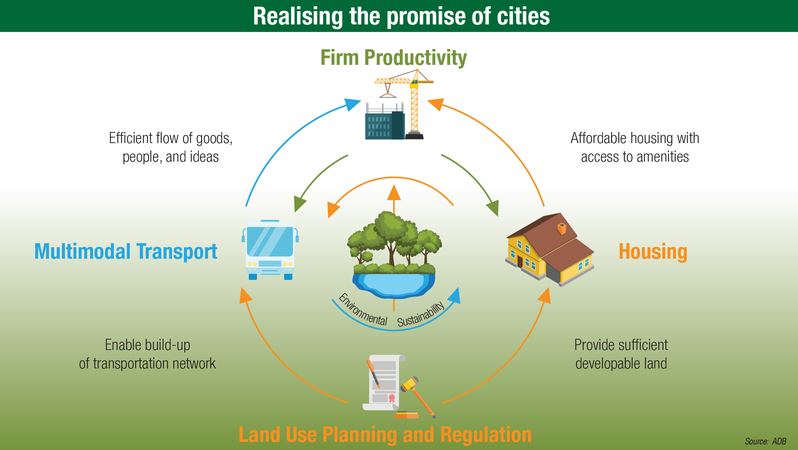
Workers and entrepreneurs who live in big cities will obtain many benefits such as the workers can receive higher wages while the entrepreneurs can host more innovative firms, but they also face hindrances such as traffic congestion in many cities and the high cost of housing. Bangkok and other large cities also face rising air pollution due largely to traffic congestion resulting in vehicle emissions of toxic gases that threaten environmental sustainability.

ABD has provided solutions to this problem for cities and urban systems by building multi-modal public transport systems, which connect between urban areas and cities, providing affordable housing, planning on land usage and regulations including economics to maintain environmental sustainability.