Sharp decline in new condo projects in first nine months of 2019

ศาสตร์เกษตรดินปุ๋ย : ขอบคุณแหล่งข้อมูล : หนังสือพิมพ์ The Nation

https://www.nationthailand.com/property/30377771

Sharp decline in new condo projects in first nine months of 2019

Oct 26. 2019
By THE NATION

764 Viewed

There has been a sharp decline in the number of new condominium projects in the first nine months of 2019, according a Colliers International Thailand survey.

he survey said 71 projects were launched in the Bangkok area with the 29,132 condo units worth Bt170 billion, 16,008 units or 35.5 per cent lesser than in the previous year.

The survey found that many of the condominiums launched in the first half of this year were purchased by foreigners, especially the Chinese.

“The district where most of the companies launched their projects was Huai Khwang, with 3,247 condo units,” said the company. “In this area, the Chinese investors focused on buying projects in CBD areas such as locations along the Rama IX to Ratchadaphisek roads”.

Regarding the areas around along the mass transit railway line, the survey found that 12,426 units or 42.65 per cent were developed along the BTS line in the first nine months of the year, while condominium units along the MRT line were 6,407, or 22 per cent. About 10,300 units, or 35.5 per cent, were in the areas of under-construction railway lines and other areas.

In addition, when looking closely at the stations of both the BTS and MRT lines, most of the condominium projects were launched around the Talat Phlu station — 2,872 units — with Bt9.242 billion investment value. The other station where most of the projects were crowded were around Punnawithi, with 1,555 condominium units worth Bt12.496 billion investment value, and the third station was Ratchathewi, with 1,417 units and investment value of Bt17.200.

“Over 65 per cent of the projects developed were by big property entrepreneurs listed in the Stock Exchange of Thailand as the land price around the BTS and MRT stations rose steeply,” the company explained, adding that this caused “small and medium-sized entrepreneurs to recede from this expensive competition to invest in cheaper areas or areas along the new railway stations that are under construction”.

TCEB bidding for 18 conventions by 2026

ศาสตร์เกษตรดินปุ๋ย : ขอบคุณแหล่งข้อมูล : หนังสือพิมพ์ The Nation

https://www.nationthailand.com/business/30377775

TCEB bidding for 18 conventions by 2026

Oct 26. 2019
Chiruit Isarangkun na Ayuthaya

Chiruit Isarangkun na Ayuthaya
By The Nation

973 Viewed

The Thailand Convention and Exhibition Bureau (TCEB) is working with several partners to win bids that would bring 18 national conventions to Thailand between 2020-26, expecting them to generate up to Bt2.5 billion revenue for the country.

TCEB president Chiruit Isarangkun na Ayuthaya said that in 2020, TCEB will organise six conventions, seven conventions in 2021, four conventions in 2022 and one convention in 2026, covering many businesses such as medical industry, aviation and education.

“We expect that 30,100 MICE travellers from other countries will attend these conventions and generate revenue of Bt2.54 billion,” he said.

He said Thailand has the potential to be a destination for world class national conventions with professional personnel from associations, organisations and educational institutions including support from the government.

According to the International Congress and Convention Association report, Thailand was the largest MICE organiser in Asean for three years, from 2016 to 2018, hosting 174, 171 and 193 conventions in those three years respectively.

Thailand was ranked as the fourth biggest organiser in Asia, following Japan at 492 conventions, China at 449 and South Korea at 273 conventions.

Chiruit added that the company expects the number of MICE travellers in the domestic and international markets in 2020 to reach 37.7 million and generate revenue of Bt232.70 billion. The international market would account for 1.38 million people, generating revenue of Bt105.60 billion while 36.39 people would come from the domestic market, generating Bt127.10 billion revenue.

Egat prepares to shut down Mae Moh coal mine in Lampang

ศาสตร์เกษตรดินปุ๋ย : ขอบคุณแหล่งข้อมูล : หนังสือพิมพ์ The Nation

https://www.nationthailand.com/business/30377770

Egat prepares to shut down Mae Moh coal mine in Lampang

Oct 26. 2019
By THE NATION

1,604 Viewed

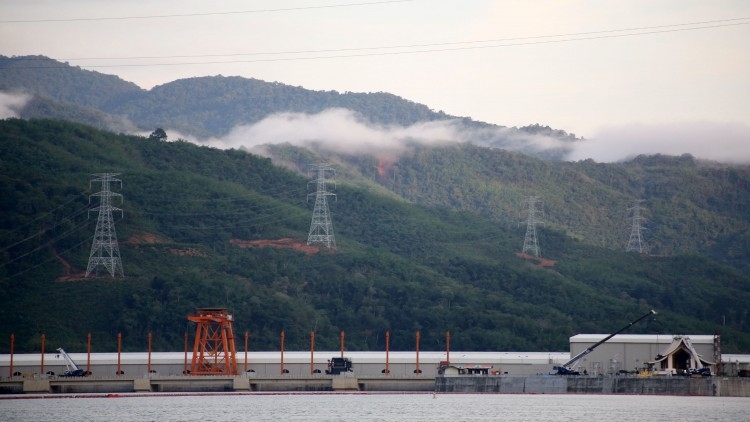
The Electricity Generating Authority of Thailand (Egat) has drawn up a plan to shut down the Mae Moh coal mine in Lampang province as the mine’s lifespan will end in the next 30 years, Egat deputy governor for fuel Tawatchai Jakpaisal has said.

Coal supply from the mine has been dwindling.

The state agency has earmarked some revenue from the coal sales to support the mine closure plan and for creating new jobs for villagers working at the mine.

It will also undertake reforestation of the mine, which occupies 40,000 rai.

He added that the reforestation would create a small water reservoir in the location where a floating storage could be installed to generate electricity.

Egat has already decommissioned units 1 to 3 of the electricity generating units, while 4 to 7 of the units were replaced by the RP1 unit, which has a capacity of 655 megawatts and started operation early this year.

Units 8 to 9 will retire in 2025. Egat is conducting a public hearing on the plan to build the RP2 plant to replace them. The new plant will have a capacity of 650MW.

Units 10 to 13 will be decommissioned after 2025 as it was estimated that the coal supply in the mine will not be enough to feed them.

The Mae Moh power plant has a total capacity of 2,400MW. The new units, which were built or will be built to replace the retired ones, will be decommissioned at the same time the mine runs out of supply.

IMF calls for further easing of monetary policy, more govt spending amid slow growth

ศาสตร์เกษตรดินปุ๋ย : ขอบคุณแหล่งข้อมูล : หนังสือพิมพ์ The Nation

https://www.nationthailand.com/business/30377752

IMF calls for further easing of monetary policy, more govt spending amid slow growth

Oct 26. 2019
By Wichit Chaitrong

The Nation

893 Viewed

The IMF has urged the Thai government to spend more and suggested the Bank of Thailand should further ease its monetary policy amid an economic slowdown while the Finance Ministry is calling for the central bank to cut rate again.

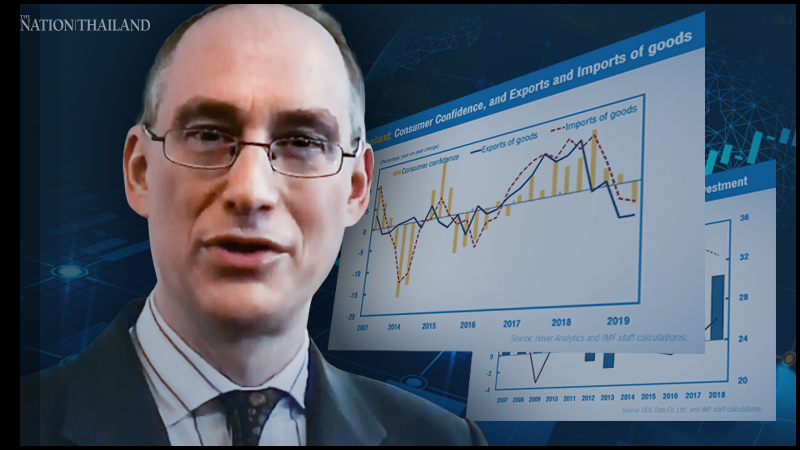
Jonathan Ostry, deputy director Asia and Pacific Department of International Monetary Fund, said in Bangkok today (October 25) that after two consecutive years of sustained expansion, growth is expected to moderate to 2.9 per cent this year and 3 per cent next year, reflecting weaker external demand. Expansionary monetary and fiscal policies are desirable to mitigate the slowdown, he told the Thai press.The IMF has cut its projection of Thai growth by 0.6 percentage point and 0.5 percentage point for this year and next year  from its previous forecast.

“We think there is fiscal space in Thailand to provide support to the economy in this period of slowdown in growth. And in a more structural sense, to accelerate the buildup of infrastructure and also crowd in private investment which will help support demand going into the medium term,” he said.

“In IMF’s recent assessment for Thailand, we came to the conclusion that there was scope on both sides of the monetary policy and fiscal policy for more vigorous and pro-active response [to cyclical slowdown]”, he said.

He said the central bank has more scope to ease monetary policy without threatening inflation or financial stability objective.

The Thai economy and that of other developing Asia Pacific countries have been adversely impacted by the US-China trade war which has also dampened  confidence in the global economy. The slowdown in China and uncertainty of Brexit have also impacted on Asia and the Pacific region.

Public investment will not only boost public demand in the short term but it will also draw in private investment, Ostry noted.

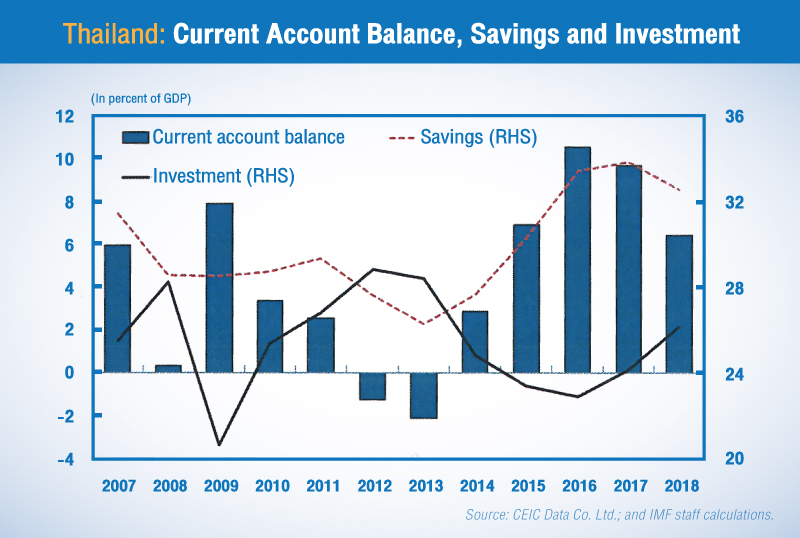
He said accelerating public investment in infrastructures would also help to alleviate upward pressure on baht’s value. He pointed out that Thailand has a larger current account surplus than it should from the point of views of people’s welfare.

The large surplus reflects a wide gap between savings and investment. He said Thailand should also reform its pension fund system as the  social safety net is underfunded, resulting in only a small fraction of retirees having access to the pension fund, similar to some countries in the region where only 22 per cent of retirees are covered by pension fund.


The baht

The value of the baht has been driven by both current account and capital account.

Capital account is not something that can be directly linked to domestic measures. One option is to close the country completely from foreign capital  flows but Thailand will not do so as it benefits greatly through integration with the  global financial system, Ostry said.

The way to look at the problem is to find whether there are domestic distortions in policy setting that draws in capital flows which put upward pressure on the value of the baht, he added. Thai exporters have complained about the strengthening of the baht which has appreciated about 7 per cent against the US dollar this year.

Meanwhile, Lavaron Sangsnit, director general of the Fiscal Policy Office, said separately that the government has fully implemented fiscal expansion measures as it is running a fiscal deficit and has launched a series of economic stimulating packages. “What is needed most is an easing of monetary policy,” said Lavaron.

He said an acceleration of infrastructure investment will occur next year as many contracts have been signed but it will take time for actual investment to kick off. Some analysts predict the central bank will again lower rate by 25 basis points to 1.25 per cent before the end of this year,following a previous cut of 25 basis points.

Thai Union expects strong interest in its Bt4 bn debentures

ศาสตร์เกษตรดินปุ๋ย : ขอบคุณแหล่งข้อมูล : หนังสือพิมพ์ The Nation

https://www.nationthailand.com/business/30377717

Thai Union expects strong interest in its Bt4 bn debentures

Oct 24. 2019
Thai Union CEO Thiraphong Chansiri

Thai Union CEO Thiraphong Chansiri
By THE NATION

1,230 Viewed

Thai Union Group PCL., a top global seafood company, expects investors to show strong interest in its Bt4-billion debentures thanks to its robust financial structure and growth potential.

The subordinated perpetual debentures, which also include an additional greenshoe offering of Bt2 billion, promises an annual return of 5 per cent for the first five years, payable quarterly.

TRIS Rating has given the debentures an A- score, while Thai Union has been given a A+ rating with a stable outlook.

The debentures, which should be up for sale between November 26 and 28, will strengthen Thai Union’s financial structure and build a long-term foundation for the company.

“At Thai Union, we have built a company that is financially robust thanks to our strict financial management,” Thai Union CEO Thiraphong Chansiri said.

“We believe our stability, together with our potential for strong growth due to our global footprint and growing investment in innovation, will be attractive to investors, who are also looking for a healthy return on investment.”

Chansiri said the subordinated perpetual debentures will not only provide a strong financial structure for Thai Union, but also give it flexibility for growth and further investment to strengthen the company.

Thai Union’s subordinated perpetual debentures No 2/2019 are payable upon liquidation with the issuer having a call option and unconditional interest deferral.

The company also retains the right to call the debentures after five years or upon other conditions in accordance with the terms and conditions of the debentures as specified in the prospectus.

The debentures will be offered to the general public and/or institutional investors via joint lead arrangers Bangkok Bank, Krung Thai Bank, Siam Commercial Bank and Phatra Securities.

TRIS Rating gave Thai Union an A+ score because of its business performance as well as its strong strategy that focuses on new product development, cost controls and improving production efficiency. The company’s debt burden has also been lowered as a result of improved business performance and a reduction in expenditure.

Thai Union, which has a portfolio of 14 brands around the world, was recently ranked No 1 in global Food Products Industry Index of the Dow Jones Sustainability Indices (DJSI) for a second year running and has been part of the DJSI for six consecutive years, driven by SeaChange, its global sustainability strategy.

Moreover, Thai Union’s Global Innovation Centre (GIC), which was established in 2015, acts as a centre for research and the development of products for the company’s brands around the world.

It was also created to combine modern nutritional science and production innovation to develop products that address the needs of consumers and the global food industry. The GIC also uses technology and innovation to improve production processes, providing additional benefits and value to customers, consumers and stakeholders.

“Thai Union’s strict financial management, together with a strong and cautious approach to risk management, has always allowed the company to not only manage its debts, but also to continue paying dividends to shareholders,” Chansiri said. “Thai Union also adopted the new accounting system TAS32 earlier this year, and these debentures align with these regulations.”

KBank eyes 4-6% growth in loans next year

ศาสตร์เกษตรดินปุ๋ย : ขอบคุณแหล่งข้อมูล : หนังสือพิมพ์ The Nation

https://www.nationthailand.com/business/30377702

KBank eyes 4-6% growth in loans next year

Oct 24. 2019
KBank's board chairman Banthoon Lamsam

KBank’s board chairman Banthoon Lamsam
By THE NATION

1,876 Viewed

Kasikornbank (KBank) sees more challenges ahead for the Thai economy next year.

Despite the expectation, the bank aims to grow its loan volume by 4-6 per cent in 2020, placing its emphasis on services that meet customers’ business and lifestyle needs, effective cost management and using data in lending to retail customers.

KBank’s board chairman Banthoon Lamsam said the Thai economy in 2020 will face numerous downside risks, in particular the protracted US-China trade rift and the strengthening baht which will hamper international trade.

In 2020, exports are expected to see a contraction of 2 per cent while the Thai economic growth will be mainly driven by domestic factors, such as implementation of infrastructure projects and cut in interest rates amid hefty household debt.

The bank’s strategy next year will follow the goal “To Empower Every Customer’s Life and Business”, towards becoming a customer-centric financial institution which creates financial innovation, equipped with proactive operation to deliver services up to international standard and sustainable value to all stakeholders.

Regarding its 2020 financial targets, KBank has set an overall loan growth target of 4-6 per cent, comprising corporate loans (2-4 per cent), SME loans(1-3 per cent)and retail loans (9-11 per cent).

Growth in net interest margin is set 3.1-3.3 per cent and non-interest income at minus 5 to minus 17 per cent.

Huawei vows to boost Thailand’s tech ecosystem as it marks 20 years in Thailand

ศาสตร์เกษตรดินปุ๋ย : ขอบคุณแหล่งข้อมูล : หนังสือพิมพ์ The Nation

https://www.nationthailand.com/business/30377699

Huawei vows to boost Thailand’s tech ecosystem as it marks 20 years in Thailand

Oct 24. 2019
 Abel Deng, CEO of Huawei Thailand

Abel Deng, CEO of Huawei Thailand
By THE NATION

1,296 Viewed

Huawei Thailand on Thursday (October 24) announced its mission to build a thriving technology ecosystem in celebration of its 20th anniversary in Thailand.

In line with the theme “Together for a Fully Connected, Intelligent Thailand”, Huawei said it was committed to bringing the latest information and communications technology to the country.

“This year marks a significant milestone for Huawei, as we are celebrating our 20th anniversary in Thailand,” said Abel Deng, CEO of Huawei Thailand. “After 20 years in Thailand, we understand the market deeper than others and know how important innovation is for the future of Thailand.”

“The key to a country’s innovation ability lies in talents while the key to a country’s digital economy development is the industrial ecosystem. We have the responsibility to contribute more to Thailand, to shape a fully connected, intelligent Thailand together,” Deng said.

Since its establishment in Thailand in 1999, Huawei has been an important contributor to the development of Thailand’s ICT industry. The company successfully participated in the construction of 2G, 3G and 4G networks with innovative technologies.

“We are so proud to say that we made great contribution to Thailand in the past two decades. We are committed to be the enabler of Thailand 4.0, which fulfills our vision of ‘Bringing digital to every person, home and organisation for a fully connected, intelligent world’,” Deng said.

Huawei has established its Southeast Asia regional headquarters, OpenLab Bangkok, Huawei Cloud Data Center, 5G Testbed, etc. Now, it has more than 3,200 employees in Thailand, 75 per cent of whom are locals.

In 2018, Huawei’s procurement in Thailand reached US$196 million.

Deng also revealed that the Thai government and Huawei Thailand had recently signed a memorandum of understanding. With this strategic MoU on ‘Nurturing Thai Digital Workforce for Innovative and Sustainable Society’, Huawei will strengthen knowledge-sharing and skills transfer and work with the Thai government, industrial organisations and enterprises to cultivate ICT digital talents and speed up Thailand 4.0.

Huawei will establish the Huawei Academy in Thailand, to explore and cultivate ICT talents, and enable Thailand 4.0.

With cutting-edge technologies such as Cloud, AI and Supercomputing, Huawei will enable the digital transformation of government departments and industries, facilitate startup and SME innovations, incubate innovative ecosystem based on 5G and drive Thailand’s innovation capabilities, in order to jointly build the prosperous industrial ecosystem for the fully-connected, intelligent society, Deng said.

“5G technology will support the development of AI, and if Thailand could be ahead, it will be faster than others. 5G will be the significant infrastructure, Cloud + AI will create a digital economy. We respect the digital sovereignty of Thailand, startups and SMEs from the world around can plant their “own crops” in the “fertile soil”, the open source platform provided by Huawei. With the digital ecosystem, Thailand can establish its own digital society,” said Deng.

As part of the celebrations marking Huawei Thailand’s 20th anniversary, Huawei will be showcasing its new vision of Thailand and achievements in creating rich ecosystems in Thailand on the theme of “Together for a Fully Connected, Intelligent Thailand” during the Digital Thailand Big Bang 2019 to be held at Bitec, Bangkok, from October 28-30.

The event will be hosted by Digital Economy Promotion Agency, which is under the Ministry of Digital Economy and Society.

The Huawei Thailand pavilion at the Digital Thailand Big Bang 2019 will feature 400 square metres of floor space divided into 5 zones covering the fully connected smart ecosystem in Thailand and showcasing Huawei’s end-to-end portfolio of products, solutions and services in 5G, 5G ecosystem, smart city, Huawei cloud, and Huawei mobile.

These events will also help introduce a new ecosystem strategy from Huawei Thailand.

Huawei will be showcasing its vision and achievements in creating rich ecosystems in Thailand – including 5G innovations, smart cities, cloud + AI, and mobile developers.

These leading technologies will bring digital innovations to every person, home and organisation.

Experts from Huawei will join the conversation on many different topics to be explored at the event – ranging from 5G and the Internet of Things to smart city, cloud, and AI.

WHART to invest in additional real estate assets

ศาสตร์เกษตรดินปุ๋ย : ขอบคุณแหล่งข้อมูล : หนังสือพิมพ์ The Nation

https://www.nationthailand.com/business/30377695

WHART to invest in additional real estate assets

Oct 24. 2019
WHART CEO Narumol Tantayawit

WHART CEO Narumol Tantayawit
By THE NATION

1,538 Viewed

WHA Premium Growth Real Estate Investment Trust (WHART) has announced its fourth capital increase to invest in additional assets with an investment size not exceeding Bt4.88 billion.

WHA Group chief executive officer Jareeporn Jarukornsakul, the property manager for WHART, said the assets to be sold into the trust are WHA’s premium built-to-suit warehouses & factories, complete with utilities-energy and digital infrastructures.

WHART CEO Narumol Tantayawit said that after the capital increase, the total assets of the trust will reach Bt38 billion.

It plans to offer the new trust units not exceeding 323.78 million units at an offering price not higher than Bt16.90/unit.

The sale of new trust units will be launched in this November and the acquisition of assets by the trust will be completed in December.

WHA Group, as the sponsor and the property manager, has gradually injected its assets into WHART since the trust’s initial public offering (IPO) in 2014.

Most of WHA Group’s assets are premium built-to-suit warehouses and factories, with a complete range of infrastructure covering utilities, energy and digital technology.

Moreover, most of WHA Group’s projects are strategically located in logistics areas of the country and in line with the development of Eastern Economic Corridor (EEC) supported by the government.

The additional projects include 3 freehold projects and 2 leasehold projects with a net leasable areas of 155,237 square meters.

Of the total net leasable areas, 90 per cent are located in the Bang Na-Trat zone and the remaining 10 per cent in the EEC. Additional space includes rooftop leasable areas of 71,482 sqm and parking areas of 2,983 sqm on land areas of 172 rai and 226.75 sq wah.

The projects include 1) the DTS factory in WHA Chonburi Industrial Estate in Tambon Borwin, Sri Racha district in Chon Buri, 2) the Roechling factory in WHA Eastern Seaboard Industrial Estate 1 in Tambon Khao Kansong, Sri Racha, 3) WHA Mega Logistics Centre (Chonharnpichit KM 3 Phase 1) in Tambon Bang Pla, Bang Phli district, Samut Prakan, 4) WHA Mega Logistics Centre (Chonharnpichit KM 3 Phase 2) also in Bang Pla, 5) WHA KPN Mega Logistics Centre(Bang Na-Trat KM23 Phase 2) in Bang Sao Thong district of Samut Prakan.

It is expected that the investment in additional assets will bring the total assets of WHART to more Bt38 billion, up from Bt33.214 billion, driving WHART into the top three in the REIT industry for warehouse, factory and distribution centres. This capital increase will also generate a steady return to the trust’s unit holders.

In the post transaction period, the proportion of freehold and leasehold assets of the trust will be maintained at 67 per cent and 33 per cent, mitigating the risks of declining asset values in the future.

The occupancy rate of the trust’s assets will be maintained at 90 per cent with strong tenant profiles and financial status.

After WHART completely invests in these assets, the trust is expected to pay higher dividends to unit holders estimated at around Bt0.79 per unit, based on the reviewed pro forma by the auditor. This represents total distribution yield from both dividend and capital decrease of around 4.67 per cent, when calculated from the trust unit offering price not exceeding Bt16.90.

Raveeratana Satchavarodom, Head of Investment Banking Business Division from Kasikornbank, the financial advisor and the lead underwriter of WHART trust units, said existing WHART unitholders will be able to subscribe WHART new trust units from the fourth capital increase, which will come to a total not exceeding 323.78 million units at the offering price not exceeding Bt16.90 per trust unit between November 12 and 15, and again on November18, while the general public (based on the consideration of the lead underwriter) will have a chance to subscribe to the new trust units from November 19 to 22 and again on November 25. The transfer of assets will be completed by the end of 2019.

Power agencies told to step up on planning of strategies

ศาสตร์เกษตรดินปุ๋ย : ขอบคุณแหล่งข้อมูล : หนังสือพิมพ์ The Nation

https://www.nationthailand.com/business/30377712

Power agencies told to step up on planning of strategies

Oct 25. 2019
Energy Minister Sontirat Sontijirawong

Energy Minister Sontirat Sontijirawong
By THE NATION

885 Viewed

Energy Minister Sontirat Sontijirawong has told state energy agencies to hasten the drafting process of their operational strategies, focusing on boosting the grassroot economy.

The state units were told to draw up plans for periods of three months, six months and 12 months.

The strategies must be aligned with the 2021 fiscal budget plans of the respective energy agencies which are due for submission to the government in January next year.

They must also be in line with the government’s new policies, including the promotion of B10 diesel and community power plants.

The Oil Fund Committee recently resolved to raise the subsidy for B10 diesel to Bt1.80 per litre from Bt0.95 per litre.

The resolution, effective October 1, lowered the price of B10 diesel to Bt22.99 per litre or Bt2 less than B7 diesel per litre.

The ministry aims to boost the consumption of B10 diesel to 57 million litre per day within the second quarter of next year.

It plans to have B10 diesel on sale at all fuel stations across the country by March next year.

Sontirat also assigned the ministry’s permanent- secretary Kulit Sirisombat to head the project for Big Data development and the deployment of advanced technologies such as Artificial Intelligence (AI) to help boost the ministry’s operational efficiency.

Kulit, who is also chairman of the Electricity Generating Authority of Thailand (Egat), said Egat board members will meet on the restructuring of the state power agency on October 28.

The board will also consider ways to set up a new company for electricity trading business.

The new company will focus on purchasing power from renewable energy sources as well as electricity from neighbouring countries.

CP group seals deal on high-speed airport rail

ศาสตร์เกษตรดินปุ๋ย : ขอบคุณแหล่งข้อมูล : หนังสือพิมพ์ The Nation

https://www.nationthailand.com/business/30377719

CP group seals deal on high-speed airport rail

Oct 24. 2019
The CP-led group and the SRT sign the contract for the high speed train project. Seen in the picture are SRT acting gover Worawut Mala, left, front row, and CP group chairman of the executive board Suphachai Chearavanont, right front row. PM Prayut Chan-o-cha presides over the contract signing ceremony.

The CP-led group and the SRT sign the contract for the high speed train project. Seen in the picture are SRT acting gover Worawut Mala, left, front row, and CP group chairman of the executive board Suphachai Chearavanont, right front row. PM Prayut Chan-o-cha presides over the contract signing ceremony.
By THE NATION

1,551 Viewed

The Charoen Pokphand-led consortium and the State Railway of Thailand today (October 24) signed the contract for the development of a high-speed railway linking three international airports, presided over by Prime Minister Prayut Chan-o-cha at Government House.

The high-speed network will connect Don Mueang Airport in Bangkok, Suvarnabhumi in Samut Prakan and U-tapao in Rayong.

CP consortium made the lowest bid for the project. Others in the group are Bangkok Expressway and Metro Plc, China Railway Construction Corp, Ch Karnchang Plc and Italian-Thai Development Plc.

The Eastern Economic Corridor Policy Committee today also signed a MoU with the SRT in support of the project’s development.

Suphachai Chearavanont, chairman of CP’s executive board said the rail route is 220 kilometre in length and the train can travel at the maximum speed of 250 km per hour. The construction of the project is expected to kick off in the next 12 months and be completed within five years.

SRT acting governor Worawut Mala said the signing marked another milestone of the country’s transportation infrastructure development, which is developed under the Public-Private Partnership Net Cost basis. The project is valued Bt224.544 billion and all asset will be handed back to the state at the end of the 50-year contract.

Eastern High-Speed Rail Linking Three Airports Co Ltd, a company set up by the CP consortium for the project, signed the deal with the SRT on its behalf.

The high-speed rail is expected to be up and running in 2023. It is estimated to create 16,000 jobs in the construction period and another 100,000 jobs in the next five years.

Deputy Prime Minister Anutin Charnvirakul said, following the signing,that the state agency would now undertake several processes, including train procurement and the hiring of consultants for various tasks.

The initial steps in preparation for construction, such as moving public utilities along the route, will take two years, he said.

Anutin said he hopes all parties involved would focus on getting the job done and not on gains or losses from the contract.