Thaicom, China Great Wall Industry ink cooperation deal

ศาสตร์เกษตรดินปุ๋ย : ขอบคุณแหล่งข้อมูล : หนังสือพิมพ์ The Nation

https://www.nationthailand.com/business/30377266

Thaicom, China Great Wall Industry ink cooperation deal

Oct 10. 2019
By THE NATION

804 Viewed

Satellite operator Thaicom Plc (THCOM) has signed a Memorandum of Understanding (MoU) with China Great Wall Industry Corporation (CGWIC), a leader in China’s commercial launch services, satellite systems, and space technology cooperation.

The companies will cooperate in the area of application development for Unmanned Aerial Vehicles (UAV) and BeiDou—China’s proprietary Global Navigation Satellite System (BDS).

The deal is part of Thaicom’s ambition to diversify its business and enter the emerging next technology markets through the integration of space, air, ground and maritime networks.

Anant Kaewruamvongs, Thaicom’s chief executive, said that China Great Wall is an important strategic partner for Thaicom.

“As we are defining our new vision and making inroads into new business areas, the next phase of our company and future growth will be fuelled by new partnerships and Thaicom’s integrated next generation service platform,” he said.

“With the fast growing number of connected devices, terrestrial networks alone cannot keep up with the dramatic growth in data traffic and requirement for everywhere connectivity in the digital age, where a vast number of emerging new markets and services need to be accommodated. Space and airborne communication infrastructures are the backbone of the smart connected solutions for the emerging digital ecosystem on the ground. Therefore, our next generation service platform seeks to integrate space, air, ground and maritime networks for agriculture, telecom and government services,” he added.

Liu Qiang, Chairman of the Board, China Great Wall Industry Corporation, said: “We are very excited to welcome Thaicom as a partner and support the company’s future growth and entry into new digital service markets enabled by the space and aerial technologies for which China Great Wall is known. Satellite and aerial technologies enable smart applications and data analysis for these markets. Our know-how and vast experience in space and aerial technologies including Unmanned Aerial Vehicles (UAV) makes us an ideal partner for Thaicom to grow its business further.”

Intel ramps up Thai investments in focus on AI and IoT

ศาสตร์เกษตรดินปุ๋ย : ขอบคุณแหล่งข้อมูล : หนังสือพิมพ์ The Nation

https://www.nationthailand.com/business/30377308

Intel ramps up Thai investments in focus on AI and IoT

Oct 11. 2019
By Wariya Khamchana

42 Viewed

Responding to the gaming demand for high-performance computers, the managing director of Intel for the Asia Pacific and Japan on Friday revealed a plan to heighten investments in Thailand to support new opportunities arising from artificial intelligence (AI), Internet of Things (IoT), and industrial automation systems.

Though the growth of the PC market has slowed, high-performance computers are needed by gamers, Santhosh Viswanathan says.

Intel will now convert from a PC-centric company to one that is data-centric in accordance with the growing data business, he said.

The company has already moved in that direction by tripling its staff in Thailand to collaborate with local allies in order to reach customers in every segment of the industry and has shifted innovative development to meet market demand.

Since Thailand is an important market and has many opportunities, Intel will prioritise the growth of the whole ecosystem and focus on customers in the IoT industry and e-commerce businesses, particularly business-to-business companies, he said.

Moreover, Intel will study new technology markets by supporting video game service providers and computer manufacturers in e-sports tournaments, the managing director said.

Intel’s human resources have not increased much in the past three years, but the company’s moves suggest that investors in AI and IoT investors have their eyes on Thailand once again.

Intel recently has debuted its 10th generation processor that enhances computer performance with a new wifi adapter and graphic processor allowing customers to experience powerful visuals.

The Intel Gen 10th is now available in 31 models of the world’s leading computer brands, including Acer, Asus, Dell, HP, Lenovo, and MSI.

Customs revenue soars on BMWs, Bentleys

ศาสตร์เกษตรดินปุ๋ย : ขอบคุณแหล่งข้อมูล : หนังสือพิมพ์ The Nation

https://www.nationthailand.com/business/30377282

Customs revenue soars on BMWs, Bentleys

Oct 11. 2019
By The Nation

584 Viewed

Imports of high-end cars such as BMWs, Bentleys and Mercedes-Benzes have increased dramatically judging by the amount of customs fees being remitted, an official in Customs Control Development said this week.

Principal adviser Chaiyut Kumkun said BMW and Bentley have this year paid 102.9 per cent more than in the previous year, while Mercedes-Benz was spending 1.8 per cent more.

“We found that imports of expensive cars slowed in 2018 after the Department of Special Investigation began examining the trade and Customs considered additional taxes,” Chaiyut said. “The new taxes were announced this year, but the import business is active again to meet high demand in this country.”

Car imports generated more Customs revenue this year than any other sector, he said. Tax collected on passenger cars was Bt1.28 billion, a 30-per-cent increase over 2018, car parts brought in another Bt8.16 billion, and buses Bt2.1 billion.

With Bt108 billion collected in 2019, Customs’ target for 2020 is Bt111 billion.

Worried BOT says it has more ammunition to rescue economy

ศาสตร์เกษตรดินปุ๋ย : ขอบคุณแหล่งข้อมูล : หนังสือพิมพ์ The Nation

https://www.nationthailand.com/business/30377296

Worried BOT says it has more ammunition to rescue economy

Oct 11. 2019
Titanun Mallikamas (second to right)

Titanun Mallikamas (second to right)
By The Nation

682 Viewed

The Bank of Thailand (BOT), the central bank, foresees continued economic slowing and declining interest rates, but insists it’s ready to take action to support the economy.

The bank’s monetary policy committee (MPC) is confident that its reduction in the interest policy rate in August will support economic expansion and help return headline inflation to its targeted framework, the assistant governor of the Monetary Policy Group said after a meeting on Thursday between BOT executives and analysts representing financial markets.

“The MPC will closely monitor risk factors, especially the effects of escalating trade protectionism, and is ready to use policy tools if needed,” Titanun Mallikamas said.

It will also closely follow via several channels exchange rates and capital flow and their impact on the baht, he said.

“The MPC will introduce additional measures in suitable circumstances, including some on which the central bank could take action right away, such as relaxing the rules on capital outflow and encouraging Thais to invest overseas,” said Titanun.

He said the BOT needs to collaborate with other agencies, like the Board of Investment, to promote investment in the country and thus reduce the current-account surplus, which remains high.

To offset the slowing economy and low interest rates, the bank must improve efforts to regulate financial institutions via micro-prudential measures and maintain financial stability via macro-prudential measures, Titanun said.

It should also collaborate with other agencies to tackle high household debt and business debt, which demand separate strategies since they dealing with different groups of clients, he said.

He noted that some people are financially sound, some with high debt and some who lack financial discipline. The central bank and other agencies have to jointly promote financial discipline, debt restructuring, household savings and responsible lending by financial institutions, he said.

Weather hampers bid to improve Thai salt quality

ศาสตร์เกษตรดินปุ๋ย : ขอบคุณแหล่งข้อมูล : หนังสือพิมพ์ The Nation

https://www.nationthailand.com/business/30377284

Weather hampers bid to improve Thai salt quality

Oct 10. 2019
By The Nation

592 Viewed

Owners of salt farms are struggling not just with ruinous weather phenomena but also with overseas competition. The solution to the latter problem could be just a matter of improving quality.

Juadee Pongmaneerat, secretary-general of the National Bureau of Agricultural Commodities and Food Standards, said this week that the 1,200 households in possession of 84,500 rai of salt farms must adhere to “Good Agricultural Practices” (GAP) to ensure their product is acceptable to foreign markets.

Katekaew Sumpaothong, a salt farmer in Petchaburi, said more salt is lately being imported from India, sending the price of Thai salt tumbling.

“The price has dropped from Bt2-Bt3 per kilogram to Bt1 since the beginning of the year, and that means no profit for farmers,” she said. “Most farmers are heavily in debt due to accumulated loss.”

Thailand imported 151,480 tonnes of salt in 2017 worth Bt216 million, and the figures doubled the next year, to 389,589 tonnes and Bt437 million.

In the first quarter of this year alone, 100,819 tonnes worth Bt120 million were imported.

“Now that India is our biggest competitor, the Department of Agriculture, Fisheries and Livestock Development need to apply the GAP to guarantee quality and standards for consumers and industries,” Juadee said. “Salt imports also have to be lowered to help our farmers.”

She cited the Thai Salt Strategic Plan 2017-2021, which aims to improve quality and standards to meet market expectations and develop eco-friendly farming methods to ensure sustainable operations and stabilise prices in the long term.

Just three Central provinces – Phetchaburi, Samut Sakhon, and Samut Songkhram – are responsible for 90 per cent of the salt produced in Thailand. The rest comes from Chonburi, Chanthaburi, Chachoengsao, and Pattani.

Domestic annual production is in excess of one million tonnes and generates at least Bt2 billion in revenue. India’s salt tends to be cheaper.

But the climate and other environmental conditions hamper efforts to improve the quality of Thai salt.

The season begins in early November and ends in mid-May, a period when there is less rain.

Salt grains can be harvested by mid-January, after which wholesalers begin buying it or farmers sell via cooperatives. The salt then moves on to food factories, mills, and storehouses.

BOT plans measures to curb baht’s rapid appreciation

ศาสตร์เกษตรดินปุ๋ย : ขอบคุณแหล่งข้อมูล : หนังสือพิมพ์ The Nation

https://www.nationthailand.com/business/30377279

BOT plans measures to curb baht’s rapid appreciation

Oct 10. 2019
BOT Governor Veerathai Santiprabhob

BOT Governor Veerathai Santiprabhob
By THE NATION

2,719 Viewed

The Bank of Thailand (BOT) plans new measures within a few months to curb the baht’s rise, the central bank’s governor said on Thursday.

Among the measures being considered are liberalisation of capital outflows.

BOT Governor Veerathai Santiprabhob said the central bank’s Monetary Policy Committee has been worried much about the appreciation of the baht.

The BOT is planning additional measures to rein in the rising baht, and it would be ready in one or two months, he told reporters.

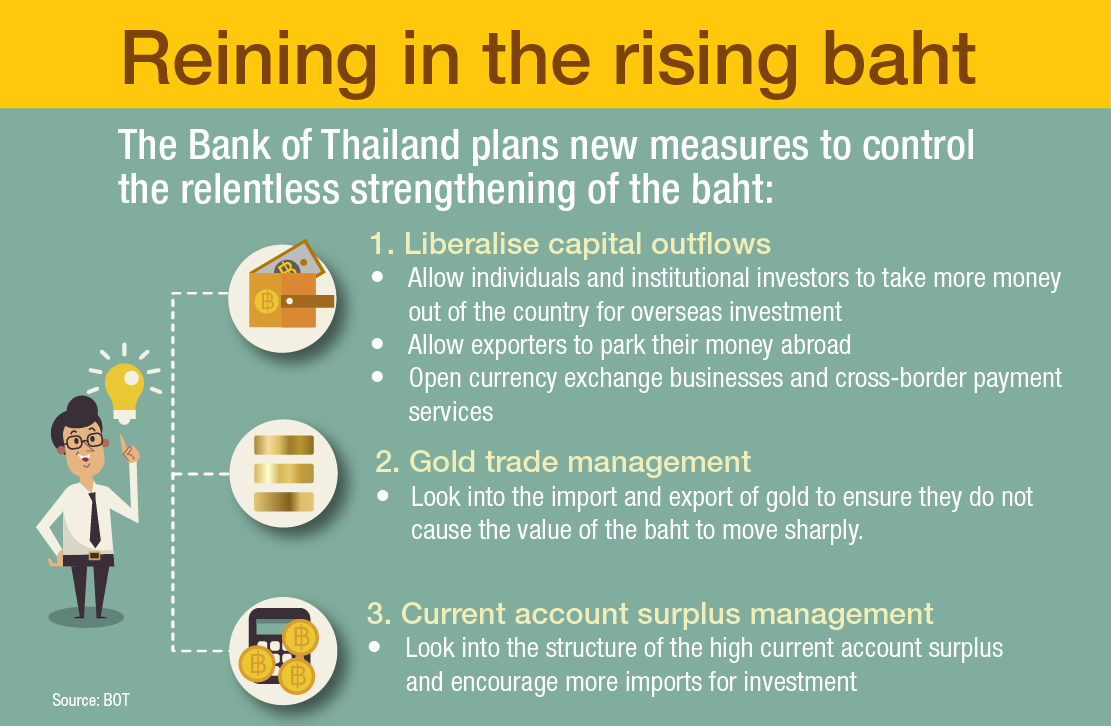
The new package of measures would cover three key areas, he explained.

First, the BOT will liberalise capital outflows by allowing individual investors and institutional investors to take more money out of the country for investment abroad. Exporters will also be allowed to park their money abroad when they earn income overseas. The BOT will also liberalise the currency exchange business and cross-border payment services in order to reduce the cost of cross-border transactions for people and businesses.

Second, the central bank will look into the import and export of gold in order to ensure that the gold trade would not move the value of the baht sharply. Veerathai insisted that the central bank would not limit or control the gold trade.

Third, the BOT will look into the structure of current account surplus. For example, the bank may encourage more import of capital goods for infrastructure investment, such as more investment to support infrastructure of digital economy.

Veerathai, however, clarified that the fast appreciation of the baht over the past few days had been a result of investors bringing in more money to invest in one large company. He did not reveal the name of that company. However, it is widely known in the market that the company being mentioned is Asset World Corp, a leading real estate developer led by billionaire Charoen Sirivadhanabhakdi’s family. The company made its debut in the stock market on Thursday.

The baht hit a six-year high on Wednesday and on Thursday it moved at around Bt30.30 per US dollar while some analysts expected it would strengthen to Bt30.

Consumer confidence continues decline

ศาสตร์เกษตรดินปุ๋ย : ขอบคุณแหล่งข้อมูล : หนังสือพิมพ์ The Nation

https://www.nationthailand.com/business/30377274

Consumer confidence continues decline

Oct 10. 2019
Thanawat Polvichai, the director of the University of the Thai Chamber of Commerce’s Centre for Economic and Business Forecasting

Thanawat Polvichai, the director of the University of the Thai Chamber of Commerce’s Centre for Economic and Business Forecasting
By The Nation

1,080 Viewed

The Consumer Confidence Index fell again in September for the seventh consecutive month despite the introduction of economic stimulus measures, the director of the University of the Thai Chamber of Commerce’s Centre for Economic and Business Forecasting said on Thursday (October 10).

Thanawat Polvichai said the index dropped to 72.2, its lowest point in 39 months. It stood at 73.5 in July 2016.

The assessment indicates that consumers believe the global economy has yet to recover, Thanawat said.

He attributed the lack of confidence to uncertainties over global trade, Brexit, Thai politics and low prices commanded by Thai farm products.

Regional growth slows under trade tensions and global uncertainties: World Bank

ศาสตร์เกษตรดินปุ๋ย : ขอบคุณแหล่งข้อมูล : หนังสือพิมพ์ The Nation

https://www.nationthailand.com/business/30377268

Regional growth slows under trade tensions and global uncertainties: World Bank

Oct 10. 2019
By THE NATION

918 Viewed

Growth in developing East Asian and Pacific economies is expected to slow from 6.3 per cent in 2018 to 5.8 per cent in 2019 and then to 5.7 and 5.6 per cent in 2020 and 2021, respectively, according to a World Bank news release on Thursday (October 10).

The slowing reflects a broad-based decline in export growth and manufacturing activity, said the Bank.

Weakening global demand, including from China, and heightened uncertainty around ongoing US-China trade tensions has led to a decline in exports and investment growth, testing the resilience of the region, according to “Weathering Growing Risks”, the October 2019 edition of the World Bank’s East Asia and Pacific Economic Update, released today.

In the region excluding China, consumption growth remained steady, though slightly lower than the same period last year, supported by monetary and fiscal policies.

Growth in the smaller economies of the region, however, remained robust, reflecting country-specific circumstances including steady growth in the tourism, real estate and extractive sectors.

“As growth slows, so does the rate of poverty reduction,” said Victoria Kwakwa, the World Bank vice president for East Asia and the Pacific.

“We now estimate that almost a quarter of the population of developing East Asia and the Pacific lives below the upper-middle-income poverty line of US$5.50 (Bt166.68) a day. This includes nearly 7 million more people than we projected in April, when regional growth was looking more robust.”

The report makes clear that increasing trade tensions pose a long-term threat to regional growth.

While some countries have hoped to benefit from a reconfiguration of the global trade landscape, the inflexibility of global value chains limits the upside for countries in the region in the near term.

“While companies are searching for ways to avoid tariffs, it will be difficult for countries in developing East Asia and the Pacific to replace China’s role in global value chains in the short-term due to inadequate infrastructure and small scales of production,” said Andrew Mason, the World Bank lead economist for East Asia and the Pacific.

The report warns that downside risks to the region’s growth prospects have intensified.

Prolonged trade tensions between China and the United States would continue to hurt investment growth, given high levels of uncertainty.

A faster-than-expected slowdown in China, the Euro Area and the United States, as well as a disorderly Brexit, could further weaken the external demand for the region’s exports.

High and rising debt levels in some countries are also putting limits on their abilities to use fiscal and monetary policies to ease the impacts of the slowdown.

In addition, any abrupt changes in global financial conditions could translate into higher borrowing costs for the region, dampening credit growth and further weighing on private investment and economic growth in the region.

To weather growing risks, the report recommends that countries with sufficient policy space use fiscal and/or monetary measures to help stimulate their economies, while guarding fiscal and debt sustainability. Countries in the region will also benefit from staying the course on trade openness and by deepening regional trade integration.

The ongoing US-China trade dispute, along with slowing global growth, also increase the need for countries in the region to undertake reforms to improve their productivity and boost growth. This includes regulatory reforms that improve the trade and investment climate to attract investment and facilitate the movement of goods, technology and know-how.

Residential developers turn to eastern Bangkok

ศาสตร์เกษตรดินปุ๋ย : ขอบคุณแหล่งข้อมูล : หนังสือพิมพ์ The Nation

https://www.nationthailand.com/property/30377237

Residential developers turn to eastern Bangkok

Oct 09. 2019
By THE NATION

830 Viewed

The new Krungthep Kreetha road in eastern Bangkok has become the latest destination of residential property developers where new projects are cropping up.

Piya Prayong, Chief Executive Officer of Pruksa Real Estate told Thansettakij newspaper that the eastern part of Bangkok is now the red ocean of land developers.

It is also the company’s golden area as 40 per cent of its horizontal project portfolio is concentrated in this zone.

The company has around 100 rai of land in the Krungthep Kritha-Wongwaen area, where it developed two projects and will launch another two residential development.

Chainid Adhyanasakul, chief executive officer of Property Perfect, said that the new Krunthep Kreetha road is considered a strategic transportation location linking Suvarnabhumi Airport with central Bangkok. It is also not far from the motorway and Airport Rail Link which will be connected with the Orange Line mass transit route running from the Thailand Cultural Centre to Minburi on the outskirts of the city.

Thai Union plans Bt6-bn debenture issues

ศาสตร์เกษตรดินปุ๋ย : ขอบคุณแหล่งข้อมูล : หนังสือพิมพ์ The Nation

https://www.nationthailand.com/business/30377244

Thai Union plans Bt6-bn debenture issues

Oct 09. 2019
Thai Union CEO Thiraphong Chansiri

Thai Union CEO Thiraphong Chansiri
1,193 Viewed

Thai Union Group Pcl, a global seafood supplier, is preparing to issue up to Bt4 billion in debentures with an additional greenshoe of Bt2 billion, totaling Bt6 billion.

The offering is aimed at strengthening the company’s financial structure towards building a sound foundation in the long term.

The subscription period is tentatively set for November 26-28, 2019.

TRIS Rating has rated Thai Union A+ with stable outlook and A- for its subordinated perpetual debentures.

The company decided to issue “subordinated perpetual debentures of Thai Union Group Public Company Limited No 2/2562. Payable upon liquidation with the issuer’s call option and unconditional interest deferral”, it said in a statement.

In addition, Thai Union retains the right to call the debentures after five years or upon other conditions in accordance with the terms and conditions of the debentures as specified in the prospectus. The coupon rate is set at 5 per cent a year for the first five years and will be payable quarterly.

The subordinated perpetual debentures will be offered to retail and/or institutional investors.

Bangkok Bank, Krung Thai Bank, Siam Commercial Bank and Phatra Securities have been appointed joint-lead arrangers.

“In our more than 40-year history, we have built a strong and successful company with a global footprint and a portfolio of 14 brands around the world,” said Thai Union CEO Thiraphong Chansiri.

“Issuing these debentures will allow us to not only further strengthen our financial footing, but continue expanding our business as we pursue a path of consistent, solid growth”.