AirAsia’s inflight WiFi service just got faster

ศาสตร์เกษตรดินปุ๋ย : ขอบคุณแหล่งข้อมูล : หนังสือพิมพ์ The Nation

https://www.nationthailand.com/business/30377230

AirAsia’s inflight WiFi service just got faster

Oct 09. 2019
AirAsia has upgraded its WiFi service to provide high-speed inflight connectivity to guests. Photo: AirAsia

AirAsia has upgraded its WiFi service to provide high-speed inflight connectivity to guests. Photo: AirAsia
By The Star Online

2,205 Viewed

Passengers on board AirAsia can look forward to an enhanced inflight entertainment and connectivity experience with a recently upgraded WiFi service.

Six planes operated by AirAsia Malaysia and two aircraft operated by AirAsia Thailand have been equipped with Inmarsat’s high-speed Ka-band platform, GX Aviation.

AirAsia Group president (RedBeat Ventures) Aireen Omar said this development is the “next logical step” for the airline.

“As the pioneer of LCC inflight WiFi in the region, we are always looking for ways to redefine the digital inflight experience for our guests,” she said.

Guests would be able to stay connected throughout their journey and perform data-intensive activities, including live streaming.

Ka-band claims to provide connectivity beyond basic broadband, supporting real-time video, music streaming and more.

The AirAsia WiFi Internet plans range between RM9 and RM58, with the most basic plan capped at 10MB. There is also the top of the range 200MB plan which is best for streaming.

The service will be rolled out to the rest of the fleet over the next year.

Moving on to connectivity of a different kind, AirAsia also recently announced the launch of the exclusive route to Da Lat from Kuala Lumpur, which further boosted the carrier’s presence in Vietnam.

With the introduction of this service, AirAsia Malaysia chief executive officer Riad Asmat said Malaysians will have better connectivity to the capital of Lam Dong province.

“As the first international airline to fly to Da Lat, visitors from Malaysia no longer need to drive three hours from Nha Trang or five hours from Ho Chi Minh City to get to this picturesque city,” he said.

The four times weekly service to Da Lat will commence on Dec 20.

Read more at https://www.star2.com/travel/2019/10/09/airasia-wifi/#ufHQTSmBtphq1MPH.99

Government on track for full digitalisation by 2022

ศาสตร์เกษตรดินปุ๋ย : ขอบคุณแหล่งข้อมูล : หนังสือพิมพ์ The Nation

https://www.nationthailand.com/business/30377247

Government on track for full digitalisation by 2022

Oct 10. 2019
Kobsak

Kobsak
By THE NATION

559 Viewed

Deputy Prime Minister Somkid Jatusripitak has set a timeframe for the government to become fully digital by 2022.

He instructed the Digital Government Development Agency on Wednesday (October 9) to prioritise its proposals and forward them next month to a committee tasked with electronically integrating all government bodies and services.

The agency must set out clear goals for every government entity to develop and adapt their services based on digital technology, Somkid said. It will then help them reorganise public policy using the massive state database in order to better serve the public.

Somkid also asked the Ministry of Digital Economy and Society to have IT-savvy personnel in all state agencies prepared to be “chief IT officers” overseeing the adoption of digital technology.

Kobsak Pootrakool, deputy secretary-general to the prime minister for political affairs, said the Digital Government Development Agency had played a key role in laying the foundation for the process, developing several online applications that benefit citizens.

It is also developing a convenient “OSS Foreigner” mobile application for foreigners staying longer than 90 days to report their whereabouts to the Immigration Bureau by supplying the required information and a “selfie” photo.

Doing so will save them trekking to the Immigration offices, and the innovation could encourage more foreigners to stay to Thailand, Kobsak said.

‘Eat, Shop, Spend’ phase 2 registration might be halved

ศาสตร์เกษตรดินปุ๋ย : ขอบคุณแหล่งข้อมูล : หนังสือพิมพ์ The Nation

https://www.nationthailand.com/business/30377242

‘Eat, Shop, Spend’ phase 2 registration might be halved

Oct 10. 2019
Finance Minister Uttama Savanayana

Finance Minister Uttama Savanayana
By THE NATION

522 Viewed

The number of registrants allowed for the second phase of the government’s “Eat, Shop, Spend” economic stimulus campaign might be limited to 5 million, Finance Minister Uttama Savanayana said on Wednesday (October 9).

The scheme is designed to encourage people to spend more in provinces with second-tier tourist attractions.

Uttama plans to submit details of the second phase to the Cabinet later this month with an eye to extending the campaign into November and December.

Registrants in the first phase are eligible for the second. The limit was 10 million for the first phase launched last month.

Uttama added that the ministry would try and drive gross domestic product growth this year as close as possible to the 3 per cent target, but the results depended as much on exports as stimulus packages.

The government will launch two other campaigns to complement “Eat, Shop, Spend”.

In one, the Tourism Authority of Thailand (TAT) would help hotels, spas and entertainment venues sell 40,000 domestic tour packages priced at Bt100 each.

In the second, aimed at boosting travellers’ spending, the TAT and private-sector partners would offer 70 per cent discounts on weekdays on luxury products and services at participating hotels, shopping malls, spas, hospitals, restaurants, jewellery stores and amusement parks.

The TAT will announce the details on October 17.

Uttama meanwhile directed the Treasury Department to use modern technology to collect data on its land holdings across the country and determine how they are currently being used.

Lack of critical thinking makes Thailand’s competitiveness ranking slip

ศาสตร์เกษตรดินปุ๋ย : ขอบคุณแหล่งข้อมูล : หนังสือพิมพ์ The Nation

https://www.nationthailand.com/business/30377258

Lack of critical thinking makes Thailand’s competitiveness ranking slip

Oct 10. 2019
By Wichit Chaitrong
The Nation

802 Viewed

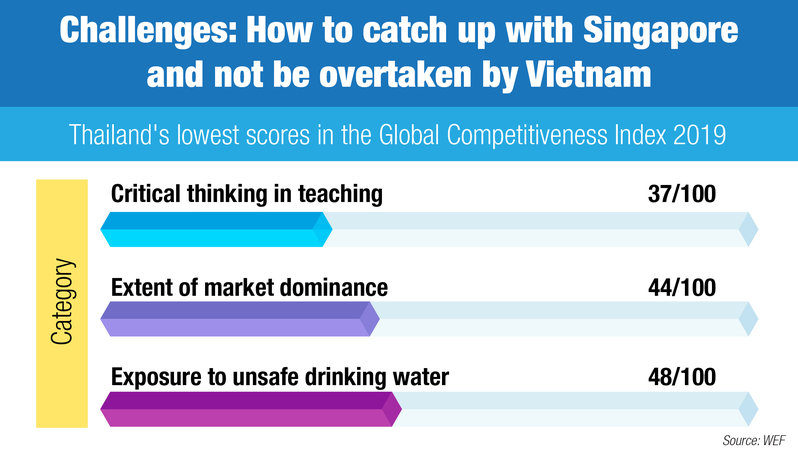
Thailand could improve its competitiveness among nations by tackling its weakest points – a lack of critical thinking in teaching, failure to dominate any markets, and unsafe drinking water, according to Switzerland-based World Economic Forum.

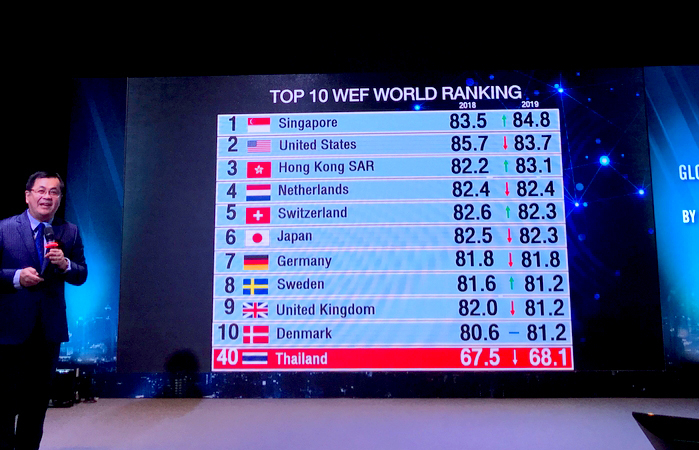
Thailand’s ranking among 141 economies has dropped to 40th place from 38 in 2018 in the just-released WEF Global Competitiveness Index.

Singapore tops the rankings, overtaking the United States, while Vietnam jumped 10 spots to 67th

place, according to a survey by the WEF, which seeks to promote public-private cooperation.

Kobsak Pootrakool, deputy secretary-general to the prime minister for political affairs, on Wednesday (October 9) acknowledged Thailand’s ranking slipping even as some scores rose. “It’s like a running competition – if our pace is slower, others will overtake us, so we have to run faster,” he said.

Assistant Professor Wilert Puriwat, dean of the Chulalongkorn Business School, which is allied with the WEF, said that, If Thailand wants to improve its ranking, labour skills must be improved.

“The survey found that skills among new university graduates have declined, especially in the area of critical thinking,” he said.

The way students are taught needs to change, he said, noting that Thailand’s score on critical thinking in the classroom was the world’s lowest at 37 out of 100 points. In assessing skills possessed by the future workforce, the survey names Finland first for critical thinking in teaching, with 89 points.

“We’ve failed the exam and it can’t be fixed by simply retaking the test – we need to restart learning,” Wilert said, alluding to Thai students routinely performing poorly on tests compared to foreign counterparts, a lag blamed on the traditional reliance here on rote learning through memorisation.

The WEF urged Thailand to encourage creative and critical individual thinking in the classroom instead.

Finland ranks second for skills of current workforce, scoring 75.8 points compared to Thailand’s 52.2. The WEF recommended better staff training and increased attention to digital skills.

Noting the only a few large Thai companies dominate the domestic market, muscling aside smaller contenders, Wilert said Switzerland provides a model for spreading dominance among many firms by helping smaller ones gain market share. Switzerland ranks first in the sharing of market dominance, he noted.

“This will take time since the few big firms have dominated the market for so long,” he said.

Although tap water has become widely available widely across the country, it is not as safe to drink as that found in developed countries, said Wilert.

The index covers four main categories.

First is proving an “enabling environment” and assesses institutions, infrastructure, ICT adoption and macroeconomic stability. Second is “human capital” and examines health and skills.

In the third, product markets, the labour market, the financial system and market size are compared. Fourth is the “innovation ecosystem”, which looks at business dynamism and capacity for innovation.

In all there are 103 separate factors examined for which up to 100 points can be awarded.

Thailand’s 68.1 GCI ranking places it in the top 40 among the 141 economies surveyed, but it it progressing more slowly than other countries, Wilert noted.

Its identified weaknesses are in institutions, innovation capability, product markets and skills. Its strengths are the financial system, public health and macro-economic stability.

The score for institutions dropped from 55.1 in 2018 to 54.8 this year, the ranking from 67 to 60. Corruption and an inefficient legal framework for challenging regulations were the key damaging factors, the WEF said.

The score for infrastructure fell from 69.7 to 67.8 and the ranking from 71st to 60th place due to continued reliance on an inefficient railway service.

“Improvement in the rankings will come if there is rapid progress in several areas, such as reducing corruption, improving infrastructure and workforce skills, and boosting the level of domestic market competition,” Wilert said.

Baht hits 6-year high, reversing trend of regional currencies

ศาสตร์เกษตรดินปุ๋ย : ขอบคุณแหล่งข้อมูล : หนังสือพิมพ์ The Nation

https://www.nationthailand.com/business/30377257

Baht hits 6-year high, reversing trend of regional currencies

Oct 10. 2019
By The Nation

601 Viewed

The baht closed at Bt30.33 against the US dollar on Wednesday (October 9), up from Bt30.42 against the greenback when trading opened. During the day, the baht shot up to Bt30.29 against the dollar, marking a record six-year high since May 30, 2012.

Since early this year, the baht has surged 7.3 per cent – more than any other Asian currency.

Roong Sanuangruang, an analyst at Krungsri Bank, said the baht’s strengthening has reversed the trend of other currencies in the region. The reason behind this is the fact that Thailand has a high current-account surplus at 7 to 8 per cent of the GDP and that it has high international reserves worth US$220 billion (Bt6.67 trillion) in line with the central bank’s long position of $33.1 billion, or total international reserves of $253 billion as of September 27.

“Foreign investors see the baht as a safe haven even though Thailand’s economic growth is not high, and the baht may even move up to Bt30 per dollar in the short term,” she said.

Meanwhile, Finance Minister Uttama Savanayana said that while exporters may be adversely affected by the strengthening of the baht, importers will gain from it.

“This is the best time for manufacturers to import machinery and invest in capital goods as prices are low,” he added.

Bank of Thailand’s monetary policy division had earlier expressed concerns about the fast-rising baht, saying the currency’s appreciation could potentially hurt exports and the economy as Thai products will become more expensive compared to those of competitors. Also, Thai exporters have long complained about the impact of the exchange rate appreciation and some exporters have even asked the central bank to make the baht stay at around Bt32 per dollar.

The central bank’s executives have also said that they will try to come up with new measures to encourage Thais to invest money overseas in a move to balance the inflow.

‘High speed’ needed to name new SRT board

ศาสตร์เกษตรดินปุ๋ย : ขอบคุณแหล่งข้อมูล : หนังสือพิมพ์ The Nation

https://www.nationthailand.com/business/30377234

‘High speed’ needed to name new SRT board

Oct 09. 2019
Finance Minister Uttama Savanayana reaffirms the ministry’s full support for the project.

Finance Minister Uttama Savanayana reaffirms the ministry’s full support for the project.
By THE NATION

1,099 Viewed

The Finance Ministry has spurred on the State Enterprise Policy Office (Sepo) to work with the Transport Ministry in quickly appointing new board members to the State Railways of Thailand (SRT).

The SRT has to sign a contract with a consortium led by Charoen Pokphand (CP) led by October 25 to develop the high-speed railway linking three major international airports.

Finance Minister Uttama Savanayana reaffirmed the ministry’s full support for the project and noted that Sepo already has a list of prospective new SRT directors and a chairman. He declined to disclose their names.

Transport Minister Saksayam Chidchob already postponed the deadline for the contract signing to October 25 from October 15 pending the board appointments.

The previous board resigned en masse on October 1.

Saksayam said that, without board approval, the SRT would be unable to submit the signed documents for Cabinet approval.

The CP-led consortium had the lowest bid for the project linking Don Mueang, Suvarnabhumi and U-tapao airports by rail.

Consortium partners are Bangkok Expressway and Metro Plc, China Railway Construction Corp, Ch Karnchang Plc and Italian-Thai Development Plc.

Thailand competitiveness ranking drops 2 spots to 40th place

ศาสตร์เกษตรดินปุ๋ย : ขอบคุณแหล่งข้อมูล : หนังสือพิมพ์ The Nation

https://www.nationthailand.com/business/30377229

Thailand competitiveness ranking drops 2 spots to 40th place

Oct 09. 2019
By The Nation

3,800 Viewed

Thailand’s competitiveness ranking for 2019 has dropped two spots from 38th to 40th among 141 world economies, despite the government’s Thailand 4.0 programme.

The World Economic Forum’s Global Competitiveness Index rankings for 2019 were announced on Wednesday (October 9) at the Chulalongkorn Business School.

The drop occurred despite the Thailand 4.0 programme, noted Ass’t Professor Wilert Puriwat, Dean of Chulalongkorn Business School.

“Other countries made faster progress in increasing their competitiveness,” he said.

Still, Thailand’s scores rose from 67.5 to 68.1, he added.

Singapore is ranked first place, followed by the US and Hong Kong.

The index is divided into four major categories and built on 12 pillars:

1. Enabling Environment, which covers institutions, infrastructure, ICT adoption and macroeconomic stability;

2. Human capital, in which health and skills are assessed;

3. Markets, which includes product markets, labour market, financial system and market size;

4. Innovation ecosystem, in which business dynamism and inoculation capacity are assessed.

The rankings are determined by the World Economic Forum in alliance with the Chulalongkorn Business School at Chulalongkorn University.

Singapore is world’s most competitive economy: World Economic Forum

ศาสตร์เกษตรดินปุ๋ย : ขอบคุณแหล่งข้อมูล : หนังสือพิมพ์ The Nation

https://www.nationthailand.com/business/30377228

Singapore is world’s most competitive economy: World Economic Forum

Oct 09. 2019
Singapore scored 84.8 out of a possible 100, beating the United States to the top spot in the rankings of 141 economies.ST PHOTO: LIM YAOHUI

Singapore scored 84.8 out of a possible 100, beating the United States to the top spot in the rankings of 141 economies.ST PHOTO: LIM YAOHUI
By The Straits Times

1,389 Viewed

SINGAPORE – Singapore is the world’s most competitive economy, according to an updated global league table.

It scored 84.8 out of a possible 100, beating the United States to the top spot in the rankings of 141 economies.

The US, which topped the charts last year, scored 83.7.

“Singapore improves from an already high base,” the World Economic Forum said on Wednesday (Oct 9), adding that the country ranked first for infrastructure – one of the index’s 12 assessment pillars.

Singapore also was number one for two of the index’s other pillars – citizens’ healthy life expectancy years and labour markets.

Other high-scoring areas included the financial system, market efficiency and macroeconomic stability.

“Singapore ranks second for the quality of public institutions, behind Finland, but its performance is undermined by limited checks and balances,” the report said.

“Singapore notably ranks 124th on the Freedom of the Press Index – and lack of commitment to sustainability.”

The report added that Singapore will need to promote entrepreneurship and further improve its skills base to become a global innovation hub.

It also noted that the US performed better in domestic competition and trade openness last year.

“Despite an overall weaker performance this year, the US remains one of the most competitive economies in the world. It is still an innovation powerhouse, ranking second on the innovation capability pillar and first in terms of business dynamism… and home to one of the most dynamic financial systems in the world.”

Hong Kong rose four spots to third place.

The report said the territory ranks first on four pillars – macroeconomic stability, health, financial system and product market – the most of any economy.

“Hong Kong’s biggest weakness is undoubtedly its limited capability to innovate,” the report said, adding that the region also lags behind Singapore in worker protection.

The Netherlands and Switzerland round up the top five most competitive economies. The Netherlands jumped two spots to fourth place while Switzerland fell one to fifth.

The Global Competitiveness Report series was launched in 1979 to provide an annual assessment of the drivers of productivity and long-term economic growth.

https://www.straitstimes.com/business/economy/singapore-is-worlds-most-competitive-economy-world-economic-forum

CP Foods’ compartment model shields spread of “avian influenza” The World Organisation of Animal Hea

ศาสตร์เกษตรดินปุ๋ย : ขอบคุณแหล่งข้อมูล : หนังสือพิมพ์ The Nation

https://www.nationthailand.com/business/30377215

CP Foods’ compartment model shields spread of “avian influenza” The World Organisation of Animal Hea

Oct 08. 2019
By The Nation

734 Viewed

The World Organisation of Animal Health will hail Thailand and CP Foods as a model in preventing the spread of bird flu virus in the region, according to a company statement today (October 8).

CP Foods was the first Thai company to apply the compartmentalisation principles of OIE as one of the key measures to shield Thailand from spread of the virus. The proactive measures of principles comprised common biosecurity management, notifiable avian influenza surveillance in compartment and buffer zone, control measures of NAI in compartment and buffer zone and traceability system. In addition, the principles have been implemented on buffer zone of one kilometre around farm to ensure distinct health status, it said.

Payungsak Somyanontanakul (DVM), vice president and head of Animal Welfare Committee of CP Foods, said the company had implemented the compartmentalisation system for broiler chicken, duck and others, neutralising the spread of Avian Influenza. It also guarantees food safety for consumers following wider spread of the virus in 2004. Moreover, it has joined hands with the Department Livestock Development (DLD) to develop risk analysis for the bird flu virus in line with Hazard Analysis Critical Control Points (HACCP). The practice ensures precise disease assessment.

“Despite lack of certification, EU commissioners, representatives of World Health Organisation, OIE and other health organisations have praised CP Foods’ compartmentalisation procedure that supports the nation’s bird flu free strategy and ensuring all of our products are bird flu free. Thailand was the pilot country in the region in OIE compartmentalisation to control spread of the avian influenza,” said Payungsak.

It allows traceability throughout the supply chain. It has also further developed the system to prevent “emerging disease” in poultry farming.

For sustainable biosecurity, CP Foods has promoted the system to its contracted farmers who will be trained by veterinarian and experts from DLD.

Payungsak added that OIE representatives recently visited the company, from feed mills to processing plants in Nakhon Ratchasima to learn more of CP Foods’ compartmentalisation model. They will raise this model as a case study in the Southeast Asia workshop on compartmentalisation, organised by the OIE. The workshop aims to prevent poultry diseases, particularly avian influenza in the region.

So far, CP Foods has extended the system to create higher quality meat through “Benja Chicken”, which is raised without antibiotic. This premium product targets health conscious consumers.

SEC suspends auditor for not detecting ‘fictitious’ numbers in NMG’s 2015, 2016 statements

ศาสตร์เกษตรดินปุ๋ย : ขอบคุณแหล่งข้อมูล : หนังสือพิมพ์ The Nation

https://www.nationthailand.com/business/30377208

SEC suspends auditor for not detecting ‘fictitious’ numbers in NMG’s 2015, 2016 statements

Oct 08. 2019
By THE NATION

616 Viewed

According to a press release issued on Tuesday (October 8), the Securities and Exchange Commission (SEC) has imposed a two-year suspension on capital-market auditor Patamavan Vadhanakul, a partner of KPMG Phoomchai Audit Ltd, for producing financial statements for Nation Multimedia Group Public Company Limited (NMG) for the years 2015 and 2016 that had deficiencies and were not compliant with auditing standards.

The suspension was related to NMG’s submission of the 2017 financial statement, which provided “fictitiously” high revenue and accrued income figures for the years 2015 and 2016.

The SEC reviewed Patamavan’s performance as NMG’s auditor and found that she had failed to obtain reliable and sufficient evidence and thereby failed to detect the fictitious figures provided in the 2015 and 2016 financial statements, which resulted in an inaccurate audit opinion on the said statements.

Owing to these errors, the SEC has suspended the approval of Patamayan as a capital-market auditor, though she quit her job on March 22. The SEC has also decided to not accept any future applications from her as a capital market auditor for two years starting from October 8, 2019.

The SEC has also advised KPMG to conduct a root-cause analysis on Patamayan’s performance deficiencies and lay out a remediation plan to prevent a recurrence of similar incidents. The detected deficiencies will be considered in detail when the SEC reviews KPMG’s audit quality control system.