Banks to step up on car, home loans after merger

ศาสตร์เกษตรดินปุ๋ย : ขอบคุณแหล่งข้อมูล : หนังสือพิมพ์ The Nation

https://www.nationthailand.com/business/30376954

Banks to step up on car, home loans after merger

Oct 02. 2019
719 Viewed

Thanachart Bank and TMB Bank, after the impending merger, will focus more on mortgage and car loans as both offer high return and where their strengths lie, said TMB Bank’s chief executive officer Piti Tantakasem.

The merger process between the two banks, with a total customer base of 10 million, has entered the final stage.

In the new shareholding structure, Thanachart Capital (TCAP) will hold 20 per cent of total shares, followed by ING Bank, which acquired TMB in 2008, with 21.3 per cent. Of the remaining shares, the Finance Ministry will hold 18.4 per cent, Scotiabank (BNS) 5.6 per cent and minority shareholders 34.3 per cent.

According a TMB Bank statement dated September 30, the bank has entered into an agreement to sell its shares in Thanachart Fund Management (TFUND) to Prudential Corporation Holdings Limited (Prudential), an affiliate of Eastspring Investments (Eastspring), the Asian asset management business of Prudential pcl.

This transaction shows the new bank’s commitment to mutual funds’ open architecture strategy. TMB, intends to record the sale by the end of 2019 after it has sealed the merger with Thanachart Bank.

Under the agreement, Thanachart Bank and the Government Savings Bank (GSB), both holding TFUND shares with ratio of 75 per cent and 25 per cent, have agreed to sell their shares to Prudential. The transaction value is expected to be at least Bt8.4 billion.

Thanachart Bank’s sale of TFUND shares, in accordance to the merger plan, will take place after the merger between TMB and Thanachart Bank is completed, Piti said.

Thanachart Bank will sell a first lot consisting of 25.1 per cent of TFUND (out of its 75 per cent holding) whereas GSB will sell all of its 25per cent of TFUND to Prudential. The total value of these transactions will be approximately Bt4.2 billion.

After the transactions are completed, Prudential will hold 50.1 per cent of the shares in TFUND while Thanachart Bank will hold 49.9 per cent of TFUND.

“Currently, TMB holds a 35 per cent stake in TMBAM Eastspring. After the acquisition of Thanachart Bank’s shares, TMB will hold 49.9 per cent of TFUND indirectly. Both TMB and Eastspring have planned to merge TMBAM Eastspring and TFUND in 2021. Following the merger, the new company will rank fourth among mutual funds asset management firms with approximate assets under management (AUM) of Bt650 billion (as of August 2019).

Within five years, TMB has an option to sell its entire stake in the new company to Prudential in order to re-affirm its commitment towards mutual funds’ open architecture strategy.

“Additionally, the TFUND share sale reflects the actual premium that TMB has to pay in order to merge with Thanachart Bank. TMB will raise funds of approximately Bt130 billion to acquire shares in TBANK. This value is based on the book value of Thanachart Bank after restructuring (with TBROKE and TFUND as its subsidiaries), which is Bt121 billion plus an estimated Bt9 billion premium (including the premium cost from both subsidiaries).

“This way, the 75 per cent sale of TFUND with at least Bt6.3 billion in value will compensate the paid premium. As a result, the real premium cost that TMB has to pay will be significantly lower than Bt9 billion, allowing TMB to achieve its objective of buying Thanachart Bank’s shares at a fair valuation.”

In its financial statement as of December 31, 2018, TMB intended to recognise the sale transaction from Thanachart Bank, which will become its subsidiary, for the first lot of 25.1 per cent share sales at the value of approximately Bt2.1 billion.

Piti concluded: “The merger will take place in 2021. Meanwhile, customers of both TFUND and TMBAM Eastspring will still be able to hold the mutual fund products and conduct transactions as normal. The merger will increase the capacity in offering more diverse services and products for customers.

The merger between TMB Bank and Thanachart Bank will take place in 2021 as well. Customers of both TMB Bank and Thanachart Bank will be able to continue using investment products and other services offered by both banks in all channels as usual”.

BEC Multimedia compensated for return of digital TV licences

ศาสตร์เกษตรดินปุ๋ย : ขอบคุณแหล่งข้อมูล : หนังสือพิมพ์ The Nation

https://www.nationthailand.com/business/30376944

BEC Multimedia compensated for return of digital TV licences

Oct 01. 2019
NBTC secretary-general Takorn Tantasith, right, handing over a cheque to BEC World's president Ariya Banomyong

NBTC secretary-general Takorn Tantasith, right, handing over a cheque to BEC World’s president Ariya Banomyong
By THE NATION

826 Viewed

BEC Multimedia today (October 1) received compensations from the National Broadcasting and Telecommunications Commission (NBTC) after the return of its terrestrial digital TV broadcasting licences for 3SD Channel 28 and Family Channel 13.

The regulator paid more than Bt661.625 million to 3SD Channel 28 and over Bt158.604 million to Family Channel 13.

Both channels went off the air at midnight, September 30 and BEC Multimedia is now left with only one digital TV channel, Channel 33.

In early May this year, six digital TV broadcasters informed the regulator of their intention to hand back the seven licences they had secured from the NBTC. The NBTC, then set May 10 as the deadline for the broadcasters to declare their final decisions.

The six opting to return the licences were Spring News Television Co Ltd ( Spring News Channel 19) and Nation Multimedia Group ( Spring 26, formerly NOW26), Bright TV (Channel 20), Voice TV (Channel 21), MCOT (Family Channel 14) and BEC Multimedia (Family Channel 13 and 3SD Channel 28).

Family Channel 13 and 3SD Channel 28 were the last two stations going off the air.

NBTC awarded 24 commercial digital TV licences via auction on December 2013, amassing around Bt50.862 billion in bid payments. The15-year licences became valid from April 25, 2014.

Later, some broadcasters found it difficult to survive due to unfavourable market conditions and fierce competition from online media channels, prompting the return of their operation licences.

The exits mean there are 15 digital TV channels left in the market.

Cashless bus fares hit the road

ศาสตร์เกษตรดินปุ๋ย : ขอบคุณแหล่งข้อมูล : หนังสือพิมพ์ The Nation

https://www.nationthailand.com/business/30376943

Cashless bus fares hit the road

Oct 01. 2019
By The Nation

912 Viewed

Krungthai Bank (KTB) teamed up with the Bangkok Mass Transit Authority (BMTA) to launch cashless bus fare payment services in Bangkok and the metropolitan area on Tuesday.

The cashless payment can be made through BMTA’s electric ticket or QR code scanning via the Krung Thai Next app or via other mobile banking including through debit/credit cards that have the “contactless” symbol, or even by using state welfare cards through an electronic data capture (EDC) machine.

BMTA director Surachai Eamvachirasakul said on Tuesday that the cashless payment is now available on every bus. Passengers can pay fares via the EDC machine with electronic tickets (one-trip payment); an advance-payment electronic ticket (unlimited access); an electronic student card; debit/credit cards with the contactless symbol; or the state welfare card. This also includes QR code scanning to pay for fares via the Krung Thai Next app or by mobile banking of any bank free of charge.

KTB first executive vice president Kittipat Peantham said Krung Thai Bank was also entrusted by the BMTA to install and implement the QR code payment system on the airport buses that operate at Don Mueang Airport.

“The bank has completed installation of the EDC machine on all BMTA vehicles. The fare collector can check and confirm payments by passengers via the EDC as the BMTA is able to monitor payments on each bus via a website. This helps increase cash management capabilities and reduce the cost of logistics management,” Kittipat said.

Banpu to open Fukushima office to promote renewable power

ศาสตร์เกษตรดินปุ๋ย : ขอบคุณแหล่งข้อมูล : หนังสือพิมพ์ The Nation

https://www.nationthailand.com/business/30376928

Banpu to open Fukushima office to promote renewable power

Oct 01. 2019
By THE NATION

761 Viewed

Banpu Plc’s subsidiary in Japan will open an office at the Smart City AiCT of Aizuwakamatsu City as it promotes a renewable power operation in Fukushima prefecture.

Banpu Power Japan Co Ltd, a subsidiary of Banpu Plc (Banpu), a leading Asia-Pacific integrated energy solutions company, recently signed an agreement to set up the office in the smart city, a centre of Information and Communication Technology (ICT) operations, according to a company release on Tuesday.

In addition to promoting the firm’s renewable power operations, the office will study opportunities for energy technology business development, including electric vehicles and robotics.

The agreement signing ceremony is considered an important step for Banpu Group, which is focusing on the expansion of its renewable energy business.

The agreement reiterates the company’s commitment to promote renewable power generation in Fukushima, where the 26-MW Nari Aizu Solar Power Plant is located.

In addition, Banpu Group’s business operation in Fukushima will partially support local economic development, increase employment opportunities and create a positive impact for the local community, the release said.

Chanin Vongkusolkit, Banpu’s chairman, said that Aizuwakamatsu City has a favourable ecosystem for innovation development. He believes that Banpu’s business operation in Fukushima will contribute to the city’s economic growth and provide a bright future to the next generations through technology and innovation, as well as build continuous and sustainable values for all stakeholders, in alignment with Banpu brand promise, ’‘Our Way in Energy”.

WTO lowers trade forecast as tensions unsettle global economy

ศาสตร์เกษตรดินปุ๋ย : ขอบคุณแหล่งข้อมูล : หนังสือพิมพ์ The Nation

https://www.nationthailand.com/business/30376964

WTO lowers trade forecast as tensions unsettle global economy

Oct 02. 2019
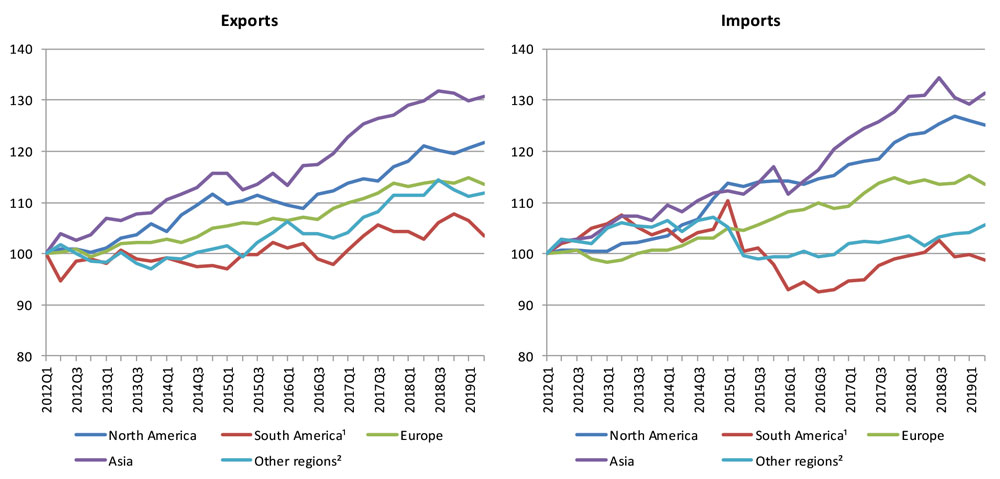
World merchandise exports and imports by level of development, 2012Q1-2019Q2
Volume index, 2012Q1=100 /Source:WTO,UNCTAD

World merchandise exports and imports by level of development, 2012Q1-2019Q2 Volume index, 2012Q1=100 /Source:WTO,UNCTAD
By The Nation

257 Viewed

Escalating trade tensions and a slowing global economy have led World Trade Organization (WTO) economists to sharply downgrade their forecasts for trade growth in 2019 and 2020. World merchandise trade volumes are now expected to rise by only 1.2 per cent in 2019, substantially slower than the 2.6 per cent growth forecast in April.

The projected increase in 2020 is now 2.7 per cent, down from 3 per cent previously. The economists caution that downside risks remain high and that the 2020 projection depends on a return to more normal trade relations.

MAIN POINTS

• World merchandise trade volume is forecast to grow 1.2 per cnt in 2019. This is substantially below the 2.6 per cent trade growth projected in April.

• Trade volume growth should accelerate slightly to 2.7 per cent in 2020 while global GDP growth holds steady at 2.3 per cent (at market exchange rates), but this depends on an easing of trade tensions.

• Trade conflicts pose the biggest downside risk to the forecast but macroeconomic shocks and financial volatility are also potential triggers for a steeper downturn.

• Trade-related indicators signal a worrying trajectory for world trade based on global export orders and economic policy uncertainty.

• Export and import growth slowed across all regions and at all levels of development in the first half of 2019.

“The darkening outlook for trade is discouraging but not unexpected. Beyond their direct effects, trade conflicts heighten uncertainty and are leading some businesses to delay the productivity-enhancing investments that are essential to raising living standards,” said WTO Director-General Roberto Azevedo. “Job creation may also be hampered as firms employ fewer workers to produce goods and services for export.”

“Resolving trade disagreements would allow WTO members to avoid such costs,” the WTO Director-General added. “The multilateral trading system remains the most important global forum for settling differences and providing solutions for the challenges of the 21st century global economy. Members should work together in a spirit of cooperation to reform the WTO and make it even stronger and more effective.”

The updated trade forecast is based on consensus estimates of world GDP growth of 2.3 per cent at market exchange rates for both 2019 and 2020, down from 2.6 per cent previously. Slowing economic growth is partly due to rising trade tensions but also reflects country-specific cyclical and structural factors, including the shifting monetary policy stance in developed economies and Brexit-related uncertainty in the European Union. Macroeconomic risks are firmly tilted to the downside.

Due to the high degree of uncertainty associated with trade forecasts under current conditions, the estimated growth rate for world trade in 2019 is placed within a range of 0.5 per cent to 1.6 per cent. Trade growth could fall below this range if trade tensions continue to build, or outperform it if they start to recede. The range of likely values is wider for 2020, ranging from 1.7 per cent to 3.7 per cent, with better outcomes depending on an easing of trade tensions.

Risks to the forecast are heavily weighted to the downside and dominated by trade policy. Further rounds of tariffs and retaliation could produce a destructive cycle of recrimination. Shifting monetary and fiscal policies could destabilise volatile financial markets. A sharper slowing of the global economy could produce an even bigger downturn in trade. Finally, a disorderly Brexit could have a significant regional impact, mostly confined to Europe.

Chart 1: World merchandise exports and imports by level of development, 2012Q1-2019Q2

Volume index, 2012Q1=100

Source: WTO and UNCTAD

Source: WTO and UNCTAD

Charts 1 and 2 show quarterly merchandise export and import volumes on a seasonally-adjusted basis by level of development and geographic region. In the first half of 2019, world merchandise trade was up 0.6 per cent compared to the same period in the previous year. This marks a substantial slowdown compared to recent years. Exports of developed economies were up just 0.2 per cent for the year-to-date, while those of developing economies were up 1.3 per cent. On the import side, developed economies recorded year-on-year growth of 1.1 per cent while developing countries declined by 0.4 per cemt. Growth rates based on quarterly data may differ slightly from calculations based on annual statistics, but they should be of similar magnitude.

Chart 2: Merchandise exports and imports by region, 2012Q1-2019Q2

Volume index, 2012Q1=100

1 Refers to South and Central America and the Caribbean. 2 Other regions comprise Africa, Middle East and the Commonwealth of Independent States, including associate and former member States. Source:	WTO and UNCTAD

1 Refers to South and Central America and the Caribbean. 2 Other regions comprise Africa, Middle East and the Commonwealth of Independent States, including associate and former member States. Source: WTO and UNCTAD

Results of ‘Eat, Spend, Shop’ scheme will determine launch of Phase 2: Finance Ministry

ศาสตร์เกษตรดินปุ๋ย : ขอบคุณแหล่งข้อมูล : หนังสือพิมพ์ The Nation

https://www.nationthailand.com/business/30376953

Results of ‘Eat, Spend, Shop’ scheme will determine launch of Phase 2: Finance Ministry

Oct 02. 2019
By THE NATION

1,119 Viewed

The Finance Ministry will evaluate the results of the “Eat, Shop, Spend” Bt1,000 cash hand-out first before considering a second phase, said Lavaron Sangsnit, director-general of the Fiscal Policy Office.

If the ministry does decide to launch Phase 2, details will be concluded within this month, he added.

As of October 1, 9 million people have signed up for the scheme since it was launched on September 23. Registration will close on November 15 or when the scheme hits the 10-million registrations target.

Thailand among three Asean economies featured in Standard Chartered’s new Trade20 Index

ศาสตร์เกษตรดินปุ๋ย : ขอบคุณแหล่งข้อมูล : หนังสือพิมพ์ The Nation

https://www.nationthailand.com/business/30376959

Thailand among three Asean economies featured in Standard Chartered’s new Trade20 Index

Oct 02. 2019
By The Nation

1,418 Viewed

Three Asean economies have substantial growth potential in trade, according to a report by Standard Chartered Bank.

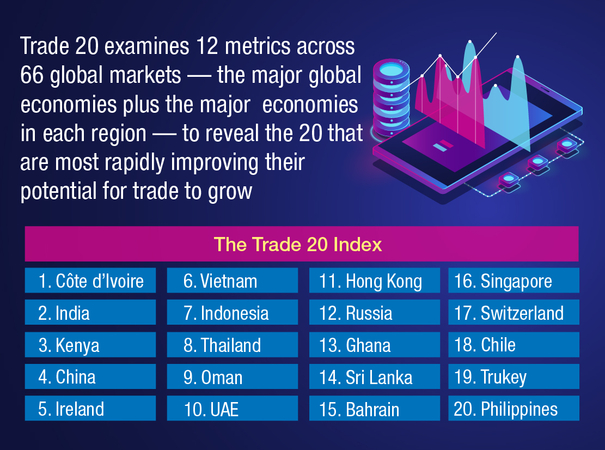
Thailand, Indonesia, and Vietnam featured in Standard Chartered’s new Trade20 Index, which identifies the 20 economies with the greatest potential for trade growth.

Thailand has been ranked eighth in the bank’s new Trade20 Index which identifies economies with strong trade growth potential, thanks to its improving trade readiness and substantial progress in e-commerce.

The Trade20 study by Standard Chartered examined 66 economies across the globe, determined each market’s potential for trade growth by analysing changes across 12 equally-weighted metrics under three pillars: economic dynamism, trade readiness and export diversity.

The Asean accelerators

Our index points to accelerated Asian trade growth potential, particularly in Thailand, Indonesia and Vietnam, which performed well in the trade readiness pillar – defined as a market’s foundation for future trade growth.

These three economies are being propelled forward by export-oriented manufacturing, growing intra-Asean trade, strong domestic demand, close trading ties with China and healthy job markets. While they all face challenges from heightened global uncertainty, they are well placed to benefit if multinationals consider moving their supply chains due to trade tensions elsewhere. Regional trade deals, infrastructure improvements, and legislative reforms are also promoting increased openness.

According to Thailand’s Board of Investment (BOI), the number of project applications for Foreign Direct Investment (FDI) increased by 7 per cent to 758 projects worth Bt232.61 billion during the first half of 2019. The FDI value in BOI’s five targeted industries, including the biotechnology industry and robotics and automation, jumped 58 per cent to Bt23.84 billion during the January-June period from a year earlier.

Thailand’s trade readiness

Thailand has also been focusing on digitising processes and increasing efficiency across industries and activities, particularly international trade and exports. Working together with its regional neighbours, Thailand should be able to adopt trade digitisation relatively quickly, helping to accelerate Asian trade growth.

Export diversity

Thailand is ranked outside of the top 20 for export diversity as the index weighs on a market’s progress in its breadth of exports. Export diversity is measured by the variety of products exported and how export revenue is spread across that product range. The markets that rank highly in this category have made the most progress in terms of diversifying their exports, which should open new prospects for trade growth and make them less vulnerable to market pressures.

Plakorn Wanglee, President & CEO of Standard Chartered Bank (Thai) said, “the Trade20 Index maps the rising stars of trade, identifying the markets where the trade environment – and trade growth potential – has been improving most rapidly over the past decade”.

“Thailand is not only a trade and investment destination for foreign countries, but also a growing number of Thai companies have strongly expanded overseas,” added Plakorn.

According to the Stock Exchange of Thailand, net outflow of foreign direct investment in 2018 by Thai firms listed on the Thai bourse hit an 8-year high at Bt199 billion. This excluded their domestic investment in 2018, which increased by 15 per cent to Bt818 billion from 2017.

“There is a huge opportunity in cross border trading. Standard Chartered Bank (Thai) has leveraged our global network and innovation and has been increasingly applying automation systems to better serve our clients,” said Plakorn. “Apart from joining the Bank of Thailand in its Project Inthanon and running the issuance of a bank guarantee on blockchain (eGuarantee), we recently succeeded in executing the first cross-border Letter of Credit issued over the Voltron blockchain platform in the oil industry.”

“In the face of rising protectionism and slow global growth, the markets that are demonstrating this impressive pace of progress may represent interesting opportunities for corporates seeking new investments, imports and supply chain partners”.

​​​

Cabinet okays plan to inspect e-bank transfers of above Bt50,000

ศาสตร์เกษตรดินปุ๋ย : ขอบคุณแหล่งข้อมูล : หนังสือพิมพ์ The Nation

https://www.nationthailand.com/business/30376952

Cabinet okays plan to inspect e-bank transfers of above Bt50,000

Oct 01. 2019
By The Nation

2,933 Viewed

Deputy Government Spokesman Rachada Dhnadirek said the Cabinet has approved a draft bill proposed by the Anti-Money Laundering Office (AMLO) to inspect electronic transactions exceeding Bt50,000, in a move to combat money laundering and financing of terrorists.

According to international standards, Thailand has been found lacking on 17 issues in relation to preventing money laundering and the financing of terrorism.

Financial institutions and businesses that come under the Anti-Money Laundering Act’s Section 16, such as gem dealers, car dealers or real-estate brokers, must undergo assessment. All transactions will be stopped and reported to AMLO if any signs of risky behaviour are detected.

Individuals who send more than Bt50,000 overseas and the recipient will have to provide their identification and information to banks before the transfer is completed.

KResearch cuts its Thai economic growth forecast

ศาสตร์เกษตรดินปุ๋ย : ขอบคุณแหล่งข้อมูล : หนังสือพิมพ์ The Nation

https://www.nationthailand.com/business/30376938

KResearch cuts its Thai economic growth forecast

Oct 01. 2019
By THE NATION

910 Viewed

Kasikorn Research Centre (KResearch) has revised downward its Thailand economic growth forecast for 2019 from 3.1 per cent to 2.8 per cent, while predicting that the economy may grow at less than 3.0 per cent next year amid numerous negative factors.

Assistant managing director Nattaporn Triratanasirikul said the downgrade in GDP growth was in line with the global economic slowdown, which caused the country’s exports during the first eight months of 2019 to see a worse-than-expected contraction, as witnessed in various product categories and in most major markets.

“KResearch has therefore cut our export projection to a range of -2.0 to zero per cent, from zero per cent previously,” Nattaporn added.

For the 2020 outlook, several global challenges will weigh on the kingdom’s exports, which will be a crucial factor in shrinking the growth of Thailand’s GDP to less than 3 per cent.

This projection is based on an estimate of present conditions, and excludes the government’s economic stimulus measures.

However, the government’s Bt1,000 “Eat, Shop, Spend” handout programme may lift the country’s GDP by 0.02 per cent this year. But it remains to be seen whether the government will launch additional fiscal measures to boost the economy next year.

Any such measures should focus on workers lacking a social safety net, such as freelancers or small and medium enterprise entrepreneurs, who may see a drop in sales after customers become more cautious in spending, Nattaporn said.

As for monetary policy, the Bank of Thailand’s Monetary Policy Committee may further cut the policy rate in the near future. Nonetheless, monetary measures would only gradually produce a positive effect on the economy, Nattaporn added.

KResearch assistant managing director Siwat Luangsomboon expressed the view that the protracted US-China trade dispute may trim Thai exports by an additional $1 billion-$2.5 billion (Bt76.3 billion) in 2020 after the US imposed tariffs on Chinese imports, compared to $2.1 billion-$3 billion projected for 2019.

Although Thailand would likely see some benefit from the relocation of production bases to this country, such relocation may primarily be seen in industries among which foreign companies already have production bases here in Thailand, Siwat said.

Regarding Brexit, it is highly likely that the UK will leave the European Union without a deal, he said.

The next step is the UK and the EU would have to negotiate on the format of any free trade agreement and the border issue with Northern Ireland. These developments may affect global financial markets, while the impact of Brexit on the Thai economy should be limited, Siwat added.

Bangkok Citismart – a one-stop service centre for property buyers/renters

ศาสตร์เกษตรดินปุ๋ย : ขอบคุณแหล่งข้อมูล : หนังสือพิมพ์ The Nation

https://www.nationthailand.com/property/30376907

Bangkok Citismart – a one-stop service centre for property buyers/renters

Sep 30. 2019
Life One Wireless-Photo by AP (Thailand) Plc

Life One Wireless-Photo by AP (Thailand) Plc
By The Nation

545 Viewed

Bangkok Citismart Co Ltd (BC), a property agent under AP (Thailand) Plc, is offering one-stop-service solutions under the digital property agent ecosystem.


The company said it has set up an ecosystem to manage the purchase, resale and rental of properties and will also provide investment advice via a real-time digital platform. It will also work with 10 Thai and foreign partners to continuously deliver value return on all kinds of property assets under its management, BC’s managing director Kayon Tantichatiwat told the press on Monday (September 30).

In order to achieve its target, BC is setting up online centralisation, online networking and providing property consultation via Cloud.

For online centralisation, the company has brought together assets it is managing, such as condominiums, single-detached homes or townhomes, in seven prime locations across Bangkok so people can easily find residences in preferred locations. The BC Membership Dashboard also allows resellers and renters to manage their assets on a real-time basis.

BC’s teaming up with 10 partner digital platforms in Thailand and overseas is creating business opportunities and value return on all assets, has resulted in the biggest community for purchase, resale and rental in the world, and built a database in Thailand, Asia and Europe. The goal is to get assets under BC’s care digitally to win at least 96 million views per month or at least 4.8 million clicks per month by the end of this year.

Consultation via the Cloud involves providing all the information customers require before they can decide whether to buy, resell, rent out or invest as well providing market trends in categories that are of interest to customers. The platform, which can be accessed any where and at any time, also includes six features to accurately resolve customers’ pain points, including trend search, BKK 7 Zones, GURU Review, Innovative Map, Forecast Rate and Mortgage Calculator.

As for resale trends in the property market, especially condominiums, there are still plenty of opportunities. The main factor is the continuously rising price of land, which has resulted in the resale market becoming interesting once again. For instance, there’s a gap in the average price of condominiums in the Ploenchit-Chidlom area based on five-year data.

The difference between new condominiums and resale ones is around 40 per cent on average. Capital gain from the resale of luxury properties going for between Bt150,000 and Bt200,000 per square metre has risen by 5.92 per cent, reflecting clear opportunities in the resale market.

Among AP Thailand’s recently completed and ready-to-move-in flagship luxury condominiums, Life One Wireless on Wireless Road can be highlighted, given the potential of its beautiful location, good resale value in comparison to new projects as well as a limited supply of new properties in the area. Since the average resale value of Life One Wireless is around Bt179,000 per sqm versus the Bt330,000 per sqm average presale price of 2019 projects, it is destined to be another well-received development.