New startup brings innovation to parking

ศาสตร์เกษตรดินปุ๋ย : ขอบคุณแหล่งข้อมูล : หนังสือพิมพ์ The Nation

https://www.nationthailand.com/business/30376903

New startup brings innovation to parking

Sep 30. 2019
Pochara Arayakarnkul

Pochara Arayakarnkul
921 Viewed

Bluebik Group, a group of consultants with specialisation in developing competitive digital strategy, innovation and technology management, have diversified into a smart parking management system.

Their new startup business Blue Parking is based on the Internet of Things (IoT) technology.

The innovative technology is expected to save time and money for users, resulting in a better parking experience.

The significant features are cardless parking, real-time management control, vehicle parking reservation, API (Applications Program Interface) Service connected with mobile app and social media platforms, automated parking system with online payment, smart e-stamp, and data analytics on cloud.

The group plans to increase the implementation of Blue Parking system to 100 parking lots by 2020.

More than 10 sites have been completely installed, mainly for department stores. The potential target groups for Blue Parking are condominium projects, office buildings, community malls, hotels and hospitals.

Pochara Arayakarnkul, CEO of Bluebik Group, said that the company aimed to strengthen and differentiate consulting services through digital knowledge, innovation technology and new initiatives to enhance customers’ business competitiveness.

Blue Parking will create a new parking experience for customers based on these following highlight features, Pochara said.

Among the features are:

⧫The ALPR (auto licence plate recognition) of the licence plate number is detected by a camera, the barrier opens automatically, and regular users can drive into a vacant space without any parking ticket.

⧫ Business owners can control the parking features in real time such as time in and out, membership management.

⧫The vehicle parking reservation feature enables customers and drivers to make a reservation of available parking space without frustration of searching for a parking spot.

⧫ The API Service enables business owners to connect the parking reservation system with other platforms such as mobile app or Line Business Connect using as a marketing tool to reach online customer group.

⧫ Cashless and ticketless parking that enables customers to access and exit a parking facility using QR Code, debit card or credit card.

⧫ E-coupon system, a promotion for visitors who park in office buildings’ parking lots. The system functions as an e-stamp that parking operators or parking businesses need not invest in hardware implementation.

⧫ Businesses can access data of customer service on the cloud so that customer behaviour data can be analysed creating value-added service business such as dynamic pricing.

RS set for big push for MPV segment

ศาสตร์เกษตรดินปุ๋ย : ขอบคุณแหล่งข้อมูล : หนังสือพิมพ์ The Nation

https://www.nationthailand.com/business/30376900

RS set for big push for MPV segment

Sep 30. 2019
Surachai Chetchotisak

Surachai Chetchotisak
By THE NATION

639 Viewed

RS will invest Bt50 million in a push for its Multi-platform Commerce (MPC) business in the last quarter, launching new products and forming partnerships.

It will introduce new innovations and offer high-quality products from leading brands in joint ventures while new deals are being sealed in the beauty category. Recently, the company recruited honey-skinned beauty “Namtan” Chalita Suansane to share her beauty secrets in a new campaign “Who says tanned skin can’t be radiant?”. It features Magique Herblisse, using story-telling strategies to highlight the benefits of health and beauty products, trageting health and beauty-conscious consumers. The campaign is expected to accelerate growth of the company’s revenure to Bt10 billion in 2022.

Surachai Chetchotisak, CEO of RS Public Company Limited, said: ” Our MPC (Multi-platform Commerce) business has been growing steadily and generates about 60 per cent of our income, through Lifestar which offers health and beauty products, home and lifestyle products, accessories, and electronic & gadgets. The growth of MPC has reached a new high as it has witnessed more penetration through various platforms such as Channel 8, Thairath TV, and Cool Fahrenheit, reaching more than 20 million people in total. Additionally, there are online platforms such as www.shop1781.com, LINE@shop1781 and LINE@COOLanything. These products are also available via LifestarBIZ or direct sales representatives. After a big lot transaction with BTS Group Holdings, the combined size of the two comanies’ database stands at 35 million with consumers 35-year old and above forming the majority of RS’s base, while BTS database mostly comprises consumers under 35. It means RS can benefit from the database of BTS as it does not duplicate with its own.

The company saw opportunities in partnering with BTS in two aspects – synergy and amplifying RS’s MPC business. BTS will serve as an additional platform, and there will be more joint efforts to take health and beauty products to another level, as well as launching new products.

RS plans to expand its telesales team from the current 500 with more skilled and experienced workers, aimed at catering to repeat purchases and offer recommendations and tips round the clock.

The company will relocate its office early next year to accommodate more than 2,000 telesales staff members. Currently, more than 1.3 million people have purchased its products with the number increasing by 20,000 a month.

There are omni channel communication and marketing strategies to link the online and offline worlds to facilitate better consumers’ access to the products.

To make its products more interesting, RS resorts to endorsement through famous presenters such as seasoned actress Duangta Tungkamanee being the presenter for S.O.M Lingzhi Sun, Channel 8 actress “Fai” Weluree Ditsayabut for Magique skincare brand, and singer “James” Ruangsak the presenter for haircare brand Revive, and superstar Pete Thongchua who is the presenter for S.O.M. CMAX coffee. To further highlight the benefits of the products, RS makes use of its programmes Sai Jai Klai Rok and Beauty Club on Channel 8 to help consumers learn more about the products from real users as well as celebrities. For instance, S.O.M I-Care is presented by “Ton” Trakarn Punthumlerdrujee, S.O.M DTX is presented by “Yui” Pattamawan Kaomulkadee, Revive Black Shine Anti-aging Hair Serum is presented by Padthai Deejai Deedeedee, as well as real users who have seen real results from using the products. In the last quarter of the year, there will be 2-3 new products in the health and beauty category.

Consumers today care more about health products and Thailand is fast becoming an aged society. People care more about their health by eating healthy food and exercising. Food supplement products are increasingly popular. In the 4th quarter of the year, which is the high season, the MPC business has prepared new product launches in the Health and Beauty category. These products are new innovations which meet international standards. The new products will be under the brand S.O.M. CMAX and a few others, and they will be backed by strong management and marketing strategies throughout the year. The products are expected to be well-received by consumers and will soon become champion products.

Surachai adds, “RS is committed to our vision in generating big growth and stability in the long run. We are open to new partnership opportunities to expand our business and reach new customers. We have deals with partners in upstream beauty. All this will help take RS to our goal of 10 billion baht revenue by 2022 as planned.”

THG expects yearly revenue growth to top 15 per cent

ศาสตร์เกษตรดินปุ๋ย : ขอบคุณแหล่งข้อมูล : หนังสือพิมพ์ The Nation

https://www.nationthailand.com/business/30376894

THG expects yearly revenue growth to top 15 per cent

Sep 30. 2019
Tanatip

Tanatip
By THE NATION

718 Viewed

Thonburi Healthcare Group Plc (THG) is projecting total revenue growth this year of 15-20 per cent above Bt7.094 billion from last year, its board vice chairman Tanatip Suppradit has said.

The group reached total revenue of Bt3.881 billion in the first half of this year, up 15.6 per cent year on year.

He added that THG has focused for increased revenue from its medical service business, which is already its main revenue contributor, expecting second-half revenues to exceed those of the first six months.

Two additional hospitals are scheduled to open in the fourth quarter this year – Thonburi Thungsong in Nakon Si Thammarat and Thonburi Burana Hospital.

THG’s revenues are from medical services, healthcare solutions and other businesses.

He added that newer THG hospitals, that opened in the past few years are showing improving performance. Among them is Thonburi Bamrungmuang Hospital, which was officially opened in January 2019 to serve premium customers and the medical tourism sector.

The Ar Yu International hospital in Yangon, Myanmar which is 40 per cent owned by THG, has seen a steady growth in patient number. The hospital was opened in March this year.

Govt considers expanding limits on ‘Eat, Shop, Spend’ scheme

ศาสตร์เกษตรดินปุ๋ย : ขอบคุณแหล่งข้อมูล : หนังสือพิมพ์ The Nation

https://www.nationthailand.com/business/30376918

Govt considers expanding limits on ‘Eat, Shop, Spend’ scheme

Oct 01. 2019
By The Nation

618 Viewed

Deputy Prime Minister for economic affairs Somkid Jatusripitak said on Monday (September 30) that the government is considering expanding the 10-million participants limit in the “Eat, Shop, Spend” scheme as the campaign has earned an overwhelming response. The Finance Ministry will also look into the possibility of boosting the Bt19-billion budget.

“Interest in this project is widespread and we were asked to extend the campaign,” Somkid said.

Kobsak Pootrakool, deputy secretary-general to the prime minister, said he has called on agencies who monitor the economy to write a summary report on the current economic state, which will be presented to the Cabinet on October 7.

“When we first proposed the project, we expected all economic stimulus packages to help boost the GDP by 0.3 to 0.5 per cent, helping the growth rate to hit 3 per cent. However, we found the economy worsening and we are looking for measures to solve this problem,” Kobsak said.

Somkid calls for haste in consideration of funding for digital projects

ศาสตร์เกษตรดินปุ๋ย : ขอบคุณแหล่งข้อมูล : หนังสือพิมพ์ The Nation

https://www.nationthailand.com/business/30376911

Somkid calls for haste in consideration of funding for digital projects

Oct 01. 2019
Deputy PM Somkid, right

Deputy PM Somkid, right
By THE NATION

649 Viewed

Deputy Prime Minister Somkid Jatusripitak on Monday (September 30) urged the Digital Economy and Society Development Fund to speed up consideration of projects that apply for funding.

The fund, chaired by Somkid, has around Bt5 billion, which was allocated to it by the National Broadcasting and Telecommunications Commission.

State and private sectors can apply for funding to develop digital projects.

The fund has earmarked Bt2.6 billion for projects this year and Bt2 billion for projects next year.

Somkid also assigned the fund to set up a subcommittee to speed up the process of granting funds to qualified recipients. The subcommittee will have to make decisions on funding every month. This will see the quick injection of funds into the economy, he said.

Kobsak Pootrakool, deputy secretary-general to the prime minister for political affairs, said that 130 projects worth Bt12 billion had applied for funding this year. However, the fund had yet to convene to consider the proposals.

He added that the fund would complete consideration of all proposals for this year within the next few months. The fund will focus on projects involving cybersecurity, digital infrastructure and development of digital skills.

Digital Economy and Society Minister Buddhipongse Punakanta said at the fund meeting on Monday that the granting of Bt2 billion for next year’s projects would focus on health-tech and agri-tech projects.

Sharp hike in subsidy to encourage consumption of B10 diesel

ศาสตร์เกษตรดินปุ๋ย : ขอบคุณแหล่งข้อมูล : หนังสือพิมพ์ The Nation

https://www.nationthailand.com/business/30376899

Sharp hike in subsidy to encourage consumption of B10 diesel

Oct 01. 2019
By THE NATION

1,134 Viewed

The Oil Fund Committee on Monday (September 30) resolved to sharply increase the subsidy for B10 diesel to Bt1.80 per litre from Bt0.95 per litre at present, the committee director, Viraphol Jirapraditkul, said.

The committee also cut by half the subsidy on B7 diesel to Bt0.05 per litre from Bt0.10 per litre. The subsidy on B20 diesel was also slashed, to Bt2.55 per litre from Bt4.80 per litre.

The resolution, which will take effect on October 1, will lower the price of B10 diesel to Bt22.99 per litre, cheaper than B7 diesel by Bt2 per litre.

The price of B20 diesel will be Bt22.99 per litre, Bt3 cheaper than B7.

The committee’s resolution is in line with the National Energy Policy Committee’s decision on September 11 that the Oil Fund be used to manage the price difference of diesel prices in order to encourage consumers to use diesel B10. This will help absorb the glut of crude palm oil in the market.

Consumption of B20 diesel is expected to decline following the committee’s decision on Monday to cut subsidy.

As of July this year, B20 diesel consumption stood at 6.71 million litres per day.

The consumption of B10 is also expected to increase from 13,000 litres per day as of July this year.

People are also expected to use less of B7 and more of B10. The consumption of diesel B7 was 54 million litres per day as of July.

Viraphol said that the global benzene price had already fallen to the level before the recent drone attacks on two major oil-processing facilities of Saudi Arabia’s Aramco.

However, the global diesel price remains high. He believes that the retail benzene operators might reduce their retail prices in the future.

Consumption weakening due to drop in earnings of non-farm labour: BOT

ศาสตร์เกษตรดินปุ๋ย : ขอบคุณแหล่งข้อมูล : หนังสือพิมพ์ The Nation

https://www.nationthailand.com/business/30376919

Consumption weakening due to drop in earnings of non-farm labour: BOT

Oct 01. 2019
By Wichit Chaitrong
The Nation

1,176 Viewed

Consumer spending in August weakened, as the real earnings of non-farm labour remained in the contraction territory, according to the central bank.

Veerathai Santiprabhob, governor of the Bank of Thailand (BOT), said the central bank had forecast an economic growth of 2.8 per cent this year, which is below the country’s growth potential. However, he said, this does not mean there is an economic crisis looming, though BOT’s monetary policy committee is still concerned about the strong baht, which could have an adverse impact on the economy.

The currency has, however, been on a downward trend, he added.

Meanwhile, Don Nakornthab, senior director at the Economic and Policy Department of the central bank, said all indicators, apart from tourist arrivals, appeared to be weaker in August as economic slowdown continues.
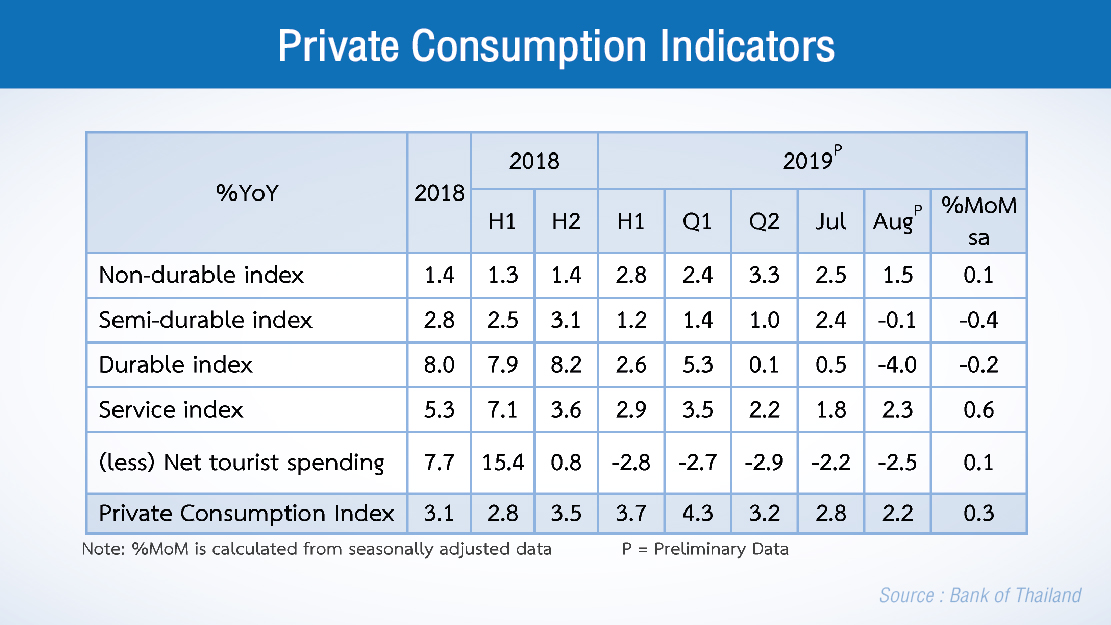
Private consumption indicators expanded moderately from the same period last year. The National Economic and Social Development Council, a state think-tank, previously considered consumer spending as a growth engine, at a time when exports, private investment and public investment weakened.

BOT said on Monday (September 30) that spending on durable goods significantly contracted following a decrease in every category of vehicle sales, partly due to weakening of income, together with credit tightening of financial institutions, after credit quality showed signs of deterioration. Spending on non-durable goods expanded at a softer pace mainly from moderate fuel usage, in line with contracting domestic vehicle sales.

In addition, spending on semi-durable goods was flat. However, spending on services expanded at a higher rate, attributed to the expansion of expenditures on hotel and restaurants. The fundamental factors supporting the overall purchasing power remained weak.
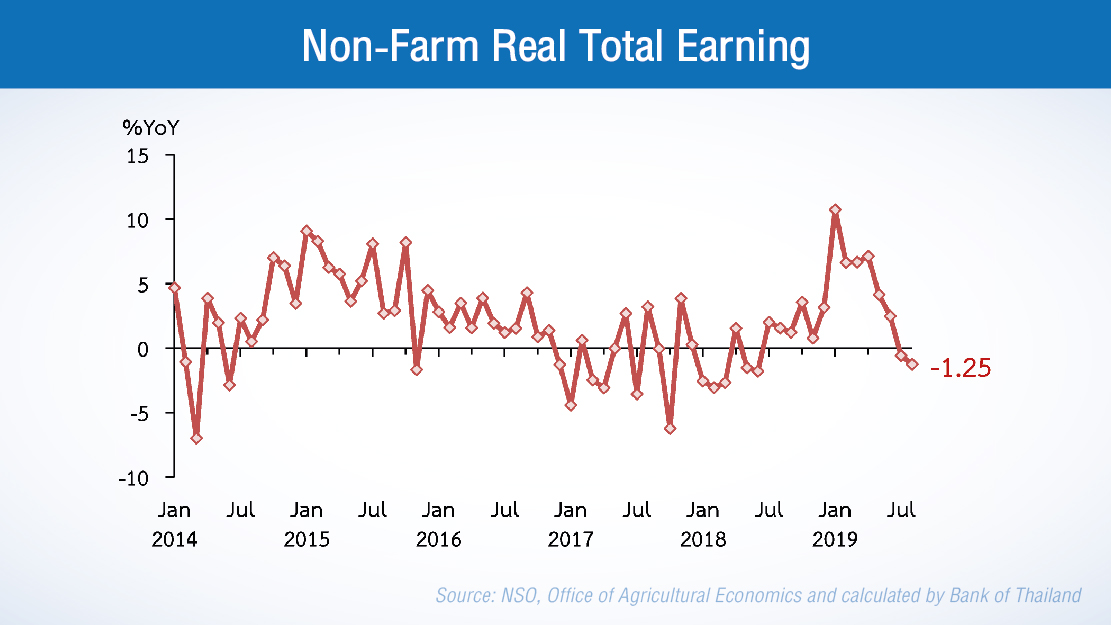
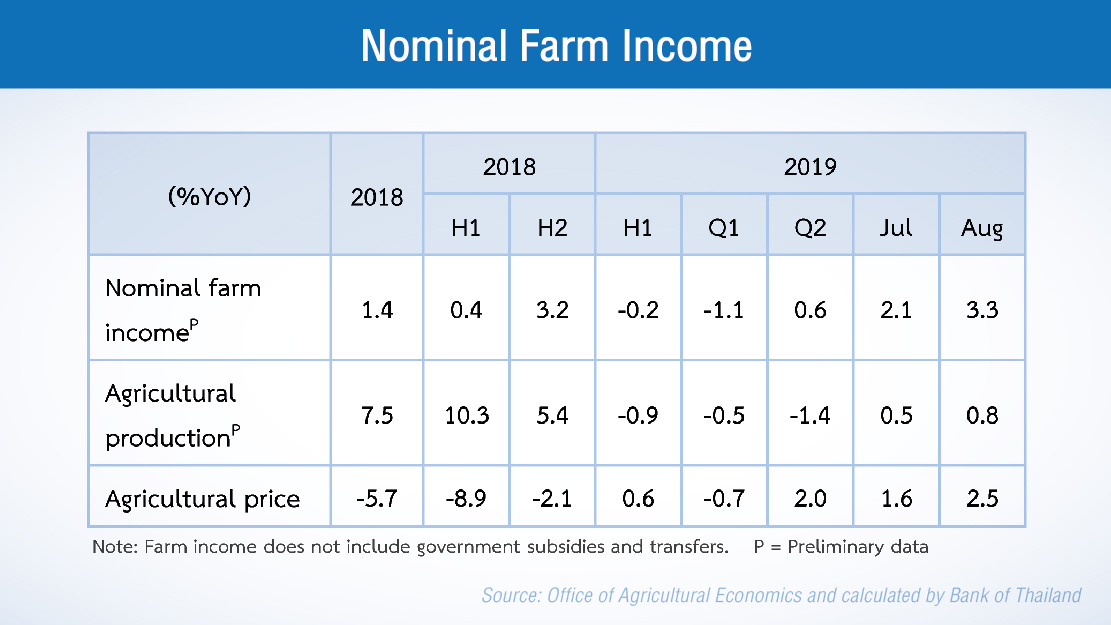
Non-farm income further contracted, while farm income rose mainly due to rising agricultural prices. Consumer confidence continued to deteriorate for the sixth consecutive month.
The report came as many factories have started laying off workers, or cutting down on overtime, especially in industries that rely heavily on exports.
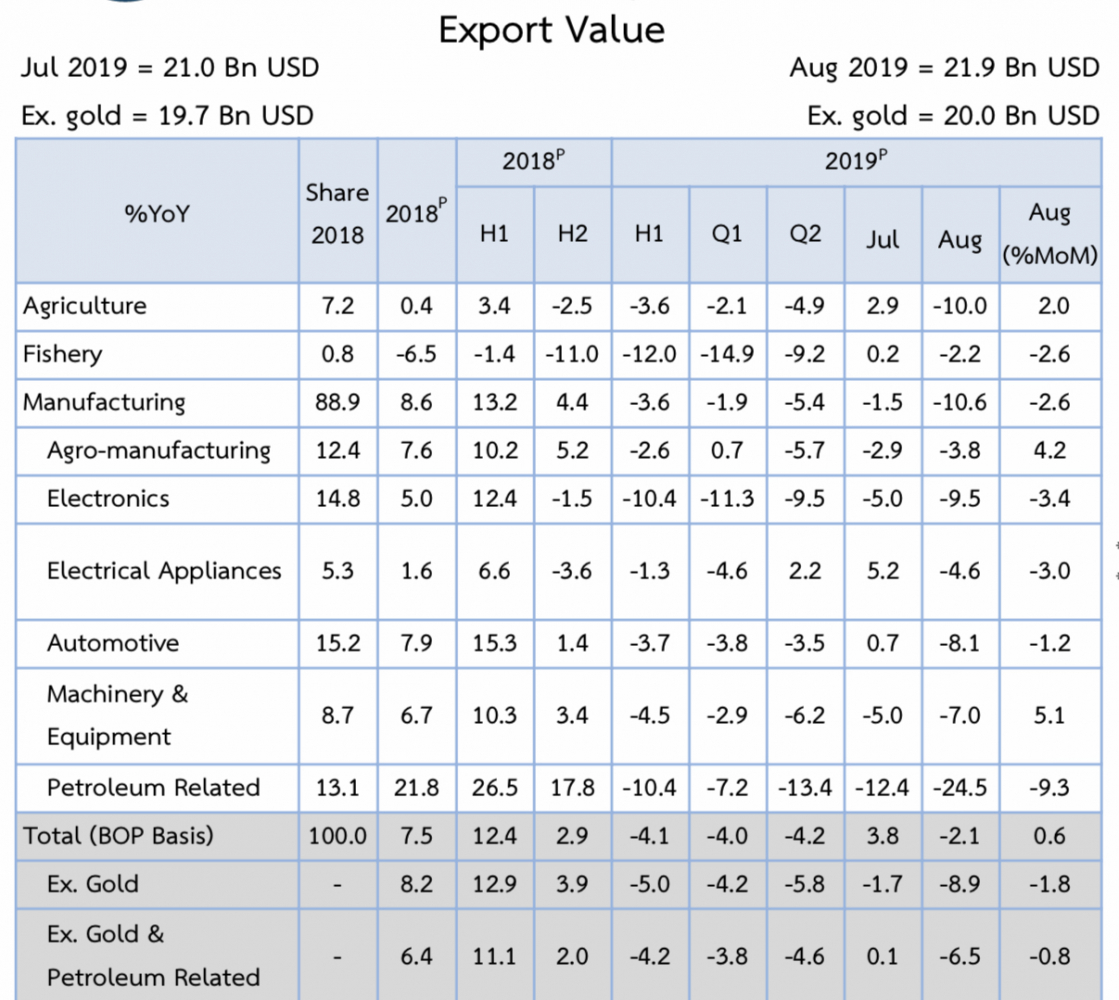
The central bank said the value of merchandise exports turned into contraction by 2.1 per cent from the same period last year. With the exception of gold, the value of all merchandise exports continued contracting at 8.9 per cent.

The continual contraction for the 10th consecutive month can be attributed to weaker global demand as a result of slower economic growth in a number of major trading economies, the US-China trade conflict, the continued downturn in electronic cycle, the contraction of global crude oil prices and a high base effect from front-load exports last year before the US started imposing import tariffs on Chinese products.

This contraction was also put down to a drop in the export of petroleum-related products and electronic products, which continued to contract for a ninth month. However, hard disk drive exports showed signs of recovery, as the production of hard disk drives, which were previously supported by the relocation of production base from Malaysia, expanded this month.

Exports in several other categories also expanded, partly due to the substitution of Chinese and American goods in the two markets, such as exports to the US market, which is continuing to expand, includes car tyres, refrigerators, television set, and apparel and textiles; while exports to China expanded at a higher rate with some products, such as high-end cars and motorcycles. However, the gains were not large enough to offset the slowdown in other export markets.

Private investment indicators also contracted from the same period last year, said the central bank.

Investment in machinery and equipment turned into contraction mainly from the drop in import of capital goods and the number of newly registered motor vehicles for investment. Investment in construction contracted due to a drop in permitted construction areas, apart from areas allocated for factories, which expanded. The sale of construction materials subsequently contracted, consistent with the slowdown in the real-estate sector. After seasonal adjustment, private investment indicators decreased from the previous month.
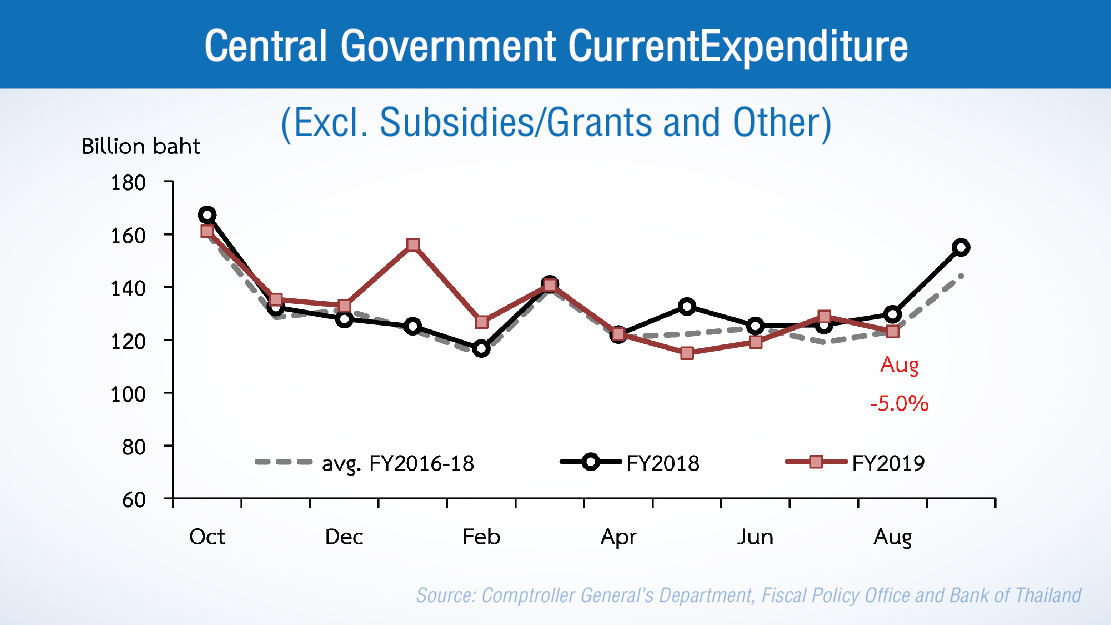
Public spending, excluding transfers, turned into contraction from the same period last year

due to current expenditures mainly on the back of expenditure on goods and services for the Army and the Royal Thai Police.
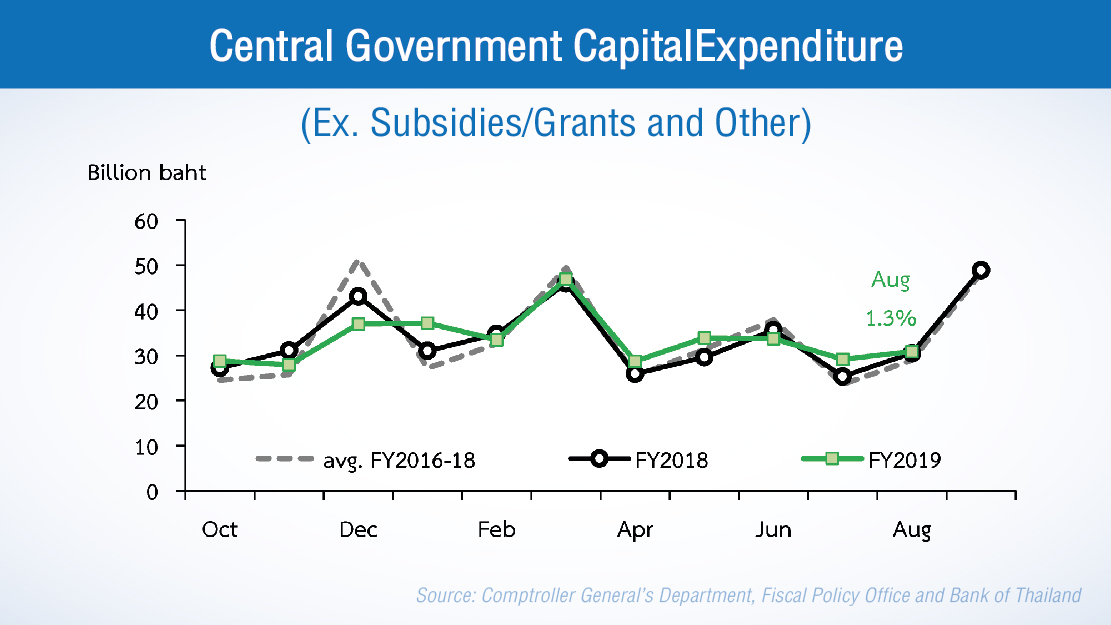
However, capital expenditure rose slightly from the disbursement of the Department of Highways, and additionally state enterprises’ capital expenditures rebounded from the disbursement of funds to PTT Public Co Ltd and Airports of Thailand Public Company Limited.

The value of merchandise imports sharply contracted by 15.5 per cent from the same period last year. Excluding gold, the value of merchandise imports contracted by 8 per cent.

The contraction was attributed to a drop in:1) Imports of raw and intermediate goods, particularly material for base metal, consistent with the contraction of private construction and car production; electronic parts, consistent with the contraction of production and exports of this product; and imports of fuel which contracted as global crude oil prices declined; 2) Imports of capital goods excluding aircraft, ships, floating structures, and locomotive, particularly telecommunication equipment and machinery and equipment, consistent with the contraction of private investment indicators;

3) Imports of consumer goods; and 4) Imports of automotive and parts, consistent with the slowdown of private consumption.

Meanwhile, the number of foreign arrivals rose by 7.4 per cent from the same period

last year, due to: 1) A low base effect from the tour boat incident in Phuket last year and

2) An increase in tourist arrivals who benefited from the exemption of visa on arrival fees, particularly those from China, India and Taiwan.
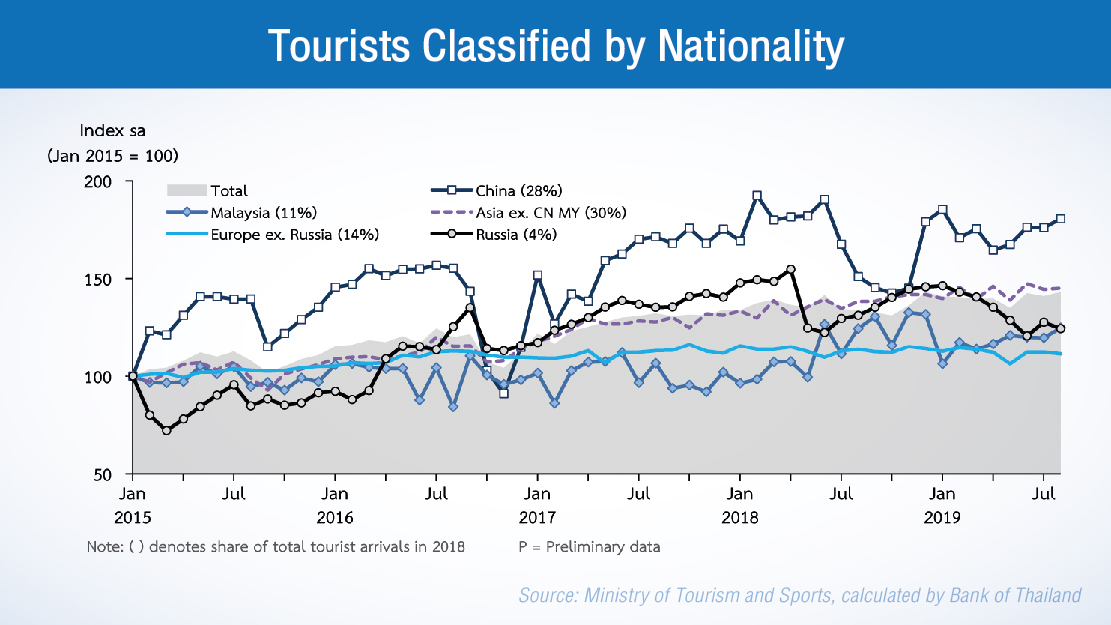
Moreover, some Chinese tourists chose Thailand over Hong Kong due to the political unrest. However, the number of European tourists, particularly from Germany and Russia, continued to drop due to the economic slowdown, according the central bank.

On the stability front, headline inflation decelerated to 0.52 per cent from 0.98 per cent

last month, due mainly to a larger contraction in energy prices caused by a fall in global crude oil prices, coupled with a decrease in fresh food prices. Meanwhile, core inflation accelerated from the previous month.

The seasonally adjusted number of employed persons decreased from previous month, mainly owing to a decline in non-farm employment. The seasonally adjusted unemployment rate remained nearly unchanged from the previous month. The current account registered a higher surplus due mainly to an increase in trade surplus. The overall capital and financial accounts registered a deficit from both the assets and liabilities positions, the central bank added.

Thai sugar industry bitter as exports and price fall

ศาสตร์เกษตรดินปุ๋ย : ขอบคุณแหล่งข้อมูล : หนังสือพิมพ์ The Nation

https://www.nationthailand.com/business/30376901

Thai sugar industry bitter as exports and price fall

Sep 30. 2019
By THE NATION

702 Viewed

The Thai sugar industry is hit by the twin crises of falling exports and sliding price, according to industry experts. The most imminent threat to the industry is the falling price of sugar in the global market, which has currently dropped by 10 to 11 cent per pound, the lowest price in six years.

FO Licht, an agribusiness intelligence agency, reported on September 19 that the global sugar stocks in fiscal year 2018-2019 (October to September) were 78.19 million tonnes, while global sugar production was 181.48 million tonnes and global consumption 186.45 million tonnes.

The report predicted that the global sugar reserves would drop to 72.67 million tonnes at the end of 2019, or 38.97 per cent of global consumption.

The huge amount of global reserve has caused the price of sugar to drop continuously with no signs of recovery in sight.

The country whose practice has caused the most concern is India, which has more than 15 million tonnes of sugar in reserve, while the government has promoted the export of six million tonnes of sugar.

Some countries sees India’s move to increase sugar export as a factor behind the lower price of sugar.

Thailand’s sugar exports in the first eight months of 2018 dropped from 7.212 million to 6.067 million tonnes compared to the previous year. Major clients included Indonesia, Cambodia, Taiwan and Myanmar, who have all reduced their imports.

Piromsak Saisunee, director of Karpolpalit Namtarn Co Ltd, said that besides the falling global sugar price, another factor that was of concern to the Thai sugar industry was the appreciation of the baht. “If the baht grows stronger than Bt30.50 to the US dollar, the Thai sugar industry will lose most of its clients to Brazil, our biggest competitor,” he said. “Currently Brazil’s currency, the real, is weakening which is boosting their sugar exports considerably.”

APAC banks face risk from leveraged corporates: Moody’s

ศาสตร์เกษตรดินปุ๋ย : ขอบคุณแหล่งข้อมูล : หนังสือพิมพ์ The Nation

https://www.nationthailand.com/business/30376893

APAC banks face risk from leveraged corporates: Moody’s

Sep 30. 2019
By THE NATION

569 Viewed

Moody’s Investors Service says in a new report that high corporate leveraging across Asia Pacific is posing increasing risk to the region’s banks, as slower economic growth and rising trade and geopolitical tensions could weaken debt servicing abilities.

“Corporate default rates in Asia Pacific have been low so far, helped by low interest rates and favourable financing conditions, but the intensifying trade and geopolitical tensions are weighing on the global economy and supply chains amid already slowing growth,” said Rebaca Tan, a Moody’s assistant vice president and analyst.

“Our stress test – which assumes a 25 per cent decline in EBITDA – shows banks in India and Indonesia are most prone to a deterioration in corporate debt repayment capacity, followed by banks in Singapore, Malaysia and China,” added Tan.

Total corporate debt across the 13 economies covered by Moody’s report grew only 1 per cent year over year in US dollar terms at the end of 2018, the slowest pace since the global financial crisis. Yet, overall corporate leverage remains high relative to GDP in many of the region’s economies.

Moreover, outstanding debt is heavily concentrated among corporates that hold debt more than four times EBITDA, raising the risk of rising defaults as operating conditions weaken.

Somewhat mitigating these risks are the strong buffers kept by most Asia Pacific banks, in the form of both loan loss reserves and capital, to withstand a sharp deterioration in asset quality.

Under Moody’s stress scenario, capital ratios would decline by 1 to 4 percentage points in most economies, leaving banks with sufficient buffers. Among the 13 banking systems, Indian banks are the most vulnerable.

Pet business reaches Bt40 billion as people indulge their darlings

ศาสตร์เกษตรดินปุ๋ย : ขอบคุณแหล่งข้อมูล : หนังสือพิมพ์ The Nation

https://www.nationthailand.com/business/30376890

Pet business reaches Bt40 billion as people indulge their darlings

Sep 30. 2019
By The Nation

756 Viewed

The pet business in Thailand has quietly grown to worth up to Bt40 billion in economic value, growing at least 10 per cent yearly, as owners indulge their pets with food and services.

Nantaphon Tantiwongampai, the vice president of the Thai Pet Products Industry Association, predicted pet-related businesses would likely experience continuous growth.

Despite various risks including to the economy the market has not been affected, he said. The market for pet dogs and cats alone is now worth nearly Bt40 billion yearly, with an average growth of not less than 10 per cent per year, with food products taking up a big share of its growth.

The behaviour of Thai animal lovers has changed, he said, as they tend to look after and pay attention to every detail for their pet, treating them much like their own child, including for food, clothing and medical care. The pet in Thailand has become a family member rather than just a housekeeper.

The population of cats in Thailand has now reached 4 million, almost double the 2.2 million of six years ago, while the dog population is growing by 10 per cent yearly. Thai people are interested in raising small dogs rather than large dogs, he said.

The average spend on pets around the world is at 3-5 per cent of household income, with the spending on food and services even higher among families that do not have children.

Also adding to the pet market in Thailand is exports, with most customers located in Asia, including in China, Korea, and Hong Kong, as well as in neighbouring countries such as Laos, Myanmar and Malaysia.