EGCO Group powers up San Buenaventura coal plant in the Philippines

ศาสตร์เกษตรดินปุ๋ย : ขอบคุณแหล่งข้อมูล : หนังสือพิมพ์ The Nation

https://www.nationthailand.com/business/30376761

EGCO Group powers up San Buenaventura coal plant in the Philippines

Sep 26. 2019
By THE NATION

576 Viewed

Commercial operations began on Thursday for the San Buenaventura, Philippines, power plant managed by San Buenaventura Power Co Ltd (SBPL), a joint venture company of EGCO Group and Meralco PowerGen Corporation, Jakgrich Pibulpairoj, the president of Electricity Generating Public Co Ltd, announced.

EGCO Group owns 49 per cent of the joint venture, while Meralco has 51 per cent.

The new power plant is expected to consistently generate revenues for the company, with earnings recongised starting in the fourth quarter of 2019, he said.

It will help ensure a more stable supply of power on Luzon Island, the Philippines.

The San Buenaventura facility, located at the site adjacent to the existing Quezon power plant in Mauban, Quezon Province, is a coal-fired power plant utilising highly efficient supercritical boiler technology with the advantage of promoting efficient fuel consumption.

The power plant has a gross output capacity of 500 megawatts, of which the entire net capacity of 455 MW is contracted for sale to the Manila Electric Company (Meralco) under a 20-year power supply agreement with five-year term extension.

With this power plant, EGCO Group boasts 27 operating power plants with total equity contracted capacity of 5,315 MW in six countries – Thailand, Lao PDR, Philippines, Indonesia, Australia and South Korea.

There are three projects now under construction with total equity contracted capacity of 331 MW. The company’s power plants generate electricity using various fuel sources such as natural gas, LNG, coal, biomass, hydro, solar, wind, geothermal and fuel cell.

Thailand slips a place in digital competitiveness ranking

ศาสตร์เกษตรดินปุ๋ย : ขอบคุณแหล่งข้อมูล : หนังสือพิมพ์ The Nation

https://www.nationthailand.com/business/30376797

Thailand slips a place in digital competitiveness ranking

Sep 27. 2019
By The Nation

1,454 Viewed

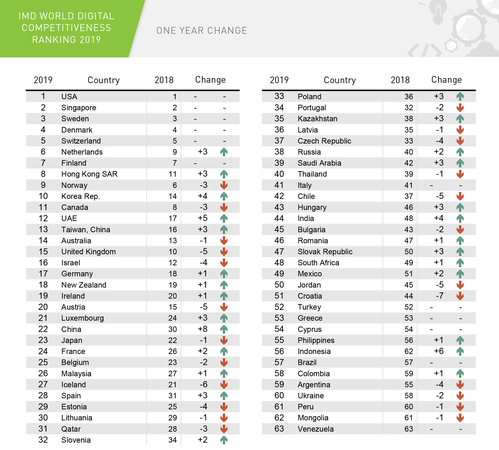
Thailand’s world digital competitiveness ranking dropped one place to 40th in 2019 from 39 the previous year, according to an IMD World Digital Competitiveness Ranking (WDCR) report released late on Thursday.

The WDCR said that Thailand dropped one place to 40th as a result of a mixed performance across three digital factors while future readiness (50th), knowledge (43rd) and technology (27th) improved compared to 2018. Several indicators related to public investment in education, agility of companies and the use of big data and analytics in firms declined.

Meanwhile, the United States held on to the WDCR number one spot in 2019, with all top five economies in the ranking unchanged: US, Singapore, Sweden, Denmark and Switzerland.

Digital Competitiveness Ranking 2019

In the top 10, the Netherlands, Hong Kong SAR and South Korea moved up (to 6th, 8th and 10th, respectively), while Norway dropped to 9th and Canada fell from 8th to 11th.

Now in its third year, the WDCR produced by the IMD World Competitiveness Centre measures the capacity and readiness of 63 economies to adopt and explore digital technologies as a key driver for economic transformation in business, government and wider society.

Technology not only affects how businesses perform but also how economies function and prepare for the future. Governments around the world are investing heavily in their digital economy to enhance value creation and prosperity.

The top five share a common thread in terms of their focus on knowledge generation, but they each approach digital competitiveness differently, the report said. The United States and Sweden follow a balanced approach between knowledge generation, the creation of a supportive environment for technology development and a readiness to adopt innovation. Singapore, Denmark and Switzerland give priority to one or two factors, the report added.

“In the midst of uncertainty and a fluid global situation, it seems that business and societies that are agile correlate strongly with the IMD World Digital Competitiveness ranking. Knowledge also remains of paramount importance for the digital performance of different economies,” said Professor Arturo Bris, director of the IMD World Competitiveness Centre.

Several Asian economies advanced significantly in the ranking compared to 2018. Hong Kong SAR and South Korea entered the top 10 while Taiwan and China moved up to 13th and 22nd respectively. All these economies experienced marked progress in their technological infrastructure and the agility of their businesses. Further down the ranking, India and Indonesia jumped four and six positions respectively, supported by positive results in talent, training and education as well as the enhancement of technological infrastructure.

In the Middle East, the UAE and Israel remained key regional digital hubs but followed opposing trends with respect to 2018. The UAE climbed five places thanks to improvements in capital availability and supportive regulation for technology development. Israel dropped four positions, due to a decline in business agility and e-government indicators.

In Latin America, Mexico and Colombia were the only economies to advance in the rankings this year. The lack of resources to support talent and technological development prevents most economies in the region from improving knowledge generation and getting the most from digital transformation.

To evaluate an economy, WDCR examines three factors:

knowledge – the capacity to understand and learn the new technologies; technology – the competence to develop new digital innovations; future readiness – the preparedness for the coming developments.

This year, two new variables related to robotics were introduced in the calculation of the WDCR: “industrial robot” to measure the total number of robots in operation; and “robots in education and R&D” worldwide. The data is provided by the International Federation of Robotics.

BAAC earmarks Bt5 bn for farmers to grow trees

ศาสตร์เกษตรดินปุ๋ย : ขอบคุณแหล่งข้อมูล : หนังสือพิมพ์ The Nation

https://www.nationthailand.com/business/30376800

BAAC earmarks Bt5 bn for farmers to grow trees

Sep 27. 2019
Prasit Techati

Prasit Techati
By Kunanon Kanjanatecha
The Nation

1,131 Viewed

Apirom Sukprasert, president of the Bank for Agriculture and Agricultural Cooperatives (BAAC), said the bank is launching a brand-new loan allowing farmers to earn from planting trees in a move to boost their quality of life as well as preserve the environment.

The project will target 800 square kilometres and 50,000 farmers who can participate in the “Planting Trees to Make an Income” project, which encourages farmers to plant trees for reforestation. Each farmer will be provided a loan of Bt100,000 from the Bt5 billion allocated for the scheme.

Participants will be given loans at a minimum retail rate of 6.875 per cent per year. For the first three years the rate will be minus 3 per cent, for the fourth to the sixth year the rate will be minus 2 per cent and minus 1 per cent in the last two years. Loans will only be available until July 31, 2021 and can be taken for no more than 15 years.

Prasit Techati, a BAAC customer development officer in Nan province, said the aim of the project is to have locals preserve forests especially those upstream in the northern provinces of Chiang Mai, Chiang Rai and Nan.

Forests provide locals with more products from different types of plants and more species of trees to use and sell. By planting trees and harvesting them, farmers can make their incomes more sustainable than by just focusing on mono crops like corn and sugarcane.

Provinces in the North like Nan have been suffering from deforestation as locals have been cutting down trees to expand farming areas. This project aims to help locals co-exist peacefully with forests.

Legalising ride-hailing services a god-send to economy, study shows

ศาสตร์เกษตรดินปุ๋ย : ขอบคุณแหล่งข้อมูล : หนังสือพิมพ์ The Nation

https://www.nationthailand.com/business/30376790

Legalising ride-hailing services a god-send to economy, study shows

Sep 26. 2019
Dr Suthikorn Kingkaew

Dr Suthikorn Kingkaew
By THE NATION

824 Viewed

Ride-hailing services contributed Bt21 billion to the Thai economy last year, a contribution that is expected to reach Bt120 billion by 2025, according to a study conducted by Thammasat Consulting Networking and Coaching Centre (CONC Thammasat).

CONC Thammasat said on Thursday (September 26) that the study focused on the role ride-hailing services have played in driving the country’s economy and the necessity of developing sustainable guidelines and regulations. The study also provided five key actionable guidelines and best practices for the government to consider as it works towards legalising ride-hailing services by March 2020.

Dr Suthikorn Kingkaew, director of CONC Thammasat which comes under the university’s Faculty of Commerce and Accounting, said ride-hailing services have changed the way people move – not just in Thailand, but also around the world. It has naturally become more popular in today’s digital age, where mobile and internet penetration is high, and people are more receptive to using technology to make their travel hassle free.

Thailand’s urban population is expected to grow from 50 per cent to 73 per cent in the next 30 years, which means people’s need for accessible, seamless and safe transportation will continue to rise. Hence, it is time for the government to legalise the industry and integrate it with the public transportation ecosystem.

The ride-hailing industry currently accounts for 6 per cent of Thailand’s ground transport sector’s GDP, and once it is legalised, it is expected to account for 20 to 25 per cent of the industry, contributing Bt120 billion by 2025.

In 2018, an estimated 2.4 million passengers per month were served by the ride-hailing industry and this is expected to rise to 11 million passengers per month by 2025. The number of drivers providing services in this industry is also forecast to rise from 105,000 per month in 2018 to about 590,000 per month by 2025, which means more people will be given access to new income earning opportunities.

“Our research shows that Thais want the service to be legalised, so they have greater peace of mind,” Suthikorn said. According to public polls, 95 per cent of respondents want the ride-hailing industry to be legalised, while 77 per cent want the action to be taken immediately.

Thailand is one of the last three countries in Southeast Asia which has yet to legalise the industry.

“The government recognises the benefits that ride-hailing will bring to people’s daily lives and sees how the service can complement the entire public transport system. The next crucial step will be to develop fair and sound regulations that safeguard public interests and yet allow innovation to thrive,” he said.

Findings from CONC Thammasat’s study quantified the economic and social impact ride-hailing services have on Thailand, reflecting opinions from 2,000 passengers and drivers collected in public polls conducted from August to September.

Most passengers said ride-hailing services has made their daily commute more convenient and given them greater peace of mind due to higher safety standards.

o 92% agreed that ride-hailing service is safer than other alternatives;

o 95% said ride-hailing services connect them easily to other modes of transportation;

o 77% say booking a ride through ride-hailing apps reduces their waiting time;

o 86% said ride-hailing services allowed them to spend more time on work or other activities during the ride.

Drivers, meanwhile, found ride-hailing services as a new stream of income that provided them with greater financial independence.

o 60% of private car drivers surveyed were either unemployed or retired before they found an opportunity to earn through ride-hailing services;

o 99% of taxi drivers said that the ride-hailing service gives them more passengers and helps them earn above the amount they get from being flagged down;

o 94% said the additional income has given them greater financial independence and helped them clear their debts.

Social Sector

Apart from offering greater convenience to passengers, ride-hailing services have also raised the bar for safety in Thailand through live location tracking and sharing GPS data, offering SOS assistance by linking up with the police through the app and other technological advances such as facial recognition and telematics that aim to protect the driver and passenger.

Economy

Ride-hailing services have directly contributed Bt21 billion to the Thai economy in 2018, not including the positive knock-on effect on the wider economy as it improves drivers’ livelihoods and boosts their spending power as consumers.

Tourism Sector

Tourists are increasingly relying on ride-hailing services, as 75 per cent of foreign visitors travel in small groups or solo, as the proportion of large groups has fallen to 25 per cent. Ride-hailing apps also help bridge the language barrier through in-app chat translation features and eliminate people’s frustration of having to haggle with drivers by displaying the price upfront before the ride is booked.

CONC Thammasat, meanwhile, has also come up with five key guidelines and best practices to help the government develop a regulatory framework for the industry:

1) Setting up basic standards to ensure the safety of passengers and drivers by:

o Introducing advance safety technology features, including real-time location tracking via GPS, in-app emergency button connected to the police, telematics to ensure driving safety;

o Driver and passenger verification through technology like facial recognition;

o Offering a channel for the easy reporting of safety issues during or after a ride and providing 24/7 customer support;

o Providing accident insurance for drivers and passengers on every trip.

2) Setting high service standards for drivers, with safety as top priority:

o Conducting stringent background checks on drivers, including checking for criminal records, before they are allowed to provide the service;

o Putting in place a clear code of conduct for drivers;

o Putting drivers through road-safety training;

o Putting all private cars through necessary safety checks.

3) Service providers must be ready to deliver high service standards in order to operate on a national scale:

o The app and back-end technology systems must be stable and reliable at all times to deal with customer volume and any business expansion;

o There must be a sufficient supply of drivers to meet the demand of passengers at a national level;

o Service providers must provide in-app chat translation and have the app supported in different languages;

o Service providers must offer a variety of payment options, including cash, debit and credit cards;

4) Fair and equitable pricing driven by market forces to balance demand and supply

o Fares should be calculated on a dynamic pricing model which represents real-time demand and supply, and also considers externalities such as weather and traffic conditions;

o The fare must be displayed upfront so passengers can make an informed decision before accepting the ride;

o Pricing must balance the needs of drivers and passengers based on the free-market dynamics of demand and supply, thereby allowing drivers to earn sustainable incomes at fares that are reasonable and acceptable to passengers.

5) Setting basic requirements for service providers with plans to make them a critical part of Thailand’s future transport infrastructure.

o Must be a legally registered company in Thailand

o Majority of the shareholders in the company should be Thai

o Must pay local taxes

o Must have enough capital to support business operations such as ensuring drivers earn a sustainable income and expanding into every major city in Thailand.

“Ride-hailing is a crucial jigsaw to complete the public transportation ecosystem in Thailand. Looking from the lens of the larger benefits to the country, all players in the industry should stay open to this inevitable trend that has brought immense benefits to the economy and society.

“Ultimately, it’s consumers that matter the most, and all players should aim to stay relevant and adapt to the changing needs of today’s mobile users. More importantly, ride-hailing brings huge troves of data which were previously non-existent with traditional transportation modes.

“The potential of analysing this big data to solve traffic congestion issues, prevent safety incidents and develop smart mobility solutions yields immense rewards for the nation in the long term,” concluded Suthikorn.

Brexit, US-China trade war high on agenda of War Room session

ศาสตร์เกษตรดินปุ๋ย : ขอบคุณแหล่งข้อมูล : หนังสือพิมพ์ The Nation

https://www.nationthailand.com/business/30376791

Brexit, US-China trade war high on agenda of War Room session

Sep 26. 2019
Photo credit: BBC

Photo credit: BBC
By THE NATION

718 Viewed

The Commerce Ministry will discuss two key issues at the next War Room session scheduled for October 7

The Commerce Ministry will discuss two key issues at the next War Room session scheduled for October 7 — the China-US trade war and Brexit — a senior official said on Thursday. 

The situation in the US is very volatile, as impeachment investigations are set to be launched against President Donald Trump, Pimchanok Vankorpon, director-general of the Trade Policy and Strategy Office under the Commerce Ministry, said on Thursday.

Pimchanok Vankorpon, director-general, of the Trade Policy and Strategy Office under the Commerce Ministry

Pimchanok Vankorpon, director-general, of the Trade Policy and Strategy Office under the Commerce Ministry

She explained that regardless of the outcome, the move for impeachment had already begun to unsettle the economic policies of the country making the War Room discussion about the trade war issue vital.

Regarding Brexit, she said the earlier discussions on the issue took place the better it would be for Thailand to brace for the impact although the deadline on a final decision by the UK about leaving the European Union had been extended to October 31.

The Commerce Ministry’s War Room was set up in August, as a solution to prepare the government to deal with global economic situations.

Chinese arrivals pick up thanks to visa-on-arrival fee waiver

ศาสตร์เกษตรดินปุ๋ย : ขอบคุณแหล่งข้อมูล : หนังสือพิมพ์ The Nation

https://www.nationthailand.com/business/30376785

Chinese arrivals pick up thanks to visa-on-arrival fee waiver

Sep 26. 2019
By THE NATION

370 Viewed

The number of Chinese arrivals to Thailand is expected to hit 10.8 million to 10.99 million this year, representing a growth of between 2.6 and 4.4 per cent from last year, the Kasikorn Research Centre said.

As per figures from the Tourism and Sports Ministry, up to 1 million Chinese arrivals were recorded in August alone.

One of the contributing factors to the increase in tourists is the extension of the waiver on visa-on-arrival fees to April next year. The current waiver covering visitors from 18 countries and one economic zone, including India and China, is set to expire in October.

The research house also put the rise in arrivals to the ongoing unrest in Hong Kong, which is forcing holidaymakers from China to change their destination.

In the first eight months of this year, 7.7 million Chinese tourists arrived in Thailand, down only 0.8 per cent when compared to the same period last year.

KResearch said Thailand’s tourism industry should maintain its recovery for the rest of the year thanks to the visa-on-arrival fee waiver and China’s long national-day holiday from October 1 to 7. As many as 240,000 Chinese people are expected to arrive in Thailand during the national day break, up 18 per cent from the same period last year.

However, maintaining the growth in Chinese arrivals may prove to be challenging next year due to unfavourable economic conditions in China and the drop in the value of yuan. Besides, Thailand is also facing tough competition from other countries in wooing Chinese tourists.

According to the Fiscal Policy Office, the number of tourist arrivals to Thailand in August stood at 3.47 million, up 7.4 per cent year on year. The number of Chinese arrivals to Thailand in the same month expanded 18.9 per cent year on year, while Indian arrivals expanded 32.4 per cent.

Related story: Chinese pick Japan, Thailand for Golden Week holidays pick Japan, Thailand for Golden Week holidays

China ready to improve strategic economic partnership: Jurin

ศาสตร์เกษตรดินปุ๋ย : ขอบคุณแหล่งข้อมูล : หนังสือพิมพ์ The Nation

https://www.nationthailand.com/business/30376764

China ready to improve strategic economic partnership: Jurin

Sep 26. 2019
By The Nation

571 Viewed

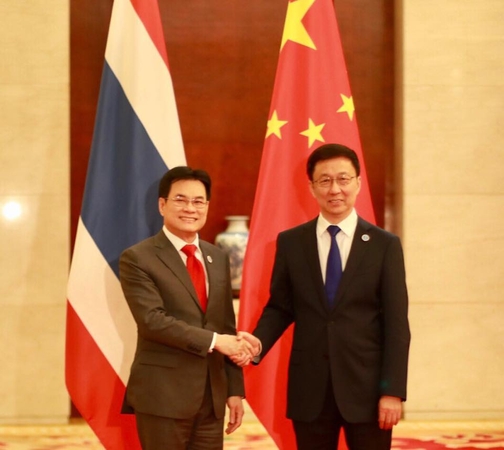
Deputy Prime Minister and Commerce Minister Jurin Laksanawisit last week met with the deputy premier of China to improve the two countries’ strategic economic partnership through a focus on greater cooperation and increasing trade in agricultural products from Thailand.

When the Deputy PM met Han Zheng on September 20, his China counterparty congratulated hi on his new position and Thailand’s work as this year’s chairman of Asean. Jurin in turn expressed his admiration for The Belt and Road Initiative (BRI), a global development strategy of the Chinese government.

Both deputies also discussed trade in agricultural goods. Jurin asked China to speed up purchases of Thai rice and rubber in line with a memorandum of understanding between the nations, while thanking China for loosening inspection measures on fruit and frozen chicken from Thailand.

Thailand’s Director-General of the Department of Trade Negotiations, Auramon Supthaweethum, said that Xi Jinping, the China President, will fly to Thailand this November to attend the Asean-China Summit, while Thai officials will bring businessmen to join the China International Import Export (CIIE) trade fair at Shanghai.

in 2018, Thai-China trade was valued $80.2 billion. Major Thai exports included plastics pellets, rubber, rubber processed products, fresh and frozen fruit, chemicals, computers and parts, and cassava. Major imported products included machinery, electrical machinery, home appliances, iron, steel and car parts.

Herbalife Nutrition launches campaign to fight global hunger

ศาสตร์เกษตรดินปุ๋ย : ขอบคุณแหล่งข้อมูล : หนังสือพิมพ์ The Nation

https://www.nationthailand.com/business/30376757

Herbalife Nutrition launches campaign to fight global hunger

Sep 26. 2019
By The Nation

110 Viewed

Herbalife Nutrition today announced the launch of the “Nutrition for Zero Hunger” global initiative, pledging US$2 million to help end world hunger, ensure people have access to good nutrition and address rising obesity.

The initiative, with the assistance of non-profit partners, will focus on providing access to healthy foods, improving nutrition education, identifying sustainable food resources and raising awareness of the global crisis.

The Company also announced its partnership with Feed the Children, a non-profit organization committed to defeating childhood hunger worldwide. Feed the Children has designated September as Defeat Hunger Month and as a lead partner of Nutrition for Zero Hunger, Herbalife Nutrition will support their programmes to help end hunger around the world.

“The Nutrition for Zero Hunger initiative addresses key pandemic problems and through our work with our partners, like Feed the Children, we hope to build a world where everyone has access to quality food and nutrition,” said Alan Hoffman, the company’s executive vice president for global corporate affairs.

In addition to supporting strategic partnerships, Nutrition for Zero Hunger aligns with the United Nation’s Sustainable Development Goal 2, which calls for bold action to end hunger in all its forms by 2030, as well as solutions to achieve food security and improve nutrition worldwide. Through the US$2 million pledge, the Company will:

• Partner with organizations addressing hunger, food security and malnutrition

• Provide in-kind donations of nutritious food and nutrition products to vulnerable people

• Deliver resources to support nutrition education

• Engage and educate communities globally through integrated campaigns

Hoffman added, “We have seen how healthy nutrition impacts people’s lives, and we are committed to supporting this critical need to vulnerable populations all around the world.”

Ikea nets high profits in SE Asia

ศาสตร์เกษตรดินปุ๋ย : ขอบคุณแหล่งข้อมูล : หนังสือพิมพ์ The Nation

https://www.nationthailand.com/business/30376746

Ikea nets high profits in SE Asia

Sep 26. 2019
By The Nation

315 Viewed

Sales at IKEA stores in Southeast Asia hit the Bt29 billion mark in fiscal year September 1, 2018 to August 31, 2019, reflecting healthy growth for a big-box retail business that is meeting the needs of a new generation of shoppers and creating fresh passion for home furnishing.

Its more than 3,400 co-workers met servers some 98 million visitors in it stores and centres, rolled out ecommerce in Thailand, embarked on construction projects in new markets and helped sell 113,000 ‘Billy’ bookcases along with thousands of other affordable home furnishings.

As one of 12 IKEA franchisees around the world, the turnover posted by the eight large IKEA stores in Southeast Asia – including two in Bangkok plus a Pick-Up and Delivery Point in Phuket – contributed to the total result released Wednesday by the global franchisor, Inter IKEA Group.

The company owns and operate IKEA stores and ecommerce operations in three active markets: Thailand, Malaysia and Singapore. When its retail sales are combined with rental income from its three IKEA-anchored shopping centres in the region (including Megabangna), total revenue reached Bt29 billion – 20 per cent more than last year, Bt8.9 billion from Thailand, the next Bt11.9 billion from Malaysia and the remaining Bt8.2 billion from Singapore.

“These results show that our IKEA stores and shopping centres have fantastic potential to grow,” said Christian Rojkjaer, Managing Director of IKEA Southeast Asia. “We make a difference to many people by making life more comfortable, more beautiful and more sustainable – all at an affordable price.”

“We face increasing competition in our markets and changing customer behaviour,” he added, “but our vision to create a better everyday life for people is perhaps more powerful than ever. We aim to offer the best deal there is in every market and we have a wide price ladder within our range. So, even in challenging times, IKEA has something for everyone no matter the size of his or her wallet.

“Our shopping centres add to the total value by creating meeting places that are the hub of the community – and provide a great day out for shoppers.”

THAI board balks at hefty acquisition plan

ศาสตร์เกษตรดินปุ๋ย : ขอบคุณแหล่งข้อมูล : หนังสือพิมพ์ The Nation

https://www.nationthailand.com/business/30376729

THAI board balks at hefty acquisition plan

Sep 26. 2019
Thaworn

Thaworn
By THE NATION

1,309 Viewed

Thai Airways International (THAI) directors on Tuesday (September 24) asked executives of the national carrier to review plans to procure 38 more aircraft worth a combined Bt156 billion.

The board cited a “fast-changing situation” in asking for a fresh plan within the next six months, THAI president Sumeth Damrongchaitham said.

Board members noted the airline’s poor financial performance and tough competition, coupled with the baht’s appreciation, Sumeth said.

He insisted that THAI must acquire new aircraft, but it would revise the methodology used.

Deputy Transport Minister Thaworn Senniam said the board’s request was not politically motivated or a matter of political interference.