Kiatnakin loans to real-estate sector continue to grow

ศาสตร์เกษตรดินปุ๋ย : ขอบคุณแหล่งข้อมูล : หนังสือพิมพ์ The Nation

https://www.nationthailand.com/business/30376170

Kiatnakin loans to real-estate sector continue to grow

Sep 16. 2019
By THE NATION

640 Viewed

The number of loans given out by Kiatnakin Bank (KKP) to real-estate sector continue to grow, thanks to its focus on major real-estate players, especially those listed in the stock exchange, Sammit Sakulwira, the bank’s first executive vice president and head of commercial lending group, said.


He added that its portfolio of loans to real-estate sector, which stands at Bt30 billion at present, is expected to expand 10 per cent this year.

Sammit explained that there has been low growth in new loans given to the real-estate sector, due mainly to a slow down in the development of new projects in response to a slowing economy and a supply glut in the market. However, he said, some developers still sought loans to purchase land for projects they plan to introduce in the next two years.

He added that tapping major developers means KKP’s loan portfolio is healthy given that the borrowers are financially stable and can repay. has continued to grow thanks to its focus on major real-estate players, especially those listed in the stock exchange, Sammit Sakulwira, the bank’s first executive vice president and head of commercial lending group, said.

Khongkwan aims to ride brand value, innovation to grow beauty business

ศาสตร์เกษตรดินปุ๋ย : ขอบคุณแหล่งข้อมูล : หนังสือพิมพ์ The Nation

https://www.nationthailand.com/business/30376218

Khongkwan aims to ride brand value, innovation to grow beauty business

Sep 15. 2019
Dr Khongkwan Fujitnirun

Dr Khongkwan Fujitnirun
By THE NATION

623 Viewed

Khongkwan Clinic aims to continue expanding its beauty treatment business at home and abroad, leveraging on its brand value in the beauty business as it celebrates its 13th year of operations.

The campaign “KKC Khongkwan Clinic 13 Years Anniversary” will be organised under the theme “Reborn, Rebody, Rebeauty” to showcase its “holistic beauty innovation”.

The clinic expects to form a partnership with new investors who have a similar business philosophy.

The beauty clinic is confident in the purchasing power of women of all ages, transgenders and men who are beauty-conscious , and plans to target more high-end customers.

Khongkwan Clinic said it has enjoyed 15-20 per cent business growth so far and expects to end the fourth quarter of 2019 with 25 per cent growth in net profit despite stronger competition.


Dr Khongkwan Fujitnirun, CEO of Khongkwan Clinic, said beauty treatment is a specific business with the focus on service, reputation and understanding. “As changes evolve every day, we adjust and grow our business via many marketing channels from online, customer referral, to free coupons to customers. Moreover, we use new innovations and technologies with safety and quality guarantees from overseas to satisfy our patients.”

“We are aware of the fake medicine issue. Khongkwan Clinic has invested more money to develop its own innovations. We are not confined to only botox fillers, laser or thread lifting, but also in developing holistic treatments combined with anti-ageing,” Khongkwan said.


She said the investment to develop holistic innovations with a foreign partner wrre in the negotiation stage.

“We can say that several equipment and materials are imported from the world’s best sources in US and Germany. Khongkwan Clinic has plans to open new clinics under new brands in three cities in China — Beijing, Shanghai and Guangzhou. We are also eyeing Indonesia,” Khongkwan said.

Khongkwan said they now have 17 clinics in Thailand and Laos. This year, Khongkwan Clinic is speeding up to form partnership with foreigners in order to get innovations. “The partnership will help us grow and have more services and Khongkwan Clinic will become an integrated medical beauty clinic for surgery, aseptic, anti-ageing, plastic surgery and cell therapy, which is the newest technology from the US and Germany under negotiation. The clinic expansion will be made to targe the high-end segment.”

Khongkwan expects the clinic to be among the top five beauty clinics in Thailand.

Family Channel 14 staff will not be laid off, MCOT assures

ศาสตร์เกษตรดินปุ๋ย : ขอบคุณแหล่งข้อมูล : หนังสือพิมพ์ The Nation

https://www.nationthailand.com/business/30376212

Family Channel 14 staff will not be laid off, MCOT assures

Sep 15. 2019
By THE NATION

577 Viewed

MCOT will not lay off staff working for its Family Channel 14 digital TV channel, which will be switched off at midnight on September 15, but will relocate them to other business units as appropriate, MCOT president Kematat Paladesh said.

He added that most of the programme content partnership contracts between MCOT’s Family Channel 14 and its partners had already expired on June 30 this year.

After the closure of the Family channel, MCOT would still run one channel, the high-definition Channel 30.

In May this year, six broadcasters informed the National Broadcasting and Telecommunications Commission (NBTC) of their intention to hand back the seven licences they had secured from the NBTC. May 10 was the deadline for broadcasters to declare their intention.

The six broadcasters are: Spring News Television Co Ltd (for Spring News Channel 19) and Nation Multimedia Group (for Spring 26, formerly NOW26). The others are Bright TV (Channel 20), Voice TV (Channel 21), MCOT (Family Channel 14) and BEC Multimedia (Family Channel 13 and 3SD Channel 28).

Spring 26, Spring News and Bright TV shut down their channels at midnight on August 15. Voice TV was switched off at midnight on August 31.

BEC Channel 28 and Channel 13 leave the airwaves at midnight on September 30.

All these channels get compensation from the NBTC after they are shut down.

After their exits, there will be 15 channels left in the crowded market.

The NBTC awarded 24 commercial digital TV licences via auction in December 2013, raising around Bt50.862 billion in bid payments. Their 15-year licences were good from April 25, 2014. However, the broadcasters found it difficult to survive due to unfavourable market conditions, coupled with brutal competition from formidable online media channels.

Focus on sustainability gives AIS a place in DJSI

ศาสตร์เกษตรดินปุ๋ย : ขอบคุณแหล่งข้อมูล : หนังสือพิมพ์ The Nation

https://www.nationthailand.com/business/30376208

Focus on sustainability gives AIS a place in DJSI

Sep 15. 2019
Somchai

Somchai
By THE NATION

808 Viewed

Advanced Info Service (AIS) has been added to the Dow Jones Sustainability Indices (DJSI) in the telecommunication services sector in 2019.

The success was a reflection of the company’s strong commitment to implementing its sustainability vision and policies, and enhancing people’s lives through digital solutions, AIS said.

AIS has been selected as a member of the DJSI family for 2019, both in the World Index and Emerging Market Index in the telecommunication services sector.

AIS chief executive Somchai Lertsutiwong said that it was an honour that AIS was named a member of DJSI for 2019, an internationally acclaimed benchmark index for business with sustainable development practices.

“As a leading digital life service provider in Thailand, AIS has utilised its strengths and fundamental infrastructure through innovative, trusted, eco-friendly and responsible digital products and services to enhance the quality of Thai lives and to meet customers demand,” Somchai said. “This will lead to new knowledge and inspiration and also to produce positive and sustainable returns for all stakeholders, which will lead to sustainable growth for Thailand,” he added.

Somchai said the achievement had become possible because of the efforts of the whole organisation towards corporate sustainability development. “We have constantly put our efforts on sustainable development to drive sustainable organisational structure, and being in line with the DJSI international standards benchmark.”

The DJSI is a set of internationally recognised indices of companies with outstanding sustainability performance, which is created jointly by S&P Dow Jones Indices and RobecoSAM as a global sustainability benchmark. It tracks the stock performance of the companies in terms of economic, environmental and social criteria. It is selected from 3,500 companies in the financial markets, who are invited to participate in the corporate sustainability assessment. All DJSI-certified companies tend to deliver sustainable returns to investors.

Incentives market from China fuels TCEB’s success

ศาสตร์เกษตรดินปุ๋ย : ขอบคุณแหล่งข้อมูล : หนังสือพิมพ์ The Nation

https://www.nationthailand.com/business/30376241

Incentives market from China fuels TCEB’s success

Sep 16. 2019
By THE NATION

1 Viewed

The Thailand Convention and Exhibition Bureau (TCEB) continues to drive incentive growth from China thanks to its innovative “Thailand Redefine Your Business Events” brand.

This is helping to build an even better performance before the 2019 fiscal year comes to a close at the end of this month and the momentum is expected to continue through to next year.

Nichapa Yoswee, TCEB’s Senior Vice President – Business, said: “TCEB’s achievement thus far and plans for the coming years strengthen Thailand’s popularity as a preferred destination for incentive groups from China. TCEB’s ‘Thailand Redefine Your Business Events’ brand is helping to drive this outstanding performance. More campaigns will be considered for the incentives market during the 2020 fiscal year.”

Thailand was selected as the host country for more than 70 incentive groups from China between October 2018 and  July, representing a total of 169,215 delegates with average expenditure of Bt72,297 per trip and generating Bt12.23 billion Baht in revenue for the Thai economy.

For the highly coveted ‘Mega’-styled incentive segment of 1,000 delegates or more, Thailand welcomed 37 groups from the total 70. This represented 99,967 delegates who generated revenue of 7.2 billion Baht. This achievement, in part, can be attributed to TCEB’s “Meet Mega” campaign that offers financial rewards for mega-size groups.

The Chinese groups come from all over the country, with the majority from Beijing, Shanghai, Guangzhou, and Shenzhen respectively, as well as from other major urban centres where large Chinese companies have offices. Top destinations for Chinese incentive groups in Thailand include Bangkok and Pattaya.

“Thailand’s strength in attracting Chinese incentives includes visa-on-arrival fee waiver scheme, modern MICE infrastructure, convenience of access, famous Thai hospitality and culture, renowned Thai cuisine and the incredible value for money,” Nichapa said.

No impact yet on PTT’s imports from attack on Saudi oil facility: Sontirat

ศาสตร์เกษตรดินปุ๋ย : ขอบคุณแหล่งข้อมูล : หนังสือพิมพ์ The Nation

https://www.nationthailand.com/business/30376219

No impact yet on PTT’s imports from attack on Saudi oil facility: Sontirat

Sep 16. 2019
Sontirat

Sontirat
By ThE NATION

883 Viewed

Energy Minister Sontirat Sontijirawong said that Saturday’s drone attacks on two major oil-processing facilities run by Saudi Arabia’s state-owned firm Aramco would not affect oil imports of the PTT group.

He added that he had learnt from Aramco and related parties that the situation there was under control and the damage was being assessed. The incident would not affect the oil depots, which supply crude oil to Thailand’s oil and gas conglomerate PTT, the minister added.

The ministry is keeping itself abreast of the situation and has already devised a back-up plan. He assured that the country had sufficient supply for the short-term if the attack led to severe impact on Saudi Arabia’s oil exports.

Last week the ministry asked six refineries nationwide to start reporting their reserves, production, and oil purchases on a daily basis, from the previous practice of monthly reports, in a move to prevent oil supply shortage.

It added that the country’s oil reserves were enough for 30 to 45 days if there was a supply shortage.

The drone attack reportedly cut Saudi Arabia’s output by around 5.7 million barrels per day or 5 per cent of the total global oil production.

Anusorn Thammajai, director of Rangsit University’s Institute of Economics, warned that if Saudi Arabia counterattacked, the situation could worsen and that would put pressure on global and Thailand’s oil price, Anusorn said.

The global oil price could jump by between US$5 and $10 per barrel next week. If the baht remains strong, this could assuage the impact from the pressure on local retail oil price to a certain degree.

If the drone attack led to a prolonged military action, this might affect global oil supply and result in protracted high oil price. If so this would exacerbate the ailing global economy, he warned.

Malaysia’s economic policies will focus on bridging wealth gap: PM Mahathir

ศาสตร์เกษตรดินปุ๋ย : ขอบคุณแหล่งข้อมูล : หนังสือพิมพ์ The Nation

https://www.nationthailand.com/business/30376210

Malaysia’s economic policies will focus on bridging wealth gap: PM Mahathir

Sep 15. 2019
Malaysian Prime Minister Mahathir Mohamad speaks at a press conference after chairing a special Cabinet meeting held to discuss the government's

Malaysian Prime Minister Mahathir Mohamad speaks at a press conference after chairing a special Cabinet meeting held to discuss the government’s “Shared Prosperity” plan on Sept 14, 2019.PHOTO: BERNAMA
By The Straits Times

626 Viewed

PUTRAJAYA – Malaysia’s economic policies will focus on reducing income inequality said Prime Minister Mahathir Mohamad on Saturday (Sept 14), after a special Cabinet meeting held to discuss the government’s “Shared Prosperity” plan.

These will include measures such as skills training for low earners, and plans to raise revenues for poorer states like Perlis, Kedah and Kelantan, and in rural areas.

“We need to raise earnings but not just by raising salaries alone,” said Tun Dr Mahathir at a press conference after the meeting. “We need to uplift the abilities of our workers so they’re more productive”.

The “Shared Prosperity” economic plan was unveiled in May this yearas a needs-based approach to achieving sustainable and equitable economic growth by 2030. It aims to provide a “decent standard of living for all Malaysians” across race, geography and class.

This plan marked a shift to a more inclusive development strategy that cuts across all ethnic groups, a departure from the country’s decades-old National Economic Policy that favours the majority Malay community.

Dr Mahathir’s announcement came as main opposition parties Umno and Parti Islam SeMalaysia (PAS) signed a political cooperation pact to unite against government policies that they say sideline the Malay Muslim community.

While the Prime Minister did not mention the Malays specifically, they stand to benefit the most from these measures as they make up the majority of low-income groups and those who live in rural areas.

Two of the poorer states singled out for assistance, Perlis and Kelantan, are currently administered by Umno and PAS respectively.

Kedah is governed by Dr Mahathir’s Pakatan Harapan coalition, with his son Mukhriz Mahathir the Menteri Besar.

Dr Mahathir also said the government will end the practice of indiscriminately handing out licences, contracts and approved permits. The so-called AP system was originally intended to assist Malay entrepreneurs gain a foothold and advance in business, but has been open to abuse.

“We will prioritise results more than (giving out) opportunities,” he told reporters, explaining that some of these opportunities have been wasted in the past.

Dr Mahathir said that instead of using these contracts to further their skills in a certain industry or sector, some companies sold off the contracts to others for a quick buck instead.

The Prime Minister said this year’s Budget, set to be announced on Oct 11, will emphasise providing vocational and skills training to keep up with higher-end jobs.


Research house predicts upside for SET Index at 1,700 next week

ศาสตร์เกษตรดินปุ๋ย : ขอบคุณแหล่งข้อมูล : หนังสือพิมพ์ The Nation

https://www.nationthailand.com/business/30376192

Research house predicts upside for SET Index at 1,700 next week

Sep 14. 2019
751 Viewed

The Stock Exchange of Thailand Index could move up to nearly 1,700 points next week, the Kasikorn Research Centre has forecast

The research house predicted that on the downside, it could fall further from Friday’s level, with defending lines of 1,650 and 1,640. On the upside swing, it could test barriers at 1,675 or as high as 1,690.

+++

The SET Index on Friday fell to 1,661.96, down 0.49 per cent from the previous week, as investors sold shares to take profits. The daily average volume was Bt59.85 billion, up 4.68 per cent.

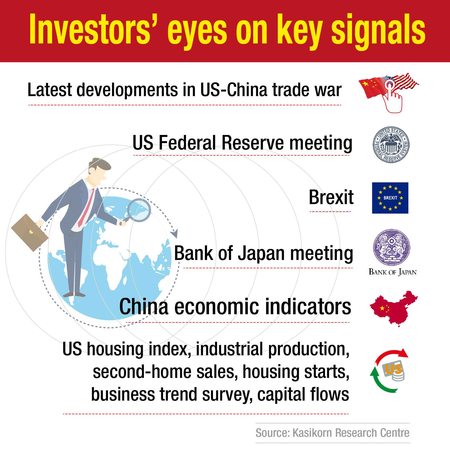
Next week, investors will await the latest developments in the US-China trade war, any movements in Brexit, the meeting of the US Federal Reserve on September 17-18, the meeting of the Bank of Japan, China economic data, fixed capital investment, industrial output and retail sales in August.

Investors are also eagerly awaiting key economic indicators in the US, including the survey of industrial activities by Fed’s New York branch; business trends of the Fed’s Philadelphia branch; the housing index in September; industrial production, second-home sales, housing starts in August and net capital flows in July, the research house added

Worries rise as baht scales six-year high

ศาสตร์เกษตรดินปุ๋ย : ขอบคุณแหล่งข้อมูล : หนังสือพิมพ์ The Nation

https://www.nationthailand.com/business/30376190

Worries rise as baht scales six-year high

Sep 14. 2019
By The Nation

1,398 Viewed

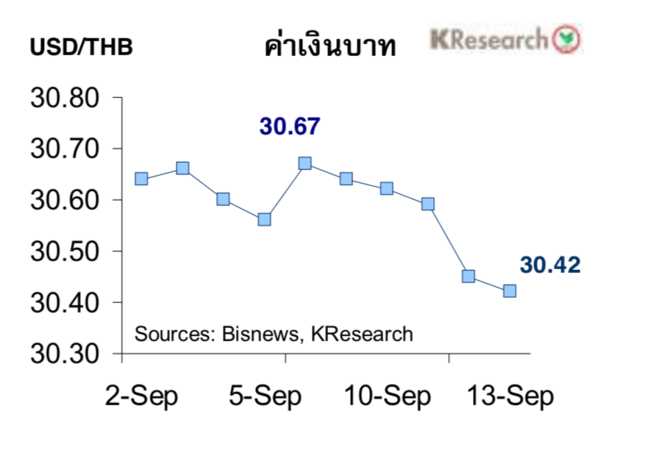
The baht continued its upward trend, appreciating to Bt30.42 to the US dollar on Friday, up from Bt30.67 the previous Friday, after having risen to a six-year high of Bt30.36 at some time during the day.

Regional currencies also moved up against the US dollar as markets expressed relief about the trade war and the European Central Bank (ECB)’s latest monetary easing.

The ECB cut its deposit facility rate, paid by banks on reserves parked with the ECB, to deeper negative territory from minus 0.4 per cent to minus 0.5 per cent and resumed bond purchases to encourage banks to lend more.

The measures came as Germany, Europe’s largest economy, showed signs of a looming recession. US President Donald Trump delayed tariff hikes on Chinese goods and China also postponed increasing tariffs on US goods.

The Kasikorn Research Centre forecast that the baht may move in a range of Bt30.20 and Bt30.60 a dollar next week.

Investors are awaiting latest developments in the trade war, the developments in Brexit, the meeting of the US Federal Reserve on September 17-18, the meeting of the Bank of Japan and Chinese economic indicators. Investors are also eagerly awaiting key economic indicators in the US, including a survey of industrial activities by the Fed’s New York branch; business trends by the Fed’s Philadelphia branch; the housing index in September; industrial production, second-home sales, housing starts in August and net capital flows in July, the research house added.

Exporters, economists and overseas Thai workers have long complained about the appreciating baht damaging exports, farm products and causing exchange losses for overseas Thai workers, adversely impacting the overall economy. Thai investors who invested in foreign equities were also facing exchange rate losses when repatriating money due to the rising baht.

Large corporates feel the pain of trade war, baht rise

ศาสตร์เกษตรดินปุ๋ย : ขอบคุณแหล่งข้อมูล : หนังสือพิมพ์ The Nation

https://www.nationthailand.com/business/30376182

Large corporates feel the pain of trade war, baht rise

Sep 14. 2019
By The Nation

753 Viewed

The trade war between the United States and China and the appreciation of the baht against other currencies have started to impact large corporates, say bankers.

Although large corporates are resilient to any impact and their ability to repay debt remained sound compared with small and medium-sized enterprises, the prolonged trade war had started to impact revenue and sales of large corporates, said Wasin Saiyawan, senior executive vice president and chief of wholesale banking at Siam Commercial Bank.

Also, the depreciation of the Chinese yuan against the baht had reduced exports to China for some corporates. This had  led to a year-on-year decline in income for these corporates, he said. So the bank has to take care of clients to ensure their ability to repay debts would not be affected.

He did not expect growth in lending to large clients. Currently outstanding loans to large corporates stand at Bt900 billion, according to Wasin. Bad debts or non-performing loans (NPLs) account for 1 per cent of total loans and the bank would try to prevent it rising over 2 per cent, he added.

Senathip Sripaipan, chief wholesale banking officer at TMB Bank, said that some large corporates have delayed investments, especially in overseas projects, because of the impact of the slow growth of the global economy and the ongoing trade war.

The bank is worried about large agri-business firms. The bank has not yet seen signs of debt default or rising bad debt. “But we have to closely monitor them,” he added.

Payong Srivanich, president and CEO of Krungthai Bank, said that some big businesses have started to cut their capacity utilisation from full utilisation to about 70 per cent. Some property developers have also delayed their investments in new projects, he added.

Pornchai Padmindra, co-head for wholesale banking and head of corporate banking and investment banking at CIMB Thailand, said that the trade war and the global slowdown had some impact on large firms.

Some of them have started to relocate their production base to avoid the impact of tariff hikes. “Big corporates could export their products to new markets,” he added.