SET boss talks up Thailand’s stock exchange

ศาสตร์เกษตรดินปุ๋ย : ขอบคุณแหล่งข้อมูล : หนังสือพิมพ์ The Nation

https://www.nationthailand.com/business/30375492

SET boss talks up Thailand’s stock exchange

Aug 28. 2019
By PHUWIT LIMVIPHUWAT
THE NATION

602 Viewed

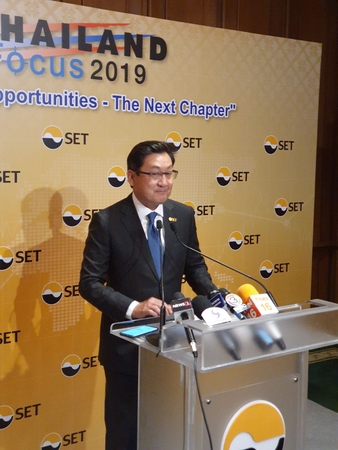
The Stock Exchange of Thailand (SET) can withstand external threats and will grow to become a key platform for start-ups and SMEs to gain access to capital, SET president Pakorn Peetathawatchai said on Wednesday.

Pakorn was speaking at the Thailand Focus 2019, an annual event organised by the SET to inform both foreign and local institutional investors on the investment opportunities in the Kingdom’s capital market.

“The key focus of today’s conference will be on empowering start-ups and small and medium-sized enterprises (SMEs) in the country as well as increasing connectivity between Thailand and the CLMV (Cambodia, Laos, Myanmar and Vietnam) subregion,” Pakorn said.

One hundred and twenty seven foreign institutional investors with a combined market cap of US$2.6 trillion, larger than Thailand’s GDP value turned out for the event.

Also participating were 203 local institutional investors and 105 listed firms, who listened closely to the investment opportunities in the stock market, according to the SET president.

“Going forward, the SET will offer more opportunities for start-ups and SMEs to gain access to capital, which will in turn, strengthen Thailand’s economy,” he said.

The key sectors that are considered Thailand’s strength are the well-being sector, healthcare, hospitality, agriculture and manufacturing, he said, adding that the conference would discuss how Thailand can become a regional leader in these areas as the country’s population starts to age.

Meanwhile, Pakorn dismissed the potential external threats to Thailand’s stock market such as the ongoing trade conflict between the US and China.

“Thailand’s stock market has a sufficiently high level of stability as the country’s financial sector maintains an impressive level of financial discipline,” he said during an interview on the sidelines.

B Grimm Power to issue debentures to refinance its debts

ศาสตร์เกษตรดินปุ๋ย : ขอบคุณแหล่งข้อมูล : หนังสือพิมพ์ The Nation

https://www.nationthailand.com/business/30375450

B Grimm Power to issue debentures to refinance its debts

Aug 28. 2019
File Photo by B Grimm Power

File Photo by B Grimm Power
By The Nation

769 Viewed

B Grimm Power, an SET-listed energy company, is considering refinancing its debt by issuing new debentures to repay its debts, its chief financial officer Nopadej Karnasuta said.

He added that the company has Bt60 billion in interest-bearing debt, of which Bt30 billion has already been refinanced. It is planning to refinance the rest to further cut its financial costs.

The plan is in line with the trend of declining loan interest rates.

Also, the drop in the price of liquefied natural gas (LNG) this year has benefited the company as the cost of LNG it uses in its power plants accounts for 70 per cent of its operating cost.

B Grimm Power has also set aside Bt10 billion this year for developing its own power plant and for the takeover of power plants in Thailand and overseas.

Siam Kubota targets high as govt promotes agricultural equipment

ศาสตร์เกษตรดินปุ๋ย : ขอบคุณแหล่งข้อมูล : หนังสือพิมพ์ The Nation

https://www.nationthailand.com/business/30375444

Siam Kubota targets high as govt promotes agricultural equipment

Aug 28. 2019
File Photo by Siam Kubota Corporation Co Ltd

File Photo by Siam Kubota Corporation Co Ltd
By The Nation

594 Viewed

Siam Kubota Corporation Co Ltd, a manufacturer of tractors and agriculture equipment, is aiming to achieve Bt100 billion in revenue over the next five years now that it has recorded total revenue of Bt27 billion in the first half of this year, or up 9 per cent from the same period last year, the company’s president Hiroto Kimura said on August 27.

Up to Bt17-billion of its total revenue in the first half of this year came from the domestic market, while the remainder came from exports, he said, adding that the company is confident it will achieve Bt60 billion in revenue by the end of the year or up 12 per cent from 2018.

“Our total sales rose in the first half thanks to the government’s policy to promote the use of agricultural equipment to replace labour as the price of some agricultural products have risen, which is improving the farmers’ purchasing power,” he said.

Kimura added that the company believes its total review will grow more than 10 per cent a year until 2023, helping it earn total revenues worth Bt100 billion during that period.

Siam Kubota has also set aside an investment budget of Bt100 million and Bt200 million a year until 2023 to boost its sales to achieve the target, he said.

Esso looking ahead – even to EV charging

ศาสตร์เกษตรดินปุ๋ย : ขอบคุณแหล่งข้อมูล : หนังสือพิมพ์ The Nation

https://www.nationthailand.com/business/30375452

Esso looking ahead – even to EV charging

Aug 27. 2019
By The Nation

469 Viewed

Esso plans to spend Bt6 billion opening 700 petrol stations across Thailand by 2021 and another Bt700 million renovating existing ones. Its aim is to become the country’s third-biggest petrol retailer following the introduction of “Synergy Fuel Technology”.

ExxonMobil director and retail manager Yodpong Sutatham said Esso (Thailand) expects sales to exceed market expectations of 2-3 per cent.

It will expand its reach to 640 stations by year’s end and to 700 by 2021, he said, and spend Bt1 million per station on renovations. Seventy per cent of its outlets – 430 in all – have already been refurbished and all of them will be by next year.

Esso’s Synergy Fuel Technology incorporated in every type of petroleum is touted as doubling engine protection and improving acceleration. Its introduction hiked global sales of both regular and premium petroleum by 10 per cent, Yodpong said.

He said Esso believes the technology will continue boosting sales, maintain the firm’s 13-per-cent share of the Thai petroleum market and earn it third place among all oil companies.

Customer memberships are expected to increase to 3 million by year’s end from the current 2.5 million.

Manoch Munjitjuntra, director and manager of retail sales at Esso Thailand, said the company supports plans to adopt Euro 5 standards and is improving its B100 – biodiesel made from crude palm oil – to meet the standards of the Japan Automobile Manufacturers Association.

“The company also sees opportunities even in the electric vehicles that are starting to gain more attention,” Manoch said.

“We forecast that Thailand will continue relying on oil as the main fuel for the next 20 years, especially in transportation. But we have begun trials on an EV charging station, and if that business expands, we will invest more in it.”

Esso’s Synergy fuels make Thai debut

ศาสตร์เกษตรดินปุ๋ย : ขอบคุณแหล่งข้อมูล : หนังสือพิมพ์ The Nation

https://www.nationthailand.com/business/30375445

Esso’s Synergy fuels make Thai debut

Aug 27. 2019
By The Nation

454 Viewed

Esso has launched a new line of gasoline and diesel fuels, produced with its new Synergy Fuel Technology that offers 30 per cent improved cleaning ability and engine protection. Additional benefits include improved acceleration and engine response.

The technology now applies to all Esso fuel grades in Thailand.

Yodpong Sutatham, AP Marketing Programs Manager of ExxonMobil Ltd, said, “The Synergy Fuels Technology is the new global standard for our fuels. The introduction in Thailand today is part of our global launch, with similar events already held in the Asia-Pacific region including Singapore, Hong Kong, Australia, New Zealand, Guam, Saipan and New Caledonia.”

He said the Synergy Fuels Technology was developed at the same ExxonMobil Research and Engineering labs used by the Red Bull Formula One Racing Team, and includes dual detergents to clean engine parts such as intake valves.

Manoch Munjitjuntra, Esso Director and Retail Sales Manager at Esso (Thailand) Public Company Limited, said Esso is investing in more attractive and brighter service stations to enhance our customers’ overall experience.

All Esso service stations in Thailand will be converted to the new Synergy look. Currently, 70 per cent of its 617 stations across Thailand have been converted to the new look with the rest to be completed by early 2020.

Muang Thai on target for Bt28-bn year

ศาสตร์เกษตรดินปุ๋ย : ขอบคุณแหล่งข้อมูล : หนังสือพิมพ์ The Nation

https://www.nationthailand.com/business/30375440

Muang Thai on target for Bt28-bn year

Aug 27. 2019
By The Nation

413 Viewed

Muang Thai Life Assurance Plc is confident of the first year premium Bt28 billion by year’s end after seeing a 25-per-cent hike in sales of new premium health policies in the first seven months of 2019 compared to the same period last year.

President and chief executive Sara Lamsam said on Tuesday its life insurance and non-life insurance sales grew an average 10 per cent in the first seven months.

However, its overall premium revenues declined by 13 per cent in the same period due to some customers’ contracts expiring as others suspending payment.

Trade conflicts taking toll on businesses: Atradius

ศาสตร์เกษตรดินปุ๋ย : ขอบคุณแหล่งข้อมูล : หนังสือพิมพ์ The Nation

https://www.nationthailand.com/business/30375482

Trade conflicts taking toll on businesses: Atradius

Aug 28. 2019
By The Nation

120 Viewed

The continuing uncertainty of world trade is increasingly taking its toll, according to Atradius, one of the world’s largest credit insurers, in its global insolvency forecasts for 2019.

North America is in the lead with 3.2 per cent, and outperforms Western Europe (2.7 per cent). Asia-Pacific, for the first time since 2009, is seeing a significant increase in corporate insolvencies with 1.8 per cent expected.

While the increase in the number of global bankruptcies in the first half of 2019 was mainly driven by Western Europe, North America is now leading. Trade tensions with China are increasingly beginning to hurt the US economy and the number of bankruptcies is increasing for the first time since 2010. Atradius expects the negative effects of this to be increasingly strong and the upward trend in the number of bankruptcies will continue in 2020 with an expected further upsurge of 2 per cent. Many US companies, especially in the vulnerable retail sector, will be affected. Globally, Atradius expects solvencies to increase by 1.2 per cent in 2020.

“The number of insolvencies continues to rise globally. Given the increasing tensions with China, the US has taken over the leading position in the rise of insolvencies from the eurozone. It is also worrying that similar developments are taking place in Asia-Pacific. The number of bankruptcies in this region is increasing for the first time in 10 years. The likelihood of this situation deteriorating further in the coming period is considerable,” said John Lore, chief economist at Atradius.

Trading on SET predicted to remain stagnant

ศาสตร์เกษตรดินปุ๋ย : ขอบคุณแหล่งข้อมูล : หนังสือพิมพ์ The Nation

https://www.nationthailand.com/business/30375477

Trading on SET predicted to remain stagnant

Aug 28. 2019
By The Nation

121 Viewed

The Stock Exchange of Thailand (SET) Index on Wednesday is likely to fluctuate between 1,610 and 1,625 as investors continue to show concern for the trade war between China and USA as both countries threaten to add more tariffs, Krungsri Securities Plc said on Wednesday morning.

Meanwhile, the Dow Jones Index on Tuesday closed at 25,777.90, a drop of 120.93 point or 0.47 per cent from Monday as the US’s 10-years bond yield dropped to its lowest in three years at 1.47 per cent.

The SET index closed at 1,615.47, a drop of 7.26 points or 0.45 per cent, with a trade value of Bt69.97 billion, forced down by recorded net sales of Bt1.72 billion.

However, Krungsri Secrities believes that the investment sentiment in SET will improve after the Thailand Focus meeting from August 28-30, that should pave the road towards improving the economy and investors’ confidence.

The impact digital technology is having on media organisations

ศาสตร์เกษตรดินปุ๋ย : ขอบคุณแหล่งข้อมูล : หนังสือพิมพ์ The Nation

https://www.nationthailand.com/business/30375461

The impact digital technology is having on media organisations

Aug 28. 2019
By KWANCHAI RUNGFAPAISARN
THE NATION

881 Viewed

Technological disruption has had a major impact on many business sectors, including the mass-media industry, which is forcing most mass-media organisations to make adjustments to cope with the changing landscape and cater for paperless consumers.

Professor Surapongse Sothanasathien, chairman of the university council at Rajamangala University of Technology Phra Nakhon (RMUTP), said media organisations will only survive difficulty by adjusting their content so it is appropriate for new digital media. They also have to move the centre of contents from “sender” to “receiver”.

“In my experience, I have learned that journalism has never died despite the disruption. It’s just that media organisations and reporters are unable to survive because they cannot adjust to changes,” Surpongse said.

He added that mass-media organisations should stop relying on content raised in social media, but instead follow these stories, add value and create good related reports themselves, noting that social media is not the final answer.

He explained that with the fall of traditional media, mass-media organisations need to gradually move to new media formats. For instance, many European countries no longer have traditional television, but instead consumers rely on podcasts and video streaming to access preferred content when and where they want.

“At present, many mass-media organisations are owned or managed by people who lack the knowledge of journalism and mass communications. Senior journalists, who are also part of the management, do not have good knowledge about business communication and management. This is why, many media organisations are failing,” he said, noting that despite the collapse of many media organisations, the government has not made the issue part of the national problem that requires urgent solution.

Larry Chao, managing director of Chao Group Limited – a consultancy on organisation change – said that last year, for the first time, the daily consumption of digital media accelerated past traditional media with more than 50 per cent of overall time spent. Since then, digital media has supplanted traditional media and now defines the industry. Media agencies that have not come up with clear strategies to harness digital media risk being left behind, he warned.

Chao pointed out that digital media has created at least four major disruptions in the media landscape. First, digital media is rapidly replacing print, as evidenced by the gradual disappearance of print media, including the print edition of this newspaper earlier this year. With the cost of digital media dropping and digital devices like mobile phones improving access to news and information, digital media has rendered print media obsolete. In fact, in order to compete successfully, media agencies will need to tailor their offerings according to each online distribution channel. For example, how they communicate with the mass market on Facebook is different to how they might engage executives on LinkedIn.

Second, digital technology has spawned the development of digital media entrepreneurs, who have created a proliferation of media content. With low barriers to entry and readily available conduits to distribute their material, it is only a matter of time before they start eating into the market share of traditional media players that have relied on in-house creativity and production. Existing media agencies will need to decide how to compete with this influx of agile competitors, or better yet, how to leverage their capabilities as outsourcing partners.

Third, the digital industry has been a boon for video content and technology. Consumers nowadays have an attention span that lasts a few seconds compared to a few minutes in the past, so media agencies should learn to capture their attention quickly, or they can lose them. This has forced many media agencies to re-think the way they share their clients’ products and services with consumers. Perhaps the answer is a combination of capturing the audience’s attention with snippets of enticing digital media, while continuing to search and innovate other non-media sources of communication.

Fourth, with so much digital media bombarding audiences it is not surprising that people have grown wary of what they see and believe. Clever artificial intelligence had created media content dubbed “deep fake”, which fooled people initially but has now started raising suspicion. To win over consumers, media businesses will need to convince them that what they are portraying is genuine and not just a lot of bells and whistles. The quality, creativity and relevance of media content and the products and services they represent will also be vital.

“To adapt to the disruptions and come out ahead, media agencies need to be crystal clear about their strategies and what they expect from their investments. The current frenzy surrounding digital media disruption reminds me of when US president Richard Nixon first opened the door to China in 1972. At that time, companies were climbing over each other trying to get a piece of the ‘China action’. Investment dollars haphazardly poured into the country hoping something would stick. But in the end, results were underwhelming and companies learned the dangers of overpromising without clear strategies,” Chao said.

He said the same caution holds true today for media agencies. Before making huge investments in digital media, it is crucial to define the benefits and desired results. For example, what do you really want to get out of your digital transformation? Are your initiatives scalable? Will they enhance consumer experience? How will you measure success?

“Despite the urgency to embrace digital media, it is important for media companies to step back and assess how they need to proceed before being swept up by the digital current,” he noted.

Kiatanantha Lounkaew, a lecturer at Thammasat University’s Faculty of Economics, said the advent of digital technology has had three disruptive effects on media industry.

Firstly, the boundary between content producers and content consumers has been eliminated. In a world where a person can be both on the supply and demand side of the market, traditional economic logic is not applicable anymore. There are no easy answers to simple questions like how to price or how much content to produce or who to market it to.

Secondly, size, resources or even regulatory protection from the government are no longer effective barriers. With smartphones connected to the internet, anybody can become part of the media industry. This is why media powerhouses have found themselves on the same playing field with small content creators competing for the same audience. While small operators are agile, media giants have to fight on two fronts – a head-on battle with big media as well as fighting guerrilla warfare with tiny competitors. To complicate things further, these small competitors are also often consumers.

The last effect is shifting the market power to the hands of customers. Traditional media prides itself for being able to mass-produce content for a large group of consumers. Digital technology, meanwhile, enables consumers to tailor the selection of content to meet their appetite. Hence, mass media is no longer the mantra for success in this new landscape.

“It is understandable that, when faced with unprecedented challenges, most traditional media giants chose to respond in the same manner: cutting cost, developing digital platforms and offering a mixture of content with the hope of maximising on the number of consumers. But a strategy used by everyone cannot be called a strategy, it’s just a rat race. Big media still have an advantage over small competitors on several fronts. For instance, experienced crew means better content quality, while well-recognised brands can also be an asset in terms of attracting audiences. They have a network of people and resources that small media do not have access to,” Kiatanantha said.

He added that small media providers are fast, but they can’t offer in-depth analyses. Plus, small media operators are situational – their interests are based on events that have the prospect of attracting mass attention. Once they succeed or fail with that, they will move on. They do not have sufficient resources to stick to a certain issue for a long period of time. Also, many of them cannot produce several pieces of high-value content in a short period of time. Big media should exploit these loopholes to their advantage. Counter speed with accuracy. Counter superficiality with enriched content. Counter copycats by making content their signature.

“The time ahead will be challenging for everyone in the media industry. Disruption is simply an unanticipated storm. To withstand this digital storm, you need balance between strengthening your core competency and trying to be more flexible. Doing otherwise might open the door to catastrophe,” Kiatanantha said.

Punyapon Tepprasit, chief executive officer of MVP Consultants and post-graduate lecturer on industrial management at Ramkhamhaeng University, said the disruption of media organisations has been continuous, beginning from the advent of and rising access to the internet.

“Humans have always wanted to keep up-to-date, and now they want to do that quickly. Traditional media formats cannot satisfy this need like online media can, with the latest news just a click away. Also news can be accessed conveniently and at a lower cost than other platforms. This disruption caused by changing consumer behaviour and the advent of many new technologies has become a big problem for media organisations,” he said.

Punyapon said changing consumer behaviour has resulted in a change in the behaviour of mass-media organisations. The most important thing that will help media organisations to be able to adapt in this time of disruption will occur in the future, when each phase of corporate communication is adjusted to create market awareness and behaviour as well as the needs of the consumers.

He said media organisations must focus on both internal and external communications. Internal communication must be adjusted using the “agile” concept, which focuses on communication and interaction between people in the organisation, rather than using tools to emphasise the creation of quality news. This can respond to the work that enhances the quality of news for people within the organisation. In presenting news for customers or audiences, it will focus on developing news content at every step of corporate communication.

Meanwhile, external communication must target consumers or audiences more by using the concept called “co-design”. This is in collaboration between the organisation and the target consumer in order to reach their needs such as by conducting research via their own purchase platforms in the form of polls or collecting information for reading and viewing news. The customers’ needs can be analysed and demands can be ranked by clustering target groups in line with their behaviour and preferences to create news that can meet the needs of customers or audiences.

Foreigners own 30% of Thai stocks

ศาสตร์เกษตรดินปุ๋ย : ขอบคุณแหล่งข้อมูล : หนังสือพิมพ์ The Nation

https://www.nationthailand.com/business/30375458

Foreigners own 30% of Thai stocks

Aug 28. 2019
1,094 Viewed

The ratio of foreign ownership in the Thai stock market as of June is estimated at 29.9 per cent, valued at Bt5.15 trillion, according to the Securities Exchange of Thailand (SET).

SET researcher Sumitra Tangsamavorapong said the ownership ratio is obtained from the corporate action registrar and trading information within the SET.

She said up to 50 per cent of ownership is in the banking, energy and utility sectors, as well as IT and communications.

“Investors in 114 countries own stocks in Thailand, four more than last year,” she said.

The top foreign investors are in Britain, Singapore and the United States, followed by Hong Kong, Japan, Switzerland, Mauritius, France, the Netherlands and Luxembourg.

In total they own a combined Bt4.59 trillion worth of stocks in the SET.