Economic uncertainty brings down auto sales

ศาสตร์เกษตรดินปุ๋ย : ขอบคุณแหล่งข้อมูล : หนังสือพิมพ์ The Nation

https://www.nationthailand.com/business/30375448

Economic uncertainty brings down auto sales

Aug 28. 2019
By The Nation

927 Viewed

The Thai automobile market in July declined by 1.1 per cent, with insiders saying that economic uncertainty is causing consumers to delay purchases.

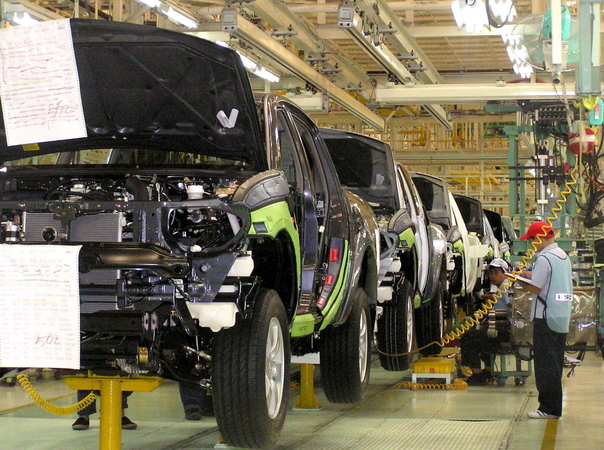
According to Toyota Motor Thailand Co Ltd (TMT), 81,044 vehicles were sold in July, comprising 32,794 passenger cars (up 0.8 per cent) and 48,250 commercial vehicles (down 2.4 per cent).

“Consumers are concerned about the economy that has been slow in recovering, as agriculture prices have remained low. That has curbed any growth in purchasing power this month,” said Paveena Nanthikulvanich, vice president at TMT.

She said in the first seven months of the year, 605,814 vehicles were sold, an increase of 5.9 per cent over the same period last year.

“Demand for automobiles was high during the first half of the year and there were a large number of sales promotions to attract customers. That helped the market grow,” she said, adding that sales in August are expected to remain stable.

“The government’s economic stimulus measures will help strengthen consumer and investor confidence, but financing is tight and some consumers are still concerned about the uncertainty in the world economy,” she said.

Toyota is a top brand in automobile market with 197,262 vehicles sold from January to July 2019, followed by Isuzu with 103,011 units and Honda with 75,723 units.

50,000 tonnes of sticky rice found stored

ศาสตร์เกษตรดินปุ๋ย : ขอบคุณแหล่งข้อมูล : หนังสือพิมพ์ The Nation

https://www.nationthailand.com/business/30375463

50,000 tonnes of sticky rice found stored

Aug 27. 2019
Commerce Minister Jurin Laksanavisit: File photo

Commerce Minister Jurin Laksanavisit: File photo
By THE NATION

857 Viewed

Now that a nationwide inspection of granaries was completed on August 27, inspectors will study the data in hand to decide whether the price of sticky rice is rising due to hoarding, Commerce Minister Jurin Laksanavisit said.

As of 2pm on August 27, reports from 280 warehouse owners showed that they had in store a total of 50,000 tonnes of sticky rice. Jurin ordered the inspection in response to the rapidly rising price of sticky rice, which also saw a smuggler being arrested trying to smuggle 30 tonnes of the grain into Thailand from Cambodia last week.

Jurin set the deadline for reports at 4.30pm on August 27, and those failing to report in time will face a thorough inspection to see if they can be considered as hoarders.

Reports had been sent in by owners of storage facilities in 41 provinces. So far, no details are available about how many people have been storing sticky rice grains across the nation.

Prayut intervenes in AOT-CPN row over Central Village

ศาสตร์เกษตรดินปุ๋ย : ขอบคุณแหล่งข้อมูล : หนังสือพิมพ์ The Nation

https://www.nationthailand.com/business/30375462

Prayut intervenes in AOT-CPN row over Central Village

Aug 27. 2019
By THE NATION

1,175 Viewed

Prime Minister Prayut Chan-o-cha today (August 27) ordered the Ministry of Transport and Interior Ministry to investigate the dispute between the Airports of Thailand (AOT) and Central Pattana (CPN) over the latter’s premium complex project “Central Village”, saying that fairness will be ensured for both parties.

AOT had previously objected to the development of the 184-rai luxury mall, reasoning that it would cause traffic congestion on the roads to Suvarnabhumi, and that lighting in the area would pose an aviation risk as it could distract pilots during landing. It also alleged that the developer lacked proper authorisation.

The Bt5-billion Central Village is the first international luxury outlet in Bangkok, situated next to Suvarnabhumi Airport on 100 rai with a total project area of 40,000 square metres.

CPN will tomorrow (August 28) conduct a press tour of the project, having declared that it was legally built in strict compliance with current city planning regulations. Central Village also has a valid licence from an authority with approval power to connect its entrance with the airport. CPN said it hopes for a fair investigation.

At the Cabinet meeting today (August 27), the prime minister asked all related agencies to swiftly solve the dispute between AOT and CPN.

“I have ordered the Ministry of Transport and Interior Ministry to take up the case to ensure fairness to both parties. The issue involves many stakeholders with some still subject to approval by local authorities,” said Prayut.

“I have told the AOT to submit a letter to the Civil Aviation Authority of Thailand to investigate the possible impact from the opening of the premium outlet mall, and the Interior Ministry to check whether the retail complex is in the green area and has received an valid licence ,” he said.

Prayut said the government will speed up the investigation and make a final decision. If the private sector is right, the public agency needs to approve the project. All parties have to act fairly, he added.

Interior Minister Gen Anupong Paojinda said the dispute was not centred on the land plot, but city planning problem which is the responsibility of the Sub-district Administration Organisation (SAO) and the chief district officer.

Permanent Secretary for Interior, Chatchai Promlert. has informed the Director General of Department of Provincial Administration and the chief district officer to find out the facts and submit a report.

Legal action will be taken if the SAO has committed wrong doings.

Rice, palm oil price guarantees fixed, rubber next

ศาสตร์เกษตรดินปุ๋ย : ขอบคุณแหล่งข้อมูล : หนังสือพิมพ์ The Nation

https://www.nationthailand.com/business/30375455

Rice, palm oil price guarantees fixed, rubber next

Aug 27. 2019
By The Nation

712 Viewed

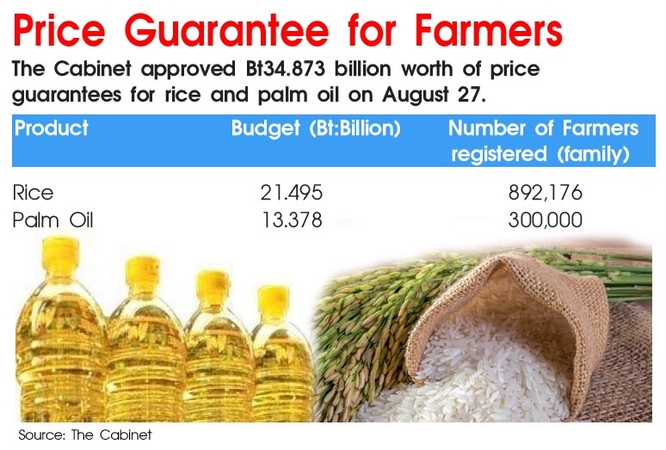
The Cabinet on Tuesday approved a Bt34.873-billion budget to guarantee growers a decent price on their rice and palm oil.

Deputy government spokesperson Ratchada Thanadirek said the rice budget of Bt21.495 billion was for 892,000 farm families registered with the Agriculture and Cooperatives Ministry.

The other Bt13.378 billion is for 300,000 registered palm-oil planters.

Applicable this month through September 2020, the oil-price guarantee is Bt4 per kilogram of product containing 18 per cent of oil per kilo. It’s based on the market price average of Bt3 per kilo plus Bt0.25 for transportation costs, allowing a price spread of Bt0.75.

Families producing palm oil on 25 rai or less are eligible, with the funds deposited in their Bank for Agriculture and Agricultural Cooperatives accounts.

The Cabinet also sanctioned long-term price-management measures such as using palm oil to produce electricity and diesel B20.

The rice price guarantee applies for one year starting in October and covers five types:

• Paddy rice grown at 15 per cent humidity, priced at Bt10,000 per tonne with an income guarantee for not more than 30 tonnes per household or not more than 40 rai

• Glutinous rice, guaranteed Bt12,000 per tonne up to 16 tonnes or 40 rai

• Jasmine rice, guaranteed Bt15,000 per tonne up to 14 tonnes or 40 rai

• Fragrant rice grown outside the coverage area, assured Bt14,000 per tonne up to 16 tonnes or 40 rai

• Pathumthani fragrant rice, guaranteed Bt11,000 per tonne up to 25 tonnes or 40 rai.

Another Bt25.842 billion was earmarked on Tuesday to support production costs averaging Bt500 per rai, up to 20 rai per family. It will apply to 4.3 million farm families.

A further Bt18.5 billion was set aside in an unallocated budget for farmers already hit by drought, to be used before September 30.

Price guarantee proposals for rubber will come before the Cabinet within the next two weeks, Deputy Prime Minister and Commerce Minister Jurin Luxanavisit said, with a likely ceiling of Bt26 billion.

Cabinet okays boost to R&D budget

ศาสตร์เกษตรดินปุ๋ย : ขอบคุณแหล่งข้อมูล : หนังสือพิมพ์ The Nation

https://www.nationthailand.com/business/30375451

Cabinet okays boost to R&D budget

Aug 27. 2019
Narumon

Narumon
By The Nation

621 Viewed

The Cabinet approved a Bt37-billion funding for research and development in fiscal year 2020, Cabinet’s spokesperson Narumon Pinyosinwat said after a meeting today ( August 27).

It is an addition to the research and development budget, she said, aimed at achieving a 1.5 per cent growth of the country’s gross domestic product (GDP) in 2027, from the current 1 per cent.

She said the Cabinet also approved the proposed policy and strategy for educational studies, research and innovation from 2020-2027.

Meanwhile, Narumon said the investment budget has been divided into four areas: 1) Bt11 billion on human resource and education, including developing workers’ skills to match the demand of the Eastern Economic Corridor and AI for all; 2) Bt5.55 billion to boost ageing and agriculture industries; 3) Bt9.25 billion to improve the country’s competitiveness and the country’s infrastructure; 4) Bt7.4 billion in innovation, poverty eradication and city development.

Transport minister seeks review of terms on airport rail link

ศาสตร์เกษตรดินปุ๋ย : ขอบคุณแหล่งข้อมูล : หนังสือพิมพ์ The Nation

https://www.nationthailand.com/business/30375441

Transport minister seeks review of terms on airport rail link

Aug 27. 2019
File Photo by BangkokBizNews

File Photo by BangkokBizNews
By THE NATION

454 Viewed

Transport Minister Saksayam Chidchob has written to State Railway of Thailand (SRT)’s acting governor Worawut Mala asking him to review the terms of reference (ToR) for the high-speed rail linking the three key airports in the Central region, namely Don Mueang, Suvarnabhumi and U-Tapao.

Meanwhile, a joint venture agreement between the government and the private sector on the high-speed railway has been drafted.

“The high-speed rail project connecting the three airports will be the first Eastern Economic Corridor [EEC] project that has a contract signed between the government and the private sector,” Saksayam said.

Thus far, the Transport Ministry has been involved in four key projects in the EEC, including the construction of the high-speed rail, aircraft maintenance, a repair and overhaul centre in U-Tapao Airport and developing the airport for commercial use.

Meanwhile, details of the joint venture between the government, the CP Group and its partners have been finalised, Worawut said, though he has yet to receive a formal request for details of the ToR from Saksayam.

“Once the request arrives, we have prepared relevant details to report to the Transport Ministry,” Worawut said.

A source in the SRT revealed that CP will take about two weeks to review the joint-venture details before the appointment of the investment committee for the high-speed rail project will commence.

The value of the high-speed rail is projected at Bt224 billion, with Bt168 billion going to trains, Bt45.1 billion to land development for the rail project and Bt10 billion to the development of the airport link. The project is expected to yield economic benefits worth Bt700 billion.

Commerce Ministry to promote Narathiwat-produced goods in Asean

ศาสตร์เกษตรดินปุ๋ย : ขอบคุณแหล่งข้อมูล : หนังสือพิมพ์ The Nation

https://www.nationthailand.com/business/30375439

Commerce Ministry to promote Narathiwat-produced goods in Asean

Aug 27. 2019
(File Photo) Photo by The Nation

(File Photo) Photo by The Nation
By The Nation

304 Viewed

The Commerce Ministry’s Trade Negotiations Department plans to promote products indigenous to Narathiwat province in the Asean market, the department’s director-general Auramon Supthaweethum said on August 27.

She said officials from the department have been meeting with communities in Narathiwat on August 27 and 28, including the Tak Bai Salted Kula Community Enterprise Group, which produces geographical indication products, as well as small and medium enterprises that produce garments, processed seafood etc.

The department will also provide information on how goods can be exported to Asean countries, she said.

According to the department’s survey, the first seven months of this year saw 26.6 per cent of total fresh durian exports worth US$988.4 million (Bt30.2 trillion), or $263.8 million, being exported to Asean, followed by the US, Japan and Europe, she said. Export of durian in the first seven months rose 4.3 per cent compared to the same period last year, which recorded durian exports worth $947.6 million.

July’s MPI falls 3.23 per cent

ศาสตร์เกษตรดินปุ๋ย : ขอบคุณแหล่งข้อมูล : หนังสือพิมพ์ The Nation

https://www.nationthailand.com/business/30375437

July’s MPI falls 3.23 per cent

Aug 27. 2019
By The Nation

270 Viewed

The manufacturing production index (MPI) in July stood at 100.07 points, dropping 3.23 per cent year on year as the global economy dropped off with a capacity utilisation of 65.68 per cent, said Aditad Vasinonta, deputy director-general of the Office of Industrial Economics (OIE).

The decline in MPI could be attributed to three factors: 1) industrial product exports expanded by just 0.004 per cent during the month; 2) car production in July fell 6.7 per cent for the third drop in three consecutive months with domestic sales and exports falling 1.1 per cent and 8.9 per cent respectively; 3) Industries Sentiment Index (TISI) dropped in July to 93.5 points from 94.5 points in June, the lowest in seven months.

Industries with the biggest impact on Thailand’s MPI are distilleries, non-alcohol beverages, air conditioner, palm oil, and furniture.

OIE forecast the MPI will expand by 0.5 per cent, in line with the indicators of industrial growth rate.

Knight Frank cautiously upbeat on Bangkok office situation

ศาสตร์เกษตรดินปุ๋ย : ขอบคุณแหล่งข้อมูล : หนังสือพิมพ์ The Nation

https://www.nationthailand.com/property/30375429

Knight Frank cautiously upbeat on Bangkok office situation

Aug 27. 2019
By The Nation

96 Viewed

The first half of 2019 has seen Bangkok office rents soar to unprecedented levels, and while occupancy rates remain high, the influx of new supply over the next six months coupled with economic headwinds will be a real test for the market, as executive at Knight Frank Thailand said on Tuesday.

Executive director Marcus Burtenshaw also warned that tenants whose leases are expiring will face the problem of rising accommodation costs for the foreseeable future.

He said political uncertainty coupled with the US-China trade war has had a dampening effect on the Thai economy. The World Bank believes economic growth will fall to 3.5 per cent this year from 4.1 per cent the previous year.

Exports also contracted by 4 per cent in the first quarter 2019 – the first quarterly decline in three years – as the baht continues to appreciate against the US dollar.

Meanwhile, public investments in infrastructure, which have been identified as a major growth driver for the economy, slowed in implementation due to election-related delays. Nevertheless, low inflation, rising employment levels and rising recurrent fiscal spending are still boosting private investment and household consumption to close to their three-year high.

Knight Frank Thailand Research indicates that, in the second quarter, one new office building was completed outside the CBD. As a result, total supply in Bangkok increased by 46,000 square metres, to a total of 5,028,419sqm.

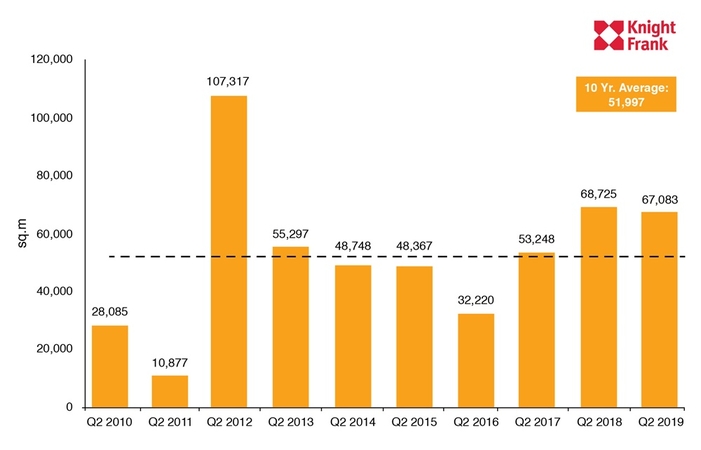
Despite slightly subdued occupier activity at the start of the year, market activity picked up considerably in the second quarter, as take-up increased to 67,083sqm from 37,974. A significant portion of the quarterly take-up occurred at the newly completed building, indicating tenants’ preferences for new supply. Although the take up is marginally lower Y-o-Y, it is still above the 10-year average of 51,997sqm.

Net absorption was positive at 5,910sqm in this quarter, increasing total occupied space to 4,575,121sqm. Despite the quarterly increase, total occupied space is still down Y-o-Y. Over the past 12 months, total supply increased by 30,190sqm, but total occupied space declined by 22,794. This suggests that annual demand was lower than supply.

Given the economic slowdown and lack of prime properties added to the CBD in the past year, current and potential tenants could be adopting a wait-and-see approach on any office relocation or expansion plans that they may have.

Overall market occupancy rate dropped to 91 per cent from 91.7 in Q2. Despite the slight decline, the market occupancy rate has remained relatively consistent. The rate has been within a healthy range of 91 per cent to 93 over the past five years, signalling a high level of stability in the market. CBD occupancy rates declined for three of the four areas sampled.

Only the Asok-Phrom Phong area, which also has the highest occupancy rate at 96.8 per cent, experienced no change in this quarter.

Outside the CBD, Asok-Petchburi has the highest occupancy rate at 93.8 per cent, despite having declined by 0.5 per cent Q-o-Q. The area maintains a high occupancy rate as a result of its close proximity to the CBD.

However, the company has maintained the expectation that demand will pick up throughout the rest of the year as a result of greater post-election political stability, albeit at a subdued level due to the current economic uncertainty and cautious outlook.

The office market response to the supply entering in the second half will be a key indicator of demand over the next few years. Given projections that supply will increase by 4.3 per cent annually from 2019 to 2023, occupancy rates will drop if demand lags behind supply.

If asking rents rise, it may occur at a slower pace as tenant bargaining power grows with increasing options of high-quality office space.

Nexus analyses pros and cons for property sector

ศาสตร์เกษตรดินปุ๋ย : ขอบคุณแหล่งข้อมูล : หนังสือพิมพ์ The Nation

https://www.nationthailand.com/property/30375427

Nexus analyses pros and cons for property sector

Aug 27. 2019
Nalinrat/Photo by Nexus Property Marketing Co Ltd

Nalinrat/Photo by Nexus Property Marketing Co Ltd
By The Nation

157 Viewed

Nexus Property Marketing Co Ltd is advising property developers to adjust their investment strategies in the second half of this year since both local and foreign investors are focusing more on the recurring income sector.

It notes fluctuations in the global economy, lower investor confidence and the government’s LTV measures introduced this year.

But Nexus also pointed out positive factors including the reduction of the policy interest rate, transfer fee and specific business tax, which is to boost demand in the last four months of 2019.

Managing director Nalinrat Chareonsuphong said this week the firm’s analysis of data in the property market indicated it has to cope with uncertainties for the remainder of this year.

The US-China trade war has caused the renminbi’s depreciation, which affects overseas Chinese investment, including in Thailand. The political chaos in Hong Kong has also affected investment sentiment in Thailand. And the baht’s appreciation has hiked property prices for foreigners.

However, Thais remain the main buyers of Thai property, while the global market might affect only 10-15 per cent of the overall property market here. Although it does not impact much on the property market, it definitely impacts on Thai capital market.

In addition to the global negative factors, there are some domestic factors including LTV measure and higher household debt are causes for concern.

Once the government announced the LTV measure to prevent speculation among real estate investors, mortgages shot up before it could take effect. The result was a drop in loan approvals in the second quarter. Unless this measure is eased, the sector might be unable to grow at the same pace as in the past few years.

Since LTV measure was effective, Nexus has found that residential property sector in all price ranges has been slowed because buyers have to reconsider their ability to retain mortgages. This is the reason mid- and large-sized developers have called for the government to alleviate such measure.

To cope with this issue, a lot of projects that were launched in second quarter have adjusted their marketing strategies.

However, the Bank of Thailand cut the policy interest rate by 0.25%, causing a positive effect for developers who can apply for loans with lower investment cost, while individual borrowers can retain mortgages at the lower rate.

Another positive factor is the new government is the same group as served in the previous military government, so they can carry on their investment policies including infrastructure, mass transit and the special economic zone.

“Although the market has some positive factors, the impact from negative factors is more solid,” said Nalinrat.

“Therefore, some measures to boost demand for the remainder of this year are advised. For example, a reduction of property transfer fee and specific business tax for the projects that are ready to transfer this year can help reduce cost for buyers who meet LTV conditions. The government can also give more discounts for such fees to help developers reduce their inventories, as well as consider privileges for the second-hand or resale market.

“In Bangkok, the second-hand market is not growing as much as it should, although buyers can get larger properties than in new projects at the same price and same location. If the government issues these measures, the market should be better.”

Nexus forecasts that developers will speed up release of their inventory according to real demand. Demand from foreigners might not be as high as the past two to three years, particularly from China and Hong Kong.

Developers tend to shift their investment into the long-term recurring income property businesses, for example, hotels, office buildings and investment in overseas.

Developers might sell off land that’s not generating income for them or switch from residential to recurring income-based projects.