Chinese paying increasing attention to culture, leisure lifestyle

ศาสตร์เกษตรดินปุ๋ย : ขอบคุณแหล่งข้อมูล : หนังสือพิมพ์ The Nation

https://www.nationthailand.com/business/30375182

Chinese paying increasing attention to culture, leisure lifestyle

Aug 22. 2019
Chih-yuan Wang, category research director, retail, Mintel China Reports

Chih-yuan Wang, category research director, retail, Mintel China Reports
By THE NATION

98 Viewed

With China undergoing an industrial transformation, shifting from a primarily manufacturing economy toward a more service- and creative-centric one, Chinese consumers are paying more attention to cultural and leisure lifestyles.

Chinese are being increasingly encouraged to visit cultural and creative venues as the latest research from market intelligence agency Mintel reveals that as many as three in five (60 per cent) urban respondents say that they have been visiting more cafés in the past six months, while over half of those surveyed have increased visits to libraries (56 per cent) and bookstores (55 per cent). What’s more, two in five (40 per cent) in urban areas say they have been visiting more museums, and more than a third (36 per cent) say the same of art galleries.

Meanwhile, lower tier cities in China present great potential for cultural and creative industries. According to Mintel’s research, 61 per cent of respondents from Tier 2 cities visited libraries more in the past six months compared to just over half (51 per cent) of respondents in Tier 1 cities. This is also happening at bookstores (59 per cent Tier 2 versus 50 per cent Tier 1) and art galleries (39 per cent Tier 3 vs 32 per cent Tier 1).

“Chinese consumers today are paying more attention to cultural and leisure lifestyles, and are therefore spending more money on leisure and entertainment,” said Chih-yuan Wang, category research director, retail, Mintel China Reports. “As discussed in the Mintel Trend report ‘Slow it All Down’, as lives become faster and more hectic, there is a wider appreciation for taking one’s time. Cultural and creative visits present an opportunity for Chinese consumers to enjoy a degree of slow-paced escapism. We are seeing the emergence of new-format bookstores and lifestyle stores featuring comfortable spaces, aligning with consumers’ pursuit of leisure and better living. It’s not just about selling products, it’s also about selling a way of life,” Chih-yuan added.

“There is also great potential for the cultural and creative market in China’s lower tier cities. Compared to consumers living in Tier 1 cities, lower tier city residents tend to have a more laid-back lifestyle with less work stress and more free time. As such, they are more active when it comes to visiting cultural and creative venues. In addition, lower tier city consumers are ready to adopt more aspirational lifestyles – something that the cultural and creative industry should take note of.”

Research from Mintel’s report also shows that Chinese consumers are indeed spending more on leisure and entertainment. Total expenditure in the sector reached an estimated 2.04 trillion yuam (Bt8.87 trillion) in 2018, growing 9.7 per cent from 2017. The research reveals that going to the cinema has become the most popular cultural activity, with three quarters (74 per cent) of urban Chinese respondents having purchased film tickets in the past six months. This is followed by spending on exhibitions (40 per cent) and concerts, operas, dramas or plays (35 per cent).

“Despite the popularity of video streaming services, our research shows that Chinese consumers love going to the cinema. Going to the cinema is perceived as a leisure activity rather than a cultural one, showcasing the potential to explore the cultural aspects of cinema and the overall film industry. Transforming cinema from a leisure venue into a cultural venue will open up opportunities for the film- or play-related merchandise market.” Chih-yuan said.

Planned biorefinery first step to ‘Biopolis’

ศาสตร์เกษตรดินปุ๋ย : ขอบคุณแหล่งข้อมูล : หนังสือพิมพ์ The Nation

https://www.nationthailand.com/business/30375158

Planned biorefinery first step to ‘Biopolis’

Aug 22. 2019
Narong Sirilertworakul

Narong Sirilertworakul
By THE NATION

749 Viewed

The National Science and Technology Development Agency will invest Bt3.4 billion in a pilot biorefinery in the Eastern Economic Corridor of Innovation (ECCi).

The aim is to add value from biological research to industrial manufacturing and create innovative products, while raising Thailand’s as a hub for bio-technology in Southeast Asia.

President Narong Sirilertworakul said the agency in charge of managing the EECi had arranged for Prime Minister Prayut Chan-o-cha to lift the symbolic first shovel of soil next February 27 and construction of Phase 1A would be completed in the first quarter of 2021.

A significant aspect of the project is the development of a modern agricultural and the biorefinery industry to promote the benefits of both by mobilising a “Biopolis” – a city of innovation.

“We will set up the pilot plant at a scale similar to industrial manufacturing,” Narong said. “It will be able to handle many raw materials and produce diversified products. It will be certified with GMP [Good Manufacturing Practice] standards for the production of consumed goods, such as nutrients and medical foods, and will be non-GMP for products with external use, such as biochemicals and bioplastic products.”

He said the biorefinery will cost Bt3.4 billion for both the GMP and non-GMP factories.

“We are now recruiting a consulting firm that will tackle engineering design. Construction is expected to start next year and operations can begin in 2022,” said Narong.

He said the plant will help establish a “circular economy” in Thailand and reduce environmental problems by turning waste into useful products.

“This pilot plant will be the first in Southeast Asia and will play a crucial role in developing biological technology in Thailand,” Narong said. “We also plan to expand by offering plants to other potential markets, such as the United States, South America and Africa, which will promote the role of Thailand in the field.”

Bidding terms ready for Digital Park Thailand

ศาสตร์เกษตรดินปุ๋ย : ขอบคุณแหล่งข้อมูล : หนังสือพิมพ์ The Nation

https://www.nationthailand.com/business/30375151

Bidding terms ready for Digital Park Thailand

Aug 22. 2019
Dr Nuttapon Nimmanphatcharin

Dr Nuttapon Nimmanphatcharin
By NOPHAKHUN LIMSAMARNPHUN
THE NATION

832 Viewed

The Digital Economy Promotion Agency (Depa) is expected to issue new terms of reference shortly for the private sector to invest in the Digital Park Thailand project in Chonburi’s Sri Racha district.

Depa president and CEO Dr Nuttapon Nimmanphatcharin said the terms for bidding should have government approval soon after August.

The 800-rai, Bt4-billion infrastructure project is part of the Eastern Economic Corridor (EEC) special economic zone covering Chonburi, Rayong and Chachoengsao.

The aim is to attract world-class tech firms to set up shop here for ventures in edutainment, drones, robots, e-sports and other technology.

“Digital Park Thailand will be implemented as a public-private sector participation [PPP] greenfield project,” Nuttapon said. “We plan to turn Sri Racha into an innovation city, with the government offering tax and other incentives to promote high-value-added software and digital industries such as content for games and movies or the design and manufacture of smart devices, as well as robots.

“Digital Park Thailand also aims to tap startup entrepreneurs similar to Airbnb and Grab. The upcoming fifth-generation [5G] network also opens opportunities in new-use cases and applications for the internet of things [IoT],” he said.

Nuttapon said an IoT institute would also be established at Digital Park to develop entrepreneurs for new growth industries such as those in 5G, cloud innovation labs, AI design labs and data analytic centres.

The availability of physical infrastructure, a digital eco-system and other supportive facilities is crucial to the success of investors in the IoT institute, who will be given tax incentives from the Board of Investment as well as work permits and other privileges for foreign staff.

“Other countries such as Indonesia help startups by pledging to buy products and services from them so that they have a ready market at the outset to generate income for further development and for survival,” he said.

Thailand offers no such a government procurement, so it’s more difficult for startups in terms of marketing their products in the initial stage.

“Over the past two years, Depa has supported dozens of Thai startups, including those in manufacturing, most of which focus on direct-selling their products. Other impressive startups include those for logistics and truck-sharing or hotel catering platforms,” Nuttapon said.

“Chef and hotel kitchen-sharing platforms, for example, are good for small hotels because they don’t have to invest a lot of money in catering services or hire many people.

“In fact, tech-driven startups are good for the overall economy because they boost productivity in various sectors facing tech disruption.

“We need e-payment, e-services, e-inventory, e-logistic via sharing platforms to reduce business costs, and even e-products, for which orders are shared among multiple factories.

“The digital transformation life-cycle covers the starting point, preparations, action plans and growth and has to be managed properly. Compared to Vietnam, Malaysia and Indonesia, the country’s transformation pace has been too slow, while our labour costs and business competition keep rising.”

For tech startups, he said, the challenge is to nurture enough successful entrepreneurs. Too few startups are succeeding here.

“Only 10 per cent will survive, so the government has to help by creating a favourable eco-system. We also need accelerator and incubator programmes, as well as early-stage business-growth funding etc,” he said.

Depa currently provides each qualified startup with a Bt50,000 grant, after which those showing promise can apply for a Bt1-million “angel’s fund”.

Depa has also introduced a digital-transformation fund to help startups and existing businesses and industries in the development and adoption of new technologies.

The planned IoT institute, Nuttapon said, will provide office space and other infrastructure and enable AI, virtual reality, augmented reality and 5G labs for the development of smart devices or robots.

“Thailand should focus on food catering, healthcare, tourism and related platforms to drive digital economic growth, because these are also scalable in foreign markets,” he said.

US market a boon for Thai exporters as trade war bites

ศาสตร์เกษตรดินปุ๋ย : ขอบคุณแหล่งข้อมูล : หนังสือพิมพ์ The Nation

https://www.nationthailand.com/business/30375162

US market a boon for Thai exporters as trade war bites

Aug 22. 2019
By WICHIT CHAITRONG
THE NATION

951 Viewed

Thailand’s exports to the US rose by double digits in the first seven months of the year, partly due to the ongoing US-China trade war, which is making importers turn to Thailand.

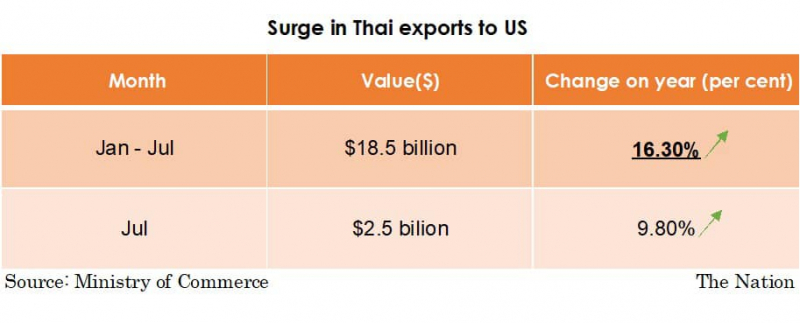
As of July 30, Thai exports to the US had risen 16.4 per cent to US$18.5 billion (Bt569.31 billion), closely followed by Thai exports to China at $16.3 billion for the same period. In July alone, Thai exports to the US rose 9.8 per cent to $2.5 billion.

Exports to the US accounted for 12.8 per cent of Thailand’s total exports, followed by 11.3 per cent to China from January to July this year, the Commerce Ministry said.

Last year, exports to the US accounted for 11.1 per cent of total exports, compared to 12 per cent to China.

“The growth of Thai exports to the US in the first seven months is high, partly due to the ongoing trade war and also because Thailand offers diversified products that can meet market demands there,” Pimchanok Vonkorpon, director-general of the Trade Policy and Strategy Office, said.

Thailand exports many different kinds of products to the US, such as rubber products, autos and auto parts, steel products, electrical home appliances, frozen food and home decorations, she said, adding that the prospect of the US market looks good overall.

Thai exports in July bounced back to 4.28 per cent with a total value of $21.2 billion (Bt652.3 billion), largely from gold exports as a safe-haven asset, the Commerce Ministry said, while exports not including gold and oil products, rose by 1.6 per cent.

“These figures provide us with some relief as we are seeing the export sector turn around and we expect a rise in the rest of the year,” Pimchanok said.

Previously, Orapin Sermpraphasilp, chairperson of the Federation of Thai Industries of the Eastern Region, said she has observed more US importers turning to Thailand as Chinese products are now subject to higher tariff.

The National Economic and Social Development Council also said on August 19 that some foreign investors have started relocating factories from China to Thailand in order to avoid high US tariffs.

A series of messages posted online by US President Donald Trump have convinced many investors that he is in it for the long haul where the dispute with China is concerned.

Nine-minute miss costs CP Bt290-billion project

ศาสตร์เกษตรดินปุ๋ย : ขอบคุณแหล่งข้อมูล : หนังสือพิมพ์ The Nation

https://www.nationthailand.com/business/30375160

Nine-minute miss costs CP Bt290-billion project

Aug 21. 2019
By THE NATION

1,443 Viewed

The court heard a testimony from the five petitioners that they had missed the 3-pm deadline for the formal submission by a mere nine minutes due to traffic congestion.

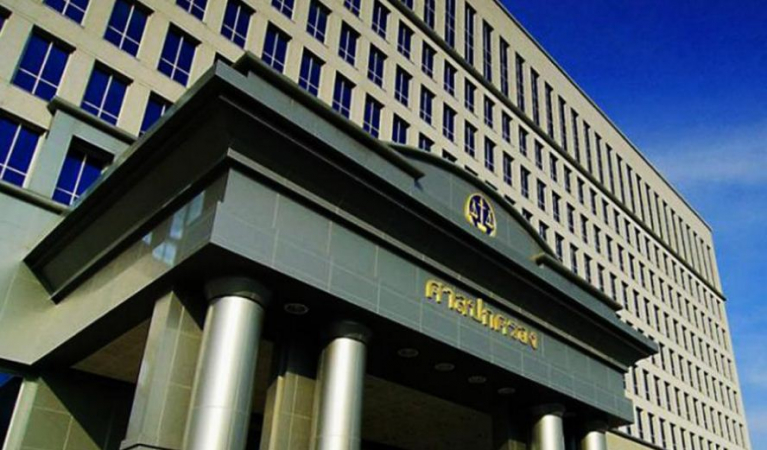
The Central Administrative Court today ruled against a construction consortium representing Charoen Pokphand Group (CP) through five affiliates that tried to submit bids, after the submission deadline on March 21, for the U-Tapao airport and Eastern Aviation City development projects worth a total of Bt290 billion.

The court heard a testimony from the five petitioners representing Thana Holding Joint Venture Co Ltd and four affiliates that they had missed the 3-pm deadline for the formal submission of bidding documents by a mere nine minutes due to traffic congestion.

The five petitioners are Thana Holding Joint Venture Co Ltd, B Grimm Joint Venture Co Ltd, Italian Thai Development Plc, Ch Karnchang Plc and Orient Success International Co Ltd.

They filed a joint complaint on April 10 with the court against a selection committee appointed by project owner Royal Thai Navy (RTN) for not formally accepting their bidding documents on that day at the RTN headquarters in Bangkok Noi district on the Thon Buri side of Bangkok.

As of 7.30 pm today (August 21), CP and the five petitioners have not issued a public statement as to whether they would appeal the court’s ruling, to exercise the right they are entitled to within a 30-day time frame.

Sontirat’s new energy plan to include local communities

ศาสตร์เกษตรดินปุ๋ย : ขอบคุณแหล่งข้อมูล : หนังสือพิมพ์ The Nation

https://www.nationthailand.com/business/30375157

Sontirat’s new energy plan to include local communities

Aug 21. 2019
Sontirat Sontijirawong

Sontirat Sontijirawong
By THE NATION

448 Viewed

Energy Minister Sontirat Sontijirawong plans to propose a new draft at the Energy Regulatory Commission’s meeting in September for future policies that will allow local communities to participate in electricity generation.

The minister also aims to boost alternative energy resources such as solar cell, biomass and biogas. Once his proposal is approved, he said he will release more details of the plan and procedure.

Sontirat also discussed his plan with leaders of the National Energy Reform Committee on August 21, and all attendees agreed that the generation of alternative energy will strengthen the economy at the grassroots level. The minister also plans to set up an advisory committee comprising representatives of related agencies as well as four members of the energy reform committee.

Separately, the National Energy Reform Committee gave Sonti a petition on the following issues:

1. Retail price of oil should not be based on Singapore’s price and the price calculation must be improved so it is fair;

2. Concerns about Thailand-Cambodia territorial claims, as Thailand may lose rights on the area if it agrees it is overlapping;

3. Corruption in the bidding for Erawan and Bongkot gas fields, which are allegedly not operating for the sake of Thai people;

4. Listing the PTT Oil and Retail Business Co Ltd (PTTOR) in the Stock Exchange of Thailand may be against the law;

5. The national electricity generating plant must generate more than half of all the electricity consumed in the country;

6. Investigation into the Rolls-Royce corruption case must be speeded up as it involves the state-owned energy company.

Govt posts Bt457.33 billion deficit for first 10 months

ศาสตร์เกษตรดินปุ๋ย : ขอบคุณแหล่งข้อมูล : หนังสือพิมพ์ The Nation

https://www.nationthailand.com/business/30375148

Govt posts Bt457.33 billion deficit for first 10 months

Aug 21. 2019
Lavaron Sangsnit

Lavaron Sangsnit
By The Nation

449 Viewed

Thailand posted a deficit of Bt457.33 billion for the first ten months of this fiscal year (October 2018 to July 2019), said Director-General Lavaron Sangsnit of the Fiscal Policy Office on Wednesday.

Lavaron,  also spokesperson of  the Finance Ministry, added that the government recorded Bt2.129 trillion in revenue while budget disbursement amounted to Bt2.586 trillion for the same period.

The government borrowed Bt322,978 million to cover the deficit incurred during the first ten months with treasury reserve declining to Bt484.55 billion as of  the end of July 2019.

Somkid hears upbeat talk on Japanese rail investment

ศาสตร์เกษตรดินปุ๋ย : ขอบคุณแหล่งข้อมูล : หนังสือพิมพ์ The Nation

https://www.nationthailand.com/business/30375147

Somkid hears upbeat talk on Japanese rail investment

Aug 21. 2019
By THE NATION

671 Viewed

Deputy Prime Minister Somkid Jatusripitak on Wednesday spoke with Japanese Ambassador Shiro Sadoshima at Government House about the possibilities for investment in a high-speed railway on the Mukdahan-Mae Sot route in the Eastern Economic Corridor.

He said the ambassador told him the Japan International Cooperation Agency had studied the idea and found potential for investment.

Somkid noted that Thailand has for years sought investment from Japan with an eye to promoting rail transport linking Vietnam, Cambodia, Thailand and Myanmar.

He planned to discuss the matter with the transportation minister and ask the Thai-Japanese Joint Committee on Trade, Investment and Economic Cooperation to consider it.

Sadoshima urged that priority be given to vocational education and industrial training in Thailand, along the lines of Japan’s Toyota National College of Technology, which trains students to work in factories.

Somkid said he would take the recommendation to the prime minister and education minister.

He also invited Japanese companies to invest in the Thailand Cyberport project and vowed to ensure that mass anti-Beijing protests in Hong Kong do not disrupt Thailand’s dealings with the territory.

CPD chief proposes 3-point plan as alternative to price-guarantee scheme

ศาสตร์เกษตรดินปุ๋ย : ขอบคุณแหล่งข้อมูล : หนังสือพิมพ์ The Nation

https://www.nationthailand.com/business/30375144

CPD chief proposes 3-point plan as alternative to price-guarantee scheme

Aug 21. 2019
By THE NATION

449 Viewed

The Cooperative Promotion Department (CPD) has come up with a three-point plan to fix the problem of farmers’ debts instead of having them rely on the government’s price-guarantee policy, which is now useless considering that most crops have been destroyed by the drought.

CPD director-general Phichead Wiriyaphaha said this year’s drought has been serious and has already destroyed most crops in several regions.

“This renders the price-guarantee policy useless as farmers don’t have anything to sell. As a result, many will not be able to pay the debts they owe to agricultural cooperatives,” he said.

Phichead added that agricultural cooperatives have accumulated debts of Bt175 billion, of which Bt163.5 billion is from members of agricultural cooperatives, Bt590 million from fishery cooperatives, Bt8.2 billion from land cooperatives, and Bt2.6 billion from other cooperatives.

“The agricultural cooperatives expect non-performing loans [NPLs] worth up to Bt41.6 billion,” he said. “The main reason behind this is the drought and the rise in production cost since the start of this year.”

In order to battle this debt problem, the director-general has proposed a three-point plan:

1) Categorising the source of funds and adjusting the interest rate and loan policies accordingly, such as reserving short-term funds for short-term borrowers etc;

2) Encouraging cooperative members to find additional income sources by providing loans for new businesses; and

3) Formulating debt-restructuring measures such as reducing interest and fines or providing debt-relief programmes.

Phichead added that CPD has earmarked Bt1.6 billion for five-year loans at 1 per cent interest for cooperatives that want to dig artesian wells and ponds to help farmers earn extra income from farming alternative crops.

“CPD realises that water is key to helping farmers get back on their feet and not be too burdened with debts,” he said.

Next month’s Medical Fair to bring together key stakeholders from medical, healthcare sectors

ศาสตร์เกษตรดินปุ๋ย : ขอบคุณแหล่งข้อมูล : หนังสือพิมพ์ The Nation

https://www.nationthailand.com/business/30375143

Next month’s Medical Fair to bring together key stakeholders from medical, healthcare sectors

Aug 21. 2019
By THE NATION

233 Viewed

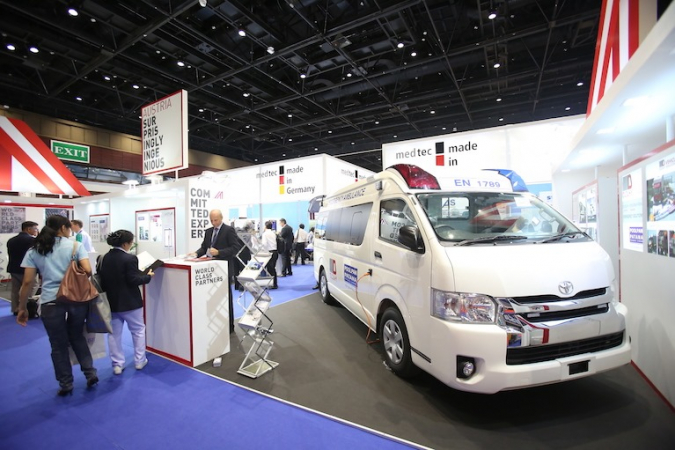
The ninth edition of Medical Fair Thailand, scheduled to be held from September 11 to 13 at new venue BITEC, expects to welcome more trade visitors and exhibitors than ever before.

More than 12,000 trade visitors are expected to attend the exhibition, with more than 40 per cent of them coming from overseas.

The three-day expo will showcase 1,000 exhibitors from 60 countries – 20 per cent more than the last exhibition in 2017. On offer will be a comprehensive range of medical and healthcare innovations, spanning state-of-the-art imaging and diagnostic equipment, patient monitoring systems, cost-effective consumables, digital healthcare solutions and more.

This year’s fair will also see the widest representation of national pavilions and country groups, including newcomers Brazil, Denmark, Indonesia, Israel and Hong Kong.

On the domestic front, there’s been a notable jump of 60 per cent in Thai exhibitors, reflecting the importance of fairs being a strategic platform for Thai companies to meet quality buyers and relevant partners on an international scale.

“Established in 2003, Medical Fair Thailand is the country’s largest international medical exhibition and is the only event of its calibre, with experience, connections and infrastructure to enable medical and healthcare companies to springboard into Asia and Southeast Asian,” said Gernot Ringling, managing director of the fair organiser, Messe Düsseldorf Asia.

Thailand 4.0 and the medical sector

Thailand 4.0 is a 20-year economic roadmap that the government unveiled in May 2016 as part of an effort to transform the economy into one that is driven by science, technology and innovation. Three years in, Thailand is making good progress as it deepens its focus on four key pillars identified in the strategy – wellness, medical services, academics and health products, with the government now providing additional technology-based incentives for investment in the development of biotechnology, nanotechnology, advanced material technology, and digital technology and enabling services that support targeted technology development.

“International exhibitions such as Medical Fair Thailand play a vital role in contributing to the growth and development of Thailand’s MICE [meetings, incentives, conferencing and exhibitions] industry as well as target industries stipulated by Thailand’s 4.0 policy, which include the medical sector. The growth of the private medical sector in Thailand is being driven by the growth in medical tourism and increasing demands from Thailand’s growing middle-class.

“Thailand’s middle-class incomes are rising and so is spending on healthcare as people are becoming more concerned about their health due to increasing prevalence of non-communicable diseases and work stress. With these factors, the Medical Fair Thailand could not take place at a more opportune time,” said Kanokporn Damrongkul, director of Thailand Convention and Exhibition Bureau’s exhibition department.