New economic stimulation plan discussed

ศาสตร์เกษตรดินปุ๋ย : ขอบคุณแหล่งข้อมูล : หนังสือพิมพ์ The Nation

https://www.nationthailand.com/business/30374994

New economic stimulation plan discussed

Aug 19. 2019
Uttama Savanayana

Uttama Savanayana
By The Nation

237 Viewed

Talking about the new economic stimulation plan that includes drought relief measures and agricultural financial support, Finance Minister Uttama Savanayana said on Monday that the Bank for Agriculture and Agricultural Cooperatives (BAAC) would apply the relief measures around the end of August.

The Finance Ministry plans to aid farmers in paying back loans by providing new loans and subsidies. This will be done by compensating 4 million rice growers by Bt500 to Bt800 per rai up to a total of 15 rai. The total capital required for this scheme will be Bt57 billion. Those affected by drought will also be able to take out a Bt500,000 emergency loan with the government without any interest for the first year, The total capital available for this scheme stands at Bt55 billion.

To stimulate tourism, the government will give away Bt1,000 to 10 million people as a personal personal budget. The measure will be applied in the second week of September. The handouts will be transferred to state welfare card during August and September. People who are interested in the campaign have to register first

Uttama added that Don Pramudwinai, Foreign Affairs Minister, disagreed with the proposed relaxation of visas for Chinese and Indian tourists. This would be further discussed in the cabinet meeting on August 20.

The Finance Ministry is also in discussions with the Interior ministry on measures to effectively stimulate local economies.

Guaranteed price for palm oil to go for govt approval

ศาสตร์เกษตรดินปุ๋ย : ขอบคุณแหล่งข้อมูล : หนังสือพิมพ์ The Nation

https://www.nationthailand.com/business/30374992

Guaranteed price for palm oil to go for govt approval

Aug 19. 2019
Jurin Laksanawisit

Jurin Laksanawisit
By The Nation

217 Viewed

The National Oil Palm Policy Committee has approved a guaranteed price for palm oil of Bt4 per kilogram for growers with not more than 25 rai and will submit the guarantee to the cabinet for approval within two weeks, deputy prime minister and commerce minister Jurin Laksanawisit said after the meeting on Monday.

It is expected 300,000 palm oil farmers will join the programme, he said.

He added that the committee led by deputy prime minister Gen Prawit Wongsuwan met on Monday and Prawit asked that the motion approved by the committee be submitted to the cabinet before August 27.

Once approved, farmers wanting to join the programme can register with the Agricultural Extension Department of the Agriculture and Cooperatives Ministry. The committee will pay the difference between the market price and guarantee price to the farmers through Bank of Agriculture and Agricultural Cooperatives or BAAC every three months.

“We cannot give the budget for this programme as it will depend on how many farmers join and the market price at the time the programme becomes effective. This will be discussed at the cabinet level for further approval,” Jurin said.

Meanwhile, the committee also approved other measures to improve palm oil price including enforcing the use of B10 grade biodiesel in the transportation sector by the end of 2019. The Electricity Generating Authority of Thailand (EGAT) is continuing to buy crude palm oil to produce electricity at Bang Pakong Power Plant under the quota approved by the Cabinet of about 130,000 tonnes.

The committee put in place measures to manage the palm oil stock nationwide by installing meters in palm oil depots to provide accurate palm oil data. At the same time, it is coordinating with security officials to oversee the smuggling of palm oil from foreign countries and punish palm oil smugglers. Once implemented, the additional measures agreed by the meeting should support the price of palm oil, which currently stands at Bt2 per kilogram.

GDP to fall to below 3 per cent, TMB Analytics confirms

ศาสตร์เกษตรดินปุ๋ย : ขอบคุณแหล่งข้อมูล : หนังสือพิมพ์ The Nation

https://www.nationthailand.com/business/30374989

GDP to fall to below 3 per cent, TMB Analytics confirms

Aug 19. 2019
Naris

Naris
By The Nation

209 Viewed

TMB Analytics has revised the country’s GDP downwards from 3 per cent to 2.7 per cent following a higher than expected drop in the economy in the first half of this year, Analytics’ head Naris Sathapholdeja said on Monday.

He added that although the government will introduce measures to boost the economy during the next few months, the country is feeling the effects of the trade war between the US and China, which is directly impacting exports. This is forecast to continue and has impacted the global supply chain.

The International Monetary Fund of IMF also forecasts that global trade for 2019 will drop from 3.4 per cent to 2.5 per cent and will affect all export markets. The appreciation of the baht is also having an effect.

“It is impossible to improve the country’s exports for the rest of this year,” he said.

He added that the country’s tourism sector is also showing lower than expected growth going from over seven per cent to just two per cent or 39.1 million tourists. This follows the baht appreciating against the Yuan by up to 10 per cent, sending Chinese tourists to Japan and South Korea instead.

Meanwhile, government investments this year have also slowed as it awaits approval for the 2020 fiscal budget 2020 by the House of Representatives in late October.

The private sector is delaying investment too and this is forecast to rise by only 1.8 per cent as most still enjoy sufficient production capacity and do not need to expand at this time.

Domestic consumption is expected to grow 3.8 per cent following the government’s stimulus package but is still lower than the first half of this year when it reached 4.9 per cent. This is matched by national household debt, which has risen to Bt13 trillion.

Naris forecasts that the Bank of Thailand, which cut the policy interest rate by 0.25 per cent last month, will be forced to make another cut to manage the value of the baht.

BOT to revise year’s growth forecast after 2Q result

ศาสตร์เกษตรดินปุ๋ย : ขอบคุณแหล่งข้อมูล : หนังสือพิมพ์ The Nation

https://www.nationthailand.com/business/30374986

BOT to revise year’s growth forecast after 2Q result

Aug 19. 2019
Don Nakornthab/Photo by BOT

Don Nakornthab/Photo by BOT
By The Nation

195 Viewed

The Bank of Thailand (BOT) will revise the country’s economy growth forecast for 2019 in its next report in September after the National Economic and Social Development Council (NESDC) announced a 2.3 per cent growth for the second quarter, lower than the central bank’s estimate of 2.8 per cent, BOT’s senior director monetary policy group Don Nakornthab said on Monday.

He added that the BOT will revise the country’s economy growth forecast in the upcoming economy report after monitoring business risk from the trade war between China and USA, global currency fluctuation, and the government’s stimulus package that will be launched this year.

“The country now faces an unpredicted situation due to internal and external pressure. We will keep a close watch and will announce the latest estimation next month,” he said.

Falling oil prices may find some support from IMO 2020

ศาสตร์เกษตรดินปุ๋ย : ขอบคุณแหล่งข้อมูล : หนังสือพิมพ์ The Nation

https://www.nationthailand.com/business/30374985

Falling oil prices may find some support from IMO 2020

Aug 19. 2019
Mriganka Jaipuriyar,  Head of News, Asia, S&P Global Platts

Mriganka Jaipuriyar, Head of News, Asia, S&P Global Platts
By MRIGANKA JAIPURIYAR
SPECIAL TO THE NATION

207 Viewed

Overwhelmingly bearish economic sentiment has sent oil prices spiraling down and persistent cuts in demand growth forecasts are indicative of further downside risk.

The oil markets, however, could find some support in the near to medium term from a demand spike led by tighter marine fuel specifications by the International Maritime Organisation (IMO) that are set to kick in on January 1, 2020.

Front-month ICE Brent futures have fallen by 22done per cent from their 2019 high of $74.50/b seen in late April to $58/b in mid-August.

According to S&P Global Platts Analytics, Brent prices are some $10/b below where fundamentals indicate they should be.

“Fundamentals suggest Brent prices should be much stronger,” Chris Midgley, Global Director for S&P Global Platts Analytics said in a recent note, adding that healthy refining margins and strong runs are pulling crude stocks lower.

Crude stocks in the three major OECD markets of US, OECD Europe, and Japan have fallen by 700,000 b/d in June-July, he said.

“Watch for much higher global crude runs in the final months of the year as refineries pump out supplies to meet [marine fuel specification] changes for January 1. This means more substantial crude stock draws in November (900,000 b/d) and December (1.3 million b/d).”

The IMO specifications require all marine fuel to contain a maximum sulfur content of 0.5 per cent , down from 3.5 per cent, and are expected to shift global diesel/gasoil demand higher by around 1.5 million b/d in the fourth quarter of 2019 and first half of 2020, Platts Analytics estimates.

According to Platts Analytics, if Brent prices continue to stay in the $55-$60/b range, driven in large part by sentiment, it will end the year closer to $70-$75/b.

But a worsening global economic sentiment poses a key downside risk.

Although central banks have begun to aggressively cut interest rates and that should eventually support growth or lessen the drop, that will take time and possibly not be evident till later in 2020, and might be overwhelmed by market forces, Platts Analytics said in recent report.

Until then, the fading impact of the US tax stimulus, the increasing headwinds on trade, and ongoing flashpoints for conflict with India-Pakistan, China-Hong Kong, and Iranian risk are now very much part of the equation, it said.

Slowing demand, plentiful supply pose downside risk

Platts Analytics has been lowering its demand growth forecast and in late-July cut it to 1.05-1.10 million b/d from 1.5 million b/d in 2018.

In China, which accounts for a bulk of global oil demand growth, Platts Analytics expects apparent oil demand growth to run out of steam from August onward, slowing down from 906,000 b/d year-on-year growth seen in June, given a bleaker outlook for the economic growth overshadowed by increasing trade tension between China and US.

“We are now seeing the [oil demand] growth will likely slow down to 321,000 b/d year on year in the second half of 2019, bringing the annual growth to 519,000 b/d this year, while growth for 2020 will further ease to 483,000 b/d,” it said in a report.

India’s oil products demand grew 1% year on year in the first half of 2019 and demand is expected to stage only a modest recovery in the second-half.

The International Energy Agency, in its August report, also lowered oil demand growth for 2019 by 100,000 b/d to 1.1 million b/d.

“The outlook is fragile with a greater likelihood of a downward revision than an upward one,” the IEA noted.

Supply, on the other hand, looks strong despite Opec’s large production cuts and continued losses from Venezuela and Iran.

Opec and its allies have agreed to cut production by 1.2 million b/d through to the end of the first quarter of 2020.

Opec pumped its fewest barrels in more than five years in July to 29.88 million b/d, aided by a huge production decline in its largest producer, Saudi Arabia, along with falls in Iran, Nigeria, Libya and Venezuela, according to a Platts survey.

But the IEA indicated non-Opec supply was up 1.4 million b/d year on year in July and is set to grow by 1.9 million b/d in 2019 and 2.2 million b/d next year.

It’s a bleak reading for Opec, with the IEA highlighting a potential oil market glut in early-2020 when the call on Opec crude oil plunges to 28.4 million b/d.

Opec has been unsettled by the recent drop in oil prices and are eyeing a response to falling prices at the next meeting of the group’s top-level monitoring committee in September. The group’s options are limited and it appears it would need to find a way to remove another 1.5 million b/d on top next year.

Mriganka Jaipuriyar is Head of News, Asia, S&P Global Platts

Netflix pledges to build Asian digital creativity skills

ศาสตร์เกษตรดินปุ๋ย : ขอบคุณแหล่งข้อมูล : หนังสือพิมพ์ The Nation

https://www.nationthailand.com/business/30374982

Netflix pledges to build Asian digital creativity skills

Aug 19. 2019
By THE NATION

159 Viewed

Netflix has signed a pledge to partner with the World Economic Forum’s (WEF) Digital Asean working group to help people and governments in Southeast Asia develop creative and digital skills and capabilities for the fourth industrial revolution.

The pledge, made today (August 19) is part of the WEF’s Asean Digital Skills Vision 2020 programme, a private-public project involving a coalition of organisations that seeks to train up 20 million workers in digital skills by 2020.

The initiative gained further urgency when a recent WEF-commissioned survey of 56,000 Asean youths found that 52 per cent believed they needed to upgrade their skills constantly to succeed in a changing job market. On top of that, they ranked “creativity and innovation” as the most important skill for their future.

Yu-Chuang Kuek, the managing director for Netflix Asia-Pacific, said, “As Netflix grows, we are partnering with Southeast Asian governments and industry players to support the development of digital creative skills needed in a fast-developing internet entertainment landscape. We believe having the necessary skills for the creative industry; being equipped for online safety and digital literacy; as well as understanding the principles for an agile governance framework will be integral to the success of initiatives like the Asean Connectivity Master Plan.”

According to the World Economic Forum’s Justin Wood, the head of Asia Pacific and member of the executive committee, “We welcome industry partners like Netflix to this important cause. Key public-private partnerships like this play a vital role in ensuring societies and governments across the region are equipped with the necessary skills and not left behind in the wake of this technological revolution. This programme is delivering significant impact. In its first eight months, the initiative has already secured commitments to train 8.9 million workers at SMEs, as well as to provide 30,000 internships.”

As part of its pledge, Netflix will start rolling out initiatives focused on three broad areas.

The first area, creative industry 4.0 skills development, will focus on the skills required to produce content for the internet entertainment industry, including writing, production and post-production.

Second, the online safety and digital literacy initiative will be built in partnership with industry experts, consumer advocacy groups, as well as regulators, to equip consumers with the necessary knowledge and tools to enjoy online entertainment in a safe and secure way.

The third area, agile governance 4.0, will be held in partnership with key stakeholders to help regulators navigate changes in the fourth industrial revolution and to keep pace with technological advancements.

Netflix will work with various partners to hold workshops and training, which will initially be held throughout the next six months in Indonesia, Malaysia, the Philippines, Thailand and Vietnam, with more locations under consideration in the future.

Growth in Q2 slowest in 19 quarters at 2.3 per cent

ศาสตร์เกษตรดินปุ๋ย : ขอบคุณแหล่งข้อมูล : หนังสือพิมพ์ The Nation

https://www.nationthailand.com/business/30374954

Growth in Q2 slowest in 19 quarters at 2.3 per cent

Aug 19. 2019
By The Nation

126 Viewed

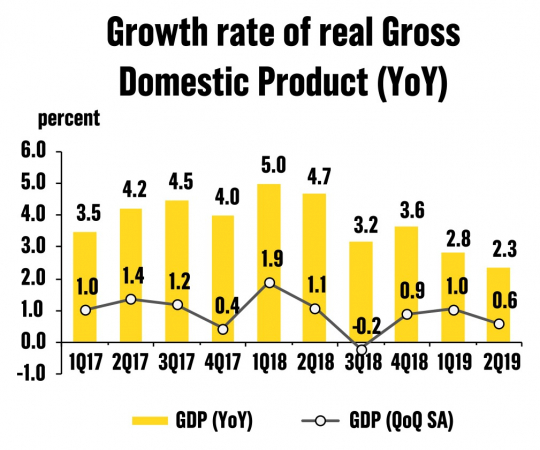
Economic growth sharply slowed in the second quarter to 2.3 per cent due to both external and domestic factors, according to a state think-tank report released today( August 19). Gross domestic product in the second quarter expanded by 2.3 per cent, a drop from the 2.8-per-cent growth rate in the first quarter, said the economic report released by National Economic and Social Development Council (NESDC), a state think tank.

The 2.3 per cent growth rate is the slowest in 19 quarters, or nearly five years.

GDP grew by 2.6 per cent overall for the first half of the year. However, the economy in the first half was affected by the trade war, a slowdown in the global economy, market volatility and the delay forming government after March’s general election, said Thosaporn Sirisumphand, the NESDC secretary general.

Unfavourable conditions have impacted on consumer and investor confidence, according to the report, with Thai exports contracting and a slowing of growth in tourist arrivals due to economic conditions in their own countries.

The think tank forecast the full year’s growth could still achieve 3 per cent, or a range between 2.7-3.2 .

“The economy is expect to recover soon,” Thosaporn said, expressing his optimism that the economic stimulus package due to for the Cabinet’s approval tomorrow would help shore up the economy.

Second-quarter GDP figures due today may impact baht, SET

ศาสตร์เกษตรดินปุ๋ย : ขอบคุณแหล่งข้อมูล : หนังสือพิมพ์ The Nation

https://www.nationthailand.com/business/30374945

Second-quarter GDP figures due today may impact baht, SET

Aug 19. 2019
By The Nation

711 Viewed

The National and Economic Social Development Council will today release the gross domestic product results for the second quarter of this year.

Most research houses predict growth would be slower at around slightly over 2 per cent, compared with 2.8 per cent in the first quarter which was the slowest growth in nearly four years. The Economic and Business Research Centre for Reform forecast growth at around 2.5 per cent for the second quarter, while Siam Commercial Bank predicted 2.2 per cent, a near five-year low.

Meanwhile, Kobsidthi Silpachai, the head of capital markets research at Kasikornbank, said that Thailand’s GDP in the second quarter may expand by 2.8 per cent while full year GDP would grow 3.1 per cent.

The new GDP figure is expected to affect the movement of the baht and the Stock Exchange of Thailand Index.

Kasikorn Research Centre said the baht would be affected when the GDP figure is released. The baht closed at Bt30.86 per dollar on Friday, weakening form Bt30.73 the previous Friday.

Foreign investors made net sales of Thai shares and government bonds as they were worried about the threat of an economic recession in the United States, leading to a weakening of the baht.

Between August 19-23, the baht is expected to move between Bt30.70 to Bt31 to the dollar. The market will focus on the GDP figure, July’s export figure and the latest developments in the trade war between the United States and China, as well as Brexit, according to Kasikorn Research.


The Thai stock market on Friday dropped 1.17 per cent from the previous week to 1,631.40. The market was in negative zone most of the week after making some gains on Friday. Investors were worried about the impact of the trade war, the recession, the protests in Hong Kong and political instability in Argentina. They, however, welcomed news reports of the Thai government’s stimulus package. The SET Index may move down to the 1,610-1,590 level while the resistance barrier is between 1,640-1,650 for this week, according to Kasikorn Research. Investors will also focus on the preliminary purchase managers’ index for July in major economies, namely the US, Japan and the euro-zone.

Investors will also keep an eye on sales of new homes and second homes in July in the US and the minutes of the US Federal Reserve meeting. The will also look at July’s inflation rate in Japan, said Kasikorn Research.

Government stimulus package not sustainable, economist warns

ศาสตร์เกษตรดินปุ๋ย : ขอบคุณแหล่งข้อมูล : หนังสือพิมพ์ The Nation

https://www.nationthailand.com/business/30374944

Government stimulus package not sustainable, economist warns

Aug 19. 2019
Uttama

Uttama
By Wichit Chaitrong
The Nation

835 Viewed

The government stimulus package will not make much difference and might not be sustainable, an economist with Rangsit University cautioned on Sunday.

The Cabinet is expected this week to approve an economic stimulus package worth Bt370 billion, covering cash handouts for farmers and low income earners, grants for children and incentives for domestic travellers as well as tax incentives to support small businesses. The government aims to boost economic growth by 3 per cent to counter both uncertain domestic conditions and the impact of trade war between the United States and China.


Finance Minister Uttama Savanayana said last week that the package would prevent economic growth sliding to below 3 per cent this year.

“Short-term spending as part of populist policies will not help much as the Thai economy is monopolised by big business,” said Anusorn Tamajai of Rangsit University’s Economic and Business Research Centre for Reform.

Most of the spending by low income groups will end up as revenue for large businesses, he noted.

He did however agree with the government plan to reduce the tax burden for small and medium-sized enterprises which could lead to more private investment. The government plans to offer generous tax reductions for those who import machinery to upgrade their production with a five-year depreciation allowance. Two state run banks; Government Savings Bank and Krung Thai Bank will also provide combined soft loans worth about Bt100 billion.

Currently, total investment in GDP is 24 per cent which is considered low compared to the peak of more than 40 per cent before the crisis of 1997. The ratio of private investment to GDP is 18 per cent GDP to government investment of 6 per cent.

Private consumption accounts for 51 per cent of GDP, and if boosted sustainably would drive the economy, he said.

The government also plans to direct other state run banks to provide soft loans to farmers and lower income groups. The Bank for Agriculture and Agricultural Cooperatives, The Government Housing Bank, and the Small and Medium Enterprise Development Bank of Thailand are expected to join the lending under the government stimulus plan. Anusorn warned that it may not be sustainable because its effectiveness depends on public confidence in the future.

Thai governments often resort to state run bank lending, quasi-fiscal measures that usually increase the burden for banks and then translate into a burden for tax players later.

Spaces bring co-working to the north of Bangkok

ศาสตร์เกษตรดินปุ๋ย : ขอบคุณแหล่งข้อมูล : หนังสือพิมพ์ The Nation

https://www.nationthailand.com/business/30374906

Spaces bring co-working to the north of Bangkok

Aug 17. 2019
By The Nation

577 Viewed

Innovative workspace pioneer Spaces is all set to bring convenience to young professional with the opening next month of a fourth branch in Phaholyothin Soi 19.

The new location features more than 2,900 sqm of leasable office space and is a joint venture between Spaces and the landlord of the Phahon 19 building under a new partnership model.

Strategically located near MRT Phaholyothin, the soon-to-open Spaces Phahon 19 is targeting a new market segment that covers Lat Phrao, Chatuchak, Bang Khen and Ratchayothin. It is surrounded by an abundance of office buildings, shopping malls and communal areas and is just a few minutes away from Central Plaza Lat Phrao.

The space boasts a modern, light and airy European design, great coffee, with banks of floor-to-ceiling windows on the second floor of Phahon 19. The building comes with its own secure basement garage, which makes travelling easy by both car and public transportation.

“Bangkok is one the most vibrant cities in the world with growing business hubs and an entrepreneurial spirit. Our decision to expand in this part of town is based on our wish to extend our reach to Bangkokians in the Northern part of the city by providing them with a place to work and meet with like-minded professionals who believe in the power of collaboration. Our contemporary design and warm and genuine hospitality allows our customers to achieve an optimal work-life balance, a ley driver for productivity, employee retention and overall job satisfaction,” said Lars Wittig, country manager of Spaces, which is part of the International Workplace Group (IWG) covering South Korea, Philippines, Vietnam, Cambodia and Thailand.

“In addition, our partnership with the landlord for Spaces Phahon 19 is a testament to the growing demand and interest in the flexible workspace industry. Thailand, as the transportation, business and industry hub of Asean, has a strong demand for quality workspace from both local and international investors, corporates, SMEs, startups and entrepreneurs. By allowing the landlord to invest in our business, we are adding value to development by fostering a community of energetic and driven professionals. At the same time, our expertise in the co-working business offers the landlord agility and a slice of the flexible workspace sector, without the risk of running his own operation,” Wittig added.

The new location at Phahon 19 will consist of 87 co-working desks, private offices, 4 meeting rooms, 6 dedicated desks, as well as meetings rooms, a pantry and a large Business Club. After a hard day at work, members can also choose to step out and enjoy a meal at nearby Rod Fai Park or visit the Thai Bank Museum.

In line with the Spaces brand concept, Spaces Phahon 19 will offer a regular flow of networking events, lunches and communal activities, allowing members to engage, network and venture into new possibilities. Members also have the convenience to access any Spaces co-working location in Bangkok, located at Summer Hill, Chamchuri Square and Empire Tower, and more than 250 Spaces locations worldwide.

Spaces was established in 2006 in Amsterdam and its first branch in Thailand opened at Summer Hill community mall in 2017. Spaces Phahon 19 is expected to be completed by October 2019. For more information on the development of Spaces at Phahon 19 and membership opportunities, visit www.spacesworks.com