Chewathai goes ahead with 7 new property projects despite slump in market

ศาสตร์เกษตรดินปุ๋ย : ขอบคุณแหล่งข้อมูล : หนังสือพิมพ์ The Nation

https://www.nationthailand.com/property/30374561

Chewathai goes ahead with 7 new property projects despite slump in market

Aug 10. 2019
By The Nation

406 Viewed

Listed property firm Chewathai Plc has revised down its revenue target from Bt2.8 billion to Bt1.6 billion after demand for residential projects showed a slump in the first half of this year, the company’s managing director Boon Choon Kiet said on Friday.

He said the company’s total revenue of Bt618.65 million in the first half of this year was lower than estimated because the property market has been facing high competition due to a limited demand for residential property and restrictions on loans approved by commercial banks.

However, the company has decided to go ahead with the launch of seven new residential projects worth Bt7.2 billion, two of which will be launched in the third quarter of this year worth a combined Bt2.64 billion and five projects in the fourth quarter worth Bt4.78 billion, he said.

Investment deals for Thai properties top Bt19 bn for first half of 2019, report finds

ศาสตร์เกษตรดินปุ๋ย : ขอบคุณแหล่งข้อมูล : หนังสือพิมพ์ The Nation

https://www.nationthailand.com/property/30374552

Investment deals for Thai properties top Bt19 bn for first half of 2019, report finds

Aug 09. 2019
Photo by Bangkok Bank

Photo by Bangkok Bank
By The Nation

160 Viewed

Investment activity across all property sectors in Thailand totalled Bt 19.2 billion for the first half of 2019.

Of this, more than half was from two transactions in Bangkok – the sale of the Sun Towers office complex and an 11-rai development site near BTS Mo Chit station, according to the Thailand Property Intelligence Centre by property consultancy JLL.

JLL’s Thailand Property Intelligence Centre monitors publicly-disclosed real estate investment activities in Thailand by private and public companies and funds.

There were four transactions worth more than Bt1 billion each recorded in the first half of 2019. The largest transaction was Singha Estate Plc’s Bt-5.7 billion sale of Sun Towers, an office complex on Vibhavadi-Rangsit Road, to its sponsored REIT, the S Prime Growth Leasehold Real Estate Investment Trust.

Sino-Thai Engineering & Construction Plc (STECON) and its subsidiaries were the second largest investor in the first half with two transactions totalling more than Bt5 billion. In April, STECON purchased an 11-rai development site near BTS Mo Chit station from U City Plc for Bt4.3 billion that will be developed into an office complex. In June, one of the firm’s subsidiaries, ST Property & Logistics Co Ltd, acquired the Summer Hill community mall and Summer Hub office building next to BTS Phra Khanong station from Boutique Corporation Plc for Bt957 million.

JLL’s managing director Suphin Mechuchep said that STECON’s investments thus far in 2019 mark the continuance of the re-entry of contractors and construction companies expanding into real estate investment, after nearly two decades of absence following the 1997 Asian financial crisis.

Other construction firms investing in real estate include Saengfah Construction’s joint venture with AIRA Securities Plc and Sena Development Plc for the development of Spring Tower, an office tower near BTS Ratchathewi station, and Thai Obayashi’s 2017 acquisition of a development site next to BTS Nana station for a then-record-setting Bt2.6 million per square wah, where it is now building O-NES Tower, the firm’s first office building investment since the Nantawan Building near BTS Ratchadarmi station in 1991.”

The most expensive land transaction thus far in 2019 on a per square wah basis was Shangri-La Hotel Plc’s February acquisition of a 658 square wah site in Thonglor for Bt1.9 billion, or Bt2.86 million per square wah.

“The price per square wah for the site acquired by Shangri-La Hotel Plc is the highest per square wah price the market has seen for the development of a hotel, but did not break the all-time record high price of Bt3.1 million per square wah achieved by the 880-square-wah plot on Langsuan Road that JLL sold on behalf of the owner in 2018,” she said..

“High land prices and the new land and property tax regulations slated for enforcement in 2020 have motivated and will continue to motivate more owners of underutilised land or land with underperforming buildings in Bangkok’s prime locations to put their sites on the market this year. This will mean more opportunities for well-capitalised investors to acquire prime sites for their new development projects. We believe that visionary investors will still be able to achieve decent returns on investment in their future development projects despite rising land costs.”

JLL expects most of the upcoming major real investment activities in the remainder of 2019 to be land and commercial property investment transactions in Bangkok. The firm also anticipates investment activities to rise in the industrial/logistics sector, particularly in the Eastern Economic Corridor (EEC), as more manufacturers are relocating their China-based operations to Southeast Asia and the fast growth of e-commerce has fuelled demand for logistics real estate in Thailand.

Property deals in Asia Pacific reach $86 bn for year’s first half

ศาสตร์เกษตรดินปุ๋ย : ขอบคุณแหล่งข้อมูล : หนังสือพิมพ์ The Nation

https://www.nationthailand.com/property/30374548

Property deals in Asia Pacific reach $86 bn for year’s first half

Aug 09. 2019
Photo by JLL

Photo by JLL
By The Nation

141 Viewed

Real estate transaction volumes in the Asia Pacific region hit US$86 billion in the first half of 2019, a report finds.

With Asia Pacific being the only region to record a year-on-year increase of 6 per cent globally, the Global Capital Flows report from JLL reveals that the region’s momentum is likely to moderate over the rest of the year, while investment levels are projected to reach a new full-year high in 2019.

“Due to the tightening of yields in core markets across the globe, particularly in Europe and US, investors are made to look beyond their domestic markets in search of higher returns,” said Stuart Crow, CEO of Capital Markets Asia Pacific for JLL. “Joint venture and consortium structures continue to increase in popularity for large deals across the region as investors seek to go more direct and see the benefit in partnering with long-term like-minded groups.”

In the latest US$1.17 billion sale of DUO Tower and DUO Galleria, JLL acted as exclusive adviser on behalf of the seller M+S Pte. Ltd. Allianz Real Estate and Gaw Capital partnered to acquire this iconic Grade-A office and retail asset which is located in the downtown Bugis area of Singapore.

Crow adds: “This deal reflects the strength of the region in attracting international insurance capital. In the next six to nine months, we’re confident that demand from insurance funds will continue to rise and lift market sentiment.”

According to JLL, property investment in Singapore nearly doubled in the first half of this year after a relatively subdued 2018. Driven in part by large-scale transactions, the office sector continues to account for the largest share of investment with nearly US$4.6 billion in acquisitions so far this year, and are likely to reach a new decade high in 2019. This compares to US$3 billion transacted in 2018 and US$4.7 billion in 2017 respectively.

“Singapore’s office sector has become a favoured investment destination over the last 12 months, largely supported by the market’s very favourable demand-supply dynamics and a benign interest rate outlook,” says Chris Fossick, head of Southeast Asia for JLL. “A big draw for investors is also its rising office rents. Singapore’s prime office rents are expected to continue growing over the next few years, backed by robust demand for the technology, professional services and financial services sectors.”

Another example of the spike in interest can be seen with the US$478 million sale by JLL of 71 Robinson Road, a 15-storey office block in Singapore’s CBD, to SV Robinson investment company. Other core funds that have recently sought to take advantage of the city’s long term growth prospects by investing in partial stakes in prime Grade-A buildings include Ocean Financial Centre – Allianz took a 20 per cent stake – and Frasers Tower, in which NPS took a 50 per cent stake.

In June, Chevron House – a 32-storey office and retail building in the heart of the central business district – was sold to U.S. real estate fund AEW for US$750 million, a 35 per cent increase on capital value from when it was purchased in 2017.

WHAUP expands its water and power business for long-term growth

ศาสตร์เกษตรดินปุ๋ย : ขอบคุณแหล่งข้อมูล : หนังสือพิมพ์ The Nation

https://www.nationthailand.com/business/30374555

WHAUP expands its water and power business for long-term growth

Aug 09. 2019
By The Nation

368 Viewed

WHA Utilities and Power PLC (WHAUP) reported a 189.8 per cent rise in net profit year on year (YoY) in the second quarter due to the expansion of its water business and return to full operation of GHECO-One after planned maintenance.

The company reported a net profit of Bt857.5 million, adding it has already secured funding for its water supply project in Vietnam.

Currently, the solar rooftop business is close to meeting its 15MW target. Retail Natural Gas Distribution in the WHA Eastern Seaboard Industrial Estate 4 (WHA ESIE 4) with the capacity of 2 million BTU per year has gone commercial since June.

WHAUP chief executive officer Wisate Chungwatana said the company’s total revenue of Bt934.5 million was a 10.5 per cent  increase YoY, and profit sharing from investment was Bt1.091 billion, up 20.5 per cent YoY.

In the power business, the Gulf NLL2 power plant achieved commercial operation date (COD) in January with an installed capacity of 127MW, representing 32 Equity MW. WHAUP’s total capacity at the end of the second quarter stood at 554 Equity MW under operation.

In the solar rooftop business, WHAUP currently has signed 13.9MW in 2019, close to its target of 15MW. It has achieved COD of 7.1MW and 20.3MW is under construction with the COD scheduled for the third quarter of this year to the first quarter of 2020. Apart from this, the waste-to-energy power plant with 8.63MW aims to achieve COD in the fourth quarter.

Meanwhile, the natural gas distribution business of WHA Eastern Seaboard NGD 4 achieved COD in June with capacity to distribute natural gas of 2,000,000 million BTU per year. This is the second natural gas distribution project after the commercial success of retail natural gas distribution for WHA Eastern Seaboard NGD 2 late last year.

Recently, the company signed a contract with Global Power Synergy Pcl (GPSC) with an initial order of 1.5 million cubic metres per year for demineralised water. In addition, the company has also signed a sale contract for clarified water with GC Oxyrane Co. Ltd (GCO), a manufacturer and distributor of propylene-oxide, which has water demand around 3.6 million cubic metres per year. It also entered a contract with GC Polyols Co Ltd (GCP), a manufacturer and distributor of polyether polyols, which has water demand of about 0.3 million cubic metres per year

The company’s board on Thursday (August 8) approved investment in water supply in Vietnam, the first investment in a household water project by the company. The company views the investment in this project has the potential to grow in the future, apart from the production capacity of the projects that have already started commercial operation and are under construction.

QTC Energy expands into overseas markets for electricity transformers

ศาสตร์เกษตรดินปุ๋ย : ขอบคุณแหล่งข้อมูล : หนังสือพิมพ์ The Nation

https://www.nationthailand.com/business/30374554

QTC Energy expands into overseas markets for electricity transformers

Aug 09. 2019
By The Nation

407 Viewed

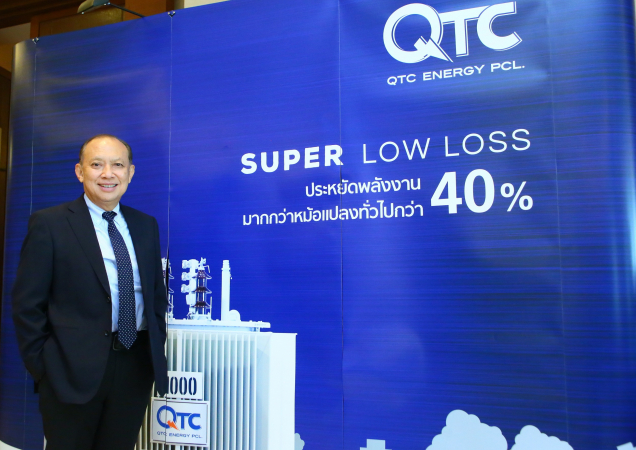
QTC Energy has reported has reported a net profit of Bt40 million for the second quarter of this year, with revenue of Bt236 million.

Company chief executive Poonphiphat Tantanasin  said that the firm plans to add  more international sales agents to back its expansion  into overseas markets.

The company currently has a backlog worth Bt530 million, for which distribution started earlier this year. As for its business as the distributor of De Busduct and Smart Transformer and Super low loss transformer products, the sales are  expected to help achieve its targeted annual revenue of around Bt1 billion.

Poonphiphat said the company started to adjust its business strategies early in 2019 in order to strengthen the business.

The strategic business adjustment plan has helped the company to meet its target. For the first six months of 2019, revenue was Bt502 million, up 24 per cent from the same period of last year.

Poonphiphat said that regarding the business outlook in the second half of 2019, the company has already begun exporting electricity transformers to Japan, Australia and some other countries but it plans to expand to tap more countries in Asia and Europe.

“Clearer direction is expected soon, especially for the government projects. The demand for electricity transformers is expected to increase in line with the government’s policy driven by Eastern Economic Corridor (EEC) and Skytrain projects.

Mono Technology swings to a loss in second quarter

ศาสตร์เกษตรดินปุ๋ย : ขอบคุณแหล่งข้อมูล : หนังสือพิมพ์ The Nation

https://www.nationthailand.com/business/30374544

Mono Technology swings to a loss in second quarter

Aug 09. 2019
By THE NATION

324 Viewed

Mono Technology has reported to the Stock Exchange of Thailand (SET) that it made a net loss of Bt95.21 million for the second quarter, down from a Bt13.66 million net profit in the same quarter last year.

The company has also reorganised its business structure with the closure of magazine and magazine businesses, and has stopped film production under its T Moment company.

Mono said revenue in the second quarter was Bt613.74 million, down Bt82.59 million, or 11.86 per cent, from the second quarter of last year.

The business group showing the highest decline in revenue is mobile phone services. This group had been divided into entertainment information, such as fortune telling via mobile phones, which posted a 73.55 per cent decline from the same quarter of last year.

Another mobile phone service, Monomax movies on mobiles, showed growth of 27.81 per cent in the second quarter of this year to Bt22.93 million.

However, the company’s overall performance in providing content through mobile phones dropped 73.55 per cent to Bt34.74 million in revenue.

Mono achieved 8.23 per cent growth in revenue at its Mono digital TV business, which earned Bt528.30 million in advertising in the second quarter of this year, up from Bt488.13 million posted in the second quarter of last year.

Mono also reported that the company has reduced its cosst by closing some non-performing businesses: the Mono Play game on mobile, Gossip Star magazine and pocket books.

The company reduced the size of mobile value added service (MVAS) in Thailand, as well as stopped film production under the T Moment company.

T Moment is a 50-50 joint venture between Thai Entertainment and Mono with Bt200 million in registered capital.

TBank and TMB to tap into post-merger capital of Bt80 bn for expansion

ศาสตร์เกษตรดินปุ๋ย : ขอบคุณแหล่งข้อมูล : หนังสือพิมพ์ The Nation

https://www.nationthailand.com/business/30374540

TBank and TMB to tap into post-merger capital of Bt80 bn for expansion

Aug 09. 2019
By PHUWIT LIMVIPHUWAT
THE NATION

481 Viewed

Thanachart Bank (TBank) and Thai Military Bank (TMB) will use the combined entity’s post-merger capital of Bt80 billion for further expansionary investments, say bank executives who have ruled out employee layoffs.

The merger, which is expected to be completed by mid-2021, involves the purchasing of shares by both banks as well as by third party participants such as the Finance Ministry.

The total value of the deal is expected to approach Bt160 billion, involving the use of Bt130 billion by TMB to purchase TBank’s shares and Bt44 billion by Thanachart Capital to buy TMB’s shares.

After the deal is completed, the two banks will merge as one and will have remaining capital for investment of around Bt80 billion, according to executives from both banks.

The remaining capital after the merger will be used for further investments to maximise benefits for the bank’s clients and shareholders, said the chairman of the executive board of director of TMB, Philippe Damas, who declined to comment on the specifics of the investment plans.

“Currently, we are focused on making sure that the merging process goes smoothly and we will have to digest this large transaction before looking into the details of the investments after the merger is completed,” Damas said at a press conference held by the two banks on Friday.

Also present at the press conference was Chumpol Rimsakorn, deputy permanent secretary of the Finance Ministry. He said the ministry will invest an additional Bt11 billion and could also purchase more shares in the future.

“The Finance Ministry has set aside an investment budget for this merger and we guarantee that the investment does not jeopardise the government budget in any way,” he said.

The merger is widely seen as part of a larger market trend in the financial sector, which has been challenged by the digital disruption changing consumer behaviour.

Banks have been trying to streamline their operations in order to focus on traditional financial businesses.

In July, Siam Commercial Bank Plc (SCB) sold 99.2 per cent of its holding in SCB Life Assurance Plc for Bt92.7 billion to FWD Group Financial Services Plc (FWD), in a move to raise investment capital and focus on its core banking business.

However, TBank and TMB stated that this merger is not a streamlining process and guaranteed that there will not be any employee layoffs.

“The merging of both banks will mean that the client size will double and the resources needed to serve our clients will increase,” said Suphadej Poonpipat, chairman of the executive committee at Thanachart Capital (TCAP).

Hence, he said, there will be no layoffs resulting from the merger. However, after the merger is completed, some branches of the two banks that are overlapping in various areas may have to be closed, he said.

Currently, the two banks have a total of 900 branches and 19,000 employees.

TBank and TMB track towards union in 2021 with 10m customers

ศาสตร์เกษตรดินปุ๋ย : ขอบคุณแหล่งข้อมูล : หนังสือพิมพ์ The Nation

https://www.nationthailand.com/business/30374539

TBank and TMB track towards union in 2021 with 10m customers

Aug 09. 2019
Executives from Thanachart Bank and Thai Military Bank present the opportunities to arise from their merger at a press conference on Friday. 

Executives from Thanachart Bank and Thai Military Bank present the opportunities to arise from their merger at a press conference on Friday.
By PHUWIT LIMVIPHUWAT
THE NATION

233 Viewed

Thanachart Bank (TBank) and Thai Military Bank (TMB) will merge into one bank with 10 million customers, with the process expected to be completed in mid-2021.

In the new shareholding structure, Thanachart Capital (TCAP) will hold 20 per cent of the shares, followed by ING Bank, which acquired TMB in 2008, with 21.3 per cent. Of the remaining shares, the Finance Ministry will hold 18.4 per cent, Scotiabank (BNS) 5.6 per cent and minority shareholders 34.3 per cent.

After the two banks have been merged, their combined asset value will be Bt2 trillion with the single entity having 10 million customers and 19,000 employees, said Suphadej Poonpipat, chairman of the executive committee at TCAP, at a press conference held by the two banks on Friday.

During the merger process, shares will be transferred in accordance with the law, involving the equity fund raising through the issuance of new common shares and debt financing by TMB, said Piti Tantakasem, CEO of TMB Bank.

As part of the process, TMB will have to raise around Bt130 billion in order to purchase TBank’s shares. To do so, TMB plans to raise Bt42.5 billion by issuing new common shares. TMB will also raise Bt9.6 billion to Bt16 billion through debt financing to foreign institutional investors, said Piti.

TCAP is set to buy TMB shares worth Bt44 billion. Suphadej said that after the purchase, TCAP will have remaining capital of Bt10 billion. The management team of TCAP will manage the fund to generate further returns for its shareholders accordingly, he said. Suphadej declined to reveal details of the investment plans.

Both banks guarantee that clients will be unaffected by the merger and that they can continue to use the services of both banks until 2021. After that, clients will be able to continue using services from the new merged bank, and will have additional service options.

CK Power boosts revenue 17% for quarter

ศาสตร์เกษตรดินปุ๋ย : ขอบคุณแหล่งข้อมูล : หนังสือพิมพ์ The Nation

https://www.nationthailand.com/business/30374534

CK Power boosts revenue 17% for quarter

Aug 09. 2019
By The Nation

236 Viewed

CK Power (CKP) has booked revenue of Bt2.312 billion for the last reported quarter, marking growth of more than 17 per cent from the same period of last year.

The growth was driven mainly by expansion in revenue from the Nam Ngum 2 Hydropower Plant (NN2), as well as from the three rooftop solar power plants that began operating during the quarter, said Thanawat Trivisvavet, managing director of CKP.

The company posted net profit of Bt 83.7 million, up 26.5 per cent from the same period last year, despite the shutdown of Bangpa-In Cogeneration 1 Power Plant for maintenance.

CK Power completed the acquisition of an additional 5.33 per cent stake in Southeast Asia Energy Limited with total investment of Bt 681.5 million in May, which resulted in CK Power increasing its effective ownership of NN2 from 42 per cent to 46 per cent.

Moreover, from May to July, CK Power began operating four rooftop solar power plants. Banglen Solar in Nakhon Pathom province (0.97 MW), Putthamonthon Sai 5 Solar in Nakhon Pathom province (0.97 MW) and Mahachai Solar in Samut Sakhon province (0.72MW) were all completed in the second quarter. The Krathum Ban Solar in Samut Sakhon province (0.52 MW) was completed in July.

CKP engages in the production and sale of electricity generated energy. The company has stakes in 13 energy projects including two hydroelectric power projects, the Nam Ngum 2 Hydroelectric Power Plant, operated by Nam Ngum 2 Power Limited and the under-construction Xayaburi Hydroelectric Power Plant, to be operated by Xayaburi Power Company Limited.

NBC reports spectacular turnaround in first half

ศาสตร์เกษตรดินปุ๋ย : ขอบคุณแหล่งข้อมูล : หนังสือพิมพ์ The Nation

https://www.nationthailand.com/business/30374529

NBC reports spectacular turnaround in first half

Aug 09. 2019
Chatchai Phukokwai, NBC managing director

Chatchai Phukokwai, NBC managing director
By THE NATION

197 Viewed

Nation Broadcasting Corporation (NBC) reported a turnaround in its fortunes with Bt463.37 million in net profit in the second quarter of this year, compared to the Bt26.95 million losses in the second quarter of last year.

The Stock Exchange of Thailand (SET) will also lift the ‘C’ sign (Caution) on NBC on August 13.

For the first six months of this year, the group reported Bt444.47 million in net profit, up 753 per cent against Bt68.10 million losses during the same period last year.

Chatchai Phukokwai, NBC managing director, informed the SET that the company had benefited after the National Council for Peace and Order (NCPO) passed order No 4/2562 to solve the problems of the TV and telecommunication operators.

The measure exempted the company’s subsidiary from payment of licence fee instalments, including a subsidy for the network rental expenditures in accordance with a national commercial digital terrestrial television broadcasting network service to licensees over the remaining period of the licences. The subsidy effectively commences after termination of the measure fore relief in accordance with paragraph one, No 8 of NCPO order No 9/2561.

The subsidiary recorded a reduction in its net book value of digital television licence fee payable and net book value of the licence amounting to Bt429.91 million (the digital television licence payable of Bt447.20 million and deducted deferred interest amounting to Bt17.29 million) and adjusted amortisation from the remaining net book value of the licence after adjustment in relation to the remaining economic useful life. Therefore, the group is reversing impairment of loss of digital television licence of Bt486.70 million in the consolidated financial statements for the six-month period ended June 30.

The group reported that six-month operations ended on June 30 this year represented an operating profit of Bt444.48 million compared to the same period last year when it reported a loss of Bt68.10 million. Excluding the reversal of impairment loss of assets of Bt486.70 million, the group’s net loss for the six months of this year rose to Bt42.22 million.