Jurin seeks easing of regulations from China for Thai exports

ศาสตร์เกษตรดินปุ๋ย : ขอบคุณแหล่งข้อมูล : หนังสือพิมพ์ The Nation

https://www.nationthailand.com/business/30374078

Jurin seeks easing of regulations from China for Thai exports

Aug 01. 2019
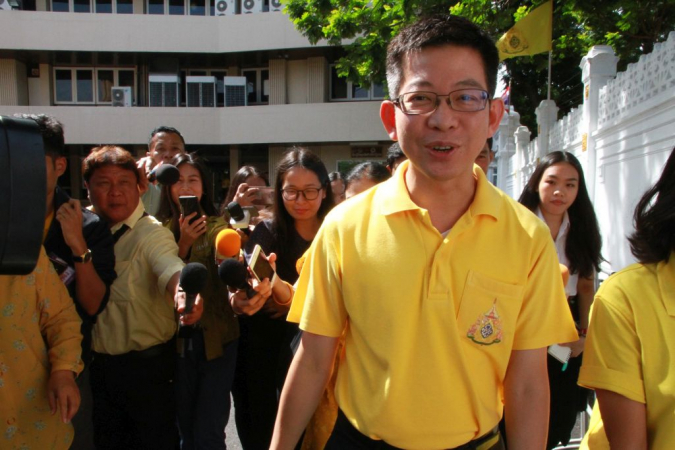
Jurin Laksanawisit (Photo: ThaiVisa News)

Jurin Laksanawisit (Photo: ThaiVisa News)
By THE NATION

456 Viewed

Commerce Minister Jurin Laksanawisit has appealed to authorities in China to relax new regulations on the import of fruits from Thailand.

Jurin has asked Thailand’s Minister for the Office of Commercial Affairs in Beijing to negotiate with China’s Ministry of Agriculture.

Jurin, who is also leader of the Democrat Party, will take part in the 8th Regional Comprehensive Economic Partnership (RCEP) meeting being held from Thursday (August 1) to Saturday in Beijing.

It is Jurin’s first international meeting since taking the reins at the Commerce Ministry. Thailand, as chair of Asean Economic Ministers this year, will also chair the RCEP meeting in which 16 Asian countries will take part. The meeting assumes added significance as the grouping tries to deal with differences before coming to an agreement.

Jurin said Asean leaders are focused on reaching conclusions at this RCEP meeting and it is one of 13 economic missions targeted by Asean to be completed within this year. Major topics to be discussed under RCEP are the opening of markets for goods, services, investments, and intellectual property, as well as financial appendix. The meeting for senior officers of Asean will be held in October, and for ministers in September and October.

Jurin said he has discussed with Chiyawan Chongvatana, Thailand’s Minister for the Office of Commercial Affairs in Beijing, about the country’s export situation with China, especially for agricultural products and fruits such as durian and longan. China has tightened regulations for import of fruits from Thailand, forcing all Thai fruit exporters to have packaging plant certification or Good Manufacturing Practice and the need to buy from the orchards that are certified as having Good Agriculture Practices. They are also required to have an exporter registration number from Thailand’s Department of Agriculture (DOA).

“We have received complaints from most exporters who have been impacted by such regulations, as many of them have no certification, and need to wait for the DOA to issue the certification. Many exporters have delayed their purchases, which will have a negative impact on the lives of farmers,” said Jurin.

“I have already ordered the Minister for the Office of Commercial Affairs in Beijing to negotiate with the central office for Chinese Customs to postpone such regulations as Thai exporters cannot find certification as identified and that it would impact Thailand’s export sector,” he said.

Saksyam signals boards of state transport enterprises to resign, giving his deputies greater say

ศาสตร์เกษตรดินปุ๋ย : ขอบคุณแหล่งข้อมูล : หนังสือพิมพ์ The Nation

https://www.nationthailand.com/business/30374076

Saksyam signals boards of state transport enterprises to resign, giving his deputies greater say

Aug 01. 2019
Transport Minister Saksyam Chidchob, left,  poses on Thursday with his deputies Athirat Rattanaset, centre, and Thavorn Senniam during a trial run of a newly launched underground train in a short trip from Sanam Chai to Tha Phra station.

Transport Minister Saksyam Chidchob, left, poses on Thursday with his deputies Athirat Rattanaset, centre, and Thavorn Senniam during a trial run of a newly launched underground train in a short trip from Sanam Chai to Tha Phra station.
By THE NATION

490 Viewed

Transport Minister Saksyam Chidchob has assigned his deputy Athirat Rattanaset to oversee water transportation while the other Deputy Transport Minister, Thaworn Senniam, has been assigned oversight of air transportation departments.

Saksyam said the boards of departments under the new leaders should be ready to resign as they were appointed by the previous government. He said it was up to the deputy ministers to decide if the board members should be reappointed.

He said the operations of the ministry and related agencies should follow the same policy, especially the urgent plan to help stimulate economic activity. Both the administrative section and operative officers should have the same goal and collaborate with departments.

Fifteen state enterprises come under the Transport Ministry: State Railway of Thailand, Electrified Train Co, Mass Rapid Transit Authority of Thailand, Port Authority of Thailand, Expressway Authority of Thailand, The Transport Co, Bangkok Mass Transit Authority, Thai Airways, Airports of Thailand, Thai Smile Airways, Civil Aviation Training Centre, Aeronautical Radio of Thailand, Civil Aviation Authority of Thailand, Suvarnabhumi Airport Hotel, and Thai-Amadeus Southeast Asia Co.

The process of appointing new boards will take two months. Until then, the old boards will continue with the task of completing their mission.

Some member of the old board have already started to respond to the changes by heading for the exit, such as Nattachat Jarujinda, the chairman of the Bangkok Mass Transit Authority, who sent in his resignation letter on June 1.

Authorities monitoring situation after US Fed cuts rate

ศาสตร์เกษตรดินปุ๋ย : ขอบคุณแหล่งข้อมูล : หนังสือพิมพ์ The Nation

https://www.nationthailand.com/business/30374058

Authorities monitoring situation after US Fed cuts rate

Aug 01. 2019
By THE NATION

298 Viewed

The government and the Bank of Thailand will keep a close watch on the situation after the US Federal Reserve cut its benchmark rate by a quarter of a percentage point on Wednesday, deputy secretary-general to the Prime Minister for Political Affairs, Kobsak Pootrakool, said on Thursday.

He said the US rate cut would trigger funds inflows to Thailand and the rate cut would put pressure on the local policy rate direction.

He added that the central bank had to keep a closer watch on the situation.

Energy Ministry seeks Bt3 billion budget to boost startups

ศาสตร์เกษตรดินปุ๋ย : ขอบคุณแหล่งข้อมูล : หนังสือพิมพ์ The Nation

https://www.nationthailand.com/business/30374044

Energy Ministry seeks Bt3 billion budget to boost startups

Aug 01. 2019
Sontirat Sontijirawong

Sontirat Sontijirawong
By The Nation

342 Viewed

The Energy Ministry is set to revise the Power Development Plan for 2018-2037 with the aim of boosting start-up businesses, Energy Minister Sontirat Sontijirawong said.

Speaking at a seminar on the direction of the energy industry hosted on Wednesday by the Thansettakit newspaper, Sontirat said that the PDP revision is in line with such future energy plans as the energy conservation system while also providing an opportunity for start-ups in the energy business to join the development.

The ministry is also open to more opinions on the revision. Sontiwat said that the new plan will not affect ongoing construction like a new powerplant in the west of Thailand for which a deal has already been finalised.

According to the news report from ministry of energy, the ministry is seeking funding to support start-ups with a budget of Bt3 billion.

Sontirat assured participants that the revision would offer investment opportunities for the private sector and on a community basis with the establishment of a community power plant.

Communities will be able to buy back shares from the investment, which will focus on renewable power plants. He also instructed related state agencies to map out zones for the establishment of community power plants and keep them within reach of the transmission network.

Sontirat also asked the Energy Conservation Fund, which will be financing this move, to revise its criteria for seeking funding to support the promotion of this community power plant development and come up with a proposal for his consideration next week. The fund has a budget of Bt12 billion.

The minister said the PDP revision must also be in line with Thailand’s policy of becoming Asean’s power hub. If all plans are achieved, the price of electricity in Thailand will drop to less than Bt3.576 per unit – a target that should be achieved in the next 20 years as set down in the current PDP.

He added that though he cannot specify when the PDP revision will be completed, as it requires the opinion of many parties, he could promise that the review will not affect existing projects.

Related  Topics : Ministry sets sights on boosting access to electricity

MediBeacon joins with Huadong Medicine for China access

ศาสตร์เกษตรดินปุ๋ย : ขอบคุณแหล่งข้อมูล : หนังสือพิมพ์ The Nation

https://www.nationthailand.com/business/30374030

MediBeacon joins with Huadong Medicine for China access

Aug 01. 2019
By The Nation

83 Viewed

As MediBeacon Inc is poised to begin its pivotal trial of a system to measure kidney function at the point of care without needing blood or urine samples, it has entered into a definitive agreement with Huadong Medicine, a publicly traded company on the Shenzhen Stock Exchange.

MediBeacon Inc., whose largest shareholder is Pansend Life Sciences, LLC, a subsidiary of HC2 Holdings, Inc announced on Thursday that they have entered into a definitive agreement with Huadong Medicine, a publicly traded company on the Shenzhen Stock Exchange.

The agreement will provide exclusive rights to MediBeacon’s portfolio of assets in Greater China, according to a company release on Thursday. Huadong Medicine will be responsible to fund the clinical trials, commercial and regulatory activities in 25 Asian countries including Greater China, Thailand, Vietnam, Indonesia, Philippines and Singapore.

MediBeacon’s Transdermal Glomerular Filtration Rate Measurement System (TGFR) is poised to begin its pivotal trial in the US and Europe. The TGFR is designed to measure kidney function at the point of care without the need for blood sampling or urine collection. The US Food and Drug Administration (FDA) granted “breakthrough device” designation to the TGFR in 2018. MediBeacon’s agents and devices are not approved for human use by any regulatory agency.

It is estimated that 10.8 per cent of the people in China suffer from chronic kidney disease, which remains a “hidden epidemic” affecting more than 850 million people worldwide. The ability to measure GFR (the transdermal glomerular filtration rate) is of high clinical interest, especially for patients with, or at risk of, kidney disease.

Under the deal’s terms, MediBeacon will receive an initial $15 million equity payment at a pre-money valuation of $300 million and a second $15 million equity payment upon achieving US FDA approval for the TGFR at a pre-money valuation of $400 million.

Huadong Medicine will fund all commercial and regulatory activities in Greater China and select Asian countries. In addition, MediBeacon will receive royalty payments on net sales in the specified countries.

“We are extremely excited to partner with Huadong Medicine in Greater China,” said Steve Hanley, CEO and co-founder of MediBeacon. “Huadong has over 6,500 representatives covering all key areas of China including a strong presence in the nephrology community. As a leading pharmaceutical company in China, we believe they are the perfect partner to drive market adoption for our pipeline of products.”

As part of this transaction, Richard B Dorshow, PhD, the chief scientific officer and co-founder of MediBeacon Inc, will assume the role of special scientific advisor to Huadong Medicine.

MediBeacon’s fluorescent agent platform for use in physiological function monitoring has important applications beyond the field of kidney health, said the release. The company’s transdermal gastrointestinal permeability system has been supported by multiple grants from the Bill & Melinda Gates Foundation. In addition, the company has just completed initial pre-clinical studies evaluating use of its agents in imaging the vasculature of the eye.

Kumwel lists on mai

ศาสตร์เกษตรดินปุ๋ย : ขอบคุณแหล่งข้อมูล : หนังสือพิมพ์ The Nation

https://www.nationthailand.com/business/30374023

Kumwel lists on mai

Aug 01. 2019
By The Nation

121 Viewed

The Market for Alternative Investment (mai) will today list Kumwell Corporation, a leading manufacturer and distributor of grounding and lightning protection systems, under the ticker symbol “KUMWEL”.

The company has a market capitalization at its initial public offering (IPO) of Bt473 million (approximately US$15.3 million).

mai President Prapan Charoenprawatt said that KUMWEL would start trading on mai in the Industrials industry group.

KUMWEL and subsidiaries manufacture and distribute grounding system, lightning protection system, surge protection system, and lightning detection & warning system products compliant with international standards for the stability and safety of the electrical system in infrastructure for customers in various businesses including electricity authorities, transportation, telecommunication, industrial, real estate, and military security sectors.

Currently, KUMWEL provides a line of more than 2,500 items. The company has a registered paid-up capital of Bt215 million, consisting of 300 million existing common shares and 130 million newly issued shares, with a par value of Bt0.50 each.

From July 24 to 26, 2019, it offered newly issued shares to the general public via IPO at Bt1.10 each, for a total of Bt143 million.

The IPO price was equivalent to price-to-earnings (P/E) ratio of 17.94 times, calculated by using the company’s net profit in the past 12 months (April 1, 2018 – March 31, 2019) amounting to Bt26.36 million, divided by 430 million fully diluted shares. Asset Pro Management Co Ltd is its financial advisor and Phillip Securities (Thailand) is its lead underwriter.

KUMWEL chief executive Boonsak Kiatjaroonlert said that the company places importance on new product research and development, as well as quality control. It has gained trust from both domestic and international clients. The products have been in accordance with the international standards in terms of design, testing and installation, such as UL standard certified by Underwriters Laboratories Inc., USA; IEC standard by KEMA Quality from DEKRA, the Netherlands; and Verband Dutscher Klekrotechniker or VDE from Germany, among others. The fund raised would be used for factory construction, factory maintenance, new product research and development, product-testing room renovation and development, and as working capital.

KUMWEL’s major shareholder after IPO is Kiatjaroonlert family (64.64 per cent). KUMWEL’s dividend policy is to pay no less than 40 percent of net profit after corporate income tax and legal reserves.

Bake A Wish’s Detective Conan Café returns after overwhelming success last year

ศาสตร์เกษตรดินปุ๋ย : ขอบคุณแหล่งข้อมูล : หนังสือพิมพ์ The Nation

https://www.nationthailand.com/business/30374003

Bake A Wish’s Detective Conan Café returns after overwhelming success last year

Jul 31. 2019
Nikan Prachyasilpawut, CEO and founder of Bake A Wish

Nikan Prachyasilpawut, CEO and founder of Bake A Wish
By THE NATION

427 Viewed

Japanese-style bakery, Bake A Wish, is launching a new themed café in Siam Centre for 46 days from August 1 to September 15 to mark the arrival of “Detective Conan: The Fist of Blue Sapphire” at movie theatres across Thailand in August.

Nikan Prachyasilpawut, CEO and founder of Bake A Wish, said: “We are ready to welcome customers who enjoy Japanese-style baked goods made fresh daily using traditional Kobe-recipes. The new menu for the Detective Conan Café 2019 perfectly fuses Thai and Japanese anime pop culture with culinary delights. Once again, this café was conceptualised and developed by PARCO [Singapore].”

The new themed menu at the Siam Centre branch includes six mains, four desserts and four drinks, while the 14 Bake A Wish branches nationwide will each have four takeaway offerings following the Detective Conan theme.

Customers ordering from the Detective Conan Café menus will receive a free limited Detective Conan placemat and free coaster with any order of drink, while each themed dish will come with a giveaway, such as a free Detective Conan movie card or a keychain among others.

Meanwhile, Good Anime, a business unit of Dai-Ichi Kikaku (Thailand), the licensee of Detective Conan in Thailand, will launch a “Detective Cafe Station” on the ground floor of Siam Centre, next to the Detective Conan Café from August 1 to September 1. At this station, fans can buy original limited “Detective Conan” goods as well as other limited items. This station will also be the starting and ending point of the Mystery Walk called the “The Phantom Quest”, which will run from August 1 to 18.

Telco shares rally has more to run, says Kasikorn analyst

ศาสตร์เกษตรดินปุ๋ย : ขอบคุณแหล่งข้อมูล : หนังสือพิมพ์ The Nation

https://www.nationthailand.com/business/30373994

Telco shares rally has more to run, says Kasikorn analyst

Jul 31. 2019
Pisut

Pisut
By The Nation

406 Viewed

The share prices of telecoms operators have plenty of room to rally further on the back of strong earnings momentum, the upside potential for revenue growth and eased concerns over 5G capital expenditure, said Kasikorn Securities Plc equities analyst Pisut Ngamvijitvong.

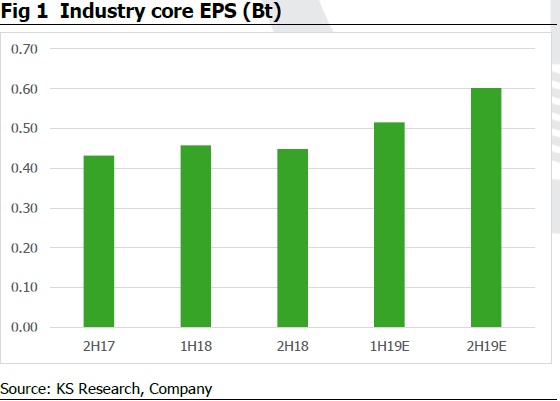
He said there is considerable headroom for further gains in the shares of Thai mobile operators Advanced Info Service, Total Access Communication and True Corp due to many factors, including their expected core profit growth of 34.3 per cent year on year in the second half of this year versus the 12.6 per cent posted for the same period last year.

The other factors are potential upside gains for industry revenue growth and more aggressive capital management from market collaborations, relieved market concerns over a 5G capital expenditure cycle, and a spectrum price resetting at the recent allocation of 700 MHz spectrum.

“We see industry core EPS [earning per share] growth acceleration to come mainly from a recovery of mobile service revenue growth and effective cost control across the industry,” said Pisut.

“From our projections, True will continue to be a major core EPS growth contributor with a core 2H19 EPS turnaround to Bt0.05 from core loss per share (LPS) of Bt0.09 in 2H18, followed by DTAC (177 per cent year on year), JAS (53 per cent year on year) and ADVANC (15 per cent year on year).”

For upside potential for mobile service revenue growth, he cited the case that DTAC’s second quarter blended average revenue per users (ARPU) grew by 1.9 per cent year on year, which was 2.7 per cent above Kasikorn Securities’ preview of -0.01 per cent year on year.

This affirms an industry improvement in terms of competitive environment thanks to better competitive parity after DTAC built up its spectrum portfolio to be competitive with its rivals.

He expects mobile industry service revenue to grow 1.4 per cent year on year in the second quarter of 2019, edging up from 0.9 per cent growth year on year in the first quarter of 2019 and -1 per cent year on year in the fourth quarter of 2018.
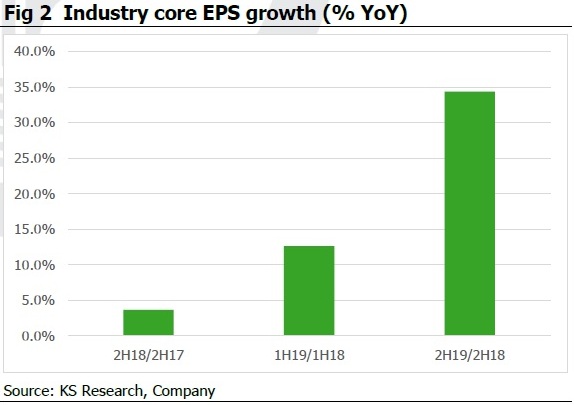
 

“All telco managements share the same view that competition will remain benign for quite some time. If market collaboration persists, we see some upside potential to our 2019E mobile service revenue growth forecast of 3.3 per cent year on year,” he said.

“We believe the removal of low-end unlimited fixed speed packages will show a full effect in 3Q19 after the validity of various packages ends. On top of this, we foresee a chance for telcos to remove other loss-making or low-margin packages and then force customers to trade up their packages, resulting in further ARPU uplift.”

He said the latest spectrum allocation of 700 MHz has already normalised the 5G spectrum acquisition cost. Applying the price per MHz of 700 MHz and adjusting for varying degrees of spectrum propagation, he forecasts telcos will see a spectrum acquisition cost of 5G at Bt97.7 billion for 2650 MHz unpaired bandwidth of 700 MHz, 2600 MHz and 26000 MHz or Bt36.9 million per MHz. This is much cheaper than the 4G spectrum acquisition cost of Bt288 billion for 120 MHz unpaired bandwidth of 900 MHz and 1800 MHz, or Bt2.4 billion per MHz.

“Also, we see the normalisation of spectrum acquisition cost per MHz will benefit telcos in the long term when their 3G and 4G licenses expire in the next 7-14 years,” he said. “So, applying the price per MHz of 700 MHz and adjusting for varying degrees of spectrum propagation, we estimate a spectrum acquisition cost for 2100 MHz, 1800 MHz, 900 MHz and 2300 MHz when they come up for renewal to be Bt137.3 billion, or Bt366 million per MHz – much cheaper than the past acquisition cost of Bt358 billion, or Bt954 million per MHz,”.

Additionally, the 10-year instalment term for 700 MHz licences and 900 MHz licences should become an industry standard and thus applied to future spectrum auctions, he added.

“Combining a normalized spectrum acquisition cost and more relaxed spectrum payment terms, we foresee cash requirements for spectrum payments to be less burdensome and manageable for telcos,” he said.

“In summary, our calculation suggests that telcos will save Bt296 billion from the normalization of the spectrum acquisition cost over the next 22 years, implying 28 per cent potential upside in terms of present value using the industry average WACC [weighting average cost of capital] of 9.4 per cent,”.

On a year-to-date basis, telco share prices have broadly outperformed the SET thanks to easing competition, scope for FCF (free cash flow) expansion and subsiding regulatory uncertainty, he said.

“We maintain our positive sector view as we foresee robust financial performances in 2H19E, further spectrum price normalisation for 2600 MHz and 26000 MHz multiple band auction and room for opex [ operating expenses] saving, all of which should strengthen telcos’ FCF positions and their ability to pursue aggressive capital management,” he said.

“The key risks to our positive sector call are 1) intensifying price competition to reoccur; 2) 5G spectrum reserve prices to be way higher than our projection; and 3) new entrants to participate in upcoming 5G auctions.

“For mobile-related stocks, we see risks to include 1) too short a 4G harvest period; 2) risk of overinvestment in unproven 5G technology; 3) risk of new entrants; and 4) risk of equity calls.”

Central Retail consolidates ahead of listing

ศาสตร์เกษตรดินปุ๋ย : ขอบคุณแหล่งข้อมูล : หนังสือพิมพ์ The Nation

https://www.nationthailand.com/business/30373990

Central Retail consolidates ahead of listing

Jul 31. 2019
By The Nation

411 Viewed

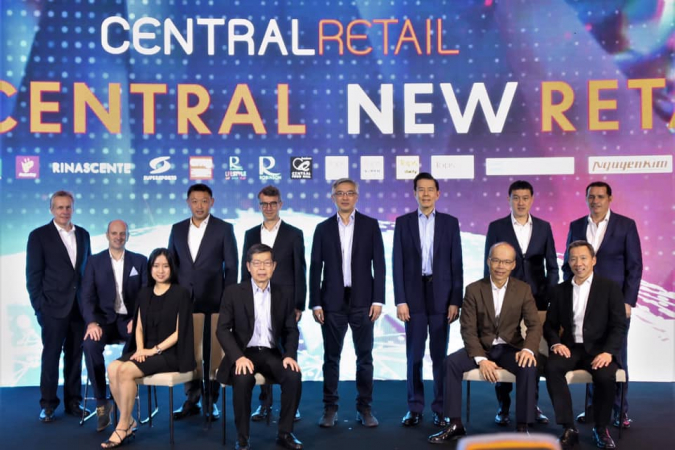
Central Retail, a subsidiary of the Central Group, today (July 31) announced a consolidation of its retail units in Thailand, Vietnam and Italy under a holding company, ahead of the company’s listing on the Thai stock market.

The move falls in line with the company’s ‘New Central New Retail’ policy by stepping forward to become a keen leader with strong capability in conducting business on a ‘customer-centric omnichannel’ platform.

The platform will create a borderless shopping experience with ‘brick-and-mortar’ stores and online channels, catering to the digital lifestyle of consumers today.

Tos Chirathivat, chairman of the executive committee at Central Retail, said the company started as a small family business 72 years ago.

“We are committed to offer new shopping experiences that cover any demand and requirement of consumers,” said Tos.

Being the leader in the Thai retail market, the company operates a wide range of multi-format stores, ranging from the first department store in Thailand to other retail outlets with diversified formats, including specialty stores for specific products. Furthermore, the company has added value to its offline channel with the launch of Omnichannel strategy to answer consumer’s shopping behaviour in every dimension, he said.

Tos said the retail industry has undergone a significant transformation and it will continue to evolve through new technology, data and the ever-changing lifestyle of consumers, adding that these are the key trends shaping the retail industry going forward.

Customers are more emotional than functional these days and massive transformation and collaboration will have to happen to create a seamless play between retail, payment and logistics.

“Central Group positions itself as the “Central of Life” for all our stakeholders. We will continue to revolutionise our platforms in order to create a “Central Experience, ” offering a unique , frictionless proposition throughout a customer’s journey,” said Tos.

Central Retail, as of March 31 this year, operates 1,979 retail stores in 51 Thai provinces. The company also has a total of 134 retail stores in Vietnam and Italy.

Yol Phokasub, chief executive officer at Central Retail, said the company conducted a restructuring process of its retail organisation over the past three years, aimed at strengthening its businesses and to expand under new models, driven by the prospects of new business opportunities amid the change in technology and consumers’ behaviour.

He said Central Retail had initiated a business model, covering three key dimensions: ‘multi-category’ of products comprising fashion, hardline, and food; ‘multi-format’ of retail stores; and ‘multi-market’ covering stores in Thailand and abroad.

Credit Suisse considers investments in Asia-Pacific property market

ศาสตร์เกษตรดินปุ๋ย : ขอบคุณแหล่งข้อมูล : หนังสือพิมพ์ The Nation

https://www.nationthailand.com/business/30373980

Credit Suisse considers investments in Asia-Pacific property market

Jul 31. 2019
Shinjuku intersection, Tokyo
Credit Suisse considers investments in Asia-Pacific property market

Shinjuku intersection, Tokyo Credit Suisse considers investments in Asia-Pacific property market
By PHUWIT LIMVIPHUWAT
THE NATION

511 Viewed

Credit Suisse is focusing on the Asia-Pacific property market as the region’s high-net worth individuals are upbeat on investing both domestically and in developed markets overseas.

“Our business strategy in the Asia-Pacific region is two-fold. Firstly, we are looking to increase the value of our assets under management [AUM] in the property sector in Asia-Pacific as the region’s emerging markets such as China and Southeast Asia have the potential for high yield, which is making them attractive for Asian investors,” said Christopher Chiang, head of real-estate Asia-Pacific, Credit Suisse.

Secondly, he said, Credit Suisse aims to help investors in the region make investments in developed markets.

Currently, Credit Suisse’s AUM stands at US$50 billion (Bt1.5 trillion) globally, with around $2 billion in Asia.

“We have raised $1 billion from Asian investors in the past two years and we aim to continue increasing our AUM from Asian clients in the upcoming years,” Chiang said, not revealing a specific target.

When compared to their Western counterparts, Asian investors are more attracted to properties that promise high yields despite higher risks, he said. This makes Asian investors more interested in spending on value-added projects instead of core projects.

Value-added projects are when Credit Suisse uses their client’s capital to invest in property that is empty, half-empty or undermanaged. They then refurbish the property before leasing it or selling it and returning the capital to the investors with profit.

In comparison, Western investors are more attracted to core investments, in which Credit Suisse purchases buildings at key locations and leases the property out for long-term income distribution to their clients, he said.

However, like their Western counterparts, Asian investors allocate around 92 per cent of their capital to the domestic market, and the remaining 8 per cent to offshore projects, said Francisca Farina Fischer, the private bank’s head of real-estate international.

According to a study by Credit Suisse, the appetite for real estate remains strong in developed markets, with cities like Boston, London, Paris, Berlin, Sydney, Tokyo and Seoul having the highest level of liquidity.

This presents key opportunities to Asian investors who are looking to invest in property overseas.

For instance, the rate of vacancy has been dropping and is at sub-1 per cent in Tokyo, indicating a strong demand for property in the city, Fischer said.

The key challenge for investing in Thailand’s property is the lack of transparency on both regulation and market data, Chiang said. Furthermore, the strengthening baht is also discouraging foreign investors from considering the Kingdom’s real-estate sector. Finally, he said, there are not a lot of commercial assets being traded in Thailand.

“While we do not have investments in Southeast Asia at present, Credit Suisse is looking at opportunities to boost its footprint and AUM in the region as growth prospects in the Southeast Asian property market is promising,” Chiang added.