SET steady after govt policies unveiled, as investors wait for more details

ศาสตร์เกษตรดินปุ๋ย : ขอบคุณแหล่งข้อมูล : หนังสือพิมพ์ The Nation

https://www.nationthailand.com/business/30373673

SET steady after govt policies unveiled, as investors wait for more details

Jul 25. 2019
Photo by: SET

Photo by: SET
By PHUWIT LIMVIPHUWAT
THE NATION

445 Viewed

Investors are still waiting for further details on the government’s economic policies after Thursday’s policy announcement in Parliament, according to market experts.

“Investors’ sentiment will likely be unchanged by today’s policy announcement and debate as the policies have been public for several days now but the details on their implementation are still unclear,” said Paiboon Nalinthrangkurn, chairman of the Federation of Thai Capital Market Organisations (Fetco).

However, the market may see positive signs in Thursday’s official policy announcement by Prime Minister Prayut Chan-o-cha, as it signalled continuity in major economic policies such as development of the Eastern Economic Corridor and promotion of foreign investment, he said.

The market is not expected to react significantly until investors see further details of policy and implementation, Paiboon added.

The policies unveiled by the government on Thursday were as expected, with key emphasis on short-term welfare and agriculture. However, the policies outlined were still vague and the details of how they will be implemented were still unclear, said Mana Nimitvanich, first vice president of the Krungthai Bank’s global business development and strategy group

On Thursday, the Stock Exchange of Thailand (SET) closed at 1,730.90 points, up 0.32 per cent or 5.46 points, with a value of Bt58.9 billion.

Foreign, institutional, and individual investors also recorded net buys of Bt57.50 million, Bt36.11 million and Bt361.42 million respectively.

GSB predicts economic growth next year to lag behind 2019

ศาสตร์เกษตรดินปุ๋ย : ขอบคุณแหล่งข้อมูล : หนังสือพิมพ์ The Nation

https://www.nationthailand.com/business/30373660

GSB predicts economic growth next year to lag behind 2019

Jul 25. 2019
Chatchat Payuhanaveechai /Photo by GSB

Chatchat Payuhanaveechai /Photo by GSB
By The Nation

394 Viewed

Thailand’s economy will grow by up to 3.6 per cent this year, at a slower pace than last year due to the negative impact from the trade war between the US and China and the strong baht, according to the latest report by the Government Savings Bank on Thursday (July 25).

GSB president and chief executive officer Chatchat Payuhanaveechai said the bank has also forecast the country’s economic growth at 3.5 per cent in 2020.

The main factor that will drive the country to achieve 3.6 per cent growth this year will be the new government’s investments in developing the country’s infrastructure and stimulus measures to improve the purchasing power of lower-income people.

The bank said Thailand still faces business risks from the US-China trade war, the slowdown in the global economy, decline in Chinese purchasing power to buy property due to that country’s declining growth and the high household debt that will directly impact purchasing power, he said.

Survey finds widening pay-gap in Thailand

ศาสตร์เกษตรดินปุ๋ย : ขอบคุณแหล่งข้อมูล : หนังสือพิมพ์ The Nation

https://www.nationthailand.com/business/30373661

Survey finds widening pay-gap in Thailand

Jul 25. 2019
By THE NATION

297 Viewed

Following the trend of widening pay gaps in most countries, the margin in wages between junior employees and senior managers in Thailand has grown by 9.3 per cent, according to a new study published by Korn Ferry.

The study, which draws on data from Korn Ferry’s world-class pay database, shows the pay gap increasing in 77 per cent of 58 countries.

Eight out of the nine countries in Asia saw moderate increases in their pay gaps between lower-level and higher-level employees. Thailand’s increase stands at 9.3 per cent, lower than the average increase of 15.3 per cent across the nine countries.

However, India stands out with a dramatic increase of 66 per cent in the pay gap.

Chanat Adhibai, Korn Ferry Thailand’s senior client partner and head of rewards and benefits, said: “When looking at the pay gap in markets like Thailand, it is important that we consider the definition of ‘equity’. Many organisations in Thailand are now facing talent shortage when it comes to digital jobs, especially as these organisations plan to transform traditional jobs using smart technologies. As such, talents taking on these jobs that are created in times of disruption tend to receive a pay premium.”

Chanat Adhibai, Korn Ferry Thailand's senior client partner and head of rewards and benefits

Chanat Adhibai, Korn Ferry Thailand’s senior client partner and head of rewards and benefits

“Pay has become a catalyst for change. It is clear that talents need a ticket to perform in today’s dynamic environment – adapting to new roles, switching back and forth regularly, going up and down without a career ladder block. If they accept new work conditions, they will receive a new pay scheme. Pay equity is not dependent on job size anymore, but on the agility in moving along with the organization’s agendas,” Adhibai continued.

The Korn Ferry analysis also points to several additional reasons for the widening gap in developed economies.

“At the lower end of these labour markets, automation and offshoring means that enhanced productivity results in an abundance of available labour – more people than jobs – which slows the increases in pay,” said Bob Wesselkamper, Korn Ferry Global’s head of rewards and benefits solutions.

“Meanwhile, at the higher end, there’s a shortage of people with important hard skills and proven experience. Organisations also have to compete for senior managers with in-demand soft skills, such as emotional intelligence, creative thinking and the ability to manage large and complex teams. Therefore, pay at this level is going up – and is likely to increase faster than other jobs.”

While a widening gap is the norm in the majority of nations, there are areas where the gap is narrowing. For example, the pay gap is shrinking in countries like France and Italy, as a result of higher tax rates for big earners, fewer pay increases at top-levels, and government and union intervention in pay at the lower levels.

BAAC earmarks Bt55 bn for special loans to drought-hit farmers

ศาสตร์เกษตรดินปุ๋ย : ขอบคุณแหล่งข้อมูล : หนังสือพิมพ์ The Nation

https://www.nationthailand.com/business/30373658

BAAC earmarks Bt55 bn for special loans to drought-hit farmers

Jul 25. 2019
 Apirom Sukprasert /Photo by: BAAC

Apirom Sukprasert /Photo by: BAAC
By The Nation

315 Viewed

The Bank of Agriculture and Agricultural Cooperatives (BAAC) has earmarked Bt55 billion to help farmers who have suffered adverse impacts from the severe drought.

The first measure is to extend special loans for farmers at 0 per cent for the first year, the bank’s president Apirom Sukprasert said on Thursday. Of the total budget, Bt50 billion has been put aside for these emergency loans.

Farmers will be offered five-year loans of up to Bt50,000, with 0 per cent interest charged for the first year, and a minimum interest of 7 per cent for the remaining four years, he said.

He added that the remaining Bt5 billion of the budget will be used to offer loans for improving the quality of life for farmers. These loans will be given at 5 per cent interest rate and will cover 1 million farmers nationwide.

Farmers will be eligible for loans of up to Bt500,000 that can be repaid over 15 years at a minimum interest rate of 2 per cent. These loans will cover development projects such as investment in water systems or crops that use less water.

Farmers can apply for these loans from August 1 until December 31.

Thailand edges up for innovation in business

ศาสตร์เกษตรดินปุ๋ย : ขอบคุณแหล่งข้อมูล : หนังสือพิมพ์ The Nation

https://www.nationthailand.com/business/30373656

Thailand edges up for innovation in business

Jul 25. 2019
Photo by: Global Innovation Index

Photo by: Global Innovation Index
By The Nation

397 Viewed

Thailand ranks 43rd in the Global Innovation Index (GII) 2019, up one place from last year, according to the latest report published by the World Intellectual Property Organizations (WIPO), the INSEAD business schools and Cornell University on Thursday.

Providing 80 detailed metrics for 129 economies, the GII has become one of the leading references for measuring an economy’s performance as it relates to innovation.

The report rated Thailand as among the better achievers and among those middle-income economies making purposeful strides to bridge the innovation divide.

This year, four of the seven GII pillars see improvements in the Kingdom: institutions (57th), human capital and research (52nd), business sophistication (60th), and knowledge and technology output (38th).

The country has benefited from improvements in important indicators such as R&D expenditure, research talent, and gdomestic expenditure on R&D (GERD) financed by business, where it ranks 4th. It also did well for its tertiary enrolments, researchers, and patent designs.

Compared with other ASEAN economies, Thailand is exceptionally strong in trade-related variables, ranking 8th in high-tech net exports and 1st in the creation of creative goods.

Some weak areas were also identified – these included PISA results, venture capital deals, GERD financed overseas, plus ICT services imports and exports but the report said that if addressed, these could help the economy scale the innovation ladder even faster.

Thailand’s Asian neighbours were among the stellar performers, with Singapore (88th, South Korea (11th), Hong Kong (13th), China (14th), Japan (15th) and Australia (22nd) the highest-ranked in the region.

Switzerland leads the world for the ninth consecutive year, the rest of the top five being Sweden, the US, the Netherlands and the UK.

Finland and Denmark follow in 6th and 7th.

The overall picture shows innovation withstanding the pressures of slowing global economic growth.

However, only a handful of nations are reaping the full benefits and a clear innovation gap persists.

‘No faith’ in Prayut’s economic team, opposition leader tells opening policy debate

ศาสตร์เกษตรดินปุ๋ย : ขอบคุณแหล่งข้อมูล : หนังสือพิมพ์ The Nation

https://www.nationthailand.com/business/30373645

‘No faith’ in Prayut’s economic team, opposition leader tells opening policy debate

Jul 25. 2019
Sompong

Sompong
By THE NATION

548 Viewed

Thailand’s Opposition leader Sompong Amornwiwat said he lacked confidence that the current economic team under Prime Minister Prayut Chan-o-cha could successfully implement its policies, given that most of its existing team members are the same as those in the previous Prayut government.

Sompong, who is the new leader of Pheu Thai Party, was the first MP to kick off Thursday’s parliamentary debate after Prayut finished announcing the government’s policies.

Sompong added that the previous government had failed to solve either the nation’s economic difficulties or to address the concentration of wealth among a small group of people.

Chinese consumers want richer experiences, quality of life

ศาสตร์เกษตรดินปุ๋ย : ขอบคุณแหล่งข้อมูล : หนังสือพิมพ์ The Nation

https://www.nationthailand.com/business/30373637

Chinese consumers want richer experiences, quality of life

Jul 25. 2019
Photo: foodnewsinternational.com

Photo: foodnewsinternational.com
By THE NATION

328 Viewed

Mintel has published its annual Chinese Consumer Report, offering an overview of the key trends and spending behaviours affecting China’s consumer landscape over the last year that reveals Chinese consumers are in pursuit of richer experiences and quality of life.

Latest findings from The Chinese Consumer Report shows that 91 per cent of Chinese respondents agree that when making a purchase, quality is more important than price; while over four in five (81 per cent) are interested in trying something new rather than sticking to the familiar.

The new Mintel research also reveals that total consumer expenditure in China grew 8.6 per cent to reach RMB41,146 billion (Bt184,177 billion) in 2018. While this is slower than the 11.2 per cent growth seen in 2017, expenditure grew in line with China’s per capita disposable income of 8.7 per cent.

Mintel’s Jessica Jin notes that the survey shows Chinese consumers are becoming savvier spenders and are willing to pay a premium for products and services that support a richer lifestyle. But when it comes to basics, value for money is still the top consideration.”

Savvier and more prudent spending

Household care products is the top sector where decreased prices or discounting has played a big part in driving consumers to spend less; as indicated by the 43 per cent of Chinese respondents who have spent less on household care products (eg tissue paper, household cleaning products). On the other hand, consumers are willing to spend more for broader, self-indulgent experiences including holidays.

Mintel research further reveals that personal items and housing remain the biggest consumer spending sector, accounting for 23.7 per cent of total consumer expenditure in 2018. This is followed by in-home food (14.3 per cent), holidays (9 per cent) and clothing and accessories (8.1 per cent). Looking ahead, Mintel predicts that holidays, transportation, and personal finance and housing, will be the top three sectors with the highest growth in terms of consumer spending, reaching a compound annual growth rate of 12.8 per cent, 10.2 per cent and 10.1 per cent, respectively, in the five years to 2023.

“China’s stable economy in 2018 has driven consumer demands beyond basic necessities like food and drink, towards more emotional requirements like attaining enjoyment from holidays, leisure and entertainment. With more and more consumers pursuing a better quality of life and wanting more new life experiences, sectors such as holidays, leisure and entertainment, and clothing and accessories, have encouraged many consumers to self-indulge and spend more in 2018. Meanwhile, increasing expenditure on essentials like in-home food, for instance, is driven by rising prices in the market,” Jin said.

Mintel’s annual The Chinese Consumer 2019 Report tracks consumer spending across 15 market sectors, revealing the future opportunities with each category. Sector highlights include:

– In-home food: Pursuing better-for-you and convenient diets

– Beauty and personal care: 360-degree holistic beauty solutions will mainstream

– Clothing and accessories: keeping up with growing individuality and Chinese brands increasingly in the spotlight

– Leisure and entertainment: Self-indulgence and breaking from routine

– Holidays: Leading sector for consumer spending with promising growth prospects

Policy debate starts with Prayut facing protests from the opposition

ศาสตร์เกษตรดินปุ๋ย : ขอบคุณแหล่งข้อมูล : หนังสือพิมพ์ The Nation

https://www.nationthailand.com/business/30373629

Policy debate starts with Prayut facing protests from the opposition

Jul 25. 2019
By THE NATION

1,254 Viewed

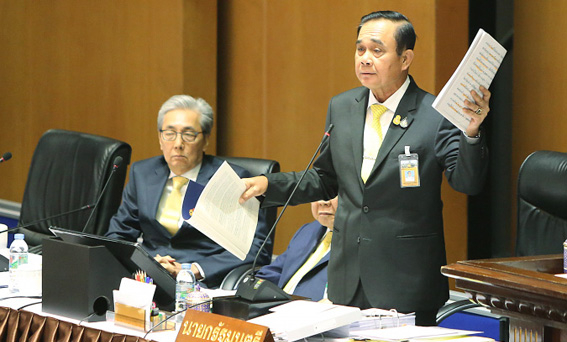
Prime Minister Gen Prayut Chan-o-cha kicked off the government policy debate at 9.30am and was immediately disrupted by protests from the opposition.

Turmoil broke out even before Prayut delivered his government policy statement when opposition Future Forward Party MP Piyabutr Saengkanokkul rose to protest against the prime minister.

Piyabutr alleged that Prayut did properly take the oath of allegiance to the King before he took office.

Phalang Pracharat MP Virakorn Khamprakorb quickly rose to defend Prayut by pointing out that the video clip of Prayut taking the oath was edited to remove certain wording.

The chair of the meeting then allowed Prayut to deliver his policy statement.

Soon after Prayut began speaking, Pheu Thai MP Julaphan Amornwiwat rose to protest on the grounds that the prime minister was violating meeting regulations by failing to speak in accordance with the copy of policy statement distributed to parliamentarians.

Another opposition MP, Pheu Thai’s Chonnan Srikaew also protested, saying that Prayut must address the chair of the meeting instead of speaking to the parlimentarians.

Chonnan also asked the chair of the meeting to tell the prime minister not to address or give orders to parliamentarians again.

Parliament President Chuan Leekpai, who chaired the meeting, then told the prime minster to adhere to copy of his policy statement when making his speech.

Prayut acknowledged the instruction and thanked Chonnan and called him a rising star before he continued to read from the copy.

But Jirayu Huangsup, Pheu Thai MP, rose to protest again when Prayut skipped over the drug issue. Jirayu asked whether this meant the government would not be serious in tacking drug issue.

Prayut resumed reading the statement after the protest.

Pace of property project launches in Bangkok rises 11% in first half

ศาสตร์เกษตรดินปุ๋ย : ขอบคุณแหล่งข้อมูล : หนังสือพิมพ์ The Nation

https://www.nationthailand.com/property/30373579

Pace of property project launches in Bangkok rises 11% in first half

Jul 24. 2019
Photo by: Prerm Ruamrudee

Photo by: Prerm Ruamrudee
By The Nation

152 Viewed

Some 219 property projects were launched in the first half of this year in Bangkok and its surrounding areas, an 11.2 per cent increase from the same period last year, the Agency for Real Estate Affairs (AREA) reported on Wednesday.

The launches put 55,596 units on the market, with a total value of Bt221.5 billion, up 18.6 per cent and 15.4 per cent, respectively, from the year-earlier period.

Up to 211 of the new projects in the first half are residential, including condominiums, single detached houses, and townhouse. The other eight projects are for commercial buildings, the research said.

The average residential price was Bt3.96 million per unit, up 1 per cent from the end of last year, the research said.

AP (Thailand) Plc led the way on the first-half launches with 5,135 units worth Bt27.27 billion, followed by Pruksa Real Estate Plc with 3,755 units worth Bt13.66 billion, and Supalai Plc with 1,983 units worth Bt18.73 billion.

The inventory of townhouses on June 30, 2019, was 61,541 units, down 2.7 per cent from the end of last year.

Meanwhile, the inventory of single detached houses on June 30 was 61,541 units, down 2.5 per cent from the end of 2018.

Condominiums recorded a total inventory of 88,788 units at the end of June 2019, falling 8.5 per cent from the end of year 2018.

In view of the market in the first half of this year, AREA forecasts the property market this year will drop 16 per cent compared with last year, when demand had slumped.

One Place Estate promotes Best Western link for Hua Hin resort

ศาสตร์เกษตรดินปุ๋ย : ขอบคุณแหล่งข้อมูล : หนังสือพิมพ์ The Nation

https://www.nationthailand.com/property/30373567

One Place Estate promotes Best Western link for Hua Hin resort

Jul 24. 2019
An image of the Carapace Hua Hin-Khao Tao resort. Construction of its first phase is expected to be completed in 2020.

An image of the Carapace Hua Hin-Khao Tao resort. Construction of its first phase is expected to be completed in 2020.
By The Nation

229 Viewed

Catering to investors keen on resort condominiums, One Place Estate Co Ltd has introduced its latest condominium project, the Bt1.6 billion Carapace Hua Hin-Khao Tao. Hotel management services will be run by the Best Western Plus chain and unit prices start from Bt2.49 million.

The company’s director, Pongpipat Kanjanasupat, said that the project guarantees a return on investment of 5 per cent a year for the first five years for those customers that buy and put their units up for rental management by Best Western Plus.

The building will have eight storeys with 532 units. Construction will start this year and the first phase is expected to be completed in 2020, with the following phase in 2021.

The company has so far sold units accounting for up to 50 per cent of the total project value, Pongpipat said.