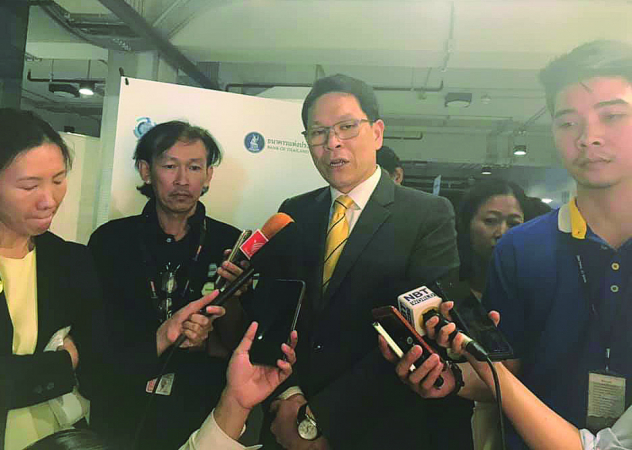
Banks to ride on digital ID scheme with new services

ศาสตร์เกษตรดินปุ๋ย : ขอบคุณแหล่งข้อมูล : หนังสือพิมพ์ The Nation

https://www.nationthailand.com/business/30373220

Banks to ride on digital ID scheme with new services

Jul 18. 2019
By PHUWIT LIMVIPHUWAT
WICHIT CHAITRONG
THE NATION

809 Viewed

Thailand’s top commercial banks will roll out new financial service plans as they embrace the National Digital ID (NDID) scheme, which is expected to be officially launched in the fourth quarter of this year.

The NDID is a blockchain database which stores the information of its users. The database has been developed jointly between the state-run National ID company in cooperation with 10 commercial banks in the Kingdom.

The use cases in the financial sector include allowing clients to open bank accounts and make financial transactions online through digital facial identification, known in the financial sector as electronic know-your-customer (e-KYC).

“The goal of the NDID is to increase the efficiency of financial services and making financial transactions and administrations more convenient for customers while guaranteeing the security and privacy of personal information,” Bank of Thailand (BOT) governor Veerathai Santiprabhob said when introducing the NDID scheme to the press at the Bangkok Fintech Fair 2019.

Boonsun Prasitsumrit, chief executive officer of the National Digital ID company, said: “The development of the NDID system has been completed and it is now in the final stages of the regulatory sandbox.”

He said the system should exit the sandbox and be launched to the public in the fourth quarter of this year, adding that once the implementation of the NDID on the financial sector is successful, the system can be implemented in other sectors that rely on identity verification such as insurance and retail.

Bank of Ayudhya (Krungsri), one of the 10 banks involved in the NDID testing and development stages, is confident the system will be rolled out by the end of the year and has started to do some internal testing of the new online identification system.

“Krungsri is now undergoing internal testings such as using digital facial identification systems when employees enter the headquarters building or when employees purchase food in the headquarters canteen,” said Thakorn Piyapan head of Krungsri Consumer Group.

“We believe the total bank accounts opened will increase ‪around 10 to 15‬ per cent once the NDID system is officially launched. This is because the NDID will increase the convenience of opening a bank account and allow customers to open bank accounts at night or on the weekends.”


Thanachart Bank has sought to take advantage of the digital ID infrastructure plans with an information-based lending service that it expects to launch by the end of this year. Tirachart Chiracharasporn , executive vice president of Thanachart Bank, said the bank aims to provide personal loans via its application called T-Fin. It will draw on artificial intelligence and machine learning for loan approvals. The new digital financial service will reduce the time for loan approvals and enable those who currently cannot access financial services to obtain loans. Small loans of between Bt 5,000 and Bt10,000 will be given in initial lending services, he said. The bank will apply for a sandbox trial with the central bank first before it provides the information-based lending to general public, Tirachart added.

The Stock Exchange of Thailand has also been keeping up with the NDID developments and announced that its sister company, FinNet, has developed a digital system that will connect to the NDID database and allow financial institutions to digitally verify their clients’ identities.

Silot, a Singapore-based fintech startup which is developing one-stop digital solutions for banks in Southeast Asia, announced its digital system will connect with the NDID once it is launched, according to Li Jiaming, Silot’s head of digital solutions.

The three-year-old startup has developed a QR payment solution for Krungsri and is looking expand its system’s use cases by embracing the NDID database.

New energy minister stresses sustainability

ศาสตร์เกษตรดินปุ๋ย : ขอบคุณแหล่งข้อมูล : หนังสือพิมพ์ The Nation

https://www.nationthailand.com/business/30373215

New energy minister stresses sustainability

Jul 18. 2019
 Energy Minister Sontirat Sontijirawong

Energy Minister Sontirat Sontijirawong
By THE NATION

638 Viewed

New Energy Minister Sontirat Sontijirawong has vowed to ensure the country’s sustainability in energy supply.

Speaking on the first day of taking office today (July 18) on Thursday, he said the costs of electricity and oil must be affordable to the general public, especially low income earners and small business operators.

He added that he would discuss with the ministry’s senior officials on whether the Power Development Plan ( 2018-2037) should be revised.

The ministry will also focus on the absorption of palm oil as part of the crude palm oil management policy.

He also said further study is needed on the ministry’s plan to extend government subsidy for B20 biodiesel.

Agriculture minister to tackle drought and falling prices

ศาสตร์เกษตรดินปุ๋ย : ขอบคุณแหล่งข้อมูล : หนังสือพิมพ์ The Nation

https://www.nationthailand.com/business/30373214

Agriculture minister to tackle drought and falling prices

Jul 18. 2019
From left: Mananya, Chalermchai, Praphat, and Thammanat

From left: Mananya, Chalermchai, Praphat, and Thammanat
By THE NATION

587 Viewed

The new Agriculture and Cooperatives Minister Chalermchai Sri-on has wasted no time in identifying his highest priorities.

On July 18, his first day in office, Chalermchai and his 3 deputies – Thammanat Phromphao, Mananya Thaiseth and Praphat Phothasuthon – announced they would be focusing on the drought and plummeting crop prices, especially rice and rubber.

“Drought is the most pressing issue as the whole country is suffering from lower rainfall,” he said. “We are formulating plans to tackle both drought and flood problems, mainly by providing compensation and suggesting weather-suitable crops as a substitute for the usual main crops.

“Although MOAC is not announcing any disaster zones at the moment, we are already surveying the damage caused by drought in several areas so that affected farmers can be suitably compensated without delay.”

According to the Royal Irrigation Department, this year’s rainfall is 18 per cent lower than normal, resulting in only 70 per cent of irrigated areas being viable for agriculture, mainly in the area below the Chao Phraya dam.

Praphat added that apart from the nationwide drought, rice farmers were also suffering from high production costs, now at Bt5,000 per ton.

The MOAC will devise suitable measures, he said, be it compensation or a program of price guarantees, after discussing the matter with related parties to ensure that it does not affect consumers and entrepreneurs.

Commerce minister to focus on agriculture, exports and trade deals

ศาสตร์เกษตรดินปุ๋ย : ขอบคุณแหล่งข้อมูล : หนังสือพิมพ์ The Nation

https://www.nationthailand.com/business/30373213

Commerce minister to focus on agriculture, exports and trade deals

Jul 18. 2019
By THE NATION

463 Viewed

Commerce Minister Jurin Laksanawisit revealed his top policy priorities upon arriving at the office on his first day of duties with his deputy, Weerasak Wangsuphakijkosol, on Thursday.

“The Ministry of Commerce will focus mainly on four pressing issues,” he said. “First is the revenue guarantee campaign for crucial economic crops such as rice, corn for animal feed, tapioca, rubber, and oil palm. The farmers’ revenue guarantee programme has been one of the most successful campaigns of the previous government and is therefore expected to continue following the existing procedures and regulations which have proved to be working.”

The second most important issue is exports, the new minister said. “Although many speculate that we will not be able to achieve the 3 per cent growth target, the MOC is still confident in the power of the private sector to expand the export market in the second half of the year with the help of government policies.,” Jurin said.

Third main issue is the cost of living and rises in product prices. “These will require intervention policies that are fair to both the consumers and entrepreneurs. Finally, the last issue that the MOC will focus on is to complete the pending trade negotiations with foreign partners such as those for the Regional Comprehensive Economic Partnership (RCEP) and the Thai-EU Free Trade Agreement, which were put on hold due to the national election in Thailand,” Jurin said.

New minister hopes to have medical marijuana prescribed from August

ศาสตร์เกษตรดินปุ๋ย : ขอบคุณแหล่งข้อมูล : หนังสือพิมพ์ The Nation

https://www.nationthailand.com/business/30373212

New minister hopes to have medical marijuana prescribed from August

Jul 18. 2019
By THE NATION

400 Viewed

Public Health Ministry officials welcomed the new minister on Thursday, saying they will support his policy to promote medical marijuana and work towards getting the formula prescribed at public hospitals from early August.

Public Health Minister Anutin Charnvirakul started his first day at work from 8.30am, when he showed up at the ministry with his deputy, Sathit Pitutecha. He was received by the ministry’s permanent secretary Dr Sukhum Kanchanapimai, ministry executives and officials.

A group of marijuana supporters also showed up to congratulate him and urged him to push forward the legalisation of medical marijuana.

The new minister explained that he had many items on his agenda, including implementing public health projects under Royal patronage, urgently addressing issues related to the universal healthcare scheme and the recruiting of newly graduated doctors to boost the quality of tambon-level hospitals.

Anutin said his policy can be summed up in the motto “reducing expenses, increasing incomes and promoting strength”. As for marijuana, he said it should be made accessible for everybody soon, and “if it is well implemented, it can become a cash crop for farmers”.

Dr Sukhum, meanwhile, said he was ready to respond to Anutin’s policy of allowing the prescription of medical marijuana in public hospitals by early August for patients in need. He added that the Government Pharmaceutical Organisation (GPO) should be able to produce 10,000 bottles of cannabis extract and the Chaophraya Abhaiphubejhr Hospital 5,000 bottles by then. The Phra Acharn Fan Acharo Hospital, meanwhile, will produce five formulas of marijuana-based traditional medicines made from confiscated weeds. In the first phase from July to September, there should be at least one hospital per province that provides medical marijuana, more community hospitals gain permission to prescribe the concoctions in the second phase by April 2020, he added.

Meanwhile, Deputy Minister Sathit said he aimed to propel forward three measures, namely promoting exercise as a way of maintaining health and reducing medical expenses, which he and Anutin will lead by example; developing the healthcare system in order to avoid long queues at hospitals; and using technology to link patient information with all medical service units.

Inefficient online bankers to be revealed to consumers

ศาสตร์เกษตรดินปุ๋ย : ขอบคุณแหล่งข้อมูล : หนังสือพิมพ์ The Nation

https://www.nationthailand.com/business/30373205

Inefficient online bankers to be revealed to consumers

Jul 18. 2019
By WICHIT CHAITRONG
THE NATION

413 Viewed

The Bank of Thailand (BOT) will next month start publishing details of which banks suffer the longest online downtimes so consumers can identify the most reliable ones.

“We will publicise the names of banks and their service downtimes in order to help consumers choose [the most] reliable banking,” BOT governor Veerathai Santiprabhob said on Thursday at the Bangkok FinTech Fair.

Veerathai said in response to a question on mobile banking services that consumers sometimes had poor online experiences caused by the banks’ servers being down.

The central bank had instructed banks to upgrade their online systems to handle the rising number of digital transactions, he pointed out, and while this might be a lengthy process many banks had successfully upgraded their systems and prevented old problems recurring.

As the industry regulator, the BOT had kept a close eye to make sure that banks complied with a standard of conduct required by the central bank, Veerathai added.

He also said that since the launch of electronic payment system PromptPay more than two years ago, digital financial services had one of highest commercial sector growth rates in the world.

Almost 50 million ID cards and telephone numbers were now linked to bank accounts via PromptPay and the number of merchants accepting payments via QR code scanning had reached 5 million.

The number of monthly electronic payment transactions increased from just 440 million transactions 18 months ago to almost 700 million in May 2019, he said.

Many digital payment services had also been developed to meet the needs of the new economy.

DE minister to establish anti-fake news centre

ศาสตร์เกษตรดินปุ๋ย : ขอบคุณแหล่งข้อมูล : หนังสือพิมพ์ The Nation

https://www.nationthailand.com/business/30373204

DE minister to establish anti-fake news centre

Jul 18. 2019
By JIRAPAN BOONNOON
THE NATION

553 Viewed

Digital Economy and Society Minister Buddhipongse Punakanta has set out three policy fronts to pursue the Thailand 4.0 scheme.

Buddhipongse said these fronts covered digital economy, digital society and digital security. The Digital Economy and Society Ministry will also set up a Fake News Center to combat fake news in the country.

With the digital economy, the ministry will develop an online platform to encourage companies in the private sector to use digital technology to support their businesses. It will promote initiatives such as cryptocurrencies. It will allow users to access e-government services via a single platform.

On the digital society, the ministry will encourage people to upgrade their digital skills. It will reduce the gaps in knowledge on digital technology. It will also push for government agencies to provide services via digital channels to achieve a paperless system. The ministry will develop a portal and a mobile application that will let users reach these services.

Buddhipongse said that for digital security, the ministry will help government agencies monitor reports and news that hurt national security and in this way protect people from fake news.

The minister said that he has asked executives who manage government agencies under the Digital Economy and Society Ministry to submit proposals to the ministry within 10 days.

The ministry then will set up a new budget for the 2020 fiscal year and submit the budget to the Budget Bureau by August 9.

The anti-fake news centre will monitor news reports in terms of national security. The ministry is in talks with officials from government agencies on how the centre will be run.

Industry chiefs to meet Somkid on Friday

ศาสตร์เกษตรดินปุ๋ย : ขอบคุณแหล่งข้อมูล : หนังสือพิมพ์ The Nation

https://www.nationthailand.com/business/30373203

Industry chiefs to meet Somkid on Friday

Jul 18. 2019
By The Nation

220 Viewed

The Federation of Thai Industries (FTI) will submit its recommendations for solving the country’s economic problems to Deputy Prime Minister Somkid Jatusripitak on Friday.

It will also join with the Joint Standing Committee on commerce, industry and banking to draw up a White Paper, which will be proposed to Prime Minister Prayut Chan-o-cha after the premier announces the government’s policy to parliament.

FTI chairman Supant Mongkolsuthree said on Thursday that the industries sentiment index declined to 94.5 in June from 95.9 in May, due mainly to intensifying trade wars between major economies, such as Japan-South Korea, US-India, and US-EU, which could impact on Thailand’s industrial sector.

The stronger baht has also hit exports so the Bank of Thailand should trim its interest rate to make the currency weaker, he added.

B2B buyers value offline relationships despite online tilt, survey finds

ศาสตร์เกษตรดินปุ๋ย : ขอบคุณแหล่งข้อมูล : หนังสือพิมพ์ The Nation

https://www.nationthailand.com/business/30373192

B2B buyers value offline relationships despite online tilt, survey finds

Jul 18. 2019
UPS, a prominent logistics operator, has canvassed views among B2B buyers in Asia.

UPS, a prominent logistics operator, has canvassed views among B2B buyers in Asia.
By THE NATION

165 Viewed

Business to business (B2B) buyers in Asia do much of their purchasing online and rely heavily on offline relationships while seeking out solid after-sales service, a survey by UPS has found.

The 2019 UPS Industrial Buying Dynamics Asia Pacific Study, which surveyed more than 3,400 industrial purchasers globally – including 600 from companies across China, Japan and Thailand – offers region-level insights and specific market-level traits that can help B2B businesses better connect with buyers in Asia.

“What we see in Asia is that business relationships are not one dimensional – online channels are popular, but so too are more traditional forms of buying, and this presents a real balancing act for those who want to sell in this region,” said Sylvie Van Den Kerkhof, vice president of marketing at UPS Asia Pacific region. “The data suggests that businesses wanting to work in Asian markets need to ensure that their e-commerce and bricks-and-mortar operations are both optimized and integrated, while ensuring that post-sales services, such as returns, offer a seamless experience for buyers.”

Where in other regions, shifting demographics have a much bigger role to play in purchasing behavior, to be successful here in Asia, a recommended approach is to consider buyers by job responsibility, rather than nationality or age demographic. As the study shows, Asia is a region of tremendous complexity –one where all buyers are focused on the targeted demands of service for their organizations.

The report found strong indications that online buying is set to increase, with Asian buyers saying they plan to use this channel more within the next five years. Amongst those that prefer making purchases online, Japanese buyers purchase online at a higher rate (31 per cent) than buyers in both China and

Thailand (both at 14 per cent). Meanwhile, in Thailand, companies with higher budgets report that in the next three to five years, they are more likely to move purchasing online; and in China, mobile online purchasing is seeing stronger growth than in other Asian nations.

Notwithstanding the anticipated increase in online purchases amongst Asian buyers, the report also indicates that speaking over the phone or in person happens more frequently in Asia than in the United States or Europe. Asian buyers especially value establishing a relationship in person before purchasing online – this practice is most pronounced in China, where winning trust before doing business is a key part of the deal-making process.

As a region, Asia is similar to the rest of the world in terms of how much its buyers source from domestic suppliers – 67 percent of all B2B purchases in Asia come from domestic suppliers, versus 73 per cent in the US and 64 per cent in Europe. However, there is one outlier in the region: Japan, where buyers source 90 per cent of all goods domestically. This may change in the near future, however, with the country having recently signed a series of free trade deals – most notably with the European Union. When asked what they considered to be the barriers to making international purchases, the top three factors listed by respondents in Asia were longer transit times (60 per cent), customs delays (55 per cent), and issues with returns (45 per cent).

Globally, post-sales support continues to emerge as an important component of industrial buying, consistent across different categories of buyers and industry segments. However, the research found Asian buyers, in particular, value all post-sales services more than buyers do in other regions. These include services such as general returns, pick-up services for difficult-to-ship products, and the provision of ready-made packaging and shipping materials for returns. In China and Japan, the post-sales service that matters most is on-site maintenance and repairs, and in Thailand, returns rank most highly.

“As the Thai government’s focus on developing innovation and technology has driven a shift towards a more value-based economy, we’re seeing a transition in Thailand’s manufacturing scene. The growth of high-value industries will place greater emphasis on the need for manufacturers and distributors to prioritise value-added services.” said Russell Reed, managing director of UPS Thailand. “The study highlights the importance that Thai industrial buyers place on returns. This is just one of the many areas that UPS has been able to provide strong solutions for in order our customers differentiate from competitors. These insights will enable us to provide more comprehensive and effective solutions for Thai manufacturers seeking to capture more regional or global growth opportunities.”

Second phase of Project Inthanon a success: BOT

ศาสตร์เกษตรดินปุ๋ย : ขอบคุณแหล่งข้อมูล : หนังสือพิมพ์ The Nation

https://www.nationthailand.com/business/30373172

Second phase of Project Inthanon a success: BOT

Jul 18. 2019
Photo by: BOT

Photo by: BOT
By The Nation

340 Viewed

The second phase of Project Inthanon has clearly illustrated that Distributed Ledger Technology or DLT can help enhance the efficiency of bond trading and repurchasing activities through the bonds’ life cycles, which include coupon payments, interbank outright trading and repurchase transactions, the Bank of Thailand or BOT states in its report released on Thursday.

Project Inthanon is a collaborative project between the BOT and commercial banks that aims to explore potential benefits of the technology in enhancing Thailand’s financial infrastructure as well as to develop an ecosystem that supports technological learning and advancement.

The BOT along with eight leading financial institutions and technology partner; R3, had conducted Project Inthanon Phase II from February to June. The latest phase was built upon Project Inthanon Phase I and involved collaborative designing, developing and testing a proof-of- concept (POC) of the decentralised Real-Time Gross Settlement system by using the wholesale Central Bank Digital Currency (CBDC). Project Inthanon Phase II was driven by business use cases in order to solve current business pain points and improve efficiency in the settlement system.

The scope of Phase II included 2 key areas: Delivery-versus-Payment (DvP) for interbank bond trading and repurchase transactions, and regulatory compliance and data reconciliation for third party funds transfer.

BOT reports that the outcomes and findings of Project Inthanon Phase II have shown that process automation using smart contracts has capabilities that can help improve post-trade operational efficiency as well as liquidity management.

In addition, the end-to-end third party funds transfer workflow was redesigned to prevent fraudulent transactions by allowing the senders to check beneficiary information before submitting the transactions.

The new workflow also enabled involved parties to track the status of the transactions, improving the transparency.

The outcomes and test results from Phase II will provide crucial fundamental for the development of Thailand’s financial infrastructure.

The eight financial institutions are Bangkok Bank, Krung Thai Bank, Bank of Ayudhya, Kasikornbank, Siam Commercial Bank, Thanachart Bank, Standard Chartered Bank (Thai), and the Hongkong and Shanghai Banking Corporation Ltd

For Project Inthanon Phase III, the BOT will collaborate with the Hong Kong Monetary Authority (HKMA) to explore the interoperability amongst ledgers to achieve cross-border funds transfer including business modality and implementation of relevant foreign exchange regulations, aiming to reduce associated costs and enhance efficiency.

Project Inthanon Phase III is expected to start in August and should be completed by the fourth quarter of this year, after which the BOT together with the HKMA will \publish a joint project report on the results.