Number of passengers, flights at airports in provinces drop

ศาสตร์เกษตรดินปุ๋ย : ขอบคุณแหล่งข้อมูล : หนังสือพิมพ์ The Nation

https://www.nationthailand.com/business/30373168

Number of passengers, flights at airports in provinces drop

Jul 18. 2019
(File Photo) Tourists at Chiang Mai International Airport. Photo by: The Nation

(File Photo) Tourists at Chiang Mai International Airport. Photo by: The Nation
By The Nation

685 Viewed

The number of flights and passengers at 28 airports under the Airports Department decreased by one per cent over the same period last year, the department chief said on Wednesday.

Ampawan Wannako, director general of the Airports Department, said some 14.4 million passengers were recorded at the 28 airports under the department during the first nine months of the 2019 fiscal year or from October 2018 to June 2019, adding that this represented a one-per-cent- drop compared to the first nine months of the 2018 fiscal year.

She said about 115,000 flights used the 28 airports between October 2018 to June 2019, a drop of one per cent.

The decrease was mainly caused by the cancellations of in-country flights by several domestic airlines.

Ampawan said her department was seeking to add flights to foreign cities from the 28 airports to compensate for the drop in the domestic flights.

On July 10, the low-cost airline T’way Air from South Korea launched a new route from Seoul to Krabi with seven flights per week.

In October, Blue Panorama Airlines, a low-cost airline from Italy, will launch a Warsaw-Krabi route with one flight per week, Ampawan said, adding three more European airlines are interested in introducing flights to Krabi and Surat Thani.

She expected that the number of passengers using the 28 airports would not grow much during the last three months of the 2019 fiscal year.

The anticipated number of passengers in July was 1.54 million, in Augus 1.52 million and in September at 1.37 million. The number of passengers is expected to grow by 0.69 per cent in July and by 0.47 per cent in August but fall by 0.10 per cent in September.

Her department estimates that that number of passengers using the 28 airports would stand about 18.82 per cent at the end of September, a 1.33 per cent fall compared to the 2018 fiscal year.

First task for Energy minister: Defuse electricity generation battle

ศาสตร์เกษตรดินปุ๋ย : ขอบคุณแหล่งข้อมูล : หนังสือพิมพ์ The Nation

https://www.nationthailand.com/business/30373024

First task for Energy minister: Defuse electricity generation battle

Jul 18. 2019
Sontirat

Sontirat
By THE NATION

1,207 Viewed

The Energy Ministry will on Thursday (July 18) submit a list of works for new minister Sontirat Sontijirawong to consider on taking office.

The ministry will first ask him to acknowledge a letter it will send to the Ombudsman’s Office clarifying the state’s contribution to the country’s electricity generation.

Kulit Sombatsiri, the ministry’s permanent secretary, said last Friday the letter was in response to the Ombudsman’s suggestion that the ministry revise its Power Development Plan (PDP) for 2018-2037 by boosting the state’s contribution to at least 51 per cent.

The letter explains that the state-owned Electricity Generating Authority of Thailand (Egat) owns the power lines across the country, indicating that the state has invested at least 50 per cent in the country’s electricity generation system.

If the Ombudsman finds the explanation inadequate, the ministry might consider asking the Cabinet to submit the case to the Constitution Court.

The Ombudsman told the ministry recently that the 2018 PDP allowed private companies to share the role of producing electricity, after which the state’s contribution was cut to less than 50 per cent. This contravened the second paragraph of the 2017 Constitution’s Article 56, said the Ombudsman, which has asked the ministry to take action to comply with the charter within 120 days.

Another issue Sontirat will have to consider is whether to maintain the B20 biodiesel price subsidy beyond the expiry date of July 31.

Sintirat’s policy on biodiesel and gasohol is eagerly awaited by the industrial sector, given that the 2019 Oil Fund Act set to come into effect on September 24 bans the use of the fund to subsidise renewable energy.

Sectors face downside of higher daily wage

ศาสตร์เกษตรดินปุ๋ย : ขอบคุณแหล่งข้อมูล : หนังสือพิมพ์ The Nation

https://www.nationthailand.com/business/30373142

Sectors face downside of higher daily wage

Jul 18. 2019
Gross profit of construction contractors may decrease by 2 per cent from an average of 8-10 per cent.

Gross profit of construction contractors may decrease by 2 per cent from an average of 8-10 per cent.
By The Nation

1,604 Viewed

Securities brokers expect the new government to raise the minimum daily wage to Bt400 from Bt325, shortly after formation of the new Cabinet.

Although the higher wage will boost domestic consumption, it would also lead to a spike in the production costs of some industries.

Natthachart Mekmasin, assistant MD at Trinity Securities Co Ltd, said industries relying heavily on manual labour will be most adversely affected, such as food, agriculture, automotive and electronic components. Producers in these sectors will likely see a decrease in profits. However, it will only have a marginal impact on the overall stock market as bigger industries such as energy, commercial bank and retail will not be significantly affected by the new wage rate.

Therdsak Thaweetheeratham, assistant MD at Asia Plus Securities Co Ltd, added that with the minimum daily wage going up by 23 per cent to Bt400, the gross profit of construction contractors may decrease by 2 per cent from an average of 8-10 per cent.

Companies whose profits are lower than the average, such as Italian Thai Development Plc (ITD) and Nawarat Patanakarn Plc (NWR), will inevitably face the biggest impact.

He also predicted that food and agriculture could see a whopping 25 per cent plunge in estimated profits this year , followed by electronics components (11.7 per cent) while automotive may suffer a Bt20-30 million decline.

Insurance firms brace for fluctuating stock and bond indices

ศาสตร์เกษตรดินปุ๋ย : ขอบคุณแหล่งข้อมูล : หนังสือพิมพ์ The Nation

https://www.nationthailand.com/business/30373144

Insurance firms brace for fluctuating stock and bond indices

Jul 18. 2019
By The Nation

1,169 Viewed

Insurance companies believe that the Thai stock and bond indices will continue fluctuating after the second quarter due to external pressure.

Thai Life Insurance Corporation has decided to keep cash on hand for future investment opportunities, while Tokyo Marine Life Insurance (Thailand) Corporation has decided to invest in government bonds and private stock that offers returns of 4 per cent.

Weena Chaiyawan, a member of Thai Life Insurance Corporation’s board of directors and vice president of the managing board, said the stock and bond indices were still fluctuating violently due to the US-China trade war. Hence, she said, the company’s investment strategy for this year will not focus on new assets. Instead, its plan is to hold cash on hand received from selling stocks until the time is right for investments again.

Once the interest rates drop, the stock market will improve and the total returns this year might be better than expected.

As of May, there has been a drop in bond index investment from 88.3 per cent to 87.4 per cent, while common stock and unit trust funds have risen from 11.7 per cent to 12.6 per cent compared to the same period last year. Common stock investment from foreign exchange has risen 1 per cent due to fluctuating stock prices in foreign markets in the first four months of this year.

Yuwadee Chalermsripinyorach, vice president Tokyo Marine Life Insurance’s financial board, said the investment market has shifted unpredictably, especially due to the ongoing trade war. The corporation aims to maintain total return index at 4 per cent until the end of the year

Investment plans are focusing on the over 30-year government bonds and private sector stocks that promise a return of 4 per cent, with spending focused mostly on 90 per cent of government and corporate bonds and 5 per cent on common stock.

The Office of Insurance Commission has reported investment of Bt3.3 trillion, showing a growth of 6.3 per cent, in the first quarter. Of this, 80 per cent of the investments focused on bonds and savings, while stock investment stood at 10 per cent. The other investments are funds, assets, lottery and bank loans

Joint push for ESG practice among listed companies

ศาสตร์เกษตรดินปุ๋ย : ขอบคุณแหล่งข้อมูล : หนังสือพิมพ์ The Nation

https://www.nationthailand.com/business/30373145

Joint push for ESG practice among listed companies

Jul 18. 2019
Paiboon

Paiboon
By The Nation

593 Viewed

The Federation of Thai capital market organisation, together with its members and other public and private institutes, have jointly declared that they will not be investing in companies that disregard ESG principle, in a move to foster good governance in the capital market.

Paiboon Nalinthrangkurn, board director of the organisation, revealed  that many companies in the Thai capital market will campaign for environmental, social and governance practice (ESG) among  listed firms for a better society and environment.

Institutes joining the campaign include the seven members of the organisation:  The Stock Exchange of Thailand, ATI-ASCO Training Institute, Thai Listed Companies Association, Association of Investment Management Companies , Investment Analysis Association, and The Alternative Investment Management Association. Others are the Government Pension Fund institute, Securities and Exchange commission, Association Of Provident fund, and Thai Institute of Directors.

The asset management organisation has a market capitalisation of Bt5 trillion, while other funds have a combined Bt8-9 trillions.

The campaign is to honour the coronation of His majesty the King.

They believe that a listed company should follow ESG practice by performimng good deeds for the society and the environment. For example, a company which uses a high volume of packaging materials should reduce non-environmental friendly content in its production process, whereas a financial company, such as Tisco, should share financial knowledge with the  public.

There are 700 listed companies engaged in environmental, social and governance practice (ESG).

Big organisations, such as the  PTT Public Company Limited (PTT) which is listed in the high finance enterprise group,  should invest more in  enterprises involved in  social issues, while listed institutes should  give advice on  ESG practice to small and medium-sized companies, they added.

SET closes 9.13 points lower on Wednesday

ศาสตร์เกษตรดินปุ๋ย : ขอบคุณแหล่งข้อมูล : หนังสือพิมพ์ The Nation

https://www.nationthailand.com/business/30373141

SET closes 9.13 points lower on Wednesday

Jul 17. 2019
By The Nation

312 Viewed

The Stock Exchange of Thailand (SET) closed at 1,718.85 with a trade value of Bt62.63 billion on Wednesday, recording a 9.13 point drop from Tuesday.

Net foreign, individual and proprietary purchases stood at Bt682.03 million, Bt2.13 billion and Bt532.95 million respectively.

Other markets in Asia were mixed, with the Singapore index closing 3,364.87, up 4.84 points, while Hong Kong’s Hang Seng dropping 26.45 points closing at 28,593.17. The Malaysia index also dropped 11.41 points, closing at 1,657.53.

Expect to pay less income tax, says new finance minister

ศาสตร์เกษตรดินปุ๋ย : ขอบคุณแหล่งข้อมูล : หนังสือพิมพ์ The Nation

https://www.nationthailand.com/business/30373140

Expect to pay less income tax, says new finance minister

Jul 17. 2019
By The Nation

930 Viewed

The new finance minister is likely to bring down the rate of personal income tax, and has said that his party will discuss the implementation of tax cuts with coalition parties.

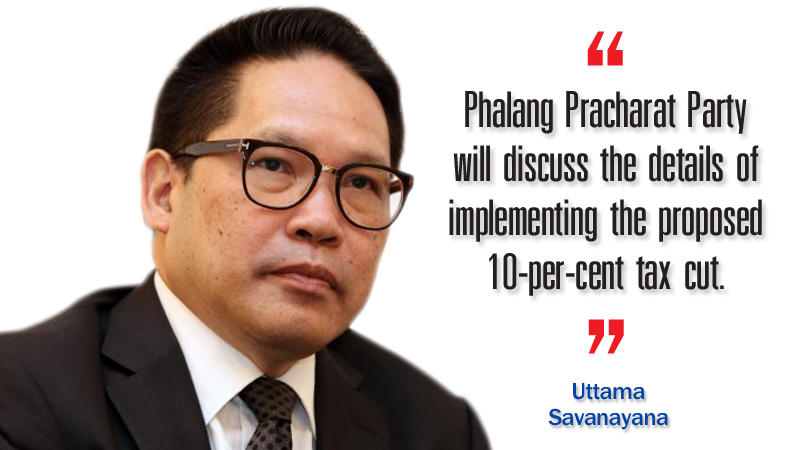
“Phalang Pracharat Party will discuss the details of implementing the proposed 10-per-cent tax cut,” Finance Minister Uttama Savanayana confirmed on Wednesday, his first day in office after the government was sworn in on Tuesday.

Uttama, who is also leader of the Phalang Pracharat Party, said the new economic package aims to support both the grassroots group as well as people living in urban areas. Details of the economic policy will be available after the new government presents its policies in Parliament on July 25-26.

While campaigning for votes, Phalang Pracharat Party promised a 10-per-cent cut in personal income tax for all seven income brackets, which is estimated to cost the country Bt50 billion to Bt60 billion annual. In comparison, coalition member Democrat Party had promised a 20-per-cent tax cut for people earning no more than Bt2 million per year.

Democrat MP and former finance minister Korn Chatikavanij had previously voiced opposition to Phalang Pracharat’s proposal, saying it would hit the tax base hard, bringing tax returns filed annually to 1 million from the current 4 million.

Meanwhile, Uttama has said that the current rates for personal and corporate income tax are not compatible because corporate tax stands at just 20 per cent.

Personal income tax is charged at a progressive rate of 5, 10, 15, 20, 25, 30 and 35 per cent. Those earning more than Bt150,000 but below Bt300,000 are subject to the lowest rate of 5 per cent, while those earning over Bt4 million a year are subject to the highest rate of 35 per cent.

Three-pronged strategy to boost industry unveiled

ศาสตร์เกษตรดินปุ๋ย : ขอบคุณแหล่งข้อมูล : หนังสือพิมพ์ The Nation

https://www.nationthailand.com/business/30373139

Three-pronged strategy to boost industry unveiled

Jul 17. 2019
Industry Minister Suriya Juangroongruangkit -
Nation Photo by Rachanon Intharagsa

Industry Minister Suriya Juangroongruangkit – Nation Photo by Rachanon Intharagsa
By THE NATION

394 Viewed

Industry Minister Suriya Juangroongruangkit has set three priorities for the strategy to boost industry inherited from the previous administration.

Easier access to bank loans for small and medium-sized enterprises (SMEs), promotion of 10 target industries, and better environmental protection would be the focus, Suriya said on Wednesday after presiding over the Thailand Industry Expo 2019 hosted by his ministry at Impact Muangthong Thani exhibition centre.

Suriya will visit the Federation of Thai Industries (FTI) early next month to gather information on challenges and problems faced by the industrial sector.

He said that his first priority was to continue pushing the promotion of 10 target industries – next-generation automotives, intelligent electronics, advanced agriculture and biotechnology, food processing, medical tourism, digital, robotics, aviation and logistics, comprehensive healthcare, and also biofuel and biochemicals.

Another priority is to seek help from the Finance Ministry and Bank of Thailand in easing access to loans for SMEs. Suriya will focus efforts on SMEs that find it difficult to obtain loans because of past debts that have already been cleared.

The third priority is to encourage factories to adopt environmentally friendly production processes, including the recycling of industrial waste.

Addressing the possibility of a rise in the minimum wage, he said that Prime Minister General Prayut Chan-o-cha had assigned a tripartite national daily wage committee to consider the issue.

Suriya said his ministry would also promote economic development zones akin to the Eastern Economic Corridor (EEC) in other regions of Thailand.

FTI chairman Supant Mongkolsuthree said that he would propose to Suriya plans supporting the use of local resources in mega projects.

He added that he would like to see the central bank launch long-term measures to curb speculation in the baht. He said the bank should trim the policy rate from the current 1.75 per cent to suppress the flow of foreign money speculating on the currency.

BOT parks rate cut in favour of capital inflow controls

ศาสตร์เกษตรดินปุ๋ย : ขอบคุณแหล่งข้อมูล : หนังสือพิมพ์ The Nation

https://www.nationthailand.com/business/30373126

BOT parks rate cut in favour of capital inflow controls

Jul 17. 2019
Presenting the Bank of Thailand’s views at a conference in Bangkok on Wednesday are, from left, deputy governor Mathee Supapongse and governor Veerathai Santiprabhob, along with Titanun Mallikamas, assistant governor and secretary of the BOT’s Monetary Policy Group, and Don Nakornthab, senior director of the economic and policy department.--Photo by The Nation

Presenting the Bank of Thailand’s views at a conference in Bangkok on Wednesday are, from left, deputy governor Mathee Supapongse and governor Veerathai Santiprabhob, along with Titanun Mallikamas, assistant governor and secretary of the BOT’s Monetary Policy Group, and Don Nakornthab, senior director of the economic and policy department.–Photo by The Nation
By PHUWIT LIMVIPHUWAT
THE NATION

625 Viewed

The Bank of Thailand (BOT) will keep its policy interest rate at 1.75 per cent for the rest of his year and focus on implementing measures such as tightening controls on short-term capital inflows to ease the appreciation of the baht.

Tightened controls on hot money inflows have been effective to some extent. However, the implementation of this measure is also intended to have a long-term impact, notably at least five days after the measure’s announcement leading up to July 22 when it will take effect, and for a period to follow.

On July 12, the central bank has announced the tightening in controls on short-term speculative capital inflows into Thailand’s economy with a reduction on the limits for outstanding balances of non-resident baht accounts (NRBA) and non-resident baht accounts for securities (NRBS) from Bt300 million to Bt200 million per non-resident.

“The baht has weakened slightly after our announcement to tighten short-term capital inflows,” said BOT governor Veerathai Santiprabhob. “We expect the measure to have more impact on the baht’s strength five days after our announcement leading up to July 22, when the measure will take effect.”

Veerathai was speaking at the Analyst Meeting conference on Wednesday.


“Thus far, the level of foreign investment in Thailand’s stock market has not been impacted much by the BOT measures,” said Sukit Udomsirikul, managing director and head of research for SCB Securities, in a separate interview.

This is because the measures are meant to target short-term exchange rate speculation, he said. Therefore, long-term investments in Thai stocks from foreign investors have continued to rise over the past month.

Since January, the Stock Exchange of Thailand (SET) has seen net foreign investment inflows of Bt58 billion. Despite the measure being announced on July 12, when the market reopened on July 12 – after the weekend – it saw net foreign investment inflows of Bt1.27 billion, according to the SET.

The BOT measure is not meant to stop foreign inflows into the country or to decrease the value of the baht, but to cushion the impact of the baht’s appreciation by discouraging short-term exchange rate speculation in Thailand’s market, Sukit said.

Another measure to soften the baht’s appreciation is for the central bank to lower the policy interest rate he added.

The economic outlook of the country, inflation level and financial stability are three factors the Monetary Policy Committee (MPC) analyses when considering whether to lower interest rates. Currently, concerns over financial stability take precedence, the BOT stated.

“The economic slowdown is occurring mostly as a result of external factors such as the trade tensions and the slowdown of the global economy, which have been dampening Thai exports,” said Veerathai. “Furthermore the delay in the government’s formation and the new budget will lead to a delay in public investment towards the end of the year.”

However, the governor expects economic growth to perform better against the low base of last year, especially when the incoming government is likely to implement policies to stimulate the economy before the year’s end.

Titanun Mallikamas, the central bank’s assistant governor and secretary of the Monetary Policy Group, said: “We expect inflation to be at around 1 per cent in 2019, which is low but still within our set bracket. Hence, our worry over Thailand’s financial stability is the key factor for our decision to hold the policy rate at 1.75 per cent.”

He cited household debt, which has increased by 6.3 per cent in the past three years, as a key risk to Thailand’s financial stability.

Another reason deterring the central bank from lowering the policy rate is that it has remained low throughout 2018 to the present.

“The reason why Thailand is more unlikely to relax its monetary policy when compared to other countries in the region is that our interest rate level has remained consistently low throughout 2018,” said Veerathai.

In contrast, he said, other countries in the region have increased their interest rates in 2018 as they have seen capital outflows from their economies, and have started to lower their interest rates back down in 2019.

However, a key concern raised by analysts at the conference was that the BoT’s move to maintain its policy rate against the tightening trend of other central banks would cause even more capital to flow into the country and cause the baht to become even stronger.

The BOT officials addressed this concern by stating that as Thailand’s interest rate is already among the lowest in the region, slightly decreasing the policy rate will not significantly impact the strength of the baht.

“The key reason why the baht has strengthened is the strong current account surplus of Thailand, which reached US$13.49 billion in the first five months of 2019. Hence, the BOT aims to implement other measures to create a financial bumper, which slows down the pace of the baht’s appreciation,” Veerathai said.


Prasarn Trairatvorakul

Prasarn Trairatvorakul

Prasarn Trairatvorakul, chairman of the Equitable Education Fund and former BOT governor comments that the key factors behind the strengthening of the baht are the weakening US dollar and euro as well as domestic issues such as Thailand’s current account surplus and the high level of foreign currency reserves.

The Bank of Thailand will have to adopt appropriate measures to cope with the situation without exhausting its resources for future financial risks, he said, adding that given the low policy interest rate, the country does not have much resources on this front.

He also predicted that in the short-term, the Thai economy will see slower growth, largely due to dampening exports. The new government should issue fiscal policies to stimulate the economy in the second half, he said.

However, the government will also have to balance its resources for long-term economic problems and implement more sustainable economic policies, targeting the productivity of the manufacturing and agricultural sectors.

ERC to discuss new policies on energy stability with minister

ศาสตร์เกษตรดินปุ๋ย : ขอบคุณแหล่งข้อมูล : หนังสือพิมพ์ The Nation

https://www.nationthailand.com/business/30373123

ERC to discuss new policies on energy stability with minister

Jul 17. 2019
Sontirat

Sontirat
By The Nation

216 Viewed

The Energy Regulatory Committee (ERC) is planning to meet new Energy Minister Sontirat Sontijirawong to discuss natural gas-related policies before presenting them to the National Energy Policy Council (NEPC).

ERC president Samerjai Suksumek said both existing and new energy-related policies will be discussed, as will the pressing issue of the Electricity Generating Authority of Thailand (Egat)’s import of 0.8 million to 1.5 million tonnes of liquid natural gas (LNG) per year. ERC will be coordinating with Egat and PTT Plc to ensure the proper usage of LNG and will mitigate any impacts on the country’s energy cost.

Another urgent topic to be put on the meeting’s agenda is the adjustment of the natural gas pipeline fees after the new zoning law allows third-party access to PTT’s reserves and pipelines. The pipeline fee should be divided into two: demand charge which will be revised every three to five years and the commodity charge for zones one to five, which have to be revised on a yearly basis.

“ERC is reviewing NEPC’s policies especially those related to LNG and pipeline fee to address the impact on Thailand’s energy situation. We will compile suitable suggestions to discuss with the new minister and later present the revised action plan to the NEPC for approval,” Samerjai said.

The ERC was established to regulate the operation of Thailand’s energy industry, prevent monopolies and promote fair competition between related parties, including the monitoring of power plants owned by Egat and the private sector, to ensure Thailand’s energy stability.