Serena Williams serves for AXA

ศาสตร์เกษตรดินปุ๋ย : ขอบคุณแหล่งข้อมูล : หนังสือพิมพ์ The Nation

https://www.nationthailand.com/business/30372881

Serena Williams serves for AXA

Jul 12. 2019
By The Nation

205 Viewed

AXA has launched a marketing campaign under the concept of “Know You Can”. The global campaign features tennis great Serena Williams, as she embodies success and self-belief.

Claude Seigne, CEO of AXA Thailand General Insurance, said: “This new campaign symbolises AXA’s promise to help people feel more confident to achieve their goals and realise their dreams. I believe that our new tagline Know You Can can resonate well with our customers’ aspirations.

“It is a clear and empathetic message that can fuel people’s self-belief so that they are closer to their goals. We don’t just help people overcome problems; as an encouraging partner, we also help them overcome doubts and feel confident they can go towards a better life.”

Lifestyle mall trust AIMCG launches on SET

ศาสตร์เกษตรดินปุ๋ย : ขอบคุณแหล่งข้อมูล : หนังสือพิมพ์ The Nation

https://www.nationthailand.com/business/30372867

Lifestyle mall trust AIMCG launches on SET

Jul 12. 2019
By THE NATION

233 Viewed

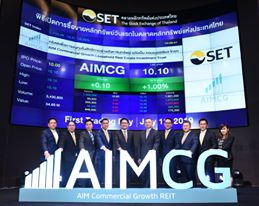
AIMCG, a REIT management company, on Friday debuted on the Stock Exchange of Thailand.

In a press release on Friday, the company said it is expected to provide decent long-term returns, given the “excellent quality” of its three initial investment assets of lifestyle malls with high occupancy rates. Its first-year distribution payment is estimated at 8 per cent.

Amorn Chulaluksananukul, the CEO of AIM Group, the independent REIT manager company, speaking as the settlor and manager of AIM Commercial Growth Leasehold Real Estate Investment Trust (AIMCG), said he is confident that the great quality of the three lifestyle malls will produce decent returns.

AIMCG’s initial assets, valued at up to Bt2.88 billion in total, include commercial leasehold interests in UD Town (Udon Thani), Porto Chino (outbound lane of Rama 2 Road in Samut Sakhon) and 72 Courtyard (in the Thonglor-Soi Sukhumvit 55 area). They are lifestyle malls with great potential and unique characteristics, said the release.

Charasrit A Voravudhi, the managing director of AIM Group, said each of the three properties offered sheer quality, unique concepts and location advantages in Bangkok or in an economically important city. He highlighted UD Town’s position as Udon Thani’s largest lifestyle mall and prominent landmark, as well as the project’s location in the city’s core business district and its popularity among the locals, people of neighbouring provinces and Lao tourists. Developed and managed by Udon Plaza Co, an experienced property developer and manager equipped with deep insights into customer behaviour, UD Town posted an approximately 97 per cent average occupancy rate over the past three years and welcomed 20,000-50,000 visitors per day, he said.

Developed and managed by D-Land Properties Co and built as a “neighbourhood mall”, Porto Chino is Samut Sakhon’s first and largest lifestyle mall. It is located on the outbound lane of Rama 2 Road, as a rest area popular among westbound and southbound travellers as well as a food oasis featuring leading brands. The Food Port area is going to be renovated and local well-known restaurants will be added to serve neighbouring residences and locals. Its average occupancy rate stood at approximately 84 per cent for the past three years, and seen 4,000-10,000 visitors daily.

The 72 Courtyard project was developed by Membership Co and is situated in the heart of the prime Thonglor-Soi Sukhumvit 55 area frequented by high-end customers. It offers a unique mix of restaurants and bars that are open day and night. The average occupancy rate reached 100 per cent over the past three years, and its visitors totalled 300-1,500 per day, said Charasrit.

Baht drops slightly after central bank’s ‘warning shot’

ศาสตร์เกษตรดินปุ๋ย : ขอบคุณแหล่งข้อมูล : หนังสือพิมพ์ The Nation

https://www.nationthailand.com/business/30372913

Baht drops slightly after central bank’s ‘warning shot’

Jul 13. 2019
Pipat: “I think this was just a warning shot and it implies that the central bank doesn’t really want to lower interest rates.”

Pipat: “I think this was just a warning shot and it implies that the central bank doesn’t really want to lower interest rates.”
By Wichit Chaitrong
The Nation

189 Viewed

The central bank’s move to curb the rising baht is just a warning shot and will have little impact on the currency’s value or on the bond and stock markets, analysts said.

The Bank of Thailand (BOT) took the first step on Friday by reducing the amount of baht accounts held by foreign investors and called on financial institutions to provide reports on foreign investors holding debt securities issued in Thailand.

After BOT’s move, the Stock Exchange of Thailand closed at 1,731.59, down 8.86 points or 0.51 per cent from trading on Thursday. The baht also weakened by about 20 to 30 satang, depreciating to Bt30.90 from Bt30.60 to the US dollar.

“It is not clear whether the central bank’s action affected the stock market, as the impact on the value of the baht is very small,” said Pipat Luengnaruemitchai, assistant managing director at Phatra Securities Co. “I think this was just a warning shot and it implies that the central bank doesn’t really want to lower interest rates.”

If the US Federal Reserve cuts its policy rate later this month, then the baht is likely to move up against the dollar, Pipat said, adding that BOT’s last resort will be to cut the policy rate.

The fast-rising value of the baht has worried both exporters and policymakers as it could further impact Thai exports, which have already suffered from the global economic slowdown. Some economists have called on the central bank to lower the interest rate to prevent the baht from rising further as it could erode the competitiveness of Thai exports as goods from countries with weaker currencies will be cheaper in the global market.

Some analysts have forecast that the baht could edge up to Bt29 or Bt28 to the dollar by the end of this year should the Fed lower its interest rate twice this year.

Tada Phutthitada, president of the Thai Bond Market Association, said foreign investors sold bonds worth only Bt912 million, while their combined total holding is about Bt1 trillion. This is indicative of the fact that the central bank’s measure did not have much of an effect on the bond market. Yields of the 4.4-year bonds rose only 2 basis points, while that of the 9.4-year bond rose only 3 basis point. The year-to-date capital outflow from the bond market is only Bt1.8 billion, he added.

Details of the central bank’s measures are as follows:

1)    In order to prevent speculation in the Thai baht the BOT reduced the limit on the outstanding balance of Non-Resident Baht Account (NRBA) and Non-Resident Baht Account for Securities (NRBS) from Bt300 million to Bt200 million per non-resident with effect from July 22. For NRBA and/or NRBS with outstanding balances that are higher than Bt200 million at the end of the day, financial institutions will have to notify account holders to reduce their outstanding balance within the deadline.

NRBA holders who are non-financial corporates with underlying trade and investment in Thailand, and have opened accounts directly with Thai financial institutions, may submit requests to the BOT for a waiver on this outstanding balance limit, which will be considered on a case-by-case basis.

2)    Non-residents holdings debt securities in Thailand will be required to report the names of their end beneficiaries. This measure will help enhance the central bank’s monitoring of non-residents’ investment behaviours. This measure goes into effect as of July 2019.

“The central bank only warned foreign investors on Friday that it may take more action against them later,” Tada said.

A statement from the central bank on Friday said: “The BOT will continue to closely monitor the Thai baht’s movements as well as non-resident behaviours and stand ready to use additional measures if undesirable speculative behaviours persist.”

Energy Ministry ready to clarify the state’s contribution to power generation

ศาสตร์เกษตรดินปุ๋ย : ขอบคุณแหล่งข้อมูล : หนังสือพิมพ์ The Nation

https://www.nationthailand.com/business/30372908

Energy Ministry ready to clarify the state’s contribution to power generation

Jul 13. 2019
By THE NATION498 Viewed

The Energy Ministry has drafted a letter addressed to the Ombudsman’s Office clarifying the state’s contribution to the country’s electricity generation.

Kulit Sombatsiri, the ministry’s permanent secretary, said on Friday that the letter was in response to the Ombudsman’s suggestion that the ministry revise its Power Development Plan (PDP) for 2018-2037 by boosting the state’s contribution to at least 51 per cent.

He said once the response is ready it will be submitted for review by the new Energy Minister Sontirat Sontijirawong.

The letter explains that the Electricity Generating Authority of Thailand (Egat) exclusively owns the power lines across the country, indicating that the state has invested at least 50 per cent in the country’s electricity generation system.

If the Ombudsman still finds the explanation inadequate, the ministry might consider asking the Cabinet to see if the case should be submitted to the Constitution Court, he added.

The Ombudsman recently told the ministry that the 2018 PDP allowed private companies to share the role of producing electricity, which has resulted in reducing the state’s contribution to less than 50 per cent. It also said that this contravenes the second paragraph of the 2017 Constitution’s Article 56. The Ombudsman has asked the ministry to find a way of complying with the charter within 120 days.

Opec production cuts, trade truce may help lift oil prices

ศาสตร์เกษตรดินปุ๋ย : ขอบคุณแหล่งข้อมูล : หนังสือพิมพ์ The Nation

https://www.nationthailand.com/business/30372892

Opec production cuts, trade truce may help lift oil prices

Jul 12. 2019
By SAMBIT MOHANTY
SPECIAL TO THE NATION

262 Viewed

Oil markets are primed for a rally in the second half of this year after an easing of international trade tensions and Opec’s extended production cuts brightened the outlook for balances.

Throw in supply concerns from the thorny geopolitical picture in the Persian Gulf and prices could be about to bounce.

S&P Global Platts Analytics expects Brent crude to push higher this year, with prices expected to trade in the US$70 per barrel to $80/b range before the end of the year on greater likelihood of tighter balances, up from current levels just below $65/b.

Rising seasonal demand, anticipated crude stock draws as refineries return from maintenance, as well as the looming deadline for ship operators to comply with tighter regulations on marine fuel specifications under IMO 2020 rules will all support the market.

“Global recession fears appeared to have been allayed by the renewed dovishness by major Central Banks, spearheaded by the US Fed,” said Chris Midgley, global director at S&P Global Platts Analytics. “Beijing policymakers look determined as usual to dispel any slowdown concerns, but the latest economic indicators paint a rather worrying picture. Trade negotiations between the US and China resumed at the G20 in Osaka providing reason for optimism. Brexit impact fears subsided lately with the UK economy stabilised at a growth rate slightly above the euro zone’s.”

Opec has also played its part. The group and its allies led by Russia have agreed to extend 1.2 million barrels per day of supply cuts for nine months. Meanwhile, the prospects of renewed trade talks between China and the US following the G20 should boost the prospects for global growth.

This should help support US crude exports heading into Asia. US oil shipments to China hit an eight-month high of 189,000b/d in May. Flows into Southeast Asia and India are also expected to increase as more barrels from Iran and Venezuela disappear from the market.

Vietnam and Indonesia have snapped up US crude for the first time. India plans to increase US crude purchases to plug the gap from Iran following the imposition of sanctions.

According to Saudi energy minister Khalid al-Falih, Opec’s action in Vienna this month could help to prevent a 100-million-barrel stock build accumulating during the Northern Hemisphere winter.

“More specifically, the nine-month duration indicates that Opec-plus will remain in wait-and-see mode longer than previously assumed, and raises the odds that they will stick to their pledged volumes through March,” said Paul Sheldon, chief geopolitics adviser for S&P Global Platts Analytics. “If the countries with the most spare capacity — Saudi Arabia, Russia, and the UAE — use their quotas as a ceiling in each month through March 2020, balances could tighten more than we previously expected.”

Iran’s bickering with the US and threats to the Strait of Hormuz have also kept the market on edge. The seizure of an Iranian oil cargo near Gibraltar last week by British security forces prompted Tehran to issue threats of retaliation. Iranian statements on enrichment and storage of uranium have also added to tensions between the Islamic Republic and the international community.

These risks have added to shipment costs for vessels passing through the Strait of Hormuz, which conveys about a fifth of world supply.

However, not all forecasters are convinced a rebound in oil prices can be sustained. RBC Capital Markets expects Brent crude prices to average $69.50/b for the rest of the year.

“While we see room for crude prices to improve, underpinned by a plethora of geopolitical risk factors, we anticipate that rallies will be capped unless refined product demand improves,” wrote Michael Tan, commodity strategist at RBC Capital Markets, in a recent research note. “The market will likely oscillate within a range through the balance of the year.”

Platts Analytics expects weaker oil products demand in India and China to push down refined oil products demand growth in Asia — which accounts for some 55 per cent of global demand growth — to 700,000b/d in 2019, from 930,000b/d in 2018, marking the weakest growth since 2014.

Sambit Mohanty is senior editor, Asia Oil News & Analysis

Trump slams Facebook plan for new digital currency

ศาสตร์เกษตรดินปุ๋ย : ขอบคุณแหล่งข้อมูล : หนังสือพิมพ์ The Nation

https://www.nationthailand.com/business/30372888

Trump slams Facebook plan for new digital currency

Jul 12. 2019
By Wichit Chaitrong
The Nation

405 Viewed

US President Donald Trump has taken to his favourite social media platform, Twitter, to pour scorn on Facebook’s plan to issue its own virtual currency, Libra.

He lauded the dollar, which he described as reliable, the only real currency in the US and the most dominant currency in the world.

He also said the inherent risk with unregulated crypto assets was that they could lead to criminal activity, specifically drugs trading.

If Facebook and anyone else wanted to become a bank they must seek a new banking charter and become subject to all banking regulations just like other banks, both national and international.

He made it clear he was not a fan of Bitcoin or any other cryptocurrency.


A Thai analyst, meanwhile, says US regulators were unlikely to let Facebook launch Libra.

Such digital currencies can threaten the entire global financial system, said Boonnisead Thanyaworanan, Citibank Thailand’s investment consultant.

If Facebook and its partners wanted to press ahead with Libra they will have to demonstrate how much in assets they are prepared to put behind it. If there are no such back-up assets the digital currency could fluctuate widely and threaten the financial system, he said.

“So far there is no detail but I think it would take considerable time to launch such a currency and US regulators would not approve it easily,” said Boonnisead.

Prominent economists, including Nobel prize laureates Paul Krugman and Joseph Stiglitz, have also opposed Libra and other digital currencies.

Phuket entertainment venue operations call for delay in excise tax enforcement

ศาสตร์เกษตรดินปุ๋ย : ขอบคุณแหล่งข้อมูล : หนังสือพิมพ์ The Nation

https://www.nationthailand.com/business/30372872

Phuket entertainment venue operations call for delay in excise tax enforcement

Jul 12. 2019
By The Nation

360 Viewed

Operators of entertainment venues on the holiday island of Phuket have called on the Excise Department to indefinitely delay the levying of 11-per cent excise tax on their businesses, saying the tourism business has become sluggish.

The call was made during a meeting on Thursday evening between representatives of the Excise Area 8 Office and the entertainment venue operators at the Baumanburi Hotel in Patong.

Wasin Sitalarom, chief excise officer of Phuket, and Suree Srisuk, director of the excise office of Area 8, briefed the owners on the excise tax requirement.

The officials said the excise law, which was enacted in 1992, has a new provision that has been enforced since September 2017 that requires the Excise Department to levy excise tax on entertainment places at the rate of 11 per cent per year on their revenue.

The officials said the owners of the entertainment places must register their businesses with the department and pay the excise taxes or face a fine and additional interest of 7.5 per cent per year.

But the operators of pubs and other entertainment venues argued that they are already paying taxes at the rate of 7 per cent on their revenue. They called on the excise tax to be indefinitely delayed, saying that the tourism business in the province has become sluggish.

The meeting ended without any conclusion. The officials will inform their department of the objections before answering the operators.

China’s rising labour costs spur investments in Southeast Asia

ศาสตร์เกษตรดินปุ๋ย : ขอบคุณแหล่งข้อมูล : หนังสือพิมพ์ The Nation

https://www.nationthailand.com/property/30372792

China’s rising labour costs spur investments in Southeast Asia

Jul 11. 2019
By The Nation

182 Viewed

More manufacturers have been relocating from China to Southeast Asia over the past few years, largely because China’s labour costs have become increasingly less competitive.

This trend has been reinforced by the China-US trade war that began in 2018. A new research report by property consultancy JLL indicates that Vietnam, Thailand and Malaysia are the primary benefactors of manufacturers moving out of China.

Foreign direct investments in Southeast Asia’s manufacturing sector have seen a strong rise over the past three years to US$46 billion (Bt1.4 trillion). The relocation of manufacturing facilities from China to take advantage of lower labour costs in the sub-region has contributed to this FDI growth.

Able to offer a high-quality workforce and competitive wages, Vietnam, Thailand and Malaysia are winning more manufacturers as they expand or relocate from Korea and Japan, as well as from China, according to JLL’s report. For example, Thailand and Malaysia have a mid-tech workforce now costing 60 per cent lower than in China, compared to 33 per cent in 2010.

JLL anticipates the trend to accelerate as the China-US tariff war causes more companies in China to relocate their operations to other countries in order to avoid US tariffs and maintain their competitiveness.

“The ongoing China-US tension has reinforced the trend of more manufacturers relocating from China to Southeast Asia in an effort to minimise the business impact of the China-US trade war,” said Subyagorn Sansugtaweesub, the head of industrial at JLL.

So far, the US has slapped tariffs on $200 billion worth of Chinese products and China has set tariffs on $60 billion worth of US goods. The latest meeting between the Chinese and US leaders on June 29 at the G20 conference in Japan ended without a clear path to ending the trade war.

“Thailand launched its Eastern Economic Corridor (EEC) at the right time,” said Subyagorn. “It has drawn strong interest from foreign companies, including those looking to relocate from China.

“We have already seen many of these companies looking for opportunities to acquire land in the promotional zones to develop their manufacturing and logistics facilities. Some are looking to acquire built-to-suit facilities. Others are looking for existing facilities that are put up for sale in the EEC, with specifications that suit or could be easily adjusted to suit their operational requirements,” he added.

Spanning three provinces – Chachoengsao, Chonburi and Rayong – the EEC has become Thailand’s most attractive industrial destination for key industries that have been identified as high-potential future new-growth engines for the country. They include automotive, intelligent electronics, robotics and aviation sectors. The Thai government has implemented a number of incentive policies and programmes to facilitate future industrial growth in the EEC, such as substantial tax breaks, permission for foreign ownership of land for projects promoted by the Board of Investment, and the right to lease state land for a 50-year term with an option, upon approval, to renew for another 49 years.

“Even if the China-US tariff war is put to an end, we believe that Thailand, particularly the EEC, will continue to retain its position as one of the most attractive industrial and logistics destinations in Southeast Asia, due to appealing incentive offers, availability of skilled labour, continued improvement in infrastructure, and the country’s advantageous location in the centre of the sub-region,” Subyagorn said.

Vietjet launches new route

ศาสตร์เกษตรดินปุ๋ย : ขอบคุณแหล่งข้อมูล : หนังสือพิมพ์ The Nation

https://www.nationthailand.com/business/30372866

Vietjet launches new route

Jul 12. 2019
By Jirapan Boonnoon
The Nation

18 Viewed

Popular budget airline Vietjet today announced the launch of its newest route from Ho Chi Minh City to Tokyo (Narita), with the company’s vice president Do Xuan Quang, telling reporters that the introduction of the new service means that Vietjet is now providing connections between the four biggest economic and tourism centres of both countries, namely Tokyo, Osaka, Hanoi and Ho Chi Minh City, “This allows us to offer Vietnamese, Japanese and international travellers even more options for air tr

In future, we hope to keep offering passengers many more flying experiences on our new aircraft with great value fares, exciting in-flight entertainment and hot meals served by our dedicated cabin crew.”

The HCMC-Tokyo route operates a daily return flight on the new Airbus A321Neo with flight time of approximately six hours. Passengers can now hunt for super-cheap tickets with the airline’s latest promotion, “Ohayo Saturday, fly to Japan from only 0VND” which runs every Saturday from now until March 31 at http://www.vietjetair.com and applies to all routes to Japan.

Vietjet earlier announced its 5th route to Japan connecting Da Nang with Tokyo (Haneda), which will operate daily return services from October 30. The airline also recently received the membership certificate of the Japan Federation of Economic Organisations (Keidanren).

Bluebik consultants invests in startups to develop digital expertise

ศาสตร์เกษตรดินปุ๋ย : ขอบคุณแหล่งข้อมูล : หนังสือพิมพ์ The Nation

https://www.nationthailand.com/business/30372865

Bluebik consultants invests in startups to develop digital expertise

Jul 12. 2019
Pochara Arayakarnkul, CEO of Bluebik Group Co Ltd

Pochara Arayakarnkul, CEO of Bluebik Group Co Ltd
By THE NATION

26 Viewed

The Thai consulting firm Bluebik Group Co Ltd, said on Friday that it has a strategy to invest in startups that have the potential to grow internationally.

The firm, which has extensive experience and expertise in developing digital strategies, said the investment strategy would strengthen the company by providing insight into digital knowledge so that it could compete on an international scale

The move would pave the path for it to become the leading consulting firm in strategy development and programme management within 2020, according to a release from the company.

Currently, Bluebik Group has invested in six startups has plans to invest in another two within the next year.

Investment will be focused on the fields of the internet of things (IoT), artificial intelligence (AI), electric vehicles (EV) and fashion, which plays a key role in driving clients’ businesses.

The consulting firm has until now specialised in strategy development, programme management and digital transformation.

Pochara Arayakarnkul, CEO of Bluebik Group Co Ltd, said it pursuing a strategy to differentiate itself from other business consulting firms through digital knowledge enhancement. That would give it the capacity to leverage innovation and technology as well as exposure to new international ideas to elevate clients’ businesses, so as to be competitive in the digital world.

Bluebik Group aims to be the leader in strategy and implementation by the end of next year, Pochara said. In addition to providing consulting services, the company has also positioned itself as a partner of clients, and serve clients seeking a consultant that could enhance their competitiveness.

To achieve this leading position, the company must develop its strength in deep knowledge and understanding of digital disruption. Investing in startups with deep technology that leverage highly complex technologies and have the potential to grow internationally would allow Bluebik to obtain critical knowledge, especially in digital technology, which is a tool for business development across industries, Pochara said.

“Innovations are more often initiated by startups than traditional companies. Startups are more flexible and run by new-generation professionals who have a thorough grasp of technology. Born in the digital age, the people behind startups have a distinct advantage in developing innovations.

“Bluebik therefore, had the idea to gain advantages, as startups do. Thinking like and entering into partnerships with startups will allow Bluebik to deeply understand and learn about the adoption of technologies for clients’ businesses. “

Working with startup strategic partners that specialise in various fields, the consultancy would provide an overview of strategy management as well as in-depth knowledge for each operating process ranging through innovation, design, and the new global way of working such as “design thinking”, Pochara said.

The consultancy has so far invested in six startups, including Blue Parking, a smart parking service provider with an IoT-based automatic licence plate recognition system and Cloud system to optimise convenience for car drivers. Other investments are in Keeps, a fashion house designed for working people through omni-channel experiences; Oxygen, an AI leader in video analytics and conventional chatbots; Ingenio, a Big Data solution provider to enhance business capability; ETRAN, a producer of high-efficiency electric motorcycles and which is a startup under the Almond Digital Group subsidiary of Bluebik Group; and Cashnow, an innovative platform for digitising the lending application process.

Within 2020, Bluebik plans to invest in two more startups with an emphasis on key technology trends that are crucial to creating competitive advantages for clients by reducing costs and increasing business opportunities. The selected tech trends are internet of things (IoT), artificial intelligence (AI), electric vehicles (EV), big data and analytics, fintech, and retail tech.