Grab Thailand signs up for government’s tax rebate shopping scheme in Q1
MONDAY, JANUARY 23, 2023
Nongluck Ajanapanya
Grab Thailand will participate in the “Shop Dee Mee Kuen 2023 (shop and payback)” scheme via GrabMart in the first quarter, joining forces with leading retailers to help stimulate the economy.
Chantsuda Thananitayaudom, senior director, commercial and marketing, Grab Thailand, told a press release on Monday that the campaign would allow users to purchase everyday goods and request a full tax invoice request through the application for a tax rebate of up to 40,000 baht.
She said Grab Thailand wanted to become one of the forces in driving the Thai economy in early 2023 and to facilitate tax rebate benefits for users through purchases made through the GrabMart app.
Tops Market, Tops Fine Food, Tops Daily, J Gourmet, Lawson, FamilyMart, Betagro Deli, Betagro Shop, OfficeMate, B2S, Boots, Matsumoto Kiyoshi, Beautrium, Oriental Princess, and Karmakamet are among the 15 leading retailers who are part of the scheme, offering a range of over 80,000 product items.
She revealed that Grab is offering exclusive discounts of up to 200 baht for GrabMart shoppers when using the ‘SHOPD’ code on a minimum purchase of 600 baht on GrabMart.
Users interested in the “Shop Dee Mee Kuen 2023” tax rebate scheme via GrabMart can make a purchase between January 23 and February 15, 2023.
Thai vehicle exports in December highest in 45 months
TUESDAY, JANUARY 24, 2023
Thailand exported 111,605 vehicles in December, the highest in 45 consecutive months, the Federation of Thai Industries (FTI) said.
Surapong Paisitpatnapong, FTI deputy chairman, said on Tuesday that the export of fully assembled units in December rose 10.17% from the same month in 2021.
During 2021, Thailand exported 1,000,256 completely built unit (CBU) vehicles, marking a 4.28% increase from the previous year, Surapong added.
He said exports to Asia, Middle East, Africa, Central and South America showed a definite increase. However, he said, exporters were still suffering from a drop in the availability of shipping liners.
He added that 158,606 vehicles were manufactured in December, up 2.75% from the same month in 2021.
Automakers were able to produce more vehicles because the supply of semiconductor parts has picked up.
In 2022, 1,883,515 vehicles were manufactured in Thailand, marking an increase of 11.73% year-on-year, Surapong added.
He said 82,799 vehicles were sold domestically in December, down 9.02% from the same month in 2021.
The FTI believes 1.95 million vehicles will be manufactured this year – 1.05 million for export and 900,000 for local consumption.
Thailand likely to hike key interest rate by 25 basis points tomorrow
TUESDAY, JANUARY 24, 2023
Kasikorn Research Centre (KResearch) on Tuesday expected the Bank of Thailand’s Monetary Policy Committee (MPC) to raise Thailand’s key policy rate by 25 basis points to 1.50 per cent to fight inflation.
The MPC, at its previous meeting on November 30, had voted unanimously to raise the interest rate by 25 basis points to 1.25% to control inflation.
KResearch said the Thai economy is continually recovering from the impact of the pandemic due to China’s earlier-than-expected reopening of its borders, which would help the tourism industry.
However, the economy is still being pressured by inflation, the centre said, adding, headline inflation in December had increased to 5.89% while core inflation is still at the same level as the previous month at 3.23%.
KResearch believed that after the revision in January, the MPC would hike the interest rate by 25 basis points one more time to 1.75% within the first quarter of the year, and maintain the rate until the year-end to control the inflation in 2023 within the target of 1-3%.
KResearch forecast that the MPC could be pressured to raise the interest rate to higher than the estimated 1.75% target if Thailand’s inflation continues to rise for too long, or the US Federal Reserve decides to use aggressive rate hikes.
The centre also predicted a K-shaped recovery for the overall economy in 2023 with uneven growth distribution among different industries. Tourism and service industries will enjoy significant growth, while those related to export sectors will suffer from the recessive global economy and the strengthening of the baht.
Location and innovation ‘crucial’ to Thailand Inc’s success in fracturing world
TUESDAY, JANUARY 24, 2023
Thai businesses must adapt to the world’s fracturing geopolitical landscape, using innovation and location to create competitive advantages, Vice Foreign Minister Vijavat Isarabhakdi told industry leaders on Monday.
Vijavat was speaking at the seminar “Geopolitics: The Big Challenge for Business”, organised by Krungthep Turakij newspaper.
He cited global social and economic impacts of the Russia-Ukraine war, including soaring inflation amid food and fuel shortages. He also warned that the conflict shows no sign of ending anytime soon but is instead escalating, with Russia now threatening to use nuclear weapons if western countries continue to provide armaments to Ukraine.
The conflict has raised the spectre of a new Cold War, as the United States leads a coalition of democracies against Russia and China.
But Vijavat also pointed to different headwinds facing Thai business.
“The modern world that has been divided by geopolitics is also filled with other challenges, including Covid-19 crises in several countries, climate change, and digital disruption from demand for e-commerce during the pandemic and the rise of artificial intelligence,” said Vijavat.
Thai businesses need to adjust their strategies to cope with the new geopolitical trend and challenges to stay ahead of the game, he said. Those that stand still are at risk of being forced to change or even being driven out of business by new regulations brought in to govern changing trends, he warned.
Incoming regulations affecting Thai exporters include the European Union’s carbon border adjustment mechanism and deforestation edict.
As digital transformation accelerates, meanwhile, Thai businesses must adopt innovations to strengthen their businesses, including big data, analytic tools, AI technology, and new markets online.
Businesses should also take advantage of Thailand’s geographic position in the heart of Asia’s hotspot for economic growth, Vijavat said.
“Thailand is located in the centre of the ‘growth triangle’ marked by India, China and the Asean region. This area has a high potential for economic expansion despite the ongoing Russia-Ukraine conflict and the pandemic. We must exploit this location advantage by attracting foreign investment, especially from corporations migrating out of conflict zones.”
Vijavat advised giant corporations to pave the way by investing in infrastructure and creating new markets, which would attract small and medium enterprises to join and strengthen the supply chain.
“Using innovation and location advantage is key to boosting Thailand’s competitive edge in the modern world shaped by geopolitics,” he concluded.
Thai businesses must learn to navigate global geopolitical tensions, experts say at seminar
MONDAY, JANUARY 23, 2023
Nongluck Ajanapanya
Geopolitical tensions are challenges global businesses have to learn to deal with, experts and representatives from the public and private sectors said on Monday.
They exchanged thoughts and ideas, focusing on two key words — positioning and sustainability — to adequately prepare Thailand for the current geopolitical atmosphere.
The event was part of a seminar on “Geopolitics: The Big Challenge for Business”, organised on Monday by Krungthep Turakij newspaper under the Nation Group.
The goal of the seminar was to explore the best ways for Thailand’s economy to continue to grow in the face of tensions between several superpowers, particularly the United States and China.
All eight panelists agreed that geopolitical tensions have become a normal challenge for global businesses to deal with if they want to continue operating and survive.
These tensions have restructured the established world order and would continue to cause uncertainties in global trade and investment for many years to come, they said.
The trade war between the United States and China, the war in Ukraine, the China-Taiwan cross-strait tensions, the imbroglio over the South China Sea, the recovery path in the aftermath of Covid-19, climate change, and digital transformation are all major issues that Thai entrepreneurs must confront along with tactical risk management, the panelists advised.
Vijavat Isarabhakdi
Vijavat Isarabhakdi, vice minister at Thailand’s Ministry of Foreign Affairs, stated in his keynote speech that as the government agency in charge of international relations, the ministry sees an opportunity for Thailand to position itself as friendly to all parties.
Thailand has obviously taken the position that it would partner any country for mutual benefit, he stated.
He cited the country’s participation in several agreements, including the Indo-Pacific Economic Framework for Prosperity (IPEF) with the US, the Regional Comprehensive Economic Partnership (RCEP), bilateral free trade agreements with the European Union, Asean members, and countries such as India and Saudi Arabia.
Auramon Supthaweethum
Auramon Supthaweethum, director-general of the Ministry of Commerce’s Department of Trade Negotiations, added that in addition to wisely implementing several trade agreements with many countries, Thailand should forge new partnerships while increasing close collaboration with its Southeast Asian neighbours.
Auramon added that Thailand must rapidly improve its business model to include greater responsibilities to the community, people, and the environment.
That means Thailand must have strong and fair labour regulations, use clean energy with green technology, and have credible product traceability to ensure the country’s products are truly eco-friendly.
Arm Tangnirun
Arm Tangnirun, director of Chulalongkorn University’s China Study Centre, believes that tensions between the United States and China will never end. The level of tensions, however, would vary, depending on the leaders’ policies and other factors, such as the recent Chip and Science Act or issues related to Taiwan that challenge Beijing’s “One China” policy, Arm said.
He advised Thailand to focus on improving the country’s resilience and adaptability, invest in more human resources, adopt digital technology and innovation, and position itself as the gateway to Asean to assist other countries in trading with the region.
Thitima Chucherd (center)
Thitima Chucherd, director of Economic and Financial Market Research, Economic Intelligence Centre, Siam Commercial Bank, endorsed Arm’s ideas. She stated that in addition to its current markets, Thailand should make new friends outside major economies, such as in Latin America, the Middle East, and South Asia.
She also recommended that Thai entrepreneurs research hard in order to outline their own risk management strategy, focus on their target customers, and transform their business model with advanced technology and skilled labour.
Wisit Limluecha (center)
According to Wisit Limluecha, vice chairman of the Thai Chamber of Commerce, Thai entrepreneurs cannot afford to stay in their comfort zones.
He warned that in the current climate of uncertainty and geopolitical tensions, doing nothing and simply resting in their safe zone would be a recipe for disaster. Entrepreneurs must take calculated risks while determining how to sustain their businesses using the Bio-Circular Green model, clean energy, and digital technology, he advised.
Meanwhile, Rak Vorrakitpokatorn, president of Thailand’s Export-Import Bank, noted that Thai entrepreneurs should improve their skills in order to be smart investors.
He encouraged Thai businesses to invest abroad and bring the profits back home. He also urged the government and the public sector to work together to promote the country’s entire ecosystem and infrastructure in order to attract foreign direct investment to Thailand’s high-value industries.
Sampan Silapanad
The president of Thailand’s Electronic and Computer Employers’ Association president, Sampan Silapanad, pointed out that Thailand must accept it is not capable of competing in the field of advanced innovations.
Hence, Thailand should now concentrate on its strengths, like making electronic parts and appliances.
He said geopolitical tension is just another condition of doing business, but Thailand’s real challenges right now are inflation, technological disruption, and climate change. Thai manufacturers and entrepreneurs should consider how to strengthen their position and prepare to adapt to high-tech environments that are more concerned with environmental issues.
That should be enough to keep the country’s economy going for the next few years, Sampan said.
In terms of other challenges, Wisit urged the government to simplify the process of doing business in Thailand, while Sampan advocated deeper and more consistent collaboration among all businesses of all sizes. Rak, meanwhile, advised Thai entrepreneurs to take financial literacy seriously.
Robert F Godec
The seminar also heard a keynote address by Robert F. Godec, US Ambassador to Thailand, on the direction of current geopolitics.
He emphasised that the priority of the United States was to build partnerships for peace and prosperity.
“The United States will work with our partners, friends and allies to tackle shared challenges and seize common opportunities,” he stated.
Although he did not specifically mention China or Russia, Godec stressed that when countries reject international rules, others must band together to promote justice and accountability.
“Our future depends on our willingness to work together and to respect international norms and agreements. Respect for international rules provides businesses with the stability and predictability to invest and grow,” he said.
Meanwhile, he praised the US-Thailand partnership as a model for the Indo-Pacific region. The two countries’ trade relationship is strong and expanding. The US continues to be a major investor in the Thai economy.
He noted that US firms are operating in diverse sectors, such as automobiles, healthcare, and high technology, with mutual collaboration on digital economic development to promote innovation.
He assured that the US was determined to actively collaborate with Thailand and its allies to create a better future.
Jurin heading to Brussels to jumpstart FTA talks with EU
MONDAY, JANUARY 23, 2023
Commerce Minister Jurin Laksanawisit will be in Brussels on Wednesday and Thursday to push for negotiations on a free trade agreement (FTA) with the European Union.
Jurin said on Monday that the Thai private sector is placing high hopes on this agreement even though talks have been stalling since 2014.
He added that he will meet Valdis Dombrovskis, European commissioner for trade, to show that Thailand is ready to work on the FTA.
“The upcoming negotiation will indicate whether or not the Thailand-EU FTA will succeed,” he said.
He added that this FTA should boost trade between Thailand and the EU, especially when it comes to exporting goods to 27 EU countries and exemption of tariff.
EU is considered Thailand’s fifth biggest trade partner after Asean, China, the US and Japan, accounting for 6.95% of the Kingdom’s global trade.
Last year, Thailand-EU trade was valued at US$41.03 billion (1.46 trillion baht), of which $22.79 billion accounted for export and $18.24 billion for imports.
Thailand’s main exports to the EU were computers, gems and jewellery, air conditioners and rubber, while imports were machinery and pharmaceutical products.
Chonburi debt restructuring fair a success, says Finance Ministry
MONDAY, JANUARY 23, 2023
Thousands of people took part in a fair for debtors to enter the restructuring programme in Chonburi province this month, making the event a success, a spokesman for the Finance Ministry said on Monday.
Pornchai Thiraveja, director-general of the Fiscal Police Office and spokesman of the Finance Ministry, said the fair, which was held from January 20-22, drew over 5,000 applications. It was the fourth debt restructuring fair held by the Finance Ministry.
He said most applicants were teachers and Education Ministry officials.
Pornchai said the total requests during the fair together with 1,800 applications submitted by Chonburi residents earlier, added up to some 1.9 billion of debt for which applicants sought debt restructuring.
A total of 180,000 people have joined the debt restructuring programme started by the Finance Ministry in September last year, Pornchai said.
He said a lot of teachers had joined the fair in Chonburi after the Finance Ministry urged the Education Ministry to inform their personnel to visit the fair and seek financial advice.
At the Chonburi fair, 800 applicants sought additional loans totalling 1.6 billion baht, while 1,200 other applicants sought career advice and loans totalling 400 million baht.
The fifth debt-restructuring fair will be held in Songkhla province from January 27-29, the spokesman added.
BTS offers new ordinary shares for existing holders until Jan 31
MONDAY, JANUARY 23, 2023
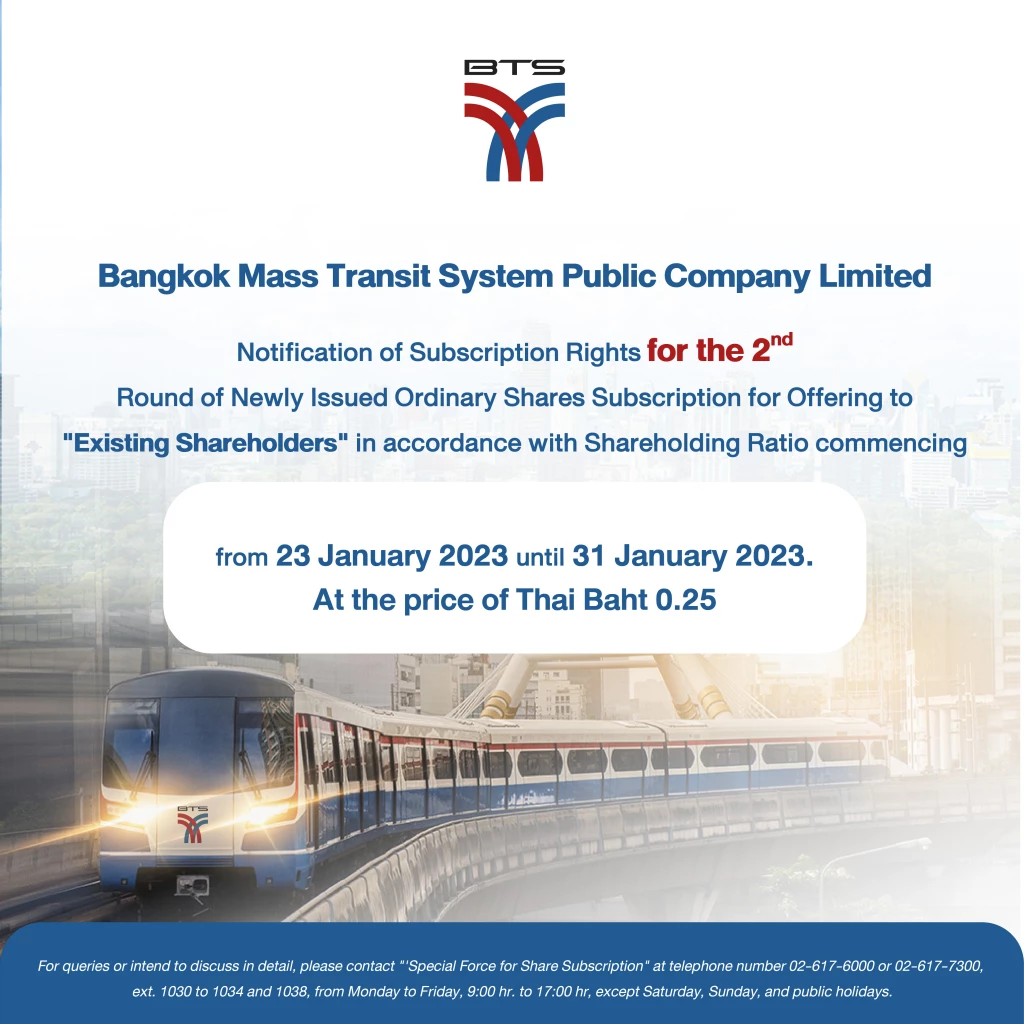
Bangkok Mass Transit System Public Company Limited (BTS) on January 20 released a Notification of Subscription Rights for the 2nd Round of Newly Issued Ordinary Shares from January 23 until January 31, 2023.
The notification advised all the Company’s shareholders that, by resolution made in the Extraordinary General Meeting No. 1/2022 held on September 8, 2022, and by the Company’s Letter dated December 27, 2022, concerning Notification of Subscription Rights for the 2nd Round of Newly Issued Ordinary Shares Subscription for Offering to Existing Shareholders in accordance with Shareholding Ratio (Right Offering), shareholders of the Company can subscribe newly issued ordinary shares (and settle subscription payment) in the ratio of 10 existing ordinary shares to 37 newly ordinary shares, at the price of Thai Baht 0.25, commencing from January 23 until January 31, 2023.
In case you have any queries or intend to discuss in detail, please contact “Special Force for Share Subscription” at telephone number 02-617-6000 or 02-617-7300, ext. 1030 to 1034 and 1038, from Monday to Friday, between 9am and 5pm, except public holidays.
True Group shares visions on human and AI collaboration to inspire world-changing innovations
MONDAY, JANUARY 23, 2023
With success, concluded the regional-renowned seminar, “MIT Media Lab Southeast Asia Forum”, run by MIT Media Lab, a world-leading research institution on technology, media, science, art, and design of Massachusetts Institute of Technology (MIT), United States.
The seminar was supported by True Group with the digital ecosystem that helped uplift tech and startup industry and True Digital Park opening its door to welcome participants from all over the world to show the true potential of Thailand and its people.
Mr Natwut Amornvivat, Chairman of the Board, True Digital Group, joined in with a special talk on “Human + AI: Opportunities and Challenges” and shared his thoughts on how AI technology will change the way businesses operate and how people live. In his talk, he also emphasized how True Group, as a leading tech company, strives to encourage the balance collaboration between humans and technology in order to create innovations that will put forward new developments for people, organizations, Thailand’s economy and its competitiveness, as well as the better living standards for Thai people. To fulfil the ambitious goals, he also outlined the plan to expand the collaboration on business and solution developments with other organizations in order to bring about top-of-the-line innovations for Thailand’s tech entrepreneurs and startups.
AI Technology: Life changer and business transformer
Stressing on True Group’s leadership as a tech company with integrated telecommunication infrastructure and end-to-end digital ecosystem, Natwut gave some examples of the innovations developed by True with the combination of AI technology and the various fields of knowledge from experts that move forward industries such as healthcare, agriculture, and retails.
Healthcare: Partners to expand fast and equal medical care
While Thailand may have an abundance of medical experts, most of them could be found in major hospitals and capital cities, resulting in inefficiency in equal reach to healthcare. To help alleviate the struggle, True strives to help decentralized the healthcare service system by partnering with leading medical institutions, such as King Chulalongkorn Memorial Hospital, Ramathibodi Hospital, and Siriraj Hospital, as well as renowned medical professors.
True now has around 400,000 patients using telemedicine services and with a firm belief that we have on “Physical + Digital”, which aligns with Media Lab’s belief that the collaboration between humans and technology is better that relying solely on technology, True opened “TrueHEALTH corner” in many areas, equipped with basic health evaluation tools and the ability to immediately connect to doctors online, to help lessen the gap in healthcare service distribution.
In addition, True also worked with Ramathibodi Hospital and opened RAMA Health Spaces for all, which has a more spacious service floor and service offerings such as phlebotomy service, specimen collection for lab tests, chest x-ray, and EKG. In another collaboration with Siriraj Hospital, Smart EMS (Smart Emergency Medical Service), highlights a human-led solution by using technology in a supporting role with the medical expertise of doctors and nurses at the forefront.
The collaboration was a reflection of True’s ambition to put forward partnerships and collaborations with every party in the ecosystem. It is True’s belief that once we have an integrated view of how the healthcare system connects, we can achieve the better service and solutions for the people.
Agriculture: Smart AgTech and the challenges in productivity
Though the agriculture sector is known to be the largest industry in Thailand, efficiency challenges still persist and result in a lacking quality of life for farmers and environmental problems. To tackle the pain points, True developed various solutions for each agricultural sector. For crops, we use satellite and drone technology to monitor and predict the upcoming impacts. For livestock, we use IoT and analytics to detect and analyse livestock’s behaviors, such as for dairy farms, we use health monitor tools that can alert farmers of potential health risks to curve early problems, for swine and shrimp, we use video analytics technology to detect movements in order to help plan and manage both the quality and the volume of the production. However, precision agriculture, robotic harvesting, and machinery quality control, among many others, are still some of the predominant challenges that True and startups are working together to crack, in order to uplift Thailand as the industry leader.
Retails: Revolutionize retails with AI
There is still room for retails to grow, from driving efficiency to serving customers’ needs better, which inspired True to develop various solutions to bridge the gaps. For example, heatmap was developed to learn more about how customers behave while in the store in order to improve the quality of services, a shelf detection system that sends alerts when the shelf is empty with connected data with the warehouse for planning, as well as AI-enabled sensor that analyses and monitor freezers to preserve product freshness. These are also some of the examples of how humans and AI need to work together; while challenges such as demand analysation, shell management, customer behaviour analysation, and personalized advertisements are still among some of the prevalent areas that need a collaborative network of organizations, startups, government, researchers, and innovators to work together to overcome.
Positive attitude and belief power innovations
Natwut concluded his talk with inspirational learning for participants; while AI may be able to help elevate works for humans, empathy is still something that AI cannot do. The collaboration between humans and AI is, therefore, what True has always believed in and practiced. Introducing innovations will also be met with doubts, but it is also a great opportunity for the innovator to be the first to succeed. A positive attitude and strong belief will be what open people’s mind and the key to making innovations come true.
Minor International accelerates growth strategy, unveils three-year strategic plan
SATURDAY, JANUARY 21, 2023
Nongluck Ajanapanya
Minor International (MINT), a Thai multinational focused on hospitality, restaurant, and lifestyle brands, has launched a three-year strategic plan focused on accelerating growth by improving productivity, cutting costs, and refining data analytics, MINT group CEO Dillip Rajakarier said on Friday.
“Moving into 2023, MINT is fully committed to driving business ‘back to growth’ with prudent business strategies and investment plans for Minor Hotels, Minor Food, and Minor Lifestyle, in order to remain market leaders capable of accommodating current and future customer demand,” he told a press conference.
MINT’s three-year strategic plan focuses on strengthening its brand portfolio, improving productivity and profitability, collaborating with partners to achieve growth, enhancing innovation and digitisation, empowering people and teams, and ensuring long-term growth, he said.
The company also anticipated that the rising number of tourists following the reopening of borders would help support business growth this year.
Dillip Rajakarier
“Tourist arrivals in Thailand are expected to rise from around 11 million in 2022 to 22 million in 2023. The two-fold increase in arrivals will be achieved as a result of Mainland China’s recent reopening on January 8, 2023, which is expected to result in additional tourist arrivals to previous forecasts, stimulate demand, and further drive economic activities for all MINT businesses,” he said.
Minor Hotels, Rajakarier said, would continue to see revenue growth this year due to an increase in advance bookings.
The company intends to raise both occupancy and room rates. It will also improve service to attract more business travellers and increase marketing, he said.
Minor Food’s revenues continue to grow across all channels while costs are being cut to increase profitability, Rajakarier said.
“New initiatives, such as new store formats, customer loyalty programmes to increase customer engagement, and new product development to create market excitement are examples of such efforts,” he said. “These strategies will continue to propel Minor Food to the forefront of its industry.”
Minor Lifestyle has expanded by focusing on being more customer-centric online as the e-commerce market expands, he said, adding that the unit of MINT would leverage data analytics “to increase customer retention and acquire new customers”.
Chaiyapat Paitoon
MINT issued new subordinated perpetual bonds, MINT No.1/2566, on December 2, 2022. MINT is rated “A” with a “stable” outlook by TRIS Rating, while the subordinated perpetual bonds are rated “BBB+”.
Chaiyapat Paitoon, MINT’s chief financial officer, said the funds raised from the bonds would help the company grow.
The new subordinated debentures will be sold to the public between February 7 and 9, through 11 Thai financial institutions.



 The FTI believes 1.95 million vehicles will be manufactured this year – 1.05 million for export and 900,000 for local consumption.


 Vijavat Isarabhakdi
 Auramon Supthaweethum
 Thitima Chucherd (center)
 Wisit Limluecha (center)
 Sampan Silapanad
 Robert F Godec


 At the Chonburi fair, 800 applicants sought additional loans totalling 1.6 billion baht, while 1,200 other applicants sought career advice and loans totalling 400 million baht.


 Dillip Rajakarier
 Chaiyapat Paitoon
 SootinClaimon.Com