Green light for north, west, east expansion of Suvarnabhumi airport
CorporateJan 15. 2021Transport Minister Saksayam Chidchob
By The Nation
The Airports of Thailand (AOT) got the go-ahead on Friday for the northern, western and eastern expansion of Suvarnabhumi airport at a cost of Bt60 billion, said Transport Minister Saksayam Chidchob.
The plan was approved at a meeting between the committee tasked with boosting the airport’s capacity, the National Economic and Social Development Council, the Finance Ministry and AOT.
The East expansion and West expansion projects each will boost capacity by 15 million passengers per year and each cost over Bt7.8 billion.
The northern expansion will serve 30 million passengers per year and cost Bt41.26 billion.
The AOT told the meeting that the airport needs to expand after seeing 60 million passengers per year pre-Covid-19, while the existing main passenger terminal could only cater to 45 million per year.
The AOT is also developing a third runway, which will raise capacity from the current 68 to 90 flights per hour, lifting passengers per year from 60 million to 90 million.
The proposed expansion is due to be vetted by the Cabinet in March.
The bidding process to build the northern expansion is expected to take six months, with construction due to be completed in September, 2023. Construction of the eastern and western expansions is slated for completion in January 2024.
AOT president Nitinai Sirismatthakarn said the AOT is ready to make investment as planned. It has cash flow of Bt32 billion.
Thai AirAsia is in talks with local and foreign financial institutes to secure loans to boost liquidity this year, said its executive chairman Tassapon Bijleveld.
The low-cost airline is also consulting a financial adviser on options to boost liquidity, including issuing new shares or taking loans. There would be good news in the next two weeks, said Tassapon, adding that Thai AirAsia would not fall out of the business.
He said seven local airlines were now seeking credit to boost their liquidity, instead of waiting for soft loans from the government.
The seven airlines have held several rounds of talks with state agencies and ministries for soft loans to counter the economic impact of Covid-19, but loans are yet to be granted.
The Stock Exchange of Thailand (SET) Index closed at 1,519.13 on Friday, down 16.85 points or 1.10 per cent. Total transactions amounted to Bt101.41 billion with an index high of 1,544.11 and a low of 1,513.48. The SET was down for a second successive day, after dropping 0.73 per cent on Thursday.
In Friday’s morning session, an analyst at Krungsri Securities forecast the day’s index would fluctuate between 1,525 and 1,550 after US President-elect Joe Biden announced a US$1.9-trillion stimulus plan and the oil price held up.
“However, the SET will be under pressure from its tight valuation and the drop in fund inflows,” he said, adding that the index’s price-to-earnings ratio was 30 times.
The 10 stocks with the highest trade value today were PTT, EA, GPSC, TASCO, CPALL, SCGP, PTTEP, NER, KBANK and KTC.
As of 4.30pm, the price of oil dropped by US$0.49 or 0.91 per cent to $53.08 per barrel, while gold was unchanged at $1,851.40 per ounce.
Other Asian indices were mixed:
Japan’s Nikkei Index closed at 28,519.18, down 179.08 points or 0.62 per cent.
China’s Shang Hai SE Composite Index closed at 3,566.38, up 0.47 points or 0.013 per cent, while Shenzhen SE Component Index closed at 15,031.70, down 38.43 points or 0.25 per cent.
Hong Kong’s Hang Seng Index closed at 28,573.86, up 77.00 points or 0.27 per cent.
South Korea’s KOSPI Index closed at 3,085.90, down 64.03 points or 2.03 per cent.
Taiwan’s TAIEX Index closed at 15,616.39, down 90.80 points or 0.58 per cent.
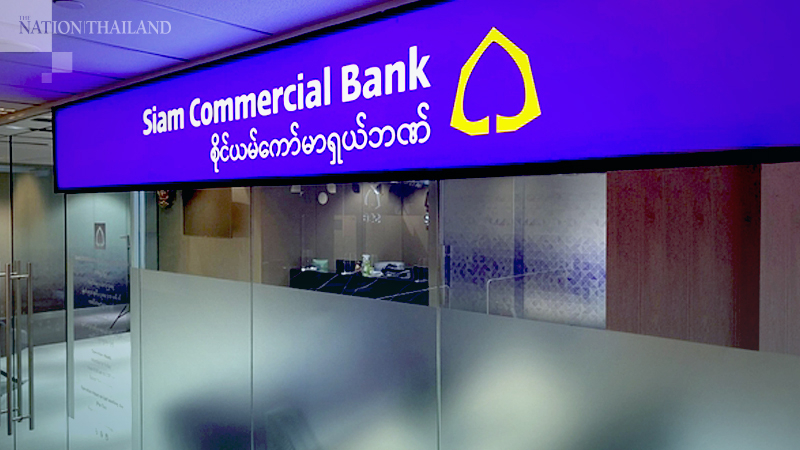
Siam Commercial Bank is setting up operations in Myanmar becoming the only Thai bank to operate a wholly-owned subsidiary in the neighbouring country.
SCB Myanmar will leverage its digital banking expertise and strength to elevate financial products, services, and payment systems in Myanmar to fulfil business requirements in Asean.
SCB’s president Sarut Ruttanaporn said: “SCB has been granted a banking licence to operate Siam Commercial Bank Myanmar by the Central Bank of Myanmar, which will be officially inaugurated on January 15 [Friday].”
This development is an important jigsaw piece in SCB’s strategic expansion of its overseas network in CLMV+2 countries, namely Cambodia, Laos, Myanmar, Vietnam, China, and Singapore, over the past several years.
“As a wholly owned subsidiary of SCB, Siam Commercial Bank Myanmar is currently the only Thai bank granted a subsidiary licence in the country. The bank will offer a full spectrum of commercial banking services in the same manner as local banks.
The bank will also support the development of financial infrastructure and payment systems by offering solutions critical for Myanmar’s businesses and digital finance, in line with increasing popularity of Myanmar’s digital banking trend,” he said.
“The bank is now studying the market so as to create satisfactory financial experiences for Myanmar. Our tasks will start from the development of digital payment systems, both a corporate portal for businesses and mobile banking for retail customers. Services are expected to be available in 2022, which will help support business payments and reduce cash usage and management costs in the country.”
Siam Commercial Bank Myanmar is located at Sule Square Office Tower in the heart of Yangon and will be headed by Rajesh Ahuja as general manager.
Deputy PM puts Dawei SEZ back on government’s agenda
EconJan 15. 2021Deputy Prime Minister Supattanapong Punmeechaow
By The Nation
Deputy Prime Minister Supattanapong Punmeechaow said he had discussed with Prime Minister Prayut Chan-o-cha that Thailand should push forward the development of Myanmar’s Dawei special economic zone (SEZ) and deep sea port.
He was speaking in his capacity as chairman of the Myanmar-Thailand joint high-level committee for development of the Dawei SEZ and related projects.
He added that Thailand has placed importance on the project.
He said the government would also hasten to hold a meeting between the three involved parties — Thailand, Myanmar and Japan — on how to proceed next.
The meeting will also discuss Myanmar’s cancellation of contractswith the Italian-Thai Development Company and partners to develop the project’s first phase.
Supattanapong said the Thai government has still maintained a loan of Bt4.5 billion earmarked for Myanmar to build a road connecting the border of Kanchanaburi province and Dawei.
The Stock Exchange of Thailand (SET) Index rose by 6.72 points, or 0.44 per cent, to 1,542.70 in the morning session on Friday.
An analyst at Krungsri Securities forecast the day’s index to fluctuate between 1,525 and 1,550 amid US President-elect Joe Biden’s planned US$1.9-trillion economic stimulus measures and rising oil price.
“However, the SET would be under pressure due to its tight valuation and the decline in funds inflows,” he said, adding that the index’s price-to-earnings ratio was 30 times.
He recommended that investors buy:
▪︎ PTTEP, PTTGC, TOP and IVL, which benefit from rising oil price, while fourth-quarter turnover was expected to improve.
▪︎ EPG, SCGP, TVO, CBG, RCL, SYNEX, XO, WICE, JMT, MTC and SAWAD, whose fourth-quarter performance is expected to improve.
▪︎ ADVANC, INTUCH, AP, SIRI and WHAUP, which pay high dividends.
The SET Index closed at 1,535.98 on Thursday, down 11.33 points or 0.73 per cent. Total transactions amounted to Bt97 billion due to mass sell-off of DELTA shares after its price dropped sharply, while investors delayed investments to monitor Biden’s measures to stimulate the economy.
The price of gold rose by Bt100 per baht weight in morning trade on Friday, the Gold Traders Association reported.
As of 9.27am, the buying price of a gold bar was Bt26,200 per baht weight and selling price Bt26,300, while gold ornaments were priced at Bt25,726.52 and Bt26,800, respectively.
At close on Thursday, the buying price of a gold bar was Bt26,100 per baht weight and selling price Bt26,200, while gold ornaments were Bt25,635.56 and Bt26,700, respectively.
Comex (Commodity Exchange) gold to be delivered in February dropped by US$3.5, or 0.19 per cent, closing at $1,851.4 (Bt55,489) per ounce on Thursday due to rising US bond yield, while investors delayed investment to monitor US economic stimulus measures.
KBank credit-card holders get a chance at free insurance for Covid-19
Jan 14. 2021
By The Nation
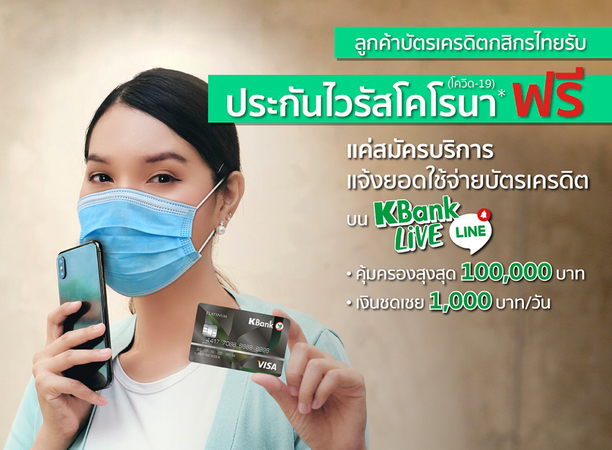
KBank is offering its 100,000 of its credit cardholders a chance to get free Covid-19 insurance for 90 days from January 21 to April 20.
The coverage will provide a maximum benefit of Bt100,000 in case of death and an income compensation of Bt1,000 per day for up to 15 days if the insured has to be hospitalised.
The credit card holders can sign up for the free Covid-19 insurance policy by activating the notification service in Line KBank Live via the “Free COVID-19 Insurance” menu option. Registration is open from until January 18.
KBank will announce who is eligible for the policy by its Line KBank Live account on January 21.
Experts to explore global economic landscape at 14th Asian Financial Forum
Jan 14. 2021
By The Nation
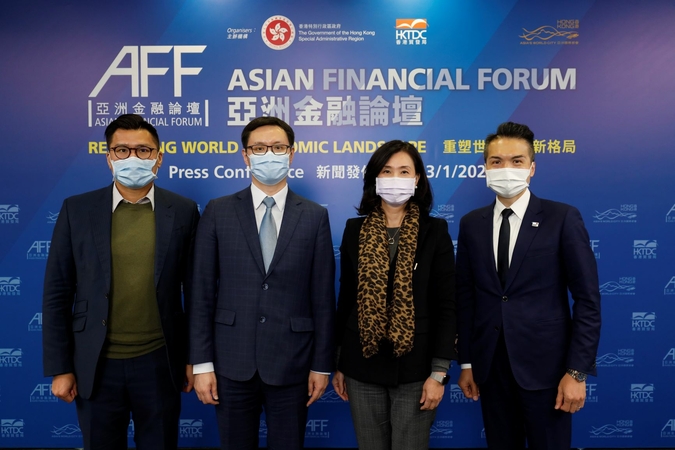
The 14th Asian Financial Forum (AFF) will be held online event on January 18 and 19, under the theme “Reshaping the World Economic Landscape”, and will cover more than 50 sessions from 8.30am to 10pm Hong Kong time.
The aim is to examine the current economic landscape and explore global business opportunities with more than 160 influential policymakers, financial experts, investors, business leaders and economists.
Guests at various sessions will share insights on a wide range of topics including the global economic outlook, socially responsible and impact investment, the asset and wealth management industry in post-Covid era, climate-change risks and opportunities for the insurance industry.
Mary Huen, chairperson of the AFF 2021 steering committee and CEO of Standard Chartered bank in Hong Kong, said: “Covid has brought unprecedented changes to the world economy, though the development of vaccines will help address some of the uncertainties. The global economy is being reshaped even as economic and trade activities begin to get back to normal. Corporates need to aggressively embrace the new normal and turbocharge the implementation of transformation, including technology upgrades, to create new opportunities for the financial industry.”
Dr Patrick Lau, HKTDC deputy executive director, said: “We endured a challenging year in 2020, which makes it all the more important for AFF participants to come together to examine the latest market developments and explore innovative solutions and investment opportunities from around the world. This year’s forum focuses on topics such as sustainable development, impact investment, fintech, 5G, philanthropy, family offices, entrepreneurship and venture capital, and will examine how businesses can turn crisis into opportunity under the new normal.”
First plenary session
The pandemic has hit the global economy hard, and even as the vaccination programme gathers speed the economy is still expected to recover at a slow pace. Whether the global economy will continue on its regular cycle or whether there will be a fundamental change brought about by the pandemic is a topic of interest to many, along with the impact of issues such as trade disputes, climate change and technology development.
The plenary session will explore the topic “Reshaping the World Economic Landscape”, with senior officials examining how the financial services sector can contribute to the recovery of the global economy and what opportunities await in the new economic landscape.
In the face of the global pandemic, many governments employed unconventional financial policies to roll out large-scale fiscal stimulus packages. The discussion will focus on the effectiveness of fiscal and monetary policies in supporting growth, and implications of the increasing use of financial technology from the perspective of regulators.
Broad spectrum of financial issues
As in previous years, the four panel discussions will be a key focus of the AFF. In the session titled “Global Economic Outlook”, business leaders from the banking and financial sectors will assess the transformation brought about by the current environment of low interest rates, increased compliance requirements and digital innovation, together with a raft of challenges resulting from the pandemic. The panellists will share their thoughts on the outlook for the global banking industry, while considering how banks should respond to regulatory changes and advances in technology.
As socially responsible investment and impact investment gain stronger ground, the pandemic has highlighted the importance of incorporating environmental, social and governance (ESG) considerations into investment decisions, creating long-term value for corporations and generating higher returns for investors. The discussion on “Responsible and Impact Investment” will review the long-term prospects for sustainable investing.
The asset and wealth management industry has inevitably been impacted by Covid-19, but while there are challenges to business operations, the pandemic has also given rise to new solutions and practices and the emergence of new perspectives and investment opportunities. The session titled the “Asset and Wealth Management Industry in the Post-COVID Era” will explore the implications of Covid-19 on the asset and wealth management industry, key industry trends in Asia and globally, and how market players can best position themselves in this fast-changing environment.
Climate change is one of the major emerging risks in the decades ahead and is expected to reshape the structure of the economy in the future, bringing both risks and opportunities to the real economy and the financial sector. The insurance industry is expected to play a key role in facilitating people and businesses to address climate change risks and move towards a sustainable future. In a discussion titled “Climate Change Risks and Opportunities for Insurance”, insurance leaders and experts will look at how the industry is responding to climate change and how to capture opportunities for insurance in the transition to a sustainable economy.
Assessing economic prospects
The impact of the pandemic and evolving international geopolitical issues have combined to create uncertainty in the global economy. Over the two days of AFF, influential global financial policymakers and business leaders will take part in more than 50 panel sessions to explore strategies that can help address the current financial situation.
Central bank digital currencies (CBDCs) are gaining traction in global markets. As a premier international financial centre and the world’s largest offshore renminbi hub, Hong Kong is well positioned to facilitate the exploration and expansion of CBDCs at the cross-boundary level. In a discussion themed “The Evolving Central Bank Digital Currency Landscape”, panellists will share insights on potential use cases for CBDCs and how Hong Kong’s burgeoning fintech ecosystem can get better equipped for the opportunities that lie ahead.
This year’s forum will also feature a number of “Fireside Chat” sessions featuring experts from various fields, who will share insights on topics such as technology development trends, venture capital, investing in the “she economy”, financing the circular economy, and the state of blockchain, providing practical advice on how to start a successful business.
This year’s AFF will also kick off the “Dialogues for Tomorrow” series to assess the impact of Covid-19 on sectors such as banking, insurance, fintech, energy, healthcare, food and agriculture and big tech, allowing industry players to get a better understanding of the current situation and ways in which they can enhance their competitiveness.
Showcase for innovations and investment opportunities
The Fintech Showcase, FintechHK Startup Salon, InnoVenture Salon and Global Investment Zone will return in a virtual format for the 2021 AFF. The AFF Deal Flow Matchmaking Session will arrange one-on-one meetings between more than 670 investors, project owners and start-ups to bring together capital and investment projects from around the world on a virtual platform. More than 700 meetings will be arranged, covering investment projects including the Internet of Things, digital technology, healthtech, fintech, education, environment and energy, food and agriculture, infrastructure and real estate.
The InnoVenture Salon will continue to empower start-up enterprises by building connections with international investors and potential business partners, joining hands with Hong Kong financial regulators to solve start-up problems.
It will also present the inaugural “AFF Accelerate”, an open innovation challenge jointly organised by the HKTDC, 500 Startups and FWD Group, inviting start-up entrepreneurs to devise insurance technology solutions for the insurance industry, bringing innovative ideas into the commercial world.
Condo, office, shopping mall markets contract while demand grows for rental factories, warehouses
Jan 14. 2021
By THE NATION
Most of the property markets in 2021, including condominiums, office space and shopping malls, are expected to contract due to the fallout from the Covid-19 pandemic, but the warehouse and factory rental markets will thrive due to rapid expansion of e-commerce, property experts said.
Nexus Property Marketing Ltd managing director Nalinrat Jaroensuphong said the condominium market in 2021 will continue to contract despite an increasing supply of new units – 33,000 to 38,000 – compared to 21,000 in 2020.
“This is due to about 20 projects postponing their openings from last year to this year,” he pointed out. “We estimate that the total condominium supply throughout the year will be 674,000 units.”
Nalinrat said new condo projects this year would focus on smaller units at cheaper prices to match the current economic situation and the trend of buying a home in outer Bangkok compared to buying a condo in the city.
“However, if the government opens the country to foreign tourists from the third quarter, the economy should start to recover and demand for condos should rise slowly,” he added.
Nexus estimates that most of the condominium projects to open this year will have starting prices of between Bt1.2 million and Bt2.5 million per unit, with the total sale price decreasing by 5 per cent, compared to 4 per cent in 2020.
Meanwhile, Nexus Real Estate Advisory Ltd managing director Theerawit Limthongsakul said demand for office space and space at shopping malls has declined since the first wave of Covid-19 last year as many companies still want their employees to work from home to avoid the risk of contracting the virus.
“Last year, office and commercial space occupancy dropped from 94 to 91 per cent, compared to over 95 per cent in the last 7-8 years before Covid-19,” he said.
“However, demand for rental factories and warehouses has been increasing for the past 4-5 years, thanks to the rapid growth of e-commerce,” he said.
“It is estimated that the rental factory and warehouse markets have available space of 4 million square metres each. Rented factories could generate income of Bt200/sqm/month, while rented warehouses could earn up to Bt150/sqm/month,” he added.

 Transport Minister Saksayam Chidchob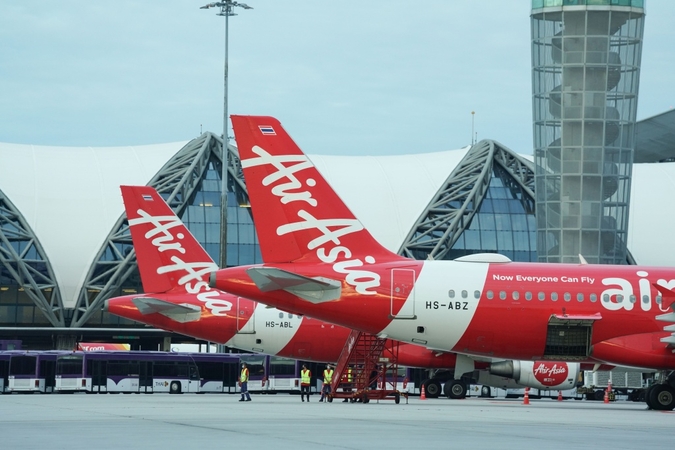

 Deputy Prime Minister Supattanapong Punmeechaow