The price of hospital shares began to rise in the Stock Exchange of Thailand amid higher revenue prospects from the second Covid-19 wave.
Hospitals can generate revenue from conducting Covid-19 tests, opening their facilities to serve as alternative hospital quarantine and deputing medical personnel to alternative state quarantine facilities.
After receiving approval from the Food and Drug Administration, hospitals will be able to procure Covid-19 vaccine to vaccinate people as well.
An analyst at DBS Vickers Securities said the government’s partial lockdown to deal with the pandemic would have a short-term impact on hospital share price because the number of people using medical services would increase once the Covid-19 vaccine arrives.
“We expect hospital business to gain positive sentiment from an ageing society, and medical tourism which is likely to expand,” he said, adding that Thai expenditure on health would increase from Bt415 billion in 2018 to between Bt1.407 trillion and Bt1.825 trillion in 2030.
The Stock Exchange of Thailand (SET) Index rose by 9.43 points, or 0.61 per cent, to 1,545.87 in the morning session on Monday.
An analyst at Krungsri Securities predicted the day’s index to hit 1,550 points on hopes of US economic stimulus measures and the sharp rise in oil price.
“However, investors should beware of volatility due to the weakening baht and the surge in Covid-19 cases,” he said.
He recommended that investors buy:
▪︎ PTTEP, PTTGC, TOP and IVL, which benefit from rising oil price and improved fourth-quarter performance.
▪︎ PSL, TTA and RCL, which would benefit from the rise in freight rate.
▪︎ KBANK, SCB, BBL and BLA, which benefit from rising US bond yield.
The SET Index closed at 1,536.44 on Friday, up 22.66 points or 1.50 per cent. The volume of total transactions was Bt125.08 billion with an index high of 1,538.61 and a low of 1,521.17.
Govt offers hefty discount for takeover of Dhara Devi Hotel
Jan 10. 2021
By The Nation
The government is wooing investors to take over Dhara Dhevi Hotel Chiang Mai by setting a low reserve price for the auction.
The Legal Execution Department will open the auction for the property next month at a price of Bt2.116 billion.
The Court of Appeal had earlier dismissed a petition for rehabilitation of the hotel, as a result the hotel has to go into bankruptcy.
Recently, it was reported that the department had announced the auction of Dhara Dhevi Hotel on February 18, at the Chiang Mai Legal Execution Office, with a starting bid of only Bt2.116 billion. The overall price would be less than half what Inter Far East Energy Corporation Pcl had paid in 2015 for the acquisition, which involved the final price of Bt2.52 billion but exceeded Bt4.3 billion when outstanding debt was taken into account.
Dhara Dhevi Hotel Chiang Mai opened in 2002 as a 5-star hotel with ancient Lanna style architecture, located at Tha Sala subdistrict in Chiang Mai province.
Spread over an area of approximately 153 rai (24.48 hectares), with 123 rooms, it is located in the middle of Muang Chiang Mai district.
The hotel completely shut down on November 18, 2020, after business was hit badly due to the Covid-19 outbreak.
The price of gold slumped by Bt300 per baht weight in morning trade on Monday, the Gold Traders Association reported.
As of 9.25am, the buying price of a gold bar was Bt26,050 per baht weight and selling price Bt26,150, while gold ornaments were priced at Bt25,574.92 and Bt26,650, respectively.
At close on Saturday, the buying price of a gold bar was Bt26,350 per baht weight and selling price Bt26,450, while gold ornaments were Bt25,878.12 and Bt26,950, respectively. The price slumped by Bt500 per baht weight last week.
Spot gold moved to US$1,829 (Bt55,135) per ounce in the morning, while the Comex (Commodity Exchange) gold to be delivered in February fell by $78.2, or 4 per cent, to $1,835.4 per ounce on Friday due to the rise in US bond yield and strengthening dollar.
Hong Kong gold price, meanwhile, was down by HK$440 to $17,050 (Bt66,284) per tael, the Chinese Gold and Silver Exchange Society reported.
The Thai National Shippers’ Council projects a brighter outlook in the export of textiles, garment and machinery this year, the council’s vice chairman Visit Limluecha said.
The council classified products under three categories: V or double-digit growth; U or single-digit growth; and L or no growth or contraction.
Industries in the V-growth group include textile and garment, machinery, finished oil and rice. Double-digit growth is expected for these products because they showed low contraction late last year.
The garment and textile sector dropped 18 per cent last year, while machinery and machine equipment fell 9.2 per cent.
Meanwhile, U-shaped growth is expected for automotive and component parts, electric and electronics appliance, food, rubber, cassava and jewellery and gems.
No growth or L-shaped growth is expected for industries like sugar, plastic pellets and products made of plastic pellets.
He said this is because major sugar producers like Brazil have released massive amounts of sugar and alcohol, causing a glut in the global market.
The council has forecast that sugar exports will suffer a drop of between 7 and 10 per cent, the same as in 2020.
Visit added that the Covid-19 pandemic will still be a key factor in affecting industries globally, especially in relation to luxury items, though market competition will intensify if manufacturers launch promotions.
Construction of Phuket highway will kick off by 2023: Transport Ministry
EconJan 11. 2021Transport Minister Saksayam Chidchob
By The Nation
The construction of the Muang Mai-Koh Kaew Highway should begin by 2023, Transport Minister Saksayam Chidchob said.
The 22.4-kilometre highway, which is part of the ministry’s project to ease traffic in Phuket, will link Phuket airport with Krabi and Phang Nga.
The design and environmental impact assessment for the highway has been completed, he said, adding that the construction is expected to cost Bt11.5 million, plus Bt11.1 billion for land reclamation.
The Highways Department believes the highway will be ready by 2025.
The Public-Private Partnership Committee has called on state agencies to speed up the development of 18 top-priority mega-projects worth Bt472 billion as part of the government’s efforts to drive the economy this year.
The committee is chaired by Deputy PM Supattanapong Punmeechaow.
Meanwhile, Transport Minister Saksayam Chidchob said the ministry has already asked related agencies like the National Economic and Social Development Council for their opinions on its many projects.
He added that the State Railway of Thailand is expected to call bids for the Tao Poon-Ratburana Purple Line mass transit route in the next quarter.
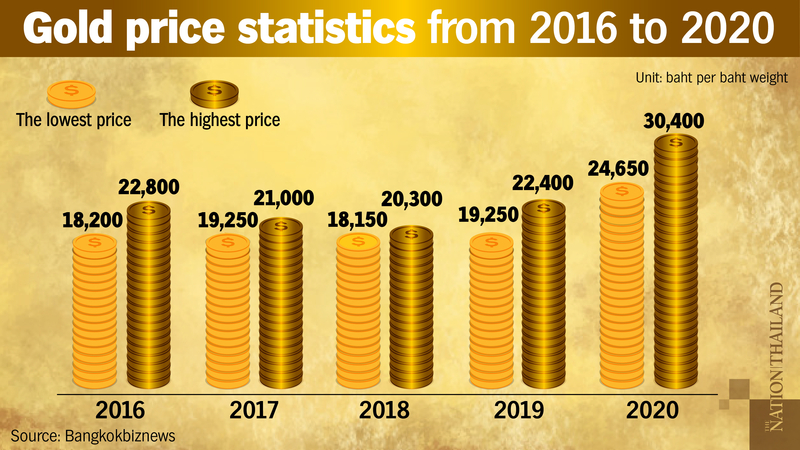
Gold price is expected to hit a new high this year, with experts predicting it could surpass the Bt30,400 per baht weight it touched in 2020.
MTS Gold chief executive Nattapong Hirunyasiri said the price is currently moving in positive territory as its returns as of January 5 this year were 3 per cent despite the news of Covid-19 vaccines.
In the long term, he expected funds to flow into the gold market due to increasing inflation rate, low-interest rate and US President-elect Joe Biden’s policies and measures to inject cash into the economic system.
“However, the gold price would move at around Bt28,000 per baht weight in the short term due to the baht’s appreciation. Meanwhile, returns on gold this year are expected to be at 25 per cent compared to 30 per cent last year,” he said.
Pawan Navawattanasap, YLG Bullion International chief executive officer, expected gold price to move in positive territory in the long term as SPDR funds had bought back gold at the end of last year.
She said gold price had gained positive sentiment from rising Covid-19 cases and the weakening US dollar, adding that foreign strategists predicted the dollar this year would weaken further.
“We expect gold price to move in positive territory for up to two years as the interest rate is expected to remain at a low level until 2023,” she said.
She added that the price could hit US$2,000 if it can pass the resistance line at $1,965 per ounce.
“Investors who are able to tolerate risks can buy gold when the price drops to $1,921 per ounce and set up stop-loss point at $1,907 per ounce,” she added.
The chief of state think-tank, National Economic and Social Development Council (NESDC), expressed concerns about the impact of the new wave of Covid-19 infections, saying this outbreak may hit the economy harder if steps are not taken in time.
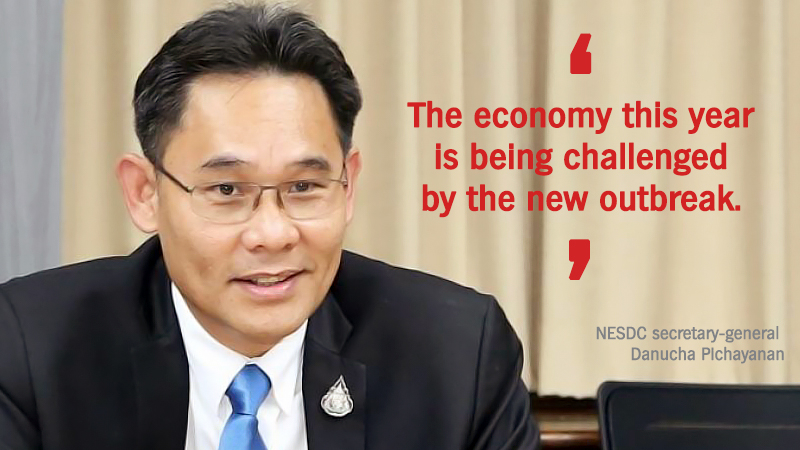
In an exclusive interview with Krungthep Turakij newspaper, NESDC secretary-general Danucha Pichayanan said that though some countries have started mass vaccinations, it will still take a long time for inoculations to arrive in every corner of the world.
And while Thailand waits for vaccines to arrive, the renewed outbreak could worsen and hit the economy hard.
The new round of infections originated in Samut Sakhon province to the west of Bangkok, and spread quickly, forcing authorities to impose restrictions on 28 provinces.
He said if the virus can be contained by early February, then the government will not have to change its economic management plans and should be able to announce relief packages in the next few weeks.
He added that so far, this new outbreak has not had as severe an impact on the economy as the first round of infections did last year. This is because many economic activities have been conducted to some extent, like people moving around and restaurants remaining open, he said.
Also, he added, Thailand is better prepared this time around and has ensured there is adequate supply of face masks, medical equipment and medication.
“Managing the economy in the first six months of this year is being challenged by the new outbreak. We have to contain it and ensure everyone’s safety first before we can drive the economy forward. And if we are successful in containing the outbreak, then we will draw more foreign investment,” he said.
However, he said, apart from Covid-19, there are more risks that need to be managed.
The first is ensuring people keep their jobs and for this we have to help bolster businesses while the economy gradually recovers from the Covid-19 fallout, he said.
The second is high household debt, which currently stands at 83 per cent of the gross domestic product. The country must address both short- and long-term issues related to debt, and ensure people are financially literate.
The third is the appreciation of the baht, which has had an adverse impact on exports. A drop in the import of capital goods and limited overseas investments by Thai corporations have contributed to the strength of the baht. We need to ensure the stronger baht does not disrupt economic recovery, he said.
Another important factor is US President-elect Joe Biden’s policies once he takes over from President Donald Trump on January 20. Thailand has to wait and see which direction Biden’s policies take. For instance, he said, the US-China trade war is expected to continue and Biden may come up with policies that have an impact on Thailand and the global economy.
The government also needs to focus on the low-income group in the first half of 2021 and find ways to boost domestic consumption. Also, he said, the economy will rely on private investment and public spending, such as Bt400 billion in government loans aimed to lift the grassroots economy in the first six months.
“In a move to sustain economic growth, the Government Centre for Economic Situation Administration will also boost foreign direct investment, which we expect will flow into the country in the fourth quarter of the year,” he said.
The country plans to restructure the economy so it has a stronger base for the next four to five years, and in order to do this, investment is required in key industries such as electric vehicles, battery, charging stations, electrical grids and electric systems, sensors and electronics.
If Thailand wants to achieve its aspiration of becoming a medical hub, then it also needs to invest in human capital and develop research centres.
The Board of Investment (BoI) also needs to adapt its strategy so it draws investment from the world’s top five or 10 firms.
Government agencies and BoI have discussed the options of investment incentives and technology transfer, which should draw more investment in the fourth quarter. This will lead to a new industry cluster and a production base in the long-term, he said.
If Thailand manages to effectively contain the spread of the virus, the economy should grow 4 per cent this year, he said, citing NESDC’s forecast.
“The Covid-induced crisis has also created an opportunity for economic restructuring, which can become a springboard for robust future growth,” he added.
The 26 initial public offerings (IPOs) on the Thai stock market last year saw average returns of 48.72 per cent at close of first-day trading, Bangkokbiznews revealed on Friday.
However, seven of the 26 new listings – four on the Stock Exchange of Thailand (SET) and three on the Market for Alternative Investment (MAI) – saw their IPO price drop below the subscription price.
Currently, 12 of the companies have allocated their IPO shares, namely Next Capital (NCAP), Well Graded Engineering (WEG), Dhouse Pattana (DHOUSE), Siam Rajathanee (SO), K&K Superstore Southern (KK), Sirakorn (SK), Micro Leasing (MICRO), Earth Tech Environment (ETC), I&I Group (IIG) Silicon Craft Technology (SICI), Sri Trang Gloves Thailand (STGT), Central Retail Corporation (CRC), NR Instant Produce (NRF) and Yggdrazil Group (YGG).
The top five investors who obtained most IPO shares are as follows:
1. Wichai Wachiraphong: 51.67 million shares from five companies – DHOUSE (5 million shares) MICRO (2.29 million), ETC (18 million), STGT (22.20 million) and NRF (4.18 million)
2. Ratchayut Jeerapornprapa: 28.15 million shares from two companies, – ETC (25.65 million) and DHOUSE (2.5 million)
3. Annop Limprasert: 27.06 million shares from two companies, namely ETC (24 million) and MICRO (3.06 million)
4. Komol Juangroongruangkit: 26.06 million shares from two companies, namely ETC (25 million) and SICT (1.06 million)
5. Sippakorn Kaosa-ard: 23 million ETC shares.
Meanwhile, the top five IPO investors in terms of profit netted more than Bt1.4 billion in total at close of first-day trading.
The top five were Wichai Wachiraphong (Bt602.99 million), Katreeya Beaver (Bt432.53 million), Chawin Tangkaravakoon (Bt141.51 million), Kanes Tangkaravakoon (Bt139.39 million) and Aiyawatt Srivaddhanaprabha (Bt106.29 million).


 Transport Minister Saksayam Chidchob
 Deputy PM Supattanapong Punmeechaow