Biden assembling new stimulus plan with checks, unemployment aid #SootinClaimon.Com

#SootinClaimon.Com : ขอบคุณแหล่งข้อมูล : หนังสือพิมพ์ The Nation.

Biden assembling new stimulus plan with checks, unemployment aid

EconJan 09. 2021President-elect Joe Biden visits Atlanta to show his support for the Democratic candidates for Senate. MUST CREDIT: Washington Post photo by Demetrius Freeman.President-elect Joe Biden visits Atlanta to show his support for the Democratic candidates for Senate. MUST CREDIT: Washington Post photo by Demetrius Freeman.

By The Washington Post · Jeff Stein, Erica Werner, Mike DeBonis · NATIONAL, BUSINESS, POLITICS, CONGRESS 

WASHINGTON – President-elect Joe Biden said Friday he is assembling a multitrillion-dollar relief package that would boost stimulus payments for Americans to $2,000, extend unemployment insurance and send billions of dollars in aid to city and state governments, moving swiftly to address the nation’s deteriorating economic condition and the rampaging pandemic.

The package will also include billions of dollars to improve vaccine distribution and tens of millions of dollars for schools, as well as rent forbearance and assistance to small businesses, especially those in low-income communities, Biden said at a news conference in Wilmington, Del.

“We need to provide more immediate relief for families and businesses now,” Biden said.

“The price tag will be high,” he said, adding, “The overwhelming consensus among leading economists left, right and center is that in order to keep the economy from collapsing this year, getting much, much worse, we should be investing significant amounts of money right now.”

Biden said he would lay out the package in more detail next week. It would build on some $4 trillion in economic assistance Congress has already devoted to battling the devastating pandemic, including a $900 billion package President Donald Trump signed into law last month.

Discussions were getting underway in earnest with Democratic leaders on Capitol Hill, with Biden aiming to move the package to a vote as quickly as possible. But in an early sign of the challenges Biden may face in getting his agenda through Congress, even with both chambers controlled by Democrats, Sen. Joe Manchin III, D-W.Va., expressed skepticism Friday about the benefits of a new round of stimulus checks.

“I don’t know where in the hell $2,000 came from,” Manchin said. “I swear to God I don’t. That’s another $400 billion dollars.”

Manchin initially seemed to suggest in an interview with The Washington Post that he was “absolutely” opposed to a new round of checks. He clarified in a follow-up interview that he could potentially support more checks if they were narrow in scope and targeted for people who really need them.

Manchin also said that the first priority needed to be on getting people vaccinated, not sending out checks.

“If they can direct money and they say, ‘This will help stimulate the economy,’ hell yeah I’m for it,” Manchin said. “But basically right now, you better get them vaccinated.”

Biden has made new stimulus checks a central promise, specifically telling Georgia voters that they would be getting $2,000 payments if Democrats won Senate runoff elections in the state this week.

Democrats won those races, clinching a majority in the Senate and unified control of Washington for the first time since the start of the Obama administration. After the Georgia wins, the incoming majority leader, Sen. Charles Schumer, D-N.Y., also pledged that the $2,000 checks would be an early priority. Sen. Bernie Sanders, I-Vt., said in a statement Friday that “the working class of this country was promised that they would receive a $2,000 direct payment. . . . We must keep that promise.”

Manchin is a moderate who will hold great sway in a Senate split 50 to 50 between Democrats and Republicans. With such slim margins, Biden and Schumer may not be able to lose even a single Democratic vote if they attempt to move legislation under special Senate rules that allow bills to pass with a simple majority, instead of the 60-vote margin generally required. In the event of a tie in the Senate, Kamala Harris, the incoming vice president, would cast the deciding vote.

Without united Democratic support, Biden would need to attract Republican votes for his proposal. Biden has often spoken of a desire for bipartisanship, and there may be GOP support for some elements of his plan, including the stimulus checks. However, many Republicans are certain to balk at a price tag Biden said would be “in the trillions of dollars.”

Formal discussions between congressional Democratic leaders and Biden officials on the details of the stimulus package are expected to begin in earnest in coming days. Officials stressed that conversations are preliminary and that no final decisions have been made about the timing or exact shape of the effort.

At least one leading Democratic senator will push for federal unemployment benefits to be approved at $600 a week, up from the current $300, although the position of the Biden team on that matter is not yet clear.

The local-aid component of the package may take the form of additional money for specific needs that local governments face, such as funding for education and child care, rather than direct grants to states and cities.

Biden’s push for a big new stimulus package comes amid a rapid deterioration of the economy under the strain of a third wave of the coronavirus. The economy shed 140,000 jobs in December, a steep decline just as U.S. covid-19 deaths hit an all-time high.

“Clearly, there’s a need. The new unemployment numbers are shocking,” said Jim Kessler, an executive vice president at Third Way, a centrist think tank. “State and local aid has to be part of it. There will be additional stimulus checks. And you have to make sure unemployment benefits continue as well.”

Enhanced unemployment benefits of up to $300 a week were included in the $900 billion package signed by Trump. That package also included $600 stimulus checks, so approving new $1,400 checks would bring stimulus payments to $2,000, a figure that has attracted widespread support.

House Speaker Nancy Pelosi, D-Calif., pushed a stand-alone stimulus-check measure through the House last month. Biden indicated Friday, however, that he would wrap the stimulus checks into a wide-ranging package, not try to move them as a stand-alone bill.

Biden is also likely to push for a larger legislative effort later in 2021 after the initial stimulus package. That effort is expected to focus on spending trillions of dollars on infrastructure and clean-energy jobs. The former vice president additionally has pushed for significant overhauls to America’s health-care system, something that could also be wrapped into legislation later in the year.

Sen. Ron Wyden, D-Ore., incoming chair of the Senate Finance Committee, said in an interview that he will push for a restoration of the $600 per week in federal unemployment benefits approved by Congress in March. Those benefits expired in the summer, although Congress last month approved an additional extension of those benefits at $300 per week. Other Senate Democrats have previously expressed internal opposition to reviving the $600-per-week benefit.

Wyden said he is in communication with Biden officials about the coming push for economic relief. He did not say whether the Biden officials will back his push for the $600 weekly benefit. He also said he is pushing for “automatic triggers” that tie the expiration of federal benefits to general economic conditions, such as the unemployment rate.

“I talked to [Biden officials] last night. I can tell you they are very much concerned about layoffs,” Wyden said. “At this point, I’m telling everybody: ‘I’m pulling out all the stops for $600.’ . . . We are going to do everything we can to put hard-hit working families on an economic footing where they can get ahead.”

The economy lost 140,000 jobs in December #SootinClaimon.Com

#SootinClaimon.Com : ขอบคุณแหล่งข้อมูล : หนังสือพิมพ์ The Nation.

The economy lost 140,000 jobs in December

EconJan 09. 2021

By The Washington Post · David J. Lynch, Eli Rosenberg, Andrew Van Dam · BUSINESS, US-GLOBAL-MARKETS 

WASHINGTON – The Labor Department said the U.S. lost 140,000 jobs last month, marking the first decline since the recovery began in May, as the economy showed signs of buckling amid an escalating pandemic.

The monthly report means that President Donald Trump, who once boasted that his business background made him uniquely qualified to “make America great again,” will leave office with fewer Americans employed than when he entered the White House.

Restaurants and bars were among the hardest hit, as rising coronavirus infections and cold weather made it harder to operate. Cash-strapped state and local governments laid off thousands of teachers and other public employees.

Amid fresh signs of economic weakness, President-elect Joe Biden said Congress must act quickly on his proposal for additional federal relief beyond last months’ $908 billion package.

“We need to provide more immediate relief for working families and businesses now,” Biden said. “Not just to help them get to the other side of this painful crisis, but to avoid the broader economic costs due to long-term unemployment, hunger, homelessness, and businesses failing.”

The current gloom is unmistakable, but it could lift in a matter of months – if the sluggish introduction of coronavirus vaccines accelerates, freeing the economy from the pandemic’s grip.

Still, the disappointing jobs report suggested it will take longer than economists expected to claw back all of the jobs lost during last year’s recession. Employers rehired millions of workers in the summer, yet 9.8 million fewer Americans are working today than were employed before the pandemic. It will likely take more than two years for the U.S. to return to full employment, many economists say.

After nine months without a job, Danielle Whittenhall, 30, a Chicago bartender, despairs of ever again finding work in the nightlife industry. Since the nightclub and sports bar she worked at closed in March, she’s cycled between living in her car and on a friend’s couch, surviving on the $560 in state unemployment benefits she receives every other week.

“It’s been a tough thing to navigate through,” she said.

In Wilmington, Del., Biden said “the anxiety and fear” in the country was reminiscent of January 2009, when he was sworn in as vice president amid a global financial crisis. Joblessness is particularly high for Black and Latino households, with unemployment rates topping 9% compared to 6% for Whites.

Battling a dual health and economic crisis, the new administration faces a more complex policy challenge, economists said. More contagious variants of the coronavirus have been detected on U.S. soil. And on Thursday, the country set a new single day fatality record with more than 4,000 deaths.

Vaccines offer hope of a return to normal activity later this year, but the pace of their rollout over the past month has disappointed. Even as the Biden team draws up plans to speed that process, workers and businesses in industries affected by social distancing need financial support to help them survive.

“Until the virus is under control, until people can freely engage in economic activity again, there is one hand tied behind the economy’s back,” said Heidi Shierholz of the Economic Policy Institute, a left-leaning think tank. “That is totally different than what Obama-Biden faced when they came in.”

Sarah Sheets, 46, who operates a daycare in Ingram, Texas, is among those the virus sideswiped. When the pandemic hit in the spring, demand for her services evaporated, leaving her to rely on unemployment benefits. Until the end of July, when an emergency federal program expired, she received $600-a-week in addition to her regular state benefits. But for the final five months of the year, she got by on $160 in state assistance each week.

“We didn’t have Christmas this year,” she said. “I had $200 for four children and dinner. It’s not going to be the same ever again.”

Sheets has just started receiving the extra $300 a week in jobless aid Congress approved last month. She said she’s hoping for more help after Jan. 20th when the Democrats will control the White House and both sides of Capitol Hill.

“It would be enough to have to deal with the fact that there was a virus,” she said. “But then the financial part of it has just pushed us over into a very difficult situation. “

The unemployment rate stayed level at 6.7% in December, according to the report, from the Bureau of Labor Statistics.

Employment in leisure and hospitality industries declined by 498,000, the majority of that at restaurants, bars and other food service establishments, which have struggled amid limitations from cold weather and a new round of restrictions across the country.

Employment in another tourism-related category – amusements, gambling and recreation – fell by 92,000. Government employment declined by 42,000. These declines offset modest gains in other sectors, such as professional and business services, retail and construction.

Still, other parts of the $21 trillion U.S. economy continued to power ahead. Retailers showed surprising strength, adding 121,000 jobs, while homebuilders pushed construction hiring up. Manufacturers added 38,000 jobs and warehouses added workers, too, as e-commerce orders boosted demand.

While the job market is sagging under the pandemic’s weight, the economy is expected to roar back in the second half of the year. The introduction of two vaccines for covid-19, the disease caused by the coronavirus, offer hope of a gradual resumption of normal operations for many damaged businesses.

With Democrats in full control of Washington, many economists say prospects for continued government financial assistance also have improved. Richard Clarida, vice chair of the Federal Reserve, said Friday he expects the nation’s central bank to continue supporting the recovery with monthly purchases of about $120 billion in Treasury and other government-backed securities.

The fresh labor market data points to the economic challenges facing Biden, who inherits one of the weakest labor markets in years from his predecessor.

There are 9.8 million fewer jobs in the United States now than in February; 3 million below the level on Inauguration Day in 2017, a track record that undercuts what had been one of Trump’s most frequently touted achievements.

On Friday, Trump – cloistered at the White House amid demands for his ouster following Wednesday’s insurrectionist riot at the U.S. Capitol – offered no tweets or other public remarks about the economy.

“It’s a damaged labor market,” said Augustine Faucher, chief economist at the PNC Financial Services Group. “But it is a labor market that is poised for recovery, given the fact that we are seeing the vaccine. With support from the federal government and support from the Federal Reserve, it could see a strong rebound over the next few years.”

The economy shed 22 million jobs between February and April with the onset of the pandemic and has regained just over half. Economists have long warned that delays renewing the packages that offered aid to businesses, families and unemployed individuals would have costly effects on the broader economy.

The pandemic’s imprint is evident in just about every corner of the economy. Nearly a quarter of employees teleworked in December, up about a percentage point from November. Another 15.8 million people said they had been unable to work because their employer closed or lost business due to the pandemic.

Some 4.6 million people who were not counted as part of the labor force were prevented from looking for work due to the pandemic, the BLS reported.

Taking into account the shrunken labor force, a true measure of unemployment would be close to 9.5%, said Gregory Daco, chief U.S. economist for Oxford Economics.

Though job growth is expected to be robust once large numbers of Americans are vaccinated, the economy at year end will still be short roughly 4 million jobs, he said.

Government employment declined by 45,000 in the month, lending credence to the warnings from economists and Democrats about coming job cuts due to budget shortfalls. Republicans resisted a measure for robust state and local government aid as part of the stimulus negotiations in December.

But with a Democratic Congress and White House, the report will likely help fuel Biden’s push for a fresh round of economic aid. The president-elect said Friday that he will unveil next week a multi-trillion dollar relief package.

Still, the next few months are likely to continue to be tough for the labor market as winter and coronavirus-related shutdowns chill the ability of hospitality and restaurant industries to operate and the level of infections remains an obstacle to other attempts to get the economy going.

Questions remain about how restaurants, bars, hotels and other businesses that rely on close personal interactions will endure. More than 110,000 restaurants have closed in the pandemic – about one in six – according to a survey released in December by the National Restaurant Association.

“We’ve got a lot of work ahead of us,” said Daco. “The situation will improve. But we won’t escape unscathed from this crisis.”

Thai stocks rise 1.5% to complete end-of-week surge #SootinClaimon.Com

#SootinClaimon.Com : ขอบคุณแหล่งข้อมูล : หนังสือพิมพ์ The Nation.

Thai stocks rise 1.5% to complete end-of-week surge

EconJan 08. 2021

By The Nation

The Stock Exchange of Thailand (SET) Index closed at 1,536.44 on Friday, up 22.66 points or 1.50 per cent. The volume of total transactions was Bt125.08 billion with an index high of 1,538.61 and a low of 1,521.17.

In the morning session, an analyst at Krungsri Securities forecast the day’s index would climb to between 1,525 and 1,530 points on hopes of more US stimulus after the Democrats took control of Congress, as well as the rising oil price.

“However, investors should beware of market volatility due to the weakening baht and a decline in foreign fund flows,” he said.

The 10 stocks with the highest trade value today were SCGP, EA, BANPU, GPSC, DELTA, KCE, PTT, KEX, GULF and INTUCH.

As of 4.30pm, the price of oil rose by US$0.28 or 0.55 per cent to $51.11 per barrel, while gold dropped by $25.60 or 1.34 per cent, to $1,888 per ounce.

Other Asian indices were mixed:

Japan’s Nikkei Index closed at 28,139.03, up 648.90 points or 2.36 per cent.

China’s Shang Hai SE Composite Index closed at 3,570.11, down 6.10 points or 0.17 per cent, while Shenzhen SE Component Index closed at 15,319.29, down 37.11 points or 0.24 per cent.

Hong Kong’s Hang Seng Index closed at 27,878.22, up 329.70 points or 1.20 per cent.

South Korea’s KOSPI Index closed at 3,152.18, up 120.50 points or 3.97 per cent.

Taiwan’s TAIEX Index closed at 15,463.95, up 249.95 points or 1.64 per cent.

GSB offers debt relief to customers in ‘red’ provinces #SootinClaimon.Com

#SootinClaimon.Com : ขอบคุณแหล่งข้อมูล : หนังสือพิมพ์ The Nation.

GSB offers debt relief to customers in ‘red’ provinces

Jan 07. 2021

By The Nation

The Government Savings Bank (GSB) has launched an urgent measure to assist customers in 28 “red zone” provinces.

They can register for relief from debt repayment at its www.gsb.or.th website from Friday (January 8) onwards.

CP Foods raises guard against Covid-19, assuring Thais of food safety #SootinClaimon.Com

#SootinClaimon.Com : ขอบคุณแหล่งข้อมูล : หนังสือพิมพ์ The Nation.

CP Foods raises guard against Covid-19, assuring Thais of food safety

Jan 07. 2021

By The Nation

Charoen Pokphand Foods (CP Foods) has pledged to deliver safe food during the fresh Covid-19 outbreak by maintaining maximum disease controls throughout its supply chain of feed mills, farms, processing plants, transportation, suppliers, distribution channels and Thai and migrant workers.

CP Food CEO Prasit Boondoungprasert said the company’s Covid-19 management centre, set up in early 2020, has implemented stringent safety measures in line with government and CP Group guidelines. These measures were safeguarding the company’s operations amid the new wave of Covid-19 infections, he said. Additional measures have been imposed, particularly regarding employees’ health and safety, as this is the heart of the production and delivery of quality and safe food to consumers, Prasit added.

CP Foods had also raised cleaning and disinfectant standards at farms, processing plants and offices – from raw materials, production lines and packing rooms to equipment and tools. Face masks, temperature checks, and hand washing with alcohol gel before starting work were compulsory for all staff. All trucks must be cleaned and all wheels must be sprayed with disinfectant, said Prasit. 

Pimonrat Reephattanavijitkul, CP Foods executive vice president for human resources, said 

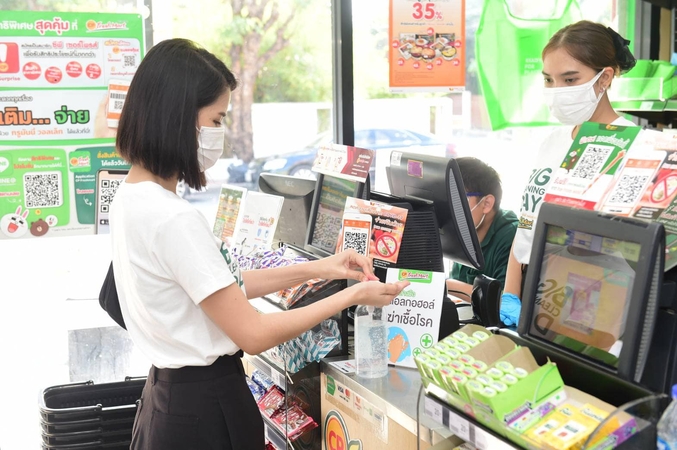
migrant workers were being housed in dormitories and transported to work by company buses. Meanwhile CP Freshmart shops were maintaining strict hygienic standards at all outlets, with nine disease-prevention measures under “CP Freshmart’s cleanliness and safety against COVID-19” project. Staff must wear face masks and gloves while cleaning frequently touched areas such as money trays and door knobs. Customers are asked to wear face masks, wash hands with alcohol gel and have their temperature checked prior to entering. Customers are also encouraged to use the delivery service rather than visiting outlets.

Tops, Central Food Hall deploy an army of robots to kill viruses #SootinClaimon.Com

#SootinClaimon.Com : ขอบคุณแหล่งข้อมูล : หนังสือพิมพ์ The Nation.

Tops, Central Food Hall deploy an army of robots to kill viruses

Jan 06. 2021

By The Nation

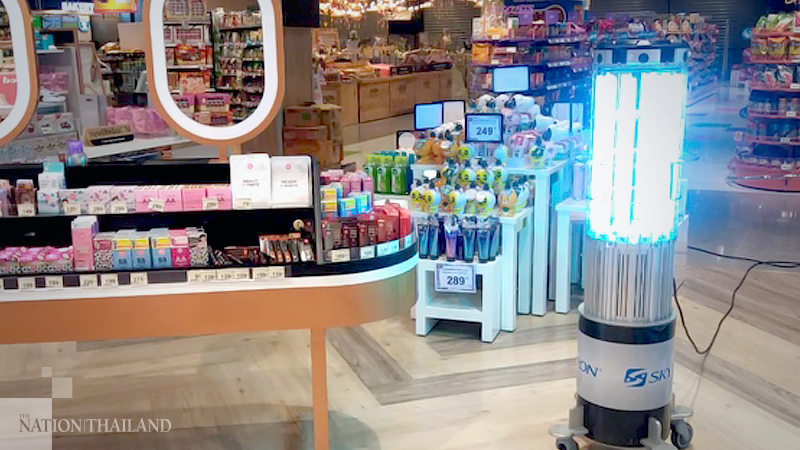
In a move to ensure shoppers’ safety and curb the spread of Covid-19, Tops and Central Food Hall have deployed UV-C Disinfection Robots to clean surfaces. These robots have been put to work at 10 Tops and Central Food Halls, namely:

• Tops Market Pinklao, Rama II, Rama III, Salaya, Samut Prakan and Westgate.

• Central Food Hall Bangna, Chidlom and Lad Phrao.

• Tops Superstore Mahachai.

Tops and Central Food Hall plan to introduce the robots at other branches as well as distribution centres of fresh and dry food and online fulfilment centres.

The UV-C Disinfection Robots have been certified by the World Health Organisation (WHO) and Centre for Disease Control (CDC) for their effectiveness as UV-C can kill Covid-19 and other viruses and bacteria.

Disinfection takes seconds as robots emit high-intensity UV-C from all angles to kill 99.9 per cent of germs. UV-C is safe and does not leave residue, thus not affecting the quality of food and products. This technology has also been approved by the UK Food Standards Agency, the US Food and Drug Administration and the organic lobby Soil Association.

Singha Estate sells stake in NVD #SootinClaimon.Com

#SootinClaimon.Com : ขอบคุณแหล่งข้อมูล : หนังสือพิมพ์ The Nation.

Singha Estate sells stake in NVD

Jan 06. 2021Naris Cheyklin, chief executive officer of Singha EstateNaris Cheyklin, chief executive officer of Singha Estate

By The Nation

A group of Nirvana Daii (NVD) shareholders led by Sornsak Somwattana on Wednesday confirmed they had purchased Singha Estate’s entire shareholding in NVD of 711,855,320 shares, or 51.56 per cent of the total stock of NVD, at Bt2.52 per share.

Sornsak said: “We are very confident in the enormous potential of Nirvana Daii and look forward in the years ahead to building on this company’s exceptional track-record as a developer of some of the finest residential properties in Thailand.”

Said Naris Cheyklin, chief executive officer of Singha Estate: “Singha Estate is structuring its portfolio of investments to accelerate growth, while remaining committed to maintaining a significant presence in Thailand’s residential development sector. During the course of this year, we plan to unveil some exciting new initiatives that will rapidly advance the company in this direction.”

B Grimm Power to enter growing independent power supply market #SootinClaimon.Com

#SootinClaimon.Com : ขอบคุณแหล่งข้อมูล : หนังสือพิมพ์ The Nation.

B Grimm Power to enter growing independent power supply market

CorporateJan 08. 2021B Grim CEO Harald Link B Grim CEO Harald Link

By The Nation

B Grimm Power has unveiled plans to enter the independent power supply (IPS) market, whereby companies produce electricity for their own use.

The IPS market has significant potential for expansion given large companies are seeking to lower their energy costs, said B Grim CEO Harald Link on Thursday. 

Mixed-use projects (shops, offices and residential) are currently looking to produce their own electricity to cut high energy costs, he added.

Link revealed he is in talks for electricity production projects with five or six clients, saying B Grim plans to begin investing in the market this year.

The company will leverage its expertise in energy equipment, air conditioners, construction materials, and solar and gas-generating electricity production, he said.

B Grimm said electricity production technology has advanced quickly and costs have fallen to a point where it envisages producing 20 to 30 megawatts for the IPS market.

The IPS venture will add to its existing operations in the small power producer (SPP) and rooftop solar energy markets.

Top ‘new normal’ trends waiting to shape the world in 2021 #SootinClaimon.Com

#SootinClaimon.Com : ขอบคุณแหล่งข้อมูล : หนังสือพิมพ์ The Nation.

Top ‘new normal’ trends waiting to shape the world in 2021

Biz insightsJan 06. 2021Thawipong Anotaisinthawee, country manager for Nutanix (Thailand)Thawipong Anotaisinthawee, country manager for Nutanix (Thailand)

By Thawipong Anotaisinthawee

Special to The Nation

2020 was a year of shocks and rapid change, reshaping the way we work and the ways in which technology was used to support the new normal.

Organisations that adjusted quickly were able to weather the storm and come out on top, though others struggled to keep pace with the digital acceleration required to survive.

This digital acceleration will continue to shape the tech and business landscape into 2021. Here are my top predictions for trends that will shape the next 12 months.

Agile strategy implementation

As countries begin to look beyond the Covid-19 pandemic, we will start to see a slow, staggered return to physical workspaces. But it will be an uneven recovery. Across the Asia-Pacific region and further afield, our countries and economies are very interconnected. So, even if one country’s recovery is going well, global uncertainty will continue until all major international players return to an even keel.

Naturally, this will create a scattered return to growth. To deal with this, organisations will need the agility to shift their strategies and spending on a quarter-by-quarter basis to ensure they can react to the macro situation. The appetite for traditional, large capitalised IT spending will be replaced with just-in-time agility.

A traditional approach to technology doesn’t allow this agility. Instead, enterprises and governments will look to subscription models over longer-term contracts or lock-ins, to ensure they have the ability to shift and innovate in the face of uncertainty.

A pay-as-you-grow model which encourages “fail fast” strategies will balance the imperatives to innovate with the need to reduce exposure.

Validation for digitisation a top priority

Regardless of how far they lag behind pre-COVID-19, countries and businesses alike will be pushed to a new level of digitisation in the coming 12 months.

Every organisation will have to rethink its model – even if we snapped back to how things were (which we won’t), our environment and peoples’ expectations have changed. To cope, even the most brittle organisations will need to embrace agility. This is being seen already – Japan, for example, has gone so far as to mandate increased digitisation across key government departments.

Previously, digitisation was the priority of the chief information officer or CIO, and not given attention by the CEO or the rest of the management. This changed rapidly with the pandemic when finally, the enabling power of digital transformation was recognised across the business world. It will remain a top priority throughout 2021, when having the right level of digital ability will continue to be vital for business agility and survival.

As a result, the CIO will become more prominent in business decisions and leadership, with their tech investments having been validated in a big way. The shift of IT from a cost centre to a key business driver will accelerate. Every business is now a technology business, even if they don’t realize it yet.

Climate change to be back on agenda

If it hadn’t been for COVID-19, climate change would have been the biggest global story of 2020. After being pushed off the global agenda this year, climate change will return to be the dominant subject in 2021.

Politics aside, it’s clear the effects of climate change are real and we need to find a way forward. This is particularly true of industries like resources, transport and agriculture. As companies continue to embed and accelerate their digital transformation, they need to do this with a view on climate change and its effects.

Distributed businesses, for example, will need to increase their resilience. Major weather events will impact supply chains and factories in vulnerable areas.

In the face of these concerns, technology can enable better practices. Innovative solutions like edge computing will play a key role in this space – for example, implementing and tracking efficient and sustainable practices on the ground, tweaking and optimising on the go to increase yield, decrease emissions, better manage productions lines, and so on.

Recent political shifts should also bring the US back to the table as a partner and driving force for dealing with climate change, with reverberations globally.

Hybrid and multi-cloud strategy

Many Asia-Pacific companies that wanted to run head first into the cloud are catching up with their US counterparts, who realised several years ago that many mission-critical or legacy applications vital to the running of a business aren’t right for the cloud.

Companies want cloud-like capabilities but need to keep optionality and flexibility. No one wants to be locked into anything. As such, CIOs will begin insisting on hybrid and multi-cloud strategies, or at the very least insist on portability assurances as they become increasingly cloud smart.

Globally, we have seen many organisations begin to modernise their applications and shift to a “cloud first” strategy, only to hit a wall when they find that key applications cannot be efficiently migrated nor refactored to a cloud-friendly model. Instead, a hybrid and multi-cloud strategy will be necessary to balance desire for cloud agility and economics with the reality of sustaining operations.

This will also enable the quarter-on-quarter agility businesses will need for the foreseeable future. Organisations will learn to take the long-term view and avoid being locked into something that next quarter might not work, if the world suddenly looks completely different.

If there’s one thing organisations should take from 2020 and apply to their 2021 strategies, it’s this: Disruptive change is inevitable. Flexibility and adaptability need to be core to business thinking.

Thawipong Anotaisinthawee is country manager for Nutanix (Thailand).

New normal heralds renaissance of the PC #SootinClaimon.Com

#SootinClaimon.Com : ขอบคุณแหล่งข้อมูล : หนังสือพิมพ์ The Nation.

New normal heralds renaissance of the PC

Biz insightsJan 06. 2021Sam Burd is president for Dell Technologies’ Client Solutions Group.Sam Burd is president for Dell Technologies’ Client Solutions Group.

By Sam Burd

Special to The Nation

The term “tablet PC” was coined in around 2000, and 10 years later we saw the first headline – “The PC Officially Died Today” – giving rise to a decade-long debate, with most tech pundits convinced that the PC would go extinct by 2020.

Fast forward to today and the narrative has changed. Worldwide PC shipments rose 17.1 per cent year on year in the third quarter of 2020, while smartphone shipments are projected to drop 1.3 per cent year on year in the same quarter, according to International Data Corporation (IDC).

While the PC has always helped us connect, collaborate and communicate, 2020 has proven the value it brings to our lives more than any other time. I believe we’re witnessing the renaissance of the PC. Not a resurgence, as that would imply a period of little activity, but a renaissance – an entirely new way of thinking about something.

We’ve been designing innovative PCs that can help you “work from anywhere” for years, but now we’ve been given a rare opportunity to step back, rethink and use this time as a catalyst for positive, innovative change.

IT doesn’t touch the PC

Dell has always put the needs of people at its core, with support available at every stage of a company’s journey to provide a productive and connected digital workforce.

But how does this evolve in our renaissance phase? Think of PCs that self-heal to keep you working instead of looking for help. Think how the combination of AI, analytics, the cloud and improved connectivity will make remote management of PCs a breeze. And how the promise of predictive maintenance means problems fix themselves before they manifest.

A future where an IT professional never physically touches a PC again? That’s a revival that could benefit us all.

With AI, PC stands for personal companion

With ever-increasing demands, we need PCs that do more than just work. We need PCs that are more intelligent, self-aware and user aware. We recently introduced Dell Optimizer, our AI-based software that learns and adapts to how you work and provides faster app launches, extended battery life, easier log-on and secure lock-outs.

Future AI capabilities will benefit us in ways we haven’t imagined yet. AI will make PC usage more seamless, customised and hassle-free, getting rid of challenges like connecting to the local network or setting up a printer.

Imagine ubiquitous connectivity and continuous experience that translates across all your preferred devices so you can always pick up where you left off. Think about having a personal AI assistant on your PC to help manage work and home life. Setting appointments or making recommendations based on contextual data will be simple tasks completed in the background for you.

Collaboration, connectivity take spotlight

The industry has long focused on offering the smallest and lightest devices possible. And Dell has worked towards balancing the demand for compact form against the convenience of a variety of ports, long battery life and the connectivity options remote workers need. The themes of “work from anywhere” won’t change, but the way they manifest will.

As your PC gets more intelligent, it understands when you want to be seen and when you don’t. If you’re participating in a video conference but get distracted – it could be a phone call, or your officemate/partner/child/dog needs you – you can trust your PC to turn off the camera until you choose to re-engage.

Remote workers need baseline internet connectivity and 5G availability is expanding. However, we still need more PCs that can leverage 5G for anywhere, secure connectivity or that can default to 5G when wi-fi is slow. Collaboration and connectivity that make you feel like you’re with your colleagues when you aren’t – that’s the next frontier.

PC luxury within reach

When I think about a renaissance of the PC, I imagine us being able to bring these “premium” experiences to more employees.

Beyond the look and feel of devices, premium is about offering features you care about, like low blue-light technology and privacy shutters for when you log many hours a day on your device.

Better PC designs engineered for disassembly and material recovery will become more important. And look for more options like PCaaS that provide flexibility in IT spending, simpler ways to refresh to the latest PCs and peace of mind with secure data removal and recycling of the device at its end of life.

Security conquers all

This new way of working comes with more opportunities for security vulnerabilities, making it crucial to secure PCs. According to a recent study, more than three-quarters of organisations prioritise supply chain security during vendor selection to address counterfeit components, malware and firmware tampering.

We also need to rethink security in a creative way. Not through patches and updates, but by offering PCs that use machine learning and AI to eradicate malware before it even settles. PCs should offer best-in-class security products and practices to lower the risk of having end-users accessing internal networks from home.

For me, a renaissance in this area means I never question if my PC –or the information on it –is secure.

Time for a renaissance is now

We have learned the PC is far from dead. It’s the gateway for us all to work, play and learn. Because of this intimacy, people expect more from their PC now than ever before – and we’re listening.

We’re working on augmenting PCs with technologies like cloud, 5G and AI to offer smart, personalised and wonderful experiences. While we’ve long been on this journey, this “renaissance” moment gives us the opportunity to pause and rethink how we bring about this future.

Sam Burd is president for Dell Technologies’ Client Solutions Group.