Birdy supports Thai athletes through “Thai Team – Win Over Thais’ Heart” campaign
Nov 21. 2020
By THE NATION
“Birdy”, the ready-to-drink canned coffee, led by Wonnarate Sukheelak, Manager of Processed Foods Business and Beverage Business at Ajinomoto (Thailand) Co., Ltd., joined “Thai Team – Win Over Thais’ Heart” campaign to support Thai athletes who will participate in the Olympic and Paralympic Games 2020 in Tokyo.
The event was honored by Phiphat Ratchakitprakarn, Minister of Tourism and Sports and Kongsak Yodmanee, Governor of Sports Authority of Thailand, including Thai athletes and Girl Group BNK 48 who recently joined the press conference at SAT Building.
The campaign, ‘Thai Team – Win Over Thais’ Heart’, is being held by Sports Authority of Thailand, Ministry of Tourism and Sports and private sectors to encourage Thai athletes and invite Thais to participate in the event “Flag of Nation: Virtual Run for 1 Million Kilometres” with an aim to provide financial aids to Thai athletes.
Ajinomoto (Thailand) Co., Ltd. has been supporting Thai athlete teams continually since the Olympic Games 2016 in Brazil, the SEA Games and ASEAN Para Games 2017 in Malaysia, and the upcoming Olympic Games and Paralympic Games 2020 which is going to be held in Tokyo, Japan.
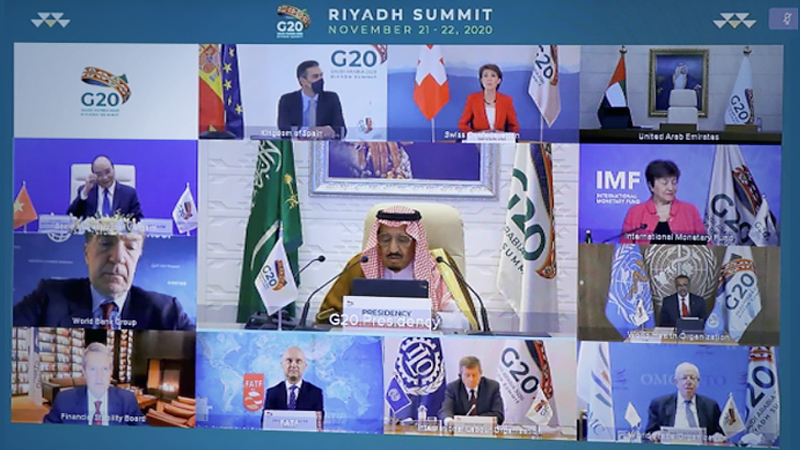
By The Washington Post · Miriam Berger · BUSINESS, WORLD, HEALTH, US-GLOBAL-MARKETS, MIDDLE-EAST BEIRUT – Leaders from the Group of 20 nations urged for greater global cooperation Saturday to ensure coronavirus vaccines reach beyond the wealthiest regions, drawing clear contrasts with the Trump administration’s break with the World Health Organization.
The comments also struck at questions over whether U.S.-made vaccines would become widely available beyond commercial deals once President-elect Joe Biden takes office and possibly restores ties with the WHO – even as the United States struggles with the world’s highest death toll from the coronavirus.
With leaders connecting by video link – and Saudi Arabia as the host – attention quickly turned to vaccines as promising results from U.S.-based labs Pfizer and Moderna raise hopes of additional weapons soon against the pandemic, with China and Russia already planning expansion beyond trials of their vaccines.
In brief comments to the group, President Donald Trump said the United States has “marshaled every resource” against the coronavirus and noted the “record-setting speed” to develop vaccines and other therapies, according to a White House summary of the remarks.
He made no pledges, however, on expanding the availability of U.S. vaccines.
Chinese President Xi Jinping China was “willing to strengthen cooperation” with other countries to accelerate vaccine development and distribution.
“We will fulfill our commitments, offer help and support to other developing countries, and work hard to make vaccines a public good that citizens of all countries can use and can afford,” Xi said.
China has opened trials for several state-backed vaccines in nations from Southeast Asia to Latin America. It also has become a leading backer of international vaccine collaborations such as Covax, a WHO-linked effort to expand vaccine distribution in the developing world. Trump had refused to join Covax as his administration pulls away from the United Nation’s public health agency.
Pfizer and Moderna have focused on eventual domestic distribution under the Trump administration’s Operation Warp Speed program. The European Union and other wealthy allies have cut separate deals for supplies of vaccines from Moderna and Pfizer, which has teamed up with Germany-based BioNTech.
Russian President Vladimir Putin said his country is ready to share its vaccines for “humanitarian considerations,” warning that the pandemic is battering the global economy and raising risks of “mass, long-term unemployment and the accompanying rise in poverty and social dislocation.”
“And the role of the G-20 is to ensure this doesn’t happen,” said Putin, according to the Kremlin translation of his remarks.
Turkey’s President, Recep Tayyip Erdogan, told the meeting that the G-20 should endorse “affordable and fair distribution of covid-19 vaccine for everyone.” Similar messages were shared by Canadian Prime Minister Justin Trudeau and South African President Cyril Ramaphosa, who said all nations should have “equitable and affordable access” to a vaccine.
Expectations remain low that the two-day summit will produce significant results in its toned-down setting for issues such as global economic crises and climate change. Members are expected to finalize a framework for providing poorer nations with debt relief and vaccine initiatives such as Covax.
The gathering brought backlash from Saudi and international human rights groups – as well as some U.S. and European lawmakers – calling on world leaders to boycott or downgrade their representation over the kingdom’s abuses, including jailings of female activists and the killing of Washington Post contributor Jamal Khashoggi at the Saudi Consulate in Istanbul in 2018.
For Trump, the meetings marked another closing lap on the world stage before handing power to the Biden administration in January.After attending some of the virtual summit from the White House, Trump left to go golfing.
In his opening remarks, Saudi Arabia’s King Salman spoke to a screen of international leaders, including Trump, and highlighted the economic support G-20 members had contributed to combating the coronavirus pandemic and economic fallout. He urged the G-20 to forge a collective path forward.
“In the near future, we must address the vulnerabilities exposed by covid-19 by working to protect lives and livelihoods,” said the 84-year-old monarch, who spoke slowly in a raspy voice.
To the king’s right was Crown Prince Mohammed bin Salman, the kingdom’s de facto ruler, who has sought to reform Saudi’s economy and society alongside a years-long crackdown on dissent that has brought him increased scrutiny and criticism.
Saudi Arabia had hoped for an in-person Riyadh summit, but in September announced it would be held virtually because of the coronavirus.
It was initially unclear whether Trump would attend, but he announced Friday he would.
In a statement Friday, European Commission President Ursula von der Leyen said she planned to push members to continue to provide pandemic-related economic support until recovery from the virus is certain.
She also expressed hope that the United States’ “new President-elect” Joe Biden will “increase multilateral cooperation” in areas such as health and climate change, noting that until now “the United States has resisted engaging,” in a rebuke of Trump’s isolationist policies.
On Friday, U.N. Secretary General António Guterres said that $28 billion remains needed to fund the manufacturing and distribution of coronavirus vaccines. While G-20 members previously agreed to suspend debt payments for the world’s poorest nations through mid-2021, he also urged them to extend relief until the year’s end so that governments could prioritize tackling the virus and economic fallouts.
Italy, who takes over the presidency next in 2021, has said debt relief for Africa will be among its priorities.
The Group of 20 nations, who produce about 85% of global economic output, include countries with among the highest coronavirus cases, led by the United States.
Trump is one of three leaders attending the summit who have had confirmed cases of the coronavirus, along with British Prime Minister Boris Johnson and Brazilian President Jair Bolsonaro.Johnson, who in April required intensive care after catching the virus, is in quarantine after recent exposure to someone who tested positive for the virus.
The Electricity Generating Authority of Thailand (Egat) is expected to invite bids for procurement and import of liquefied natural gas (LNG) in the first quarter of next year, the deputy governor for fuel, Ranee Kositvanich, said.
The state authority plans imports not exceeding 1.9 million tonnes of LNG next year and 1.8 million tonnes in 2022 and 2023.
The Energy Policy Administration Committee chaired by Energy Minister Supattanapong Punmeechaow on November 11 acknowledged Egat’s LNG procurement plan for 2021-23. The LNG will be used to generate power at its power plants in Chacheongsao, Samut Prakarn and Ayutthaya provinces.
Earlier, the Energy Ministry said that Egat needs to wait for the National Energy Policy Committee to approve the country’s plan to restructure the natural gas sector’s competition first before the state agency can go ahead with the plan to import LNG during 2021-23. The LNG competition plan is expected to get clearer early next year.
Kasikorn Securities has advised investors to follow Thailand’s export data in October, the Covid-19 outbreak and the political situation in Thailand and US as factors that would affect the Stock Exchange of Thailand (SET) Index next week.
An analyst at Kasikorn Securities predicted the SET Index’s support line at between 1,375 and 1,360, and resistance line at between 1,400 and 1,420.
Among international economic data, he advised following the US third-quarter gross domestic product (GDP), the minutes of the US Federal Reserve, the US new homes and durable goods sales, US personal income and spending in October, US and the euro zone composite purchase managers index in November and China’s industrial profit in October.
The SET Index closed at 1,389.34, up 3.18 per cent from the previous week, while average daily transaction was Bt81.68 billion, down 25.88 per cent from the previous week.
The Market for Alternative Investment rose by 1.48 per cent, closing at 320.99.
Thai stock indices closed in positive territory over an improvement in the country’s third-quarter GDP, positive news in the development of a Covid-19 vaccine, S&P Global Ratings’ move to maintain the country’s credibility, Bank of Thailand’s lenient currency supervision measures, and foreign investors’ mass buy-ups of Thai stocks.
GSB to offer auto-title loans via Sawad’s Fast Money
Nov 20. 2020
By THE NATION
The Government Savings Bank (GSB) will next year begin offering auto-title loans at low interest of 18 per cent under a joint investment with Srisawad Corporation (Sawad), said bank president Vitai Ratanakorn.
The service will be offered through GSB’s joint investment in Fast Money, the auto-title lending arm of Sawad.
“GSB will jointly invest Bt1.5 billion with Sawad, purchasing up to 49 per cent of its shares. This will help bring down the company’s current interest rate for auto-title loans from 24 per cent to 18 per cent,” he said.
GSB began seeking a joint investor in the auto-title loan business in July, in line with the bank’s strategic expansion plan. Eight companies in the non-banking sector reportedly submitted proposals and Sawad’s Fast Money eventually won the contract.
“Sawad has more than 40 years of experience in the auto-title loan business with a nationwide network of branches and an online platform for money transactions,” said Thida Kaewbootta, investor relations officer at Srisawad Corp.
“The joint investment will benefit Sawad’s business operations by expanding its customer base, while also promoting the government’s policy of financial institutes maximising access to loans for the public.”
“In the early phase of the service, which will be available in early 2021, we will target individual customers by providing loans through over 5,000 branches of Sawad and 1,060 branches of GSB,” she added.
By Syndication Washington Post, Bloomberg · Katherine Greifeld, Claire Ballentine · BUSINESS, US-GLOBAL-MARKETS
The S&P 500 Index extended a weekly decline as traders weighed a conflict between the White House and Federal Reserve over emergency lending programs along with assurances that the government has plenty of room to help the economy.
The benchmark equity gauge slumped in the wake of the disagreement over releasing government funds to further shore up growth, even as Treasury Secretary Steven Mnuchin said he will try to revive stimulus talks with congressional Democrats. Pfizer Inc. rose after filing for emergency approval of its Covid-19 vaccine. Gilead Sciences Inc. fell after authorities advised against using its remdesivir drug to treat Covid-19.
The Stoxx Europe 600 index posted its third week of gains – the best streak since July – amid a rotation into economically sensitive sectors. Mining and energy firms led the gauge higher Friday.
Global stocks hit a record Monday, but have eased off the highs in a choppy week of trading, with investors now trying to look beyond the rare show of discord between Mnuchin and Fed Chair Jerome Powell that erupted amid a resurgence of virus cases and with months to go before a vaccine is widely available. The S&P 500 was set for a 0.7% weekly decline.
“This public spat between the Fed and the Treasury is not a very good sign for the markets,” said John Praveen, managing director at QMA. “It kind of casts a shadow on market confidence.”
Mnuchin said lawmakers should redirect unspent stimulus funding, including money he’s pulling back from the Fed. But the Fed pushed back, saying the programs served a vital role.
In other markets, Asian equities climbed. Precious metals gained. Bitcoin advanced past $18,500.
These are the main moves in markets:
– – –
– The S&P 500 index fell 0.4% as of 3:41 p.m. in New York.
– The Stoxx Europe 600 index gained 0.5%.
– The MSCI Asia Pacific Index rose 0.5%.
– The MSCI Emerging Market Index advanced 0.7%.
– – –
– The Bloomberg Dollar Spot Index rose less than 0.1%.
– The euro slipped 0.2% to $1.1857.
– The pound rose 0.2% to $1.3281.
– The yen slipped 0.1% to 103.83 per dollar.
– – –
– The yield on 10-year Treasuries was little changed at 0.83%.
– Germany’s 10-year yield dipped one basis point to -0.585%.
– The U.K.’s 10-year yield fell two basis points to 0.3%.
– – –
– West Texas Intermediate crude rose 1% to $42.15 a barrel.
By Syndication The Washington Post, Bloomberg · Andres Guerra Luz
Oil is poised for a third weekly gain with positive covid-19 vaccine developments paving the way for a more sustained recovery in oil demand.
Futures are up 4% this week in New York with Pfizer and BioNTech planning to request emergency authorization of their covid vaccine later Friday. Moderna has also released positive interim results from a final-stage trial and has said it’s close to seeking emergency authorization.
Despite a strong week, prices traded little changed Friday as investors assessed the impact of a dispute between the White House and the Federal Reserve over emergency lending programs.
“The oil market continues to hold up well with optimism generated with the progress of covid-19 vaccines,” said Harry Tchilinguirian, head of commodity-markets strategy at BNP Paribas SA. “At the same time, we should also be getting the results from AstraZeneca and the University of Oxford soon, and if similar to those of Pfizer and Moderna, this means that the light at the end of the tunnel is going to burn a little brighter and risk assets like oil can continue to ascend.”
Even with vaccines on the horizon, a recovery in oil demand faces obstacles with governments under pressure to tighten restrictions and curb the spread of the virus. Americans are being urged not to travel for Thanksgiving, and European road use is once again depressed because of lockdowns.
As prices push toward the top of a range they’ve held for months, many of the biggest moves have been in timespreads — the difference in price between futures contracts. On Friday, the closely watched spread between December 2021 and 2022 West Texas Intermediate crude contracts is close to flipping into backwardation.
Pfizer and BioNTech’s vaccine could be the first to be cleared for use, but first it must undergo a thorough vetting. The filing could enable its use by the middle to the end of December, the companies said in a statement. Yet, it could take at least three weeks for a U.S. Food and Drug Administration decision.
Uncertainty over a recovery in the oil market will be one of the challenges for the Organization of Petroleum Exporting Countries and its allies when they meet in less than two weeks to discuss whether to add crude oil to a still-saturated market in January.
Ahead of the OPEC+ meeting, which could see a possible extension of the current output cuts by three-to-six months, a buying spree by Asian refiners is complicating the outlook amid surging production from countries such as Libya. Crude stockpiles in China have fallen in five out of the past seven weeks, according to data from Ursa Space Systems.
The Thai National Shippers’ Council predicts the export sector will grow between 3 and 5 per cent next year, vice chairman Visit Limluecha said on Friday.
He said the council expects the sector to show strong growth in the first half of 2021, and has also forecast a lower contraction in exports during the fourth quarter of this year.
The export of food, IT products, vehicles and medical equipment will continue to expand in the fourth quarter this year.
The council said the export sector is not expected to drop more than 7 per cent this year.
Meanwhile, gem and jewellery exports during the first nine months this year rose 23.72 per cent to US$16.130 billion, according to the Gem and Jewelry Institute of Thailand (Public Organisation).
Excluding gold, exports over the same period fell 46.45 per cent to US$3.360 billion.
Exports of gold alone grew 88.85 per cent to US$12.769 billion.
BOT’s move to rein in rising baht not working: experts
EconNov 21. 2020Kobsidthi Silpachai, Kasikornbank’s head of capital markets research, says monetary policy will not be effective in curbing the baht’s rise.
By The Nation
Analysts are sceptical about the central bank’s latest measures to curb the rising baht, despite praise for the move from business quarters.
The Bank of Thailand (BOT) on Friday announced measures to encourage capital outflow in order to restrain rapid appreciation of the baht.
However, foreign funds continued to flow into the Thai stock exchange on Friday, with foreign investors making net buys of Bt2.38 billion.
“It seems that the market is not reacting, the measures seem to be more of the same old thing,” Kobsidthi Silpachai, head of capital markets research at Kasikornbank, told The Nation.
Though the central bank was encouraging capital outflows, it had not imposed “scary” measures like Tobin tax [on currency conversions], he said.
Thus he was pessimistic the measures would slow down the baht’s rise.
“The fundamentals have not changed: our current account will remain in surplus,” he said.
While the new measures may address the “symptoms”, they would not cure the underlying cause of the strong baht – an imbalanced economy, he argued.
After years of relying on monetary measures, it was time to try fiscal measures like tax reform, he added.
He was also sceptical of the BOT’s recent move to loosen restrictions on foreign currency deposit accounts. Focusing on foreign capital flows might not be effective, as exporters need to convert their US dollar revenue to baht for working capital, he said.
The measure risked upsetting long-term inflation management by spurring outflow of capital and indirectly discouraging investment in Thailand, which would dampen future economic activity and inflation, he warned.
He suggested that if authorities really want the baht to weaken, they need to rebalance the economy. This is where tax reforms comes in, because high taxes, high household debt and a strong baht are all related.
“Excise tax on imported goods is high, suppressing imports and forcing the current account surplus even higher, which leads to a strong baht,” he said.
US President Donald Trump has proven that cutting taxes actually boosts tax revenue, because the tax base increases, Kobsidthi added.
Naris Sathapholdecha, executive director at TMB Analytics, shares a similar view, saying that foreign investors were undeterred by the latest measures as they still bought short-term bonds worth US$700 million in Friday’s intra-day trading.
He suggested that to rein in the baht, the central bank should reduce its issuance of short-term bonds. The BOT could also raise costs for foreign investors investing in Thai stocks and bonds by stipulating they must buy insurance against baht exchange rate risk.
He predicted a slight short-term weakening of the baht due to two factors outside Thailand. First, while the more trade-friendly Joe Biden had wo the US presidential election, his Democrat Party had not won a majority in the Senate. Second, a Covid-19 vaccine may not be available as soon as expected. Therefore, investors may sell Thai assets.
The baht would stay at around Bt30.50 per dollar and is unlikely to strengthen beyond Bt30, Naris added.
Meanwhile, Kriengkrai Thiennukul, vice chairman of the Federation of Thai Industries, expressed support for the BOT’s moves.
“The action of the central bank will prevent a rapid rise beyond the Bt30/dollar level. Doing nothing would have seen the baht appreciate further, making Thai exports even less competitive,” he said.
The baht’s rise would also benefit Thai investors seeking to acquire businesses in Europe, where many companies are expected to go bankrupt amid the second wave of Covid-19. But foreign businesses could yield high returns when the pandemic eases.
He also predicted the baht would remain strong for the foreseeable future since the Biden presidency will inject more money into US economy.







 Kobsidthi Silpachai, Kasikornbank’s head of capital markets research, says monetary policy will not be effective in curbing the baht’s rise.

