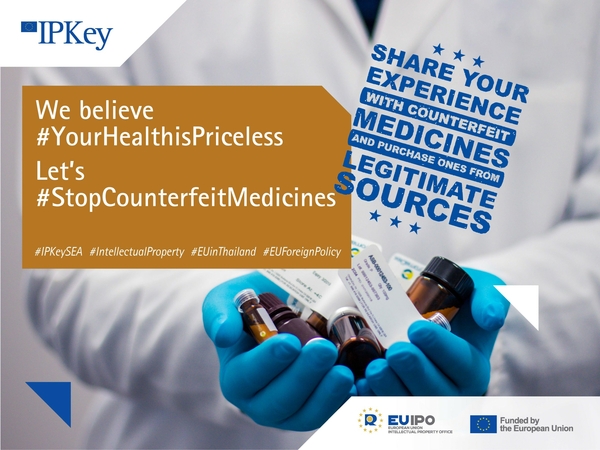
IP Key SEA has revealed that counterfeit pharmaceuticals pose the greatest potential harm to the health of consumers
Oct 02. 2020
By The Nation
Research shows that counterfeit medicine cannot cure illnesses and can cause more harm to your health. Counterfeit medicines have been in the market for a long time, and without sufficient awareness, consumption of these substances can lead to unexpected symptoms, permanent disabilities, and even loss of life.
The EU-funded project IP Key South-East Asia (SEA) believes that #YourHealthisPriceless. So today, we are launching an online campaign to raise awareness of the harms that counterfeit pharmaceutical and healthcare products can cause. The campaign is also a call for the public to share their experiences with counterfeit medicines on social media.
“#YourHealthIsPriceless campaign emphasizes the EU mission through IP Key SEA project in raising awareness on IP rights on social media. We also believe that the stories shared will help envisage the current situation and encourage customers to be fully aware of the product’s authenticity and buy from legitimate sources,” said Tiago Guerreiro, IP Key SEA Project Leader.
The threat to national public health
Counterfeit medicines are medicines that do not comply with intellectual property law. In the vast majority of cases (90%), they can be harmful to a patient’s health according to a study recently released by the European Union Intellectual Property Office (EUIPO) and the Organisation for Economic Cooperation and Development (OECD) on ‘Trade in Counterfeit Pharmaceutical Products’. The World Health Organization (WHO) also reported in the 2017 report ‘WHO Global Surveillance and Monitoring System for Substandard and Falsified Medical Products’ that an estimated number of children may die from pneumonia each year after consuming counterfeit medicines is between 72,000 and 169,000.
The products in the sector include antibiotics, painkillers, and medicines for diabetes, central nervous system, heart disease, cancer malaria, and HIV/AIDS, among others. The sector also covers lifestyle drugs and medicines for an esthetical purpose, ranging from beauty injections to skincare, although some of these products are classified as food supplements or cosmetics in some countries. Consumers can be tricked by logo and packaging of counterfeit products designed to imitate authentic ones, promotions and lower prices offered by unauthorized sellers, or popularity of certain products among peers. They may become vulnerable to the adverse effects that medicines from illegitimate sources bring to their health and the possible failure to treat or prevent diseases.
Although a global problem, the proliferation of counterfeit medicines in South-East Asia is a particularly serious concern. A 2019 study by the United Nations Office on Drugs and Crime (UNODC) on Transnational Organized Crime in South-East Asia identifies a number of SEA countries, including Thailand, where counterfeit pharmaceutical and healthcare products originate from. The country has also been identified as a significant transit point for such products, and a country usually linked to counterfeiting or diversion of medicines alongside the Philippines, Indonesia, and Vietnam during 2013-2017.
“The harmful effects of counterfeit pharmaceutical products bring intellectual property (IP) closer than ever to the course of our daily lives. They show that the strong enforcement of IP rights protection–including the protection of trade mark, patent, and industrial design–can greatly contribute to consumers’ well-being and public health”, shared Tiago Guerreiro.
The threat to international trade and legal supply chains
Cross-border trafficking of counterfeit pharmaceutical products occurs with more ease in the digital age, where e-commerce and logistics have increased access to. Globalization makes it possible for second-tier distributors to sell their fake products globally; that is, they do not have to be produced in the market of distribution as they can be shipped from anywhere.
Global trade in counterfeit pharmaceutical products accounts for EUR 11.87 billion, representing more than 3.3% of total global trade in the pharmaceutical sector, according to the 2016 OECD study. It remains to be a challenge for IP and government officials to detect fake products and enforce IPRs protection measures, hence the need for local consumers to be careful when being approached by unauthorized sellers.
“The EU is supporting Thailand and ASEAN regional approach and initiatives for combatting substandard and falsified medicines. Harmonized pan-ASEAN safety and control measures allowing easier identification of counterfeit medicines, and improving verification and controls at borders, as well as a system enabling patients to identify legally operating online pharmacies, would certainly help limiting the commerce of these dangerous products”, stated Laurent Laurdais, Counsellor at the EU Delegation to Thailand.
Purchase genuine products from verified or verified and legitimate distributors and join the campaign by sharing your experiences with counterfeit pharmaceutical products alongside a description, photo, or video, include the hashtag #YourHealthIsPriceless and mention @IPKey_EU Twitter account or IP Key Facebook page.
ABOUT IP KEY SOUTH-EAST ASIA:
#YourHealthisPriceless campaign is an initiative of the IP Key South-East Asia (IP Key SEA), a four-year EUR 7 million programme funded by the European Union and implemented by the EUIPO aimed at supporting IP rights protection and enforcement across Southeast Asia, with a view to creating the appropriate legal and economic environment conducive to trade and investment in the region. By contributing to the enhancement of IP frameworks and implementation of best practices, IP Key SEA aims to ensure a level playing field for both local enterprises and EU stakeholders. IP Key SEA is one of three EU-funded programmes dedicated to IP that are being implemented by the EUIPO, together with IP Key China and IP Key Latin America.
ABOUT THE EUIPO:
The European Union Intellectual Property Office (EUIPO) is an agency of the EU, based in Alicante, Spain. It manages the registration of the European Union trade mark (EUTM) and the Registered Community Design (RCD), both of which provide protection in all 28 EU member states, as well as carrying out cooperation activities with the national and regional intellectual property offices of the EU. Under the goals of its Strategic Plan 2020, the EUIPO, in cooperation with national and regional EU IP offices, aims to promote global cooperation on IP between EU partners, third countries and multilateral organisations.
Thai Airways International Pcl (THAI) is offering a new economy plus class for passengers’ “superior comfort and to promote social distancing practice” amid the outbreak situation.
Wiwat Piyawiroj, THAI executive vice president of Commercial, said they would be available for booking from now until December on flights from Bangkok to London and Bangkok to Frankfurt. The flights will start from October 25.
Wiwat added that the new economy-plus class is the first four rows of the economy seats, featuring spaced out seats (middle seats are left empty) and special services such as express check-in, extra luggage weight of 5kg, same in-flight meal as business class, and free use of THAI special lounge at Suvarnabhumi Airport (terms and conditions apply.)
“THAI has also employed strict health measures in flights and at boarding areas to ensure the safety of all passengers and staff from Covid-19,” added Wiwat.
To reserve a flight, visit thaiairways.com or call THAI Contact Center 0-2356-1111 (between 8am-8pm).
Debt-laden Thai Airways International (THAI) is aiming to franchise its dough-fritters operation as business soars at the snack stall it opened in Bangkok.
THAI began frying up the dough sticks, or “pa tong go”, in front of company headquarters on Silom Road last month, attracting long queues of customers from 5am every day.
To meet demand, staff have increased production from 200 to 1,000 portions per day and are generating revenue of about Bt10 million per month.
A portion of three fritters with condensed milk costs Bt30 – or an extra Bt20 with taro custard.
THAI acting president Chansin Treenuchagron said the company is now considering franchising the snack stall to meet demand.
The franchise plan is the latest effort to find new revenue sources after the THAI fleet was grounded by Covid-19 travel restrictions and the company began restructuring about Bt350 billion of debt last month.
The airline has also opened a restaurant at its head office on Vibhavadi Rangsit Road and opened its flight simulators to the public.
Meanwhile there are now seven outlets selling THAI’s dough fritters – five in Bangkok and two in Chiang Mai:
1. Puff and Pie outlet at Ortorkor Market in Bangkok every Friday, Saturday and Sunday
2. Puff and Pie outlet at THAI head office on Vibhavadi Rangsit Road in Bangkok every Monday, Wednesday, Thursday and Friday
3. Puff and Pie outlet at the Rak Khun Thao Fa building in Bangkok every day
4. THAI Catering restaurant at Bangkok’s Don Mueang Airport on Tuesdays and Thursdays
5. THAI headquarters on Silom Road Monday to Friday
6. Puff and Pie outlet on Phra Pokklao Road, Chiang Mai every Monday, Wednesday and Friday
7. Puff and Pie outlet on Suthep Road, Chiang Mai every Thursday
Energy company Banpu told the Securities and Exchange Commission on Friday that its subsidiary BKV Corporation has completed the acquisition of a US natural gas company for US$570 million.
BKV Corp was able to deduct $80.2 million, which accounted for the US company’s adjustment in income and other expenses since September 1, 2019, from the investment value and has paid a deposit of $170 million.
The remaining $319.8 million or Bt10.1 billion will be paid later this month.
This acquisition will help Banpu boost its natural gas production capacity in the US, while it will be able to realise cash flow from the US firm’s operation since September 1, 2019 immediately.
The acquired firm operates in the Barnett Shale area in Texas.