Resumption of tourism between China and Thailand ‘not happening any time soon’
EconSep 07. 2020Yang Xin, minister counsellor and deputy chief of mission at the Embassy of the People’s Republic of China to Thailand
By The Nation
A senior official of the Chinese embassy in Bangkok has ruled out early reopening of tourism between China and Thailand, as the two countries are not ready to open the sector.
China has been recently reopening for domestic tourism, but has not yet welcomed foreign tourists, or urged Chinese people to travel abroad, said Yang Xin, minister counsellor and deputy chief of mission at the Embassy of the People’s Republic of China to Thailand.
Even Chinese tourists want to visit Thailand, but Thailand is unlikely to open for foreign tourists, he said in an exclusive interview to Nation Multimedia Group.
The Thai government has not yet reopened the tourism sector, as it was still worried about potential import of new Covid-19 cases. The government only plans to allow first 200 long-stay tourists to enter the country next month. About 10 million Chinese tourists visited Thailand annually in recent years out of some 40 million every year.
Yang said that China was currently reopening travel for business persons who could apply for fast lane clearance when they enter China for doing business. Foreign business persons are not subject to 14-day quarantine but they can visit only limited places essential for their business activities.
He said the Chinese government has managed to control the Covid-19 outbreak and now schools nationwide have been reopened after they were closed for eight months.
China this year has not set a target for economic growth but would focus on job creation and people’s living standards, he said.
The government has implemented many stimulus packages to support people and businesses especially small and medium-sized enterprises, said Yang.
Regarding Hong Kong, Yang said that the special administrative region had returned to stability following the enforcing of the security law. He reiterated that China wants to maintain the one country, two systems principle, but foreign interference was trying to create a two-country system.
Brokerage firms in stock and futures exchange markets have urged the Securities and Exchange Commission (SEC) to cut trading fees in the capital market to help their businesses.
SEC held a meeting with brokerage firms’ top management in the stocks and futures exchange markets at the end of August to hear their comments on operating securities business, mitigate difficulties to increase flexibility, and set up guidelines to support business in the future.
The brokerage firms’ top management urged SEC secretary-general Ruenvadee Suwanmongkol to review trading fee calculations in the capital market because the SEC and the Stock Exchange of Thailand (SET)’s trading fees are currently high, increasing the cost burden for securities businesses.
“We believe that they want the SEC to cut trading fees when investors make transactions in stock and futures exchange markets as trading fees are currently high compared to commission fees that have continued to drop, resulting in losses for brokerage firms even though the trading volume is likely to rise,” Ruenvadee said.
“If we cut trading fees, it would alleviate the burden for brokerage firms and boost their performance, while it would encourage them to provide knowledge to investors.”
She added that high trading fees could also be due to brokerage firms having to pay fees to both the SEC and SET.
Meanwhile, Somchai Kanjanapetcharat, KGI Securities (Thailand)’s senior managing director of retail equity business, said the SEC would change trading fee collection in the Thailand Futures Exchange market to monthly payment, while earlier the SEC collected fees when investors made transactions. He added that trading fees from transactions in the stock market would be collected when investors made transactions as before.
“We believe that the SEC move would increase the cost for brokerage firms because the firms would increase commission fees to be in line with the rise in trading fees,” he said.
“If possible, we would like the SEC to cut trading fees because brokerage firms are currently bearing a lot of expenses.”
U.S. real estate pain leaves foreign investors holding the bag
Sep 05. 2020Hudson Yards stands without visitors in New York on Wednesday, 8, 2020. MUST CREDIT: Bloomberg photo by Jeenah Moon. Photo by: Jeenah Moon — Bloomberg Location: New York, United States
By Syndication The Washington Post, Bloomberg · Patrick Clark
Foreign investors who backed real estate projects in return for U.S. visas are emerging as losers in the pandemic-driven commercial property crisis.
In Manhattan, Chinese investors who helped fund Related’s Hudson Yards have called for arbitration to pressure the developer into returning their money. On Long Island, a separate group assumed the lease to the Nassau Coliseum, after billionaire Mikhail Prokhorov’s Onexim Sports and Entertainment decided to walk away from the project.
The investors, who backed development deals through the U.S. Citizenship and Immigration Services’ EB-5 program, aren’t the only ones getting hammered by the Covid-19 pandemic, which has kept mall-goers, hotel guests and office workers home, pushing commercial-property owners into delinquency. But EB-5 investors, who cared more about coming to the U.S. than financial returns, have less leverage than most.
“Cash is king during Covid, and developers are reluctant to let go of any cash,” said Mona Shah, a New York lawyer who works on EB-5 deals. “It doesn’t help that there are some developers who show distinct lack of respect for EB-5 money. It’s easy money.”
Shah said she represents a hotel developer who is looking to reduce the principal owed on an EB-5 loan, because the property closed due to the pandemic and is unlikely to return to profitability quickly. In other cases, developers are seeking to extend loan terms or withhold payments entirely, Shah said.
At Hudson Yards, roughly 2,000 EB-5 investors poured $1 billion into the Manhattan project through a series of deals, according to a demand for arbitration filed recently by Chicago lawyer Doug Litowitz. The investors were unsophisticated about U.S. real estate, according to Litowitz, and were told by the Chinese firm that helped Related raise money that they would be repaid following approval of their work visas, known as green cards.
But the funding was structured as a preferred equity investment, not a loan, and there was no fixed timetable for returning the money. After Neiman Marcus Group, the luxury retailer that was the anchor of the upscale mall at Hudson Yards, declared for bankruptcy, Litowitz asked Related to tell his clients when they could expect to get their money out of the project. He also asked the developer to open its books so his clients could determine whether the pandemic had diminished the value of their investment.
“The Related deal is interesting because the terms given to the Chinese are so bad that it’s almost like a test case for how bad a structure can be and still be legal,” said Litowitz, whose brother Alec is the CEO of hedge fund Magnetar Capital. “Dostoyevsky said, ‘If murder is allowed, everything is allowed.’ That’s how I feel about this case.”
Related has been unmoved by those requests.
“Financial investment returns are a function of the market economy and obviously this is a challenging time,” related spokesman Jon Weinstein said in an email. “We were off to a good start, but now we need to be patient.”
EB-5 was a sleepy program until the 2007-2008 financial crisis, when developers like Related looked overseas to replace traditional financing sources. They found a bonanza: foreign investors who viewed U.S. real estate as a safe asset and were principally concerned with obtaining visas, meaning they were willing to accept returns as low as 1% and sometimes less.
The program, which provided visas to foreign investors who sank at least $500,000 into U.S. projects that created at least 10 jobs, was meant to promote investment in rural areas, as well as urban locales with high unemployment. But gerrymandered districts allowed EB-5 funding to flow to developments like Hudson Yards and an Extell Development tower on Manhattan’s Billionaire’s Row.
Roughly $36 billion in EB-5 capital flowed into the U.S. from 2010 to 2019, according to estimates from Invest In the USA, a trade group, though the program has become less popular as the backlog of applications grew and the investment threshold increased.
The program attracted scrutiny when Kushner Cos., the developer formerly run by Jared Kushner, who is President Donald Trump’s son-in-law, sought EB-5 funds from Chinese investors.
It also gained a reputation as a Wild West, rife with false promises and conflicts of interest. Theoretically, lending money to big projects should have been more solid, but even marquee developers haven’t been shielded from the pandemic.
As Covid-19 cases surged through the New York City area this spring, Prokhorov’s Onexim canceled sporting events and concerts at the Nassau Coliseum. By June, the company decided that the pandemic had made the events business unappealing, and signaled its intention to hand the arena lease over to lenders.
On Aug. 20, Nassau County announced a deal with the U.S. Immigration Fund, which funneled EB-5 capital into renovations at the arena. As part of the agreement, an affiliate of the EB-5 group assumed the lease, promising to operate the building so the National Hockey League’s New York Islanders could eventually return to the ice.
Maureen Hanlon, CEO of Nassau Events Center, which had operated the building for Onexim, said she was sorry to abandon the arena, but happy to reach an agreement that allows “the county to receive its rent and, most importantly, for the fans to have a functioning arena as soon as health guidelines allow.”
Gary Friedland, who has studied the program as a scholar-in-residence at New York University’s Stern School of Business, expects that because of the pandemic and the way the loans are structured, many EB-5 investors won’t be repaid.
“Many of these EB-5 loans were made when the market was much stronger,” said Friedland. “With the market downturn, many of these loans are very vulnerable.”
By The Washington Post · Jeanne Whalen · NATIONAL, BUSINESS, WORLD, TECHNOLOGY, POLITICS, ASIA-PACIFIC WASHINGTON – The Trump administration is considering adding China’s largest semiconductor manufacturer to a trade blacklist, in another sign of heightening U.S.-China technology tensions.
The Defense Department said it is working with other agencies to determine whether the “actions” of Semiconductor Manufacturing International Corporation, or SMIC, warrant adding the company to the so-called Entity List, which would block U.S. companies from selling SMIC technology without a license.
“Such an action would ensure that all exports to SMIC would undergo a more comprehensive review,” Pentagon spokeswoman Sue Gough said by email Saturday, confirming an earlier report by Reuters.
Gough declined to comment on the reasons for the review. The Pentagon in the past has warned that China’s efforts to develop corporate strength in technologies including semiconductors would be likely to benefit the People’s Liberation Army.
A report last month by SOS International, a defense contractor in Reston, Va., said that SMIC has a variety of ties to China’s defense sector, including an ongoing relationship with CETC, a state-owned developer of military electronics. SMIC has helped CETC test new manufacturing technologies, and has used CETC technologies in its own manufacturing, according to the report, details of which were earlier reported by The Wall Street Journal. SOS also said Chinese military researchers have disclosed in research papers using SMIC technology to manufacture chips.
SMIC officials didn’t respond immediately to a request for comment.
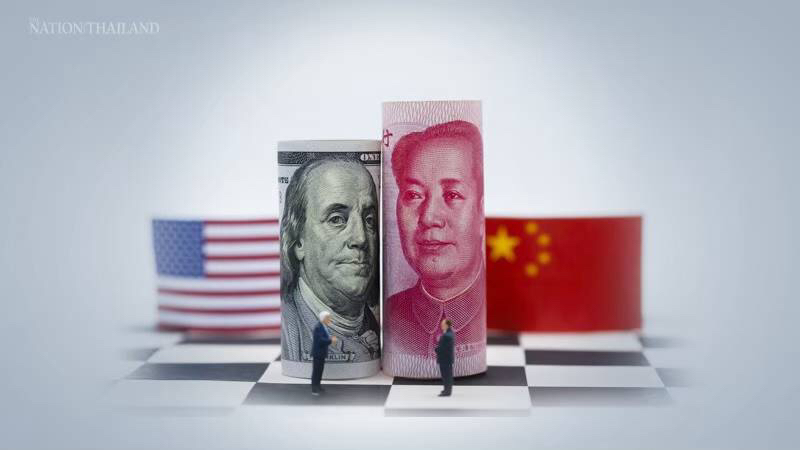
The Entity List, overseen by the Commerce Department, has become a favorite Trump administration tool to crack down on China and now includes more than 300 Chinese entities.
The Trump administration has previously used it against Chinese telecom company Huawei, against entities engaged in alleged human rights violations in China’s Xinjiang region, and most recently against Chinese companies allegedly involved in building controversial islands in the South China Sea.
Founded in 2000 in Shanghai, SMIC ranks among the top five semiconductor manufacturers in the world, according to a report from the United States International Trade Commission, or USITC.
Industry experts say SMIC’s technology lags behind that of chip manufacturers in Taiwan and the United States, but Beijing is pouring billions into the industry to help SMIC and other Chinese companies catch up.
SMIC has enjoyed generous government financial support, including low-interest loans, tax breaks and investments to help build manufacturing facilities, the Organization for Economic Cooperation and Development in Paris said in a report last year.
Western industry experts say that China’s semiconductor companies, while growing, are still reliant on some U.S. technology, including software and manufacturing equipment needed to make chips.
SMIC started as a private company, but state ownership has steadily grown over time, to more than 45% of SMIC stock as of 2018, according to the OECD report.
SMIC’s shares used to trade on the New York Stock Exchange, but the company removed its stock from the NYSE last year. The shares now trade on the Shanghai and Hong Kong exchanges.
In 2018, the U.S. added a different Chinese chip maker, Fujian Jinhua Integrated Circuit Company, to the Entity List, saying it posed a “significant risk of becoming involved in activities that are contrary to the national security interests of the United States.”
Around the same time, the U.S. accused state-owned Fujian Jinhua of stealing commercial secrets from U.S. semiconductor company Micron.
A federal indictment alleged that Fujian Jinhua was part of a conspiracy to use Micron employees in Taiwan to steal sensitive data related to the design and production of so-called DRAM chips, which are used by the defense industry. The Chinese company denied the allegations.
In blacklisting the company, the Commerce Department said Fujian Jinhua’s plans to manufacture DRAM chips threatened “the long term economic viability of U.S. suppliers of these essential components of U.S. military systems.”
Surge in gold export makes up for overall slump in demand for gems and jewellery
EconSep 05. 2020Sumed Prasongpongchai, deputy director of the Gem and Jewellery Institute of Thailand (Public Organisation)
By The Nation
Thai export of gems and jewellery in the first seven months of this year rose 33.73 per cent compared to last year, bouyed by the demand for gold, Sumed Prasongpongchai, deputy director of the Gem and Jewellery Institute of Thailand (Public Organisation), said.
The export accounted for US$12.069 billion, or 9.06 per cent, of the country’s total exports.
However, excluding gold, the export of gems and jewellery during the period dropped 41.87 per cent to $2.576 billion.
Gold export in the period skyrocketed 106.72 per cent to $9.492 billion, accounting for 78.65 per cent of the total gems and jewellery exports. During the period the global demand for gold surged, as people rushed to seek the safe-haven asset during the economic crisis.
Export of silver and gold ornaments dropped 8.29 per cent and 45.18 per cent, respectively.
He added that worries of a second wave of the Covid-19 outbreak and the strengthening baht remain risk factors for gems and jewellery exports.
CP Foods opts for renewable energy to meet its emissions target
Sep 04. 2020
By THE NATIONChareon Pokphand Foods (CP Foods) is introducing renewable energy in its manufacturing facilities with the aim of achieving the target of cutting carbon dioxide emissions by 25 per cent in the next five years.
Wuthichai Sithipreedanant, senior vice president for corporate social responsibility and sustainable development, said CP Foods was applying the “circular economy” concept to minimise its negative impacts on the environment, society and economy, and maximising its positive impacts.
For instance, all waste meat will be developed into a new product, water used in shrimp farms will be recycled to ensure zero discharge into natural water resources, while renewable energy will be used to cut down on the use of electricity and petrol.
CP Foods also aims to become a coal-free operation by 2022.
Wuthichai said that with renewable energy and a balance with nature, CP Foods can realise its dream of becoming the “kitchen of the world”.
CP Group’s chairman urges private sector to help revive economy through sustainable means
Sep 03. 2020
By THE NATION
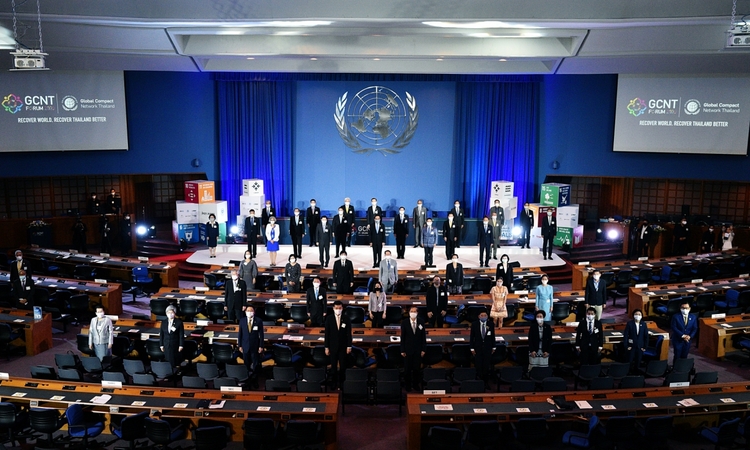
Suphachai Chearavanont, president of Global Compact Network Thailand and CEO of Charoen Pokphand Group, told the recent “GCNT Forum 2020: Thailand Business Leadership for SDGs” that the world is facing several crises at present, including Covid-19, income disparity, human rights, environmental and economic issues.
However, he said, collaborations between Thailand and the other 60 GCNT members will help realise Sustainable Development Goals (SDGs), as member companies in each country work alongside their governments, civil society organisations and the private sector.
By linking up the world’s largest sustainability network, first-hand experience and knowledge can be shared, especially in relation to responsible and sustainable operation of the private sector’s supply chain.
Suphachai said once the Covid-19 crisis is over, the private sector will play a key role in mitigating the impact of the pandemic on people’s lives and the nation’s economy.
Cooperation will be necessary to develop sustainability and improve the livelihoods of millions of people.
At this time, new graduates are finding it difficult to secure jobs. Hence, the private sector needs to participate in reviving the economy in the fallout of Covid-19 by continuing to invest and expand their businesses with a view to creating new jobs.
Suphachai added that the approach toward creating awareness among the next generation of sustainability leaders should be via action-based learning. As part of the Leadership for Sustainable Education Development (Connext Ed) learning model, 100 schools are teaching students economic discipline; creating social understanding; and understanding the environment, public health, how to plant trees and reduce toxic pollution in water systems.
Lessons on analysing problems and offering solutions will help create a next generation of responsible and sustainable adults.
The price of gold dropped by Bt100 per baht weight in morning trade on Saturday (September 5), the Gold Traders Association reported.
As of 9.32am, the buying price of a gold bar was Bt28,600 per baht weight and selling price Bt28,700, while gold ornaments were priced at Bt28,091.42 and Bt29,200, respectively.
At close on Friday (September 4), the buying price of a gold bar was Bt28,700 per baht weight and selling price Bt28,800 while gold ornaments were priced at Bt28,182.44 and Bt29,300, respectively.
The Comex (Commodity Exchange) gold price to be delivered in December dropped by US$3.5, or 0.18 per cent, closing at $1,934.3 (Bt60,736.36) per ounce on Friday. The price dropped by 2.1 per cent this week.
Gold closed in negative territory due to mass sell-offs of the precious metal after the US showed strong nonfarm payrolls.
By Syndication Washington Post, Bloomberg · Claire Ballentine, Vildana Hajric · BUSINESS
U.S. stocks bounced back from a sharp sell-off but still closed at a two-week low as megacap tech shares sold off.
Losses for Amazon.com, Microsoft Corp. and Facebook Inc. pushed the tech-heavy Nasdaq 100 down more than 5% at one point, though it pared those declines to just over 1% as the day wore on and investors spotted bargains. Gains in financial shares limited losses in the S&P 500 Index, which ended the week down 2.3% at the lowest level since Aug. 21.
Treasury yields jumped while the dollar slipped. Oil fell below $40 a barrel to reach the lowest since late June.
The worst of Friday’s stock sell-off appeared to stem from concern that the recent run-up in tech shares wasn’t tied to broad investor sentiment, but instead was driven by outsize options trades from one firm. The Financial Times reported that SoftBank bought billions of dollars in tech derivatives before the rout that began Thursday.
Traders are seeking to find an appropriate valuation for tech stocks and gauge the health of the U.S. economy as the coronavirus pandemic rages on after having killed more than 180,000 Americans. While the industry is generating blockbuster profits during the stay-at-home lockdowns, there’s also evidence that highflying names have become overheated.
“It’s those crowded names that were over-owned that are being sold again,” said Dan Russo, chief market strategist at Chaikin Analytics. “It’s the lofty valuations, the stocks just were stretched.”
Elsewhere, emerging-market stocks fell for a third day. European shares slumped. Asian shares dropped, with Australia’s benchmark recording the biggest decline since May.
Here are the latest market moves:
Stocks
– The S&P 500 Index fell 0.8% at 4 p.m. EDT.
– The Nasdaq 100 Index fell 1.3%.
– The Stoxx Europe 600 Index fell 1.1%.
– The MSCI Asia Pacific Index dropped 1.2%.
Currencies
– The Bloomberg Dollar Spot Index fell 0.1%.
– The euro was little changed at $1.1847.
– The Japanese yen was little changed at 106.21 per dollar.
Bonds
– The yield on 10-year Treasurys increased eight basis points to 0.71%.
– Germany’s 10-year yield rose two basis points to -0.48%.
– Britain’s 10-year yield climbed three basis points to 0.26%.
Commodities
– West Texas Intermediate crude fell 4.5% to $39.51 a barrel.
By Syndication Washington Post, Bloomberg · Joanna Ossinger · BUSINESS
The technology sell-off was speculative excess coming off a hot market, rather than the beginning of a broader pullback.
That’s the consensus view of investors and strategists after Thursday’s 5.2% plunge in the Nasdaq 100 Index, the worst since March.
With the pandemic continuing to rage and a vaccine likely months away, bulls say there are plenty of good reasons why technology shares can be supported at current levels, despite lofty valuations.
“Yes, today was a bad day. Ripe for profit-taking, but even with the 3% to 5% drop markets are still at impressive levels,” said Larry Peruzzi, director of international trading at Mischler Financial. The monthly jobs report — a key data point amid Covid times — comes out Friday morning U.S. time and that “could restart the rally” if it’s much better than expected, he said.
Volumes and engagement might be lower ahead of the Labor Day holiday in the U.S., which will keep markets closed on Monday, he noted.
“Many market narratives have focused on the low put/call ratios on some key big-cap tech and tech index levels as a sign of complacency,” said Michael Purves, CEO of Tallbacken Capital Advisors LLC. “But while these put-call ratios reflect a bullish frenzy, Apple and Tesla being key examples, they don’t necessarily have to portend some enormous market vulnerability.”
“Under-protected trending assets can have widespread implications that can bleed over into all assets — the financial crisis of 2008 being an extreme example of this condition,” he said. “But the data suggests that put buying has been robust, just not as robust as the call buying has been.”
Stifel Nicolaus & Co.’s head of institutional equity strategy, Barry Bannister, offers a case for further gains in valuations — though he warned the path is fraught.
“The current market level is pivotal: the cyclically adjusted price-to-earnings multiple of the S&P 500 is knocking at the doorstep of the same point at which CAPE broke out in the last two years of the most powerful bull markets of the past century, the late 1920s and late 1990s,” he said.
“If CAPE does break out, the building (and inevitable bursting) of a bubble could make the market a ‘greater fool game’ challenge in the near-term and a modest return vehicle longer term,” he added. “The mega-bull case: Combinations of equity risk premium and 10-year TIPS produce much higher S&P 500 fair values.”
“When it comes to the tech sector and the other online giants that have gained so much in the last few months, there could be profit taking as we head toward the U.S. presidential election in November,” said JPMorgan Asset Management strategist Kerry Craig. “Negative headlines on potential regulatory and tax changes are likely to add to investor unease in a market with elevated valuations.
“However, this is unlikely to be a repeat of the tech wreck of the late 1990s, given how much the market and sector have changed,” he added.
“While tech sector valuations are elevated, we are also mindful of the earnings and revenue potential in the coming years from areas like cloud computing and artificial intelligence, as well as how many of these companies will benefit from the shifts in corporate attitudes toward physical workplaces,” he said.
Still, other strategists pointed to areas that continued to concern them.
“If more positive announcements regarding a viable and effective vaccine are forthcoming, as expected, selling in technology could continue as funds raised will be allocated across the sectors most closely associated with the other side of the pandemic,” said Quincy Krosby, chief market strategist at Prudential Financial Inc.
Rising volatility and correlation could trip markets, according to Olivier D’Assier, head of applied research for Asia-Pacific at Qontigo GmbH.
“There is a lot of short-term liquidity in the market now because of all the quantitative easing programs, but this liquidity has a low risk tolerance,” he said. “If volatility rises and correlation takes away their ability to construct a well-diversified portfolio, they will pull it out of equities and back into liquid, safe, Treasury bonds.”
“Our view is that this sell-off centered on tech stocks has mostly to do with buying fatigue setting in, and that it represents a spontaneous adjustment in response to how the market’s giddiness caused a heavy concentration of buying to be directed at certain popular stocks,” wrote Masanari Takada, cross-asset strategist at Nomura Holdings Inc. in a note.
“It may be that a bullish narrative built around what the post-pandemic world might look like is distorting not only stock prices, but also the earnings forecasts that supposedly justify those stock prices.”

 Yang Xin, minister counsellor and deputy chief of mission at the Embassy of the People’s Republic of China to Thailand
 Hudson Yards stands without visitors in New York on Wednesday, 8, 2020. MUST CREDIT: Bloomberg photo by Jeenah Moon. Photo by: Jeenah Moon — Bloomberg Location: New York, United States
 Sumed Prasongpongchai, deputy director of the Gem and Jewellery Institute of Thailand (Public Organisation)