Sri Trang Agro Industry stocks perform best in first half this year #ศาสตร์เกษตรดินปุ๋ย

#ศาสตร์เกษตรดินปุ๋ย : ขอบคุณแหล่งข้อมูล : หนังสือพิมพ์ The Nation.

Sri Trang Agro Industry stocks perform best in first half this year

Econ

Jul 01. 2020

By The Nation

Nine out of 19 stocks in the SET100 Index generated returns of more than 10 per cent, while 51 out of 81 stocks performed worse than expected in the first half of this year.

The stock that rose the highest was Sri Trang Agro Industry (STA), which spiked 167.5 per cent to Bt26.75 per share.

STA stocks did well after the company decided to list its subsidiary Sri Trang Gloves (STGT) in the Stock Exchange of Thailand (SET) in July.

Through the listing, STA will be able to raise approximately Bt15 billion to expand its production of rubber gloves worth about Bt11 billion, while STA will hold 50.7 per cent of STGT shares after launching initial public offerings.

Other stocks that did well were TQM Corporation (TQM) and Super Energy Corporation (SUPER), which rose by 104.55 and 66.07 per cent, respectively.

Investors were positive about these stocks as TQM’s net profits rose from Bt404 million in 2018 to Bt507 million in 2019 and Bt179 million in the first quarter of this year, while SUPER’s net profit rose from Bt1.045 billion in 2018 to Bt2.137 billion in 2019 and Bt718 million in the first quarter of this year.

Meanwhile, the stock that fell the most was that of Banpu (BANPU), which dropped 49.16 per cent to Bt6.05 per share, followed by Thai Airways International (THAI) and Minor International (MINT), which dropped by 45.99 per cent and 45.28 per cent respectively due to the Covid-19 fallout.

Sornchai Pitthayaprug, a stock analyst at Capital Nomura Securities, said BANPU’s net profits dropped due to a decline in coal prices as many countries are opting for clean energy. The coal business accounts for approximately 70 per cent of BANPU’s earnings before interest, tax, depreciation, and amortisation (EBITDA).

“In the second half of this year, coal businesses may face oversupply as many countries are aiming to cut down on the consumption of coal,” he said, adding that BANPU’s move to invest in natural gas may also result in oversupply due to the economic slowdown and the Covid-19 impact.

“However, the price of BANPU stock is likely to rise because there is always a demand for natural gas, but it also depends on the world’s economy,” he said, adding that BANPU’s net profits in the first quarter rose to Bt1.7 billion from a loss of Bt552 million in 2019 thanks to Bt3.3 billion in profits from foreign exchange.

“We expect BANPU’s second-quarter performance to drop to its lowest this year,” he added.

Meanwhile, a stock analyst at Phillip Securities expects BANPU to make a loss of about Bt3.2 billion this year.

“However, we are advising investors to buy this stock at Bt8 per share as its price to book value ratio [P/BV] was 0.6 times,” the analyst said.
State-banks’ contributions to specialised financial institutions cut to 0.125% for two years #ศาสตร์เกษตรดินปุ๋ย

#ศาสตร์เกษตรดินปุ๋ย : ขอบคุณแหล่งข้อมูล : หนังสือพิมพ์ The Nation.

State-banks’ contributions to specialised financial institutions cut to 0.125% for two years

Econ

Jul 01. 2020

By The Nation

In its meeting on Tuesday (June 30), the Cabinet approved the Finance Ministry’s proposal to cut down on state-owned banks’ contribution to specialised financial institutions’ (SFIs) development fund due to the impact the Covid-19 crisis has had on SFIs’ financial standing. 

Government spokesperson Narumon Pinyonsinwat said the Cabinet had agreed to reduce contributions to SFI development funds in order to ease the burden on state-owned banks such as the Bank for Agriculture and Agricultural Cooperatives (BAAC), the Government Savings Bank, the Government Housing Bank and the Islamic Bank of Thailand. 

Currently, these banks pay 0.25 per cent of their deposit base annually to the SFI fund. 

According to the Cabinet’s decision on Tuesday, their contribution will be reduced to 0.125 per cent for this year and next, before they return to paying 0.25 per cent in 2022. 

In its proposal, the Finance Ministry cited the impact of Covid-19 on state-run banks, and this new rate will ease their financial costs. It will also be in line with the central bank’s decision to halve commercial banks’ contribution to the Financial Institutions Development Fund. 

The Bank of Thailand and the Finance Ministry are closely monitoring bad debts in the financial system, which have the potential of rising due to the severe impact the virus has had on the country.

The banks’ contribution is designed to save taxpayers from bearing the cost of government rescue financial institutions should a crisis take place in the future as it did during the 1997 financial crisis.

Cabinet okays final version of domestic tourism campaign #ศาสตร์เกษตรดินปุ๋ย

#ศาสตร์เกษตรดินปุ๋ย : ขอบคุณแหล่งข้อมูล : หนังสือพิมพ์ The Nation.

Cabinet okays final version of domestic tourism campaign

Econ

Jun 30. 2020

By THE NATION

The Cabinet approved the amended version of the Bt22.4-billion domestic tourism campaign at its meeting on Tuesday (June 30), said deputy government spokesperson Traisulee Traisoranakul.

The campaign, which will run from July 1 to October 31, aims to bring the tourism industry back to life after it was brought to its knees by the Covid-19 outbreak.

The campaign includes a government subsidy on hotel stays totalling 5 million nights, restaurants and tourism activities as well as up to 2 million domestic air tickets.

The air ticket subsidy gives travellers a 40 per cent discount on airfare, but not exceeding Bt1,000 per seat.

The campaign also includes a Bt2,000-per-head subsidy for 1.2 million village health volunteers and medical staff at tambon hospitals for study tours.

SET lifted by signs of recovery in China, US #ศาสตร์เกษตรดินปุ๋ย

#ศาสตร์เกษตรดินปุ๋ย : ขอบคุณแหล่งข้อมูล : หนังสือพิมพ์ The Nation.

SET lifted by signs of recovery in China, US

Econ

Jun 30. 2020

By The Nation

The Stock Exchange of Thailand (SET) Index closed at 1,339.03 today (June 30), up 9.27 points or 0.70 per cent.

Total transactions amounted to Bt58.589 billion with an index high of 1,351.59 and a low of 1,339.03.

In the morning session, a stock analyst at Krungsri Securities expected the index to rebound to between 1,340 and 1,345 points in response to strong economic data emanating from the US and China, before falling back.

“The US Pending Home Sales Index in May rose by 44.3 per cent compared to the previous month, while China’s industrial profits in May rose 6 per cent year on year,” the analyst said.

“Resulting positive sentiment boosted the price of crude oil, with demand for fuel expected to increase.”

However, the analyst said the index was still pressured by uncertainty following a second wave of Covid-19 infections in the United States.

The 10 stocks with the highest trade values today were ADVANC, PTT, KBANK, CBG, KCE, AOT, CPF, CPALL, SCC, and PTTEP.

As of 4.30pm, the crude oil price had dropped by US$0.53 or 1.34 per cent to $39.17 per barrel, while gold rose by $1.40 or 0.08 per cent to $1,782.60 per ounce.

Other Asian indices were on the rise:

Japan’s Nikkei Index closed at 22,288.14, up 293.10 points, or 1.33 per cent.

China’s Shang Hai SE Composite Index closed at 2,984.67, up 23.16 points, or 0.78 per cent, while the Shenzhen SE Component Index closed at 11,992.35, up 239.99 points, or 2.04 per cent.

Hong Kong’s Hang Seng Index closed at 24,427.19, up 125.91 points, or 0.52 per cent.

South Korea’s KOSPI Index closed at 2,108.33, up 14.85 points, or 0.71 per cent.

Taiwan’s TAIEX Index closed at 11,621.24, up 78.62 points, or 0.68 per cent.

May 2020 suffered sharp contraction, but economy still sound: BOT #ศาสตร์เกษตรดินปุ๋ย

#ศาสตร์เกษตรดินปุ๋ย : ขอบคุณแหล่งข้อมูล : หนังสือพิมพ์ The Nation.

May 2020 suffered sharp contraction, but economy still sound: BOT

Econ

Jun 30. 2020

By The Nation

The Bank of Thailand’s report for May shows that the Thai economy continued contracting substantially due to a drop in external demand, both in the tourism sector and in export.

According to the report, the number of tourist arrivals contracted by 100 per cent from the same period last year. There were no arrivals for two consecutive months due to restrictions on inbound travel, and due to this, businesses and workers in tourism-related sectors were severely affected. 

Meanwhile, the value of exports contracted sharply by 23.6 per cent from the same period last year, and excluding gold, the value of exports shrank to 29 per cent. High contraction in export in nearly all categories was due to weak demands and low global crude oil prices, as well as the effect of drought, which brought down the export of sugar. However, the export of one agricultural product showed signs of expansion – fruits sold to China. 

Private consumption indicators also continued to contract significantly from the same period last year in all spending categories due to weakening factors such as employment, income and consumer confidence. However, the contraction rate was slightly lower compared to April because the easing of Covid-19 restrictions allowed some economic activities to resume, while the government’s relief measures also helped farming income to contract at a lower rate. 

However, high inventories, weakening domestic and external demand contributed to a high rate of contraction in the manufacturing sector. 

Private investment in machinery, equipment and construction sectors continued to contract at a higher rate from the same period last year, proving that businesses had delayed their investment plans, while stocks remained high due to low local and foreign demand, coupled with concerns over economic outlook which remains highly uncertain. 

The value of merchandise imports also contracted sharply at 34.2 per cent from the same period last year. The contraction was in all categories including consumer goods, raw materials and intermediate goods, as well as capital goods. The sharp decline in merchandise imports led to a higher trade balance, as merchandise exports also contracted. 

However, with the exception of transfers, public spending was flat due to a contraction in current expenditure and state enterprises’ capital expenditure after expansion in March and April, though capital expenditure by the central government continued to expand. 

Overall, economic stability remains sound though more vulnerable. Headline inflation was more negative compared to April due to a drop in fresh food and core inflation. The labour market was more vulnerable as reflected by the continued rise in social-security claims by the unemployed. 

The country’s current account, however, became balanced after a deficit last month from a huge surplus in trade balance. Capital and financial accounts posted a surplus mainly from both asset and liability positions, despite the net sell in portfolios by foreign investors. The former continued to contract extremely due to international travel restriction, while the latter contracted from weakening demand from trading partners.

Consequently, domestic economic activities were affected, especially from sharp contraction in private investment and manufacturing. Nevertheless, public spending continued to expand and contraction in private consumption was somewhat lower due to the easing of lockdown measures and the government’s Covid-19 relief schemes. 

Thai economy to shrink 5% as Covid-19 hammers households, firms, tourism: World Bank #ศาสตร์เกษตรดินปุ๋ย

#ศาสตร์เกษตรดินปุ๋ย : ขอบคุณแหล่งข้อมูล : หนังสือพิมพ์ The Nation.

Thai economy to shrink 5% as Covid-19 hammers households, firms, tourism: World Bank

Econ

Jun 30. 2020

By The Nation

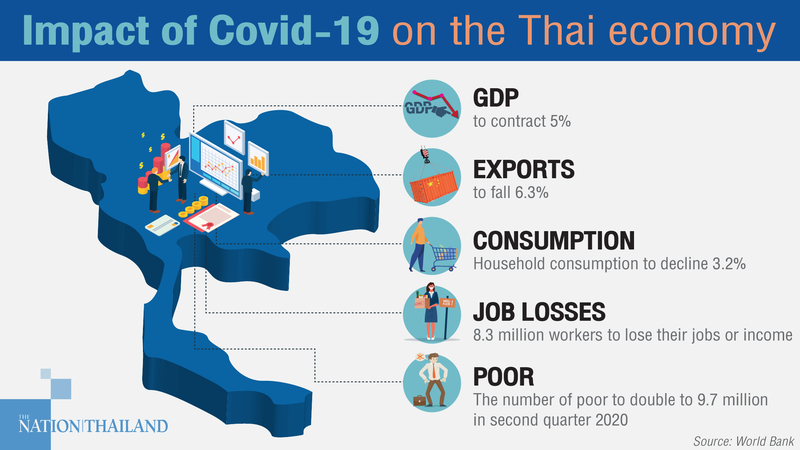
Thailand’s economy is expected to be impacted severely by Covid-19, shrinking by at least 5 per cent in 2020 and taking more than two years to return to pre-virus GDP levels, according to the World Bank’s Thailand Economic Monitor, released today (June 30).

The pandemic has “shocked the economy especially in the second quarter of 2020 and has already led to widespread job losses, affecting middle-class households and the poor alike”, it said.

While Thailand has been successful in stemming the tide of infections over the last three months, the economic impact has been severe. The tourism sector, which makes up close to 15 per cent of GDP, has been hit hard, with a near cessation of international tourist arrivals since March 2020, the monitor said.

Exports are expected to decline by 6.3 per cent in 2020, the sharpest quarterly contraction in five years, as demand for Thai goods abroad remains weak by the global slowdown. Household consumption is projected to decline by 3.2 per cent as restrictions on movement and dwindling incomes limit consumer spending, especially in the second quarter of 2020.

As Thailand starts to ease mobility restrictions, domestic consumption – traditionally the strongest driver of growth – may pick up in the second half of 2020 and in 2021, but economic recovery will be gradual and uncertain, it said. In the baseline, the economy is projected to grow by 4.1 per cent in 2021 and by 3.6 percent in 2022, which represents a slow recovery to pre-Covid GDP levels by mid-2022. The shape of the recovery is subject to considerable downside risks, including weaker global growth, feeble tourism, and continuing trade and supply chain disruptions.

“The strength of the economic recovery will depend in part on an effective policy response, in particular effective support to vulnerable households and firms,” said Birgit Hansl, World Bank country manager for Thailand. “As the recovery phase begins, a key challenge will be how to help people who lost their jobs reconnect with the labour market. Active labour market measures, such as wage-subsidies targeting individuals in the most vulnerable sectors, and on-the-job training to promote re-employment, should be explored.”

An estimated 8.3 million workers will lose their jobs or income because of the Covid-19 crisis. 

The report found that the number of “economically insecure”, or those earning below US$5.5 (Bt170) per day, is projected to double from 4.7 million people in the first quarter to 9.7 million people in the second quarter of 2020. In particular, the share of economically insecure middle-class households with workers in the manufacturing and services sector will rise three-fold, from 6 per cent to 20 per cent.

Thailand’s combined Covid‭-19 aid ‬packages amount to 12.9 per cent of GDP, the report said, focused on providing relief to vulnerable households and affected firms. 

‭‭The ‭ ‬programmes ‭ ‬are ‭ ‬unprecedented ‭ ‬for ‭ ‬Thailand ‭ ‬in ‭ ‬terms ‭ ‬of ‭ ‬size, ‭ ‬coverage ‭ ‬and ‭ ‬variety ‭ ‬of ‬‬ instruments, it added.

To protect vulnerable households, the World Bank report recommends extending social protection coverage to ensure that no gaps remain for the elderly and migrant workers.

The report also recommends continuing cash transfers for the most vulnerable groups and, where possible, linking such transfers to training, mentoring and other types of support that could create income-generating opportunities. Over the medium term, Thailand could consider establishing programmes with universal benefits to help cushion against epidemic outbreaks as well as other negative shocks, complemented by more targeted programmes for the poor, it said.

“For vulnerable companies, the nature of support will need to shift from emergency relief to more support for productive firms that are still standing,” said the bank’s senior economist for Thailand, Kiatipong Ariyapruchya. “This includes redirecting fiscal support from emergency measures to temporary job creation programmes by easing firm participation in public procurement and public works.”

Going forward, interventions could revamp firm support programmes focused on promoting companies and productivity growth, especially promoting investments for worker training, management training and technology adoption, he said.

Kiatipong also said Thailand “still has fiscal space to implement fiscal expansion policies and to extend the Bt5,000-cash transfer scheme to support affected people”.

The Bank of Thailand recently revised its forecast to a 8.1 per cent GDP contraction. World Bank economists said the forecast, which is subject to downside risks, is not different from others in times of big shock. 

All analysts agree that the impact from Covid-19 is severe and it would take two to three years before economic recovery can reach pre-virus-crisis levels.

Samyan Mitrtown all set to hold marketplace event #ศาสตร์เกษตรดินปุ๋ย

#ศาสตร์เกษตรดินปุ๋ย : ขอบคุณแหล่งข้อมูล : หนังสือพิมพ์ The Nation.

Samyan Mitrtown all set to hold marketplace event

Jun 30. 2020

By The Nation

Samyan Mitrtown is set to hold its “Mitr Marketplace for CU” event from July16 to 19 after the venue was inspected for safety in this new normal situation.

Department of Health deputy director-general Dr Danai Teewunda together with MICE Capabilities Department director Orachorn Wongpan-ngam and Prachuab Noiarmat, the chief of the Environment and Sanitation Section, Pathumwan District Office, paid the Samyan Mitrtown Hall a visit to assess the venue’s readiness in hosting the event. The venue said it is abiding by the Public Health Ministry’s Department of Disease Control guidelines.

KBTG launches Eatable – a ‘complete’ food-ordering app #ศาสตร์เกษตรดินปุ๋ย

#ศาสตร์เกษตรดินปุ๋ย : ขอบคุณแหล่งข้อมูล : หนังสือพิมพ์ The Nation.

KBTG launches Eatable – a ‘complete’ food-ordering app

Jun 29. 2020KBTG chairman Ruangroj Poonpol, centre, and KBTG’s senior principal visionary architect Dr Charoenchai Boworntummarat, right, along with KBTG’s advanced partnership engineer Dr Surasak Chantasirichot launch the ‘Eatable’ food-ordering platform.KBTG chairman Ruangroj Poonpol, centre, and KBTG’s senior principal visionary architect Dr Charoenchai Boworntummarat, right, along with KBTG’s advanced partnership engineer Dr Surasak Chantasirichot launch the ‘Eatable’ food-ordering platform.

By THE NATION

Kasikorn Business-Technology Group (KBTG) on Monday (June 29) launched Eatable, a food-ordering app that caters to the new normal by providing contactless services for customers who want to either dine at restaurants, order take outs or have their food delivered at home.

While restaurateurs do not need to download the application or pay fees and can manage their back-office system online on a real-time basis, diners can browse menus, order food, and make contactless payment. The platform will be fully rolled out by October.

Ruangroj Poonpol, KBTG chairman, said restaurants are doing their best to adapt to the new normal and according to KResearch, market turnover for restaurants this year is likely to stand at around Bt380 billion, down almost 10 per cent compared to last year because customers are preferring to eat at home due to the Covid-19 outbreak.

Hence, in line with this trend, KBTG has designed and developed “Eatable” – a complete online food ordering service for restaurants and consumers. For instance, those who wish to dine at restaurants can order food by scanning the QR code at their table or by opening a link created by the Eatable platform. This way, diners will not have to wait for the server to take their order.

Customers wanting to pick up their food can place their order via the platform and set a time for pick up. This way, they will not have to wait at the restaurant.

Customers who want their food delivered can place their orders using an online menu and can choose the cheapest delivery option.

Restauranteurs, meanwhile, can use the platform to launch promotions, as well as create or change information and prices. The platform also has a feature that helps restaurants keep track of orders and update customers in real time.

In September, Eatable will be linked to an online payment service, which allows its customers to place orders and make payments through a single channel.

KBTG will also launch “Kai Tai Dian Cai” food ordering programme that caters to Chinese tourists at the end of the year. This app can be used via WeChat.

AirAsia offers ‘Unlimited Pass’ #ศาสตร์เกษตรดินปุ๋ย

#ศาสตร์เกษตรดินปุ๋ย : ขอบคุณแหล่งข้อมูล : หนังสือพิมพ์ The Nation.

AirAsia offers ‘Unlimited Pass’

Jun 29. 2020

By THE NATION

In a move to support domestic tourism, AirAsia has introduced its “Unlimited Pass”, offering a limited number of tickets for Bt2,999 for travel on its domestic routes, the airline said.

Tickets are on sale from today until July 5 for travel anytime from July 20 to December 17, 2020.

Under this offer, guests can fly to 23 top domestic destinations, including Chiang Mai, Chiang Rai, Phuket, Krabi, Hat Yai, Nan, Ubon Ratchathani, Udon Thani, Khon Kaen.

“The Covid-19 situation has significantly impacted the economy and the tourism sector, especially in terms of foreign tourist spending in the country, which has yet to return to normal,” AirAsia Thailand chief executive Santisuk Klongchaiya said.

“To support both the public and private sectors, AirAsia has launched the Unlimited Pass for the first time in Thailand to help stimulate domestic air travel and provide a welcome boost for the economy. AirAsia is looking to offer the best convenience and value to our guests as well as reassure them that their health and safety is our top priority,” Santisuk said.

“We also wish to reassure our passengers that we have stepped up all precautionary measures to do with safety and hygiene, on the ground and in the air, to ensure our guests arrive safely and healthy at their destinations,” he added.

Chesapeake’s Collapse Is Latest in Long Line of Shale Busts #ศาสตร์เกษตรดินปุ๋ย

#ศาสตร์เกษตรดินปุ๋ย : ขอบคุณแหล่งข้อมูล : หนังสือพิมพ์ The Nation.

Chesapeake’s Collapse Is Latest in Long Line of Shale Busts

Corporate

Jun 30. 2020A gas flare is seen in a field at dusk near Mentone, Texas, on Aug. 31, 2019. MUST CREDIT: Bloomberg photo by Bronte WittpennA gas flare is seen in a field at dusk near Mentone, Texas, on Aug. 31, 2019. MUST CREDIT: Bloomberg photo by Bronte Wittpenn

By Syndication Washington Post, Bloomberg · David Wethe · BUSINESS 

The shale bust has reached a grim milestone by claiming the pioneer of America’s drilling renaissance. But Chesapeake Energy Corp., which filed for bankruptcy protection on Sunday, is just the latest in a long list of casualties.

More than 200 North American oil and gas producers, owing over $130 billion in debt, have filed for bankruptcy since the beginning of 2015, according to a May report from law firm Haynes & Boone. This month alone, seven oil and gas companies have gone under, tying December 2015 for the busiest on record after crude prices plunged amid the Covid-19 pandemic, according to data compiled by Bloomberg.

The shale boom spearheaded by the likes of Chesapeake a decade ago was fueled by debt. Profitability and shareholder returns have been consistently disappointing, and investors had already grown wary of throwing more money into shale before this year’s oil crash. The rate of default on high-yield energy debt stood at 11%, Fitch Ratings said in a June 11 report, the highest level since April 2017.

Here are a handful other notable shale bankruptcies so far this year:

Whiting Petroleum

An oil explorer focused on the Bakken Shale in North Dakota, Whiting Petroleum Corp. was already facing head winds before 2020. Last year, the Denver-based company announced it would fire a third of its workforce and scale back production targets after posting a surprise quarterly loss.

Crude prices had their worst quarter ever in the first three months of 2020, with oil heavyweights Saudi Arabia and Russia failing to agree on supply cuts just as worldwide lockdowns wiped out demand for fuel. That was enough to push Whiting, saddled with $3.6 billion in debt, into bankruptcy on April 1.

But not before the board approved $14.6 million in cash bonuses for top executives to “ensure the stability and continuity of the company’s workforce and eliminate any potential misalignment of interests that would likely arise if existing performance metrics were retained,” the company said in a filing the same day it filed for Chapter 11 protection.

Extraction Oil & Gas

Another Colorado driller, Extraction Oil & Gas Inc. focused exclusively on the Denver-Julesburg Basin in the Rockies. It filed for Chapter 11 on June 15, offering to ease its debt burden of roughly $1.5 billion by giving noteholders 97% of new common stock to be issued.

Extraction had withdrawn its 2020 guidance in May and warned it may have to file for bankruptcy. Then, in early June, the company announced plans to pay 16 executives and senior managers a total of $6.7 million in return for staying with Extraction ahead of a possible default on its bond payments.

Ultra Petroleum

Once wasn’t enough.

Ultra Petroleum Corp. filed for its second bankruptcy in May, four years after its first. Listing $2.56 billion in debt and $1.45 billion in assets in its Chapter 11 filing, the Englewood, Colorado, driller reached a deal with most of its senior creditors that would slash $2 billion in debt, while looking to restructure within three months.

In its struggles to stay afloat, Ultra went so far as to suspend its drilling program in January to bolster free cash flow and focus on paying down debt. The explorer first filed for bankruptcy in 2016 and emerged the following year, just as the shale patch was beginning to crawl out of what had been the worst oil industry crash in a generation — until this year.

Sable Permian Resources

Soon after his ouster from Chesapeake in 2013, co-founder Aubrey McClendon went to work building a new empire, American Energy Partners. But after McClendon died in a car crash three years later, the company shut down.

Part of that business, American Energy – Permian Basin, merged with Sable Permian Resources LLC last year. That particular business was widely seen as having among the best assets of a half dozen oil-and-gas acquisition vehicles that McClendon set up during his brief tenure at American Energy Partners.

Sable filed for bankruptcy last week in Houston alongside affiliates, listing at least $1 billion of assets and liabilities each.

Lilis Energy

The Permian explorer Lilis Energy Inc. followed right on the heels of Chesapeake, filing for bankruptcy protection on Monday.

The company said it was a victim of the coronavirus-induced downturn. Lilis was struggling even before the pandemic, warning in January that it might default after lenders slashed its credit line.

“Like many companies in the oil and gas industry, we have been impacted by the severe downturn in commodity prices throughout the Covid-19 pandemic,” Joseph C. Daches, Lilis’s chief executive officer, said in a statement announcing the filing.