Baht’s rise worries govt; BOT blames it on a weaker dollar #ศาสตร์เกษตรดินปุ๋ย

#ศาสตร์เกษตรดินปุ๋ย : ขอบคุณแหล่งข้อมูล : หนังสือพิมพ์ The Nation.

https://www.nationthailand.com/business/30389469?utm_source=category&utm_medium=internal_referral

Baht’s rise worries govt; BOT blames it on a weaker dollar
Jun 12. 2020
By The Nation

Though the Finance Ministry is worried about the fast rising baht, the central bank assures that the baht is only strengthening in line with regional currencies.

Finance Minister Uttama Savanayana said on Thursday (June 11) that the Bank of Thailand understands that the currency exchange rate is necessary to support economic recovery.

“The central bank knows that the baht exchange rate should move in line with the Finance Ministry’s and government economic plan for recovery, and that it is responsible for the range of the baht’s movement,” he said.

His comments came after the baht passed the Bt31 to the dollar mark to rest at its strongest point of Bt30.82 before closing at Bt30.95 on Thursday closing.

The Bank of Thailand (BOT), however, is saying the baht is moving in line with regional currencies.

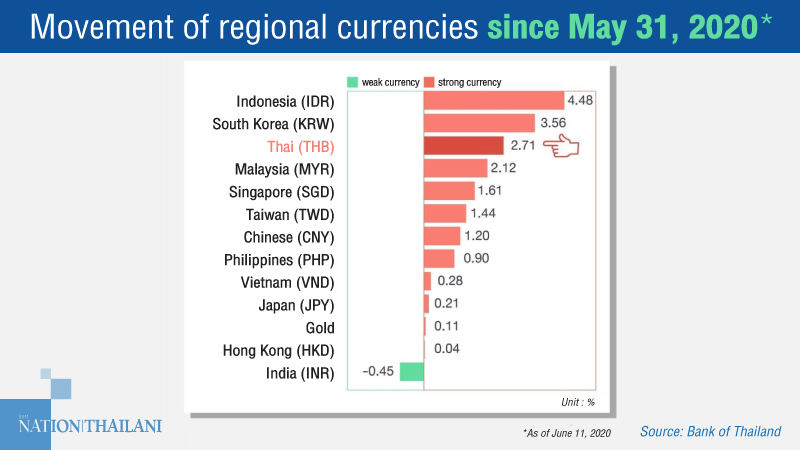
“As of June 11, the baht has risen 2.71 per cent against the US dollar since the end of May,” assistant BOT governor Chantawan Sutcharitkul said, pointing out that the baht is the third strongest currency in the region after Indonesia’s rupiah and South Korea’s won.

The actual reason for Asian currencies rising against the greenback is that the US currency is weakening, she said.

Also, capital is flowing back into Thailand as investors who previously moved money out to invest overseas are now bringing the money back, while foreign investors have returned to the equity and Thai bond markets, but their net buys are not that much, she said.

She also warned of exchange rate volatility due to uncertainty in the global economy, financial markets and Thai economy. Businesses that have engaged in international trade have to regularly hedge their risks where the exchange rate is concerned.

She added that importers and exporters should not rely solely on the dollar when quoting a price for their goods and services, they should also use other currencies, especially when trading within the region.

Naris Sathaphondecha, senior director at TMB Analytics, said the baht rose on Thursday after the US Federal Reserve predicted slow recovery saying it may take two to three years and signalled that it was maintaining low key policy rates until 2022.

Also, global financial markets have been flooded by liquidity injected by central banks in Japan, US and Europe. Besides, money is flowing into Thailand as the economy is showing signs of improvement as the government is easing the Covid-19 lockdown measures.

Since early June, foreign investors have made net purchases of Thai equities and bonds worth Bt6.5 billion and Bt23 billion respectively, he said, adding that the dollar’s weakening was also contributing to the baht’s rise.

“The dollar over the past three days fell by 0.85 per cent, but the baht rose by 1.6 per cent. The baht was the strongest in the region followed by the Japanese yen, which rose 1.4 per cent, and the South Korean won, which rose 0.68 per cent in the same period,” he said.

The baht may stay within the Bt30.5 and Bt31 range and is likely to rise until the end of this month.

However, it may fall to Bt31.5 to a dollar in the third quarter in line with economic fundamentals. The current account is expected to be at a deficit of 3 to 4 per cent of the GDP, reversing from the usual 6 to 8 per cent surplus to the GDP in recent years.

The government’s efforts to curb the spread of Covid-19 has demonstrated an outstanding performance in relation to neighbouring countries, which has also pushed the baht up. He expects the central bank to introduce extra measures to curb the baht’s rise and the Finance Ministry to launch additional stimulus packages.

Jitipol Puksamatanan, chief of market strategy at SCB Securities, said the baht rose on Thursday because exporters sold off their dollars out of panic over the baht’s fast appreciation. Early this year, most companies had estimated one dollar to cost Bt30, so selling their dollars now, they will only be making a small profit, not a loss from the exchange rate, he added.

Oil plummets with economic jitters surging through markets #ศาสตร์เกษตรดินปุ๋ย

#ศาสตร์เกษตรดินปุ๋ย : ขอบคุณแหล่งข้อมูล : หนังสือพิมพ์ The Nation.

https://www.nationthailand.com/business/30389470?utm_source=category&utm_medium=internal_referral

Oil plummets with economic jitters surging through markets

Jun 12. 2020
A crew member walks on the deck of an oil tanker anchored in the Pacific Ocean off Long Beach, Calif., on May 1, 2020. MUST CREDIT: Bloomberg photo by Patrick T. Fallon.

A crew member walks on the deck of an oil tanker anchored in the Pacific Ocean off Long Beach, Calif., on May 1, 2020. MUST CREDIT: Bloomberg photo by Patrick T. Fallon.
By Bloomberg · Hailey Waller, Alex Longley · BUSINESS, US-GLOBAL-MARKETS

Crude futures plunged by the most in more than two weeks as jitters reverberated through markets a day after the Federal Reserve provided a gloomy outlook for the U.S. economy.

The rally that’s brought West Texas Intermediate crude from negative territory to the high $30-a-barrel range this month due to production cuts by OPEC and its allies and the easing of lockdowns is showing signs of fading. Federal Reserve Chairman Jerome Powell said Wednesday that the coronavirus pandemic continues to pose considerable risks to the economy. WTI futures tumbled as much as 8.7% Thursday.

Plus, oil inventories in the U.S. are at record-high levels and a true demand recovery remains shaky given the risk of a second wave of coronavirus cases in some U.S. states.

“The surprisingly bearish stats, particularly on crude, the relatively dour comments by the Fed yesterday and fears of a resurgence of the coronavirus have all added up to the price weakness today,” said Thomas Finlon, director of the Energy Analytics Group in Wellington, Florida.

Many in the oil market are too optimistic that the impacts of coronavirus will be a short-term blip, Standard Chartered analysts Emily Ashford and Paul Horsnell wrote in a report.

On the supply side, higher crude prices have pushed some producers to turn on the taps. U.S. crude stockpiles rose last week to 538.1 million barrels, according to the Energy Information Administration. That’s the highest level in data compiled by Bloomberg since 1982.

In a more positive sign, data showed that oil demand in the United Kingdom has been steadily recovering in recent weeks. Despite that, there’s still a massive glut to be cleared globally, including more than 180 million barrels of crude stored at sea, according to Vortexa data.

Jerome Powell sees long road ahead for jobs market #ศาสตร์เกษตรดินปุ๋ย

#ศาสตร์เกษตรดินปุ๋ย : ขอบคุณแหล่งข้อมูล : หนังสือพิมพ์ The Nation.

https://www.nationthailand.com/business/30389472?utm_source=category&utm_medium=internal_referral

Jerome Powell sees long road ahead for jobs market

Jun 11. 2020
Fed chairman Jerome Powell speaks during a virtual news conference on June 10, 2020. MUST CREDIT: Bloomberg photo by Andrew Harrer.

Fed chairman Jerome Powell speaks during a virtual news conference on June 10, 2020. MUST CREDIT: Bloomberg photo by Andrew Harrer.
By Syndication Washington Post, Bloomberg · Rich Miller · BUSINESS, US-GLOBAL-MARKETS, CAREER-WORKPLACE 

President Donald Trump says the U.S. economy will be back and better than ever next year. Federal Reserve Chairman Jerome Powell begs to differ.

In an almost hour-long virtual press conference Wednesday after the Fed left interest rates pinned near zero, Powell repeatedly played down the surprise, welcome news of a pick-up in jobs growth in May that Trump hailed last week as the “greatest comeback in American history.”

Instead, the Fed chairman spotlighted the many millions of American still out of work and suggested it would take years for a return to anything like the strong labor market that the U.S. enjoyed before the coronavirus pandemic.

“We have to be honest that it’s a long road,” Powell said. “It’s — depending on how you count it — well more than 20 million people displaced in the labor market.”

Just how long a road it will be was seen in the forecasts that policy makers released after their two-day meeting. While they expect the economy to begin to recover from its government-imposed lockdown in the second half of the year, they see unemployment falling slowly — to 9.3% at the end of this year from May’s 13.3% — and don’t envisage it returning to anywhere near its pre-Covid-19 rate of 3.5% by the end of 2022.

That dour outlook didn’t stop Trump from telling reporters that the Fed delivered “some good news today” while the president again touted May’s jobs numbers. He appeared to revise that judgment with a tweet on Thursday.

“The Federal Reserve is wrong so often,” he wrote. “I see the numbers also, and do MUCH better than they do. We will have a very good Third Quarter, a great Fourth Quarter, and one of our best ever years in 2021.”

Faced with sagging opinion-poll ratings, Trump has seized on last week’s report of a fall in joblessness — from April’s post Great Depression high of 14.7% — to make his case for re-election in November.

“We’re going to actually be back higher next year than ever before,” Trump said in triumphant remarks at the White House on June 5, setting aside a week of turmoil over his hostility toward nationwide protests against police brutality following the death of George Floyd. “The only thing that can stop us is bad policy.”

Trump even invoked the memory of Floyd, the black man who died at the hands of Minneapolis police last month, as he touted the U.S. economic recovery from the coronavirus pandemic.

“Hopefully, George is looking down right now and saying there’s a great thing happening for our country,” Trump said in remarks at the White House on Friday. “It’s a great day for him, it’s a great day for everybody.”

That drew an immediate rebuke from former Vice President Joe Biden, the president’s presumed opponent in the November election. Not only did he take Trump to task for his comments on Floyd, Biden criticized the president for crowing about the May jobs number while millions of Americans are still unemployed.

In an unusual comment for the apolitical Fed, Powell also alluded to Floyd’s death in his opening statement at the press conference — to condemn racism in the U.S.

“There is no place at the Federal Reserve for racism, and there should be no place for it in our society,” Powell said. “Everyone deserves the opportunity to participate fully in our society and our economy.”

Prior to the pandemic, Powell had taken particular pride in the success the Fed had achieved pushing down unemployment to a half-century low and in the process spreading the benefits of the recovery to black and other workers who’ve historically been left behind.

That success had come in the face of withering criticism from Trump that the Fed was needlessly holding back the economy by keeping interest rates too high. It was only after the central bank cut rates effectively to zero in March that the president allowed that Powell had finally gotten policy right.

The Fed chairman expressed concern at Wednesday’s press conference about the disproportionate loss of jobs among women, black and Latino workers as a result of the coronavirus, saying that the central bank wants to return these groups to pre-crisis levels of low unemployment.

“Unemployment has gone up more for Hispanics, more for African-Americans, and women have borne an extraordinary and notable share of the burden beyond their percentage in the workforce,” he said. “That’s really, really, really unfortunate.”

Kathleen Bostjancic, an economist at Oxford Economics in New York, said the Fed’s heightened awareness of the advantages to society from a tight jobs market will help convince officials to keep interest rates low even as the economy recovers and unemployment falls.

“The recent protests likely highlight for the Fed the importance of trying to ensure a broader spread of economic gains, which means running the labor market hot,” she said in a note to clients.

Indeed, Powell pledged Wednesday that the Fed would do whatever it takes for as long as it takes to get the jobs market back to full health, even holding out the possibility that it would cap yields on Treasury securities — a strategy it last employed during World War II and its immediate aftermath.

“We’re not even thinking about raising rates,” he told reporters, after the Fed released forecasts showing that almost all officials expect to keep rates effectively at zero through 2022.

He also suggested that the Fed, Congress and the Trump administration might need to do more to help the economy recover from its steepest downturn in almost a century.

Speaking on Capitol Hill on Wednesday, Treasury Secretary Steve Mnuchin said the U.S. needs additional fiscal stimulus — particularly for businesses struggling to reopen from coronavirus-related closures — even as he said the economy has started to recover.

Powell acknowledged that the jobs market may have bottomed out. But he seemed under no illusion that heralded a quick return to the super-healthy labor market that prevailed at the start of the year.

There could be “well into the millions of people who don’t get to go back to their old jobs” or to the industry they used to work in, he said. “It could be some years before we get back to those people finding jobs.”

SET dips below 1,400 points after gloomy Fed prediction #ศาสตร์เกษตรดินปุ๋ย

#ศาสตร์เกษตรดินปุ๋ย : ขอบคุณแหล่งข้อมูล : หนังสือพิมพ์ The Nation.

https://www.nationthailand.com/business/30389458?utm_source=category&utm_medium=internal_referral

SET dips below 1,400 points after gloomy Fed prediction

Jun 11. 2020
By The Nation

The Stock Exchange of Thailand (SET) Index closed at 1,396.77 today (June 11), down 22.00 points or 1.55 per cent. Total transactions amounted to Bt82.892 billion with an index high of 1,421.51 and a low of 1,384.68.

In the morning session, a stock analyst at Krungsri Securities expected the index to fall to between 1,400 and 1,410 in response to sliding regional stocks.

“The US Federal Reserve decided to maintain its interest rate at 0-0.25 per cent until the economy recovers,” the analyst said.

“However, investors have begun to worry about the US economic slowdown after the Fed forecast US gross domestic product this year would contract by 6.5 per cent and the unemployment rate would be 9.3 per cent.”

The analyst added that the SET would rebound on expectations that the government will lift the curfew for a 15-day trial period, and begin the fourth phase of lockdown relaxation this week.

The 10 stocks with the highest trade values today were SUPER, BAM, STA, MINT, SCB, AOT, CPF, KBANK, PTT, and PTTEP.

As of 4.30pm, the price of crude oil price had dropped by US$1.39 or 3.51 per cent to $38.21 per barrel, while the gold price rose by $20.90 or 1.21 per cent to $1,741.60 per ounce.

Global indices were on the slide:

Japan’s Nikkei Index closed at 22,472.91, down 652.04 points, or 2.82 per cent.

China’s Shanghai SE Composite Index closed at 2,920.90, down 22.86 points, or 0.78 per cent, while Shenzhen SE Component Index closed at 11,243.62, down 92.25 points, or 0.81 per cent.

Hong Kong’s Hang Seng Index closed at 24,480.15, down 569.58 points, or 2.27 per cent.

South Korea’s KOSPI Index closed at 2,176.78, down 18.91 points, or 0.86 per cent.

Taiwan’s TAIEX Index closed at 11,535.77, down 184.39 points, or 1.57 per cent.

UK launches Digital Trade Network to grow tech businesses in Thailand and region #ศาสตร์เกษตรดินปุ๋ย

#ศาสตร์เกษตรดินปุ๋ย : ขอบคุณแหล่งข้อมูล : หนังสือพิมพ์ The Nation.

https://www.nationthailand.com/business/30389452?utm_source=category&utm_medium=internal_referral

UK launches Digital Trade Network to grow tech businesses in Thailand and region

Jun 11. 2020
UK Trade Commissioner for Asia Pacific, Natalie Black

UK Trade Commissioner for Asia Pacific, Natalie Black
By The Nation

The UK is launching a new Digital Trade Network in Asia Pacific, to increase trade and investment opportunities, and to forge new international partnerships for the digital economy with Thailand and the wider region.

The three-year pilot scheme will run on a budget of £8 million (Bt314.3 million) and aims to support tech businesses as they seek to internationalise.

The scheme also aims meet growing demand for digital tech solutions after Covid-19 – from improving supply chain resilience to managing expanded e-commerce.

“Digital technology is more important than ever, delivering innovations that improve people’s lives and make businesses more productive – as we’ve seen through the Covid-19 pandemic,” said UK Trade Commissioner for Asia Pacific, Natalie Black. “Strengthening the UK’s partnership with Asia Pacific through this new Digital Trade Network will allow us to create new collaborations, driving trade and investment and ensuring we all benefit from the best global digital innovation.”

Tech Nation – the UK tech scale-up experts – will join the Digital Trade Network by extending their successful Entrepreneur Engagement Network internationally – in Japan, Singapore and Australia. The network will support tech scale ups in Asia Pacific interested in the UK market, by providing a direct link to key tech clusters across the country.

The UK is a world-leader in tech and digital, attracting more than £10 billion worth of investment in 2019, ranking third only behind the US and China.

Meanwhile, 79 tech unicorns have been developed in the UK in recent years – more than Germany, France and Israel combined.

Gold price sees a slight dip #ศาสตร์เกษตรดินปุ๋ย

#ศาสตร์เกษตรดินปุ๋ย : ขอบคุณแหล่งข้อมูล : หนังสือพิมพ์ The Nation.

https://www.nationthailand.com/business/30389442?utm_source=category&utm_medium=internal_referral

Gold price sees a slight dip

Jun 11. 2020
By The Nation

The price of gold dropped by Bt50 per baht weight in morning trade on Thursday (June 11), the Gold Traders Association reported.

As of 9.25am, buying price of a gold bar was Bt25,250 per baht weight and selling price Bt25,350, while gold ornaments were priced at Bt24,801.76 and Bt25,850, respectively.

At close on Wednesday (June 10), buying price of a gold bar was Bt25,300 per baht weight and selling price Bt25,400, while gold ornaments were priced at Bt24,847.24 and Bt25,900, respectively.

The Gold Spot Index price on Thursday morning moved to around US$1,732 (Bt53,602) per ounce after the price dropped slightly by $1.2 to $1,720.7 per ounce at close on Wednesday as investors delayed trading to follow the outcome of US Federal Reserve meeting on monetary policy.

The price in the Hong Kong gold market rose by HK$140 to $16,040 (Bt64,060) per tael.

SET falls amid worries of US economic contraction #ศาสตร์เกษตรดินปุ๋ย

#ศาสตร์เกษตรดินปุ๋ย : ขอบคุณแหล่งข้อมูล : หนังสือพิมพ์ The Nation.

https://www.nationthailand.com/business/30389437?utm_source=category&utm_medium=internal_referral

SET falls amid worries of US economic contraction

Jun 11. 2020
By The Nation

The Stock Exchange of Thailand Index opened at 1,413.20, down 5.57 points, or 0.39 per cent, on Thursday morning (June 11).

A stock analyst at Krungsri Securities expected the index to fall to between 1,400 and 1,410 in response to the decline in regional stocks.

“The US Federal Reserve decided to maintain the interest rate at 0-0.25 per cent until the economy recovered,” the analyst said.

“However, investors have begun to worry about the US economic slowdown after the Fed expected the US gross domestic product this year to contract by 6.5 per cent and the unemployment rate this year was expected to be at 9.3 per cent.”

The analyst added that the index would rebound from hopes that the Centre for Covid-19 Situation Administration was preparing a proposal to end the night curfew for 15 days, and begin the fourth phase of lockdown relaxation this week.

He recommended investors buy:

▪ Stocks that would be added to the SET50 and SET100 calculation, such as BPP, TTW, ACE, DOHOME, RBF, SIRI, SISB, TVO and WHAUP.

▪ Stocks whose second-quarter performance will improve, such as CKP, TASCO, STA and RS.

▪ Financial stocks that benefit from the low interest rate, such as KTC, SAWAD, MTC, JMT and BAM.

The SET Index on Wednesday rose by 10 points, or 0.74 per cent, closing at 1,419. Total transactions were worth Bt77 billion. Foreign investors made net buy of Bt859 million in stocks and Bt3.040 billion in the bond market. There were 13,767 Net Long TFEX SET50 contracts.

How to help electric shock victim #ศาสตร์เกษตรดินปุ๋ย

#ศาสตร์เกษตรดินปุ๋ย : ขอบคุณแหล่งข้อมูล : หนังสือพิมพ์ The Nation.

https://www.nationthailand.com/biz-moves/30389392?utm_source=homepage&utm_medium=internal_referral

How to help electric shock victim

Jun 10. 2020
By THE NATION

Metropolitan Electricity Authority (MEA) posted on its facebook page this week a video and tips on how to help victim of electric shock.


The tips are:

– Keep calm and cut/turn off the power source as fast as possible

– Absolutely do not touch the victim with bare hands

– Use dry rope or towel pull the victim from the electricity source in a swift manner

For more information on electricity safety, contact MEA call center 1130, twitter: @MEA_news, Line: @meathailand, facebook: @Metropolitan.Electricity.Authority or download the mobile application “MEA Smart Life”, available for both android and iOS users.

CFOs must make smart moves to thrive after COVID-19 #ศาสตร์เกษตรดินปุ๋ย

#ศาสตร์เกษตรดินปุ๋ย : ขอบคุณแหล่งข้อมูล : หนังสือพิมพ์ The Nation.

https://www.nationthailand.com/business/30389399?utm_source=category&utm_medium=internal_referral

CFOs must make smart moves to thrive after COVID-19

Jun 10. 2020
Marisa Aunhavichai

Marisa Aunhavichai
By Special to The Nation Thailand

Covid-19 has affected millions of people worldwide, claiming hundreds of thousands of lives and drastically impacting the global economy. However, the full impacts of the disease are still unknown as the contagion continues to spread.

Meanwhile almost every business sector has been hit hard, with profits plummeting, liquidity scarce, and financial restructuring or even bankruptcy now common.

However, the dark picture also contains a bright spot, namely opportunities to acquire talent and assets at very competitive prices – but only if companies are agile enough to cope with changes demanded by the “new normal” for business.

In the heat of the moment, chief financial officers (CFOs) must adapt quickly to the virus crisis if their companies are to prosper. We suggest that CFOs consider the following imperatives and take appropriate action.

First, liquidity management has become a top priority. Many business sectors are now struggling with a lack of liquidity due to low demand, declining sales volume, and the shrinking stock market caused by market volatility and uncertainty.

Companies with a high debt-to-equity ratio are struggling to stop their credit rating from being downgraded, while even those with strong balance sheets are facing higher financial risks related to assets such as cash, receivables, short-term loans, etc.

Thus, it is important for CFOs to make “scenario plans” to ensure the company’s cash flow viability, reforecasting the short-term liquidity position on even a weekly basis.

They must also look for opportunities to accelerate collection of receivables, shorten the cash conversion cycle, seek out alternative cash sources, diversify new lines of credit and arrange current debt by requesting debt covenant resets and/or waivers with financing partners.

Additionally, CFOs should not ignore the financial risks for key trading partners, customers and suppliers. To reduce company risk, they must carefully monitor and quickly respond to changes in customer behaviour, while diversifying suppliers and third-party partners.

The second imperative concerns internal and external relationship management. During the time of social distancing, clear and frequent communication is difficult since the majority of people are currently sheltering at home.

This requires individuals to work remotely and businesses to promote work virtualisation.

To engage with external stakeholders, CFOs should encourage companies to provide current and forward-looking information to their investors and to proactively reach out to regulators for financing negotiations and resilience purposes.

For internal business operations, finance seems better suited to remote working practices than manufacturing and other functions.

CFOs should engage with HR and IT departments to ensure active interaction among staff with efficient systems and data in place, while managing any extra cyber-risk. Usage of digital communication platforms like Skype, ZOOM, Microsoft team and Google Meet is rocketing during this time. Companies need to consider the pros and cons of this tech, balancing convenience against concerns over security, privacy, user-friendliness and the price factor. Those staff unable to work from home require new ways of organising workspaces for social distancing.

Operations must be enhanced under the continuous impact of new remote working conditions and market disruption. It’s vital for organisations to stay aware of negative shifts in demand and disruption of supply during the current crisis.

In addition, CFOs should consider the whole value chain when they assess the needs to change and/or enhance finance and business operations. When scenario planning, they should also consider initiatives to transform operations so as to optimise cost and operational excellence to ensure the company can bounce back after the Covid-19 is defeated.

Currently, many firms are focused on minimising operational costs and managing the bottom line via SG&A, procurement and the supply chain.

For example, converting fixed costs to variable costs via outsourcing, contracted manufacturing, leasing the transport fleet, and third-party warehousing, can potentially preserve your core business operations while simultaneously providing companies flexibility on the fringes and creating long-term cash flow viability.

Integrating digital tech into daily operations where possible is another development.

Besides virtualisation of work, companies should also consider reconfiguring their marketing, go-to-market, and supply chain operations with greater automation, leaner processes, and more real-time data flow, which will help them to respond to future disruption efficiently.

The virus pandemic is a global crisis that’s attacking businesses in every industry, generating big losses and huge changes. From an optimistic viewpoint, though, it comes as a test of how businesses can prepare for, confront and survive the crisis and rebound to embrace the new normal in its aftermath.

Post-crisis, the business ecosystem will no longer be the same. Remote-working tools will disrupt traditional ways of operating, forcing workers and businesses into different communication and working styles.

New business models will emerge in response to the social-distancing world, such as cultivation of direct-to-customer (D2C) models. It is crucial for business owners, executives and management to rethink the way they currently operate and look to gain long-term competitive advantages, not only to survive but to get ahead in the “new normal”.

Marisa Aunhavichai,

Partner, Consulting Services,

Deloitte Thailand

Stocks drop with dollar, Treasurys rise after Fed #ศาสตร์เกษตรดินปุ๋ย

#ศาสตร์เกษตรดินปุ๋ย : ขอบคุณแหล่งข้อมูล : หนังสือพิมพ์ The Nation.

https://www.nationthailand.com/business/30389421?utm_source=category&utm_medium=internal_referral

Stocks drop with dollar, Treasurys rise after Fed

Jun 11. 2020
By Syndication Washington Post, Bloomberg · Rita Nazareth, Katherine Greifeld · BUSINESS 
U.S. stocks and the dollar fell as investors assessed the Federal Reserve’s views on the economy. Treasurys rallied.

The S&P 500 ended the session lower after getting whipsawed as Chairman Jerome Powell suggested the pandemic could inflict permanent damage on the economy even as the Fed signaled it would keep rates near zero possibly for years to come. The Treasury curve steepened sharply after the central bank said it will at least maintain the current rate of bond purchases.

“It seems like profit-taking is underway after the Fed didn’t deliver any new measures,” said Sameer Samana, senior global market strategist at Wells Fargo Investment Institute. “It’s not as easy to take risk at this point.”

U.S. equities have rallied more than 40% from their March lows as central-bank asset purchases and unprecedented stimulus sparked demand for risk assets. Earlier Wednesday, Treasury Secretary Steven Mnuchin said that the U.S. “definitely” needs additional fiscal stimulus.

Stocks may be the ultimate beneficiary of trillions of dollars in economic stimulus from the Fed, according to Savita Subramanian, Bank of America Corp.’s chief U.S. equity strategist. “Liquidity looking for a home” is bolstering the FANG stocks — Facebook Inc., Amazon.com Inc., Netflix Inc. and Google’s owner, Alphabet Inc. — along with their technology-driven peers, she wrote in a report this week.

The danger, though, is that any complication in the economic recovery could see market gains swiftly reverse — at a time when there’s less room for additional support. The pandemic is splintering the world economy, and policymakers can’t risk a premature withdrawal of lifelines to businesses and the most vulnerable people, the Organisation for Economic Co-operation and Development warned.

These are some of the main moves in markets:

Stocks

– The S&P 500 decreased 0.5% as of 4 p.m. EDT.

– The Stoxx Europe 600 Index fell 0.4%.

– The MSCI Asia Pacific Index increased 0.6%.

Currencies

– The Bloomberg Dollar Spot Index fell 0.6%.

– The euro advanced 0.4% to $1.1388.

– The Japanese yen appreciated 0.6% to 107.14 per dollar.

Bonds

– The yield on 10-year Treasurys dipped 10 basis points to 0.73%.

– Germany’s 10-year yield fell two basis points to -0.33%.

– Britain’s 10-year yield dipped seven basis points to 0.267%.

Commodities

– The Bloomberg Commodity Index increased 0.4%.

– West Texas Intermediate crude advanced 0.3% to $39.05 a barrel.

– Gold gained 1.5% to $1,747.80 an ounce.