BTS Group’s third-quarter profit surges 107 per cent year on year #ศาสตร์เกษตรดินปุ๋ย

#ศาสตร์เกษตรดินปุ๋ย : ขอบคุณแหล่งข้อมูล : หนังสือพิมพ์ The Nation

https://www.nationthailand.com/business/30382263?utm_source=category&utm_medium=internal_referral

BTS Group’s third-quarter profit surges 107 per cent year on year

Feb 17. 2020
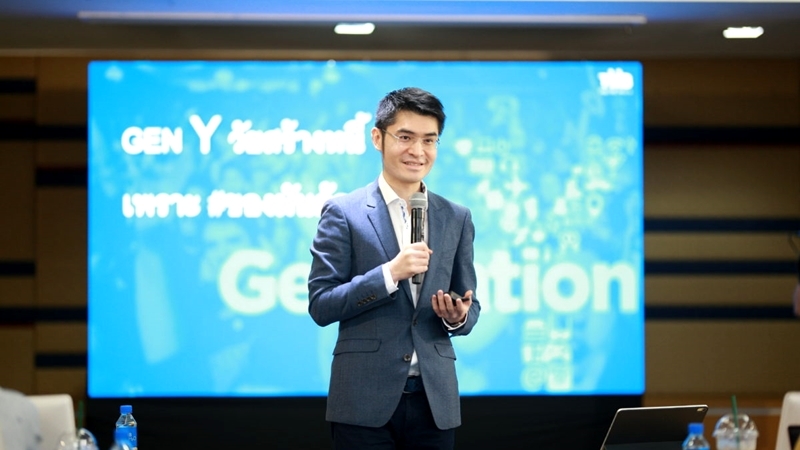
Kavin Kanjanapas, chief executive officer of BTS Group

Kavin Kanjanapas, chief executive officer of BTS Group
By The Nation

BTS Group Holdings Pcl (BTS Group) posted a 107 per cent growth year on year (YoY) in net profits in the third quarter of fiscal year 2019-20, the company said in a statement.

BTS Group earned a net profit of Bt2.46 billion, mainly through improved performances in its mass transit and media businesses as well as a higher share of net profit from its associate, U City Pcl, and gains of Bt1.118 million from the sale of land in Mo Chit.

The recurring net profit also soared by 143 per cent YoY to Bt2.37 billion, the company said.

In the third quarter of fiscal 2019-20, total operating revenue was Bt11 billion. The mass transit business was the main contributor, accounting for 78 per cent of revenue. Operating and maintenance (O&M) revenue rose by 67 per cent YoY to Bt942 million, principally driven by the opening of the Southern Green Line extension (Bearing-Kheha) in December 2018.

On the media side, VGI Group again achieved the highest quarterly revenue and net profit. VGI reported a 25 per cent increase in quarterly revenue of Bt1.867 billion, an all-time high, largely driven by the growth in all media segments, as well as additional revenue from online advertising, under VGI Digital Lab. This was also reflected in VGI’s net profit, which expanded by 30 per cent YoY to Bt401 million.

BTS Group’s rail mass transit network expansion continues, with significant progress on the Northern Green Line expansion. Ha Yaek Lat Prao station opened in August 2019 and four additional stations commenced operations on December 4, 2019, the company said. Four more stations are expected to open in June 2020 and full operation of the Northern Green Line extension (with a total of 16 stations) is anticipated by this year. These recently opened and upcoming stations will lead to strong growth in O&M revenue in forthcoming quarters.

On the Media side, the acquisition of Hello Bangkok LED Co Ltd by Master Ad Pcl (Maco) provides a clearer function for domestic media asset management. VGI will continue to focus on strengthening its offline-to-online solutions, as well as enhance synergies across its subsidiaries and associate companies. Maco will focus on international expansion and on being the proprietor of outdoor domestic assets; its domestic media assets will be managed by Plan B Media Pcl (PlanB), the BTS Group said. It is anticipated that synergies across VGI Group’s subsidiaries and associate companies will be enhanced as a result of workforce integration, which should lead to potential cost reductions and attractive development opportunities in the future.

Kavin Kanjanapas, chief executive officer of BTS Group, elaborated: “Aside from these strong financial results, we are investing in our long-term future in complementary sectors. We are open to invest in opportunities that enable us to create synergy around our existing platform, with driven partners who have operational expertise.”

In recent years, BTS Group has been exploring partnerships and projects across the transportation, infrastructure, media, payment, retail and logistics sectors. Most recently, consortiums comprising BTS Group were named as the best bidders of two Intercity Motorway projects and U Tapao International Airport.

In line with the company’s vision “to provide sustainable ‘City Solutions’ that strive to improve the city, community, and its way of life”, BTS Group has been recognised for its sustainability efforts by leading institutions around the world. In this quarter, BTS Group won The Asset Triple A Sustainable Capital Markets Regional Awards 2019 under the category “Best Green Bond” deal in the transportation and infrastructure sector and received the “RobecoSAM’s Silver Class distinction” in the Sustainability Yearbook 2020. “These awards are recognition of our genuine focus on sustainability development, which we firmly believe will ultimately create long-term positive impact for our stakeholders,” Kavin said.
Boutique banks lose luster as M&A boom wanes #ศาสตร์เกษตรดินปุ๋ย

#ศาสตร์เกษตรดินปุ๋ย : ขอบคุณแหล่งข้อมูล : หนังสือพิมพ์ The Nation

https://www.nationthailand.com/business/30382244?utm_source=category&utm_medium=internal_referral

Boutique banks lose luster as M&A boom wanes

Feb 16. 2020
By Syndication Washington Post,  Bloomberg · Michelle F. Davis · BUSINESS, US-GLOBAL-MARKETS

After spending years stealing market share from bulge-bracket peers on Wall Street, many boutique investment banks are stalling as a lengthy merger boom sputters.

Global boutique banks advised on the fewest number of deals last year since 2016, and their share of the deal pool fell to their lowest point since 2013, based on the number of transactions they worked on, according to data compiled by Bloomberg, which tracked deal participation by 248 boutiques. That led to the first annual decline in advisory revenue for the six biggest U.S. boutique firms since 2011.

They’re losing ground at a potentially perilous time. Dealmakers are forecasting a slump in M&A activity this year and bulge-bracket firms are increasingly encroaching on their turf by chasing smaller clients in the middle market.

Boutiques largely don’t have as many sources of revenue as full-service firms such as Goldman Sachs and JPMorgan Chase, which provide financing and other banking services. Their playbook is simpler: they rely on star rainmakers to sell M&A advice in specialized industries.

In the U.S., the six biggest by market capitalization are Lazard, Evercore, Houlihan Lokey, PJT Partners, Moelis & Co. and Greenhill & Co. As a group, they generated $6.2 billion in revenue for advising on deals last year, a 2.2% drop from the previous year, according to data compiled by Bloomberg. PJT Partners and Houlihan Lokey bucked that trend. PJT’s advisory revenue rose 27% year-over-year while Houlihan’s gained 13%.

There are signs that some boutiques may be starting to feel the pinch.

Evercore, the highest-ranking boutique on the league tables, in January said it will reduce about 6% of its headcount, with cuts affecting more than 100 workers. The firm said the moves were aimed at giving it “greater flexibility of operations and better position itself for future growth.”

Perella Weinberg Partners, another boutique, has put on hold its plan to go public, with top bankers at the firm concerned about volatile markets for boutique financial stocks, Bloomberg News reported in November.

Nearly a dozen dealmakers have also left boutiques for bulge-bracket firms in the past six months — a reversal of the trend over the last several years. Among the most high-profile were Amy Lissauer’s move from Evercore to Bank of America to lead its global M&A-activist and raid-defense advisory practice. HSBC Holdings has hired Nabil Lahham, a former veteran Middle East dealmaker at Perella Weinberg, people familiar with the matter said this week.

The moves beg the question: are boutiques getting too big for their own good? As they’ve bulked up and increasingly landed roles on more of the biggest M&A transactions, some clients and observers worry they’re losing some of what made them an attractive alternative to big banks.

“They’ve floated up to something that’s in between a boutique and a bulge-bracket firm,” said Erik Gordon, a lawyer and business professor at the University of Michigan’s Ross School of Business. “Sometimes I wonder how boutiquey they actually are. Where your proposition is being small — whether it means personal attention, exclusivity, lack of conflicts — it’s sustainable only if you stay small.”

In one case, Evercore had to pass up a role advising LVMH on its $16.2 billion deal for Tiffany & Co. due to a conflict of interest, according to a person familiar with the matter. That’s because Evercore’s William Shutzer sits on Tiffany’s board, said the person, who asked to not be identified because the matter isn’t public. A representative for Evercore declined to comment.

As competition for fees has intensified, some boutiques have also ventured into new sectors. Houlihan Lokey, a Los Angeles-based firm with a strong restructuring group, has been expanding globally. In January, the firm said it had hired a banker to spearhead a new equity capital markets practice in Europe.

To be sure, some of the firms gained share last year. PJT Partners was ranked a top 10 M&A adviser for the first time since going public after it co-advised AbbVie Inc. on its $63 billion deal for rival drugmaker Allergan Plc. The firm jumped to ninth place from fifteenth the year before, according to Bloomberg data.

Evercore’s Peter Bundage, a senior managing director and head of the bank’s Dallas office, says he thinks boutiques are well-positioned to take advantage of what he expects to be a strong M&A market this year.

“There will continue to be a very, very strong niche that corporate America is going to value that the independents bring,” Bundage said in an interview Thursday. “I think these big firms do it very well, very professionally, but at the same time they do want truly independent advice that’s not tied into many of the other services that they’re selling.”

Some analysts dispute the notion that boutiques can get too big.

Scale isn’t necessarily an impediment for firms such as Lazard and Rothschild & Co. that historically have been broadly focused, according to Brennan Hawken, an analyst with UBS AG.

“To me, this idea that boards really want independence; No, they don’t,” he said. “Boards want good advice and they’re gonna hire the firms that deliver the best advice. It’s just that simple.”

State agency to educate insurance entrepreneurs on investments #ศาสตร์เกษตรดินปุ๋ย

#ศาสตร์เกษตรดินปุ๋ย : ขอบคุณแหล่งข้อมูล : หนังสือพิมพ์ The Nation

https://www.nationthailand.com/business/30382229?utm_source=category&utm_medium=internal_referral

State agency to educate insurance entrepreneurs on investments

Feb 16. 2020
Suthipol Taweechaikarn

Suthipol Taweechaikarn
By The Nation

The Office of Insurance Commission (OIC) is planning to educate insurance business entrepreneurs about international investments such as private equity investment after new investment criteria were publicised, the office’s secretary-general, Suthipol Taweechaikarn, said.

On March 12, the office will hold a meeting with the private sector at the OIC meeting room with the purpose of exchanging ideas and presenting guidelines for the development of investments by insurance businesses.

The OIC is also preparing to specify the qualifications of the businesses to ensure effective investments and manage the risks properly.

The OIC has updated the criteria for investments after making it effective from January 29, enabling large insurance companies to plan investment portfolios and expand business assets such as equity instruments in businesses established to operate hospitals, businesses related to the care of the elderly and long-term care and technology business for insurance.

The new approach might increase revenue, help cope with low rate insurance and lower stress of business caused by the baht’s appreciation.

Economy expected to contract 2%: TMB Analytics #ศาสตร์เกษตรดินปุ๋ย

#ศาสตร์เกษตรดินปุ๋ย : ขอบคุณแหล่งข้อมูล : หนังสือพิมพ์ The Nation

https://www.nationthailand.com/business/30382288?utm_source=category&utm_medium=internal_referral

Economy expected to contract 2%: TMB Analytics

Feb 17. 2020
By THE NATION

The economy is expected to contract 2 per cent year on year in the first quarter, according to TMB Analytics chief Naris Sathapholdeja.

He said fourth quarter momentum last year into this first quarter is lower than expected.

However, the economy is expected to recover in the second quarter, propelled by the disbursement of the fiscal 2020 budget and the expected improvement of private consumption following the government’s continued stimulus packages.

Naris forecast economic growth of 1.8 per cent this year.

Vegetable oil market in state of flux after India-Malaysia estrangement hits palm oil #ศาสตร์เกษตรดินปุ๋ย

#ศาสตร์เกษตรดินปุ๋ย : ขอบคุณแหล่งข้อมูล : หนังสือพิมพ์ The Nation

https://www.nationthailand.com/business/30382274?utm_source=category&utm_medium=internal_referral

Vegetable oil market in state of flux after India-Malaysia estrangement hits palm oil

Feb 17. 2020
By The Nation

Last month India, a large palm oil customer, stopped buying from Malaysia. The decision caused fluctuation in the world oil palm market as Indonesia switched to penetrate the Indian oil market instead. As for Malaysia, it is accelerating reach into markets that Jakarta used to lead while India is seeking use of other types of oil instead of palm oil.

India, the world’s largest palm oil buyer, reportedly banned the import of refined palm oil from Malaysia last month. Many people view this as a response to Malaysian Prime Minister Mahathir Mohamad criticising New Delhi on Kashmir and a new citizenship amendment act after which buyers also slowed down purchase of crude palm oil from Malaysia.

The latest figures from Malaysia showed that in January, palm oil exports to India fell by 85 per cent year on year, down to 46,876 tonnes, the lowest since 2011.

In 2019, exports to India accounted for almost a quarter of all Malaysian palm oil exports. India has been Malaysia’s largest customer for five years. To make up for the lost market, Malaysia is increasing exports to other countries, including Pakistan, Saudi Arabia and Ghana, who rely mainly on palm oil from Indonesia. Total exports to all three countries last month jumped more than 100 per cent compared to the same period in 2019.

A palm oil trading company based in Mumbai revealed that the palm oil market is currently balancing out the situation. Buyers from Asia who mainly look at prices and European buyers are moving from Indonesia to Malaysia because it is cheaper.

Lee Yeow Chor, chairman of the Malaysian Palm Oil Council, said the reduced palm oil reserves helped to counter the effects of India’s cessation of purchases.

“Now the situation for Malaysia is not bad. Our stock is still tight. India may buy more from Indonesia but it provides an opportunity to create a demand vacuum in some markets,” said Lee. Malaysia’s palm oil depot is at the lowest in two years. Besides, Malaysia is expanding its market share in the Middle East, Africa and Southeast Asia.

According to the Malaysian palm oil board, in January Malaysia sold 170,802 tonnes of palm oil to Pakistan up from 80,660 tonnes in the same period of 2019, 12,527 tonnes to Bangladesh, up by 575 tonnes in the same period last year.

In 2019, Indonesia used to be the largest supplier to these markets.

Between July and December 2019, the reference palm oil price increased by 60 per cent but it has recently fallen amid concern about the needs of India and the spread of the new coronavirus in China.

India, which is a price-sensitive palm market, has dropped its purchase power in the past three months due to the higher palm price while other oils are not much different, encouraging Indians to use other types of oil instead.

India’s Solvent Extractors Association said that in January, India’s palm oil imports were down by 27 per cent, compared to the same period in 2019, to 594,804 tonnes, but import of soybean and sunflower oil rose by 40 per cent and 51 per cent respectively, reducing the proportion of cooking palm oil in India to 51 per cent, the lowest since June 2018.

Chevrolet to cease sales in Thailand by 2020 end #ศาสตร์เกษตรดินปุ๋ย

#ศาสตร์เกษตรดินปุ๋ย : ขอบคุณแหล่งข้อมูล : หนังสือพิมพ์ The Nation

https://www.nationthailand.com/business/30382268?utm_source=category&utm_medium=internal_referral

Chevrolet to cease sales in Thailand by 2020 end

Feb 17. 2020
By The Nation

General Motors announced today (February 17) that it had signed a binding term sheet with Great Wall Motors to purchase GM’s Rayong vehicle manufacturing facility, and would withdraw Chevrolet from the domestic market in Thailand by the end of 2020.

The automaker also announced it would wind down sales, design and engineering operations in Australia and New Zealand and retire the Holden brand by 2021. The company will focus its strategies on the GM speciality vehicle business.

“I’ve often said that we will do the right thing, even when it’s hard, and this is one of those times,” said GM chairman and CEO Mary Barra. “We are restructuring our international operations, focusing on markets where we have the right strategies to drive robust returns, and prioritising global investments that will drive growth in the future of mobility, especially in the areas of EVs [electric vehicles] and AVs [autonomous vehicles].

“While these actions support our global strategy, we understand that they impact people who have contributed so much to our company. We will support our people, our customers and our partners to ensure an orderly and respectful transition in the impacted markets,” she said.

GM had undertaken a detailed analysis of production at its Rayong manufacturing facility. Low plant utilisation and forecast volumes have made continued GM production at the site unsustainable. Without domestic manufacturing, Chevrolet is unable to compete in Thailand’s new-vehicle market, the firm said.

GM senior vice president and president Steve Kiefer said these decisions build on the announcement in January that the automaker would sell its Talegaon manufacturing facility in India, conduct significant restructuring in Korea, and invest in South American operations.

“These are difficult decisions, but they are necessary to support our goal to have the GM International region on the pathway to growth and profitability,” Kiefer said.

In Thailand, Australia, New Zealand and related export markets, customers can be assured that GM will honour all warranties and continue to provide servicing and spare parts, the firm said. Local operations will also continue to handle all recall and any safety-related issues, working with appropriate governmental agencies.

As a result of these actions in Thailand, Australia and New Zealand, the company expects to incur net cash charges of approximately $300 million (Bt9.34 billion). The company expects to record total cash and non-cash charges of $1.1 billion. These charges will primarily be incurred in the first quarter and continue through the fourth.

Fourth-quarter Thai GDP growth lost the momentum of Q3 #ศาสตร์เกษตรดินปุ๋ย

#ศาสตร์เกษตรดินปุ๋ย : ขอบคุณแหล่งข้อมูล : หนังสือพิมพ์ The Nation

https://www.nationthailand.com/business/30382264?utm_source=category&utm_medium=internal_referral

Fourth-quarter Thai GDP growth lost the momentum of Q3

Feb 17. 2020
By The Nation

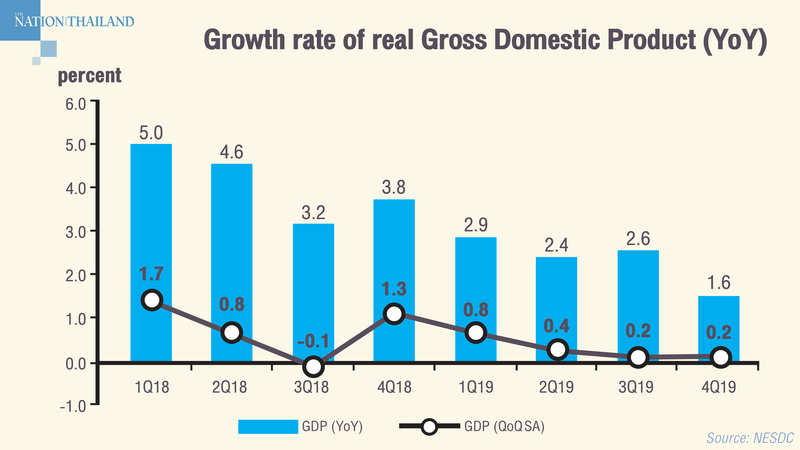
Thailand’s gross domestic product in the fourth quarter of 2019 expanded by 1.6 per cent year on year, decelerating from 2.6 per cent in Q3 2019, as a consequence of decrease in exports, government final consumption expenditure and public investment. However private final consumption expenditure and private investment maintained their growth momentum, the Nation Economic and Social Development Council reported today (February 17)

On the production side, the agricultural sector decreased by 1.6 per cent, compared to a rise of 2.7 per cent in Q3 2019. Non-agricultural sector increased by 2 per cent, slowing down from 2.5 per cent in Q3 2019, due to the manufacturing sector declining by 2.3 per cent.

NESDB lowers 2020 economic growth estimate

The coronavirus’s effect on tourism will carry into 2021, experts say

Economic fallout from China’s coronavirus mounts across the globe

Manufacturing was hurt mainly by a drop in output of motor vehicles and refined petroleum products. Nevertheless, the services sector increased by 4.1 per cent, compared to an expansion of 3.9 per cent in the previous quarter. The improvement was driven by expansion in accommodation and food service activities, wholesale and retail trade; repair of motor vehicles and motorcycles, and information and communication with growth rates of 6.8 per cent, 5.2 per cent, and 10.8 per cent, respectively.

On the expenditure side, private final consumption expenditure, and gross fixed capital formation grew by 4.1 per cent, and 0.9 per cent, compared to 4.3 per cent, and 2.7 per cent in Q3 2019, respectively.

Government final consumption expenditure, exports and imports of goods and services decreased by 0.9 per cent, 3.6 per cent, and 8.3 per cent, respectively. After seasonal adjustment, the Thai economy in Q4 2019 expanded by 0.2 per cent.

Private final consumption expenditure increased by 4.1 per cent, in comparison with a rise of 4.3 per cent in Q3 2019, contributed largely by an expansion of semi-durable and service items with a rise of 2.7 per cent and 8.5 per cent, accelerating from 2.4 per cent and 6.4 per cent respectively in Q3 2019. However, non-durable items grew by 2.6 per cent, slowing from 3.5 per cent in Q3 2019 whereas durable items declined by 4.1 per cent, in contrast to a rise of 1.6 per cent in Q3 2019.

General government final consumption expenditure decreased by 0.9 per cent, compared to a 1.7 per cent growth in Q3 2019. The contraction was mainly contributed by a 6.5 per cent decline in purchases of goods and services while compensation of employees increased by 1.4 per cent, slowing from 1.8 per cent in Q3 2019.

Meanwhile, social transfer in kind grew by 5.1 per cent.

Gross fixed capital formation grew by 0.9 per cent, slowing from 2.7 per cent in the third quarter of 2019, contributing largely to private investment with an increase of 2.6 per cent, compared to 2.3 per cent in Q3. The expansion was due mainly to a 3.1 per cent and 2.5 per cent investments in construction and machinery items, respectively. However, public investment dropped by 5.1 per cent, compared to a 3.7 per cent growth in Q3 2019, which contributed to a decrease in construction and machinery items. In particular, a contraction in government construction resulted from a delay in passing the FY2020 budget bill.

Changes in inventories at current market prices in this quarter increased with a value of Bt126.3 billion. Accumulation in stocks was mainly from paddy, gold, and wearing apparel.

Goods and services balance at current market prices recorded a surplus of Bt390.9 billion comprising surpluses of Bt180.1 billion in trade balance and Bt210.8 billion in service balance.

Airports’ expansion work ready for bidders #ศาสตร์เกษตรดินปุ๋ย

#ศาสตร์เกษตรดินปุ๋ย : ขอบคุณแหล่งข้อมูล : หนังสือพิมพ์ The Nation

https://www.nationthailand.com/business/30382151?utm_source=category&utm_medium=internal_referral

Airports’ expansion work ready for bidders

Feb 17. 2020
Photo credit: Department of Airports website

Photo credit: Department of Airports website
By THE NATION

The Department of Airports is ready to call bids for expansion projects, worth a total of Bt3.6 billion, to boost the capacities of four airports this year, said director-general Tawee Gasisam-ang.

Among the planned developments is the construction of a new taxi way at Krabi airport, valued at Bt1.350 billion. This project will boost the airport’s capacity to serve 25 flights per hours from ten flights currently. The new taxi way is expected to be operational in 2022.

A new passenger terminal, worth Bt800 million, will be built at Narathiwat airport to raise passenger capacity from 800,000 to 1.7 million a year. Completion is expected in 2023.

Expansion of the departure area and installation of a jet bridge in Surat Thani airport at a cost of Bt200 million will also be up for grabs. This project will raise the airport’s total capacity from 2.3 million passenger per year to 3.5 million. Currently, the airport handles 2.16 million passenger a year.This project is scheduled for completion in 2022.

A second passenger terminal will be built at Buriram airport, costing Bt775 million, to raise its passenger capacity from 800,000 to 1.7 million a year. Construction is expected to complete in 2022.

He added that the term of reference for the projects at Krabi, Narathiwat, and Surat Thani airports will be available in March before the bids in April for construction to begin in August this year.

The bid for the project at Buriram airport is expected in May this year, said Tawee.

Direct-sales watchdog panel being readied #ศาสตร์เกษตรดินปุ๋ย

#ศาสตร์เกษตรดินปุ๋ย : ขอบคุณแหล่งข้อมูล : หนังสือพิมพ์ The Nation

https://www.nationthailand.com/business/30382145?utm_source=category&utm_medium=internal_referral

Direct-sales watchdog panel being readied

Feb 17. 2020
File Photo by The Office of the Consumer Protection Board's Website

File Photo by The Office of the Consumer Protection Board’s Website
By THE NATION

Candidates are being considered for membership on Thailand’s first committee charged with overseeing direct sales and direct marketing businesses.

The Office of the Consumer Protection Board will propose a list this week to the permanent secretary of the Prime Minister’s Office for consideration.

Dechawat Chaeng-chuen, director of the Centre for Consumer Protection in Direct Selling and Direct Marketing Business, said the committee’s appointment responds to new legislation regulating direct sales, a type of retailing that’s playing an increasingly influential role in Thai life.

The committee will have eight members, with the chairman appointed by the Cabinet.

Members will include the directors-general of the departments of Internal Trade and Industrial Promotion, the chief of the Royal Thai Police and the secretary general of the Food and Drug Administration.

The Cabinet will appoint other members from associations and foundations involved in direct sales and marketing and consumer protection.

Dechawat said the committee will ensure consumers of fair treatment.

NBTC makes Bt100.521 billion in spectrum licences auction #ศาสตร์เกษตรดินปุ๋ย

#ศาสตร์เกษตรดินปุ๋ย : ขอบคุณแหล่งข้อมูล : หนังสือพิมพ์ The Nation

https://www.nationthailand.com/business/30382237?utm_source=category&utm_medium=internal_referral

NBTC makes Bt100.521 billion in spectrum licences auction

Feb 16. 2020
By Sirivish Toomgum
The Nation

The National Broadcasting and Telecommunications Commission (NBTC) raked in Bt100.521 billion (excluding VAT) from its auction of 49 licences of three spectrum band – 700MHz, 2600MHz and 26GHz, today (February 16). Of the 49 licences put on auction , 48 were taken up, leaving just a single licence for the 26GHz spectrum unsold. There were 27 26GHz licences at the auction.

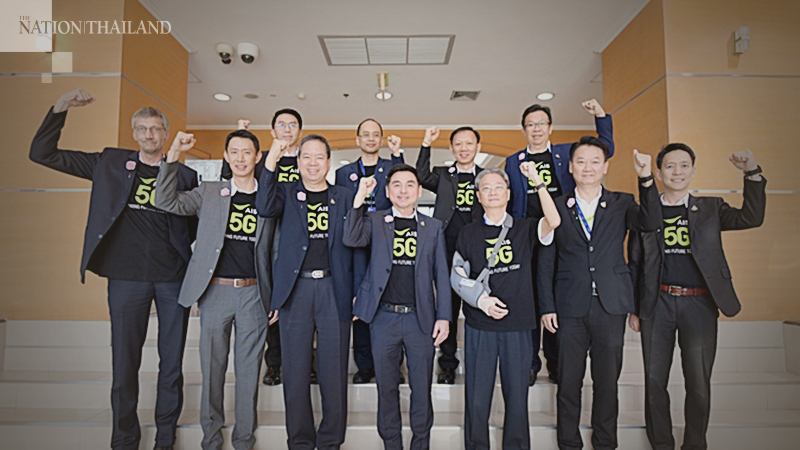
Five bidders took part in the much-awaited multiband auction, which is expected to give the country’s march towards 5G technology a big push. Advanced Wireless Network (AWN) of Advanced Info Service (AIS), dtac TriNet of Total Access Communication, TrueMove H Universal Communication (TUC) of True Corp, CAT Telecom, and TOT were in the fray for the licences.

AWN secured the most licences. It offered more than Bt17.154 billion to win one 700MHz licence, more than Bt19.56 billion to win 10 licences in the 2600MHz spectrum and Bt5.345 billion to win 12 licences of 26GHz.

AWN already has 2x10MHz bandwidth of the 700MHz. Clinching an additional 2x5MHz of 700MHz would mean it will have a total of 2x15MHz of the band.

CAT proposed Bt34.306 billion to clinch two 700MHz licences.

TUC offered Bt17.873 billion to win nine licences of 2600MHz and Bt3.577 billion to win eight licences of 26GHz.

TOT offered Bt1.795 billion to grab four licences of 26GHz.

Dtac Trinet offered more than Bt910 million to win two licences of 26GHz.

The NBTC started the auction early in the morning with three 700MHz licences, totalling 2x5MHz bandwidth each. All the licences were grabbed before noon after less than three hours of bidding.

This was followed by the auction of 19 licences of the 2600MHz spectrum, totalling 10MHz. All licences were grabbed.

Then it auctioned 27 licences of the 26GHz spectrum, totalling 100MHz each. Twenty-six licences were grabbed.

Overall, the auction of all the licences took five hours.

Only CAT, TUC and AWN bid for the both the 700MHz and 2600MHz bands, while all, except CAT, bid for the 26GHz band.

NBTC secretary-general Takorn Tantasith said the NBTC board will approve the bid results on February 19. The winning bidders can obtain the licences after that.

The watchdog is expecting the licence-holders to offer 5G service on these bands.

The NBTC had originally intended to auctionfour spectrums, including 1800MHZ licences. However, none of the bidders showed interest in the 1800MHz bandwidth. Therefore, the NBTC auctioned off only three bands today.