
Fact-checking Trump’s call to the Georgia secretary of state #SootinClaimon.Com

#SootinClaimon.Com : ขอบคุณแหล่งข้อมูล : หนังสือพิมพ์ The Nation.

Fact-checking Trump’s call to the Georgia secretary of state

InternationalJan 05. 2021
By The Washington Post · Glenn Kessler

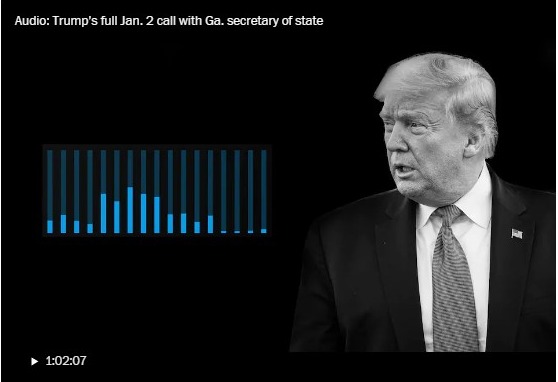
The Washington Post’s Amy Gardner had a terrific scoop Sunday, obtaining the audio of a one-hour call between President Donald Trump and Georgia Secretary of State Brad Raffensperger, in which Trump urged Raffensperger to “find” enough votes to overturn his defeat in the state.

Her article provided a quick summary of the various false claims that president made in the call, but here’s a quick guide to the facts so readers can see how the president framed these statements himself. We will go through the claims, more or less in the order in which they were presented. What is clear is that the president is relying on highly dubious sources of information as he continues to contest the election results.

– – –

“I think it’s pretty clear that we won. We won very substantially in Georgia.”

No, Trump lost. Joe Biden has been certified as the winner of the state, after two recounts.

– – –

“You even see it by rally size, frankly. We’d be getting 25-30,000 people a rally, and the competition would get less than 100 people. And it never made sense.”

Trump has long been obsessed over the size of the crowds at his rallies. In the final days of the election campaign, according to our database of Trump’s false and misleading claims, Trump repeatedly hyped the number of people at his rallies – he rarely attracted more than 25,000 people – and often remarked that his crowds were bigger than any previous American or even world figure. (Not so.) He also knocked Joe Biden for having small crowds, even though the Biden campaign was purposely trying to model good behavior during the pandemic.

In these comments, Trump echoes something he said often in his final rallies – that he could not possibly lose because of the crowds he attracted. He constantly inflated the size of the “tractor rallies” and “boat rallies” on his behalf. But it’s absurd to believe that crowd sizes translate into votes. Many losing presidential campaigns – such as George McGovern’s in 1972 – attracted huge crowds in the last days of the campaign.

“The crowds at campaign events were large and enthusiastic,” recalled McGovern in a 2012 article. “I didn’t pay undue attention to the polls, and I wasn’t overly concerned that there would be no face-to-face debates with Nixon. But when election night came and the early returns revealed one of the most lopsided victories in U.S. history, I was genuinely stunned.” (McGovern lost 49 states to Richard Nixon.)

– – –

“Anywhere from 250 to 300,000 ballots were dropped mysteriously into the rolls.”

Only someone unaware of how ballots are counted would think something is mysterious. Trump is referring to the counting of mail-in ballots – almost two-thirds of the 1.3 million absentee ballots in Georgia were cast for Biden – that were generally counted after in-person ballots had been tabulated. In Georgia, absentee ballots can be processed (such as removed from envelopes and signature checked) upon receipt but they cannot be counted until Election Day.

– – –

“Much of that had to do with Fulton County, which hasn’t been checked. We think that if you check the signatures – a real check of the signatures going back in Fulton County – you’ll find at least a couple of hundred thousand of forged signatures of people who have been forged.”

Trump is making up numbers here. There were only about 147,000 absentee ballots cast in Fulton County, making it impossible for “a couple of hundred thousand” forged signatures.

– – –

“People that went to vote and they were told they can’t vote because they’ve already been voted for. And it’s a very sad thing. They walked out complaining. But the number’s large. . . . You also have a substantial numbers of people, thousands and thousands, who went to the voting place on November 3, were told they couldn’t vote, were told they couldn’t vote because a ballot had been put on their name. And you know that’s very, very, very, very sad.”

This has been a persistent claim by the Trump campaign in various states – that Trump supporters went to vote, only to find their ballot had already been cast (presumably by Democratic operatives) and thus they were given a provisional ballot. No evidence has ever emerged to prove this.

– – –

“There were no Republican poll watchers. Actually, there were no Democrat poll watchers, I guess they were them. But there were no Democrats, either, and there was no law enforcement. Late in the morning, early in the morning, they went to the table with the black robe and the black shield, and they pulled out the votes. Those votes were put there a number of hours before – the table was put there – I think it was, Brad, you would know, it was probably eight hours or seven hours before, and then it was stuffed with votes. They weren’t in an official voter box; they were in what looked to be suitcases or trunks, suitcases, but they weren’t in voter boxes.”

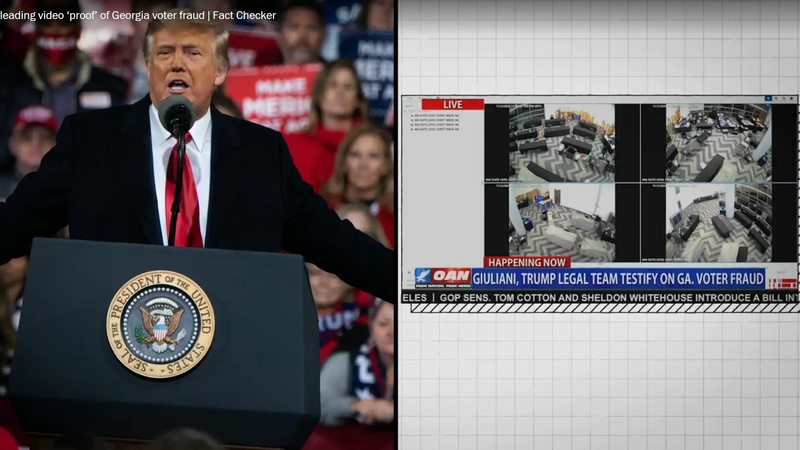
During a campaign rally for the Senate runoff races in December, Trump made a similar claim – which we debunked at the time.

The surveillance video at State Farm Arena, which comprises four security camera feeds – shows no irregularities, illegal behavior or evidence of malfeasance on behalf of poll workers. The supposed “suitcases” have been repeatedly identified by election officials as the standard boxes used in Fulton County to transport and store ballots. The video also fails to show any act of hiding or obscuring any ballots or election materials. Additionally, the video shown doesn’t prove the Trump campaign’s assertion that GOP monitors were told to leave the counting room in order for poll workers to engage in illegal ballot counting.

– – –

“It was late in the evening, late in the, early in the morning, and there was nobody else in the room. Where were the poll watchers, and why did they say a water main broke, which they did and which was reported in the newspapers? They said they left. They ran out because of a water main break, and there was no water main. There was nothing. There was no break.”

Later in the call, Trump referenced a supposed water main break used to clear the room of poll watchers, a key focus of right-wing conspiracy websites. Officials have explained that a urinal had created a “little slow leak” in the arena.

– – –

“You had out-of-state voters. They voted in Georgia, but they were from out of state, of 4,925.”

During the call, secretary of state counsel Ryan Germany told Trump that his numbers were wrong. “They’re not accurate,” he said. “Every one we’ve been through are people that lived in Georgia, moved to a different state, but then moved back to Georgia legitimately.”

– –

“You had drop boxes, which is very bad. You had drop boxes that were picked up. We have photographs, and we have affidavits from many people.”

Germany previously told the state House Government Affairs Committee that video reviews found this to be false.

– – –

“The other thing, dead people. So dead people voted, and I think the number is close to 5,000 people. And they went to obituaries. They went to all sorts of methods to come up with an accurate number, and a minimum is close to about 5,000 voters.”

Another ludicrous number. During the call and at the state hearing, Germany said they have found a total of two dead people who voted. “Usually, that’s somebody who died recently, and a family member votes with [the name],” Germany said. “That handful of instances are consistent with what we see in every election. Again, it’s not OK.”

– – –

“The bottom line is, when you add it all up and then you start adding, you know, 300,000 fake ballots.”

It is easy to add up nonsense numbers and come up with an even bigger number.

– – –

“They are burning their ballots, that they are shredding, shredding ballots and removing equipment. They’re changing the equipment on the Dominion machines and, you know, that’s not legal.”

As Raffensperger explained during the call, none of this is true. At a news conference Monday, Germany expressed bewilderment at Trump’s claim about Dominion machines being altered. “This is not a thing,” he said.

During the call, Raffensperger pointedly noted that Trump’s claims about Dominion machines could not possibly be true “because we did a hand re-tally, a 100% re-tally of all the ballots, and compared them to what the machines said and came up with virtually the same result. Then we did the recount, and we got virtually the same result.”

– – –

“Remember, her reputation is – she’s known all over the internet, Brad. She’s known all over. I’m telling you, ‘Where’s [name]’ was one of the hot items . . . [name] They knew her. ‘Where’s [name]?’ So Brad, there can be no justification for that.”

At one point, Trump referenced by name an election worker at the State Farm Arena who has been subject of feverish speculation by QAnon followers, who falsely believed she had been arrested. (The Washington Post is not printing her name.) Trump here demonstrates how deep in the conspiracy swamps he has swum.

– – –

“Brad, why did they put the votes in three times? You know, they put ’em in three times.”

“Mr. President, they did not put that,” Raffensperger replied. “We did an audit of that, and we proved conclusively that they were not scanned three times.”

– – –

“They supposedly shredded I think they said 300 pounds of, 3,000 pounds of ballots. And that just came to us as a report today.”

This is more crazed Twitter speculation, with no basis in fact. Cobb County officials explained on Nov. 24 that a shredding company every election is hired to “dispose of non-relevant materials that cannot be easily disposed of,” such as mailing labels and sticky notes. “None of these items are relevant to the election or the re-tally,” said Elections Director Janine Eveler. “Everything of consequence, including the ballots, absentee ballot applications with signatures, and anything else used in the count or re-tally remains on file.

– – –

“In Detroit, we had, I think it was, 139% of the people voted. That’s not too good.”

This has been debunked repeatedly. As we previously reported, Trump campaign allies mixed up precincts in Minnesota and Michigan. Someone had apparently mixed up two states that started with “Mi.” The precincts were not in Wayne County but in some of the reddest parts of Minnesota – Trump country. It turns out that about 51% of the registered voters in the city cast a ballot.

– – –

“In Pennsylvania, they had well over 200,000 more votes than they had people voting.”

Another debunked statement, based on a misunderstanding of an incomplete voter registration database, which was missing numbers for some of the most populous counties in the state. “To put it simply, this so-called analysis was based on incomplete data,” said Pennsylvania’s Department of State, which labeled the claim “obvious misinformation.”

– – –

“She got you to sign a totally unconstitutional agreement, which is a disastrous agreement. You can’t check signatures. I can’t imagine you’re allowed to do harvesting, I guess, in that agreement.”

The “she” here is voting-rights advocate Stacey Abrams. Trump is referring to a March settlement under which voters were to be contacted if problems arose with their absentee ballot. But Trump wrongly believes it did not allow signature verification and that it allows “harvesting,” the collecting of ballots in bulk permitted in some states. But not in Georgia, as Raffensperger quickly pointed out.

– – –

The Pinocchio Test

Is there any doubt? Four Pinocchios.

Here’s what to expect when Congress meets to confirm Biden’s win #SootinClaimon.Com

#SootinClaimon.Com : ขอบคุณแหล่งข้อมูล : หนังสือพิมพ์ The Nation.

Here’s what to expect when Congress meets to confirm Biden’s win

InternationalJan 05. 2021This is what a joint session of Congress looked like before the pandemic. MUST CREDIT: Washington Post photo by Nikki KahnThis is what a joint session of Congress looked like before the pandemic. MUST CREDIT: Washington Post photo by Nikki Kahn
By The Washington Post · Amber Phillips

This week, as many as three dozen congressional Republicans will launch a final challenge to the electoral college results of the 2020 presidential election.

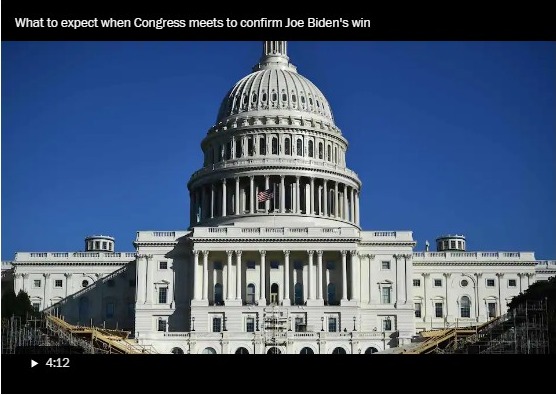
Congress will meet Wednesday to count and confirm each state’s electoral votes. It has become routine after recent elections for House lawmakers on the losing side to put up a symbolic fight over the results, which they can do under an 1880s law governing the process.

It has been less common for senators to join them, but this time a dozen will. Sens. Josh Hawley, R-Mo., and Ted Cruz, R-Texas, will lead the challenge of the votes and call for an emergency audit to investigate alleged fraud. It’s also unprecedented to see as many challenges to states’ results as are expected Wednesday. This will happen despite no evidence of widespread election fraud and as the outgoing president has refused to concede and tried to strong-arm the process at every step to stay in power.

The challenges are poised to delay the inevitable, which is Congress confirming Joe Biden’s win. But it will force Congress to vote on the challenges and put Vice President Mike Pence in the position of eventually having to officially announce Biden’s win.

Newly elected Republican House members gather on the steps of the Capitol for their formal photo on Monday, Jan. 4, 2021. MUST CREDIT: Washington Post photo by Michael Robinson Chavez

Newly elected Republican House members gather on the steps of the Capitol for their formal photo on Monday, Jan. 4, 2021. MUST CREDIT: Washington Post photo by Michael Robinson Chavez

Here’s how the day probably will go:

– – –

What Congress is doing Wednesday

Throughout November and December, states certified their results. Then the electoral college voted Dec. 14 based on those results and made Biden the winner. States sent their electoral college vote totals to the new Congress to be counted and confirmed. This counting will happen Wednesday. It’s largely a formality, since election law says Congress has to treat states’ results completed by the deadline of Dec. 8 as “conclusive.”

Wednesday is the penultimate step in the post-election process. All that’s left after that is to inaugurate Biden.

– – –

How Congress counts the votes

Congress will meet in a joint session, meaning the House and Senate are together (with precautions taken for the coronavirus). Pence will preside over the process. He could delegate the job to another senator, but that is unlikely.

They will go through the states alphabetically. For each state, clerks sitting below Pence will hand him the envelopes and tell him the votes; he is to read them out loud. Congress will vote on accepting states’ results.

– – –

How challenges to states’ electors will work

For a challenge to proceed, at least one lawmaker from each chamber must object to a state’s electors. More than two dozen House Republicans have said they will try to challenge results, and a dozen GOP senators will join them – even though Senate Majority Leader Mitch McConnell, R-Ky., has urged senators to stay away from this move.

Lawmakers do not have to give a detailed explanation of why they object; they just object in writing, which Pence will read out loud.

If there’s an objection to a state’s electors raised by a lawmaker in the House and one in the Senate, the chambers have to split up and vote on that objection. They have up to two hours to debate each one.

– – –

How voting on challenges is expected to occur

If a House member and a senator challenge the electoral count in a state, the Senate splits off and debates this challenge for up to two hours, then each senator gets a vote on which electors to approve. The House does the same.

The Democratic-controlled House has the votes to knock down all challenges.

Senate Republican leaders have not been able to keep their party unified through this process, but they expect to have the votes to confirm Biden’s win, despite as many as a dozen Republican defections. Sen. John Thune of South Dakota, the No. 2 Senate Republican, said last month that any challenges are “going down like a shot dog.” Republican senators such as Mitt Romney of Utah and Ben Sasse of Nebraska have characterized their colleagues’ challenges to certified election results as dangerous.

At least one Republican critic of the objections pointed to President Donald Trump’s hour-long phone call with Georgia’s secretary of state, in which the president tried to get his loss in Georgia overturned, as all the more reason for the Republican Party to stand up to Trump and vote to certify states’ legitimate results. “To every member of Congress considering objecting to the election results,” tweeted Rep. Adam Kinzinger, R-Ill., “you cannot – in light of this – do so with a clean conscience.”

Republican leaders’ resistance to challenging the election now is notable given that the majority of Republican lawmakers waited more than a month to acknowledge that Biden was the winner. Many still have not. But there does not seem to be an appetite among a majority of Republican lawmakers to use Congress to try to overturn the will of the voters.

There’s also no legal basis for senators to question the electoral college results, since all the states that are in Trump’s focus met every legal requirement for having their electoral votes recognized by Congress.

– – –

What happens if one chamber votes to accept a challenge to electors

If the Senate decided to vote in favor of a challenge to a state’s electors, there are still many hurdles to overturning Biden’s win.

The law requires both chambers of Congress to affirmatively vote to object to a state’s electors, which will not happen with a Democratic-controlled House.

Even if both chambers agreed to accept the challenge, the tiebreaker would go to the governor of the state. All governors in contested states have certified results that Biden won.

– – –

This process could stretch into the night

Trump lost about six swing states, and they’re spread throughout the alphabet – Arizona to Wisconsin. Republicans who question the election results have indicated that they will try to challenge all of them. Each time there’s a challenge supported by at least one member of each chamber, Congress has to split off and vote on it. Then they come back together and keep counting states. Voting will also take longer than normal because of coronavirus precautions to space lawmakers apart from one another.

What is a normally quick and easy process could get dragged into the wee hours.

– – –

Pence’s role

Pence’s part here is administrative. He has no real authority to refuse to accept electoral results. If he did, it would be in violation of the law. It might even face a court challenge (although legal experts have said they do not think he would face criminal charges). A majority of Congress probably would quickly vote down any challenges he brought up.

Rep. Louie Gohmert, R-Texas, recently filed a lawsuit in federal court trying to undermine the 1880s election law that governs Pence’s role in the process. He wanted Pence to have total control over counting the votes from states, then award the election to Trump. Election law experts say that has no basis in law or the Constitution, and Pence’s team said it did not agree with the lawsuit. The judge threw it out in a matter of days.

Pence has told Trump that he has no power to thwart Biden’s electoral college win, The Washington Post reports, and aides say Pence plans to stick to his perfunctory role.

But after being tight-lipped about the process, his office this weekend encouraged the challenges to states’ results, saying Pence “welcomes the efforts of members of the House and Senate to use the authority they have under the law to raise objections and bring forward evidence.”

– – –

What’s happened in past challenges

Members of the party that lost the presidential election have raised objections after nearly every election since 2000. All have failed, and only one succeeded in splitting the chambers to force them to debate one challenge.

When certifying the contentious 2000 election, House Democrats tried to challenge Vice President Al Gore’s loss using Florida’s electoral votes, but they could not find a Senate partner to get things started.

In 2005, House Democrats challenged President George W. Bush’s reelection the same way over the result in Ohio. Then-Sen. Barbara Boxer, D-Calif., joined them, but the effort was quashed quickly, including by her fellow Democrats in the Senate. House Democrats tried again in 2016 to challenge Trump’s win, but no senator was willing to stand with them.

For that challenge, it was then-Vice President Joe Biden who was presiding over everything. “It is over,” he told Democrats.

National Guard activated for D.C. protests, with more restraints than in June, officials say #SootinClaimon.Com

#SootinClaimon.Com : ขอบคุณแหล่งข้อมูล : หนังสือพิมพ์ The Nation.

National Guard activated for D.C. protests, with more restraints than in June, officials say

InternationalJan 05. 2021D.C. Mayor Muriel E. Bowser, center, with acting D.C. police Chief Robert Contee III behind and to her left on Dec. 22. MUST CREDIT: Photo by Robb Hill for The Washington Post.D.C. Mayor Muriel E. Bowser, center, with acting D.C. police Chief Robert Contee III behind and to her left on Dec. 22. MUST CREDIT: Photo by Robb Hill for The Washington Post.
By The Washington Post · Julie Zauzmer, Marissa J. Lang, Dan Lamothe

WASHINGTON – The District has mobilized the National Guard and will have every city police officer on duty Tuesday and Wednesday to handle protests of the November presidential election, which Mayor Muriel Bowser said may include people looking to instigate violence.

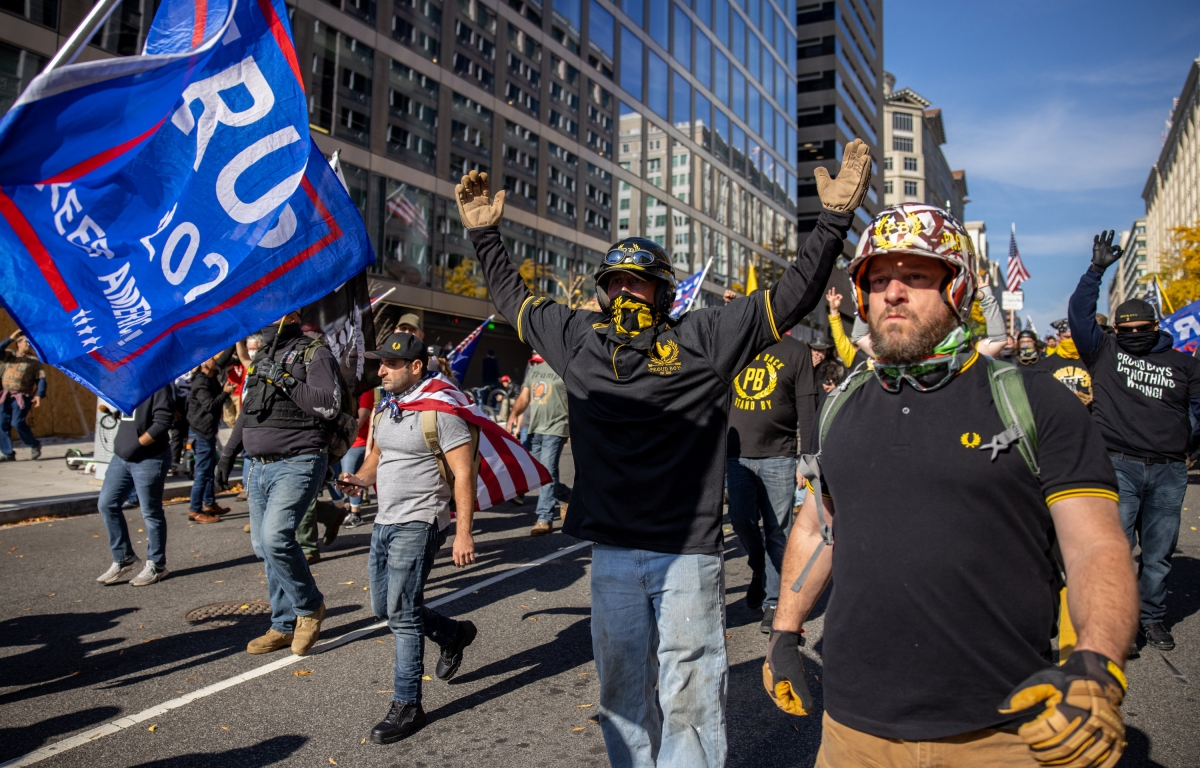
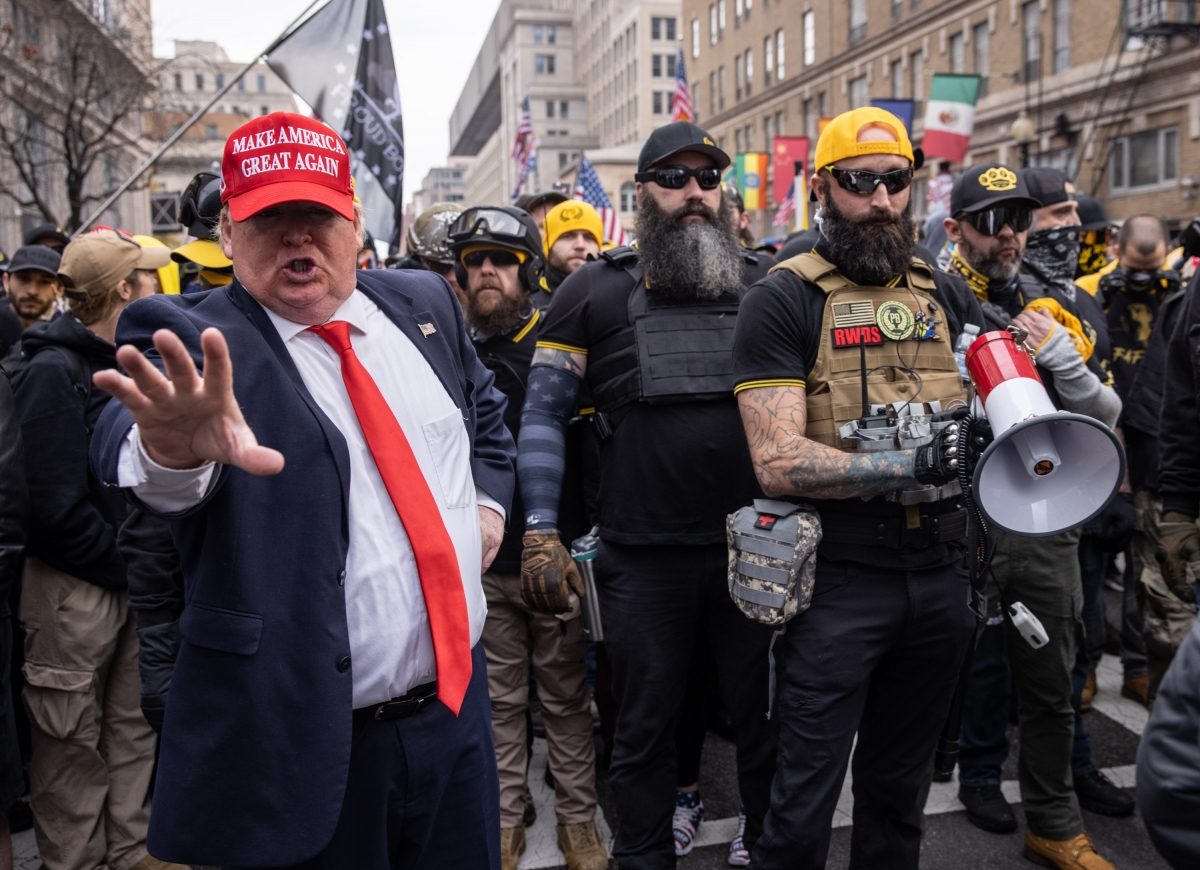
Bowser, a Democrat, has asked D.C. residents to stay away from downtown Washington on both days while members of far-right groups, including the Proud Boys, amass to falsely claim President Donald Trump was reelected.

Trump – who lost both the popular and electoral-college vote to President-elect Joe Biden – has continued to dispute the results, without evidence, and is encouraging his supporters to attend the rallies.

He has said he might appear at Wednesday’s demonstration at the Ellipse, just outside the White House, which is timed to coincide with Congress’s vote to certify the election results – a formality that this year will be a fraught and divisive process.

“People are allowed to come into our city to participate in First Amendment activities,” Bowser said Monday. “We will not allow people to incite violence, intimidate our residents, or cause destruction in our city.”

Pro-Trump protests in November and December, which included some of the same groups, ended violently, with multiple people stabbed and several Black churches vandalized. This time, members of right-wing groups have discussed how to bring guns into the District despite laws banning open carry throughout the city and prohibiting guns on such federal lands as the Mall and Freedom Plaza or anywhere within 1,000 feet of a protest.

Proud Boys march in Washington, D.C. on Nov. 14 to protest the election results. MUST CREDIT: Photo by Evelyn Hockstein for The Washington Post.

Proud Boys march in Washington, D.C. on Nov. 14 to protest the election results. MUST CREDIT: Photo by Evelyn Hockstein for The Washington Post.

Bowser said that the National Guard members, who will not carry guns, will help enforce street closures and otherwise assist with crowd management so that D.C.’s police department can focus on law enforcement, including arresting anyone who is unlawfully carrying a gun.

Defense officials said the Pentagon approved the activation of more than 300 members of the District of Columbia National Guard, but limited the size and scope of the mission after a deployment in June raised questions about whether the Trump administration was trying to use the military as a political club.

Two defense officials familiar with the plans, speaking on the condition of anonymity due to the sensitivity of the issue, said the guardsmen are not expected to use armored vehicles, including Humvees, relying instead on civilian vans owned by the government. The military also has not approved the use of its helicopters, which were deployed over racial justice protesters in June in an apparent show of force, prompting a military investigation whose results still have not been released.

No National Guard members from other states are expected to be called into D.C., the officials said – again, in contrast to June.

The smaller military presence comes as current and former defense officials warn against relying on the Armed Forces for election-related activities. The military, with its nonpartisan tradition, should not be dragged into politics, they have said.

On Sunday, all 10 living former defense secretaries combined to publish an op-ed in The Washington Post warning that the time has come to stop contesting presidential election results, and that the military should have no role in overturning them.

The National Park Service began issuing permits Monday for the so-called “Stop the Steal” rallies, which are expected to begin Tuesday afternoon and continue through Wednesday.

Women for America First – a group behind a pro-Trump march in November and another on Dec. 12 that ended in a night of chaos on D.C. streets – was granted a permit to host about 5,000 people on the southern half of the Ellipse on Wednesday morning. A list of potential speakers includes longtime Trump ally Roger Stone, whose sentence for seeking to impede a congressional probe into Russian election interference was commuted by Trump in July before being upgraded to a full pardon, and Rudy Giuliani, Trump’s campaign attorney, who has waged a roundly unsuccessful legal fight to overturn the election results.

Groups questioning the election outcome will also hold protests at Freedom Plaza, on Pennsylvania Avenue NW, on Tuesday afternoon and outside the Capitol at 1 p.m. on Wednesday.

Though no organized march between the Wednesday rallies has been planned, organizers said they expect a large number of attendees to make their way from the Ellipse to the Capitol at the conclusion of the morning event.

Proud Boys during a Dec. 12 rally in downtown Washington that questioned President Trump's election defeat. MUST CREDIT: Photo by Evelyn Hockstein for The Washington Post.

Proud Boys during a Dec. 12 rally in downtown Washington that questioned President Trump’s election defeat. MUST CREDIT: Photo by Evelyn Hockstein for The Washington Post.

Pro-Trump protesters have also frequently visited the stretch of 16th Street NW north of the White House that Bowser renamed Black Lives Matter Plaza during the summer demonstrations, where they have torn down signs honoring Black leaders and victims of violence and demanding racial justice.

Acting D.C. police chief Robert Contee III, who assumed the position just this week, said Monday that police might close off the plaza to all pedestrians if conditions warrant.

The organization Black Lives Matter DC put out a statement Monday asking Bowser to go further than she has so far in her denunciation of far-right demonstrators.

The statement included three specific demands: that businesses in the District refuse to do business with “white supremacists and hate groups who incite violence”; that D.C. officials do more to enforce mask and social distancing protocol among rallygoers; and that D.C. lawmakers do more to “protect our sacred Black spaces.”

“The authorities have no problem keeping the White House – and the white man inside – safe; Black people expect and demand no less for our sacred Black spaces, including Black churches and Black Lives Matter Plaza,” the group wrote.

Bowser said Monday that police would focus on enforcing gun laws and addressing any potential violence, and would not arrest or fine people for violating the city’s masking and social distancing requirements.

She said she would consider imposing a curfew if needed, as she did during racial justice protests in June.

Did Trump break the law in his call to Georgia’s secretary of state? Some lawyers say yes. #SootinClaimon.Com

#SootinClaimon.Com : ขอบคุณแหล่งข้อมูล : หนังสือพิมพ์ The Nation.

Did Trump break the law in his call to Georgia’s secretary of state? Some lawyers say yes.

InternationalJan 05. 2021President Donald Trump walks to the Oval Office on Thursday, Dec. 31, 2020. MUST CREDIT: Washington Post photo by Bill O'LearyPresident Donald Trump walks to the Oval Office on Thursday, Dec. 31, 2020. MUST CREDIT: Washington Post photo by Bill O’Leary
By The Washington Post · Teo Armus

After The Washington Post on Sunday published an extraordinary phone call between President Donald Trump and Georgia Secretary of State Brad Raffensperger, R, many observers shared one question: Did Trump break the law?

https://www.washingtonpost.com/video/c/embed/3f9426f4-7937-4718-8a8e-9d6052001991?ptvads=block&playthrough=false

During that hour-long call on Saturday, Trump urged Raffensperger to “find” enough votes to overturn his defeat and threatened him with vague legal consequences, seemingly encouraging his fellow Republican to fix the election results.

As the sole Democrat on Georgia’s state election board on Sunday urged Raffensperger to investigate the president over the call, some lawyers and legal scholars say Trump’s actions indeed appeared to violate both state and federal criminal statutes.

On social media, much of the conversation among legal observers and Trump critics revolved around a federal statute, 52 U.S. Code 20511, that makes it a crime to “knowingly and willfully” deprive or defraud a state’s residents of a free or fair election – or to attempt to do so.

Eric Holder, the former attorney general under President Barack Obama, shared the text of that statute on Twitter on Sunday. “As you listen to the tape consider this federal criminal statute,” Holder wrote.

The question, according to Justin Levitt, a law professor at Loyola Marymount University, is whether Trump was “knowingly and willfully” pressuring Raffensperger to count nonexistent votes when he told the GOP official, “I just want to find 11,780 votes.”

In other words: Does Trump actually believe that 11,780 ballots in his favor were cast but not counted?

Considering that two recounts, an audit and several judges have upheld President-elect Joe Biden’s win in Georgia, Levitt said it is clear Trump was not actually pushing for an “honest tally” of the votes.

“Either the president was engaged in the commission of a felony,” he said, “or he has lost his hold on reality such that he can no longer distinguish fact from the fictions he has been fed.”

Michael R. Bromwich, a former Justice Department inspector general, put it more bluntly on Twitter: “His best defense would be insanity.”

Since 52 U.S. Code 20511 was adopted as part of the National Voter Registration Act of 1993, it has been used sparingly by federal prosecutors. It was used in 2005 to go after Milwaukee grandmother Kimberly Prude, who voted illegally in the city while still on probation. But Levitt said there is no precedent to use it against someone of Trump’s stature.

Other legal scholars said that Trump possibly violated 18 U.S. Code 241, which makes it illegal to participate in a conspiracy against people exercising their civil rights. That longstanding statute has been used frequently to prosecute acts of voter intimidation, especially those committed by the Ku Klux Klan against Black voters.

But charging Trump under that code would require prosecutors to show that someone else on the phone call was also aiding and abetting a scheme, Levitt said.

Additionally, Trump’s apparent threat of criminal consequences if Raffensperger failed to act could be seen as an attempt at extortion, The Post reported.

On the state level, Trump’s call could also have violated a Georgia statute.

Leigh Ann Webster, a criminal defense attorney in Atlanta, told The Post that in Georgia, Trump could run afoul of a state law that makes it illegal to cause someone else to partake in election fraud – by soliciting, requesting, or commanding it.

That’s the same statute cited on Sunday by David J. Worley, the Georgia election board member who asked Raffensperger to investigate Trump. In his email to the GOP official, Worley said that “probable cause” may exist to find violations of that law.

“It’s a crime to solicit election fraud, and asking the secretary to change the votes is a textbook definition of election fraud,” Worley said in an interview with The Post.

The argument may be more straightforward compared to a potential federal case. Under the Georgia statute, Webster said the crime would be merely asking someone else to partake in one of several forms of election fraud, including interfering with the secretary of state’s handling of an election.

But because such matters at the state level have rarely been interpreted in court, “none of this is bulletproof,” she said.

And whether Trump broke federal state law, it’s a different question of whether any prosecutor would try to charge him.

Until Biden is sworn in on Jan. 20, legal scholars say there is virtually no chance of federal charges being filed. Besides the short time frame, Levitt said, the Justice Department maintains a long-standing principle that a federal prosecutor may not prosecute a sitting president.

No such principle exists once a commander in chief is out of office. Yet under a Biden administration juggling a bevy of competing priorities, going after Trump in the courts could be a politically fraught choice.

Trevor Potter, a Republican and former Federal Election Commission chairman who was appointed by President George H.W. Bush, told the New York Times “there is a good argument” that Trump had been pushing for a fraudulent vote count during the call.

“But even if the Biden Justice Department thinks they have a good case, is that how they want to start off the Biden presidency?” he said. “That is a policy decision.”

Japan’s Suga mulls renewed state of emergency #SootinClaimon.Com

#SootinClaimon.Com : ขอบคุณแหล่งข้อมูล : หนังสือพิมพ์ The Nation.

Japan’s Suga mulls renewed state of emergency

InternationalJan 05. 2021Prime Minister Yoshihide Suga speaks during a New Year's press conference at the Prime Minister's Office in Tokyo on Jan. 4, 2021. MUST CREDIT: Japan News-YomiuriPrime Minister Yoshihide Suga speaks during a New Year’s press conference at the Prime Minister’s Office in Tokyo on Jan. 4, 2021. MUST CREDIT: Japan News-Yomiuri
By Syndication Washington Post, The Japan News-Yomiuri

Japan Prime Minister Yoshihide Suga said Monday the government will consider declaring a fresh state of emergency amid the spread of the novel coronavirus, covering Tokyo and the three neighboring prefectures of Saitama, Chiba and Kanagawa.

A meeting of experts will be held as early as Friday, and the state of emergency is expected to be declared this week. It is expected to last for about a month.

Speaking at a New Year’s press conference at the Prime Minister’s Office, Suga said: “The number of newly confirmed infections did not decline in the first three days of the New Year. Tokyo and the three prefectures accounted for half of the infections nationwide.

“I take this situation seriously and have come to think that a stronger message [by declaring a state of emergency] is needed,” he said.

The risk of infection is said to be high during eating and drinking, such as when eating dinner. Since the end of last year, the government has called on the public to refrain from dining out. However, the turnout in bustling areas in Tokyo has not decreased.

“Details to make [the declaration] effective will be worked out as soon as possible,” Suga said.

The stage of emergency would be declared under the special measures law to cope with new strains of influenza. It would be the first since then Prime Minister Shinzo Abe declared a state of emergency on April 7 last year for Tokyo and six prefectures.

A state of emergency can be issued for specific areas over a set period of time if a prime minister judges that the rapid expansion of infections nationwide would have a “huge impact on people’s livelihoods and their financial situation.”

Governors of prefectures that are subject to a state of emergency can ask residents to refrain from going out, as well as ask or order limits on, or the suspension of, the use of certain facilities.

Tokyo logged 1,337 newly confirmed infections on Dec. 31, topping the 1,000 mark for the first time for a single-day figure. As of Sunday, the number of seriously ill COVID-19 patients in Tokyo totaled 101, the highest since last year’s state of emergency was lifted. The current situation is weighing heavily on the medical system in the capital.

On Saturday, the governors of Tokyo and the three prefectures asked Yasutoshi Nishimura, the economic revitalization minister who is also tasked with handling the pandemic, to issue a fresh state of emergency, saying the increase in new infections showed no signs of abating.

The previous state of emergency was declared on April 7 for Tokyo and six prefectures, and was expanded to all 47 prefectures on April 16. The government initially planned to maintain the state of emergency through May 6, but it was ultimately lifted on May 25.

With regard to vaccinations against COVID-19, Suga said: “The entire government is preparing so that vaccinations can start by the end of February. I am willing to be vaccinated.”

Until vaccinations start, the prime minister said, “It’s important [for the people] to move in the same direction, to get the number of infections declining.”

Regarding the resumption of the Go To Travel program to support domestic tourism, Suga said, “It will probably be difficult if a state of emergency [is declared again].” Go To Travel has been suspended through Jan. 11 nationwide.

108 seriously ill in Tokyo

The Tokyo metropolitan government said Monday that there were 108 seriously ill patients infected with the novel coronavirus, up by seven from the previous day and the highest ever.

The previous high was 105, marked on April 28 and 29, when the country was under a state of emergency.

New cases of coronavirus infections in Tokyo numbered 884, the highest for a Monday.

China races to give coronavirus vaccine to 50 million workers before Lunar New Year #SootinClaimon.Com

#SootinClaimon.Com : ขอบคุณแหล่งข้อมูล : หนังสือพิมพ์ The Nation.

China races to give coronavirus vaccine to 50 million workers before Lunar New Year

InternationalJan 05. 2021

By The Washington Post · Eva Dou

China has begun a nationwide drive to vaccinate some 50 million front-line workers against the coronavirus before the Lunar New Year travel rush next month, in hopes of avoiding a repeat of last year’s grim holiday season.

Workers in a range of industries will receive their first of two vaccine shots by the middle of this month, with the next shot two to four weeks afterward, according to the national plan. The nine prioritized groups include health sector workers, delivery workers, people whose jobs require overseas travel, public servants and utilities employees.

China’s target of vaccinating 50 million people in a month is an ambitious goal, more than the populations of California and Michigan combined. In the United States, where the Trump administration has touted its “Operation Warp Speed” to fast-track delivery of vaccines, 4.2 million people have received a first dose since distribution began on Dec. 14, according to the Centers for Disease Control and Prevention’s Covid Data Tracker.

There’s urgency to complete these vaccinations before Lunar New Year – often called the world’s largest annual human migration – which takes place Feb. 11-17. Last year, some 1.5 billion trips were made over the holiday in China, half the normal number, as people sheltered in place against the growing coronavirus outbreak.

After scuttled reunion plans for many families last year, there is pressure on Chinese authorities to make the country safer for holiday travel this time around. For many in China who work far from home, Lunar New Year is the only time they can gather with their families for celebration and feasting.

“We can’t require people to stay at home and not go out during Lunar New Year,” prominent Shanghai infectious-disease expert Zhang Wenhong was quoted saying in the official People’s Daily on Saturday, even as he said controls may be necessary in higher-risk areas.

Millions in priority groups had already received shots as part of an earlier “urgent use” push, before regulators gave the green light to a vaccine from Sinopharm, a state-owned drugmaker, last week. Now, vaccines are being rolled out by municipal authorities to all prioritized workers willing to take them, and should begin to reach some other demographics by next month.

China’s approval of Sinopharm’s vaccine has given confidence to some other countries. Egypt said Saturday it had approved Sinopharm’s vaccine for emergency use, while a Pakistan minister said the country would purchase 1.2 million doses from Sinopharm.

However, Sinopharm has also come under criticism for lack of transparency, with scant detail released about its Phase 3 clinical trials. Wu Yonglin, the president of the Sinopharm unit that developed the vaccine, has said that the company will provide detailed data after more observation.

Within China, state media on Monday was awash with reports of the vaccination drive. In the capital city, Beijing, municipal officials reported that 73,537 people received their first dose of vaccine in the first two days of the new year.

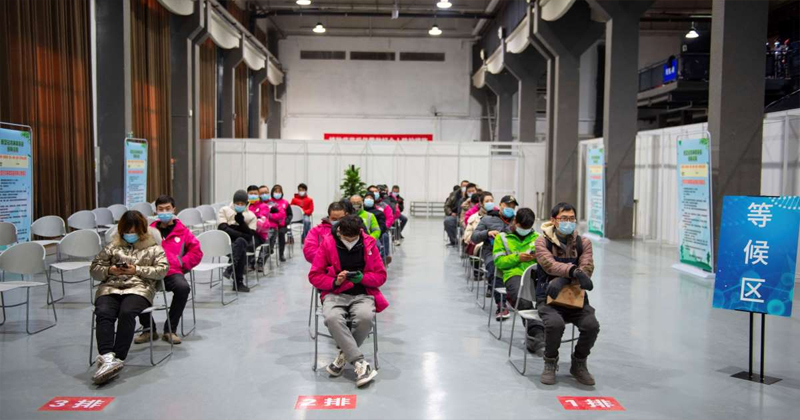
State broadcaster CCTV showed footage of people standing in line over the weekend at pop-up vaccination sites in Beijing, and sitting in socially distanced seats afterward for monitoring for any adverse symptoms. The broadcaster said there were more than 200 vaccination sites in the capital.

Other cities across the country have also announced drives to vaccinate front-line workers over the past two weeks.

Health Times, a state-run newspaper, quoted vaccine expert Tao Lina last month as saying the government planned to vaccinate 50 million people by Lunar New Year, with the first shot by Jan. 15 and second shot by Feb. 5.

Front-line workers eligible for this round of vaccination include those aged 18 to 59 employed in ports, delivery companies, the transportation industry, health and sanitation, public servants, police and firefighters, utilities, elder care, telecommunications, and people whose work or studies takes them overseas.

Besides the vaccine push, officials have issued some restrictions for the Lunar New Year holiday to try to prevent another surge in coronavirus cases. Several cities limited the size of gatherings to 10 people. Chinese Communist Party members in Beijing have been ordered not to leave the city without permission.

These restrictions are still mild compared with last year’s Lunar New Year season, when authorities put swaths of China under lockdown to try to control the rapidly spreading virus. Wuhan, where the virus emerged in late 2019, was sealed off from the rest of the country for more than two months. In many other cities, residents were prevented from leaving their homes without an approved reason.

Britain bolsters vaccination with Oxford shot amid covid surge #SootinClaimon.Com

#SootinClaimon.Com : ขอบคุณแหล่งข้อมูล : หนังสือพิมพ์ The Nation.

Britain bolsters vaccination with Oxford shot amid covid surge

InternationalJan 05. 2021

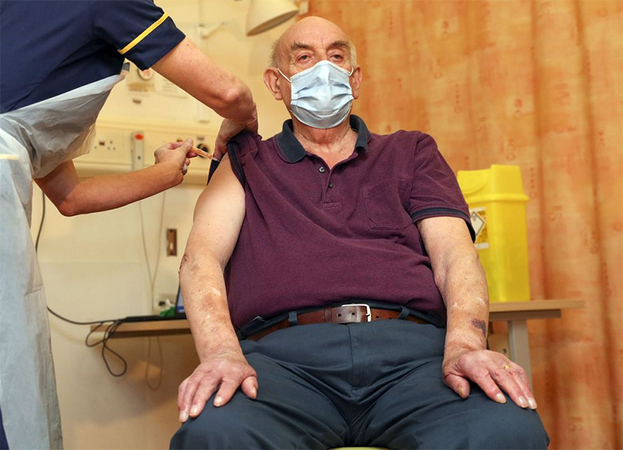
Brian Pinker receives the AstraZeneca Plc and the University of Oxford Covid-19 vaccine in Oxford, on Jan. 4.Photographer: Steve Parsons/PA Wire/Bloomberg

Brian Pinker receives the AstraZeneca Plc and the University of Oxford Covid-19 vaccine in Oxford, on Jan. 4.Photographer: Steve Parsons/PA Wire/Bloomberg

By Syndication Washington Post, Bloomberg · Eric Pfanner

Britain gave the first shots of a coronavirus vaccine from AstraZeneca Plc and the University of Oxford, in a race against a faster-spreading coronavirus variant that’s prompted new restrictions on movement across much of the country.

The first injection was administered Monday morning to an 82-year-old kidney dialysis patient at Oxford University Hospital.

Britain is stepping up its vaccine campaign as coronavirus infections surge across the country, putting the country on the brink of another national lockdown. It’s moved more rapidly on approvals and rollouts than the U.S. or the European Union, clearing the AstraZeneca-Oxford product despite clinical trials that involved a smaller number of participants and that were complicated by a dosing error. A regulatory decision to lengthen the interval between doses of the two-shot vaccines to as many as 12 weeks has prompted further questions.

A new strain that’s estimated to be as much as 70% more transmissible is fueling the pandemic’s resurgence in the U.K. Schools have been closed across much of the country, and Prime Minister Boris Johnson has warned that tougher restrictions may be on the way.

U.K. regulators cleared the AstraZeneca-Oxford shot last week, marking its first approval worldwide. It’s the second injection to be authorized for emergency use in Britain, after one from Pfizer Inc. and BioNTech SE received the go-ahead in early December.

More than a million people in Britain have received injections of the Pfizer-BioNTech vaccine, according to the Department of Health and Social Care.

The U.K. has raced ahead of France, where only about 500 people had got initial shots as of this weekend. President Emmanuel Macron has come under fire for the slow pace of that country’s rollout, which has been hampered by caution amid high levels of vaccine skepticism. France is behind not just European neighbors such as Britain and Germany, but also Israel, where more than 12% of the population has already received injections.

In the U.K., more than 500,000 AstraZeneca-Oxford doses will be available as of Monday, and they will be delivered at hospitals for the first few days. The U.K. aims to expand the number of vaccination sites to more than 1,000, with as many as 100 more hospitals and 180 general practitioner-led services coming online this week.

Although the newly approved vaccine has shown lower effectiveness than the Pfizer-BioNTech one in clinical trials, it has some key advantages: It’s cheaper and easier to transport and store, requiring only refrigerator temperatures rather than deep freezing. That makes it crucial for the broader global vaccination push.

David Nabarro, World Health Organization special envoy for covid-19, called for caution amid the global rush to vaccinate populations.

“I really would like to appeal to every leader just to really slow down a bit on the rush to get the vaccine into as many arms as possible and put more time into systematic planning on what has to be a really effective global operation,” he said in an interview with Bloomberg Television.

The NHS is administering the first injections under a two-shot regime approved by the Medicines and Healthcare Products Regulatory Agency. The second can be given as many as 12 weeks later, as the U.K. seeks to maximize the number of vulnerable people who receive the first portion, which provides some protection from infection.

The U.K. has also taken a more flexible approach to the two-dose regimen, saying that in certain circumstances — such as when it’s not known which vaccine a patient received the first time around — the second shot can be administered with a different company’s product.

The U.K. regulator has yet to publish full data backing its decision to allow a greater time interval between shots, which has drawn opposition from the British Medical Association.

“It is grossly and patently unfair to tens of thousands of our most at-risk patients to now try to reschedule their appointments,” said Richard Vautrey, chairman of the association’s General Practitioners Committee.

Harris, others condemn Trump’s call to Raffensperger while Republicans remain largely silent #SootinClaimon.Com

#SootinClaimon.Com : ขอบคุณแหล่งข้อมูล : หนังสือพิมพ์ The Nation.

Harris, others condemn Trump’s call to Raffensperger while Republicans remain largely silent

InternationalJan 04. 2021

By The Washington Post · Paulina Firozi

WASHINGTON – Vice President-elect Kamala Harris and other top Democrats swiftly denounced remarks that President Donald Trump made during an extraordinary hour-long phone call with Georgia’s Republican secretary of state, in which the president pressures Brad Raffensperger to “find” votes that will overturn the results of the presidential election in the state in his favor.

https://www.washingtonpost.com/video/c/embed/ae84f2e0-e5b6-4c9c-97c9-85f31345cd64?ptvads=block&playthrough=false

Bob Bauer, a senior adviser to President-elect Joe Biden’s transition team, said the conversation provides “irrefutable proof of a president pressuring and threatening an official of his own party to get him to rescind a state’s lawful, certified vote count and fabricate another in its place.”

The Washington Post obtained a recording of the call, in which the president repeatedly states that there is “no way I lost Georgia.” He makes threats about vague criminal consequences and tells the secretary of state that he’s taking a “big risk.”

Bauer added: “It captures the whole disgraceful story about Donald Trump’s assault on American democracy.”

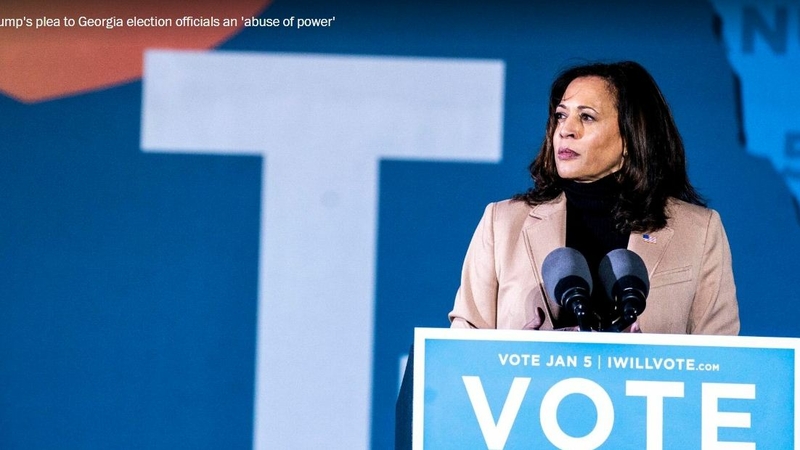
Speaking in Georgia on Sunday, Harris called Trump’s conversation a “baldfaced, bold abuse of power by the president of the United States.”

“It was certainly the voice of desperation, most certainly that,” she said.

Harris was there to campaign for Democrats Jon Ossoff and Raphael Warnock ahead of Senate runoff elections on Tuesday in the state.

During the call, Trump urged Georgia’s election officials to act quickly, and suggested that not doing so could endanger the political fate of Sens. David Perdue and Kelly Loeffler, both Georgia Republicans.

“You would be respected, really respected, if this thing could be straightened out before the election,” Trump said during the call. “You have a big election coming up on Tuesday.”

The two Democratic Senate candidates were among those who quickly condemned Trump for the call.

“When the president of the United States calls up Georgia’s election officials and tries to intimidate them to change the results of the election, to disenfranchise Georgia voters,” Ossoff said, speaking to supporters, “. . . that is a direct attack on our democracy.”

He added: “If David Perdue and Kelly Loeffler had one piece of steel in their spine, one piece of integrity, they would be out defending Georgia voters from that assault.”

In a statement, Warnock called on Loeffler to “speak out against the unsubstantiated claims of fraud, to defend Georgia’s elections, and to put Georgia ahead of herself. She has not and never will.”

Trump was joined on the call by White House Chief of Staff Mark Meadows, as well as longtime conservative lawyer Cleta Mitchell and Georgia-based lawyer Kurt Hilbert. Ryan Germany, who is general counsel for Raffensperger’s office, and Deputy Secretary of State Jordan Fuchs were also on the call.

Sen. Dick Durbin of Illinois, who will be the ranking Democrat on the Senate Judiciary Committee if his party does not take the chamber, said the call was “more than a pathetic, rambling, delusional rant.”

“His disgraceful effort to intimidate an elected official into deliberately changing and misrepresenting the legally confirmed vote totals in his state strikes at the heart of our democracy and merits nothing less than a criminal investigation,” Durbin said in a statement. “The President is unhinged and dangerous.”

Trump vaguely threatened Raffensperger and Germany, suggesting that they would be subject to criminal liability if they do not find that thousands of ballots in Fulton County were illegally destroyed to block investigators, a baseless allegation.

“You are going to find that they are – which is totally illegal – it is more illegal for you than it is for them, because, you know, what they did and you’re not reporting it,” he said. “That’s a criminal, that’s a criminal offense. And you can’t let that happen. That’s a big risk to you and to Ryan, your lawyer.”

Michael Bromwich, who served as the Justice Department inspector general from 1994 to 1999, suggested that Trump’s threats against Raffensperger and Germany could violate federal law that prohibits efforts to deprive voters of a fair election.

“His best defense would be insanity,” Bromwich tweeted, adding: “The entire call is astonishing. The bullying, the threats, the insults, the credulous embrace of discredited conspiracy theories. Like a crime boss, Trump occasionally says that all he wants is the truth. But he doesn’t – he wants the win.”

In a tweet, Rep. Adam Kinzinger, R-Ill., suggested to his fellow lawmakers that any “member of Congress considering objecting to the election results, you cannot – in light of this – do so with a clean conscience.”

Sen. Bob Casey, D-Pa., appeared to jab at some of his Senate colleagues across the aisle who have said they will not certify Biden’s win without an investigation of voter fraud allegations, which have been unsubstantiated.

“I heard there’s a group of Senate Republicans eager to investigate election fraud,” he tweeted.

Sen. Josh Hawley, R-Mo., who has pledged to contest the electoral college vote certification, did not immediately respond to a request for comment about Trump’s conversation; neither did Senate Majority Leader Mitch McConnell, R-Ky.

GOP infighting marks first day of new Congress #SootinClaimon.Com

#SootinClaimon.Com : ขอบคุณแหล่งข้อมูล : หนังสือพิมพ์ The Nation.

GOP infighting marks first day of new Congress

InternationalJan 04. 2021Senate Majority Leader Mitch McConnell, R-Ky., exits the Senate floor following a vote Friday. MUST CREDIT: Photo for The Washington Post by Amanda VoisardSenate Majority Leader Mitch McConnell, R-Ky., exits the Senate floor following a vote Friday. MUST CREDIT: Photo for The Washington Post by Amanda Voisard
By The Washington Post · Mike DeBonis, Paul Kane · NATIONAL, POLITICS, CONGRESS 

WASHINGTON – A new Congress convened Sunday with Republicans in open warfare as several GOP senators unleashed salvos against at least a dozen Republican colleagues who are planning to challenge the results of the presidential election this week.

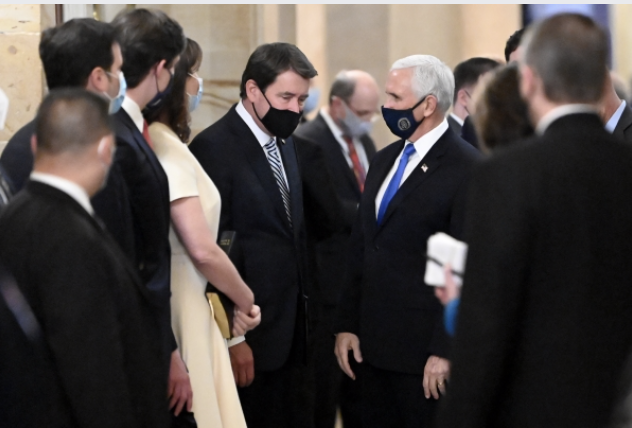
Vice President Mike Pence attends a ceremony at the Capitol on Sunday, Dec. 3, 2021. MUST CREDIT: Washington Post photo by Katherine Frey

Vice President Mike Pence attends a ceremony at the Capitol on Sunday, Dec. 3, 2021. MUST CREDIT: Washington Post photo by Katherine Frey

The bitter split among Republicans, virtually unprecedented during the tenure of Senate Majority Leader Mitch McConnell, R-Ky., came as the traditionally celebratory moment unfolded instead against the backdrop of a pandemic that is killing thousands of Americans each day.

The conflict played out in public as dissenting senators said they only wanted to “get the facts out” and critics said they were sabotaging democracy. Sen. Ben Sasse, R-Neb., called the challenge “a very, very, bad idea,” adding: “I’m concerned about the division in America – that’s the biggest issue – but obviously this is not healthy for the Republican Party, either.” 

It was the starkest illustration of the conflict that could engulf the Republican Party in the post-Trump era as factions prepare to battle over whether the party will continue down the unorthodox, scorched-earth path forged by President Donald Trump or return to a more traditional brand of conservative politics. The back-and-forth came two days before a pair of special elections in Georgia that will determine whether the GOP retains control of the Senate.

Sunday’s clash was triggered by the plans of 12 senators to challenge as many as six states’ electoral vote tallies at Wednesday’s joint session of Congress, a usually routine procedure that this year is shaping up as the final opportunity of Trump loyalists to insist, without evidence, that President-elect Joe Biden’s win was somehow illegitimate. 

In the House, a similar split developed: Several dozen GOP members have signaled that they will question the results, prompting a top Republican leader to call the idea “an exceptionally dangerous precedent.”

House Speaker Nancy Pelosi, D-Calif., who was narrowly elected to a fourth term as speaker Sunday, was among those noting that the challenge was almost certain to fail. But she said lawmakers have a responsibility to counter the dissenters’ claims.

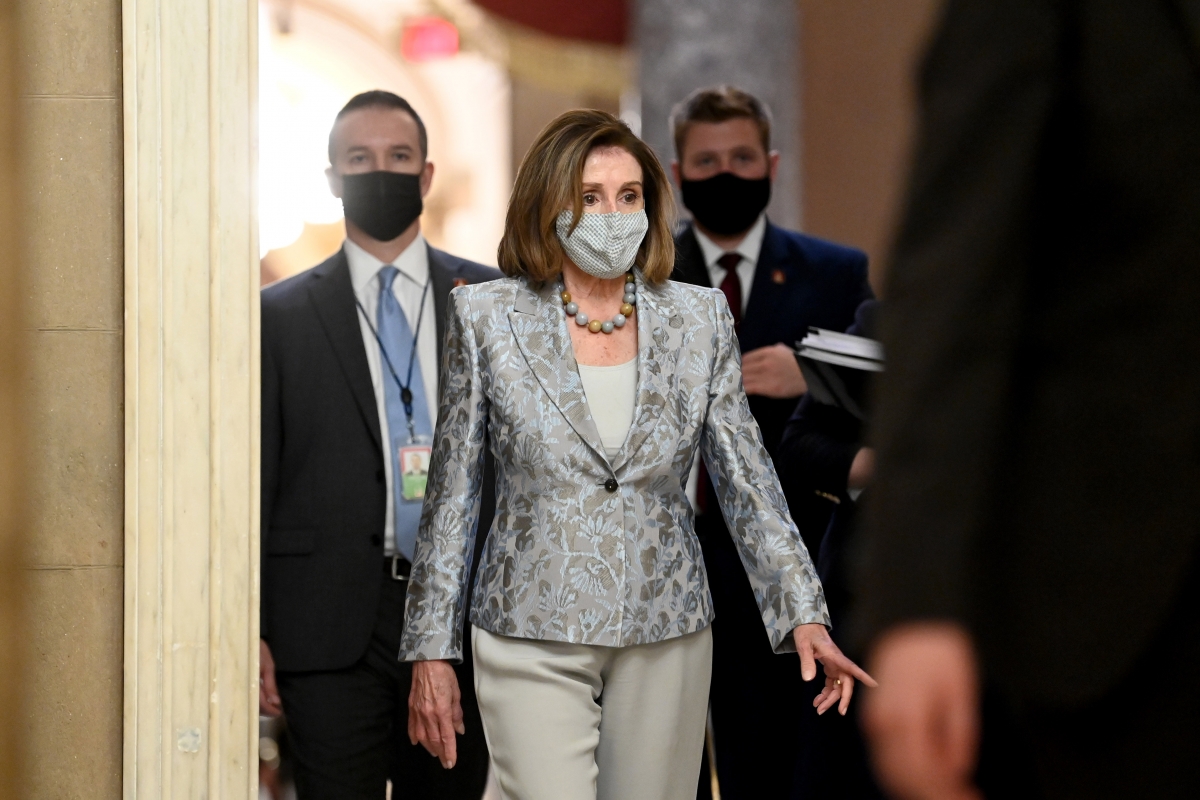
Rep. Nancy Pelosi, D-Calif., was elected speaker of the House on Sunday, Dec. 3, 2021. MUST CREDIT: Washington Post photo by Katherine Frey

Rep. Nancy Pelosi, D-Calif., was elected speaker of the House on Sunday, Dec. 3, 2021. MUST CREDIT: Washington Post photo by Katherine Frey

“Our choice is not to use the forum to debate the presidency of Donald Trump,” she wrote in a letter to colleagues. “While there is no doubt as to the outcome of the Biden-Harris presidency, our further success is to convince more of the American people to trust in our democratic system.” 

While the chances of derailing Biden’s victory are virtually nonexistent – doing so would require the Democratic-controlled House, for instance, to reject electoral votes for Biden – the event provides a stage for Republican lawmakers seeking to court Trump loyalists, who may be influential in the GOP for years to come, by proclaiming their fealty to the president.

The conflict began Saturday evening, when a group of 11 Republican senators announced that they would join Sen. Josh Hawley, R-Mo., in challenging the electoral tally of one or more states, making it clear that the revolt would not be a minor affair but would involve more than one-fifth of Senate Republicans.

Sen. Pat Toomey, R-Pa., said in a statement that the effort “directly undermines” Americans’ right to choose their leaders, and Sen. Mitt Romney, R-Utah, called it an “egregious ploy.” Hawley shot back that Toomey and others were engaging in “shameless personal attacks.”

The contention spread through the party on Sunday as lawmakers returned to the Capitol for the swearing-in. Sen. James Lankford, R-Okla., among the challengers, argued that the effort was no different from Democratic objections to the 1969 and 2005 counts. In those instances, however, the losing candidate had long since conceded, and the dissent was marginal. 

“Our democracy is strong enough to handle conversations about electoral integrity issues,” Lankford said. 

Should the challenges be rejected Wednesday, Lankford said he would “absolutely” accept Biden as the rightful president. “Our goal is obviously to try to get the facts out, more than to be able to vote against the electors,” he added.

Lankford and Sen. Roger Marshall, R-Kan., a former House member who was sworn in Sunday as a senator, said they were signing on to the challenge as a response to concerns from constituents worried about electoral improprieties.

“I think the people of Kansas feel disenfranchised,” Marshall said. “They want us to follow through on the many irregularities that they saw in this particular election.” 

He brushed off the near-unanimous finding of courts and state officials, including Republicans, that the election was fair. “I don’t think that the courts have heard all the facts,” Marshall said. “And I think that my responsibility is to fulfill my duty to the Constitution, the oath that we just took.” 

But many Republicans appeared distraught that the move would put party members on record as fighting the clear outcome of a democratic election.

Sen. Shelley Moore Capito, R-W.Va., said lawmakers had “a solemn responsibility to accept these electoral college votes that have been certified” by state officials. Sen. Roger Wicker, R-Miss., added, that “the overwhelming weight of the evidence is that Joe Biden defeated my candidate, Donald Trump, and I have to live with it.” 

Late Sunday, Sen. Tom Cotton, R-Ark., issued a statement saying that he shares the “concerns of many Arkansans about irregularities in the presidential election,” but that the Founders “entrusted our elections chiefly to the states – not Congress,” and that he therefore will not oppose the counting of certified electoral votes.

The rare open conflict was an embarrassing spectacle for McConnell, who has for weeks urged Republicans to refrain from disputing the electoral tally. McConnell fears it will force his members into a politically difficult choice of either defying Trump or rejecting the electorate’s verdict.

While that is not expected to create an immediate problem for McConnell’s authority – he was reelected GOP leader by acclamation in November – it demonstrates that Trump’s departure from the White House will not diminish the intraparty tensions that made the past four years a high-wire act for many Republicans.

McConnell himself declined on Sunday to address the dissension in his ranks. “We’ll be dealing with all of that on Wednesday,” he said. 

Democrats warned that the dissenters’ actions could damage the country for years to come. 

Senate Minority Leader Chuck Schumer, D-N.Y., said Republicans are “hurting themselves and hurting the democracy . . . to try to please somebody who has no fidelity to elections or even the truth.” 

Democrats have been particularly exasperated by Trump supporters’ tactic of groundlessly claiming the election was unfair, then citing the voter doubts fueled by those claims as a reason for further investigation. Dozens of judges, including several appointed by Trump, have summarily rejected allegations that any fraud capable of changing the outcome occurred.

“There’s a political invasion of the body-snatchers which is taking place,” said Sen. Ed Markey, D-Mass. “Donald Trump and his supporters are now actually able to create a situation this coming Wednesday where people who are senators and House members are going to vote for something that is absolutely and totally untrue.”

The GOP turmoil also reached into the House, where Rep. Liz Cheney, R-Wyo., the third-ranking House Republican, circulated a 21-page memo rebutting the case made by the dissenting senators. She urged members not to go down the path of questioning states’ voting tallies.

“Such objections set an exceptionally dangerous precedent, threatening to steal states’ explicit constitutional responsibility for choosing the President and bestowing it instead on Congress,” Cheney wrote. “This is directly at odds with the Constitution’s clear text and our core beliefs as Republicans.” 

Former House speaker Paul Ryan, R-Wis., weighed in as well, saying “it is difficult to conceive of a more anti-democratic and anti-conservative act than a federal intervention to overturn the results of state-certified elections.” 

The turmoil reflected the rocky path that probably lies ahead for what will be the most closely divided Congress in memory. The Senate would be split 50-50 if Democrats prevail in both Georgia races Tuesday, while the Democrats’ advantage in the House has dwindled to several seats.

On Sunday, Pelosi became the second lawmaker in the past 34 years to win a fourth term as speaker, claiming 216 votes to the 209 that Republicans cast for their leader, Rep. Kevin McCarthy, R-Calif. Five moderate Democrats either voted “present” or supported another Democrat. 

Pelosi’s vote total fell below the usual 218-vote threshold for a House majority in part because three lawmakers missed the vote because of illness, including two who recently tested positive for the novel coronavirus.

Two House members voted even though they were still technically in quarantine, using a special, newly constructed alcove in the House gallery sealed off by plexiglass. Republicans accused Democrats of bending the quarantine rules to boost Pelosi’s vote total, but the change did not alter the outcome: Two Democrats and one Republican – Reps. Jeff Fortenberry, R-Neb., Tim Ryan, D-Ohio, and Frederica Wilson, D-Fla. – used that area to vote.

Scores of Democratic members have used new proxy voting procedures to weigh in from afar during the past seven months, but those procedures were not allowed for Sunday’s vote, so lawmakers had to appear in person.

The proceedings began on a somber note, with the announcement of an unexpected vacancy due to the death last week of Rep.-elect Luke Letlow, a 41-year-old Louisiana Republican who had been hospitalized with covid-19, the illness that the novel coronavirus can cause. 

Veteran lawmakers, accustomed to the joyous pomp and packed House chamber for their swearing-in, found the restrictions jarring. Only first-time members were allowed to bring a guest, for example.

Rep. Fred Upton, R-Mich., first elected in 1986, called the atmosphere “real different” after leaving the Capitol’s coronavirus testing site. “First time I’ve been without my family,” he said. “My wife’s always up in the gallery.” 

The selection of the new speaker – historically made with all members on the floor and lawmakers rising one at a time in alphabetical order to shout their selection – was instead done in shifts, with 72 lawmakers called to the floor at a time.

Shortly before 5:30 p.m., Pelosi took the rostrum to speak before a chamber with fewer than 150 members as the other two-thirds of lawmakers watched on television.

She began by noting that a new Congress’s first day usually begins with a bipartisan service at a Capitol Hill church – but not this year.

“Until that is possible, let us pray personally.” Pelosi said. “Let there be peace on Earth, and let it begin with us.” 

World Bank: China’s GDP to rise to 7.9% in 2021 #SootinClaimon.Com

#SootinClaimon.Com : ขอบคุณแหล่งข้อมูล : หนังสือพิมพ์ The Nation.

World Bank: China’s GDP to rise to 7.9% in 2021

InternationalJan 04. 2021A bird view of Beijing's central business district, which is home to the headquarters of a great number of companies on the Fortune Global 500. [Photo/VCG]A bird view of Beijing’s central business district, which is home to the headquarters of a great number of companies on the Fortune Global 500. [Photo/VCG]

By China Daily

The World Bank projected that China’s GDP growth will return to its pre-pandemic level by 2021, to accelerate to 7.9 percent next year from 2 percent in 2020, in response to improved consumer and business confidence and better labor market conditions, according to a report published on Wednesday.

Although the growth rate remained unchanged from the bank’s projection in the summer, the new report suggested navigating near-term uncertainty, which will require an adaptive policy framework calibrated to the pace of the recovery both in China and the rest of the world, according to the report.

“A premature policy exit and excessive tightening could derail the recovery,” it said. “Along with a flexible and supportive monetary policy, China could use its fiscal space to hedge against downside risks to growth and ensure a smooth rotation from public to private demand.”

The special direct fiscal transfers to local governments, a new mechanism launched this year to ensure fiscal and bailout funds can be directly received by primary-level government departments and entities, could be extended through next year and explicitly targeted to increased social spending and/or green investment by local governments, the World Bank said.

“The global environment remains highly uncertain and this calls for an adaptive policy framework,” said Martin Raiser, World Bank Country Director for China.

“The withdrawal of fiscal support should proceed gradually, but the focus should shift from traditional infrastructure to more social spending and green investment.”

In terms of monetary policy, the People’s Bank of China, the central bank, should return to more conventional tools while phasing out window guidance, lending targets, and relending facilities adopted to provide targeted support in the context of the COVID-19 shock, it added.

Sebastian Eckardt, World Bank lead economist for China, said that China will need to embrace the growth potential of its most developed and innovative metropolitan areas and city clusters, to rebalance the economy from investment to more innovation- and services-driven growth.

“Such a shift will need to be accompanied by fiscal policies to ensure more equitable public service delivery and increased investment in human capital for people living outside urban areas and coastal provinces,” Eckardt said.