
Two Biden aides will recuse on BlackRock issues as past ties pose questions #SootinClaimon.Com

#SootinClaimon.Com : ขอบคุณแหล่งข้อมูล : หนังสือพิมพ์ The Nation.

Two Biden aides will recuse on BlackRock issues as past ties pose questions

InternationalJan 04. 2021Adewale Adeyemo, President-elect Joe Biden's pick for Deputy Treasury Secretary, is pictured at the Queen in Wilmington, Del., on Dec. 1, 2020. MUST CREDIT: Washington Post photo by Demetrius FreemanAdewale Adeyemo, President-elect Joe Biden’s pick for Deputy Treasury Secretary, is pictured at the Queen in Wilmington, Del., on Dec. 1, 2020. MUST CREDIT: Washington Post photo by Demetrius Freeman

By The Washington Post · Yeganeh Torbati · NATIONAL, BUSINESS, POLITICS 

In 2013, the asset management firm BlackRock unleashed a lobbying blitz to carpet-bomb a new Treasury Department agency, pushing federal regulators away from tightening requirements on its massive business lines.

In 2019, the company won again when the Trump administration cemented an approach that would essentially exempt large companies such as BlackRock from more scrutiny.

Now, however, the New York firm – with $7.8 trillion in assets under management – could face its biggest threat yet, with Democratic control of the White House and influential figures on the left bent on breaking Wall Street apart.

But BlackRock, the world’s largest asset manager, is entering this era in a unique position: Two of President-elect Joe Biden’s senior economic advisers worked there in the years after they left the Obama administration.

Brian Deese, who until Dec. 18 led sustainable investing at BlackRock, is Biden’s pick to lead the White House National Economic Council. And Wally Adeyemo, who worked at BlackRock for just over two years, including as an interim chief of staff to founder Larry Fink, is slated to be deputy treasury secretary, with a direct hand in shaping the Biden administration’s approach to financial regulation. Adeyemo left the firm in 2019 to lead the Obama Foundation.

A Biden transition official said the incoming administration expects Deese and Adeyemo to recuse themselves from matters pertaining specifically to BlackRock for an “appropriate period” determined by law and an ethics agreement that is still in development. Still, their prominence within the top tier of Biden’s economic team, and BlackRock’s heavy investment in Washington influence in recent years, puts the company in a unique position heading into a period when its business lines could be coming under close scrutiny.

The firm’s ability to emerge victorious during battles in the Obama administration offers clues about how it could seek to survive and thrive during Biden’s time in office, and it presents the incoming administration with thorny questions about how it will seek to regulate a powerful firm with direct connections to its team.

BlackRock has a lot at stake. Janet Yellen, Biden’s nominee to run the Treasury Department, has been sharply critical of moves by the Trump administration to ease oversight of companies such as BlackRock. If Yellen tightens restrictions, the company could find itself in a much different regulatory environment, potentially forcing it to set aside more reserves and hire more compliance officials.

In 2019, the Trump administration went further, overhauling the process by which the FSOC could assess the risks presented by non-bank financial firms and making it unlikely, experts said, that any company would draw tighter regulation. ce across the global economy. It has made purchases on behalf of the Fed and holds 5% or more of the shares of nearly all the companies traded on the S&P 500, according to one analysis published in 2019.

Still, combining a deft touch and an unrelenting lobbying blitz, it has kept policymakers at bay and been allowed to continue growing.

“The way that we proceeded reflected what I think was a correct view that you have to ask the questions without knowing the answers,” said a former senior Obama administration official, who like other current and former officials interviewed for this report spoke on the condition of anonymity to discuss private deliberations or preserve working relationships. “Candidly in some ways, the aggressive nature of the BlackRock advocacy made that harder, not easier.”

BlackRock said in a statement that as an asset manager, it is subject to regulation by a range of agencies, and that it supports regulatory reform that “increases transparency, protects investors and facilitates responsible growth.”

“We believe in the value of open dialogue and transparency on important policy issues, and over the last decade, as regulators around the world implemented new rules and regulations that have re-shaped the regulatory environment governing a wide range of asset management products and practices, we aimed to be a helpful contributor to this process,” the company said.

Former officials who worked with Adeyemo and Deese pointed out that neither worked at BlackRock or other finance firms for long portions of their careers and said they believe it unlikely that they would have adopted the firm’s views on financial regulation. Adeyemo previously worked for now-Sen. Elizabeth Warren, D-Mass., a frequent antagonist of Wall Street, at the Consumer Financial Protection Bureau. When he announced Adeyemo’s nomination, Biden said he was “highly recommended” by Warren.

Neither Adeyemo nor Deese consulted with BlackRock executives about the firm’s engagement with the Treasury Department or regulators during their time with the company, said a person familiar with the matter.

But Washington observers said that even if BlackRock does not lobby Deese and Adeyemo directly, the perception of the firm being well connected within the Biden team will give it extra sway at a critical time. Finance experts and former officials said the Biden administration will need to strengthen the very government institutions and regulatory mechanisms that BlackRock has spent years aggressively lobbying against, and some worried that BlackRock could try to use its connections to undermine tougher enforcement.

“This is an area that the Biden administration really needs to take a close look at, and hopefully there aren’t going to be conflicts of interest affecting things,” said Marcus Stanley, policy director for Americans for Financial Reform, a liberal nonprofit group that advocates for stricter regulation of Wall Street. “BlackRock’s policy positions are very relevant to choices that the Biden administration is going to have to make.”

Biden transition spokeswoman Rosemary Boeglin said in an emailed statement that the incoming administration “has committed to establishing the most ethically rigorous administration in American history.”

“All nominees and appointees will commit to following all appropriate ethics rules in their work, including by meeting financial disclosure requirements, stepping down from outside positions, divesting assets, and recusing themselves from matters as required by federal ethics rules, their agencies, and the White House,” Boeglin said.

BlackRock is a massive financial company, but it is not a bank. It does not take government-insured deposits. It is an asset manager, investing and holding money on behalf of clients.

The firm aggressively snapped up senior and mid-level Obama administration officials from the White House and Treasury Department, giving it connections that have now proved fortuitous with Biden’s victory. And its political action committee and employees have given millions of dollars in campaign donations to politicians over the past decade, with more funds going to Democrats than Republicans, according to an analysis by the Center for Responsive Politics.

Shortly after Barack Obama took office in 2009, BlackRock executives began meeting with midlevel and senior White House economics officials, senior adviser Valerie Jarrett, Chief of Staff Rahm Emanuel and, later, Chief of Staff William Daley, according to White House visitor logs. In 2014, Fink met three times with Jeff Zients, then the director of President Obama’s National Economic Council and now slated to take on the role of coronavirus czar in the Biden administration.

Because it is not an investment bank – risk-taking in the investment banking sector helped cause the 2008 financial crisis – BlackRock could present itself as a constructive voice with useful perspectives on a range of issues facing policymakers, former officials said. The Fed Bank of New York turned to BlackRock for help in 2008, asking it to oversee failing assets held by Bear Stearns and American International Group. During meetings at the White House and in Congress during the Obama era, Fink would offer his insights on the health-care industry, infrastructure and gig workers, said people who met with him. BlackRock has further honed this stance through its Investment Institute, a sort of internal think tank that publishes bulletins with commentary on geopolitics, and an entire section on its website devoted to commentary on financial stability.

But BlackRock’s engagement in Washington took on a different tenor when it came to the prospect of regulations it saw as a serious threat to the firm’s business model. Former Obama officials and congressional aides pointed to how BlackRock reacted to the possibility of being named a “systemically important” non-bank financial institution by regulators, another way of saying the company was “too big to fail.”

Such a designation, a power granted by Congress to a group of regulators called the Financial Stability Oversight Council, could have cut into BlackRock’s profits by requiring it to set aside more capital reserves or hire more compliance specialists, for instance, and it would have placed BlackRock under the direct supervision of the Fed. In late 2013, news leaked that the FSOC was reviewing BlackRock and Fidelity, another asset manager, as it studied the issue.

Former officials said the chances of BlackRock actually being designated were minimal, but the firm still unleashed what they saw as a disproportionate, aggressive lobbying effort, blanketing congressional aides and regulators directly and via industry trade groups with meeting requests, letters and white papers laying out their views.

BlackRock’s main position has been that instead of targeting individual firms, regulators ought to review potentially risky activities in a sector, such as exchange-traded funds. Opponents of the activities-based approach say such a method would not have prevented the 2008 financial collapse.

But former officials said much of their frustration with BlackRock stemmed not from any specific policy position but rather what they saw as the firm’s aggressiveness and its willingness to exaggerate regulators’ actions to members of Congress. They viewed its bare-knuckles approach in Washington as contrary to its public stance of praising regulators for their actions after the 2008 crisis.

“You cannot do financial regulatory policy without some measure of trust in regulators’ judgment,” said a former Obama-era Treasury Department official. “BlackRock’s efforts were not just focused on policy changes but were focused on undermining that trust.”

Other officials said they found BlackRock to be sincere in its effort to educate policymakers about complex lines of business.

“I did find them to be very knowledgeable,” said one former Obama-era regulator who spoke on the condition of anonymity to describe internal meetings. “They did lots of research and published the findings of that research, thought about the issues and commented on the issues in a thoughtful way.”

Spurred by BlackRock’s push, members of the GOP-led Congress held public hearings in which they lacerated Obama administration officials and criticized their decision-making process as opaque.

In a related episode, BlackRock also led a charge to discredit the Treasury Department’s Office of Financial Research (OFR), created by Congress in the 2010 Dodd-Frank Act. The agency was designed to be an independent bureau empowered to demand data from Wall Street giants, shed light on opaque financial markets and hold its own against the same regulators who had missed the warning signs before the 2008 crash.

Four former officials said BlackRock’s lobbyists were by far the most vocal in pushing back against a 34-page September 2013 OFR report on the asset management industry that concluded those firms could pose a risk to financial stability. The report had been commissioned by the FSOC to help it figure out a framework for judging whether such firms were systemically important.

For its part, BlackRock felt the OFR report had not been prepared transparently, unhappy that it was granted just two meetings a year apart, to engage with the agency on the report, said a person familiar with the matter. The firm filed six letters with the Securities and Exchange Commission commenting on the OFR report between November 2013 and May 2014. By comparison, its three biggest competitors in the asset management industry – Vanguard, Fidelity and State Street – filed five letters total. The fallout over the report permanently damaged the OFR’s reputation, several former officials said, and eroded its support in Congress.

Former officials attributed BlackRock’s aggressive approach to vice chair and firm co-founder Barbara Novick, who has a reputation as a dogged, dedicated operator who makes it her job to get to know everyone, from 24-year-old entry-level agency staffers to senior White House advisers, Republicans and Democrats.

“We believe policy decisions should be data driven, and we have approached advocacy by publishing educational materials drawing on data and facts,” Novick said in a statement. “We are proud of our contributions to policy issues that impact investors globally.”

Novick and her staff made themselves ubiquitous, spreading their influence through industry groups such as the Managed Funds Association, the Investment Company Institute, the Securities Industry and Financial Markets Association and the Committee on Capital Markets Regulation, officials said.

“There are some companies or trade associations who will wait until a particular issue gathers momentum before intervening, but BlackRock seems pretty determined to quash anything,” one former Democratic congressional aide said. “They don’t miss anything, and they intervene early and often.”

By 2014, BlackRock had notched a key victory when the FSOC announced it would focus on potentially risky activities rather than labeling individual firms as risks.

Last year, the Trump administration went further, overhauling the process by which the FSOC could assess the risks presented by non-bank financial firms and making it unlikely, experts said, that any company would draw tighter regulation. The new approach, which among other changes requires a cost-benefit analysis before a company is designated, was hailed in its draft form by BlackRock, in a 72-page submission complete with appendixes, as a “very significant improvement on the existing process.”

Dennis Kelleher, president and CEO of Better Markets, an advocacy group that favors more robust Wall Street oversight, said the changes “created this Rube Goldberg set of procedures that make it almost impossible for the FSOC to ever designate any activity as systemically significant” and even harder to designate any entity, either.

“It is entirely consistent with everything the shadow banking system lobbyists all wanted,” including asset managers, private equity firms, hedge funds and others, said Kelleher, who is a volunteer with the Biden transition team.

The new approach drew rare public criticism from four former senior U.S. economic officials, including Yellen. She and her colleagues wrote in a letter that the changes “would make it impossible to prevent the buildup of risk in financial institutions whose failure would threaten the stability of the system as a whole.”

The Treasury Department did not respond to a request for comment on the 2019 guidance. Treasury Secretary Steven Mnuchin’s former counselor at the agency, Craig Phillips, was a managing director at BlackRock before he joined the Trump administration.

In her new role, Yellen could try to rescind the guidance and push the FSOC to increase its scrutiny of non-bank financial firms. A Biden transition official said that there is “no daylight between Yellen and Adeyemo on financial regulation” and that Adeyemo agrees with Yellen’s stance in the 2019 letter.

Another major issue regulators were examining in the years after the financial crisis was what kinds of new rules to institute for money-market funds, which are not guaranteed by the federal government like regular bank accounts but which still typically serve as risk-free places for investors to store cash. They are run by asset managers such as BlackRock.

In 2008, when investors fled money-market funds, the Fed had to step in to prevent further mayhem. In response, the FSOC proposed three possible changes in November 2012 and questioned the wisdom of an approach BlackRock had advocated months earlier, for liquidity fees that would activate only in times of crisis. But the FSOC could only recommend rules, and it was then up to the SEC to debate and adopt them.

Novick filed a letter with the FSOC pushing back against its proposals. Then she and her team met with SEC officials around a week before Christmas in 2012, presenting their views in PowerPoint form. BlackRock was one of many Wall Street players that lobbied the SEC during this time period, including Vanguard, Fidelity and Federated. BlackRock also organized a 2013 letter that suggested a new definition for retail money-market funds, which the SEC ended up adopting.

The eventual changes adopted by the SEC in 2014 were weaker than what the FSOC had proposed. They incorporated liquidity fees and were greeted with cautious praise by industry players. Now, those who wanted stronger regulations feel they have been vindicated. In March, as investors rushed to pull money out of the market during the first weeks of the coronavirus pandemic, the Fed was forced to intervene, announcing it would establish a special backstop for money-market funds, among several other emergency actions. The industry was effectively bailed out again.

BlackRock has already moved to shape the discussion around further measures, issuing a paper in July that deflected blame for the instability away from money-market funds.

The turmoil last spring revealed unstable practices in parts of the asset management industry, including in money-market funds, said Sheila Bair, former chair of the Federal Deposit Insurance Corp.

“Everybody always knew this was a significant source of systemic risk that, because of the power of the asset management industry, we didn’t really tackle,” Bair said. “That was true of Obama as well as Trump. I hope they [members of the Biden team] have the courage to do it.”
NYSE to delist Chinese telco giants on U.S. executive order #SootinClaimon.Com

#SootinClaimon.Com : ขอบคุณแหล่งข้อมูล : หนังสือพิมพ์ The Nation.

NYSE to delist Chinese telco giants on U.S. executive order

InternationalJan 04. 2021

By Syndication Washington Post, Bloomberg · Max Zimmerman, Gregor Stuart Hunter · BUSINESS, US-GLOBAL-MARKETS 

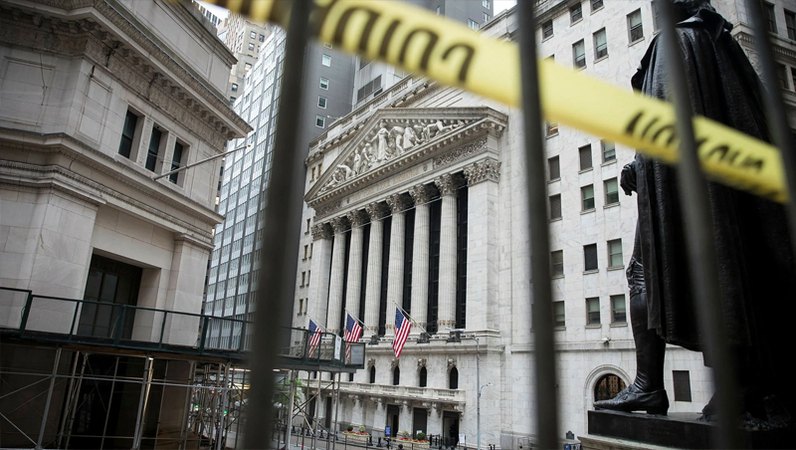
The New York Stock Exchange said it will delist three Chinese corporations to comply with a U.S. executive order that imposed restrictions on companies identified as affiliated with the Chinese military.

China Mobile Ltd., China Telecom Corp Ltd., China Unicom Hong Kong Ltd. will be suspended from trading between Jan. 7 and Jan. 11, and proceedings to delist them have started, according to a statement by the exchange.

In response, China’s Ministry of Commerce said on Jan. 2 that the country will adopt necessary actions to protect the rights of Chinese companies and hopes the two countries can work together to create a fair, predicable environment for businesses and investors.

Quantitative hedge fund managers including Renaissance Technologies, Dimensional Fund Advisors and Two Sigma Investments were among the largest holders in these U.S. listings but the stakes they held at the end of September were small, 13F filings show.

The three Chinese companies have separate listings in Hong Kong. All generate the entirety of their revenue in China and have no meaningful presence in the U.S. except for their listings there. Their shares are also thinly traded on the New York Stock Exchange compared to their primary listings in Hong Kong, making this NYSE delisting more of a symbolic blow amid heightened geopolitical friction between the U.S. and China.

President Donald Trump signed an order in November barring American investments in Chinese firms owned or controlled by the military, in a bid to pressure Beijing over what it views as abusive business practices. The order prohibited U.S. investors from buying and selling shares in a list of Chinese companies designated by the Pentagon as having military ties.

The Chinese Foreign Ministry later accused the U.S. of “viciously slandering” its military-civilian integration policies and vowed to protect the country’s companies. Chinese officials have also threatened to respond to previous Trump administration actions with their own blacklist of U.S. companies.

The executive order has resulted in a series of companies being removed from indexes compiled by MSCI Inc., S&P Dow Jones Global Indices and FTSE Russell.

The U.S. Federal Communications Commission in May barred China Mobile from operating in the U.S. In December, it ordered carriers to remove equipment made by Huawei Technologies Co., and begun looking into whether China Telecom should be allowed to operate in the country. China Telecom’s U.S. unit told the FCC in a June 8 filing that it’s an independent business based in the U.S. and not subject to Chinese government control.

Global exchanges, including NYSE and Nasdaq Inc., courted Chinese companies during the past decade as they attempted to expand their IPO business, particularly in the internet sector. In response, Hong Kong Exchanges & Clearing Ltd. changed its rules in recent years to lure back listings, including allowing share sales by companies with weighted voting rights — strengthening the power of company founders at the expense of weaker protections for minority investors.

Companies including e-commerce giants Alibaba Group Holding and JD.Com, which already had listings in New York, conducted secondary listings in Hong Kong in the past two years as tensions between the U.S. and China intensified on a range of issues including trade and the novel coronavirus.

Trump pressures Georgia secretary of state to recalculate vote in his favor #SootinClaimon.Com

#SootinClaimon.Com : ขอบคุณแหล่งข้อมูล : หนังสือพิมพ์ The Nation.

Trump pressures Georgia secretary of state to recalculate vote in his favor

InternationalJan 04. 2021President Donald Trump walks to the Oval Office on Thursday, Dec. 31, 2020. MUST CREDIT: Washington Post photo by Bill O'LearyPresident Donald Trump walks to the Oval Office on Thursday, Dec. 31, 2020. MUST CREDIT: Washington Post photo by Bill O’Leary
By The Washington Post · Amy Gardner

WASHINGTON – President Donald Trump urged fellow Republican Brad Raffensperger, the Georgia secretary of state, to “find” enough votes to overturn his defeat in an extraordinary one-hour phone call Saturday that legal scholars described as a flagrant abuse of power and a potential criminal act.

The Washington Post obtained a recording of the conversation in which Trump alternately berated Raffensperger, tried to flatter him, begged him to act and threatened him with vague criminal consequences if the secretary of state refused to pursue Trump’s false claims, at one point warning that Raffensperger was taking “a big risk.”

Throughout the call, Raffensperger and his office’s general counsel rejected Trump’s assertions, explaining that the president is relying on debunked conspiracy theories and that President-elect Joe Biden’s 11,779-vote victory in Georgia was fair and accurate.

Trump dismissed their arguments.

“The people of Georgia are angry, the people in the country are angry,” he said. “And there’s nothing wrong with saying, you know, that you’ve recalculated.”

Raffensperger responded: “Well, Mr. President, the challenge that you have is, the data you have is wrong.”

At another point, Trump said: “So look. All I want to do is this. I just want to find 11,780 votes, which is one more than we have. Because we won the state.”

The rambling and at times incoherent conversation offered a remarkable glimpse of how consumed and desperate the president remains about his loss, unwilling or unable to let the matter go and still believing he can reverse the results in enough battleground states to remain in office.

“There’s no way I lost Georgia,” Trump said, a phrase he repeated again and again on the call. “There’s no way. We won by hundreds of thousands of votes.”

Several of his allies were on the line as he spoke, including White House Chief of Staff Mark Meadows and conservative lawyer Cleta Mitchell, a prominent GOP attorney whose involvement with Trump’s efforts had not been previously known.

In a statement, Mitchell said Raffensperger’s office “has made many statements over the past two months that are simply not correct and everyone involved with the efforts on behalf of the President’s election challenge has said the same thing: Show us your records on which you rely to make these statements that our numbers are wrong.”

The White House, the Trump campaign and Meadows did not respond to a request for comment.

Raffensperger’s office declined to comment.

On Sunday, Trump tweeted that he had spoken to Raffensperger, saying the secretary of state was “unwilling, or unable, to answer questions such as the ‘ballots under table’ scam, ballot destruction, out of state ‘voters,’ dead voters, and more. He has no clue!”

Raffensperger responded with his own tweet: “Respectfully, President Trump: What you’re saying is not true.”

The details of the call drew demands from congressional Democrats for criminal investigations. Biden’s top campaign lawyer, Bob Bauer, said the recording “captures the whole, disgraceful story about Donald Trump’s assault on American democracy.”

Republicans, however, were largely silent. Sen. Ted Cruz, R-Texas, when asked about the call while campaigning in Georgia on Sunday for the two GOP senators who face a run-off Tuesday, dodged the question completely.

Trump’s pressure campaign on Raffensperger is the latest example of his attempt to subvert the outcome of the Nov. 3 election through personal outreach to state Republican officials. He previously invited Michigan Republican state leaders to the White House, pressured Republican Georgia Gov. Brian Kemp in a call to try to replace that state’s electors and asked the speaker of the Pennsylvania House of Representatives to help reverse his loss in that state.

His call to Raffensperger came as scores of Republicans have pledged to challenge the electoral college’s vote for Biden when Congress convenes for a joint session on Wednesday. Republicans do not have the votes to successfully thwart Biden’s victory, but Trump has urged supporters to travel to Washington to protest the outcome, and state and federal officials are already bracing for clashes outside the Capitol.

During their conversation, Trump issued a vague threat to both Raffensperger and Ryan Germany, the secretary of state’s general counsel, suggesting that if they don’t find that thousands of ballots in Fulton County have been illegally destroyed to block investigators – an allegation for which there is no evidence – they would be subject to criminal liability.

“That’s a criminal offense,” he said. “And you can’t let that happen. That’s a big risk to you and to Ryan, your lawyer.”

Trump also told Raffensperger that failure to act by Tuesday would jeopardize the political fortunes of David Perdue and Kelly Loeffler, Georgia’s two Republican senators whose fate in that day’s runoff elections will determine control of the U.S. Senate.

Trump said he plans to talk about the alleged fraud on Monday, when he is scheduled to lead an election eve rally in Dalton, Ga. – a message that could further muddle the efforts of Republicans to draw out their voters.

“You have a big election coming up and because of what you’ve done to the president – you know, the people of Georgia know that this was a scam,” Trump said. “Because of what you’ve done to the president, a lot of people aren’t going out to vote, and a lot of Republicans are going to vote negative, because they hate what you did to the president. OK? They hate it. And they’re going to vote. And you would be respected, really respected, if this can be straightened out before the election.”

Trump’s conversation with Raffensperger put him in legally questionable territory, legal experts said. By exhorting the secretary of state to “find” votes and to deploy investigators who “want to find answers,” Trump appears to be encouraging him to doctor the election outcome in Georgia.

Trump’s apparent threat of criminal consequences if Raffensperger does not act could be seen as an attempt at extortion and a suggestion that he might deploy the Justice Department to launch an investigation, they said.

“The president is either knowingly attempting to coerce state officials into corrupting the integrity of the election or is so deluded that he believes what he’s saying,” said Richard Pildes, a constitutional law professor at New York University, who noted that Trump’s actions may have violated several federal statutes.

But Pildes said Trump’s clearer transgression is a moral one, and he emphasized that focusing on whether he committed a crime could deflect attention from the “simple, stark, horrific fact that we have a president trying to use the powers of his office to pressure state officials into committing election fraud to keep him in office.”

Edward Foley, a law professor at Ohio State University, said that the legal questions are murky, and that it could be difficult to prove that Trump knew he was encouraging illegal behavior. But Foley also emphasized that the call was “inappropriate and contemptible” and should prompt outrage.

“He was already tripping the emergency meter,” Foley said. “So we were at 12 on a scale of 1 to 10, and now we’re at 15.”

Throughout the call, Trump detailed an exhaustive list of disinformation and conspiracy theories to support his position. He claimed without evidence that he had won Georgia by at least a half-million votes. He floated a barrage of assertions that have been investigated and disproved: that thousands of dead people voted; that an Atlanta election worker scanned 18,000 forged ballots three times each and “100 percent” were for Biden; that thousands more voters living out of state came back to Georgia illegally just to vote in the election.

“So tell me, Brad, what are we going to do? We won the election, and it’s not fair to take it away from us like this,” Trump said. “And it’s going to be very costly in many ways. And I think you have to say that you’re going to re-examine it, and you can re-examine it, but reexamine it with people that want to find answers, not people who don’t want to find answers.”

Trump did most of the talking on the call. He was angry and impatient, calling Raffensperger a “child” and said law enforcement officials “either dishonest or incompetent” for not believing there was widespread ballot fraud in Atlanta – and twice calling himself a “schmuck” for endorsing Kemp, whom Trump holds in particular contempt for not embracing his claims of fraud.

“I can’t imagine he’s ever getting elected again, I’ll tell you that much right now,” he said.

He also took aim at Kemp’s 2018 opponent, Democrat Stacey Abrams, trying to shame Raffensperger with the idea that his refusal to embrace fraud has helped her and Democrats generally. “Stacey Abrams is laughing about you,” he said. “She’s going around saying, ‘These guys are dumber than a rock.’ What she’s done to this party is unbelievable, I tell you.”

The secretary of state repeatedly sought to correct Trump, saying at one point, “Mr. President, the problem you have with social media, they – people can say anything.”

“Oh, this isn’t social media,” Trump retorted. “This is Trump media. It’s not social media. It’s really not. It’s not social media. I don’t care about social media. I couldn’t care less.”

At another point, Trump claimed that votes were scanned three times: “Brad, why did they put the votes in three times? You know, they put ’em in three times.”

Raffensperger responded: “Mr. President, they did not. We did an audit of that and we proved conclusively that they were not scanned three times.”

Trump sounded at turns confused and meandering. At one point, he referred to Kemp as “George.” He tossed out several different figures for Biden’s margin of victory in Georgia and referred to the Senate runoff, which is Tuesday, as happening “tomorrow” and “Monday.”

His desperation was perhaps most pronounced during an exchange with Germany, Raffensperger’s general counsel, in which he openly begged for validation.

Trump: “Do you think it’s possible that they shredded ballots in Fulton County? ‘Cause that’s what the rumor is. And also that Dominion took out machines. That Dominion is really moving fast to get rid of their, uh, machinery. Do you know anything about that? Because that’s illegal, right?”

Germany responded: “No, Dominion has not moved any machinery out of Fulton County.”

Trump: “But have they moved the inner parts of the machines and replaced them with other parts?”

Germany: “No.”

Trump: “Are you sure? Ryan?”

Germany: “I’m sure. I’m sure, Mr. President.”

It was clear from the call that Trump has surrounded himself with aides who have fed his false perceptions that the election was stolen. When he claimed that more than 5,000 ballots were cast in Georgia in the name of dead people, Raffensperger responded forcefully: “The actual number was two. Two. Two people that were dead that voted.”

But later, Meadows said, “I can promise you there are more than that.”

Another Trump lawyer on the call, Kurt Hilbert, accused Raffensperger’s office of refusing to turn over data to assess evidence of fraud, and also claimed awareness of at least 24,000 illegally cast ballots that would flip the result to Trump.

“It stands to reason that if the information is not forthcoming, there’s something to hide,” Hilbert said. “That’s the problem that we have.”

Reached by phone Sunday, Hilbert declined to comment.

Mitchell contradicted Trump on several occasions on the call, saying, “Well, I don’t know about that,” when the president alleged that a Fulton County election worker had triple-counted 18,000 ballots for Biden. She claimed that the extent of the fraud is unclear because Raffensperger’s office has not shared all the data Trump’s lawyers have sought.

“We never had the records that you have,” she said. Germany noted that the office is barred under law from sharing some voter information.

In the end, Trump asked Germany to sit down with one of his attorneys to go over the allegations. Germany agreed.

Yet Trump also recognized that he was failing to persuade Raffensperger or Germany of anything, saying toward the end, “I know this phone call is going nowhere.”

“Why don’t you want to find this, Ryan?” he asked of Germany. “What’s wrong with you? I heard your lawyer is very difficult, actually, but I’m sure you’re a good lawyer. You have a nice last name.”

But he continued to make his case in repetitive fashion, until finally, after roughly an hour, Raffensperger put an end to the conversation: “Thank you, President Trump, for your time.”

OPEC+ emerges from 2020 chaos to face delicate balancing act #SootinClaimon.Com

#SootinClaimon.Com : ขอบคุณแหล่งข้อมูล : หนังสือพิมพ์ The Nation.

OPEC+ emerges from 2020 chaos to face delicate balancing act

InternationalJan 04. 2021Oil pumping jacks operate in an oilfield near Neftekamsk, in the Republic of Bashkortostan, Russia, on Nov. 19, 2020. MUST CREDIT: Bloomberg photo by Andrey RudakovOil pumping jacks operate in an oilfield near Neftekamsk, in the Republic of Bashkortostan, Russia, on Nov. 19, 2020. MUST CREDIT: Bloomberg photo by Andrey Rudakov
By Syndication Washington Post, Bloomberg · Grant Smith

As one of the most tumultuous years in oil’s history ends, a delicate task now confronts OPEC+.

The alliance of producers led by Saudi Arabia and Russia must decide whether it can continue to restore crude supplies without capsizing the price recovery they spent most of 2020 working to achieve.

Moscow believes that the group – which slashed output during the pandemic – can revive another 500,000 barrels a day of idle capacity in February, on top of an increase scheduled for this month. Riyadh, which has favored greater caution, is keeping its own views under wraps.

“It feels like OPEC+ is trying to steer a giant oil tanker through a narrow straight,” said Giovanni Staunovo, an analyst at UBS Group AG in Zurich.

Whatever they ultimately decide, the Organization of Petroleum Exporting Countries and its partners are leaving nothing to chance.

With its Jan. 4 gathering, the coalition is switching to meeting every month – rather than just a few times a year – in order to fine-tune production levels more precisely.

After the brutal lessons delivered over the past 12 months, the impulse to micro-manage is understandable.

Last year’s challenges for OPEC+ began in February, when oil demand in China collapsed 20% as the world’s biggest importer locked down to beat the emerging coronavirus.

Riyadh and Moscow then clashed over how to respond to the demand shock, a dispute that shattered the 23-nation alliance and ushered in a vicious price war. By April, the world was so awash in crude that U.S. futures traded below zero for the first time in history.

Relations were only mended after the intervention of President Donald Trump. An unlikely mediator, having lambasted the cartel for years, Trump nonetheless brokered a peace deal that resulted in OPEC’s biggest-ever output cuts.

Phasing out those curbs is provoking new controversies.

Last month, OPEC+ talks ran into a five-day stalemate as Saudi Arabia and the United Arab Emirates – for years stalwart allies in both political and energy spheres – disagreed over how quickly to revive the idled barrels.

While the kingdom wanted to delay any increases for three months, its neighbor – eager to monetize investments in capacity, and promote a new regional oil benchmark – pushed for a speedier timetable.

Though a compromise was reached, the brief rupture in their longstanding partnership – which at one point saw Abu Dhabi hint at eventually leaving OPEC – has left an ominous shadow.

The pace of restoring output will occupy the producers on Monday. Currently idling 7.2 million barrels a day, or about 7% of world supplies, the producers have resolved to return a further 1.5 million barrels a day in carefully calibrated installments.

Russian Deputy Prime Minister Alexander Novak has signaled his readiness to proceed, saying last month that prices are in an optimal range of $45 to $55 a barrel. If OPEC+ refrains from bolstering exports, its competitors will simply fill the gap, he said.

“The market needs the oil,” said Jan Stuart, a global energy economist at Cornerstone Macro LLC. “The prevailing view in OPEC+ seems to be that you have to go for market share. You cannot subsidize the return of U.S. shale.”

Saudi Energy Minister Prince Abdulaziz bin Salman hasn’t publicly expressed a preference beyond his intention to keep speculators “on their toes.”

On Sunday, a panel of OPEC+ technical experts known as the Joint Technical Committee met to assess implementation of the output cuts on behalf of ministers. Its preliminary data showed members implemented 101% of promised curbs in December, according to a delegate who asked not to be identified.

OPEC+ nations “stand ready to adjust” production levels “depending on market conditions and developments,” OPEC Secretary-General Mohammad Barkindo said at the opening of the JTC conference. “Crude oil demand will shift from reverse to forward gear” this year, he said.

There is a solid case for going ahead with the production increase.

Oil prices have stabilized above $50 barrel in London despite OPEC’s pledge of extra supply, bolstered by vaccine developments and robust fuel use in Asia. Supply and demand should remain broadly balanced in the first half of the year, according to the Paris-based International Energy Agency.

“The market has underlying support and as such should shrug off a modest increase in OPEC+ supply,” said Doug King, chief investment officer of the Merchant Commodity Fund, which manages $170 million.

It’s a choice that might also come as a relief to OPEC+ members like Iraq. Baghdad is engulfed in a mounting economic crisis that is only exacerbated by limits on oil sales, and is struggling to get through a backlog of overdue output cuts from 2020. With its access to bond markets restricted, Iraq agreed on an oil-supply deal with a Chinese trader last month that will see the Arab nation get paid $2 billion upfront.

But there’s also an argument for holding back the extra barrels.

Oil refiners haven’t yet had a chance to absorb this month’s supply hike, and a more infectious virus strain is clouding the outlook for demand.

While the IEA anticipates no fresh surplus, it warned that the existing inventory overhang will linger to the end of the year if OPEC+ opens the taps. Despite the market’s rebound, crude prices remain far below the levels most OPEC members need to cover government spending.

Finally, OPEC+ must navigate the impact of incoming President Joe Biden, who has signaled readiness to revive a nuclear pact with Iran that could release more than 1 million barrels a day of oil exports currently under U.S. sanctions.

“OPEC+ can likely pull off another production increase in February,” said Bob McNally, president of consultant Rapidan Energy Group and a former White House official. “But in terms of vanquishing last year’s covid glut, they’re far from out of the woods.”

Australia makes gains in Pacific Islands as covid hinders China #SootinClaimon.Com

#SootinClaimon.Com : ขอบคุณแหล่งข้อมูล : หนังสือพิมพ์ The Nation.

Australia makes gains in Pacific Islands as covid hinders China

InternationalJan 04. 2021

Prime Minister Scott Morrison's government has promised to supply its neighbours with Covid-19 vaccines in 2021.PHOTO: AFP/PRIME MINISTER OFFICE AUSTRALIA

Prime Minister Scott Morrison’s government has promised to supply its neighbours with Covid-19 vaccines in 2021.PHOTO: AFP/PRIME MINISTER OFFICE AUSTRALIA

By Syndication Washington Post, Bloomberg · Jason Scott

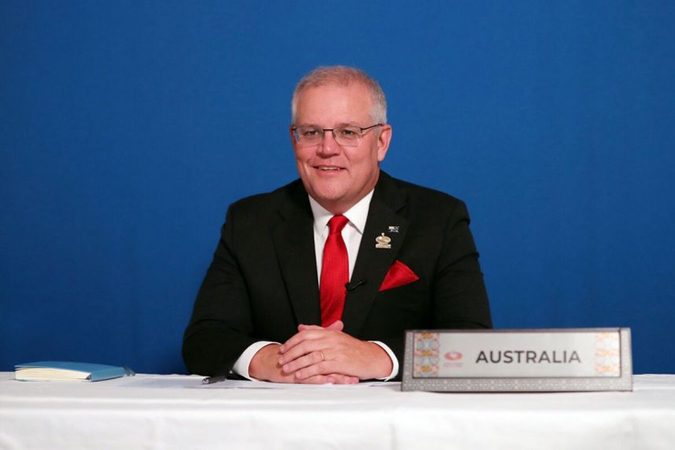
Australia is moving to boost ties with small island nations off its eastern coastline, pushing back against China’s growing influence in the Pacific Ocean as the virus outbreak hinders travel.

Prime Minister Scott Morrison’s government has promised to supply its neighbors with covid-19 vaccines in 2021 as part of a $500 million package aimed at achieving “full immunization coverage” in the region. It also recently signed a “landmark” deal with Fiji, one of the region’s most populous nations, to allow military deployments and exercises in each other’s jurisdiction.

“China has largely been missing in action in regards to providing covid-related support in the region,” said Jonathan Pryke, who heads research on the region for Sydney-based think tank the Lowy Institute. “Australia has built up an amount of goodwill by not forgetting about the Pacific in a time of crisis.”

Over the past decade, China’s growing influence in the 14-nation Pacific Islands – whose cumulative population of just 13 million is sprawled over thousands of islands and atolls in a region stretching across 15% of the world’s surface – has triggered alarm bells in the U.S. and Australia. Diplomats and intelligence officials fear Beijing’s ultimate goal may be to establish a naval base that would upend their military strategies.

The battle for influence in the region comes after China hit Australia with a series of damaging trade reprisals following Morrison’s decision to seek an independent investigation into the origins of the coronavirus. Australia’s largest trading partner has put curbs on everything from wine to lobsters, prompting Canberra to file a challenge against barley tariffs at the WTO.

Still, Australia has made inroads in the Pacific after island nations quickly blocked incoming flights and cruise ships to keep the virus away from vulnerable communities in the aid-dependent region. China also ordered workers developing projects tied to its Belt and Road Initiative to return home, and reduced diplomatic staff in the 10 Pacific nations that recognize Beijing instead of Taiwan.

In resource-rich Papua New Guinea, the region’s most populous nation and by far the biggest recipient of China’s financial backing, work on one of the region’s highest-profile infrastructure projects stalled this year, according to Paul Barker, chief executive of Institute of National Affairs, a non-profit economic research group partially funded by the private sector based in Port Morseby.

Chinese staff left the marine industrial zone site in Madang on the nation’s north coast, which has received at least $73 million in funding from Beijing and will be used as a base to fish tuna, said Barker, who has lived in Port Moresby for four decades. While other China-backed projects around Papua New Guinea’s capital have also crawled to a standstill this year, he said he expects China’s on-the-ground presence, along with offers of financial aid, to ramp up again when the pandemic is under control.

“It’s logical for Papua New Guinea to want to get competitive contractors and finance, and if the Chinese were to offer that going forward, the government will be interested,” he said. “While most Papua New Guineans tend to look to their ‘southern friends’ in Australia because they know them, they also want to be offered more opportunities.”

China hasn’t been completely inactive. New Chinese ambassadors to the two countries that recognized it over Taiwan in 2019 – Solomon Islands, one of the region’s largest economies, and Kiribati. The new envoy in the former British colony raised eyebrows when a photo taken on his arrival seemed to show him walking over about 30 local men lying on their stomach.

The nation’s foreign ministry said in an emailed response to questions that ties with Pacific Island countries progressed during 2020 despite the impact of covid-19. It said Beijing shared medical experience and provided materials to nations during the pandemic, while Belt and Road projects including a new highway in western Papua New Guinea and a stadium in the Solomon Islands had been “progressing steadily.”

“China hopes all other countries could adopt a mutually respectful attitude and open-minded spirit to facilitate the stability and prosperity of the region, instead of maintaining ‘zero-sum’ and Cold-War mentality and building exclusive ‘small groupings’,” the ministry said.

Kiribati’s plan to build two major tran-shipment ports looks set to be integrated into the Belt and Road, according to a September report by government-backed think tank Australian Strategic Policy Institute. That would “raise the prospect of Chinese military bases across the center of the Pacific” through major sea lanes and near U.S. bases including Hawaii, the report said.

China also signed a memorandum of understanding last month to potentially fund a new $150 million marine base in southern Papua New Guinea, on Australia’s doorstep. The deal may have geopolitical implications, especially as the impoverished area isn’t near rich fishing stocks.

“The pandemic is not going to deter China from executing its strategy in the South Pacific because it wants to continue to exert its influence over weak, fragile democracies,” said Paul Maddison, director of the University of New South Wales Defence Research Institute. “Under a Joe Biden administration, there’s an opportunity for the U.S. and like-minded democracies to show sovereign Pacific nations they have a better choice in who they choose to work with.”

Lawmakers in Washington and Canberra have warned developing countries to avoid taking Chinese loans, saying that Beijing would use the debt as geopolitical leverage. China has spent at least $1.7 billion in aid and loans to the Pacific Islands in the past decade, much of it on much-needed transport and utility infrastructure, according to Lowy Institute data.

In response, Australia – seen by China as an American puppet – unveiled a $2 billion ($1.5 billion U.S.) infrastructure fund for the region in 2018. The U.S., meanwhile, established a Directorate of Pacific Affairs within the White House National Security Council, which provides a hub for coordinating policy in the region with other like-minded countries.

With the economic devastation from the pandemic set to linger for years, the geostrategic competition in the region is only set to intensify as nations look to recover, said Pryke from the Lowy Institute.

“Beijing will be aware that covid has shaped an economic crisis that’s made the region even more vulnerable and desperate for foreign aid and loans, creating a better strategic environment to further its interests,” he said.

Norway landslide death toll climbs as searchers push on #SootinClaimon.Com

#SootinClaimon.Com : ขอบคุณแหล่งข้อมูล : หนังสือพิมพ์ The Nation.

Norway landslide death toll climbs as searchers push on

InternationalJan 04. 2021

By Syndication Washington Post, Bloomberg · Stephen Treloar

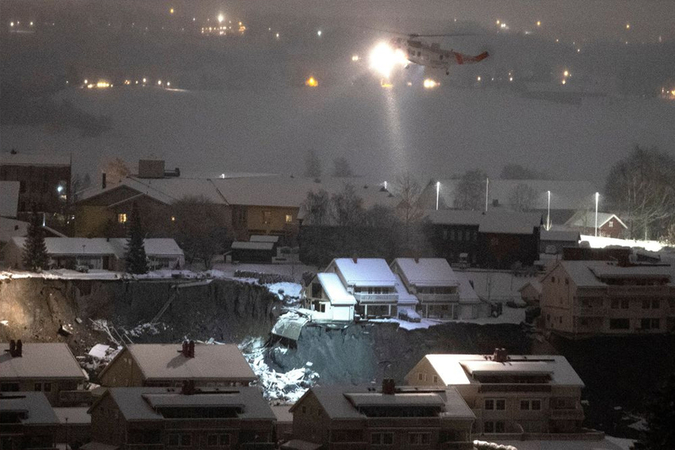
Norwegian rescuers have now recovered six bodies at a village hit by a landslide on Wednesday not far from the nation’s capital, with 4 people still missing.

The latest two discoveries were made on Sunday in the wrecks of buildings in the same area as previous finds, Goran Syversen, head of the fire brigade operation, told reporters. Rescuers worked through the night and are still searching for survivors, he said.

The quick-clay slide happened about 20 kilometers north of Oslo and follows a month of record rainfall in the capital. About 1,000 people were evacuated from the area after the landslide devastated large parts of the village.

Such landslides are known to occur in Norway and neighboring Sweden when the quick clay common to some parts of Scandinavia fills with rainwater and turns to liquid, according to the Norwegian Geotechnical Institute. Several houses were carried out into the sea due to a similar slide in June. No one was injured in that event.

Johnson says U.K. restrictions will probably get tougher #SootinClaimon.Com

#SootinClaimon.Com : ขอบคุณแหล่งข้อมูล : หนังสือพิมพ์ The Nation.

Johnson says U.K. restrictions will probably get tougher

InternationalJan 04. 2021

By Syndication Washington Post, Bloomberg · Brian Swint, Lynn Thomasson

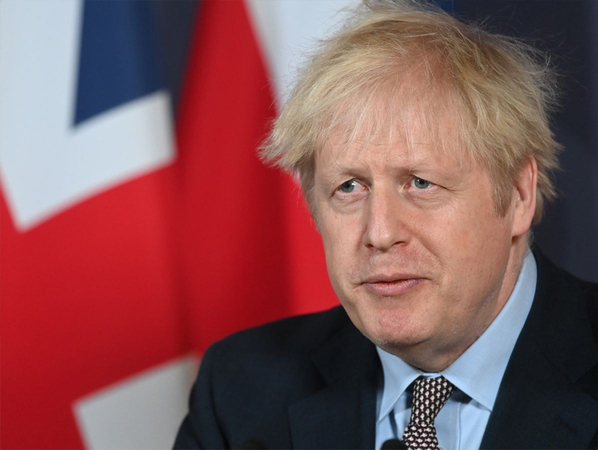
U.K. Prime Minister Boris Johnson said tougher measures will probably be needed to combat the pandemic, including school closures.

In an interview with the BBC’s Andrew Marr on Sunday, Johnson didn’t elaborate on what kind of additional measures might be needed and rejected criticism that his government has been too slow to act as the more contagious form of the virus spreads rapidly across the country.

“It may be that we need to do things in the next few weeks that are tougher in many parts of the country,” Johnson said. “The U.K. is grappling with a new variant of the virus which is surging particularly in London and the southeast and that’s why we’ve had to take exceptional measures for some parts.”

One of the biggest questions now facing the government is how to manage school reopenings at a time when U.K. virus cases are surpassing 50,000 a day. Johnson’s administration has been trying to keep in-person classes in England going throughout the pandemic, and on Sunday the prime minister sought to reassure parents that schools are safe and the virus poses little risk to young people.

“We’ve kept schools going for a long, long time in areas where the pandemic is in very high levels,” Johnson said. “We’ve got to keep things under constant review, but we will be driven not by any political considerations, but entirely by the public health question.”

Johnson’s statements contrast sharply with warnings coming from teachers’ unions, which have told members not to return to classrooms. In London, which has one of the country’s highest levels of covid-19 infections per capita, the government has ordered all primary schools to remain closed for the start of the new term this week.

Keir Starmer, leader of the opposition Labour Party, went further, calling on the government to impose a national lockdown within 24 hours.

Throughout the pandemic, the U.K. government has been forced to backtrack several times on efforts to reopen the economy, especially as the virus’s winter resurgence pushes public health services to the brink. Most recently, Johnson was forced to U-turn on plans that would have relaxed social-distancing rules over Christmas.

When asked about the U.K.’s plans for mass vaccinations, Johnson didn’t offer any detail about how the country would be able to deliver 2 million vaccines a week.

“Everybody’s working flat out to do this,” he said. “We do hope that we will be able to do tens of millions in the course of the next three months.”

In Scotland, First Minister Nicola Sturgeon asked for the parliament in Edinburgh to be recalled on Monday so she can lay out extra measures to curb rising infections. At the moment, schools are due to return for face-to-face teaching on Jan. 18 after a prolonged Christmas break.

Daily covid-19 cases have been rising to records and Sturgeon has said the country faces its most critical weeks since the pandemic began. The new strain counts for four in 10 new infections, a University of Edinburgh public health expert told the BBC.

Pelosi wins speakership as new Congress takes over #SootinClaimon.Com

#SootinClaimon.Com : ขอบคุณแหล่งข้อมูล : หนังสือพิมพ์ The Nation.

Pelosi wins speakership as new Congress takes over

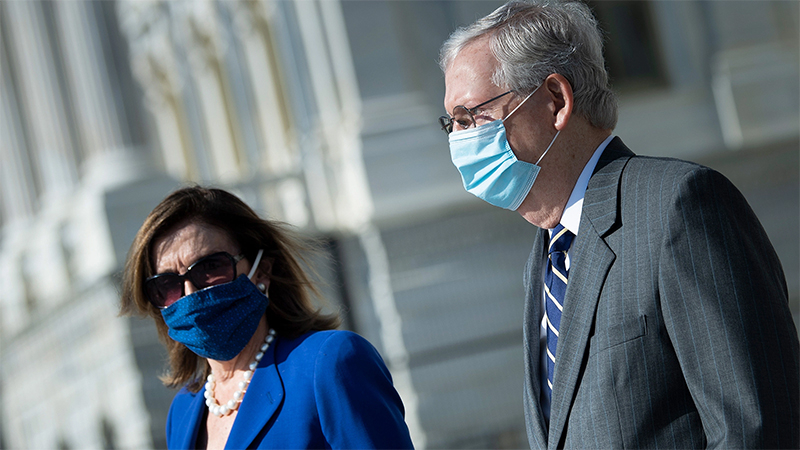
InternationalJan 04. 2021Rep. Nancy Pelosi, D-Calif., was elected speaker of the House on Sunday, Dec. 3, 2021. MUST CREDIT: Washington Post photo by Katherine FreyRep. Nancy Pelosi, D-Calif., was elected speaker of the House on Sunday, Dec. 3, 2021. MUST CREDIT: Washington Post photo by Katherine Frey
By The Washington Post · Mike DeBonis, Paul Kane

WASHINGTON – A new Congress convened Sunday with Senate Republicans in open warfare, as several GOP senators leveled highly personal accusations against at least a dozen fellow Republicans who are planning a challenge this week to the results of the presidential election.

The split, virtually unprecedented during the ironclad tenure of Senate Majority Leader Mitch McConnell, R-Ky., came as the traditionally celebratory moment unfolded instead against the backdrop of a pandemic that is killing thousands of Americans each day.

It was the starkest illustration yet of the civil war that could engulf the Republican Party in the post-Trump era, as factions prepare to battle over whether the party will continue down the unorthodox, scorched-earth path forged by President Donald Trump or return to a more traditional brand of conservative politics. The bitter back-and-forth also was erupting two days before a pair of special elections in Georgia that will determine whether the GOP retains control of the Senate.

The battle was triggered by the plans of 12 senators to challenge as many as six states’ electoral vote tallies at Wednesday’s joint session of Congress, a usually routine procedure that this year is shaping up as the final opportunity of Trump loyalists to insist, without evidence, that Biden’s win was somehow illegitimate. The chances of derailing Biden are almost nonexistent, but the event provides a stage for Republican lawmakers seeking to court Trump loyalists.

Their announced challenge was met with an impassioned response from other Republican senators, who hope the party can move beyond Trump’s chaos and are frustrated that GOP members would challenge a patently legitimate election outcome. Sen. Patrick Toomey, R-Pa., said in a blistering statement that the effort “directly undermines” Americans’ right to choose their leaders and would “disenfranchise millions of voters in my state and others.”

“The senators justify their intent by observing that there have been many allegations of fraud,” he said. “But allegations of fraud by a losing campaign cannot justify overturning an election.”

Sen. Mitt Romney, R-Utah, called the effort to challenge the results an “egregious ploy” that “dangerously threatens our Democratic Republic.”

“I could never have imagined seeing these things in the greatest democracy in the world,” Romney said. “Has ambition so eclipsed principle?”

Sen. Josh Hawley, R-Mo., the first GOP senator to announce his intent to challenge the electoral college tally, swiped back in a letter to his colleagues late Saturday accusing Toomey and others of engaging in “shameless personal attacks” and making “unfounded claims about the intentions of our fellow Senators.”

He cited what he said was skepticism among his constituents about Biden’s win. “I believe it is my responsibility as a Senator to raise their concerns in the forum allowed to members of Congress,” he said. “That’s exactly what I intend to do.”

Democrats have criticized some Republicans’ practice of citing doubts by voters about the election – which they themselves helped fuel – as a reason for further investigation. Dozens of judges, including several appointed by Trump, have summarily rejected allegations that any notable fraud occurred in the election.

Dozens of Republican House members are expected to challenge the electoral tally when Congress meets in joint session on Wednesday. But the split among Senate Republicans, who are generally less fractious and chaotic, was striking, signaling what is likely to be an extended period when the GOP wrestles to define itself.

Sen. Lindsey Graham, R-S.C., a steadfast Trump ally, also took issue with the challenge, though he was less hard-hitting than Toomey or Romney. “Proposing a commission at this late date – which has zero chance of becoming reality – is not effectively fighting for President Trump,” Graham said. “It appears to be more of a political dodge than an effective remedy.”

In all, it was an embarrassing spectacle for McConnell, who has for weeks urged his Republican colleagues to refrain from questioning the election at the Wednesday joint session of Congress. McConnell feared it would force many of his members into a politically difficult vote, as they would have to either defy Trump or question the results of a legitimate election.

While that is not expected to create an immediate problem for McConnell’s leadership – he was re-elected GOP leader by acclamation in November – it demonstrates that Trump’s departure from the White House will not mean a lessening of the intraparty tensions that made the past four years a high-wire act for Republican legislators.

A McConnell spokesman did not respond to a request for comment on the turmoil late Saturday.

The chaos in the Senate, which assures a lengthy and angry debate on Wednesday and possibly into Thursday, is only one aspect of the factionalism likely to roil both parties in what will be the most closely divided Congress in memory. If Democrats win the two Georgia races, that chamber will be split 50-50, while Democrats’ advantage in the House has dwindled to just a handful of seats – causing endless headaches for leaders of both parties and daunting challenges for Biden.

In the House, Rep. Nancy Pelosi, D-Calif., was on Sunday won her fourth term as speaker, one that she has signaled will be the last chapter in a storied four-decade political career.

Her election was not assured, thanks to the shrinking of the Democratic majority in November’s elections and the uncertainty surrounding lawmakers’ attendance during the ongoing pandemic.

She will lead a razor-thin Democratic majority in the House, with Democrats controlling 222 seats to the GOP’s 211, with two vacancies.

Several Democratic lawmakers defected during Sunday’s vote. Rep. Jared Golden of Maine voted for Sen. Tammy Duckworth, D-Ill., to serve as House speaker; Rep. Conor Lamb of Pennsylvania voted for Rep. Hakeem Jeffries, D-N.Y.; and Reps. Abigail Spanberger of Virginia, Elissa Slotkin of Michigan and Mikie Sherrill of New Jersey voted present.

While scores of Democratic members have used new proxy voting procedures to weigh in from afar during the past seven months, those procedures were not available for Sunday’s vote – meaning lawmakers appeared in person.

The two chambers convened at noon Sunday, as prescribed in the Constitution. After the swearing-in of members, the Senate has no business to conduct until Wednesday’s electoral college proceedings.

Sunday’s proceedings were on a somber note, with the announcement of an unexpected vacancy due to the Tuesday death of Rep.-elect Luke Letlow, a 41-year-old Louisiana Republican who had been hospitalized with covid-19, the illness caused by the novel coronavirus. Letlow’s seat and an upstate New York seat that remains too close to call will remain vacant Sunday.

Another three members were not expected to attend. GOP Reps.-elect David Valadao and María Elvira Salazar both said last week that they are isolating due to positive coronavirus tests, while Rep. Alcee Hastings, D-Fla., who is battling cancer, is not likely to make the trip to Washington, a Democratic aide said.

Veteran lawmakers, used to the joyous pomp and circumstances of a packed House floor for their swearing in, found the safety conditions a bit jarring.

“Real different,” said Rep. Fred Upton, R-Mich., first elected in 1986, after leaving the Capitol’s coronavirus testing site. “I just got tested, real different. I flew back last night. First time I’ve been without my family. My wife’s always up in the gallery.”

Upton recalled past swearing-in days, including one in the early 1990s when his young son was wrapped around his shoulders and their picture made the front page of USA Today.

“It’s a whole different world right now,” Upton said.

That somber tone was widespread. In the House, only first-time members have been granted a ticket for a guest. Already-sitting lawmakers have been advised to come to the Capitol alone.

The selection of the new speaker – historically made with all members sitting together on the floor and lawmakers rising one at a time in alphabetical order to shout their selection – is instead being done in shifts, with 72 lawmakers called to the floor at a time.

A number of Democratic lawmakers have signaled their restlessness at Pelosi’s long-term tenure, suggesting an unrest that could take hold in the Democratic House members even as she retains her hold on the speakership.

In a note to Democratic lawmakers before Sunday’s speaker vote, Pelosi thanked her colleagues for confronting a challenge “as daunting and as demanding as any that previous generations of leadership have faced.”

“Each of our communities has been drastically affected by the pandemic and economic crisis: 350,000 tragic deaths, over 20 million infections, millions without jobs – a toll almost beyond comprehension,” she wrote.

India approves two vaccines as it prepares for unprecedented immunization push #SootinClaimon.Com

#SootinClaimon.Com : ขอบคุณแหล่งข้อมูล : หนังสือพิมพ์ The Nation.

India approves two vaccines as it prepares for unprecedented immunization push

InternationalJan 04. 2021

By The Washington Post · Niha Masih

NEW DELHI – India on Sunday granted emergency approval to its first vaccines, Oxford-AstraZeneca and homegrown Covaxin, as it gears up to undertake an unprecedented immunization program for the country of more than 1.3 billion.

The announcement of India’s approval of the Oxford-AstraZeneca vaccine came days after the regulators in Britain gave their nod to the vaccine and marks a big step forward for the world’s second worst-affected country by the coronavirus pandemic. India aims to administer the vaccine to 300 million people in the first phase and the rollout could begin in the coming days.

The Oxford-AstraZeneca vaccine, known as Covishield in India, is being produced locally by the Serum Institute of India, the world’s largest vaccine manufacturer. It has stockpiled 40-50 million doses and plans to produce 300 million doses by July. Its billionaire owner, Adar Poonawalla, has pledged 50 percent of its production for India. On Sunday, Poonawalla said on Twitter that his company’s risks “paid off” and the vaccine is “ready to roll out.”

Interim results published by Oxford-AstraZeneca researchers in the U.K. showed that the vaccine was 62 percent effective among those administered two doses. A different dosage proved 90 percent effective; scientists are actively studying that dosage and its efficacy. Pfizer-BioNTech and Moderna, which have rolled out vaccines in the United States, reported a 95 percent efficacy rate.

According to a statement by the Indian drug regulator, the company conducted phase 2 and 3 trials on 1600 participants in the country and the data was found to be “comparable” with the data from overseas studies. The approval is subject to regulatory conditionalities, though details of that were not shared immediately.

Prime Minister Narendra Modi said it was a matter of pride for “every Indian” that both vaccines are “made in India.”

But the announcement was marred by questions over the fast track approval to Covaxin, which has not completed its third phase of human clinical trials. The vaccine is being developed by Hyderabad-based Bharat Biotech in collaboration with two government backed institutes. The drug regulator shared that the first two phase trials demonstrated the vaccine was safe but did not share any efficacy data.


“Detailed analysis documents need to be put in the public domain,” said public health expert Giridhar Babu, who said terms like “restricted use” in the announcement need to be explained.

“Regulatory conditions need to be spelt out much more clearly,” he said. “That should not be subject to interpretation.”

Shashi Tharoor, a politician of the opposition Congress party tweeted that the approval to Covaxin was “premature and could be dangerous.”

Bharat Biotech in a statement said that the vaccine addresses “an unmet medical need” and their goal is to provide “global access to populations that need it the most.”

India hopes to play a big role in the supply of coronavirus vaccines to the developing world through its homegrown vaccine candidates. Even as wealthy countries such as the United States and the United Kingdom have snapped up vaccines for their entire population, poorer regions are struggling to secure supplies.

Both the vaccines require two doses – like the Pfizer-BioNTech vaccine – but are cheaper and do not require the extremely low temperatures to store.

Health Minister Harsh Vardhan told reporters Saturday that the vaccine will be given free of cost for 30 million health care and other essential workers who will be the first in line to get vaccinated.

With over 10 million cases, India’s covid-19 caseload is second only to the United States. More than 148,000 people in India have lost their lives to the disease. However, the number of daily infections in India have fallen drastically since the early stages of the pandemic. The country confirmed the presence of the new U.K. strain of the virus among recent arrivals from Britain that has led to renewed worries about a possible resurgence of infections.

For the rollout of the program, India will first vaccinate 30 million health care workers and other first-responders including police and armed forces. This will be followed by individuals above the age of 50 and those with co-morbid conditions – another estimated 270 million people.

India’s health care system is patchy especially in rural parts and under strain from the pandemic. Logistics and delivery will be an uphill task. In September, at the peak of the pandemic, hospitals in some states faced oxygen shortages for lack of storage and delivery facilities. It also lacks the infrastructure for vaccines such as Pfizer’s that require storage at extremely low temperatures.

But the challenges are outweighed by other factors, experts in the field say.

“I think India’s biggest advantage is its vaccine manufacturing capacity,” said Shahid Jameel, director of Trivedi School of Biosciences at Ashoka University near Delhi. “India will have sufficient doses of vaccine of various types without spending huge amounts of money to preorder vaccines.”

India is a global leader when it comes to vaccine manufacturing and claims to produce 60 percent of the world’s vaccines. Its experience in running large-scale immunization programs will also come in handy. Its child immunization program targets 27 million newborn babies annually.

For effective distribution of the coronavirus vaccine, India is looking to its experience in conducting the world’s largest electoral exercise every five years.

“The procedure of the vaccination drive is the same as the election,” said Vardhan, the minister for Health on Friday, involving thousands of workers who receive training in a standardized operating procedure carried out nationwide. Step-by-step processes have been outlined and roles demarcated for vaccination teams.

For seamless tracking and delivery of vaccines, India has developed a digital platform called Co-WIN, which will maintain the database of beneficiaries, cold chain points and post-vaccination symptoms. Identification of beneficiaries, physical sites for administering vaccines and training of tens of thousands of vaccination workers is being carried out by state governments.

According to government guidelines, about 100 people will receive vaccination shots at every site in a day. Last week, four state sites held dry runs that went off smoothly.

“We were able to create vaccine sites, link to cold chains and upload beneficiary data who received (text messages) with details,” said Rajesh Bhaskar, the officer incharge of pandemic management in the state of Punjab. He said the state, which was one of the four to hold a dry run last week, had identified 150,000 health care workers for the first round who can be vaccinated within two days.

In the southern state of Andhra Pradesh, Mohammed Imtiaz, a high-ranking official said the test run was conducted in rural and urban areas at government and private facilities. The focus was on ensuring the vaccination officers were well-versed with protocols to validate identities, follow biomedical waste norms and monitor for any adverse reactions.

The rest of the country conducted similar test runs this week before the rollout formally begins.

Jameel, the virologist from Ashoka University, says there may not be a need to vaccinate everyone. Areas where 70 percent of population have antibodies for the coronavirus won’t require vaccinations, while those with a lower percentage of people with antibodies should be given priority, he said. The current government plan for vaccination will take nine to 12 months to complete, and scientists should conduct periodic sero-surveys to assess the antibody levels. “That will guide us,” he said.

Homes of Pelosi, McConnell are vandalized after Senate fails to pass $2,000 stimulus checks #SootinClaimon.Com

#SootinClaimon.Com : ขอบคุณแหล่งข้อมูล : หนังสือพิมพ์ The Nation.

Homes of Pelosi, McConnell are vandalized after Senate fails to pass $2,000 stimulus checks

InternationalJan 04. 2021

By The Washington Post · Meryl Kornfield

With spray paint, fake blood and a pig’s head, vandals defaced the homes of House Speaker Nancy Pelosi, D-Calif., and Senate Majority Leader Mitch McConnell, R-Ky., this week after Congress adjourned at the end of 2020 without the Senate passing a House bill approving $2,000 stimulus checks.

“WERES MY MONEY,” an assailant wrote early Saturday morning on the front door of McConnell’s Louisville home days after the lead Republican lawmaker dubbed $2,000 stimulus checks “socialism for rich people.” “MITCH KILLS POOR” was scribbled on a window.

Early Friday morning, San Francisco police responded to Pelosi’s home about a report of vandalism at her residence. On the garage door, “$2K” was written and crossed out in spray paint, along with “Cancel rent!” and “We want everything.” Sitting in a pool of fake blood trailing down the driveway was a pig’s head.

Investigations are ongoing into the vandalism at the homes of the two most powerful members of Congress, police in both cities confirmed to The Washington Post.

McConnell called the damage to his home a “radical tantrum” that would not deter him.

“I’ve spent my career fighting for the First Amendment and defending peaceful protest. I appreciate every Kentuckian who has engaged in the Democratic process whether they agree with me or not,” he said in a statement shared with The Washington Post. “This is different. Vandalism and the politics of fear have no place in our society.”

Pelosi’s office did not respond to a request for comment about the incident.

On New Year’s Eve, McConnell refused to allow debate on a bill passed by the House to increase the direct cash payments from $600 to $2,000 to qualifying American households. Among those who have supported $2,000 payments is President Donald Trump.

“The president of the United States has expressed his support for the $2,000,” Pelosi said in a news conference Wednesday. “The Democrats and Republicans in the House have passed that legislation. Who is holding up that distribution to the American people? Mitch McConnell and the Senate Republicans.”

In speeches in the Senate this week, McConnell compared the $2,000 checks to socialism and said that payments would need to be addressed along with Trump’s other two demands of lawmakers: establish a commission to investigate the 2020 election and repeal Section 230 of the Communications Decency Act, a regulation that provides legal immunity for Internet services for content posted on their platforms.

“The Senate is not going to be bullied into rushing out more borrowed money into the hands of Democrats’ rich friends who don’t need the help,” McConnell said.