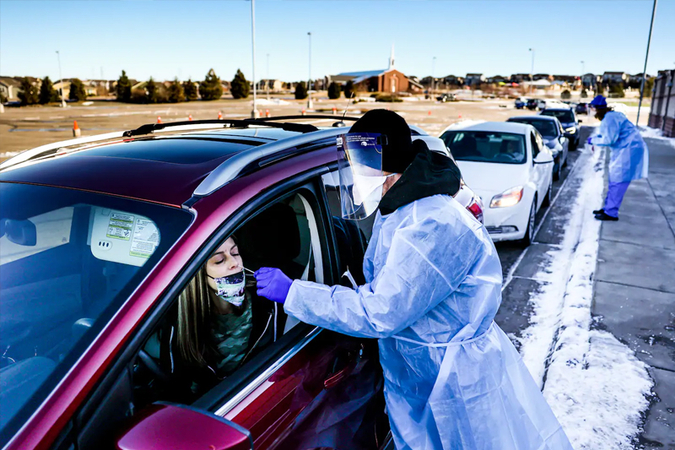
Over 30 countries have reported cases of the highly-transmissible U.K. variant of the novel coronavirus, raising fears of increased global spread of the virus, even as countries begin to unroll vaccination programs in the new year.
Vietnam on Saturday was the latest nation to report a case, which authorities detected in a woman quarantined after recent travel from the United Kingdom. Vietnam has banned nearly all international travel, but it is providing repatriation flights for citizens stranded in the U.K.
Turkey reported Friday its first 15 cases of the U.K. variant, found in recent travelers from the U.K., leading Turkish authorities to issue a temporary ban on entries from the there. Turkey, along with many other countries, suspended flights between the United Kingdom in late December.
At least three U.S. states have identified cases of the variant. Public health officials, however, say it is likely already spreading undetected due to limited genetic sequencing of the coronavirus in the United States.
The United States leads the world in coronavirus cases and deaths, though widespread transmission of the fast-spreading form of the virus would likely lead to even larger outbreaks, putting further strain on the country’s already overwhelmed health-care system.
In recent weeks British authorities have imposed strict lockdowns on millions of people as the variant, first documented in late September, has led to surges in infections. So far, scientists do not think that the fast-spreading form of the virus is more deadly or vaccine resistant.
As global infections continue to rapidly rise, Ireland has recently gone from having the European Union’s lowest per capita rate of cases to the fastest growing, the Guardian reported.
“The virus is absolutely rampant now in the community,” the CEO of Ireland’s health services Paul Reid said Friday. “Everybody is at extreme risk of contracting the virus.”
But Philip Nolan, the head of Ireland’s covid-19 modeling group, told national news broadcaster RTE on Saturday that the U.K. variant represented between 5% and 17% of current cases, according to the latest available genetic analysis.
While Nolan’s predicted new infections would continue to increase as the variant spreads, he attributed the current surge to socializing over the Christmas holiday.
“Right now we believe the UK variant is here at a relatively low level, even with that small sample,” he said. “We saw an even more intense level of socialization and viral transmission over Christmas than we might have expected and that’s what’s leading us to the really precarious position we’re in now.”
The bleak return to lockdowns in many communities across the globe comes in sharp contrast to the hopeful rollout of vaccines programs in some countries.
Israel has provided the first of two coronavirus vaccine shots to more than a million of its citizens, the highest rate in the world since beginning its efforts in late December. The United States, in contrast, vaccinated some 2.8 million people by Dec. 30, falling far short of President Trump’s pledge to inoculate 20 million people by the years end.
Despite widespread expectations that vaccines will turn the tide of the pandemic, it will still take weeks for the initial shots to kick in and months before vaccines will likely become available for a majority of the world’s communities and countries, in particular poorer ones. Adding to concerns, significant percentages of many populations have reported hesitations around injecting the fast-tracked vaccines, while health experts worry about the impact of disinformation campaigns dissuading publics from taking it.
As the United Kingdom tries to contain the U.K. variant, health authorities have also deviated some from initial inoculation plans.
On Wednesday, British health officials said they would prioritize giving more people the first shot to ensure wider, partial protection from the virus, and in turn delay providing the second injection, only after which is the vaccine is most effective.
Early vaccination in prisons, a public health priority, proves politically charged
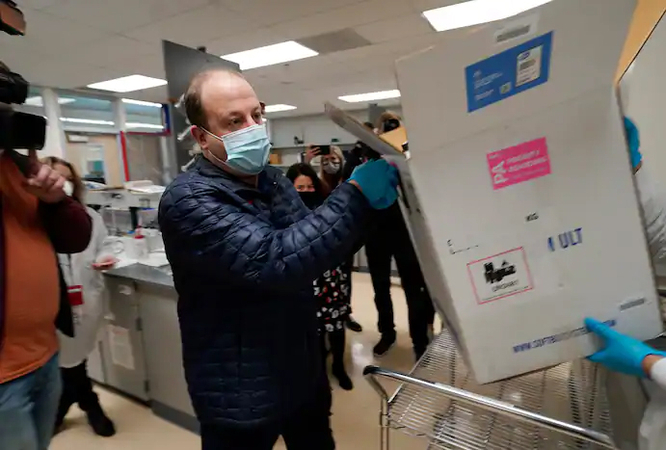
InternationalJan 03. 2021Colorado Gov. Jared Polis (D) helps put the state’s first shipment of a coronavirus vaccine in a Denver freezer on Dec. 14. (David Zalubowski/AP)
By The Washington Post Isaac Stanley-Becker
First came the outcry in a Denver newspaper op-ed, arguing that Colorado’s coronavirus vaccination plan would bring relief to a man who fatally shot four people before it protected the author’s law-abiding, 78-year-old father.
Then came the backlash on social media. The accusation that state leaders were coddling convicts like Nathan Dunlap, who is being held for life in the Colorado State Penitentiary for the 1993 slayings at a Chuck E. Cheese restaurant, caught fire in pro-Trump Facebook groups with titles such as “ALL ABOARD THE TRUMP TRAIN.” Within days, the person behind the broadside, a Republican district attorney, was making his case on Fox News, labeling the state’s vaccination plan “crazy.”
The plan, which put incarcerated people in line for coronavirus immunization ahead of the elderly and those with chronic conditions, had been released by the state health department. It was the product of months of deliberation by members of the state’s medical advisory group – physicians, public health officials and experts in bioethics. But their framework, when subject to the machinery of online outrage, quickly unraveled.
Asked by a Fox News reporter about the prioritization, and the criticism touched off by the op-ed, Colorado Gov. Jared Polis, a Democrat, said at a December news briefing there was “no way” the limited supply of shots would “go to prisoners before it goes to people who haven’t committed any crime.” He let out a short laugh as he pronounced the word “prisoners.”
As promised, a revised version of the state’s plan, released a week later without input from the advisory panel, put incarcerated people in no particular phase. It similarly demoted people living in homeless shelters and other congregate settings, while guaranteeing access to front-line workers and adults 70 and older as part of the priority group following medical workers and residents and staff of long-term care facilities.
The shift in Colorado offers an early sign that prisons and jails, which hold a disproportionate share of people of color and have reported some of the most virulent coronavirus outbreaks, are creating daunting dilemmas for state leaders apportioning finite shares of the vaccine. The episode illustrates how a system of preferences geared to stop the virus where it is most destructive may clash with other values in a nation that incarcerates more people than does any other.
More broadly, the makeup of the second tier is exposing sharply different priorities across the country, with some governors bucking expert advice to focus on vulnerable workers and high-risk living settings and instead rushing shots to the elderly.
Experts advising Polis said they could not be sure why he discarded their recommendations to prioritize congregate living settings – he has not expounded on his thinking – but said they were troubled that he seemed to yield to criticism from political adversaries.
Polis spokesman Conor Cahill declined to make the governor available for an interview but issued a statement defending the state’s plan, stressing the “moral obligation” to prioritize elderly people most at risk of dying from the virus and “front-line health-care heroes” caring for the sick.
“Inmate status will not make a difference in terms of timing of receipt of the vaccine,” Cahill said. “Someone who falls into a category for early priority of the vaccine and is in custody will receive the vaccine at the same time as someone in the same category who is outside our correctional facilities.”
About a dozen states take a similar approach, according to a review of draft plans by the Prison Policy Initiative, a Massachusetts think tank. Several states, including New Jersey and Washington, have already begun vaccinating inmates. And another seven – Connecticut, Delaware, Maryland, Massachusetts, Nebraska, New Mexico and Pennsylvania – put incarcerated people after health-care workers and the residents and staff of long-term care facilities, according to the think tank.
Plans in about half the states suggest inmates will gain access at some point ahead of the general population. But details are preliminary and subject to political winds.
“It’s a very stigmatized population, and there are people who say, ‘They’re in prison, they must have done something terrible, and they don’t deserve a place in line,’ ” said Matthew Wynia, director of the Center for Bioethics and Humanities at the University of Colorado and a member of the state’s medical advisory group. But viewing the priorities in terms of who deserves to be inoculated, he said, “might end up prolonging the pandemic and killing more people.”
Anyone making a “moralistic argument,” Wynia said, should focus more on the math – 14 of Colorado’s 15 largest outbreaks have occurred in prisons, jails or college dorms. Nationally, more than 40 of the 50 largest clustered outbreaks have occurred in jails and prisons, according to a “call for urgent action” published in the Lancet medical journal in October. Inmates live in crowded conditions and have high rates of hypertension, heart disease and other conditions linked to serious risk from covid-19, the illness caused by the coronavirus. They are disproportionately Black and Hispanic, part of communities stricken by the pandemic.
More than 7,000 people in the care of the Colorado Department of Corrections have tested positive for the virus, and the state says 14 have died. Anuj Mehta, a Denver pulmonologist who chaired the advisory group addressing vaccine prioritization, said he thought Polis was operating on a principle of “trying to save the most lives,” though he disagrees with the governor’s approach. Viral spread hardly stays within prison walls, he noted, mainly because corrections officers return to their families, often in minority and low-income communities.
For these reasons, immunization experts tapped by the Centers for Disease Control and Prevention to develop federal recommendations to guide state planning have highlighted the needs of incarcerated populations and people living in homeless shelters. Guidance approved recently by the CDC’s Advisory Committee on Immunization Practices put corrections officers in what is known as Phase 1b, along with other front-line workers and people aged 75 and older, recommending states immunize inmates at the same time or, depending on vaccine supply, in the next phase. Colorado’s plan essentially strips them from that tier.
“All these groups, in various facilities, are very vulnerable,” said Sharon Frey, a committee member and clinical director of St. Louis University’s Center for Vaccine Development.
The point was brought home in public testimony, when Joseph Bick, director of health-care services for the California Department of Corrections and Rehabilitation, told the CDC advisory group that, “Prisons are essentially long-term care facilities with bars.” California, where more than 40,000 inmates have been infected and about 130 have died, has already begun vaccinating some high-risk inmates. Officials have not yet decided how to prioritize the broader inmate population, said Ali Bay, a spokeswoman for the state health department.
A number of states place prison and jail staff ahead of inmates. Asked about the rationale for that approach, Gavin Lesnick, spokesman for the Arkansas Department of Health, said staff “come and go from the facility and into the community and may have a higher risk.” Shannon Litz, a state health department spokeswoman in Nevada, said the state considered “chance of exposure to covid-19 and the guidance provided by federal partners.”
Peter Wagner, executive director of the Prison Policy Initiative, said it was difficult to spot trends among the states putting incarcerated people near the front of the line. Connecticut, Wagner said, is a “big reformer,” but some other states pursuing significant criminal justice reform have not publicly committed to early vaccination of inmates.
In Massachusetts, the priority given to incarcerated people stems from the broader focus on congregate settings, said Paul Biddinger, medical director for emergency preparedness at Mass General Brigham and chairman of the state’s vaccine advisory group.
“Congregate settings are congregate settings, and they are high density and at risk whether they’re long-term nursing facilities or prisons,” said another committee member, Massachusetts state Sen. Cindy Friedman, a Democrat. That inmates are in such dire need of inoculation, she said, shows the failures of criminal justice in America, revealing the “extent of the breakdown and the gaps and the poor access to behavioral health care.”
But the pandemic has put vows of reform to the test.
In remarks last year before the coronavirus began spreading out of control, Polis said he would “like to see Colorado lead the nation in criminal justice reform.” He issued an executive order in March allowing the Department of Corrections to reduce the state prison population, but the rule expired in May, and he faces litigation by the American Civil Liberties Union of Colorado accusing him and his corrections director of failing to protect vulnerable inmates.
Mark Silverstein, legal director of the state branch of the ACLU, said he initially thought Polis had made an error and misstated his own health department’s plan when, responding to an interview question in Spanish, he said, “Free people must receive it before incarcerated people.”
The following week, the governor reiterated his position in even stronger terms, “seemingly in response,” Silverstein noted, to the position staked out by the Republican district attorney, George Brauchler.
Brauchler said the Democratic governor had demoted inmates even more drastically than Brauchler had suggested in his Denver Post op-ed. Even though he was outraged that his elderly father might be put in line after inmates, Brauchler, 51, said he thinks people locked behind bars should gain access before he does.
How D.C. and its teachers, with shifting plans and demands, failed to reopen schools
InternationalJan 03. 2021Chancellor Lewis Ferebee, left, and Mayor Muriel Bowser, a Democrat, right, tour Shepherd Elementary School in the District of Columbia on Nov. 10, 2020. Washington Post photo by Marvin Joseph
By The Washington Post Perry Stein, Laura Meckler
WASHINGTON – Online classes in the District of Columbia in spring had been a disaster. Thousands of students didn’t have computers or reliable WiFi. Many were falling behind. So as spring gave way to summer, Mayor Muriel Bowser, a Democrat, was determined to open schools again.
By mid-July, she had a plan. But it depended on cooperation of the teachers, and their union responded with protests.
Hours before the mayor was to make an announcement, she said she needed more time.
The city spent the next five months trying to bring students and teachers back to classrooms. A combination of mismanagement by the mayor and her aides and intransigence from the District’s teachers union combined to thwart every move, according to interviews with city officials, union leaders, educators and activists. The city kept changing its plan, and the union kept changing its demands. A lack of trust on both sides fueled failure at every turn.
As urban school districts across the country struggled with classroom reopening plans, a close look at the District’s experience shows how hard it has been to develop workable strategies – and how much power teachers wield, particularly when they have a strong union behind them.
The District’s impasse meant it squandered the chance to give its most vulnerable children classroom time while infection rates were low. Now the earliest any students will have face-to-face instruction will be February.
While teachers worked to persuade parents that reopening was dangerous and the District’s plan inadequate, the city did little to sell either the urgency of going back or the details of its plan to the general public.
The school system had proof that children were falling behind because of remote learning but sowed doubt in the findings by presenting inaccurate data. Principals had no input in shaping the reopening plan and were left in the dark about its details. Advocates for homeless children – the students city officials argued most urgently needed to be in school – never heard from administrators. Groups that worked with students with disabilities said they couldn’t get their questions answered, so these families were reluctant to go back.
Paul Kihn, deputy mayor for education, said the city surveyed families in the summer and knew about half were ready to return to school buildings. But city officials made a major miscalculation. They assumed they would be able to strike a deal with the union and enough teachers would be willing to come back to classrooms.
That never happened.
At least twice, the Washington Teachers’ Union reached tentative agreements with the city to reopen, only to back out a few days later. The union staked out demands that went far beyond what was in place elsewhere and beyond guidelines set by its national union.
The result: Teachers were applying maximum pressure to stay closed, but there was virtually no public pressure to reopen.
“The plans we made assumed we would be able to have our teachers in our buildings,” Kihn said.
Even as restaurants and salons opened to customers, as private and charter schools began in-person classes and available data show scant virus infection in the nation’s open schools, the traditional public school system has remained entirely virtual, with a few hundred elementary school students participating in virtual learning from classrooms under the supervision of nonteaching staff.
City officials maintain they have done everything possible to reopen safely and effectively.
“Our plans are being made on the best available science,” District Public Schools Chancellor Lewis Ferebee said in July before previewing one of the city’s reopening plans. “There is no substitute for in-person instruction.”
The teachers union says it agrees, in theory, but has opposed every plan to open classrooms.
“It’s almost like they are building the plane while flying,” Elizabeth Davis, the union’s president, said. “That is not okay with us.”
Now city leaders are trying again. If health metrics allow for it – a major question given the surging caseloads – they plan to reopen all school buildings with teachers in February. This time around, according to city officials, principals, staff and parents are having more of a say in their schools’ reopening plans.
– – –
School had been virtual all spring and summer, and with the new academic year looming, Bowser planned to bring students back to schools. Schools would use a hybrid model, an idea employed across the country where students would be in class part of the week and home the rest. Teachers would return unless they qualified for an exemption.
It rested on a survey of teachers to determine who could come back, but the teachers union said its contract required terms to be negotiated and told its members not to respond. Bad blood between the city and teachers was already thick, with a toxic history of mistrust.
Teachers began venting on a private union Facebook page. They tagged one another, and the group grew fast from about 250 to some 1,000 members.
“I’ve tried to tell [school leaders] that this is not just a few rabble-rousers anymore,” said the union’s secretary, Laura Fuchs, a high school history teacher and a leader of the union’s far-left contingent.
Union participation swelled, prompting the union to upgrade its Zoom subscription. Even then, a July meeting hit the 1,000-person limit, and the union had to switch to another platform to accommodate everyone.
Fuchs’s growing faction inside the union embraced aggressive tactics. Teachers staged protests in front of the mayor’s and chancellor’s colonial homes in Northwest Washington. On July 28, a group of teachers dropped mock body bags in front of the district’s headquarters to warn of the deaths that they believed would result from reopening schools.
The union’s initial demands included hazard pay for going back and a suspension of teacher evaluations and standardized testing. These went well beyond guidelines adopted by the American Federation of Teachers, their national union.
In mid-July, Bowser had punted a decision on reopening until the end of July. When that deadline arrived, she canceled it altogether. All students would begin online in September.
– – –
By early September, school leaders had data showing how far students had fallen behind in the spring and during summer school. Some of the city’s charter schools began to bring small groups of students back to buildings.
“I think DCPS can do it, and I think DCPS should do it,” Bowser said. She put together what turned out to be a tiny plan with limited programs and virtually no teachers at just 13 schools.
Union negotiations continued with the parties convening for virtual sessions – Ferebee sometimes logging on from an empty classroom between meetings; Davis at home, digitally surrounded by at least a half-dozen union representatives.
The mayor and chancellor did little to win support from the broader community.
A city committee had been formed in May to look at school reopenings, but the mayor did not seek its input or try to recruit its members as advocates for her plans, said Cathy Reilly, a longtime education activist who served on that panel. Kihn, who chaired the committee, responded that it disbanded as planned in the summer after it presented broad guidelines on how schools should reopen.
“They consulted with us after they had decided on it,” Reilly said. Yet she said she “absolutely” heard from Davis and other teachers about their concerns.
The chancellor held a few public forums and said teachers helped shape the plans during hundreds of hours of union negotiations. But the virtual town halls frustrated many attendees, as participants were forced to ask questions through a chat window, providing no opportunity for follow-up questions or pushback.
On Oct. 5, Bowser went to an elementary school to announce a new reopening plan. She appeared to have made no effort to recruit allies for it ahead of time.
School leaders and the head of the Council of School Officers, a union representing principals, said they were left to tune in to her news conference to find out what was going on, because there was no direct communication. These same people were tasked with answering parent questions, with scant information to share.
“I am learning the information in real time with you, so I am working to obtain more details for all of us,” said a note to parents from an elementary school principal.
Davis, too, said the mayor didn’t give her a heads-up that the plan was coming. The city again was surveying teachers to figure out who could return to classrooms. Again, the union told members not to participate.
Kihn said city officials knew they wouldn’t be able to get enough teachers for a systemwide hybrid model, so they settled on something smaller.
The plan they picked was complicated and appeared to please just about nobody. Eleven students per grade in each elementary school, chosen by lottery, could come back for in-person classes, with priority given to homeless, English-language learners and special education students. That would accommodate about 7,000 of the district’s 52,000 students. A second piece of the plan would let another 14,000 students could come back to buildings to do remote school from inside classrooms, supervised by nonteachers, including some administrative staff pulled from other schools.
Some students would have the chance for a more normal school day, but because classes were so small, the online classes for everyone else would grow larger. Some students would have to change teachers in the middle of the semester, frustrating parents who were already struggling to make remote school work.
Parents who wanted their children to return to classrooms were confused about what the in-person program would look like. Would they have the same teacher? Would they receive specialized services such as speech or occupational therapy?
“The lack of concrete and specific information absolutely made families lose confidence,” said Judith Sandalow, executive director of Children’s Law Center, an organization that represents District children from low-income households. “They didn’t have thoughtful answers to really legitimate questions that parents were asking.”
Confused parents bombarded principals with questions. Confused principals turned to Richard Jackson, the head of the Council of School Officers, who didn’t know any more. “It has made the principals’ lives kind of miserable,” Jackson said.
The plan also required the city to divert administrative staff from middle and high schools to elementary schools to supervise the CARE classrooms, angering a whole new set of parents and administrators.
Then, two days after the plan was announced, Ferebee unexpectedly fired a veteran principal who had been openly critical of the city’s plans for building safety.
Ferebee said he was fired for unrelated reasons – he was accused of not following enrollment rules last academic year, a lightning rod issue in the District – but the dismissal fueled fears that the city was glossing over safety concerns.
The principals union, normally a quiet group loath to complain publicly about anything, released a scathing letter deriding just about every aspect of the reopening plan.
The plan was aimed at high-needs students, but many of these families turned down slots offered by the school system.
“They didn’t understand it. They didn’t trust that their kids would be safe. And they already found alternatives,” said Ryane Nickens, who operates a learning hub out of the Langston Lanes subsidized apartment complex in Southeast Washington for children impacted by gun violence.
Nickens said the city failed to make the case to these parents, and she wished there had been meetings in school parking lots or courtyards of public housing complexes to answer questions. “They didn’t go directly to the people impacted,” she said.
Eighty percent of the school system’s 52,000 students are Black or Hispanic, and 47% are considered “at risk,” which puts them in the high-needs category.
Kihn said he thought the city did what it needed to do. Schools reached out to families personally to offer them slots. The District had expensive safeguards in place in classrooms to mitigate the spread of the virus. And they had people who wanted to go back, with demand about what the city had expected based on a summer family survey.
Before the city canceled the reopening plans, it offered about 5,500 students seats for in-person learning, and 2,200 accepted slots. The city was awaiting a response from 1,100 families and then planned to call more people to offer them slots.
– – –
By mid-October, the city and the union both signaled they had finally reached a deal. A five-page agreement marked “FINAL” was circulated Oct. 14.
The chancellor committed to more measures than he had before, including a safety checklist for each school. Schools would require masks and social distancing. A health professional would be on every campus, taking temperatures and monitoring isolation rooms set aside for people showing symptoms. The city promised to update its air filtration systems with a $24 million plan to buy top-of-the-line air filters and portable air filtration systems for each classroom.
In an email, a labor lawyer for the city referred to the documents as “the final agreed upon version,” and the union shared them with reporters.
Overnight, the deal fell apart. The next morning, Davis insisted a union representative be empowered to verify that buildings were compliant with the agreed-upon checklist. It is unclear whether this had been her understanding all along or whether she added this demand after circulating the proposal with her members. It was not spelled out in the documents.
For their part, the mayor’s advisers said they were angry Davis continued to share tentative agreements with the media. They suspected she was trying to test reactions among teachers and the public before signing.
A week later, the Public Employee Relations Board delivered the city a debilitating blow. The union had filed a formal complaint over the teacher surveys, and the board concluded the city could not use the results. The board said the city was obligated to work through the union, not communicate with teachers on its own. Without the survey, the chancellor had no way of assigning teachers and staff.
An agreement with the union was not strictly required for schools to open. But school leaders feared they would not have enough teachers show up without a deal. Nonetheless, two days later, Ferebee told the District Council that he would go through with a reopening plan even without an agreement with the union.
But now something else was holding up an agreement. The union said teaching had to be optional for all teachers, even those who are young and healthy, or nobody would go back.
Meanwhile, teachers had been lobbying parents to oppose the reopening, and the city had barely even tried to sell it to the general public. Not a single member of the city council spoke up in favor of the reopening plan.
Over Halloween weekend, the union and the city continued talks, and on the evening of Nov. 1, Bowser and Davis spoke by phone, Davis and aides to the mayor said. Bowser said the deal they reached had to stick for the entire school year. She didn’t want more uncertainty. But Davis wasn’t willing to commit to anything beyond the next quarter, saying circumstances could change.
Bowser also wanted to use the survey results to assign teachers. Davis objected to that, too.
During that phone call, Davis never mentioned what the union had planned for the following morning. That Monday, in the early hours, thousands of parents received emails from their children’s teachers telling them that they were taking a “mental health day” and would not be teaching that day.
In the end, 39% of all city teachers called in sick. An hour after the school day began, Ferebee emailed the community saying the District was abandoning its reopening plan.
“We apologize for any inconvenience this update may cause,” he wrote.
The city was left with a tiny plan: 450 or so students returned to 24 campuses in November for online school from inside supervised classrooms. By mid-December, around 900 elementary students accepted slots at nearly 70 campuses, with attendance hovering around 50% each day. These CARE classrooms were envisioned as serving 14,000 students, but the plan had to reduce the number, partly because schools were only able to use nonteaching personnel assigned to their schools for supervision.
This was cold comfort to Nery Pena, who had accepted an in-person slot for her second-grade daughter at Garrison Elementary in Northwest Washington. She was also hoping for a spot for her younger daughter, who has developmental delays and is struggling with distance learning.
The family lives in transitional housing, which means her daughters meet the federal definition of homeless and were given priority in the lottery for seats. When Pena told her daughters they might be returning to school, her youngest was particularly excited.
“If the plan was not definite, they should have kept it to themselves and not informed parents because parents are obviously going to inform their children,” Pena said. “I was counting on it. I was getting ready.”
In the aftermath, Bowser and Ferebee explicitly blamed the union for the failure to reopen schools.
“The primary barrier now for in-person learning is having the supply of teachers to teach in those classrooms,” Ferebee told families at a town hall meeting.
Again in November, the union signaled a deal had been reached for teachers to return to classrooms on a purely voluntary basis, at least at first. But looking like Lucy, who repeatedly pulled the football away from Charlie Brown at the last moment, the union changed its mind a few days later and another agreement unraveled.
Infection rates were surging throughout the region. The effort to give some students classroom instruction in the first semester had failed.
Focused now on February, the third quarter of the academic year, Ferebee and Davis signed an agreement last month that is intended to reassure teachers. They will not get a carte blanche to refuse to teach in-person but will be required to return if not enough teachers volunteer. It also outlines safety protocols and protective items that will be in each school building. The city recently started testing asymptomatic students and staff, which teachers had wanted.
Ferebee says he is “optimistic” schools will reopen with teachers in February. Some teachers have already volunteered to return, though Ferebee said it is fewer than he expected.
As the pandemic rages on, school leaders are visiting school buildings, touting their safety features and hoping they can someday say their plans were successful.
“We will be able to say this is a success,” Kihn said, “when the students that really need to be in school buildings with teachers are back in school buildings with teachers.”
InternationalJan 03. 2021The U.S. Capitol is pictured with the sun setting on Dec. 30, 2020 in Washington, D.C. Washington Post photo by Katherine Frey
By The Washington Post Philip Rucker, Josh Dawsey
WASHINGTON – A last-ditch effort by President Donald Trump and his allies to overturn the election thrust Washington into chaos Saturday as a growing coalition of Republican senators announced plans to rebel against Senate leaders by seeking to block formal certification of President-elect Joe Biden’s victory.
The push to subvert the vote is all but certain to fail when Congress gathers in joint session Wednesday to count electoral college votes already certified by each state. Still, Trump is continuing to press Republican lawmakers to support his baseless claims of election fraud while calling on thousands of supporters to fill the streets of the nation’s capital on Wednesday in mass protest of his defeat.
A group of 11 Republican senators and senators-elect, led by Ted Cruz of Texas, vowed to join Sen. Josh Hawley, R-Mo., in challenging votes from some contested states, calling for an “emergency 10-day audit” to investigate Trump’s unfounded claims. Hours later, Trump wrote on Twitter that there would be “plenty more to come.”
The move amounts to an open rebellion against Senate Majority Leader Mitch McConnell, R-Ky., who last month pleaded with GOP senators to avoid a public debate over the legitimacy of November’s election results. McConnell has personally congratulated Biden on his victory.
The high drama at the Capitol is set to punctuate a momentous week in politics that will delineate power at the dawn of the Biden presidency. The new Congress to be sworn in Sunday will reduce the size of the Democratic House majority. Trump and Biden will both campaign Monday in Georgia ahead of twin runoff elections for the U.S. Senate on Tuesday that will determine which party controls the upper chamber. Later in the week, members of the Republican National Committee will gather at a Florida beach resort to chart the party’s future beyond Trump’s presidency.
“What’s happening next week foreshadows what’s going to be happening for the following 24 months,” said Peter Hart, a veteran Democratic pollster. “It’s a question of do we start to move to the future or get locked into the past. . . . This [could] continue to rip apart the fabric of this country that has already been torn through.”
Congress is all but certain to drive a final stake through the heart of Trump’s dream of four more years on Wednesday. But the gulf between the reality of the certification process and Trump’s fantasy of subverting the vote to stay in office is politically perilous for Republicans – none more than Trump’s unfailingly deferential No. 2, Vice President Mike Pence.
As president of the Senate, Pence will wield the gavel when the electoral votes are counted and Biden is declared the winner by a wide margin, 306 to 232.
Though Pence’s role is strictly ceremonial, the lawyer Sidney Powell and other conspiracy-minded Trump allies are trying to convince the president that Pence has the power to overturn the election by rejecting some of Biden’s electors, according to two senior administration officials with knowledge of the conversations. After Pence labored for four years to stay in the mercurial president’s good graces, his performance on Wednesday could risk a rupture on their 14th-to-last day in office.
While the growing GOP chorus to challenge Biden’s victory may ease the burden on Pence to lead the charge for Trump, it increases the likelihood of a volatile, discomfiting debate. And it virtually guarantees that Republicans will face a vote that forces them to decide whether they will honor the collective will of the voters or stand with Trump – a vote that could long serve as a litmus test for the GOP base.
With dozens of House Republicans expected also to challenge the election results, Wednesday’s event is likely to be a very public showcase of Trump’s two-month campaign to delegitimize Biden’s presidency, even as Washington barrels inexorably toward Biden’s inauguration.
For days, Trump has been urging supporters to converge on Washington on Wednesday – in a showing that could offer a measure of the enduring popular appeal of his unfounded claims of fraud.
As many as four rallies are expected to draw pro-Trump demonstrators to the Washington Monument, Freedom Plaza and the Capitol. The Proud Boys, white supremacists and members of armed right-wing groups have pledged to attend, while threats of violence and calls for an “armed encampment” on the National Mall are proliferating online.
“I’m focused on the long-term damage rather than the short-term turbulence – the formation of a very large group of people who simply will not accept the legitimacy of Joe Biden as president of the United States or the legitimacy of the processes by which he ascended to the presidency,” said William Galston, the chairman of governance studies at the Brookings Institution. “That, in my view, is the fundamental danger.”
Trump has made plain his goal with the certification process: to overturn the results of an election he insists was “rigged,” though he has produced no evidence to support that claim. But so far, at least, he has not provided clear directives about how, procedurally, he intends for that goal to be accomplished.
Trump wants Pence and others to help recruit lawmakers to join the effort led by Hawley and Cruz in the Senate and a handful of Trump allies in the House, and to publicly present what he considers evidence of voter fraud, according to a senior administration official, who, like others interviewed, spoke on the condition of anonymity to candidly discuss internal deliberations.
Pence and others have explained to Trump that the vice president does not have the power to take substantive action on Wednesday, such as moving to invalidate the results, administration officials say. Pence’s legally prescribed duties are strictly ceremonial: read aloud the electoral votes from each state and officiate any debate that unfolds.
However, Pence is encouraging lawmakers to publicly debate what they see as voting irregularities in key states, said Pence chief of staff Marc Short.
“Vice President Pence shares the concerns of millions of Americans about voter fraud and irregularities in the last election,” Short said. “The vice president welcomes the efforts of members of the House and Senate to use the authority they have under the law to raise objections and bring forward evidence before the Congress and the American people on January 6th.”
Late Friday, a federal judge dismissed a lawsuit filed by Rep. Louie Gohmert, R-Texas, arguing that the Constitution gives the vice president sole discretion to determine whether electors put forward by the states are valid. Gohmert’s suit asked the judge effectively to tell Pence that he has the right to invalidate electoral college votes cast for Biden and instead recognize other slates of Trump electors.
Pence asked that the suit be rejected, and the judge, Jeremy Kernodle, complied. Kernodle, who was nominated by Trump to serve on the federal bench in Texas in 2018, wrote that Gohmert lacked standing to sue.
For Trump, the dismissal compounds nearly two months of anger and agita over the election outcome and his failure to reverse it, either through dozens of lawsuits or by personal pressure on state and local officials.
Over the Christmas vacation, the president was in a foul mood at Mar-a-Lago, his Florida seaside club. In addition to venting about the election, he fumed about renovations to the property overseen by first lady Melania Trump in preparation for the couple’s impending move from the White House, according to someone who spoke with the president at the club.
Trump left Florida three days earlier than planned, skipping Mar-a-Lago’s annual New Year’s Eve party, which he typically attends. Hundreds of guests bought tickets to the bash, expecting the president to be there. “People go to see him,” said one person who planned to attend but bowed out after learning Trump was returning to Washington.
Trump did not explain his unexpected departure but told some guests at Mar-a-Lago that he thought Iran might seek to retaliate against the United States around the Jan. 3 anniversary of last year’s U.S. killing of Iranian Maj. Gen. Qasem Soleimani in Baghdad.
Still, Trump has been in a rancid state since his November loss to Biden. Obsessed with conspiracy theories fed to him by Powell, his personal lawyer Rudy Giuliani and other allies, he has aired grievances at will on Twitter and been easily provoked to lash out at aides.
“All of us are just trying to stay off the radar,” one senior administration official said. “You have a conversation with him and, the next thing you know, you’re pulled into, ‘Hey, Sidney Powell told me yadda, yadda, yadda,’ or, ‘Rudy said blah, blah, blah.’ There’s no upside to being in his orbit right now.”
A recent advertisement from the Lincoln Project, an anti-Trump super PAC run by longtime Republican strategists, drew the president’s fury. In it, the narrator speaks directly to Trump and says, ominously, that Pence is “running away” from him by not fully amplifying his claims of widespread election fraud.
“The end is coming, Donald,” the narrator intones. “Even Mike Pence knows.”
Trump wanted to issue a cease-and-desist letter to the Lincoln Project over the ad, although it is unclear what legal ground, if any, he might have for doing so. Officials said he ultimately was talked out of it.
In recent weeks, Trump also has been displeased with Pence, thinking the vice president and other advisers have not done enough to help him overturn the election results. But people familiar with the dynamic between the two men said the relationship remains strong.
On Monday, they are to fly to Georgia to campaign for Sens. David Perdue and Kelly Loeffler, Republican incumbents trying to fend off energized Democratic challenges in Tuesday’s runoffs. Both Trump and Pence are expected to emphasize the high stakes, telling Georgia voters that if Perdue and Loeffler lose, Republicans will lose control of the upper chamber – opening the door for a Democratic House and Senate to reverse many Trump administration accomplishments.
However, Trump has been feuding openly for weeks with Georgia’s Republican governor and secretary of state, blasting their unwillingness to reverse the state’s presidential election results. Biden was the first Democrat to win Georgia and its 16 electoral votes in nearly three decades.
As a result, some GOP officials are concerned that Trump might veer from prepared remarks at his election-eve rally and deliver a sour message that risks depressing Republican turnout on Election Day.
Polls show both races are tight, and the outcome may be uncertain when lawmakers gather back in Washington for the presidential certification the next day. McConnell and other party leaders have discouraged their members from interfering with the traditionally pro forma process, contending that any effort to change the outcome would fail.
McConnell has told others privately that he is frustrated by Hawley’s decision to challenge slates of Biden electors and force votes likely to divide Republicans, saying it will serve only to invite a political backlash from Trump supporters against GOP senators who vote to confirm Biden’s victory.
In an open letter to his constituents, Sen. Ben Sasse, R-Neb., a frequent Trump critic, went further, calling the effort to use the congressional process to reverse the election results a “dangerous ploy,” given that there is no evidence of widespread fraud. Instead, Sasse wrote, the effort is “designed to disenfranchise millions of Americans simply because they voted for someone in a different party.”
On Saturday, the Cruz-led coalition publicly rejected that position, arguing that “deep distrust” among some voters about the legitimacy of the election demands the creation of an “Electoral Commission … to conduct an emergency 10-day audit of the election returns in the disputed states.” A previous commission appointed to investigate Trump’s allegations about the 2016 election disbanded without finding evidence of fraud or even issuing a report.
Those in the Cruz coalition also said they would reject electors from disputed states as not “lawfully certified,” though they offered no legal basis for doing so. In Georgia, for example, Biden’s victory was certified after three separate recounts.
Hawley has indicated that he will object to electoral votes submitted by at least one state, Pennsylvania, and that he may challenge some others. He has justified the move as a means of speaking up for the 74 million Americans who voted for Trump. In a statement, Hawley singled out Pennsylvania as failing “to follow their own state election laws,” though he offered no evidence to support that charge.
Hawley and Cruz are among several senators seen as potential presidential contenders in 2024, and their moves could open the floodgates for other ambitious Republicans to lodge similar challenges on Wednesday in hopes of appealing to Trump’s base.
This revolt will put a squeeze on incumbents facing reelection in 2022, including two members of the GOP leadership, John Thune of South Dakota and Roy Blunt of Missouri. Both men are expected to vote to certify Biden’s victory, with Thune telling reporters just before Christmas that any attempt to challenge the election’s outcome is “just not going anywhere. I mean, in the Senate it would go down like a shot dog.”
Since then, Trump has been attacking the No. 2-ranking GOP senator. On Friday, Trump tweeted that Thune was a “RINO” – a “Republican in name only” – and called on Gov. Kristi Noem to run against him in the state’s GOP primary.
Never mind that Noem had tweeted just 10 days earlier that she would not challenge Thune, calling him “a friend of mine” and announcing that she would seek reelection as governor in 2022.
Tesla delivers 499,550 vehicles in 2020, just shy of target
InternationalJan 03. 2021Tesla Inc. vehicles at the assembly plant in Fremont, Calif., on Aug. 13, 2020. MUST CREDIT: Bloomberg photo by David Paul Morris.
By Syndication Washington Post, Bloomberg · Dana Hull
Tesla delivered a record number of cars worldwide in the fourth quarter of 2020, but fell just shy of a goal for 500,000 units for the full year.
The electric-car maker delivered 180,570 vehicles in the last three months of the year, eclipsing its prior all-time high of 139,300 in the third quarter of 2020 while increasing 36% from 367,500 deliveries in 2019. The company has been ramping up output of its mass market models to meet rising global demand for battery-powered cars.
The Palo Alto, California-based company said in a statement on Saturday its delivery count should be viewed as slightly conservative and final numbers could vary by up to 0.5% or more.
The quarterly delivery figure is widely seen as a barometer of demand for both Tesla’s vehicles and consumer interest in electric vehicles worldwide. The result capped a remarkable year for Chief Executive Officer Elon Musk and his company, which joined the Standard & Poor’s 500 Index on Dec. 21 after posting five consecutive quarters of profit.
The company’s shares rallied 743% last year.
Tesla had predicted in January 2020 — before the onset of the coronavirus pandemic — it would “comfortably exceed” sales of half a million cars. The company said in October that it still expected to meet that target despite a temporary shutdown of its factories in the spring, and Musk signaled it was well within reach in a internal email sent to employees in December and viewed by Bloomberg.
Analysts also predicted Tesla would meet its sales goal for the year, which further buoyed the company’s shares in the waning days of 2020. The surge, coming despite multiple share offerings, has vaulted Tesla’s valuation to an auto industry-leading $669 billion.
The company undershot the 181,000-vehicle threshold it needed to clear in the most recent quarter, a 30% jump over the July-September period. The push largely depended on increased output from its Chinese plant and higher output in the U.S. of the newest car in its lineup: the Model Y.
On Saturday, Tesla said Model Y production in Shanghai has begun, with deliveries expected to begin soon.
While Tesla is the clear global market leader, its vehicle deliveries are tiny compared to the millions of gasoline-powered cars and trucks sold by established automakers such as General Motors and Volkswagen. Those two carmakers and others are preparing to flood the nascent EV market with dozens of battery-powered models over the next five years.
To capitalize on its head start, Tesla is building two new vehicle assembly operations — one in Berlin that could eventually assemble as many as 500,000 cars annually, and another in Austin, Texas, that will make the brand’s first pickup. Both are expected to start production later this year, joining its existing vehicle-assembly facilities in Fremont, California, and Shanghai.
Once known for niche luxury models such as its S sedan and X sport utility vehicle, Tesla has broadened its appeal with the 3 and Y models priced to start below $50,000. Musk said in September that he plans to start sales of a cheaper $25,000 Tesla by 2023.
As usual, Tesla delivered many cars during the quarter’s final days. Musk added an incentive to buyers in the final three days of the year, saying in a tweet that they would get three months of an optional driver-assistance tool Tesla calls Full Self-Driving.
Danielle Watson, a 31-year-old pharmacist, tweeted on Dec. 28 that she had just taken delivery of a Model Y. In a private message, the Greenville, South Carolina, resident said she took delivery in Charlotte, North Carolina — a sign the lure of Tesla’s brand power in the U.S. is growing well beyond its home state of California.
Over 30 countries have reported cases of the highly-transmissible U.K. variant of the novel coronavirus, raising fears of increased global spread of the virus, even as countries begin to unroll vaccination programs in the new year.
Vietnam on Saturday was the latest nation to report a case, which authorities detected in a woman quarantined after recent travel from the United Kingdom. Vietnam has banned nearly all international travel, but it is providing repatriation flights for citizens stranded in the U.K.
Turkey reported Friday its first 15 cases of the U.K. variant, found in recent travelers from the U.K., leading Turkish authorities to issue a temporary ban on entries from the there. Turkey, along with many other countries, suspended flights between the United Kingdom in late December.
At least three U.S. states have identified cases of the variant. Public health officials, however, say it is likely already spreading undetected due to limited genetic sequencing of the coronavirus in the United States.
The United States leads the world in coronavirus cases and deaths, though widespread transmission of the fast-spreading form of the virus would likely lead to even larger outbreaks, putting further strain on the country’s already overwhelmed health-care system.
In recent weeks British authorities have imposed strict lockdowns on millions of people as the variant, first documented in late September, has led to surges in infections. So far, scientists do not think that the fast-spreading form of the virus is more deadly or vaccine resistant.
As global infections continue to rapidly rise, Ireland has recently gone from having the European Union’s lowest per capita rate of cases to the fastest growing, the Guardian reported.
“The virus is absolutely rampant now in the community,” the CEO of Ireland’s health services Paul Reid said Friday. “Everybody is at extreme risk of contracting the virus.”
But Philip Nolan, the head of Ireland’s covid-19 modeling group, told national news broadcaster RTE on Saturday that the U.K. variant represented between 5% and 17% of current cases, according to the latest available genetic analysis.
While Nolan’s predicted new infections would continue to increase as the variant spreads, he attributed the current surge to socializing over the Christmas holiday.
“Right now we believe the UK variant is here at a relatively low level, even with that small sample,” he said. “We saw an even more intense level of socialization and viral transmission over Christmas than we might have expected and that’s what’s leading us to the really precarious position we’re in now.”
The bleak return to lockdowns in many communities across the globe comes in sharp contrast to the hopeful rollout of vaccines programs in some countries.
Israel has provided the first of two coronavirus vaccine shots to more than a million of its citizens, the highest rate in the world since beginning its efforts in late December. The United States, in contrast, vaccinated some 2.8 million people by Dec. 30, falling far short of President Trump’s pledge to inoculate 20 million people by the years end.
Despite widespread expectations that vaccines will turn the tide of the pandemic, it will still take weeks for the initial shots to kick in and months before vaccines will likely become available for a majority of the world’s communities and countries, in particular poorer ones. Adding to concerns, significant percentages of many populations have reported hesitations around injecting the fast-tracked vaccines, while health experts worry about the impact of disinformation campaigns dissuading publics from taking it.
As the United Kingdom tries to contain the U.K. variant, health authorities have also deviated some from initial inoculation plans.
On Wednesday, British health officials said they would prioritize giving more people the first shot to ensure wider, partial protection from the virus, and in turn delay providing the second injection, only after which is the vaccine is most effective.
PARIS – An illegal New Year’s Eve party that drew around 2,500 people to a small French village came to an end Saturday morning, more than 24 hours after authorities had to abort an initial attempt to shut the rave down.
“Sound equipment and generators were seized,” France’s Interior Minister Gérald Darmanin said Saturday morning, adding that the organizers would be “severely punished.”
Around 1,200 penalty notices have been issued, local officials said, with most of them being linked to violations of coronavirus restrictions.
Regional authorities set up a coronavirus testing site near the rave’s location and urged all participants to quarantine for seven days, amid concerns that the event could worsen an anticipated rise in novel coronavirus infections in the coming weeks.
“We must consider that all the participants in this rave party were exposed,” regional health official Stéphane Mulliez told radio network France Bleu.
The party in Lieuron, a village in France’s northwestern region of Brittany, had gone ahead despite a nationwide 8 p.m. curfew and other restrictions on large gatherings.
When officers tried to move into the warehouses where the party was taking place on Thursday night, several officers suffered minor injuries in clashes with revelers. A police car was torched.
After the officers retreated, first-aid workers were sent in to distribute masks and hand sanitizer among the partygoers.
Partying continued Friday, even as French officials pleaded with the participants to leave and as inquietude mounted within the French government. Photos from inside the warehouses showed that only a few participants, who included foreigners, wore masks and that social distancing was virtually impossible.
“This gathering,” wrote local official Florian Bachelier on Twitter, “shames our country and our caregivers.”
Police officers had begun cordoning the site shortly after the party began, in an effort to prevent more people from joining it and to fine those who left.
Despite concerns that officers moving in may cause a mass panic, pressure to end the event – which was originally set to continue until Tuesday – mounted Friday, and France’s interior minister called a meeting. France’s BFM television channel reported that one scenario involved the deployment of the French military to the party site.
But by Saturday morning, the partygoers had begun to disperse, with some reportedly managing to leave the site without being intercepted by officers stationed around the area.
French officials fear that year-end parties, including the rave in Lieuron, will trigger a surge in new infections in the coming weeks.
France lifted some coronavirus restrictions – including its nighttime curfew – for Christmas Eve, despite a warning from the government-advising Scientific Council that family reunions and parties may spark an “uncontrolled resumption of the epidemic” this month.
France reported over 19,000 new coronavirus infections on Friday, fewer than during the peak of the second wave in November but almost four times more than the target of 5,000 that the government had set.
As a result, France has called off the easing of existing restrictions. Some parts of the country face additional measures, with an extended nighttime curfew beginning at 6 p.m. instead of 8 p.m. set to take effect Saturday.
Colorado Gov. Jared Polis (D) helps put the state’s first shipment of a coronavirus vaccine in a Denver freezer on Dec. 14. (David Zalubowski/AP)
By The Washington Post · Isaac Stanley-Becker
First came the outcry in a Denver newspaper op-ed, arguing that Colorado’s coronavirus vaccination plan would bring relief to a man who fatally shot four people before it protected the author’s law-abiding, 78-year-old father.
Then came the backlash on social media. The accusation that state leaders were coddling convicts like Nathan Dunlap, who is being held for life in the Colorado State Penitentiary for the 1993 slayings at a Chuck E. Cheese restaurant, caught fire in pro-Trump Facebook groups with titles such as “ALL ABOARD THE TRUMP TRAIN.” Within days, the person behind the broadside, a Republican district attorney, was making his case on Fox News, labeling the state’s vaccination plan “crazy.”
The plan, which put incarcerated people in line for coronavirus immunization ahead of the elderly and those with chronic conditions, had been released by the state health department. It was the product of months of deliberation by members of the state’s medical advisory group – physicians, public health officials and experts in bioethics. But their framework, when subject to the machinery of online outrage, quickly unraveled.
Asked by a Fox News reporter about the prioritization, and the criticism touched off by the op-ed, Colorado Gov. Jared Polis, a Democrat, said at a December news briefing there was “no way” the limited supply of shots would “go to prisoners before it goes to people who haven’t committed any crime.” He let out a short laugh as he pronounced the word “prisoners.”
As promised, a revised version of the state’s plan, released a week later without input from the advisory panel, put incarcerated people in no particular phase. It similarly demoted people living in homeless shelters and other congregate settings, while guaranteeing access to front-line workers and adults 70 and older as part of the priority group following medical workers and residents and staff of long-term care facilities.
The shift in Colorado offers an early sign that prisons and jails, which hold a disproportionate share of people of color and have reported some of the most virulent coronavirus outbreaks, are creating daunting dilemmas for state leaders apportioning finite shares of the vaccine. The episode illustrates how a system of preferences geared to stop the virus where it is most destructive may clash with other values in a nation that incarcerates more people than does any other.
More broadly, the makeup of the second tier is exposing sharply different priorities across the country, with some governors bucking expert advice to focus on vulnerable workers and high-risk living settings and instead rushing shots to the elderly.
Experts advising Polis said they could not be sure why he discarded their recommendations to prioritize congregate living settings – he has not expounded on his thinking – but said they were troubled that he seemed to yield to criticism from political adversaries.
Polis spokesman Conor Cahill declined to make the governor available for an interview but issued a statement defending the state’s plan, stressing the “moral obligation” to prioritize elderly people most at risk of dying from the virus and “front-line health-care heroes” caring for the sick.
“Inmate status will not make a difference in terms of timing of receipt of the vaccine,” Cahill said. “Someone who falls into a category for early priority of the vaccine and is in custody will receive the vaccine at the same time as someone in the same category who is outside our correctional facilities.”
About a dozen states take a similar approach, according to a review of draft plans by the Prison Policy Initiative, a Massachusetts think tank. Several states, including New Jersey and Washington, have already begun vaccinating inmates. And another seven – Connecticut, Delaware, Maryland, Massachusetts, Nebraska, New Mexico and Pennsylvania – put incarcerated people after health-care workers and the residents and staff of long-term care facilities, according to the think tank.
Plans in about half the states suggest inmates will gain access at some point ahead of the general population. But details are preliminary and subject to political winds.
“It’s a very stigmatized population, and there are people who say, ‘They’re in prison, they must have done something terrible, and they don’t deserve a place in line,’ ” said Matthew Wynia, director of the Center for Bioethics and Humanities at the University of Colorado and a member of the state’s medical advisory group. But viewing the priorities in terms of who deserves to be inoculated, he said, “might end up prolonging the pandemic and killing more people.”
Anyone making a “moralistic argument,” Wynia said, should focus more on the math – 14 of Colorado’s 15 largest outbreaks have occurred in prisons, jails or college dorms. Nationally, more than 40 of the 50 largest clustered outbreaks have occurred in jails and prisons, according to a “call for urgent action” published in the Lancet medical journal in October. Inmates live in crowded conditions and have high rates of hypertension, heart disease and other conditions linked to serious risk from covid-19, the illness caused by the coronavirus. They are disproportionately Black and Hispanic, part of communities stricken by the pandemic.
More than 7,000 people in the care of the Colorado Department of Corrections have tested positive for the virus, and the state says 14 have died. Anuj Mehta, a Denver pulmonologist who chaired the advisory group addressing vaccine prioritization, said he thought Polis was operating on a principle of “trying to save the most lives,” though he disagrees with the governor’s approach. Viral spread hardly stays within prison walls, he noted, mainly because corrections officers return to their families, often in minority and low-income communities.
For these reasons, immunization experts tapped by the Centers for Disease Control and Prevention to develop federal recommendations to guide state planning have highlighted the needs of incarcerated populations and people living in homeless shelters. Guidance approved recently by the CDC’s Advisory Committee on Immunization Practices put corrections officers in what is known as Phase 1b, along with other front-line workers and people aged 75 and older, recommending states immunize inmates at the same time or, depending on vaccine supply, in the next phase. Colorado’s plan essentially strips them from that tier.
“All these groups, in various facilities, are very vulnerable,” said Sharon Frey, a committee member and clinical director of St. Louis University’s Center for Vaccine Development.
The point was brought home in public testimony, when Joseph Bick, director of health-care services for the California Department of Corrections and Rehabilitation, told the CDC advisory group that, “Prisons are essentially long-term care facilities with bars.” California, where more than 40,000 inmates have been infected and about 130 have died, has already begun vaccinating some high-risk inmates. Officials have not yet decided how to prioritize the broader inmate population, said Ali Bay, a spokeswoman for the state health department.
A number of states place prison and jail staff ahead of inmates. Asked about the rationale for that approach, Gavin Lesnick, spokesman for the Arkansas Department of Health, said staff “come and go from the facility and into the community and may have a higher risk.” Shannon Litz, a state health department spokeswoman in Nevada, said the state considered “chance of exposure to covid-19 and the guidance provided by federal partners.”
Peter Wagner, executive director of the Prison Policy Initiative, said it was difficult to spot trends among the states putting incarcerated people near the front of the line. Connecticut, Wagner said, is a “big reformer,” but some other states pursuing significant criminal justice reform have not publicly committed to early vaccination of inmates.
In Massachusetts, the priority given to incarcerated people stems from the broader focus on congregate settings, said Paul Biddinger, medical director for emergency preparedness at Mass General Brigham and chairman of the state’s vaccine advisory group.
“Congregate settings are congregate settings, and they are high density and at risk whether they’re long-term nursing facilities or prisons,” said another committee member, Massachusetts state Sen. Cindy Friedman, a Democrat. That inmates are in such dire need of inoculation, she said, shows the failures of criminal justice in America, revealing the “extent of the breakdown and the gaps and the poor access to behavioral health care.”
But the pandemic has put vows of reform to the test.
In remarks last year before the coronavirus began spreading out of control, Polis said he would “like to see Colorado lead the nation in criminal justice reform.” He issued an executive order in March allowing the Department of Corrections to reduce the state prison population, but the rule expired in May, and he faces litigation by the American Civil Liberties Union of Colorado accusing him and his corrections director of failing to protect vulnerable inmates.
Mark Silverstein, legal director of the state branch of the ACLU, said he initially thought Polis had made an error and misstated his own health department’s plan when, responding to an interview question in Spanish, he said, “Free people must receive it before incarcerated people.”
The following week, the governor reiterated his position in even stronger terms, “seemingly in response,” Silverstein noted, to the position staked out by the Republican district attorney, George Brauchler.
Brauchler said the Democratic governor had demoted inmates even more drastically than Brauchler had suggested in his Denver Post op-ed. Even though he was outraged that his elderly father might be put in line after inmates, Brauchler, 51, said he thinks people locked behind bars should gain access before he does.
InternationalJan 03. 2021Before being treated to sake, Namahage have their hands disinfected at a home in the Masugawa district of Oga, Japan, on Thursday. MUST CREDIT: Japan News-Yomiuri photo.
By Syndication Washington Post, The Japan News-Yomiuri
OGA, Japan – While not in full force, the masked ogres came out on New Year’s Eve to dispel evil and bring good auspices – after spritzing their hands with germ-killing sanitizer and donning surgical masks beneath their disguises.
The Namahage, maintaining a tradition listed as a UNESCO intangible cultural heritage, were seen making the rounds of Oga, Akita Prefecture, while taking countermeasures to prevent the spread of the coronavirus.
In the custom held on Dec. 31, the Namahage admonish the lazy and guard against plague, are said to bring good harvests and good health.
According to the Oga government, of the 93 districts that normally perform the ritual, at least 48 canceled it this year because they felt they could not fully negate the risk of infection.
In the Masugawa district, a trio of Namahage were seen sanitizing their hands as they entered a house. In place of the usual sharing of complimentary sake, they drank out of paper cups they brought with them. Their calls of “Are there any crying children here?” were done in low voices.
“Even amid the pandemic, we managed to do this by taking some measures,” said a 29-year-old man who filled the role of a Namahage. “I want to keep this going next year so that the tradition is not disrupted.”
In the Okura district, the role-players put on surgical masks before putting on the Namahage masks. While they would usually be invited into houses, this time they remained in the entrance, where they performed their evil-dispelling ritual to bring a good harvest and safety to the home.
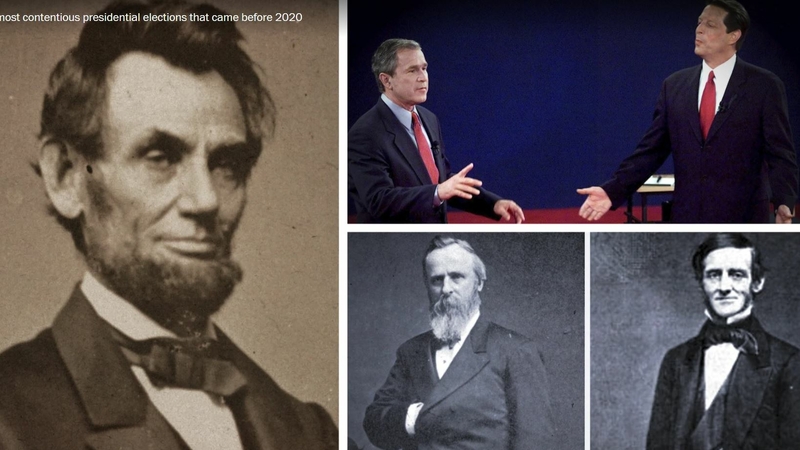
WASHINGTON – Usually, it is highly scripted pomp and circumstance. Mahogany boxes containing sealed envelopes with each state’s electoral college vote are marched into a joint session of Congress. The presiding officer opens the envelopes in alphabetical order, and House and Senate “tellers” read the results aloud. It is generally so boring that few lawmakers show up.
This year, they’ll be watching with bated breath. Will the presiding officer, Vice President Mike Pence, resist pressure from President Donald Trump and his supporters to write a new script for the proceedings?
U.S. vice presidents, in their constitutional role as president of the Senate, have long presided over the ceremonial certification of the electoral college vote count, even when it has meant turning the reins over to the opposition (see: Dick Cheney, Jan. 6, 2009; Joe Biden, Jan. 6, 2017).
In fact, two modern vice presidents have overseen the most humbling of certifications – their own election losses.
On Jan. 6, 1961, then-Vice President Richard M. Nixon became the first in a century. Massachusetts Sen. John F. Kennedy had beaten him narrowly; plus, many Republicans suspected voter fraud in 11 states, even filing lawsuits in two. (Judges threw both out.) So even though the result of the certification was supposed to be a foregone conclusion, some wondered whether Nixon would really go through with it.
He did, and according to The Washington Post’s coverage at the time, he did so jovially.
“Nixon seemed to enjoy doing it,” The Post wrote. “Time and again he pumped humor, life and even a little political sense into the nearly two-centuries-old ceremonial.”
During the joint session, he asked to make a statement, promising to follow House custom of a one-minute speech, instead of the Senate’s unlimited-time rule.
“I do not think we could have a more striking and eloquent example of the stability of our Constitutional system and of the proud tradition of the American people of developing, respecting and honoring institutions of self-government,” he said. “In our campaigns, no matter how hard-fought they may be, no matter how close the election may turn out to be, those who lose accept the verdict, and support those who win.”
He declared Kennedy the winner and received a standing ovation.
The awkward moment was handled well, but Post correspondent Robert C. Albright’s description of the electoral college system that created the situation was unsparing. Perhaps expecting it might be reformed soon, Albright called it “creaky,” “archaic,” “tired,” “no longer dependable” and “America’s outworn way of electing its presidents.”
The Senate majority leader, he reported, “was confident that one day the electoral college will retire as gracefully as Mr. Nixon did.”
Thirteen years later, Nixon retired again – this time, in disgrace. And the “creaky” old electoral system remains.
Four decades later, the country found itself in an even bigger electoral drama, when then-Vice President Al Gore had to certify Tex. Gov. George W. Bush’s win, despite Gore’s having won the popular vote. The month before, Gore had conceded to Bush after a court battle over the Florida count that went all the way to the Supreme Court.
Like Nixon in 1960, Gore tried to bring “grace and humor” to the proceedings, according to The Post’s coverage at the time. As scripted, the roll of states was called in alphabetical order, and when it reached California, which Gore won, he jokingly pumped a fist in the air.
He had “achieved celebrity status,” according to The Post’s coverage, signing autographs for the assembled lawmakers, congressional staffers and pages. Even then-Speaker J. Dennis Hastert asked Gore to autograph the wooden gavel he used that day. Like Nixon, when he declared Bush the winner – asking God to bless his opponent – Gore drew a standing ovation.
There was an extra awkward cherry on top of the day, though, when the roll reached the state of Florida and a handful of House Democrats raised objections. Most of them, including Rep. Maxine Waters, D-Calif., were members of the Congressional Black Caucus “who share the feeling among black leaders that votes in the largely African American precincts overwhelmingly carried by Gore were not counted because of faulty voting machines, illicit challenges to black voters and other factors,” The Post said.
Because no senators signed on to the objections with the House members, Gore was bound by law to refuse to hear the objections, putting him in the position of squelching a last-ditch effort to make him president.
This Jan. 6, things are expected to proceed differently, and not just because Trump has thus far declined the take the “grace and humor” route. Sen. Josh Hawley, R-Mo., has signed on to House Republican objections, meaning that even if Pence acts according to the script, the objections will be heard.
 Colorado Gov. Jared Polis (D) helps put the state’s first shipment of a coronavirus vaccine in a Denver freezer on Dec. 14. (David Zalubowski/AP)
 Chancellor Lewis Ferebee, left, and Mayor Muriel Bowser, a Democrat, right, tour Shepherd Elementary School in the District of Columbia on Nov. 10, 2020. Washington Post photo by Marvin Joseph
 The U.S. Capitol is pictured with the sun setting on Dec. 30, 2020 in Washington, D.C. Washington Post photo by Katherine Frey
 Tesla Inc. vehicles at the assembly plant in Fremont, Calif., on Aug. 13, 2020. MUST CREDIT: Bloomberg photo by David Paul Morris.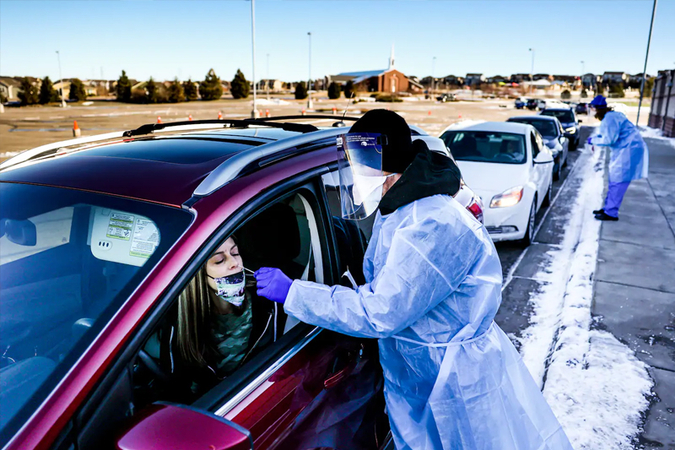

 Before being treated to sake, Namahage have their hands disinfected at a home in the Masugawa district of Oga, Japan, on Thursday. MUST CREDIT: Japan News-Yomiuri photo.