Democrats see grim prospects despite win #SootinClaimon.Com

#SootinClaimon.Com : ขอบคุณแหล่งข้อมูล : หนังสือพิมพ์ The Nation.

Democrats see grim prospects despite win (nationthailand.com)

Democrats see grim prospects despite win

InternationalDec 22. 2020
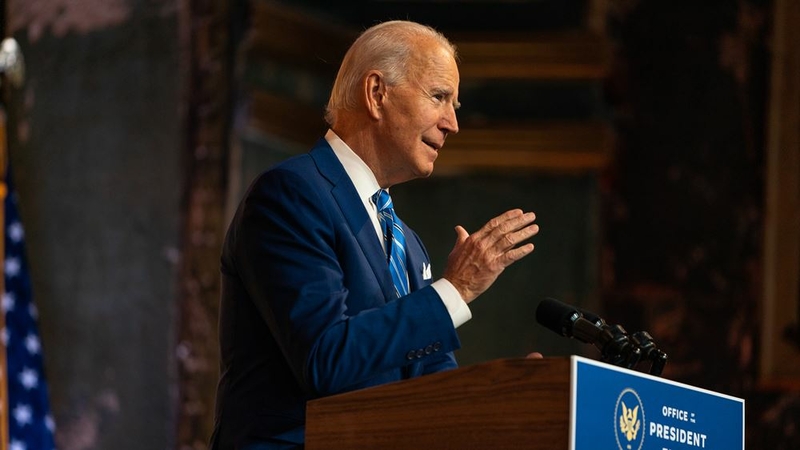
By The Washington Post · Michael Scherer

Voters in the once Democratic Ohio county that surrounds the shuttered Lordstown General Motors plant delivered a decisive victory last month to the sitting president who had promised and failed to save their jobs.

In the heavily Hispanic South Bronx, the liberal sanctum of San Francisco and the immigrant-rich neighborhoods of Miami, President Donald Trump also shrank Democratic margins by drawing thousands more to his side. He even swept the 31 Iowa counties that voted twice for Barack Obama before choosing Trump in 2016.

Ultimately, President-elect Joe Biden won the contests that mattered most, besting Trump by 7.1 million votes nationally and scoring pathbreaking wins in Georgia and Arizona. But beneath the surface, despite low approval ratings, high unemployment and a raging pandemic whose handling he had fumbled, Trump’s strength grew among key parts of the electorate.

Those warning signs have dampened the celebratory mood among Democrats enthusiastic about dispatching Trump. Party strategists now speak privately with a sense of gloom and publicly with a tone of concern as the election results become clearer.

They worry about the potential emergence of a mostly male and increasingly interracial working-class coalition for Republicans that will cut into the demographic advantages Democrats had long counted on. They speculate that the tremendous Democratic gains in the suburbs during the Trump years might fade when he leaves office. And they fret that their inability to make inroads in more rural areas could forestall anything but the most narrow Senate majority in the future.

“We just need to acknowledge that Trump’s poison was deeper in the bloodstream of the American electorate than we thought,” said Bradley Beychok, the president of American Bridge, which ran a $62 million ad campaign to hurt Trump among White working-class voters in three northern states that Biden won.

Upping the stakes further is the grim math of the midterm elections in 2022, when historical trends favor a Republican takeover of the House and continued Senate control, especially if they can hold the two Georgia seats in a runoff Jan. 5 that will again test the party’s reach among college-educated White and working-class Black voters.Democratic losses in the House combined with post-election retirements could reduce the party’s majority to a razor-thin seven-seat margin if the two outstanding contests are called for Republicans.

“We won back the House and the White House in the suburbs, but my sense is we are leasing that support – we don’t own it,” said Robby Mook, the manager of Hillary Clinton’s 2016 campaign who led the House Majority PAC this cycle. “With Trump gone, that lease is up for renewal. If we don’t hold on to our gains in the suburbs or replace it by winning back working-class White voters, we will have a problem.”
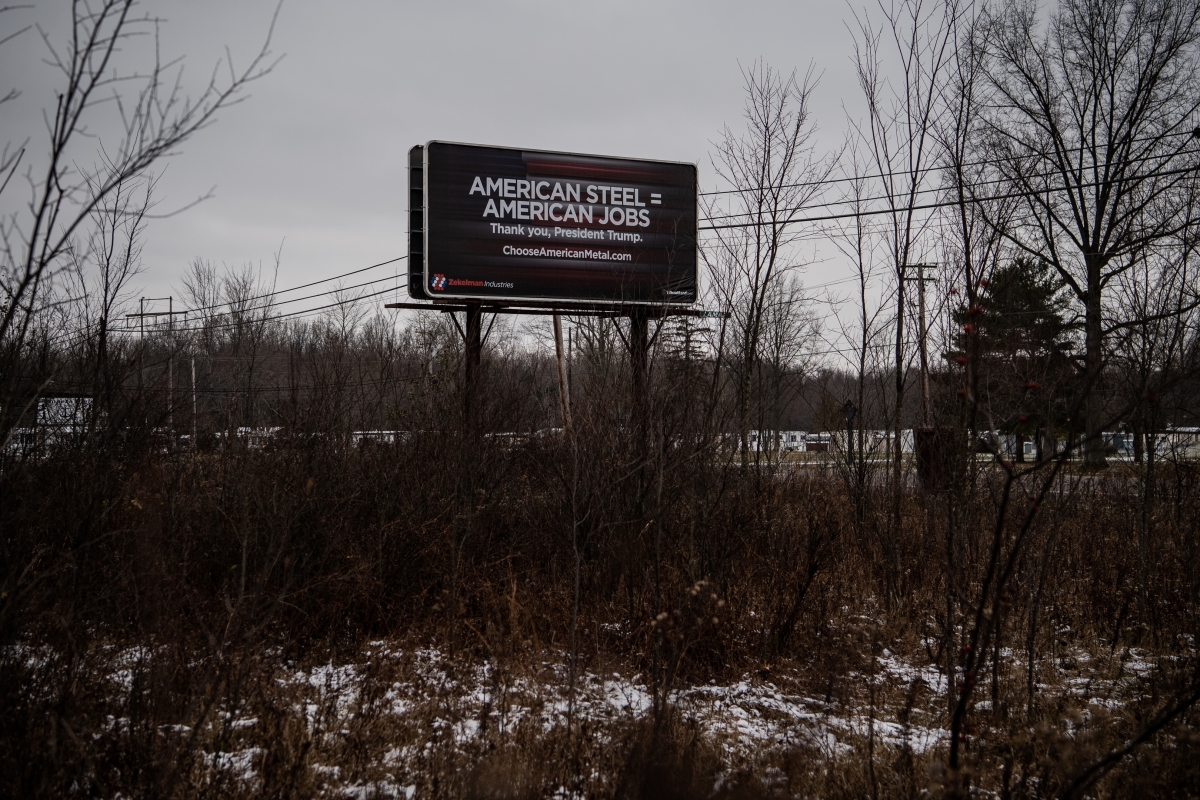
A billboard reads: "American steel = American Jobs. Thank you, President Trump" in Warren, Ohio in November. MUST CREDIT: Washington Post photo by Salwan Georges

A billboard reads: “American steel = American Jobs. Thank you, President Trump” in Warren, Ohio in November. MUST CREDIT: Washington Post photo by Salwan Georges

The nation’s political boundaries are in flux, making any future contest impossible to predict. Biden, who has appointed a small town mayor from Indiana to run his Transportation Department and an Iowa governor to run Agriculture, is certain to attempt a rebranding of Democratic politics in rural areas. His advisers are also hopeful that a successful vaccination campaign and economic boom in the second half of 2021 could reset the midterm playing field.

What is clear at the moment is that Biden’s coalition still ended up losing ground among working-class voters of all sorts, a fact that continues to shape the focus of his team. Biden has signaled that improving the lives of working people is the overriding goal of his administration.

“When the American people see that this is an administration that wants to work with members of Congress from both parties to the extent they can in order to help improve their lives, we believe that will help Democrats across the board,” said Anita Dunn, a senior campaign adviser who has been co-chairing the transition. “It’s a challenge for the Democratic Party to communicate with voters who don’t want to listen to us right now.”

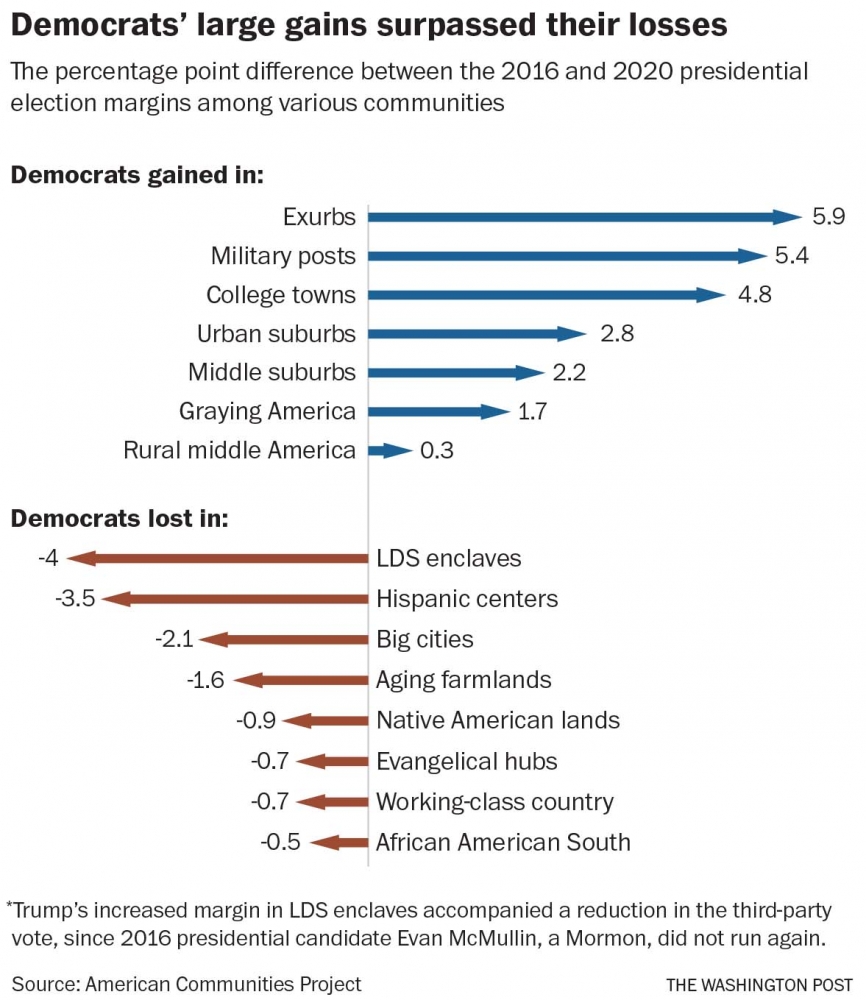
The rejection of Trump by college-educated and coastal voters did not extend across a broad swath of Americans, who had an opposite allergic reaction to what Democrats were selling. An analysis of county election result data by the American Communities Project at George Washington University laid the shifts bare by sorting actual ballot counts into categories based upon demographic characteristics of the counties where they were cast.

Compared with 2016, Democrats performed much better in places dominated by college-educated voters, increasing their margins by 4.8 percentage points in college towns, 5.9 points in exurban communities and more than two points is suburban areas. But Trump performed better in big cities by two points, in Hispanic centers by 3.5 points and in working class-dominant parts of the country by nearly a point.

In some places, the pro-Trump shift was even more striking. Ohio’s Trumbull County had become a talking point for Democrats heading into the election, featured in ads and highlighted at Biden’s summer convention as an example of the president’s empty promises to workers. Trump won the county by 6.2 percentage points in 2016. Months later, he traveled back to the area, bemoaned the shuttered factories and declared, “They are all coming back . . . Don’t sell your house.”

The nearby General Motors Lordstown plant, which had once employed thousands, stopped operation a year later. But Trump’s support only grew. He won the county by 10.6 percentage points in November.

“You move Biden aside for half a second and you have a Democratic brand that is completely disconnected from workers,” Rep. Tim Ryan, D-Ohio, who represents part of the county, when asked what went wrong. “It’s working class, White, Black and Brown.”

He argues for a far more targeted economic message, promising a tax cut for the middle class, infrastructure spending and a new manufacturing agenda. David Pepper, the Ohio Democratic chairman, agrees that the party has failed to communicate directly with the more rural parts of America, and he has written a memo to the Biden transition urging the president-elect to make a shift in strategy central to his presidency.

“We need to go right into these small towns and tell them what the Democratic agenda is for them and why it will lift them,” Pepper said. “Until we do that, we will be on defense.”
Democrats also worry about the culture war aspects of the Republican message, the idea that elites are trying to manipulate and control regular Americans to fit ideological ends. In pre-election focus groups, this showed up in a rejection by voters of identity politics. “Don’t slice me and dice me. I want a job,” was how one Democrat who has been briefed on the results summed up the message from voters.

“It is a box-checking party and one group of people never get their box checked, which is the almost half of Americans who are male,” explained a Democratic strategist, who spoke on the condition of anonymity to speak more frankly.

Wisconsin Democratic Party chair Ben Wikler, who fought county by county to deliver a win for Biden of 20,682 votes in a state Trump won in 2016, put the challenge more in terms of the media consumption on the other side of the cultural divide.

“Drive through rural Wisconsin and it is hard not to listen to conservative talk radio,” he said. “One long-term lesson is the necessity of building communications channels that go beyond buying ads on someone else’s communications channel.”

There was clear evidence that advertising targeting rural White Americans could have an effect, though it often required delivering the messages with people from the other side of the cultural divide.

Multiple Democratic advertising efforts, including the Biden campaign’s, produced testimonial ads using dairy farmers who talked about the impact of Trump’s tariffs, nurses to talk about the pandemic and small-business owners to explain economic struggles. The Biden campaign decided to put an Arizona spot featuring Republican Cindy McCain on a national rotation, for instance, after seeing its impact with voters.

“At the end of the day, it’s about using the right language and the right messengers – and that goes beyond just advertising,” said Dan Wagner, the chief analytics officer for Obama’s 2012 campaign, who tested thousands of Democratic ads this cycle for campaigns and outside groups through his firm, Civis Analytics. “This is about how we frame the issues we care about for people that look nothing like us.”

Behind these decisions was the novel use of online advertising testing panels, with scientifically sound randomized control groups, which has since 2018 revolutionized the way Democrats produce their messages, effectively overriding the instincts of the party’s top ad creators or even the dependence on polling and focus groups.

“The ads that were really snazzy with graphics didn’t move voters as much as the ones that were speaking to voters directly and obviously,” Patrick Bonsignore, the director of paid media for Biden’s campaign, said. “Voters are looking for authenticity and looking for a party that recognizes the struggles they are facing.”

Another trend that has become clear is that Biden and many Democratic policy ideas were more popular than the party itself, which has been defined for many voters by Republican attacks which wounded down-ballot candidates. Biden was able to win in suburban areas like Nebraska’s 2nd Congressional District, even as more liberal politicians like Democrat Kara Eastman lost.

“A brand problem means people like your product more than they like you,” Wagner said, pointing to wins for higher minimum wage in Florida and legalization of marijuana in South Dakota. “What Democrats do to solve the brand problem is you have to narrow the gap between you and your product.”

Democratic pollster Pete Brodnitz has been arguing that even the way Democrats speak about economic issues can be off-putting to the voters they are targeting, who don’t really have a problem with big box retailers moving into their neighborhoods or questions of corporate power – issues that can dominate the party’s ideological disputes.

“We have to get over our allergy of talking about economics in a way normal people can relate to,” he said, citing research he has done with these communities. “You are not going to hear about inequities and inequality. You are going to hear about jobs and making money.”

Strategists believe these economic worries, about tangible daily struggles, helped Trump succeed among non-White blue-collar voters. Trump, whose career has been built on the promise of economic success, consistently scored well on economic questions.

The exact impact of these arguments on Black voters remains unclear, as the two national exit polls reached contradictory findings. One media-sponsored survey found 12% of Black men supported Trump, while the other found 19% supported him. In 2016, the exit polls found 13% support for Trump among Black men.

Just how far the working-class dismay with Democrats extended in the Latino community also remains an open question, as data is still being collected. Trump did well among segments of the population, including the South Florida immigrant communities opposed to the tilt by some in the party toward socialism and parts of South Texas, where rural communities tend to be socially conservative.

But Matt Barreto, a Democratic pollster at Latino Decisions, said the overall shift nationwide still gave Democrats two-thirds of the vote, which is a huge advantage to have among the fastest growing segment of the electorate. He estimates a 30% increase in the number of Latinos who voted in 2020 compared to four years earlier, about twice the overall turnout growth.

Even if the margins between Democratic and Republican candidates narrowed nationwide, as the data suggests, Democrats won Arizona and Nevada with this increase in voters and saw their loss in Texas cut to less than six points, from nine points in 2016 and 16 points in 2012. That doesn’t mean, Barreto argues, there is not more work for Democrats to do, especially around economic issues and the concerns about socialism from Latin American immigrants.

“Somebody – and I do think it is White liberals – has invented this idea that Hispanics have to hate Donald Trump because he said racist things about Mexicans, and they blame us when we don’t turn out 100% against him,” Barreto said. “And it’s messed up.”

A recent Pew Research Center poll in April found just 3% of Latino adults use the term “Latinx,” a preferred term in Democratic campaign circles. Nearly half of the population prefer using the country of origin of their family – Mexican, Spanish, Dominican – to the broader terms like Hispanic or Latino. That meant some Democrats were literally talking past their targeted voters by failing to see them as they wished to be seen.

“People think the only thing Latino voters want to talk about is immigration,” said Liz Jaff, the president of Be A Hero PAC, a health care-focused group that has been supporting Latino outreach in Georgia for the Senate runoffs. “You could not be more racist if you tried.”

Biden’s advisers say they are well aware of the challenge.

“We have to make the case. There is no question that Democrats have to work for those votes,” Dunn said.

Europe moves to isolate Britain, where mutated virus causes Christmas chaos #SootinClaimon.Com

#SootinClaimon.Com : ขอบคุณแหล่งข้อมูล : หนังสือพิมพ์ The Nation.

Europe moves to isolate Britain, where mutated virus causes Christmas chaos (nationthailand.com)

Europe moves to isolate Britain, where mutated virus causes Christmas chaos

InternationalDec 22. 2020Passengers walk toward the check-in area at London Heathrow Airport in London on Dec. 19, 2020. MUST CREDIT: Bloomberg photo by Chris RatcliffePassengers walk toward the check-in area at London Heathrow Airport in London on Dec. 19, 2020. MUST CREDIT: Bloomberg photo by Chris Ratcliffe 

By Syndication Washington Post, Bloomberg · Priscila Azevedo Rocha, Kitty Donaldson

Britain plunged into Christmas chaos with police blocking people from boarding packed trains, holidays abroad scrapped and travel with Europe banned after London went into an emergency lockdown.

France on Sunday suspended inbound travel from the U.K. for 48 hours and Germany halted arriving flights from Britain, which is in the middle of delicate Brexit negotiations with its European Union partners. Those talks are still at a critical stage after the weekend.

In a sudden turnaround, Prime Minister Boris Johnson canceled plans to allow families to see one another over the festive period as the government warned that a new strain of the coronavirus is “out of control.” There were scenes of panic at train stations, with people defying social-distancing rules to get out of the capital before the new rules took effect on Sunday.

Ireland banned flights with the British mainland at least until Tuesday. Italy, the Netherlands and Belgium halted air, train or ferry links earlier.

France’s Emmanuel Macron, Germany’s Chancellor Angela Merkel, European Council President Charles Michel and EU Commission president Ursula von der Leyen discussed the health situation in the U.K. as well as Brexit.

For the U.K., it’s a double body blow, leaving the country potentially isolated with the pandemic still wreaking havoc. Its departure from the EU has been punctuated by a souring relationship with its neighbors, while this latest twist has its once-close partners putting up the shutters.

It will also unleash more damage to struggling European airlines. The country was the busiest in the region on Saturday with more than 2,200 flights, according to Eurocontrol.

More than 16 million Britons are now required to stay at home after new restrictions came into force in London and southeast England. The measures ban household mixing in the capital and the southeast, and restrict socializing to just Christmas Day across the rest of England.

For many Britons trying to see relatives or go on a winter vacation, the restrictions are a reminder of the last nationwide lockdown and will add to the burden of contending with a virus that is still dangerous, even with vaccines being rolled out into the population.

This is the latest U-turn from a government that has been reluctant to impose limits to movement, unless forced. Until Friday, Johnson was adamant that close households would be able to mix over Christmas. There is some unease among his Conservative rank-and-file lawmakers.

One Tory member of Parliament, Charles Walker, expressed dismay that the government had “pulled the plug” on Christmas in what is a clearly politically sensitive time. U.K. Health Secretary Matt Hancock told Sky News presenter Sophy Ridge earlier this morning that the government had little choice because “this is deadly serious.”

While it is normal for viruses to mutate and several strains of the virus that causes covid-19 have emerged, the one said to have triggered the tighter curbs on London may be as much as 70% more transmissible than others currently circulating, preliminary analysis in the U.K. shows.

The World Health Organization is working to understand the extent to which the virus may spread more easily, along with other human behavioral factors that may be driving transmission, Maria van Kerkhove, the body’s technical lead on covid-19, told the BBC Sunday. She said that current information suggests that the new variant doesn’t have any impact on the vaccines being rolled out.

While London’s Heathrow airport was crowded Sunday morning as dozens of planes departed, an 11:45 a.m. KLM service to Amsterdam left empty, according to a spokeswoman for the hub. Two later British Airways flights to the Dutch city were canceled. Most other operations at the airport were shown to be on schedule.

France will suspend all travel from the U.K. from midnight for 48 hours while EU members coordinate on the matter, Junior Transportation Minister Jean-Baptiste Djebarri on LCI TV.

Germany is banning inbound flights from the U.K., Health Minister Jens Spahn told broadcaster ARD. The Transportation Ministry in Berlin cited an EU directive that could keep the suspension in place until Dec. 31.

The bans are very concerning, the Heathrow spokeswoman said. The airport just had one of its busiest weeks since the first U.K. lockdown as people caught flights in the buildup to Christmas, and there are large numbers still due to travel, she said.

A spokesman for Schiphol airport in Amsterdam said planes arriving from London on Sunday were essentially empty. Deutsche Lufthansa AG has canceled crew layovers in the U.K. and is weighing further actions.

Virgin Atlantic Airways Ltd. is reviewing its flight schedule in light of the Tier 4 restrictions. Customers on flights that are still scheduled will have the option to rebook, though like British Airways the airline is only offering cash refunds when it cancels a flight. easyJet PLC said it’s operating its schedule back to the U.K.

Eurostar International Ltd., which operates passenger trains through the Channel Tunnel, will scrap services from London to Brussels Monday. Even before the new curbs, Eurostar had been operating a minimal service of one train a day in each direction on most routes to allow for emergency travel. Anyone leaving London faced quarantining on their return as well as possible restrictions at their destination.

In the meantime, officers are increasing patrols and focusing on popular spots in the capital.

“Officers across London will pay particular attention to those groups who have willfully ignored the rules, putting communities and lives at risk,” the Metropolitan Police said.

Britain confronts threat of food crisis as virus blocks trade #SootinClaimon.Com

#SootinClaimon.Com : ขอบคุณแหล่งข้อมูล : หนังสือพิมพ์ The Nation.

Britain confronts threat of food crisis as virus blocks trade (nationthailand.com)

Britain confronts threat of food crisis as virus blocks trade

InternationalDec 22. 2020A sign reads A sign reads “French Borders Closed” on Dec. 21, 2020, in Dover, England, where Britain’s biggest port stopped all traffic heading to Europe, triggering delays to food supplies after the discovery of a new variant of the virus prompted a wave of countries to ban travel from Britain. MUST CREDIT: Bloomberg photo by Chris Ratcliffe 
By Syndication Washington Post, Bloomberg · Alex Morales, Christopher Jasper, Siddharth Philip, Lizzy Burden

Britain confronted threats of food insecurity and panicked shopping days before Christmas as European nations restricted trade and travel to guard against a resurgent coronavirus, offering Britain a preview of the border chaos to come in the absence of a Brexit deal.

Fearing a fast-spreading new strain of the virus that forced a strict lockdown across England, France on Sunday suspended travel from the U.K. for 48 hours and Germany halted arriving flights from Britain. The crisis gave renewed urgency to negotiations for a trade deal with the European Union that remained at a critical stage after weekend talks.

The Port of Dover late Sunday halted freight moved by truck into France while allowing unaccompanied cargo to keep moving. Though traffic into the U.K. is unaffected, truckers often run supplies in both directions and the latest outbreak in the heart of the country may discourage them from entering Britain.

The disruptions are exposing Britain’s trade vulnerabilities just as a 4 1/2-year odyssey to leave the EU moves from political rhetoric to economic reality. Business groups facing catastrophic losses urged Prime Minister Boris Johnson’s government to act soon, with the 18,000-member Logistics UK calling for rapid coronavirus testing of truckers departing the country as the quickest way of protecting supply chains.

“This is the nightmare before Christmas,” said James Withers, chief executive officer at the Scotland Food & Drink industry group.

He said there are more than 100 trucks laden with seafood due to cross the border into the EU, bound for Christmas wholesale markets in France and Spain that would normally be held on Wednesday. Fears are growing that live shellfish will spoil if they’re held up at the border, and the government needs to act today to ensure that the freight can keep moving, Withers said.

French Transport Minister Jean-Baptiste Djebbari said European nations are working on “a solid health protocol” to be implemented “in the coming hours” so trade flows from the U.K. can resume.

“Our priority: protect our nationals and fellow citizens,” he said on Twitter.

Container ports and ferry terminals were already congested because of stockpiling ahead of the Dec. 31 deadline marking a final break from the European single market.

The border chaos comes at the tail end of a year that’s seen Johnson nearly die of the virus and come under heavy criticism over his response to the pandemic — which has seen the U.K. suffer the worst hit to output of any major economy as well as a death toll second only to Italy in Europe.

British supermarket chain J Sainsbury Plc said it is considering using airfreight for products sourced from Europe. If the situation doesn’t change, Sainsbury will start to see “gaps” in the coming days sourcing some fruits and vegetables, said Victoria Durman, head of corporate communications.

Outside Dover, trucks began lining up on the M20 motorway as the “Operation Stack” emergency plan was triggered with drivers unable to board ferries. The Department for Transport was also preparing Manston airport in Kent, which is being overhauled to accommodate as many as 4,000 vehicles as part of Britain’s no-deal planning, according to the kent.gov.uk website.

Richard Ballantyne, chief executive officer of the British Ports Association, urged travelers to follow the advice of their carriers. “There could be a period of disruption at some of the U.K.’s ferry ports for the next 48 hours,” he said. “We are confident that the U.K. will continue to be supplied.”

U.K. travel, leisure and retail shares slumped on Monday as flights were canceled, while stay-at-home stocks, like Ocado Group Plc, got a boost. Airlines that were expecting a lift around the festive period were among the worst hit, with British Airways parent IAG SA falling as much as 20% and easyJet PLC down as much as 18%.

Economists at Berenberg cut their 2021 growth forecast for the U.K. just last week to 7.3% from 8% because of new lockdowns. Transport Secretary Grant Shapps sought to downplay the urgency of the situation, telling Sky News the short straits between Dover and Calais account for about 20% of goods to and from the country.

“It’s not the mainstay. Most goods actually come in and out by unaccompanied containers, and those will continue to flow,” he said. “We obviously don’t want these links to be closed for too long, but it’s not unusual for them to be closed and disrupted.”

Asked about the vaccine, he said “virtually all” of it comes across via containers and is unaffected by the stoppage at Dover. Shapps said the French have told U.K. authorities they want to restart haulers crossing the channel “as quickly as possible.”

Still, the economic drag of tougher lockdown and trade turmoil will only deepen the hole the country is in, unleashing more damage stretching from mom-and-pop retailers to already struggling European airlines.

Johnson abruptly canceled plans to allow families to mix over the holiday period as the government warned over the weekend that the new strain of the virus is “out of control.” There were scenes of panic at train stations, with people defying social-distancing rules to get out of the capital.

More than 16 million Britons are now required to stay at home, mainly in London and southeast England.The measures ban household mixing in the capital and the southeast, and restrict socializing to just Christmas Day across the rest of England.

Until Friday, Johnson was adamant that close households would be able to mix over Christmas. It was the latest U-turn from a government that has been reluctant to impose limits to movement, unless forced. There is some unease among his Conservative rank-and-file lawmakers.

Congressional leaders agree on nearly $900 billion coronavirus relief package #SootinClaimon.Com

#SootinClaimon.Com : ขอบคุณแหล่งข้อมูล : หนังสือพิมพ์ The Nation.

Congressional leaders agree on nearly $900 billion coronavirus relief package (nationthailand.com)

Congressional leaders agree on nearly $900 billion coronavirus relief package

InternationalDec 21. 2020

By The Washington Post · Jeff Stein, Mike DeBonis

WASHINGTON – Senate leadership announced a bipartisan deal on an approximately $900 billion economic relief package late Sunday afternoon that would deliver emergency aid to a faltering economy and a nation besieged by surging coronavirus cases.

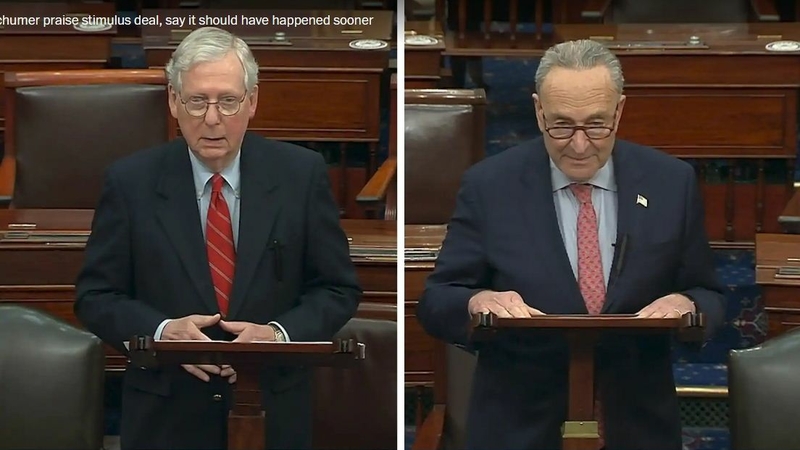
After months of contentious negotiations and seemingly intractable partisan gridlock, Senate Majority Leader Mitch McConnell, R-Ky., and Senate Minority Leader Chuck Schumer, D-N.Y. took to the Senate floor to say a deal had been finalized and could be approved quickly.

The emerging stimulus package was expected to direct hundreds of billions of dollars in aid to jobless Americans, ailing businesses and other critical economic needs that have grown as the pandemic ravages the country and batters the economy.

“More help is on the way,” McConnell said. “Moments ago, in consultation with our committees, the four leaders of the Senate and House finalized an agreement. It would be another major rescue package for the American people. As our citizens continue battling this coronavirus pandemic this holiday season, they will not be fighting alone.”

Schumer then took to the floor, calling the aid package insufficient but heralding it as a critical measure to “give the new president a boost, a head start, as he prepared to right our ailing economy.”

The House and the Senate on Sunday night approved a one-day extension of government funding to allow the final bill text on the relief package to be written. President Donald Trump signed the stopgap measure late Sunday night, preventing a government shutdown.

The legislation includes stimulus checks for millions of Americans of up to $600 per person. The size of that benefit would be reduced for people who earned more than $75,000 in 2019 and disappear altogether for those who earned more than $99,000. The stimulus checks would provide $600 per adult and child, meaning a family of four would receive $2,400 up to a certain income.

Congress would also extend federal unemployment benefits of up to $300 per week, which could start as early as Dec. 27.

The income criteria for the stimulus checks is expected to reflect that of the first round of relief payments sent by the Treasury Department this year.

Adult dependents are not expected to qualify for the stimulus payments, people familiar with the negotiations said, despite a push from congressional Democrats. The deal would include stimulus payments for families in which one of the parents is not a citizen, but not for undocumented immigrants themselves.

The deal to extend federal jobless benefits for millions of unemployed Americans at a level of $300 per week would cover up to 11 weeks of unemployment through March 14, aides familiar with the negotiations said. An unemployment benefits program for contract and gig workers, which is also set to expire at the end of the year, would be extended over the same period for those workers.

A compromise proposal reached earlier this month by Sens. Mitt Romney, R-Utah, and Joe Manchin, D-W.Va., among other centrist lawmakers, would have provided 16 weeks in unemployment benefits instead of the 11 weeks under the current agreement. It was unclear why congressional leaders slashed the duration of unemployment benefits in their latest agreement.

Negotiators also agreed to extend the deadline for states and cities to use unspent money approved for them by the Cares Act, two people familiar with internal deliberations said. States and cities have until the end of the year to spend billions of dollars before it expires and has to be returned to the federal government. The deal would instead extend that deadline for a full year.

Republicans have successfully opposed Democrats in their demands for hundreds of billions of dollars in state and local aid. Many local governments are experiencing steep declines in tax revenue and have been warning of layoffs. Extending the deadline for using leftover local government funding from the Cares Act allows Democratic lawmakers to say they still provided some relief to ailing municipalities.

The agreement also leaves out a liability shield to protect businesses from virus-related lawsuits, which McConnell had previously demanded as a precondition for a deal.

The agreement would extend for one month a moratorium on evictions that is set to expire at the end of the year, two people with knowledge of the matter said. The moratorium would be extended through January, at which point Democrats believe the incoming Biden administration can extend it again if necessary. The legislation would provide about $25 billion in emergency assistance to renters, the people said, though it remained unclear how that money would be disbursed.

The single biggest expenditure in the legislation is about $325 billion in business relief, including about $275 billion for another round of Paycheck Protection Program (PPP) funding. The legislation also includes $45 billion for transportation needs, such as state transportation departments and Amtrak; $82 billion for schools; $20 billion for vaccine distribution; and $13 billion for a major expansion in food stamps.

The agreement also included $1.4 billion in new funding for Trump’s border wall with Mexico and new border security technology, according to House Republican Whip Steve Scalise of Louisiana.

The bill also includes a tax break for corporate meal expenses lobbied for by the White House and denounced by congressional Democrats, according to two people with knowledge of the matter. Trump has for months talked about securing the deduction – derisively referred to as the “three-martini lunch” by critics – as a way to revive the restaurant industry battered by the pandemic. Critics say the measure, led by Sen. Tim Scott, R-S.C., will do little to help ailing restaurants but will reduce firms’ tax obligations.

Lawmakers had also appeared to resolve a dispute over whether businesses that received PPP loans, and would have them forgiven, and would allowed deductions of the costs covered by those loans on their federal tax returns. Those costs would be deductible under a final agreement so long as a PPP recipient could show a loss in revenue in 2020 compared with prior years, according to a lawmaker briefed on the deal.

It may take more time for congressional staff members to draft those agreements into legislative text and prepare the massive bill for votes in the House and Senate. Lawmakers had not released text of the agreement between senior Democrats and Sen. Pat Toomey, R-Pa., over the central bank, which was a sticking point Saturday.

Toomey initially demanded that a stimulus package prohibit the expiring lending programs, or anything “similar” to them, from being re-created in the future. He ultimately agreed to Schumer’s compromise, which steered away from barring programs “similar” to the ones that expire this year and instead applies more narrowly to the same programs.

The spending bill also includes a measure protecting patients from “surprise” medical bills. These bills – which can total tens of thousands or even hundreds of thousands of dollars – can result when a patient through no fault of their own gets care from a doctor or hospital outside their health plan’s network, often surrounding emergency care.

Under the provision, doctors and hospitals may no longer charge patients the extra out-of-network costs not covered by their insurance plan. Instead, a third-party arbiter would decide the payment for these bills.

Covid risks a lost generation amid India’s digital divide #SootinClaimon.Com

#SootinClaimon.Com : ขอบคุณแหล่งข้อมูล : หนังสือพิมพ์ The Nation.

Covid risks a lost generation amid India’s digital divide (nationthailand.com)

Covid risks a lost generation amid India’s digital divide

InternationalDec 21. 2020A young student attends an online Thunkable Inc. coding class at her home in Mumbai on Oct. 24, 2020. MUST CREDIT: Bloomberg photo by Dhiraj Singh.A young student attends an online Thunkable Inc. coding class at her home in Mumbai on Oct. 24, 2020. MUST CREDIT: Bloomberg photo by Dhiraj Singh. 

By Syndication Washington Post, Bloomberg · Vrishti Beniwal

Dhiru, an Indian teenager who entered 10th grade this year, hasn’t attended even one day of class since the academic year began in April.

The school was closed for months amid the pandemic, but even since it reopened Dhiru’s mother Rekha Devi is afraid to send her son to class. Unlike some schools, Dhiru’s doesn’t offer online instruction — and even if it did, the family doesn’t own a computer or a smartphone to access the internet.

“The school is now saying, ‘Come and attend class,’ but we don’t want to take the risk,” said Rekha Devi, a domestic helper near New Delhi. “Unlike rich people, we don’t have the option of online classes. So we’ve started private tuition for him, but I’m not sure he’ll be able to pass the exams without any schooling this year.”

Plenty of Indians are facing a similar predicament: As many as 80% of Indian students couldn’t access online schooling during the lockdown, and many might not return to classrooms when they reopen, according to a recent study by Oxfam.

That’s just one example of how the pandemic has exacerbated the country’s digital divide — the gap between those with the means and knowledge to benefit from the internet, and those without — worsening already stark levels of inequality and weighing on economic growth. While the divide isn’t unique to India, it’s especially acute in a nation where more than half the population of 1.3 billion people is under 25 years old.

When Prime Minister Narendra Modi announced lockdowns earlier this year, services from banking and schooling to medical consultations and job searches moved online, and in some cases remain there nine months later. Many companies see “work from home” as the new normal.

Before the pandemic, government researchers estimated India’s digital shift could unlock as much as $1 trillion of economic value over five years. But the crisis is spreading those benefits unevenly and widening socio-economic inequalities, with girls suffering more than boys and rural areas more affected than cities.

“The digital divide in India is an ongoing problem and the pandemic has definitely made it worse,” said Sumeysh Srivastava, a New Delhi-based internet-access researcher at Nyaaya, an open-access platform that provides simple and actionable legal information. “The government needs to ensure that all Indians are in position to benefit from digitization, otherwise we’re at risk of creating a new class of digitally poor citizens.”

India has the world’s second-largest pool of internet users, about 600 million, comprising more than 12% of all users globally. Yet half its population lacks internet access, and even if they can get online, only 20% of Indians know how to use digital services, according to government data.

Every 10% increase in India’s internet traffic delivers a 3.1% increase in per-capita gross domestic product, according to a 2018 report by the Indian Council for Research on International Economic Relations. But the benefits of those gains aren’t reaching everyone: Srivastava said government-run digital literacy programs cover 5% or less of the population, are focused only on rural areas and suffer from various design and implementation issues.

“The digital revolution has made services more tradable and enabled India to grow rapidly with a different growth model compared to China,” said Ejaz Ghani, a former economist at the World Bank. “But this is now being restrained by the digital divide.”

The launch of online job portals for laborers and e-passes to move around during the lockdown meant Indians who aren’t digitally literate could have lost out on livelihood opportunities.

The government said last week the pandemic “has necessitated delivery of stable and high-speed broadband internet services to an increasingly large number of subscribers in the country,” and allowed for public Wi-Fi networks to be established. That will create employment, boost small businesses’ income and raise GDP, the government said.

“Reducing the digital divide will be through increased investments in digital infrastructure,” Ghani said. “China has marched way ahead of India and closed the gap with the U.S. on the digital revolution. We have a long way to catch up.”

Major U.S. companies are lobbying in a scrum for early vaccine #SootinClaimon.Com

#SootinClaimon.Com : ขอบคุณแหล่งข้อมูล : หนังสือพิมพ์ The Nation.

Major U.S. companies are lobbying in a scrum for early vaccine (nationthailand.com)

Major U.S. companies are lobbying in a scrum for early vaccine

InternationalDec 21. 2020

By The Washington Post · Christopher Rowland, Isaac Stanley-Becker, Jacob Bogage, Abha Bhattarai, Laura Reiley

Companies across America – from Amazon and Uber to railroads and meatpacking plants – are lobbying states and the federal government to prioritize their workers for early immunization against the coronavirus amid limited supplies of the vaccine.

After front-line health-care workers and elderly people in nursing homes and assisted-living centers are immunized, the government within two months or so is expected to begin shipping vaccine to communities across America for those it has designated as essential workers.

A Centers for Disease Control and Prevention vaccine advisory group voted Sunday to recommend that grocery store workers, teachers, day-care staffers, adults over 75 and other front-line workers who cannot work remotely should be the next to get the coronavirus vaccine, followed later by another large batch of essential workers and elderly people. The recommendations guide state authorities in deciding who should have priority to receive limited doses of vaccines made by Pfizer-BioNTech and Moderna.

The two groups of essential workers that the government is prioritizing comprises 87 million people, spanning dozens of industries and including many people of color and many earning low wages. And the task of setting the sequence of vaccinations within that sprawling, disparate population, verifying who is essential, and setting up equitable systems for access is triggering competition. The government’s list is so broad that it weather forecasters and operators of shooting ranges.

Adding to the uncertainty for business leaders is a patchwork process for emergency planning: All 50 states have the power to set their own priorities.

What is clear is that there won’t be enough doses to go around for months. Local officials in each state will have to make tough choices about which essential workers get their shots first.

“It almost feels like a wrestling match out there, where many interests want to make it clear that the people they represent have a lot of essential workers,” said Jonathan Slotkin, chief medical officer of Contigo Health, which leads partnerships between large, national employers and hospital systems. Companies are displaying a “voracious appetite” for vaccines for their workforces, he said.

Police, firefighters, public transit workers and teachers will be at the top of most state lists. But lower down the line, states have divergent views on who should get shots to reduce infections and get local economies back up and running.

Once the vaccine does begin to flow to essential workers, states will be working from the government’s master list of industry categories. State officials have said they will follow these guidelines for the most part, but they are not required to.

Some advocates and policy experts fear the competition for vaccines will favor the wealthiest companies with the strongest lobbying teams in state capitals. That could disadvantage smaller firms.

Individual gig workers who deliver food and vital supplies to households, but who are not as organized, also could get left out of the planning and off vaccination lists, advocates said.

Many delivery drivers are people of color. Members of minority groups are more prone to die of covid-19 because of historical disparities in health care. They also have been shown in polls to place less trust in vaccines because of those disparities, as well as unethical medical experiments on Black people.

“They are in fact bearing an enormous risk, the ones who are delivering to our homes,” said Dania Rajendra, who leads Athena, a coalition of social justice and labor groups that advocates on behalf of workers at Amazon from outside the company, which has 800,000 employees in the United States.

But large employers may be able to improve their place in line by helping embattled state governments, which have been starved of federal financial support to organize vaccination efforts. Companies are offering vaccination sites, logistical help and the ability to identify which workers qualify as essential.

The ride service companies Uber and Lyft, which consider their drivers independent contractors, not employees, are making their size and organization a key part of the appeal for prioritization.

“We believe Lyft can play a significant role in increasing access to the vaccine,” Lyft spokeswoman Julie Wood said. In a letter to all 50 state governors, Uber chief executive Dara Khosrowshahi said of the company’s drivers, “I want to ensure these individuals can receive immunizations quickly, easily and free, and I offer Uber’s assistance to you in making that a reality.”

Drivers themselves are eager to be prioritized. Aziz Bah, who drives for Lyft and Uber in New York and is an organizer for the Independent Drivers Guild, a labor union for drivers, said as ride-share drivers returned to work over the summer, they drove front-line medical workers to hospitals, allowing those workers to avoid mass transit.

“We are actually the front line to those front-line people because they rely on us to get to work,” he said.

The dilemmas are especially stark in lightly populated states like North Dakota, where nearly 60 percent of the population meets a federal classification for essential workers. Stephen Pickard, a former epidemiology field officer for the CDC in North Dakota who has been moderating the state’s vaccination ethics committee, said his email inbox is filling up with requests from organizations seeking to beat one another out for priority. Among them were messages from a railroad company and group homes for the disabled.

A survey by the Kaiser Family Foundation this month found that 30 states were still developing their plans on how to prioritize vaccine after the front-line health care workers and elderly in residential facilities.

“It’s going to get a lot messier,” said Jennifer Kates, senior vice president and director of global health and HIV policy at KFF. “That’s a huge group of people and choices will have to be made.”

Amazon, whose founder and chief executive Jeff Bezos owns The Washington Post, was among the many companies that lobbied to be placed on a master list of essential workers compiled by a division of the Department of Homeland Security earlier this year.

Initially, that list was used to decide what workers could be exempt from lockdown orders as governors and mayors ordered the general public to remain indoors and work from home. Now the list is being used to allocate scarce vaccines, a much more difficult proposition.

The company sent a letter Wednesday to the CDC’s vaccine advisory panel, the Advisory Committee on Immunization Practices, asking that its workers be placed in line “at the earliest appropriate time.”

In response to a question from The Post, Amazon said it would be also be asking state officials to prioritize delivery drivers and contract workers.

“Our view is that our essential workers and those that work outside the house for us at fulfillment centers and Whole Foods stores and as delivery drivers are all part of that essential supply chain that helps tens of millions of other people stay home,” Steve Hartell, Amazon’s vice president of public policy, said in an interview.

Warehouse Workers for Justice, a Chicago-based rights group that is often critical of Amazon’s labor practices, is calling on public officials to give priority to warehouse workers like those at Amazon. The group said warehousing and manufacturing sites account for the second-largest concentration of covid-19 infections in Illinois behind long-term care facilities, but outpacing restaurants, bars, schools and social gatherings. About 85 percent of the state’s 650,000 temporary workers, the group said, are Black and Hispanic.

“We believe there is a correlation to high infections in these workplaces that then spread to Black and brown communities,” Tommy Carden, an organizer for the group, said in a statement. “If we want to address covid-19 transmission in these communities, we need to vaccinate where people work, which includes the temp workers.”

Officials in Midwestern and Great Plains states said they were being lobbied especially hard by railway companies and other transit groups. A spokeswoman for the BNSF Railway Company, the largest freight railroad network in North America, said the company was working with allies in the transportation industry to ensure early access to the vaccine for its employees.

A collection of organizations representing freight, rail, port and waterway infrastructure sent a letter this month to the top members of the Senate Committee on Commerce, Science and Transportation, noting the sacrifices of these workers, who are unable to work from home, while also warning of their critical role in the “continued viability of our domestic supply chain.”

A health official in Texas, speaking on the condition of anonymity because they were not authorized to discuss internal communications, said the state is being lobbied by groups that “run the gamut,” from dentists and optometrists to federal judges and power plant workers.

Corrections officers are seeking priority, the person said, as are convenience store employees. The rice industry is making a pitch for agriculture workers. Someone associated with Southwest Airlines had recently reached out seeking clarity about the place of airline workers. And private schoolteachers were pushing to make sure they were classed together with public employees.

Among finance sector workers, the American Bankers Association is urging the government to prioritize bank tellers and managers who interact with the public.

Floor traders at the New York Stock Exchange, who mingle in the common space, are likely to receive some later level of prioritization, but they want to be sure higher-priority workers facing greater infection risks go first, said Philip Quartuccio, managing director and head of global trading, for investment firm ThinkEquity.

“There’s 500 to 1,000 people on the floor of the exchange,” he said. “I suspect they will be in line at some point before the general population.”

NYSE President Stacey Cunningham said on CNBC on Dec. 11 that financial workers are prepared to wait their turn: “We’re not looking to jump any queue with respect to vaccines.”

After spending months over the spring and summer trying to justify essential worker designations that allowed factory workers to go back on the job, manufacturing industry trade groups say most states now recognize their workforce for priority vaccinations.

“Phase 1B, which includes the term ‘essential workers,’ is a fairly broad bucket,” Robyn Boerstling, the National Association of Manufacturers’ vice president of infrastructure, innovation and human resources, said in an interview. “And we just really wanted to make sure that governors really had the tools and awareness that manufacturing is an essential industry.”

But manufacturers in some states are bracing for a longer wait before their workers receive the injections. Pennsylvania includes the “critical manufacturing” sector in its Phase 1B, but industry representatives there say the state’s playbook is not clear which subsectors that will cover.

“We’re in limbo,” Pennsylvania Manufacturers’ Association President David N. Taylor said. “And I hope that there’s a recognition of the critical role that manufacturing plays in standing up the rest of the economy.”

Michigan, home base for the auto industry, is still wrestling with the question of where to prioritize manufacturing. Ford announced in November that it ordered a dozen ultracold freezers to store coronavirus vaccines for its workforce – among the most aggressive responses by any company. But the automaker said it didn’t actually know when those freezers would be filled.

The freezers, said Ford spokeswoman Kelli Felker, were part of the company’s early effort to explore “how best to provide a vaccination program to our employees, which will vary among our global locations.”

“Our initial emphasis is on essential workers at our manufacturing plants, warehouses, workplace-dependent employees and employees who are required to travel,” Felker said in a statement.

The scramble is twofold for many of the country’s supermarket and grocery chains, which are racing to sign agreements with the federal government to distribute coronavirus vaccines to the public, while also lobbying for their front-line employees to be given priority for those vaccines.

Grocery, warehouse and supply chain workers have been hit hard by covid-19-related deaths and infections during the pandemic. They have risked exposure for as little as a temporary pay bump of $2 an hour and “bonuses” that are disproportionate to the record profits their companies have raked in during the public health crisis. Many food and retail workers do not receive paid sick leave or health insurance.

The United Food and Commercial Workers International Union, which represents 1.3 million employees at chains such as Kroger and Albertsons, is urging the CDC to vaccinate grocery, meatpacking and food processing workers “immediately after health-care workers.”

At least 350 of its members – including 109 grocery employees and 128 meatpacking workers – have died and thousands have been infected by the virus since March, according to the union.

Mark Lauritsen, director of the UFCW’s food processing and meat packing division, toured a Smithfield Foods meat-processing facility in Denison, Iowa, on Tuesday. The plant is the largest employer in Denison, he said, and almost all of the town’s 8,400 residents are connected to it in some way.

“Food supply chain workers didn’t have the luxury of working from home for three months,” Lauritsen said.

“You have to remember what our members went through in March, April and May. It was as deadly as anything in the meatpacking industry’s history,” he said. “Thousands were sick, hundreds died. Members saw their co-workers getting sick.”

Walmart, the country’s largest private employer, is preparing to distribute the vaccines to employees and customers. It is adding freezers and supplying dry ice to its 5,000 pharmacies to make sure they can properly store doses once they arrive, Tom Van Gilder, the company’s chief medical officer, said in a statement.

But, Van Gilder stressed, the company “will not have any say in who can receive the vaccine.” It will defer to states to determine when customers and employees are eligible, he said. Company representatives did not respond to questions about whether Walmart was pushing state and federal officials to give their workers priority.

A blueprint for survival by the National Restaurant Association calls for their prioritizing testing and vaccine distribution for food supply chain employees. The Bureau of Labor Statistics’ November employment report showed that restaurants and bars lost 17,400 jobs last month and are still down over 2.1 million jobs since the start of the pandemic, far more than any other industry.

Nabeel Alamgir, chief executive of digital ordering start-up Lunchbox, says the government recognizes the health value of ghost kitchens – eateries designed for meal delivery only, without dining rooms. They keep people from congregating in restaurants. But the chefs and drivers need to be vaccinated, he said.

“People who work in ghost kitchens and food delivery are in so much contact with people, traveling from building to building,” Alamgir said. “They come to our doorstep and into our homes.”

Some business are not obviously essential to providing basic goods, emergency services, or heat and light, but are essential to the functioning of local economies. Tourism is a prime example. It is not on the government’s list of essential operations, but in Florida, interest is especially keen in a return to normal to restore jobs and tourist revenue.

Two lobbyists in Florida, speaking on the condition of anonymity to offer a candid assessment based on private conversations, said they expect the Florida Restaurant and Lodging Association to push for hotels in particular and said Disney would also exert significant influence.

“They are the Supernova in Tallahassee,” one of the lobbyists said, referring to the Orlando branch of the entertainment complex.

A third lobbyist, who specializes in tourism clients and is close to Disney in Florida, said the company was taking more of a “wait and see” approach, seeking clarity from the state about its plans. A spokeswoman for Disney’s theme park division, Stephanie Corzett, declined to comment.

The theme-park industry has been pummeled by the coronavirus. Disney, the country’s largest operator, lost more than $3 billion from April through September in its typically highly profitable parks division. California’s Disneyland has remained closed through the nine months of the pandemic, while Florida attractions have been open only since the summer, at reduced capacity.

“Vaccines would certainly help Disney with hiring or rehiring – a lot of their cast members are worried about covid and they need to be able to get all their top people back,” said Scott Smith, who teaches hospitality management at the University of South Carolina. “But I don’t see it making much of a difference to their traffic. The biggest reasons people aren’t coming to the parks is because they’re scared of getting covid from other guests, or because they’re cutting back in a recession.”

Smith said that given the financial stakes he believed there would be little backlash if the workers were vaccinated early.

“Unless there’s a real elbowing to the front of the line, I don’t think you would hear more than mild grumbling,” he said. “People in Central Florida understand what Disney means to the economy.”

Ashley Chambers, a spokeswoman for the Florida Restaurant and Lodging Association, said the group has “not specifically sought prioritization of our industry members in Florida as we know the focus right now is on those most vulnerable at at-risk for exposure, including health-care workers and our large senior population.”

One of the Florida lobbyists also said he expected athletic teams to seek special treatment, having seen the National Basketball Association establish a protective bubble to prevent infection in Florida for the end of its regular season and playoffs. Entertainment had considerable purchase in early decision-making about essential infrastructure, when Republican Gov. Ron DeSantis justified his decision to give World Wrestling Entertainment that classification by saying people were “starved for content.”

Countries across Europe halt flights from Britain over concerns about coronavirus mutation #SootinClaimon.Com

#SootinClaimon.Com : ขอบคุณแหล่งข้อมูล : หนังสือพิมพ์ The Nation.

Countries across Europe halt flights from Britain over concerns about coronavirus mutation (nationthailand.com)

Countries across Europe halt flights from Britain over concerns about coronavirus mutation

InternationalDec 21. 2020

By The Washington Post · Miriam Berger

European countries – and some beyond the continent – are restricting travel from the United Kingdom amid mounting fears over an infectious new strain of the novel coronavirus first detected in England.

Austria, Belgium, Italy, Ireland, Germany, France and the Netherlands announced bans Sunday, with others expected to follow. Israel, Turkey and Saudi Arabia have also temporarily suspended flights departing from or arriving in the United Kingdom.

British officials have reported that a mutation of the virus appears to speed its transmission, and they have imposed restrictions on 18 million people in London and across southern England.

British Health Secretary Matt Hancock told the BBC on Sunday that “the new variant is out of control.”

The new strain also has been found in Australia, Denmark and the Netherlands, the BBC reported. Italy’s Health Ministry confirmed Sunday night that scientists had detected the U.K. mutation in a person who returned to Italy from Britain “in the last few days.” The ministry’s statement said that the person and close contacts were in isolation.

Germany planned to ban all air traffic from Britain late Sunday and review the ban on Dec. 31, the German Embassy in London announced. Irish Transport Minister Eamon Ryan said his nation will impose 48-hour restrictions on flights and ferries from Britain starting Monday and review the regulations Tuesday. “There is an exception for goods traffic and essential supply chain workers,” he told Virgin Media News.

Not so in France. That country’s 48-hour travel ban, which was scheduled to start Monday, included nearly all shipments of freight as well, a stricter measure than that imposed during the first wave of travel restrictions in the spring and one that was sure to cause chaos in Britain as trucks destined for France snarled on roads.

The ban is on all travel of people – “including those related to the transport of goods, by road, air, sea or rail from the United Kingdom,” the office of the French prime minister said in a statement. Only unaccompanied freight – truck trailers that are loaded onto ferries without drivers – will be allowed to continue to pass through.

The passage from Britain to France is one of the most important transport corridors in Europe, which means that food and other time-sensitive cargo may end up rotting on the side of British roads in the coming days. In a bit of dark irony, the transportation snarl is exactly what was warned if Britain cuts its last ties with the European Union on Dec. 31 without a trade deal in hand. That “no-deal” Brexit remains a risk, but the chaos may have come a few days early. The French government said that French nationals in Britain hoping to come home for Christmas may still be able to do so once the ban is lifted, and that they should get tested for the coronavirus so they can have a better chance of returning later this week.

The Netherlands was among the first to ban flights from the United Kingdom starting Sunday until at least the end of the year. Dutch health officials raised the alarm after they detected a coronavirus case with the same British strand. Belgium on Sunday ordered a 24-hour ban on flights and trains to and from the United Kingdom.

In Germany, a government spokeswoman confirmed Sunday evening that the country intends to “restrict travel options between Germany and Great Britain, as well as South Africa.”

French President Emmanuel Macron, German Chancellor Angela Merkel, European Commission President Ursula Von der Leyen and European Council President Charles Michel spoke Sunday to discuss “the latest development on virus variant and the measures related to it,” according to an E.U. official. The European Union has scheduled a crisis meeting for Monday morning to discuss the mutation.

Greece issued new rules requiring a seven-day quarantine for travelers from the United Kingdom, rather than the current three-day period, The Associated Press reported. Bulgaria also announced a ban on U.K. travelers through January, Reuters reported.

The new mutation , or variant, has significantly faster transmission rates, though experts said it does not appear to be more lethal or vaccine-resistant.

“While it seems to be more easily transmissible, we do not have evidence yet that this is a more deadly virus to an individual who acquires it,” Vivek Murthy, the Biden administration’s nominee for U.S. surgeon general, told ABC News’ “Meet the Press” on Sunday. “There’s no reason to believe that the vaccines that have been developed will not be effective against this virus, as well.”

He added: “The bottom line is if you’re at home and you’re hearing this news, it does not change what we do in terms of precautions as individuals that can reduce the spread of this virus.”

Cases have spiked in Britain. Public Health England on Sunday announced 35,928 new cases; last Sunday, the figure was 18,447. Health officials said the sharp increase was of serious concern, but it was too early to know whether it was linked to the new variant. As cases mounted, Britain on Saturday announced increased pandemic restrictions, reversing earlier hopes for a more relaxed holiday period.

The news has suddenly left travelers from the United Kingdom scrambling to return home as rules change fast. Israel on Sunday afternoon announced a new ban on passengers from the United Kingdom, Denmark, and South Africa, citing fears of the new strain. In a Twitter post Sunday night, Turkish Health Minister Fahrettin Koca, noting the uptick in British infections because of the mutation, said Turkey was temporarily suspending flights to the United Kingdom. Flights were also being suspended between Turkey and Denmark, the Netherlands and South Africa, he said, but it was not clear whether those suspensions were related to the new virus strain. Saudi Arabia also announced a suspension of international flights for at least the coming week.

Hopes for justice are fading after police killed at least 20 Kenyans while enforcing coronavirus rules #SootinClaimon.Com

#SootinClaimon.Com : ขอบคุณแหล่งข้อมูล : หนังสือพิมพ์ The Nation.

Hopes for justice are fading after police killed at least 20 Kenyans while enforcing coronavirus rules (nationthailand.com)

Hopes for justice are fading after police killed at least 20 Kenyans while enforcing coronavirus rules

InternationalDec 21. 2020A mural in memory of Yassin Moyo, a 13-year-old boy who was shot by a police officer enforcing a coronavirus curfew in Nairobi. MUST CREDIT: Photo for The Washington Post by Sarah WaiswaA mural in memory of Yassin Moyo, a 13-year-old boy who was shot by a police officer enforcing a coronavirus curfew in Nairobi. MUST CREDIT: Photo for The Washington Post by Sarah Waiswa 

By The Washington Post · Max Bearak, Rael Ombuor

NAIROBI – On the evening of March 27, when the pandemic was new and full of terrifying unknowns, Francis Otieno switched on the news. What he saw is now seared into his mind.

Live video showed police officers beating women who were waiting for a ferry ahead of the first night of a nationwide curfew – imposed out of concern for public health – that hasn’t been lifted since. Otieno has spent all of his 23 years in Nairobi’s ghettos and said he understood the message behind the officers’ blows: We will not hesitate to kill you if you don’t comply.

The night after that, 20 minutes past the 7 p.m. curfew, police caught his 18-year-old brother, Ibrahim Onyango, and beat his face into an unrecognizable pulp. He crawled home and bled to death by morning.

“I called him earlier that night and said, ‘If they can beat women like that, they will kill you, Ibra,’ ” Otieno recalled recently. “That’s the last thing I ever said to him.”

Onyango’s killing was the first of at least 20 by Kenyan police while they enforced curfew and other coronavirus-related rules such as mandatory mask-wearing. The government’s police oversight authority said 20 had been killed. It also documented 73 severe assaults, some sexual in nature.

That count doesn’t include Onyango, whose death was never formally registered because his family sees such little hope in Kenya’s justice system for it to be worth the effort and because of the potential for further retribution. It’s indicative of what human rights groups say is likely a much higher, but hidden, toll.

Others died because of the curfew and accompanying police brutality in indirect ways that also went largely undocumented. Mothers giving birth, for instance, often couldn’t find transport to clinics as taxi drivers feared police beatings.

A spokesman for the police force, Charles Owino, didn’t deny the pandemic-era police killings but said officers weren’t out to do harm, and “if a policeman did such a thing, it’s a simple thing, make a report.”

Even if making a report could be the first step toward justice for his brother, Otieno was unswayed.

“Every day in these streets we see criminals walk free, cops and robbers, even cops who are robbers,” he said. “We want justice. But where would we even start to look for it?”

Francis Otieno stands outside his house in a Nairobi ghetto. MUST CREDIT: Photo for The Washington Post by Sarah Waiswa
Francis Otieno stands outside his house in a Nairobi ghetto. MUST CREDIT: Photo for The Washington Post by Sarah Waiswa

Since the inception of Kenya’s police oversight body in 2011, only eight officers have been convicted of crimes, less than 1 percent of the cases it has pursued. According to Amnesty International, more than 740 Kenyans have been killed by police since 2007, including 130 already this year. A national survey in 2018 found that most Kenyans believed the biggest risk to their lives was violence by police.

Most of the pandemic-related killings occurred between late March and May. Only one case has been brought to trial: the killing of Yassin Moyo, a 13-year-old boy who was shot while sitting on his balcony with his mother, allegedly by officer Duncan Ndiema, who was enforcing curfew two days after Onyango died.

Moyo’s age and obvious innocence propelled public outrage, and numerous human rights groups, as well as the government’s police oversight body, took up the case.

But even with support, the trial has barely moved forward. Because of the pandemic, nearly all court sessions happen online, which has added to an already massive backlog of cases. Ndiema is free after paying a bail of around $9,000 – a huge amount for a poorly paid constable – that his lawyer said was paid in part by colleagues and others.

Like Otieno, Yassin’s father, Hussein Moyo Molte, came up in Nairobi’s vast expanse of slums, home to more than 2.5 million people, and knows how the system is stacked against people like him.

“The longer this case takes, the less chance of justice,” he said. “We have 10 witnesses, but with enough time, they will be killed, they will disappear, they will go quiet. That’s how it works: slow it down until the case falls apart.”

Ndiema’s lawyer, Danstan Omari, said he thought the trial would start in 2022 at the earliest.

“Cases from five years ago have not even been given a date. In that time, judges can also be transferred or retire and delay further,” he said in a phone interview.

And even then, Omari said, his defense strategy on Ndiema’s behalf is one that is sure to be hugely time-consuming, and puts the ability to stall or control the outcome of the case more firmly in the police force’s hands.

“Our position is that the bullet that shot the child is a bullet that came from a different police station. We want an inventory of guns from that police station,” he said. “We have demanded the ballistic report, but we have not received it yet.”

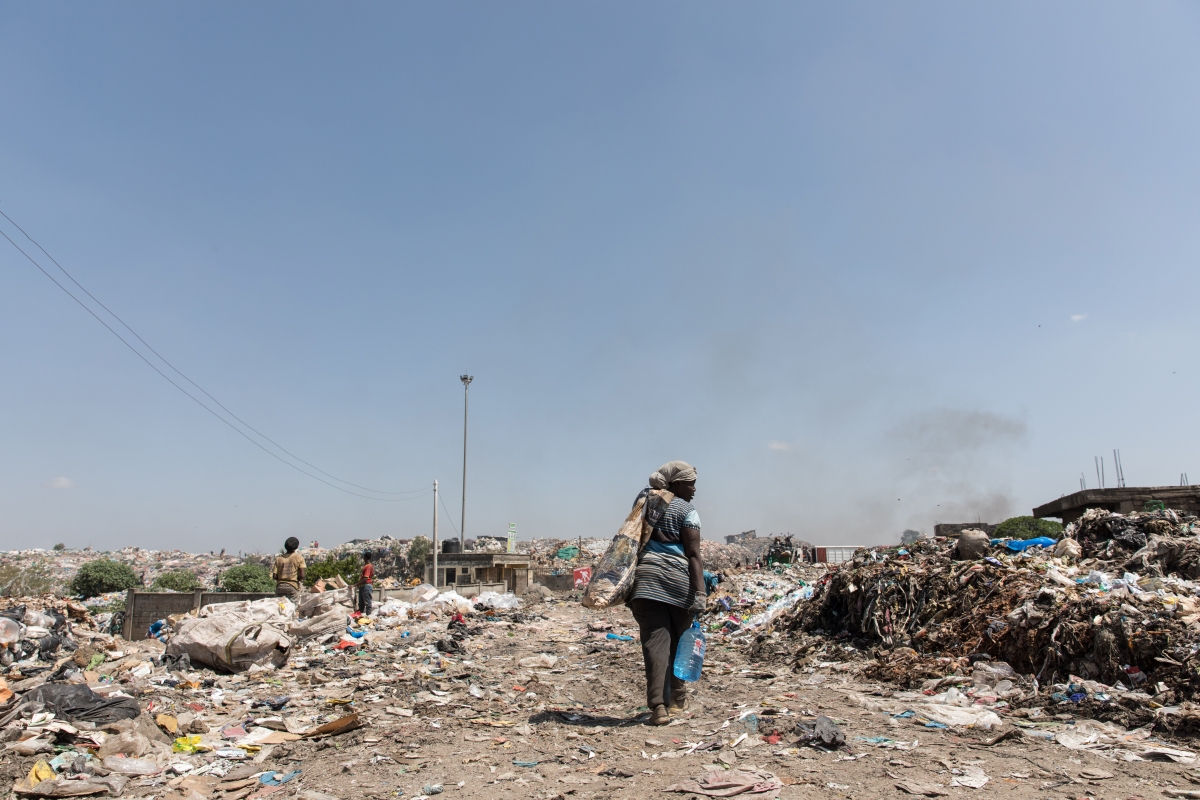
A woman walks through the dump site where Ibrahim Onyango, Francis's brother, worked before he was killed in March. MUST CREDIT: Photo for The Washington Post by Sarah Waiswa

A woman walks through the dump site where Ibrahim Onyango, Francis’s brother, worked before he was killed in March. MUST CREDIT: Photo for The Washington Post by Sarah Waiswa

The lack of closure will prolong Yassin’s family’s pain, which lives right below the surface of an otherwise happy family.

On a recent day at home, Molte sat in his living room, the walls of which Yassin, a flamboyant kid who loved to dress up and strut about, had half-finished decorating with stickers, stars and butterflies. He jovially talked about his and his wife’s business selling shaved ice and little cakes, and played with his son Mukhtar, who is just 2, the youngest of their remaining six children. But at the first mention of Yassin, tears sprang to his eyes.

“Our youngest children still don’t understand,” he said. “They ask me, ‘Daddy, when is Yassin coming home from the hospital?’ “

Their three-story house is haunted by Yassin’s absence – the bunk bed that isn’t shared anymore, the end of the family’s nightly chats on the balcony where he was shot, the older sister who shared his birthday week and never wants to celebrate again.

That Yassin’s case is the best – or only – chance at justice for any of the families of those killed during enforcement of coronavirus restrictions has reinforced a disillusionment among activists working toward police reform. Many said that it bore the hallmarks of other cases that were eventually thrown out.

“What we have is a system that allows the police to investigate themselves,” said Peter Kiama, the director of the Independent Medico-Legal Unit, a collective of doctors and lawyers that support human rights causes. “So the police will execute an individual either in custody or during arrest, and they are the ones to pick up the body, take it to the morgue, and then call the medical experts to examine the body after they have already compromised the scene of crime.”

Hussein Moyo Molte talks to his three young children outside their home in Nairobi. MUST CREDIT: Photo for The Washington Post by Sarah Waiswa

Hussein Moyo Molte talks to his three young children outside their home in Nairobi. MUST CREDIT: Photo for The Washington Post by Sarah Waiswa

In 2017, Kenya passed a law that should have created an independent forensic unit, but Kiama said it was never implemented, and his organization is the only one in the country that provides that service.

Other activists offered long lists of other challenges. No witness protection. No funding for human rights work. No safety for human rights activists who are routinely harassed. No sense of solidarity with the poor from more well-off Kenyans. No political will to reform a police force hollowed out by poor training, poor leadership and poor salaries.

“If you’ve worked a dozen cases and nothing has happened, you get discouraged,” said Gacheke Gachihi, who co-founded the Mathare Social Justice Center, a community outreach organization in one of Nairobi’s biggest slums. Instead of convictions, she said, usually the best outcome is still an unjust one: The officer gets transferred to another post.

“If you transfer them, you transfer impunity,” Kiama said. “What we do in this country is transfer impunity from one place to another, and we postpone dealing with the problem. We are living in denial that we have institutionalized police violence.”

With little recourse, both Otieno and Molte voiced desperation. Otieno, unable to hold back his tears, said his decision to let justice for his brother slip away made him feel “like this life was useless.”

Molte dreamed of taking matters into his own hands.

“But even if I met Duncan Ndiema and killed him myself, it wouldn’t bring Yassin back,” he said, his face again wet with tears.

Trump drove lie that election was stolen, undermining voter trust in outcome #SootinClaimon.Com

#SootinClaimon.Com : ขอบคุณแหล่งข้อมูล : หนังสือพิมพ์ The Nation.

Trump drove lie that election was stolen, undermining voter trust in outcome (nationthailand.com)

Trump drove lie that election was stolen, undermining voter trust in outcome

InternationalDec 21. 2020Supporters of President Donald Trump rally against the election results outside the Georgia Capitol in Atlanta on Saturday, Nov. 7, 2020. MUST CREDIT: Photo for The Washington Post by Kevin D. LilesSupporters of President Donald Trump rally against the election results outside the Georgia Capitol in Atlanta on Saturday, Nov. 7, 2020. MUST CREDIT: Photo for The Washington Post by Kevin D. Liles 
By The Washington Post · Amy Gardner

WASHINGTON – Elena Parent, a Democratic state lawmaker from the Atlanta area, listened incredulously in a small hearing room in early December as a stream of witnesses spun fantastical tales of alleged election fraud before the Georgia Senate’s Judiciary Committee.

A retired Army colonel claimed that the state’s voting machines were controlled by communists from Venezuela. A volunteer lawyer with President Donald Trump’s campaign shared surveillance video that she said showed election workers in Atlanta counting “suitcases” of phony ballots that swung Georgia’s election to former vice president Joe Biden. The president’s personal lawyer Rudy Giuliani told the panel: “Every single vote should be taken away from Biden.”

“Since this has been debunked repeatedly, what evidence can you give to us that counters what our elections officials presented us with only an hour ago?” Parent asked one of the witnesses, her voice rising in exasperation. When she tried to ask a follow-up question, the Republican committee chairman cut her off.

Her questions – and the fact that the claims were misleading, unsubstantiated or just plain false – did little to keep the rumors in check. It did not matter that state and local election officials had explained what was in the video and conducted a hand recount to show that the machines were not rigged. It did not matter that news outlets detailed, over and over, that there was no evidence of widespread fraud. It did not matter that, amid a global pandemic and massive demand for mail ballots, a system under historic strain in fact held up decisively.

To preserve his hold on power, Trump has spent the weeks since Election Day promoting falsehoods about voting problems in Georgia and five other states, successfully persuading tens of millions of his supporters to believe a lie – that the election was stolen from him, and from them.

He has done so by harnessing the power of his position, using his pulpit at the White House and his Twitter feed to let loose a fusillade of conspiracy theories. His assault on the integrity of the election has gotten a hefty assist from pro-Trump media outfits and an assortment of state lawmakers and lawyers who gave oxygen to the debunked allegations – and a majority of congressional Republicans, who called on the Supreme Court to overturn the results in four states.

Trump is continuing to press his case, even now that the electoral college has formally elected Biden. In a meeting with allies on Friday, the president discussed deploying the military to rerun the election and appointing attorney Sidney Powell, whose conspiracy theories about election fraud have been widely discredited, as a special counsel to investigate the outcome.

Along the way, Trump has willfully damaged two bedrocks of American democracy that he has been going after for years: confidence in the media as a source of trusted information and faith in systems of government. It might be one of his lasting legacies.

A Fox News poll released Dec. 11 shows that more than a third of registered voters believe the election was stolen from Trump – a number that rises to 77% among those who voted for Trump. Conversely, 56% of voters believe Trump weakened American democracy by contesting election results in various states, with the number rising to 85% among those who voted for Biden, according to the poll.

Trump’s campaign spokesman Tim Murtaugh declined to answer specific questions about the damage the president has done or the untruths he has embraced.

“President Trump owes it to the 75 million Americans who voted for him – and to those who voted for Joe Biden – to ensure that the election was free, fair and secure,” he said.

Even now that the electoral college has voted, and the GOP’s top leaders have publicly accepted Biden’s victory, both major political parties and the country overall must reckon with the mark Trump has left on American democracy. Biden will start his presidency with nearly half the country believing he is not the legitimate occupant of the White House. Many Americans who voted against Trump and have watched with horror as he has tried to subvert the results are equally disillusioned about the strength of the system, which they fear could have toppled but for the courage of election officials, state Republicans and judges who held the line.

Few anticipate that the mistrust and divisions will fade with the 45th president’s departure from the White House. One reason: The most ardent purveyors of unfounded accusations say they have no plans to back down.

“The fact is that President Trump was reelected by what will be known soon to be a landslide victory unparalleled in this country,” said Lin Wood, a Georgia lawyer and Trump ally who has filed unsuccessful lawsuits on the president’s behalf.

Wood said he spoke to the president in a phone call this month, encouraging him not to concede in what he described as “a battle between good and evil.”

Nathaniel Persily, a professor at Stanford University’s law school and co-director of the Stanford-MIT Healthy Elections Project, said that kind of rhetoric has emboldened some in the country to doubt the results merely because their preferred candidate lost.

“We’re entering a very dangerous phase where a sizable share of the population has no faith in the basic mechanics of the democracy,” Persily said. Millions of voters, he added, now see the fight over who should lead the country as a function of “the willingness to exert power as opposed to playing by fair rules of the game.”

Clayton County, Ga., election workers recount votes by hand on No. 13, 2020. MUST CREDIT: Photo for The Washington Post by Kevin D. Liles
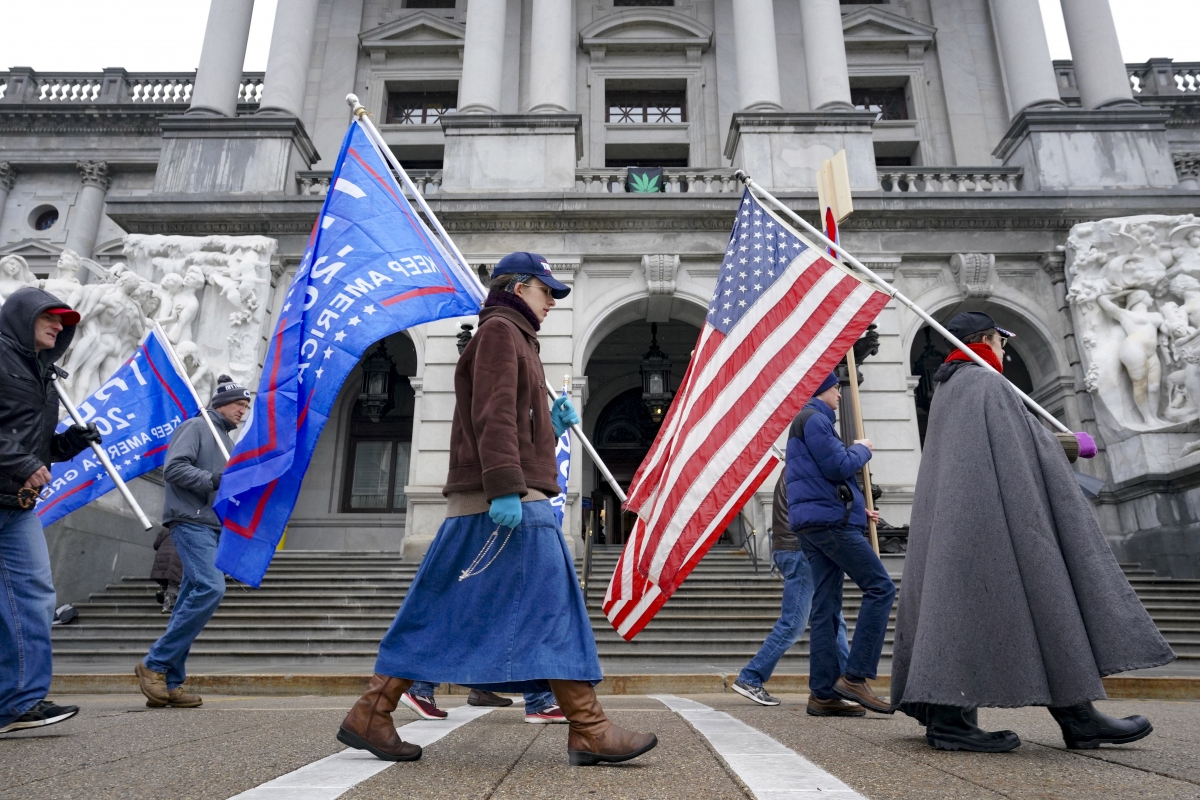
Clayton County, Ga., election workers recount votes by hand on No. 13, 2020. MUST CREDIT: Photo for The Washington Post by Kevin D. Liles
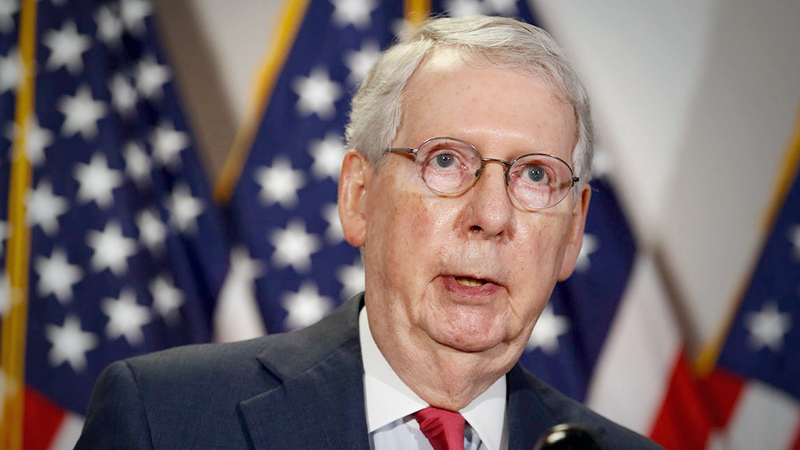
Trump has demonstrated a unique capacity to rally supporters to his war cries, even when they are false or unproven. He gained notoriety nearly a decade ago as the leader of the so-called birther movement, asserting falsely that then-President Barack Obama was not born in the United States.

This year, Trump’s obsession with election fraud has tested his followers anew, and their willingness to go along with him has shown how powerful his hold is on the GOP.

The president’s false claims about voting ramped up in the early days of the coronavirus pandemic, when election officials were gearing up for a historic surge in mail balloting. He got help from a chorus of Republican allies, who echoed and amplified his untruths on the campaign trail, on conservative television and in state capitols in key battlegrounds.

In the days after the election, his rhetoric defied logic as he cited more and more outlandish accusations and echoed unverified Twitter accounts. “They are finding Biden votes all over the place – in Pennsylvania, Wisconsin, and Michigan,” Trump tweeted on Nov. 4, suggesting falsely that ballots still being counted a day after the election were fraudulent. “So bad for our Country!”

On Nov. 30, the president retweeted an account named @Catturd2 that claimed in Arizona, “Truck Loads of Ballots Kept Coming in For 10 Days After Elections Officials Thought They Were Done Counting.”

Many of his increasingly outrageous accusations – blasted out to his 89 million followers on Twitter – came straight from one of his new favorite news sources, One America News.

“Pennsylvania Poll Watcher: USB Drives uploaded to machines, gave Biden thousands of votes,” the president tweeted on Nov. 27.

Dec. 16: “Study: Dominion Machines shifted 2-3% of Trump Votes to Biden. Far more votes than needed to sway election.”

Trump and his allies also claimed to have scores of “affidavits” alleging fraud on a massive scale. But the sworn statements his campaign and his allies submitted in lawsuits contained meaningless observations, such as one complaint in Michigan that a “man of intimidating size” had followed a poll watcher too closely, and another who said a public address system was too loud and therefore “distracting to those of us trying to concentrate.”

Trump and his allies have lost overwhelmingly when they tried to overturn Biden’s victory through the courts, with at least 88 judges across the country ruling against them either on procedural grounds or on the merits in more than 50 cases. The president’s campaign on Sunday said it was filing a new petition with the Supreme Court seeking to overturn the result in Pennsylvania, challenging state voting procedures similar to those that the court has declined to act on.

Even as his accusations have collapsed under scrutiny, they have gained traction among his most ardent supporters.

They have been spurred on by Trump-supporting cable and online news outlets such as OAN and Newsmax, which touted unfounded theories about the Dominion machines, dead people voting and poll workers in Michigan allegedly covering up windows with cardboard to prevent observers from watching the process.

At a rally in Valdosta, Ga., this month for two Republican senators facing a runoff election on Jan. 5, Trump paused his speech and turned to giant screens that played misleading news reports on fraud. Thousands in the crowd watched the videos, rapt.

Trump’s arguments made sense, his supporters said. They could not believe that Biden fared better than Obama had in his races, and they were suspicious that Trump was ahead in some states on Election Day but fell behind as mail ballots were counted – either unaware or untrusting of news reports explaining why that was expected.

“Do you truly believe that Joe Biden got more votes than Barack Obama?” asked Wendy Mick, 53, who traveled from New Jersey to a “Stop the Steal” rally in the District of Columbia on Dec. 12, and said Newsmax and OAN are her new preferred sources for political news. “He never campaigned. There’s no way that Biden got so many votes.”

Trump supporters pray and sing during a demonstrations outside the Pennsylvania Capitol in Harrisburg on Monday, Dec. 14, 2020. MUST CREDIT: Washington Post photo by Bonnie Jo Mount

Trump supporters pray and sing during a demonstrations outside the Pennsylvania Capitol in Harrisburg on Monday, Dec. 14, 2020. MUST CREDIT: Washington Post photo by Bonnie Jo Mount

The relative silence of Republican lawmakers in the initial days after the election, in states and on Capitol Hill, quickly gave way to a flood of support for Trump’s posture.

A stock line emerged among Republican leaders who refused to acknowledge Biden’s win: The president has the right to pursue all legal avenues available to him.

But Trump has done more than pursue all legal avenues. He has openly cajoled his supporters to join the fight. And they did.

In Maricopa County, Ariz., home of Phoenix, his supporters lashed out at local election officials, accusing them without evidence of improperly verifying signatures, switching Trump votes to Biden votes on duplicate ballots and keeping observers too far away from ballot-counting to see anything.

In Wisconsin, they claimed that the use of drop boxes for mail ballots was illegal. With most municipal offices closed to the public because of the pandemic, many city clerks set up secure drop boxes not just for ballots but for other city business such as utility bills.

“I had customers dropping off absentee ballots and saying, ‘How are you going to differentiate my ballot from a utility bill?’ and I thought, ‘Wow, you must really think I’m dumb that I can’t differentiate a ballot envelope from a utility bill,’ ” said Lori Stottler, the city clerk in Beloit, Wis., on the Illinois border. “But then I thought, ‘Well, they don’t know what I do.’ And I took a step back and I tried to explain.”

Pennsylvania House Speaker Bryan Cutler’s Facebook page was inundated with demands from constituents that he reverse Biden’s win in the state. Protesters also gathered outside his rural home in Lancaster County on Dec. 5 with bullhorns and signs.

“Petition your governor for a special session!” an organizer shouted toward the Republican lawmaker. “Why haven’t you petitioned him?”

“Do your job!” the crowd chanted back. “Do your job! Do your job!”

Rep. Seth Grove, a Republican lawmaker from York County, Pa., said a conservative activist confronted him at the Capitol in Harrisburg, demanding that the legislature take action to seat Trump’s electors – even though state law does not allow such a move.

Grove said he was stunned when the longtime tea party organizer proclaimed, “You know, the Constitution doesn’t limit government!”

It was a reminder, Grove said, of how much power Trump has amassed over the Republican electorate, to the point that some of his supporters are no longer guided by political principles they have claimed adherence to in the past.

“It shocked me,” Grove recalled. “Shocked me.”

Lawmakers in Arizona and Pennsylvania rebuffed the president’s efforts to stage official hearings to examine potential fraud. But back benchers in both states assembled media spectacles in hotel ballrooms, labeling them hearings but presenting “witnesses” that were not under oath and offering no evidence for their claims.

Republican lawmakers in Michigan and Georgia did hold official hearings, giving Giuliani an additional platform to unspool false claims.

“I know they are under a lot of pressure from their base, from the lies being spun by Trump and his enablers, right-wing media, etc., but it was really disappointing,” said Parent, the Georgia senator. “The hearing was obviously a sham that wasn’t designed to answer any questions about the election.”

Republicans on the committee did not respond to requests for comment.

One witness at the Michigan hearing, Mellissa Carone, gained notoriety for a stream of unfounded accusations, including one claim that she’d seen a van pull up to a Detroit vote-counting center that was meant to bring in meals for election workers but was actually filled with phony ballots. Carone had previously been deemed “simply not credible” by a state judge.

Trump lashed out at those who refused to bend to his will. He called Georgia Secretary of State Brad Raffensperger, a Republican, an “enemy of the people” for not embracing the president’s accusations of fraud. He accused the Michigan secretary of state, Democrat Jocelyn Benson, of “breaking the law” by rigging voting machines.

And he threatened Georgia Gov. Brian Kemp, a Republican, with a primary challenge in 2022 for not helping him reverse the outcome – even though Kemp had explained in a contentious phone call that he did not have the power to do so.

Trump’s rhetoric has spurred some of his supporters to do more than protest.

Raffensperger and his wife began receiving death threats and accepted a state security detail at their home in suburban Atlanta. Protesters trespassed at Benson’s home in Detroit, some armed with bullhorns and some with guns, ignoring neighbors’ pleas to go home because they were scaring children, including Benson’s 4-year-old son.

In Houston, a former police captain was arrested Tuesday after allegedly slamming into an air-conditioning repairman’s truck to thwart what he said was a vast election-fraud scheme. The man, Mark Anthony Aguirre, was paid $250,000 by a right-wing organization to pursue fraud conspiracy theories and believed that the truck contained 750,000 fake ballots, police said.

The truck contained air conditioning parts.

– – –

Vanishingly few national Republicans have been willing to stand up to the false statements, despite privately acknowledging that the election is over. “The future will take care of itself,” Senate Majority Leader Mitch McConnell, R-Ky., told reporters in early December, refusing to acknowledge that Biden had won.

In Pennsylvania, Republican lawmakers who had initially resisted the president’s entreaties wound up signing on to an emergency petition to the Supreme Court that sought to overturn Biden’s win in the state, though they never cited fraud in their filing. They also sent a letter to Congress urging federal lawmakers to reject Pennsylvania’s electoral votes when they convene Jan. 6.

Grove, the GOP lawmaker from Pennsylvania, said he and other Republicans had assumed that the letter would go nowhere. A challenge requires support from a member of both the House and Senate, but Grove and others incorrectly thought they had to be from the state in question, and they knew that Pennsylvania’s two senators, Republican Pat Toomey and Democrat Bob Casey, would not support it.

“We didn’t know that anyone can do it from any state,” Grove said. “That was a surprise.”

Congressional Republicans also began echoing Trump’s claims; 126 of them ultimately signed on to an emergency petition to the Supreme Court seeking to overturn results in four states Biden had won.

“The fraud happened,” said Sen. Rand Paul, R-Ky., at a hearing last week in Washington to examine election irregularities.

Sen. Ron Johnson, R-Wis., who called the hearing despite acknowledging after the electoral college vote that Biden had won a legitimate election, declared at the start of the proceeding: “There was fraud in this election. I don’t have any doubt about that.”

That idea that something went wrong with the vote this year has taken hold among many Americans.

Anna Van Winkle, a retired aesthetician in Savannah, Ga., who voted for Trump, has accepted her candidate’s defeat, but she believes lawmakers must fix the election process to make sure such broad doubt in the outcome cannot happen again.

“My concern is that we don’t go down this road again,” she said. “We had a problem. We had a big problem. And now, going forward, the best way to deal with this is to fix this where somebody like me is not going to wonder, ‘OK, was there fraud here?’ “

Van Winkle was perplexed when she received multiple absentee ballot request forms at her address, and she worries that others willing to commit ballot fraud would have been able to do so by requesting more than one ballot. Although Georgia requires identification to request a ballot online – and signature matching on ballots themselves – Van Winkle does not understand why states do not require mail voters to get their ballots notarized.

Voting-right activists, meanwhile, are concerned that such sentiments will now be cited as an excuse to try to erect new barriers to casting ballots.

GOP lawmakers in Georgia have already floated a proposal to eliminate no-excuses absentee balloting, meaning only those with a qualifying reason such as illness or an overseas assignment could vote by mail. In Texas, lawmakers have filed bills to limit distribution of absentee ballot applications and make it a felony to help voters fill out ballots. Pennsylvania Republicans have discussed tighter identification requirements for mail ballots and signature matches.

Defenders of this year’s elections also recognize the need to shore up public confidence. Sen. Amy Klobuchar, D-Minn., who advocated unsuccessfully for billions of dollars in election aid for states this year, believes Congress must act to curtail misinformation on social media companies, which she said fell short in their civic obligation to restrict false claims on their platforms.

Klobuchar said she was heartened by the Republicans who immediately acknowledged Biden’s win, by those who did so after the electoral college vote and by the dozens of judges across the country, many of them Republican appointees, who roundly rejected the fraud claims of Trump and his allies.

“All of those things mean our democracy is working during a really hard time,” she said.

But there remains the reality that Trump and millions of his supporters still refuse to accept Biden’s win, creating a disturbing precedent, Klobuchar said, in a political system that has prided itself on the peaceful transfer of power and acknowledgment of election results.

“I’m concerned about our democracy in the long run if these civil mores change,” she said, “so people don’t even have to tell the truth about who won.”

McConnell announces agreement on nearly $900 billion coronavirus relief package #SootinClaimon.Com

#SootinClaimon.Com : ขอบคุณแหล่งข้อมูล : หนังสือพิมพ์ The Nation.

McConnell announces agreement on nearly $900 billion coronavirus relief package (nationthailand.com)

McConnell announces agreement on nearly $900 billion coronavirus relief package

InternationalDec 21. 2020

Mitch McConnell

Mitch McConnell

By The Washington Post · Jeff Stein, Mike DeBonis, Paul Kane

WASHINGTON – Senate Majority Leader Mitch McConnell announced late Sunday night that lawmakers have finalized an approximately $900 billion economic relief package.

“More help is on the way. Moments ago, in consultation with our committees, the four leaders of the Senate and House finalized an agreement for another major rescue package for the American people,” said McConnell, R-Ky.

He said lawmakers only have to “promptly finalize text” and “avoid any last-minute obstacles.”

Lawmakers have for month sought a breakthrough on economic relief legislation.

House Speaker Nancy Pelosi, D-Calif., told her leadership team earlier in the day that she wanted a vote Sunday, according to one person who spoke on the condition of anonymity to share details of the congresswoman’s private comments. Congress has until midnight to pass a temporary stopgap measure to keep the government open.

Negotiators have decided to provide stimulus checks worth $600 per person. The size of that benefit would be reduced for people who earned $75,000 the preceding year, similar to the last round of stimulus checks, according to two people who spoke on the condition of anonymity to share details of private deliberations. The stimulus checks would provide $600 per person, including adults and children, meaning a family of four would receive $2,400 up to a certain income.

Congress would also extend unemployment benefits of up to $300 per week, which could start as early as Dec. 27.

While there’s broad agreement on stimulus checks and unemployment insurance, officials say nothing is final until the bill text is released. That may come as early as Sunday afternoon. Other policy disputes remained outstanding, according to aides close to negotiations, which could push the timeline back again.

House leaders are exploring another stopgap measure that would fund the government while also giving them seven days to file technical corrections to the legislation if necessary. They would still plan on pass the relief package within 24 hours.

At 12:18 a.m. on Sunday, President Donald Trump tweeted that Congress needs to give “more money in direct payments.” The Washington Post reported last week that White House aides talked Trump out of issuing a public statement demanding stimulus checks as big as $2,000 out of fear that he would sink the delicate negotiations.

Congressional lawmakers appeared ready to ignore the president’s demands. People close to negotiations said they did not expect the White House to oppose the package over Trump’s push for larger stimulus payments, though Trump has repeatedly scrambled congressional negotiations with last-minute demands.

Lawmakers have agreed in principle to new stimulus payments. Sens. Bernie Sanders, I-Vt., and Josh Hawley, R-Mo., as well as Trump, have made a push for more generous stimulus checks, but those efforts are unlikely to be successful.

The income criteria for the stimulus checks is expected to reflect that of the first round of stimulus payments sent by the Treasury Department this year. The payment would be smaller for those who earned more than $75,000 in 2019 and disappear altogether for those who earned more than $99,000.

Adult dependents are not expected to qualify for the stimulus payments, people familiar with the negotiations said, despite a push from congressional Democrats. The deal would include stimulus payments for families in which one of the parents is not a citizen.

The deal over extending federal jobless benefits for millions of unemployed Americans at a level of $300 per week would cover up to 11 weeks of unemployment, at least through March 14, aides familiar with the negotiations said. An unemployment benefits program for contract and gig workers, which is also set to expire at the end of the year, would be extended for 11 weeks for those workers.

Negotiators also agreed to extend the deadline for states and cities to use unspent money approved for them by the Cares Act, two people familiar with internal deliberations said. States and cities have until the end of the year to spend billions of dollars before it expires and has to be returned to the federal government. The deal would instead extend that deadline for a full year.

Republicans have successfully opposed Democrats in their demands for hundreds of billions of dollars in state and local aid. Many local governments are experiencing steep declines in tax revenue and have been warning of layoffs. Extending the deadline for using leftover funding from the Cares Act, however, allows Democratic lawmakers to say that they still provided some relief to ailing municipalities.

The bill would extend for one month a moratorium on evictions that is set to expire at the end of the year, two people with knowledge of the matter said. The moratorium would be extended through January, at which point Democrats believe the incoming Biden administration could extend it again. The legislation would also provide about $25 billion in emergency assistance to renters, the people said, though it remained unclear how that money would be disbursed.

Lawmakers had also appeared to resolve a dispute over whether businesses that received Paycheck Protection Program loans, and had them forgiven, will be allowed to deduct the costs covered by those loans on their federal tax returns. Sen. John Thune, R-S.D., the No. 2 ranking Republican senator, said the costs would be deductible under the final agreement.

Other hurdles to a deal remain under discussion, according to the aides close to negotiations. For instance, Pelosi told Democratic lawmakers Saturday that the parties remained divided over how much aid to provide for hungry Americans.

Even if leaders are able to resolve remaining sticking points on Sunday, it may take more time for congressional staff members to draft those agreements into legislative text and prepare the massive bill for votes in the House and the Senate. Lawmakers had also not yet released text of the agreement between senior Democrats and Sen. Pat Toomey, R-Pa., over the central bank, which was a sticking point Saturday.

Lawmakers had hoped to vote this weekend on legislation to fund the government along with the broader relief package. Bill language had not materialized by Sunday morning.

The emerging legislative package is expected to also devote as much as $330 billion in small-business aid and allocate tens of billions of dollars to an array of other critical needs, such as transportation agencies, distressed renters and hungry people.

A compromise proposal this month by Sens. Mitt Romney, R-Utah, and Joe Manchin, D-W.Va., among other centrist lawmakers, would have provided 16 weeks in unemployment benefits instead of the 11 weeks under the current agreement.

The push for an approximately $900 billion relief plan gained new momentum Saturday night as lawmakers resolved a dispute over a Republican plan to rein in the Federal Reserve.

As part of his proposal, Toomey wanted the Fed’s lending programs for businesses and local governments to be cut off at the end of the year, and to ensure that no similar programs could be propped up later.

While Toomey and Republican leadership held firm for much of Saturday, Democrats chastised the plan, saying it stretched far beyond specific programs propped up under the Cares Act. They also said the GOP was undermining the Fed’s ability to fight future crises, and with it, the incoming Biden administration.

Despite hopeful statements from leadership on timing of passing the relief legislation, other lawmakers, including Sen. John Cornyn, R-Texas, have cast doubt that Congress could pass the measure on such an accelerated timetable.