Supreme Court weighs child-slavery case against Nestlé USA, Cargill #SootinClaimon.Com

#SootinClaimon.Com : ขอบคุณแหล่งข้อมูล : หนังสือพิมพ์ The Nation.

Supreme Court weighs child-slavery case against Nestlé USA, Cargill (nationthailand.com)

Supreme Court weighs child-slavery case against Nestlé USA, Cargill

InternationalDec 02. 2020Children from Burkina Faso take a break in 2019 on a cocoa farm near the village of Niambly, Ivory Coast. MUST CREDIT: Washington Post photo by Salwan GeorgesChildren from Burkina Faso take a break in 2019 on a cocoa farm near the village of Niambly, Ivory Coast. MUST CREDIT: Washington Post photo by Salwan Georges 

By The Washington Post · Peter Whoriskey

WASHINGTON – The Supreme Court heard arguments Tuesday about whether U.S. chocolate companies should be held responsible for child slavery on the African farms from which they buy most of their cocoa.

Six African men are seeking damages from Nestlé USA and Cargill, alleging that as children they were trafficked out of Mali, forced to work long hours on Ivory Coast cocoa farms and kept at night in locked shacks. Their attorneys argue that the companies should have better monitored their cocoa suppliers in West Africa, where about two-thirds of the world’s cocoa is grown and child labor is widespread.

These “are former child slaves seeking compensation from two U.S. corporations which maintain a system of child slavery and forced labor in their Ivory Coast supply chain as a matter of corporate policy to gain a competitive advantage in the U.S. market,” the Malians’ attorney, Paul L. Hoffman, told the court. He asked the justices to “allow these former child slaves to have their day in court.”

Nestlé USA and Cargill have responded that they, too, deplore child slavery and trafficking, and that they have taken steps to eradicate such practices among their suppliers.

Nestlé USA “firmly believes that traffickers deserve punishment,” the company said in court filings. “This case is not about any of that.”

The companies have asked the Supreme Court to toss the lawsuit, arguing that courts in the United States are the wrong forum for the Malians’ complaint and that the applicable law permits such cases against individuals but not corporations. In the view of the companies, such cases ought to be filed not against the corporations but against the traffickers and farmers involved.

“This case is about a 15-year-old lawsuit brought against the wrong defendant, in the wrong place, and under the wrong statute,” according to the brief on behalf of Nestlé USA filed by Neal Katyal and other attorneys. “The true wrongdoers are the Malian and Ivorian traffickers, farmers, and overseers.”

On Tuesday, both sides faced skepticism from the justices.

“Mr. Katyal, many of your arguments lead to results that are pretty hard to take,” Justice Samuel Alito said.

Suppose, Alito continued, a U.S. corporation surreptitiously hired agents in Africa to kidnap children to enslave them on a plantation so that the corporation can buy cheap cocoa or coffee.

“You would say that the victims … should be thrown out of court in the United States, where this corporation is headquartered and does business?” Alito asked.

Katyal answered, among other things, that the victims could sue in African courts or Congress could pass a law specific to such abuses.

Probing the arguments of the other side, however, the justices zeroed in on whether the companies’ practices really amounted to “aiding and abetting” child slavery. Is simply buying cocoa from these farms enough?

“What counts as aiding and abetting for purposes of this statute?” Justice Stephen Breyer asked Hoffman, the Malians’ attorney. “When I read through your complaint, it seemed to me that all or virtually all of your complaint amounts to doing business with these people. They help pay for the farm. And that’s about it.”

Hoffman answered that the companies had “crossed the line” from merely buying cocoa to facilitating the system.

The proliferation of global supply chains in recent decades has led to recurring debates over the responsibility of multinational companies to monitor the adherence of their far-flung suppliers to human rights and environmental standards.

Business groups, including the U.S. Chamber of Commerce and the National Association of Manufacturers, have pushed back against lawsuits such as the one against Nestlé and Cargill, arguing they are burdensome and could discourage investment in developing economies. U.S. and foreign companies have been sued 150 times over the past 25 years under a statute that permits foreign nationals to sue in the United States for international law violations, the business groups said.

Allowing the cases imposes “heavy legal and reputational burdens on companies that are sued on the basis that they conducted business with foreign actors accused of committing torts abroad,” their attorneys argued.

There is plenty of evidence, however, that the world’s chocolate supply depends heavily on child labor and that despite two decades of industry promises, it remains widespread. While much of it occurs on family farms, some is also arranged by traffickers who ferry in children from neighboring Mali and Burkina Faso. To human rights advocates, the persistence of child labor in the world’s cocoa supply amounts to, at best, tragic negligence.

A Washington Post investigation of the use of child labor in the cocoa industry found representatives of some of the biggest and best-known brands could not guarantee that any of their chocolate was produced without child labor. It featured children from Burkina Faso working in appalling conditions on Ivory Coast cocoa farms.

More recently, a report sponsored by the U.S. Department of Labor, indicated that the West African cocoa industry was exploiting the aid of 1.6 million West African child laborers. Most of those laborers were involved in tasks considered hazardous such as wielding machetes, carrying heavy loads or working with pesticides, according to the report.

What makes the legal cases against the companies particularly complex is the difficulties investigators face in connecting any child laborer with a specific company. But human rights advocates say the companies should be held responsible because child labor arises in part because they refuse to pay enough for cocoa and have yet to fully institute systems for tracing cocoa beans to specific farms.

“The business practices of these companies clearly have contributed to the use of forced and child labor in West Africa,” said Charity Ryerson, an attorney for the Corporate Accountability Lab who has traveled to Africa to investigate cocoa practices.

She noted that some smaller chocolate companies such as Tony’s Chocolonely pay higher prices and take extra care to eliminate child labor from their cocoa suppliers. Those added costs can make it difficult for the producers of “ethical chocolate” to compete against the companies using cocoa produced with child labor, she said.

“As slave-free cocoa and chocolate companies, [we] are at a competitive disadvantage to companies that source cheap cocoa produced with forced child labor,” some of the companies said in a legal filing. “The higher production costs associated with compliance with international human rights norms require [us] to sell . . . chocolate at higher prices.”

Indeed, cocoa prices are critical to the debate. As the Supreme Court begins to consider the case, a cocoa price war appears to be breaking out between the multinational companies and the governments of Ivory Coast and Ghana, which regulate cocoa exports.

The West African governments have added a $400 cost per ton in an attempt to give farmers what they call a “living income,” a move that has been met with some reluctance from the chocolate companies.

“Unfortunately, industry steps to lower the price are going in precisely the wrong direction,” said Antonie Fountain, managing director of the Voice Network, a group that pushes for environmental and human rights reform in the cocoa industry. “Prices need to go up, not down.”

The Voice Network issued an annual report on the industry Tuesday, citing the lack of progress despite promises by the companies to eradicate child labor.

“Twenty years into rhetoric, the challenges on the ground remain as large as ever,” it said. “Poverty is still the daily reality for virtually all West African cocoa farmer families, child labour remains rife, and old growth forests continue to be cleared to make way for cocoa production.”

White House planning a packed season of holiday parties #SootinClaimon.Com

#SootinClaimon.Com : ขอบคุณแหล่งข้อมูล : หนังสือพิมพ์ The Nation.

White House planning a packed season of holiday parties (nationthailand.com)

White House planning a packed season of holiday parties

InternationalDec 02. 2020The Great Hall at the White House is decorated for Christmas with the theme The Great Hall at the White House is decorated for Christmas with the theme “America the Beautiful.” MUST CREDIT: Washington Post photo by Jabin Botsford. 

By The Washington Post · Josh Dawsey, Yasmeen Abutaleb

WASHINGTON – The White House is forging ahead with plans for more than a dozen indoor holiday parties this month despite the ongoing surge in coronavirus cases, ignoring warnings from the Trump administration’s own public health professionals to limit travel and avoid congregating in large group settings.

https://www.washingtonpost.com/video/c/embed/fd273b4e-e8c6-4b74-b495-be25f5a13cdc?ptvads=block&playthrough=false

The president and the first lady are determined to have a final holiday season in the White House, officials said, despite a pandemic that has killed more than 266,000 Americans and infected 13 million across the country. Many of the administration’s supporters have taken a skeptical view of the restrictions aimed at combating the virus and are choosing to attend, officials said.

The events, including the Congressional Ball on Dec. 10, will each include more than 50 guests and could risk the health of White House staffers and others who work at the parties. Most guests will not be tested in advance, one official said.

At the first such event Monday afternoon – a reception for volunteers who helped decorate the White House – guests were given sparkling wine and snacks, and they mingled in the State Dining Room and the East Room, among other places. Some did not wear masks or adhere to social distancing, officials said.

The parties, likely to cost millions of dollars, will be paid for by the Republican Party, according to a person with knowledge of the planning.

Stephanie Grisham, a spokeswoman for first lady Melania Trump, said on Tuesday that protocols will be taken to protect attendees.

“This includes smaller guest lists; masks will be required and available, social distancing encouraged while on the White House grounds, and hand sanitizer stations throughout the State Floor,” Grisham said. “Guests will enjoy food individually plated by chefs at plexiglass-protected food stations. All passed beverages will be covered. All service staff will wear masks and gloves to comply with food safety guidelines. Attending the parties will be a very personal choice.”

But health experts expressed dismay at the plans, noting that cases are not only increasing across the country but in the Washington area specifically. They also said travel by many guests outside the District of Columbia probably would violate myriad state and city restrictions.

“Our rates in the area, just in the region, are going up at a degree where it’s hard now to trace or identify sources of infections, and testing alone is no longer protective unless you’re testing and technically quarantining, which I doubt these people are” said Kavita Patel, a fellow at the Brookings Institution who worked on health policy in the Obama administration. She is also an internal medicine physician at St. Mary’s health center in Washington who sees patients treated for covid-19, the disease that can be caused by the novel coronavirus.

“While colleagues of mine are literally leaving families and living in garages and trying to help take care of covid patients, this feels like another slap in the face. That is a disaster,” Patel said.

Across Washington, many businesses, trade associations and political groups are not having holiday parties this year because of concerns about spreading the deadly virus. Millions of families across the country have also canceled their plans to gather in large groups.

One White House ally said he had been invited to two parties already, while another said a formal invitation to one event included no guidance on masks or social distancing. Invitees include donors, lawmakers, senior staffers on Capitol Hill, family members of White House aides and prominent conservative supporters. The president and first lady are expected to make appearances at the events, officials said.

The parties are a bipartisan annual tradition, and many guests residing outside Washington visit the city for the fetes. There is considerable interest among Republicans on Capitol Hill in attending the parties, a senior Republican aide said.

Some of the events are tours, while others are formal receptions with food and drink offerings. There will be two parties a day on some days, officials said.

The Centers for Disease Control and Prevention says that indoor gatherings pose more risks than outdoor, and that “gatherings with more people pose more risk than gatherings with fewer people.” But the CDC does not have a limit on the number of attendees for gatherings.

Still, the administration’s leading scientists have asked Americans to be particularly careful over the holiday season. Health officials have repeatedly warned the White House against hosting indoor events, but they have resigned themselves to the fact that Trump and his aides will ultimately do what they want.

“I blame the White House for hosting as much the guests who choose to attend knowing that good public health behaviors are not practiced in and around the White House,” one senior health official said.

Anthony Fauci, the nation’s top infectious-disease expert, warned about a rising surge in cases on NBC News’s “Meet the Press.”

“What we expect, unfortunately, as we go for the next couple of weeks into December, is that we might see a surge superimposed on the surge we are already in,” Fauci said. “I don’t want to frighten people, except to say it is not too late to do something about this.”

Fauci floated additional restrictions he said the country might have to consider. “We are going to have to make decisions as a nation, state, city and family that we are in a very difficult time, and we’re going to have to do the kinds of restrictions of things we would have liked to have done, particularly in this holiday season, because we’re entering into what’s really a precarious situation,” he said.

Trump has shown no inclination to avoid attending large events, even after contracting the virus in early October.

A number of events at the White House have been linked to coronavirus outbreaks, including a ceremony for Supreme Court Justice Amy Coney Barrett’s nomination and an election night party. Besides the president, dozens of White House aides, including the chief of staff, the national security adviser and the press secretary, have contracted the virus.

Many aides say they believe Trump’s mishandling of the virus is one of the primary reasons he lost the election to Joe Biden, who has endorsed mask-wearing and other restrictions aimed at limiting spread.

“The White House is . . . sending out 2020 with a bang. Indoor gatherings like this at a time of high community spread of SARS-CoV2 puts revelers at the White House holiday party at risk, as well as staff who must work the event,” said Gregg Gonsalves, an epidemiologist at the Yale University school of public health. “It’s characteristic of the irresponsibility that has defined this administration’s approach to the pandemic. It’s cavalier, selfish and wrong.”

Two British retail collapses threaten 25,000 jobs in 24 hours #SootinClaimon.Com

#SootinClaimon.Com : ขอบคุณแหล่งข้อมูล : หนังสือพิมพ์ The Nation.

Two British retail collapses threaten 25,000 jobs in 24 hours (nationthailand.com)

Two British retail collapses threaten 25,000 jobs in 24 hours

InternationalDec 02. 2020Topshop's flagship store on Oxford Street in London. MUST CREDIT: Bloomberg photo by Jason AldenTopshop’s flagship store on Oxford Street in London. MUST CREDIT: Bloomberg photo by Jason Alden 

By Syndication Washington Post, Bloomberg · Deirdre Hipwell, Katie Linsell

The British retail industry suffered one of the harshest blows yet after two of the country’s best-known retailers collapsed, putting 25,000 jobs at risk in less than 24 hours.

The Debenhams flagship store on Oxford Street in central London on Nov. 30, 2020. MUST CREDIT: Bloomberg photo by Jason Alden
The Debenhams flagship store on Oxford Street in central London on Nov. 30, 2020. MUST CREDIT: Bloomberg photo by Jason Alden

Debenhams said Tuesday morning it’s preparing to close its doors for good after failing to find a buyer. Late Monday, Philip Green’s Arcadia Group, which owns brands including Topshop and Dorothy Perkins, began insolvency proceedings.

Both retailers have anchored malls and main streets across Britain for decades and operate about 600 stores combined. U.K. retailers have suffered a double whammy: the pandemic hit as many were struggling to adjust to online competition. The industry is set to lose 235,000 retail jobs this year, according to the Centre for Retail Research.

The failure of Arcadia and Debenhams is “truly devastating” in a country where main streets are being increasingly hollowed out, said Richard Lim, chief executive officer of Retail Economics, a consultancy. “We cannot overstate the significance of the collapse given the vast property portfolio, number of jobs impacted and the reverberations felt across the industry.”

The U.K. government stands ready to support employees of both retailers, Chancellor of the Exchequer Rishi Sunak said Tuesday in the House of Commons.

Debenhams, a 232-year-old department-store chain, has been struggling for years as consumers shifted to online shopping and store visits declined. In April, the company filed to continue operating under administration while seeking a buyer.

The chain decided to wind up the business Tuesday after talks to sell the business to JD Sports Fashion Plc failed. Arcadia is the biggest concession partner of Debenhams, and after that retailer failed, the sportswear retailer said the purchase was no longer appealing.

Debenhams said it had no choice but to start winding down the business, given the prolonged effects of the pandemic. It’s still open for offers for all or parts of the company.

The decision is a blow to Debenhams’ lenders, a consortium of financial investors including Silver Point Capital and GoldenTree Asset Management, who took control of the chain last year as it struggled under a $962 million (720 million-pound) debt load. At the time the company rejected rescue offers from retail tycoon Mike Ashley, the founder of Frasers Group.

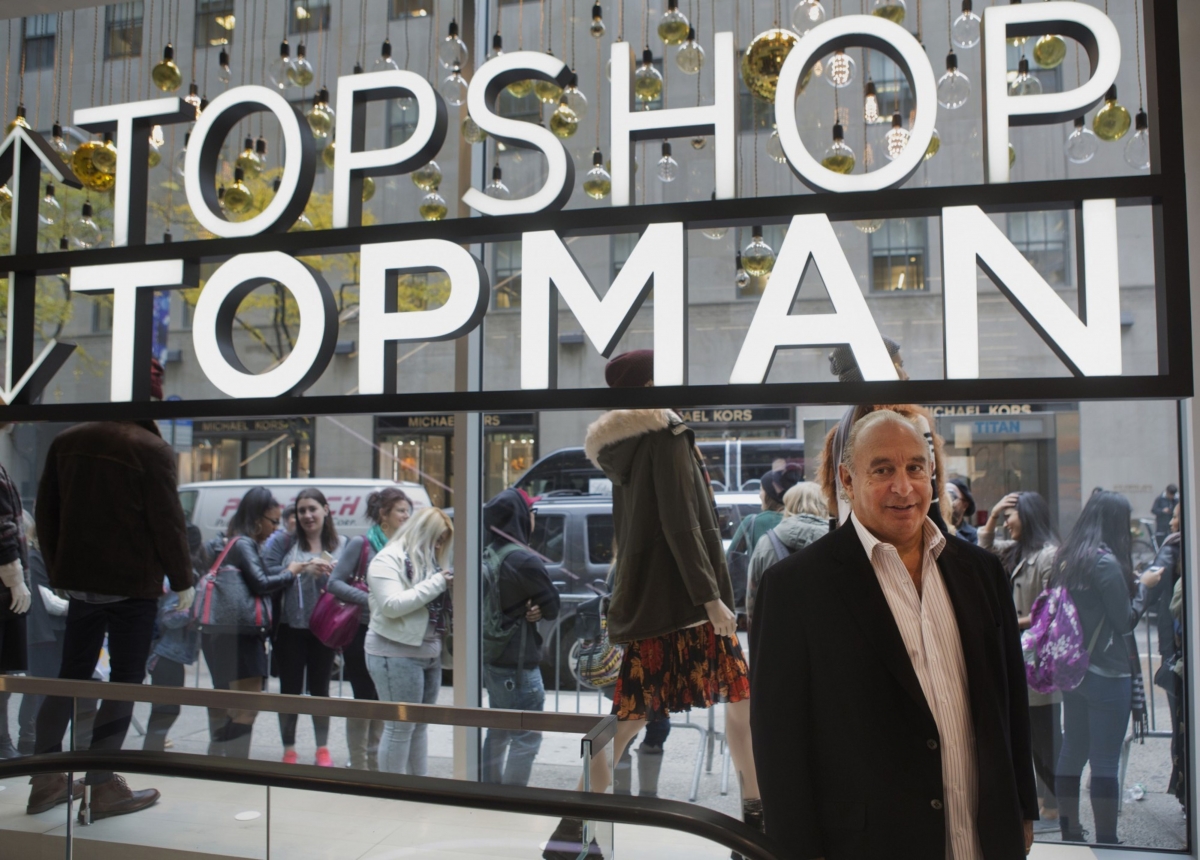
Philip Green at the opening of the Topman flagship store in New York. MUST CREDIT: Bloomberg photo by Victor J. Blue

Philip Green at the opening of the Topman flagship store in New York. MUST CREDIT: Bloomberg photo by Victor J. Blue

Ashley may now return once again as a suitor as Debenhams is liquidated. He acquired rival retailer House of Fraser out of administration in 2018. The tycoon has also expressed interest in buying Arcadia.

Arcadia has appointed Deloitte to run the administration and the consultancy now has eight weeks to draw up initial proposals for the business, which could include a sale of all or part of the group. No job losses have been announced yet but they are likely to start mounting in the coming weeks as unprofitable stores are closed by the administrator.

The business employs 13,000 people across 466 stores, of which 444 are in the U.K.

Arcadia’s performance suffered from the nimbler growth of online rivals, such as Asos and Boohoo, and a heavy cost burden, bogged down by expensive store rents and property taxes.

Creditors to Arcadia will now be lining up to get repaid from asset sales if no buyer or new financing emerges. Among them, the company has a 310 million-pound loan with Apollo Global Management Inc. secured on its flagship store on Oxford Street. The subsidiary that owns that property has hired KPMG as administrators to assess options for the 100,000 square-foot site, which used to welcome 400,000 customers a week before the pandemic.Another liability is Arcadia’s pension plans, which the company agreed to provide security for last year to the value of 210 million pounds. The Unite union has warned that employees may lose their pensions as a result of the administration. The Pension Protection Fund is now assessing whether the schemes can be rescued, according to a statement Monday.

Pfizer, BioNTech seek EU clearance for covid-19 vaccine #SootinClaimon.Com

#SootinClaimon.Com : ขอบคุณแหล่งข้อมูล : หนังสือพิมพ์ The Nation.

Pfizer, BioNTech seek EU clearance for covid-19 vaccine (nationthailand.com)

Pfizer, BioNTech seek EU clearance for covid-19 vaccine

InternationalDec 02. 2020

By Syndication Washington Post, Bloomberg · Naomi Kresge

Pfizer Inc. and partner BioNTech SE sought regulatory clearance for their Covid-19 vaccine in the European Union, putting the shot on track for potential approval there before the end of the year.

The European Medicines Agency said on Tuesday it could issue an opinion within weeks, with a meeting on the assessment scheduled for Dec. 29 at the latest. Submitted on Monday, the formal application caps a rolling review process that started on Oct. 6 and allowed Europe’s drugs regulator to examine data on the vaccine as it emerged.

Governments around the world are eager to start vaccinating their populations to curb the pandemic. Rival Moderna Inc. requested clearance in the U.S. and Europe on Monday. The U.K. invoked a special rule to allow its regulator to bypass its EU counterpart and may be the first to sign off on the Pfizer-BioNTech product. The U.S. isn’t far behind, with a Food and Drug Administration panel set to meet on Dec. 10 to discuss the vaccine.

BioNTech can start shipping the first doses “within hours” after regulatory clearance, Chief Financial Officer Sierk Poetting said at a press conference. BioNTech shares rose 2.3% in German trading.

In November, a study of almost 44,000 people showed the shot prevented 95% of symptomatic coronavirus cases.

If the EMA concludes that the benefits of the Pfizer-BioNTech shot outweigh its risks, it will recommend granting a conditional clearance that could enable the shot to be rolled out in Europe before the end of the year, the companies said in a statement. The agency said it would work “over the Christmas period” on the assessment.

Pfizer and BioNTech also started regulatory submissions in other countries including Australia, Canada and Japan, they said. The partners have signed deals to deliver hundreds of millions of doses of the vaccine, including an agreement with the EU for 200 million doses, with an option for an additional 100 million.

A conditional clearance is issued when European authorities want to get a drug to patients quickly without waiting for as comprehensive a data package as would normally be required for standard authorization. It’s valid for one year and can be renewed — and eventually converted into a standard approval.

OPEC+ talks delayed as split deepens between key gulf allies #SootinClaimon.Com

#SootinClaimon.Com : ขอบคุณแหล่งข้อมูล : หนังสือพิมพ์ The Nation.

OPEC+ talks delayed as split deepens between key gulf allies (nationthailand.com)

OPEC+ talks delayed as split deepens between key gulf allies

InternationalDec 02. 2020

By Syndication Washington Post, Bloomberg · Grant Smith, Javier Blas, Salma El Wardany

OPEC+ talks were delayed for two days to give ministers more time to reach a deal, after a long and tense meeting on oil production broke down without an agreement.

The move, set out in a letter seen by Bloomberg, was the most dramatic sign yet of the deep division inside the cartel after hours of talks on Monday yielded no result. Oil prices, which have rallied on vaccine hopes as well as expectations that OPEC will maintain its current output curbs, slipped on the news.

OPEC ministers met on Monday and had been scheduled to talk to their non-OPEC partners on Tuesday. At one point, there had appeared to be a consensus building between ministers yesterday, but the meeting then became unusually fraught. Saudi Arabia’s energy minister, in what appeared to be a gesture of frustration, told others he may resign as co-chair of a key OPEC+ panel.

At stake is the credibility of the cartel whose actions have underpinned the market since the spectacular oil crash earlier this year. The run-up to the meeting saw new cracks emerge in the relationship between the United Arab Emirates — a core part of the group — and other members. The UAE’s national long-term strategy to crank up production is clashing with the cartel’s current strictures.

“The market is underestimating a little bit how serious this is — this is one of Saudi Arabia’s biggest allies,” Amrita Sen, co-founder of consultant Energy Aspects Ltd., told Bloomberg Television. She doesn’t predict a messy outcome this week, but sees tensions persisting into next year. “Despite the disputes, they will get through this one.”

Informal talks are expected to continue by phone before the OPEC+ meeting on Thursday. Ministers are discussing whether to increase production in January as planned or maintain the current level cuts — in one scenario for another three months.

Some members think the market is still too fragile to accept more barrels, while others want to make the most of rising prices to increase production and bolster revenue.

The UAE isn’t overtly opposing an extension of the current output cuts, but is effectively blocking an agreement by trying to attach conditions to a rollover that are almost impossible to meet, according to delegates. The UAE is calling on those who have previously breached their quotas to commit to full compliance before making a deal.

In another sign of the building tension, the UAE was offered the position of co-chair of the OPEC+ monitoring committee that the Saudis may give up, but rejected it, according to a person familiar with the situation.

“There are going to have to be some concessions made to the UAE and to other producers who are concerned about this compliance burden,” Bob McNally, president of Rapidan Energy Advisors, told Bloomberg Television. That could mean a short extension and then a gradual increase in production, a change in output limits, or a stronger compliance mechanism.

It was earlier this year that friction first emerged between the UAE and the Saudis, traditionally stalwart partners. Abu Dhabi had grown impatient to use its new production capacity, while also planning to launch a regional oil benchmark contract that would be helped by a large liquid market.

“They do need liquidity ahead of it,” Sen said of the so-called Murban futures contract. “That’s a big driver.”

In the summer, the UAE cast aside its usual obedience to cartel discipline and started pumping more crude than its quota allowed. The Saudis were furious, and summoned Energy Minister Suhail Al-Mazrouei to Riyadh for a public dressing down.

The UAE soon fell into line, but the resentment remained. The country thinks its quota is unfair, and is keen to make the most of massive investments in production capacity. Those ambitions are held back by the rules of the cartel.

The Emiratis’ frustration flared two weeks ago, when officials signaled privately that they were dissatisfied with the quota assigned to them by the Organization of Petroleum Exporting Countries, and were even contemplating leaving the organization in the long term.

This week’s meeting — and the decisions on output — are a follow-up to the vast production cuts made during the depths of the pandemic. The alliance had planned to ease some of those curbs at the start of 2021, in anticipation of a global economic recovery.

Over the past few weeks, leading figures in the alliance such as Saudi Energy Minister Prince Abdulaziz bin Salman and Russian Deputy Prime Minister Alexander Novak have signaled support for changing the current plan because the market is still fragile.

While a breakthrough in vaccines to tackle the coronavirus propelled oil prices to an eight-month high, a resurgence in infections has triggered a new wave of lockdowns and inflicted a fresh blow to fuel consumption. The cartel and the wider industry have downgraded their outlooks for 2021, with a picture that’s sharply polarized between recovery in Asia and stagnation in Europe.

OPEC is no stranger to difficult meetings. The gathering in April that resulted in the current output agreement went on for several days as Mexico haggled over its contribution. But that’s nothing compared to some of the meetings the cartel held back in the 1980s, when the group was again struggling to cut output. One round of talks in Geneva ran for 17 days in 1986, and was quickly followed by a 10-day marathon.

Black Lives Matter sees divided stance on Biden #SootinClaimon.Com

#SootinClaimon.Com : ขอบคุณแหล่งข้อมูล : หนังสือพิมพ์ The Nation.

Black Lives Matter sees divided stance on Biden (nationthailand.com)

Black Lives Matter sees divided stance on Biden

InternationalDec 02. 2020A protestor holds a Black Lives Matter flag in front of the White House in Washington, D.C. during demonstrations in August. MUST CREDIT: Washington Post photo by Salwan GeorgesA protestor holds a Black Lives Matter flag in front of the White House in Washington, D.C. during demonstrations in August. MUST CREDIT: Washington Post photo by Salwan Georges 

By The Washington Post · Tim Craig, Robert Klemko

Activist John Sloan III saw the swell of White faces in Black Lives Matter protests after the killing of George Floyd in June and girded for the worst.

He acknowledged it was a sign of progress, proof that the Democratic establishment was coming around to his cause. But the 37-year-old lead organizer for the Black Lives Matter chapter in Detroit was worried the increased support would turn a cause anchored in grass-roots uprising into a commercialized, mainstream political movement. He voted for Joe Biden anyway.

“Joe Biden was not my first choice. Not my second choice. He was not my third choice,” Sloan said. “But I’m also a pragmatic individual, and I think Biden is going to be better than the Trump administration for me.”

Sloan’s hesitant support for Biden reflects a divide among racial justice activists about the movement’s strategy under the soon-to-be presidency. Some factions of the Black Lives Matter movement – which spread globally with decentralized leadership and multifaceted goals – worry that Biden embodies the cautious brand of moderate, Washington-centric politics they loathe. The president-elect’s support for the 1994 crime bill, which disproportionately affected Black Americans with mandatory minimum sentences and other tough-on-crime policies, has further fueled their skepticism.

But Biden also campaigned as a supporter of the movement, asserting in a fall campaign ad that “Black lives matter. Period.”

“I am not afraid to say it,” Biden declared.

Some longtime leaders of the movement say that support offers a rare opportunity to achieve lasting policy changes, despite Biden’s reputation for being a cautious politician.

“People went to the polls and said, ‘Let’s solve some problems,’ ” said Alicia Garza, a founder of Black Lives Matter. “Donald Trump was a barrier to that, and we are getting rid of that barrier. And now I think the expectation is that this administration will deliver.”

After networks declared Biden the projected winner of the presidential contest on Nov. 7, the Black Lives Matter Global Network, a national umbrella group for the movement, issued an open letter demanding a meeting with Biden and Vice President-elect Kamala Harris.

“We want to be heard and our agenda to be prioritized,” wrote Patrisse Cullors, a founder of the movement, in the letter. “We issue these expectations not just because Black people are the most consistent and reliable voters for Democrats, but also because Black people are truly living in crisis in a nation that was built on our subjugation.”

Launched after the death of Trayvon Martin in Florida in 2012, the Black Lives Matter movement has struggled since Trump’s election to build a national agenda. The movement’s demands for more police accountability were initially overshadowed in 2016 by the outpouring of support for other left-wing causes such as women’s rights, immigration and gun control. Many of the movement’s early leaders launched nonprofit or advocacy organizations at that time or settled into new jobs in academia, with more focus on securing mainstream political power.

Some formulated the Breathe Act this summer, a federal policy proposal that many Black Lives Matter activists hope will become a road map for congressional action. The proposal calls for divesting federal resources from policing and incarceration, greatly expanding funding for low-income schools, creating a universal basic income for poor Americans, overhauling drug laws and ending mandatory minimum sentences, among other things.

Though many of the proposals are unlikely to be supported by Republicans, Garza said activists believe Biden can signal his support for the movement’s goals through budget and spending decisions, including steering more funding to predominantly minority communities as part of any new coronavirus stimulus package.

“There is an opportunity right now to bring people together by really doubling down on what our alleged values are,” said Garza, who now runs the Black Futures Lab, which seeks to bolster African Americans’ political power. “And how you do that is through resource allocation.”

Justin Hansford, who was an activist in Ferguson, Mo., after the police killing of Michael Brown in 2015, said the election presents an opportunity for Biden and activists to work together. But Hansford, now the executive director of the Thurgood Marshall Civil Rights Center at Howard University, said the “biggest mistake” Biden could make would be to assume that he can appease today’s generation of activists by repackaging the reform proposals that circulated during the final months of President Barack Obama’s second term.

While activists were then calling for the “demilitarization of the police,” Hansford said, today’s generation will settle for nothing less than “reimagining the police.”

The broad Black Lives Matter banner now encompasses those calling to “defund the police” by shifting some law enforcement funding to social services and crime prevention strategies. Biden and other mainline Democratic leaders have distanced themselves from that slogan, though they have backed other changes that activists successfully pushed in states and cities, including bans on police chokeholds, mandated body cameras and the creation of police accountability and review boards.

Although Hansford expects that Biden will continue to be skeptical of far-reaching proposals like cutting police funding, he said he believes the new administration is open to steering more money to diversion and anti-poverty programs. Hansford also noted that Biden has pledged to rein in qualified immunity, which has been used to shield police from civil lawsuits.

“I don’t think it will come down to Biden coming up with these answers,” Hansford said. “It’s going to take his courage to bring the right people to the discussion table . . . because you cannot expect people who have been moderate or establishment their entire careers to suddenly start implementing the Black Lives Matter movement ideas overnight.”

Biden may struggle to get some of the movement’s most vocal local leaders to sit at a table with him, if they are asked.

After leading street demonstrations this summer, the leaders of some of the most active chapters of Black Lives Matter say they are wary of hasty efforts to form ties with the incoming administration. They helped globalize a diffuse, grass-roots movement in the aftermath of Floyd’s death in May, while focusing demands on local law enforcement in Minneapolis, Portland, Ore., and other communities nationwide.

Chanelle Helm, a leader of the Black Lives Matter chapter in Louisville, where members have spent months protesting the police shooting of Breonna Taylor, said local chapter organizers fear that Biden will rush to form relationships with national leaders, while glossing over local activists’ chief priority – upending how policing is practiced in their communities.

“If I wanted to sit around and listen to a bumbling White man talk about Black people, I live in Kentucky, and I can do that on any corner out here in any rural bar stool,” Helm said. “I just don’t know what we would even get by meeting with him.”

Even so, Helm said organizers for more than 30 Black Lives Matter chapters – including Nashville, Memphis, Indianapolis, Chicago and Philadelphia – have formed a discussion group to consider their own sets of demands from a Biden administration. She expects the agenda to focus heavily on building national support for dismantling traditional policing strategies, also known as the police “abolition movement.”

Biden will have to navigate tensions over the movement’s message after Democrats suffered unexpected losses in congressional and state legislative elections amid attacks from Republicans over cutting aid for police departments.

“People want to feel safe,” said Christy Clark, a Democratic North Carolina state legislator from suburban Charlotte, who lost her bid for reelection after her GOP opponent falsely accused her of wanting to cut police funding. “And when they think we talk about taking away their police departments, and people become afraid, that is a powerful message to overcome.”

Both Helm and Sloan said, for them, the movement’s chief focus should remain on ways to change policy locally, where they think they can have the most impact.

“The more that we as a movement can focus on what is right in front of us, the better off we’re going to be,” said Sloan, a writer and artistic director who got involved in the movement in 2016.

“The presidential election has very little to do with the work we do on a day-to-day basis,” he said. “Unless Joe Biden is going to walk in here and fundamentally change the way our city government works, then whether he’s elected or not doesn’t affect that.”

Some local leaders of the movement also worry that Biden’s election will make it harder for them to maintain public support for their demonstrations and subsequent political action.

Nikki Archuleta, a Black Lives Matter organizer in Albuquerque, N.M., said the protests this summer had been infused by support from people who viewed their participation as a broader rejection of President Trump and his policies.

“And now people are going to get comfortable and say we have Biden, we have Harris. Everyone’s going to go back to the normalcy of America before Trump and that’s what terrifies me,” Archuleta said.

Scholars who study protest social movements say it would be common for Black Lives Matter to keep evolving, at times struggling to maintain its focus and public support for its priorities.

Candis Watts Smith, an associate professor of political science and African American studies at Penn State, noted that the civil rights movement really began to form after World War II, but it still took decades for activists to achieve historic judicial and legislative achievements.

“Americans have, on average, a short attention span, especially on hard issues,” Watts Smith said. “Historically, Americans get riled up and then they pull back, and sometimes there is backlash. And I would not be surprised if we didn’t see a similar trend” with Black Lives Matter.

Airlines face ‘mission of the century’ in shipping vaccines #SootinClaimon.Com

#SootinClaimon.Com : ขอบคุณแหล่งข้อมูล : หนังสือพิมพ์ The Nation.

Airlines face ‘mission of the century’ in shipping vaccines (nationthailand.com)

Airlines face ‘mission of the century’ in shipping vaccines

InternationalDec 02. 2020A passenger aircraft at Ciudad Real International Airport in Ciudad Real, Spain, on Oct. 27, 2020. MUST CREDIT: Bloomberg photo by Paul Hanna.A passenger aircraft at Ciudad Real International Airport in Ciudad Real, Spain, on Oct. 27, 2020. MUST CREDIT: Bloomberg photo by Paul Hanna. 

By Syndication Washington Post, Bloomberg · Christopher Jasper, William Wilkes

In cooled warehouses on the fringes of Frankfurt airport, Deutsche Lufthansa is preparing its depleted fleet for the gargantuan task of airlifting millions of doses of the vaccines meant to end the global pandemic.

Lufthansa, one of the world’s biggest cargo carriers, began planning in April in anticipation of the shots that Pfizer to Moderna and AstraZeneca are developing in record time. A 20-member task force is at work devising how to fit more of the crucial payload onto the airline’s 15 Boeing Co. 777 and MD-11 freighters, along with hold space in a vast passenger fleet now flying at just 25% of capacity.

“The question is how we scale it up,” said Thorsten Braun, who leads Lufthansa’s part in the global effort.

Laid low by a covid-19 outbreak that’s decimated passenger demand, airlines will be the workhorses of the attempt to eradicate it, hauling billions of vials to every corner of the globe. It’s an unprecedented task, made more difficult by the carriers’ diminished state after culling jobs, routes and aircraft to survive a crisis that’s reduced air traffic globally by an estimated 61% this year.

“This will be the largest and most complex logistical exercise ever,” said Alexandre de Juniac, chief executive officer of the International Air Transport Association, the industry’s chief lobby. “The world is counting on us.”

IATA estimates that the equivalent of 8,000 loads in a 110-ton capacity Boeing 747 freighter will be needed for the airlift, which will take two years to supply some 14 billion doses, or almost two for every man, woman and child on Earth. It’s a tall order, given about one-third of the global passenger fleet is still in storage, based on data from Cirium.

Katherine O’Brien, the World Health Organization’s head of immunization, likens the task of distributing the vaccines after the months-long development sprint to summiting Mount Everest having reached base camp.

“The climb to the peak is really about delivering the vaccines,” she said on Nov. 16.

Here are some of the biggest challenges along the way:

– Cargo capacity. There are around 2,000 dedicated freighters in use, carrying about half of all goods moved by air. The remainder typically goes in the bellies of the world’s 22,000 regular jetliners.

While the freighters are full, air-cargo volume has tumbled this year because so much belly capacity is sitting idle. Airlines have drafted about 2,500 passenger planes into cargo-only roles, but the job of distributing the vaccine would be easier if fleets were flying with usual frequencies to their usual destinations.

At the start at least, space will be limited. The massive undertaking is expected to begin at a peak time for cargo carriers, right as the online Christmas shopping frenzy, boosted this year by covid-19, reaches its zenith.

Pfizer plans to ship 1.3 billion doses of its vaccine by the end of next year. Moderna, which plans to request U.S. and European approval on Monday, will produce about 500 million. AstraZeneca has manufacturing capacity for 2 billion doses, half of those targeted to low- and middle-income nations.

“What we have to do is very quickly help the world get up on its feet,” said Dennis Lister, vice president for cargo at Emirates, the world’s largest long-distance airline. “Part of that is making sure we get vaccines on planes to people that need it, so we get people flying again.”

To allow more passenger jets to be brought back into service, governments should open up travel, says Glyn Hughes, IATA’s global head of cargo, striking a familiar industry refrain.

– Deep freeze. The Pfizer-BioNTech vaccine adds an extra layer of difficulty. It must be transported at minus 70 degrees Celsius, colder than winter in Antarctica, and the companies plan to use GPS-enabled thermal sensors to track the location and temperature of each vaccine shipment.

Upon arrival, the vaccine can be stored in ultra-low temperature freezers (which are commercially available and can extend the vaccine’s shelf life for up to six months), or in a fridge in a hospital for five days at 2-to-8 degrees Celsius, or in a special Pfizer thermal shipper, in which the doses will arrive. That can be used as a temporary storage unit by refilling with dry ice for up to 15 days. Once thawed, the vials cannot be re-frozen.

The choreography will be delicate, with controls in place from factory to clinic and all points between. Virtually no aircraft are capable of keeping items so cold. Airlines will instead rely on Pfizer’s specialized containers to cool the medicine.

United Airlines Holdings Inc. has begun flights to ready Pfizer’s vaccine for distribution if it receives regulatory approval, said a person familiar with the matter. The pharmaceutical company and the airline declined to comment on the flights, which were reported earlier by the Wall Street Journal.

Delta Air Lines Inc. and American Airlines Group Inc. are among other carriers that said they are prepared to handle shipments of the Pfizer drug. American has both temperature-controlled containers and pre-packaged shipments with cold packs or dry ice.

Delta recently approved use of DoKaSch GmbH’s Opticooler RAP climate-control containers. It also increased allowable levels of dry ice, which is regarded as a “dangerous good,” according to IATA, meaning only about 50% of hold space can normally be filled with vaccine shipments packed this way.

“If all vaccine producers ship within a narrow time frame, the situation would require all cargo carriers to be involved,” said Vittal Shetty, director of innovation and delivery-airport excellence and cargo for American. “While distribution needs continue to evolve, a team approach will ensure that there will be enough air cargo capacity to handle demand.”

– Storage. Despite the hurdles, a well-established global network for pharmaceutical distribution should expedite the flow of doses. Cities ranging from Miami, Dallas and London, to Liege in Belgium, Dubai, Mumbai, Singapore and Incheon in Seoul have well-established deep-freeze capabilities.

United Parcel Service Inc. has built facilities in Louisville, Kentucky, and in the Netherlands with a total of 600 deep freezers that can each hold 48,000 vials of vaccine at temperatures as low as minus 80 degrees Celsius.

FedEx Corp. has added freezers and refrigerated trucks to its already extensive cold-chain network, and Richard Smith, who’s heading up the delivery firm’s vaccine effort, has pledged to free as much air and ground capacity as needed.

Delivery firms have experience transporting flu vaccines and medical samples at low temperatures. And both UPS and FedEx mobilized earlier this year to fly tons of needed medical supplies into the U.S. when the shortage was acute. They’ve since been coordinating with vaccine makers and government officials to prepare for the vaccine rollout.

“We’re just waiting until they tell us they have a vaccine ready and we will be ready to go out there and deliver it to every ZIP code in the U.S.,” Smith said. “We’ll be ready to deliver it around the world as well.”

– Reaching the poor. United Nations humanitarian relief agency Unicef has been recruiting airlines into its vast effort to distribute the vaccine to more than 170 countries.

While transporting vials from their point of manufacture to a major hospital or clinic in a big, developed city is one thing, the challenge gets steep in emerging nations, where infrastructure to remote villages and towns may be rickety and unreliable, or even non-existent.

Unicef held a call in November with about 40 carriers to make plans for the global airlift to 92 of the world’s poorest nations, for which it’s leading efforts to purchase and distribute Covid vaccines. With another 80 higher-income countries that have chosen it to procure inoculations they will buy, the agency’s effort will cover 70% of the world’s population.

PT Garuda Indonesia was certified last month to transport vaccines across a country that has Southeast Asia’s biggest outbreak with more than 520,000 confirmed cases. The nation also presents one of the toughest logistical challenges, with a population of some 273 million spread across the world’s largest archipelago.

Singapore, meanwhile, a close neighbor to some of Asia’s poorest nations, should be able to target a disproportionate share of the transit, according to Alex Hungate, chief executive officer of ground-handling giant SATS Ltd. The former Singapore Airlines unit is IATA CEIV Pharma certified in Singapore, Beijing and Bangalore and is in the process of receiving the designation in Jakarta and Kuala Lumpur, he said.

– The last mile. Delivery won’t be just about airlines. Cars, buses, trucks — even motorcycles, bicycles and donkeys — may be required to get the vaccine to rural areas. In some places, it may need to be carried in by foot.

“You just don’t have deep-freezers everywhere,” said Adar Poonawalla, chief executive officer of Serum Institute of India Ltd., the world’s biggest vaccine maker. It’s tied up with five developers, making 40 million doses of AstraZeneca’s vaccine so far. The company aims to start manufacturing Novavax Inc.’s contender soon.

“These frozen vaccines, which are highly unstable, the developers need to work on stabilizing,” Poonawalla said.

The possibility of tampering, production of counterfeit shots and even attempts to disrupt distribution are also a concern, according to IATA. Drug companies have responded by requesting end-to-end security escorts, according to Dominic Kennedy, managing director for cargo at Virgin Atlantic Airways Ltd.

De Juniac, the IATA chief, insists that the industry is ready. “We will not disappoint,” he said.

U.S. holiday sales are booming, just not in stores #SootinClaimon.Com

#SootinClaimon.Com : ขอบคุณแหล่งข้อมูล : หนังสือพิมพ์ The Nation.

U.S. holiday sales are booming, just not in stores (nationthailand.com)

U.S. holiday sales are booming, just not in stores

InternationalDec 02. 2020People stand in line to enter a GameStop store in Tampa, Florida, on Nov. 27. MUST CREDIT: Bloomberg photo by Eve Edelheit.People stand in line to enter a GameStop store in Tampa, Florida, on Nov. 27. MUST CREDIT: Bloomberg photo by Eve Edelheit. 

By Syndication Washington Post, Bloomberg · Kim Bhasin, Jordyn Holman, Tiffany Kary, Gabrielle Coppola

Don’t let the empty Black Friday parking lots fool you. This holiday shopping season still looks like it’ll be one for the record books.

Adobe Analytics, a tracker of digital sales, says every “Cyber Week” day from Thanksgiving on broke records for online spending. Customer Growth Partners’ President Craig Johnson, who’d been forecasting 5.8% growth this holiday season to a record $749 billion, now says spending in the final two months of the year may actually rise by nearly 7%. The shopping may have started weeks earlier than usual and billions of dollars more of it took place online, but the overall trend is certainly up.

“We’ve been predicting it will be a decent Christmas for months, but we didn’t realize it would be this strong,” Johnson said. “There’s an extra $1.2 trillion in people’s pockets versus a year ago. It’s like dry powder to spend for Christmas.”

Shoppers pass a Black Friday sale sign at a mall in Tampa, Florida, on Nov. 27. MUST CREDIT: Bloomberg photo by Eve Edelheit.
Shoppers pass a Black Friday sale sign at a mall in Tampa, Florida, on Nov. 27. MUST CREDIT: Bloomberg photo by Eve Edelheit.
Americans are snatching up everything from yoga pants to video games to air fryers – the kind of items that will keep homebound shoppers dressed, entertained and fed as the U.S. braces for a long winter of social distancing. External monitors and keyboards are also in demand for those looking to upgrade their work-from-home set-up. GameStop Corp., one of the few retailers to do a brick-and-mortar release of newest video game consoles this year, even saw shoppers camp out in Thanksgiving Day lines in a throwback moment reminiscent of Black Friday of the early aughts.

High-end handbags and jewelry – items to “bolster a sense of self-worth” – are also having a big holiday, said Doug Stephens, who runs consulting firm Retail Prophet. That’s because Americans who canceled vacations and fancy dinners all 2020 long are sitting on loads of extra cash – at least the ones who kept their jobs. “It’s a tale of two cities; for consumers whose jobs are secure, they can jump online and have stuff sent to their doors. Another part of the population is living on the margin right now.”

The boom in overall spending is what retailers needed to bounce back after a challenging year that saw weeks of spring shutdowns, millions of worker furloughs and dozens of big-name bankruptcies, from J.C. Penney to J.Crew. Even with stores seeing half their normal foot traffic, the unprecedented surge in online orders is more than offsetting weakness in malls and shopping districts.

“We could be on track for the strongest holiday season in 20 years,” Matt Shay, president of the National Retail Federation, said in an interview on Black Friday. The trade group will release its estimates for holiday-weekend performance on Tuesday.

In an effort to draw smaller physical crowds and avoid turning their stores into superspreader events, retail executives started the shopping season earlier than ever by offering promotions in October and early November. They also actively encouraged shoppers to buy online and pick-up their goods in stores, rather than spend time browsing in person. It wasn’t just goodwill: Margins are lower when items have to be shipped, so retailers are pushing curbside, and hard.

Adobe Analytics, which had been expecting as much as $12.7 billion in spending on Cyber Monday in the U.S., said spending actually came in at $10.8 billion after retailers started to entice people to shop earlier in the season to avoid capacity problems. That’s still a record though. Adobe is now predicting U.S. online holiday sales will total $184 billion, up 30% from last year.

The shift online meant Black Friday wasn’t the shopping frenzy of long-lines and door-busting Americans have grown accustomed to. At the Macy’s flagship in New York, the largest department store in the U.S., it looked like a normal day, and malls across the country were subdued. Visitors to stores declined by 52% on Black Friday, according to preliminary data from Sensormatic Solutions. On Thanksgiving Day, store traffic plummeted 95%, with most major retailers opting to shut their doors on the Thursday holiday for the first time in years.

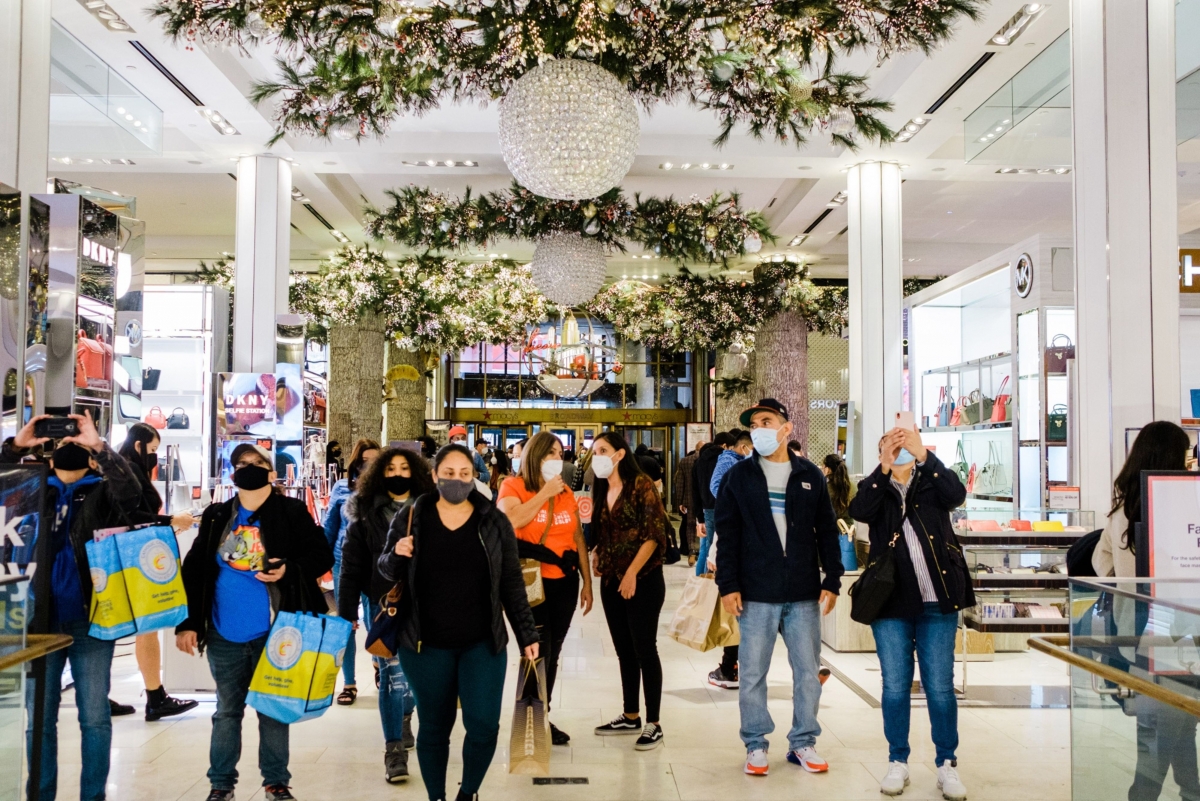
Shoppers walk through Macy's flagship store in New York, on Nov. 27. MUST CREDIT: Bloomberg photo by Gabriela Bhaskar.

Shoppers walk through Macy’s flagship store in New York, on Nov. 27. MUST CREDIT: Bloomberg photo by Gabriela Bhaskar.

Some shoppers hit the mall anyway. Even though many retailers took precautions – Walmart limited the number of customers inside its stores to just 20% of usual capacity, for example – there were still lines reported at stores across the U.S. including Lululemon Athletica, Bath & Body Works and Urban Outfitters on Black Friday. Gabriella Santaniello, founder of retail research firm A-Line Partners, said teenagers in particular went out to shop in person, though that may have been more for the social aspect after months cooped up inside.

“A lot of teens want to be at the mall to look at the merchandise, and look at each other,” she said in a phone interview.

Most in-person shoppers were in-and-out, with nearly everyone who showed up making a purchase, boosting what retail watchers call the “conversion rate.”

“They want to make each trip count; especially with covid, you don’t want to just go idly to a store or just do window shopping,” analyst Johnson said. “There are very few things that will stop American consumers from spending when they want to spend.”

The major general merchandise sellers like Amazon.com and Walmart are set to be the big winners this year with their strong e-commerce platforms and distribution networks. But even small businesses without the logistical muscle of their larger kin may prove surprisingly resilient.

They’ve coped by using social media and online shops to drive business. Black Friday sales shot up 75% to a record-setting $2.4 billion for the million or so independent businesses that use the e-commerce platform Shopify globally.

Small Business Saturday, a nationwide marketing campaign started by American Express in the wake of the 2009 financial crisis, helped draw shoppers into independent stores. Steering money to these shops has grown more urgent as pandemic-related shutdowns across the country pushed millions of small firms over the edge.

Consumers have gotten the message, said Rachel Lutz, owner of the Peacock Room, a women’s clothing boutique in Detroit. Sales at the Peacock Room and its sister store were about 20% better this past weekend than any previous year, with people snapping up self-care items such as tiaras, shea butter hand cream and “anything with a swear word on it,” she said.

“People are fiercely shopping local,” said Lutz. Though she hasn’t started an e-commerce site, she’s hosted shows on Facebook Live to display her wares.

The Detroit City Distillery is another brick-and-mortar business that’s been forced onto the internet to survive covid. The whiskey factory and cocktail lounge has supplemented a street-side bar with bottle releases online, and it’s doing more business because of it. It’s already sold over half the stock of its honey bourbon that went on sale on Black Friday, said Ian Redmond, the tasting room manager.

“We’re not going to stop doing it, I tell you that,” Redmond said in a phone interview Sunday. “We’re going to keep the online store going hard now and forever.”

Fed, Treasury emergency lending facilities divide lawmakers on state of the economic recovery #SootinClaimon.Com

#SootinClaimon.Com : ขอบคุณแหล่งข้อมูล : หนังสือพิมพ์ The Nation.

Fed, Treasury emergency lending facilities divide lawmakers on state of the economic recovery (nationthailand.com)

Fed, Treasury emergency lending facilities divide lawmakers on state of the economic recovery

InternationalDec 02. 2020

By The Washington Post · Rachel Siegel

WASHINGTON – Lawmakers debated the emergency lending facilities run by the Federal Reserve and Treasury Department at a Senate Banking Committee hearing Tuesday, revealing diverging opinions on the state of the recovery and how to keep it going.

Treasury Secretary Steven Mnuchin testified before the panel on Tuesday, giving a strong defense of his decision not to extend the programs beyond the end of the year. Mnuchin said the programs had done their jobs and that hundreds of billions of dollars put toward the facilities would be better spent elsewhere. Fed Chair Jerome Powell, meanwhile, said that “we would have left the facilities in place to be backstops” and continued to push for more help from Congress.

Support for the emergency lending facilities set up at the start of the pandemic has waned among Republicans who say it’s time to phase out the programs. By contrast, Democrats say cutting them off too soon jeopardizes the economic recovery.

Disputes around programs became especially charged last month when Mnuchin said he would not extend most of the programs beyond the end of the year. Mnuchin also requested that the Fed return hundreds of billions of dollars that had been put toward the facilities but never spent, saying the money could be reallocated by Congress to directly reach distressed parts of the economy.

The announcement spurred a rare public clash between Treasury and the Fed, which wanted the programs to stay in place to continue backstopping the markets in case the recovery faltered. Democrats and several economists condemned Mnuchin’s move saying it was premature to cut off the extra support. Biden’s transition team called the decision “deeply irresponsible.”

At the hearing, Mnuchin said his decision to end the programs at the end of the year reflects a legal interpretation of the Cares Act, adding the programs were never meant to be in place indefinitely. Despite the initial rebuke, the Fed has agreed to return the unused money and is in the process of doing so.

“My decision not to extend these facilities was not an economic decision,” Mnuchin said Tuesday. He also dismissed criticism from the left that the move was politically motivated.

Republicans on the banking panel echoed Mnuchin, saying financial markets have healed since a tailspin in February and March. Sen. Patrick Toomey, R-Pa., a top Republican on the panel, said the programs were designed for a specific purpose in the pandemic’s early days, and that they should not be thought of as an evergreen supplement to fiscal policy.

“It’s always been the case that you could imagine some bad thing happening in the future, if some terrible thing were to happen to threaten the viability of our financial markets,” Toomey said. “There are some industries that are in big trouble. That is a true fact…It’s up to Congress to decide what to do about that.”

The emergency programs that targeted small businesses and local governments have issued few loans, drawing criticism around those programs’ usefulness. Some economists have pushed the Fed and Treasury to loosen the lending terms and expand the programs’ reach. Fed officials have said the Main Street lending program, for example, could see more interest if businesses continue to struggle through the winter.

The programs only allow the Fed to lend money, with the expectation that those loans are repaid, while Congress can issue grants or direct payments through a stimulus package.

During the hearing, Senate Democrats said the programs should not be cut off.

Sen. Sherrod Brown, D-Ohio, the top Democrat on the panel, said Mnuchin was “trying to sabotage our economy on your way out the door.” Sen. Robert Menendez, D-N.J., told Mnuchin at the hearing that “no one will be better off when you end the Cares Act facilities.”

“There is a choice here, and unfortunately the choice you’re making is very consequential,” Menendez said.

The recovery picked up speed faster than many economists expected, with unemployment falling to 6.9 percent in October. But there are mounting fears that a wintertime surge in coronavirus cases, plus uncertainty around another stimulus package, will claw back that momentum. Powell said the pace of improvement has moderated over the past few months, with spending on services like travel and hospitality remaining low.

“We can both acknowledge the progress and point out just how far we have left to go. The lion’s share of the credit should go to fiscal policy,” Powell said Tuesday.

In the backdrop are ongoing questions of whether Congress and the White House will reach a deal on another stimulus package. Powell has long maintained that fiscal support will be needed to keep the recovery on track, and Mnuchin has called for a targeted relief bill to fill the economy’s lingering gaps.

Negotiations around another stimulus package have broken apart multiple times. On Tuesday, a bipartisan group of senators unveiled a roughly $908 billion stimulus proposal that includes $300 weekly unemployment benefit lasting four months as well as $160 billion in funding for state and local governments.

The package would also include a temporary moratorium on some coronavirus-related lawsuits against firms and other entities and funding for small businesses, schools, health care, transit authorities, and student loans. Still, much remained in flux, and many congressional aides were skeptical the plan will become law.

Asked at Tuesday’s hearing about the proposal, Mnuchin reiterated that more help from Congress was needed and said he looked forward to reviewing the pitch.

“I think what’s more important is what we can pass quickly on a bipartisan basis to target the most difficult parts of the economy,” Mnuchin said.

When it comes to the government’s economic response, Powell said there is less of a risk to “overdoing it” than there is to “underdoing it.” With encouraging news about a vaccine, Powell said that many businesses and households can “see the light at the end of the tunnel…but they may need more help to get to that place.”

“We can see the end. We just need to get there,” he said.

Biden’s economic team set to prepare ambitious recovery plan, challenging Republicans’ renewed debt worries #SootinClaimon.Com

#SootinClaimon.Com : ขอบคุณแหล่งข้อมูล : หนังสือพิมพ์ The Nation.

Biden’s economic team set to prepare ambitious recovery plan, challenging Republicans’ renewed debt worries (nationthailand.com)

Biden’s economic team set to prepare ambitious recovery plan, challenging Republicans’ renewed debt worries

InternationalDec 02. 2020Joe BidenJoe Biden 

By The Washington Post · David J. Lynch

President-elect Joe Biden’s choice of economic advisers highlights a commitment to spend whatever is needed to restore a full-employment economy, setting up a clash with Senate Republicans who are sounding alarms over a national debt they helped President Trump increase by nearly $7 trillion.

As the economic recovery shows signs of faltering amid rising coronavirus caseloads, even members of Biden’s economic team who have called rising government debt a problem support a generous new rescue package. Former Federal Reserve chair Janet Yellen, a deficit hawk Biden picked for treasury secretary, said earlier this year that the United States could afford new borrowing to help a wounded economy and would save money in the long run by preventing lasting damage to the labor market.

On Tuesday, as Biden introduced his economic brain trust in Wilmington, Del., Yellen labeled the pandemic recession “an American tragedy” and urged a swift response. “It’s essential that we move with urgency,” she said. “Inaction will produce a self-reinforcing downturn causing yet more devastation.”

The Biden team’s push for government borrowing to fill the pandemic-size hole in the economy also reflects a broader shift in some leading economists’ view of public debt. By cutting interest rates to near zero – and all but exhausting its conventional tool kit – the Federal Reserve has made such borrowing more attractive and left the nation’s fiscal authorities in Congress with a greater role in propping up the economy, they say.

But prominent Republican lawmakers are balking at Democrats’ $2 trillion proposal for additional pandemic relief, saying annual budget deficits that add to the government’s debt bulge must be trimmed.

At stake in the debate are the hopes of millions of jobless Americans for an early return to the workforce along with the economy’s long-term health, economists said. Failure to provide additional government stimulus would probably drag out the recovery, threaten more small businesses with closure and force state and local governments to proceed with major layoffs, economists said.

“We need a bridge to the vaccine, and fiscal stimulus can provide that bridge,” said Nathan Sheets, chief economist for PGIM Fixed Income. “Are there issues in the long term with the level of debt? Yes, but we need to make it through these short-term challenges with the economy intact.”

When the pandemic hit in March, Congress and the administration moved quickly to provide roughly $3 trillion to cushion the blow. But subsequent talks over additional money for extra unemployment benefits, small-business loans, and budget aid for state and local governments have run aground.

Prospects for resolving a months-long stalemate between the two parties may turn on the outcome of two Senate runoff elections in Georgia on Jan. 5. If Republicans win at least one of the two seats, as expected, they will retain control of the Senate, dimming hopes for an additional multitrillion-dollar measure.

“The politics of a divided Washington are going to make it very difficult to agree on much of anything,” said Eric Winograd, senior economist for fixed income at AllianceBernstein in New York. “Republicans in the Senate seemed reluctant to pass more stimulus when there was a Republican president. They are likely to be even more reluctant with a Democratic one.”

Indeed, Sen. Lindsey Graham, R-S.C., slated to chair the Senate Budget Committee if Republicans maintain control of the upper chamber, told reporters after the Nov. 3 election that he wants to “finally begin to address the debt.”

Likewise, Sen. John Thune of South Dakota, the No. 2 Senate Republican, said he expects to focus next year on curbing spending on entitlement programs, adding: “I think that’s kind of getting back to our DNA. … I think spending, entitlement reform, growth and the economy are all things that we’re going to have to be focused on.”

Top Democrats scoff at Republicans’ renewed debt fears after years of their support for Trump’s budget-busting policies. In 2017, for example, every Republican senator voted in favor of the president’s signature tax cut, which added $1.9 trillion to the debt, according to the nonpartisan Committee for a Responsible Federal Budget.

Government spending under Trump, who once crowned himself “the king of debt,” soared to $6.6 trillion in the fiscal year that ended Sept. 30 – up 71% from $3.8 trillion four years earlier, according to the Congressional Budget Office.

“It is hard to take the Republican senators seriously,” said William Spriggs, chief economist of the AFL-CIO labor union. “We still have very rough days ahead of us.”

While Democrats such as Sen. Elizabeth Warren, D-Mass., accuse Republicans of rediscovering their debt phobia only to impede Biden’s agenda, Senate Majority Leader Mitch McConnell, R-Ky., began flagging government debt as “a matter of genuine concern” in April.

Republicans back a $500 billion package targeted to small businesses and the jobless and resist a blank-check approach because the economy has healed faster than expected, said Brian Riedl, a senior fellow at the Manhattan Institute. The current 6.9% unemployment rate is well below the double-digit levels many Wall Street economists initially expected for the end of this year.

“An economy with unemployment below 7% requires a different solution than if unemployment stayed above 10%,” he said.

Biden this week filled out his economic team with experts who have called for rebuilding the economy first and dealing with deficit concerns later. Among them are all three members of his Council of Economic Advisers: Princeton University economist Cecilia Rouse, the incoming chair; Jared Bernstein, who advised Biden on economic policy during his vice presidency; and Heather Boushey, head of the Washington Center for Equitable Growth. Neera Tanden, president of the Center for American Progress who was nominated to head the Office of Management and Budget, also supports deferring deficit action.

While Republicans cite the economy’s progress in recent months, Democrats point to a mounting toll of hardship and loss. Existing federal programs, including extended unemployment benefits and a moratorium on evictions, are scheduled to expire at year end. Roughly 3.6 million Americans have been unemployed for more than six months, four times the number at the end of April.

“You’re going to get the recovery starting in April, May, whether or not we get this package,” said economist Adam Posen, head of the Peterson Institute for International Economics. “Whether we get stimulus in December or January is about how much human suffering there is between now and then.”

Democrats’ stimulus push is driven by lessons of the last financial crisis as well as subsequent shifts in the economic climate.

After Republicans took control of the House in 2010, they pressed President Barack Obama to accept spending limits that contributed to the weakest recovery since World War II. Leading Republicans at the time, including then-House Budget Committee Chairman Paul Ryan, warned of soaring inflation and a collapsing dollar if deficits weren’t quickly corralled.

“We’ve gone through this before,” said Sam Bell, policy director for Employ America, a left-leaning think tank. “We didn’t have spikes in interest rates. We didn’t have ruinous inflation. It’s hard to overstate how much the mainstream academic consensus has moved.”

On Tuesday, a pair of prominent Democratic economists – Lawrence Summers and Jason Furman – are scheduled to deliver a new paper that underscores that shift. The former Obama administration officials, appearing at a virtual Brookings Institution event, will argue that persistently low interest rates require a “revolution” in thinking about debts and deficits.

The implications for government tax and spending policies “are as profound as those that occurred in the wake of the inflation of the 1970s,” wrote Summers, a former treasury secretary, and Furman, who led Obama’s National Economic Council.

The government’s borrowing spree since the 2008 financial crisis has not had the effects – rising bond yields or higher inflation – that traditional economics would have predicted. Private businesses have not been “crowded out” of bond markets by government agencies or faced higher borrowing costs. Consumers expect inflation even a decade from now to be a tame 1.4%, according to the Federal Reserve Bank of Cleveland.

The $21.2 trillion national debt – up from $14.4 trillion on the day Trump was inaugurated – is now slightly larger than the U.S. economy, a nominal milestone that hasn’t been reached since World War II and yet seems to have little real-world impact.

Even the Federal Reserve, normally hypervigilant about potential inflation, has been outspoken in calling for lawmakers to support the economy. Last month, Fed Chair Jerome H. Powell reiterated that the economy requires more government spending to complete its recovery, saying the risk was that policymakers would provide too little help, not too much.

“The consensus view among many economists is that there are limits to how much debt you can take on. But where those limits are and when the constraints start to bite – that’s very much an open question,” Sheets said. “We don’t know for certain if the limit on debt is another 50% of GDP or another 300% of GDP.”

The Biden team will take office with the government able to borrow for 10 years at 0.8%, compared with roughly 4% in late 2008.

That explains why even as the federal government is expected to rack up an additional $10 trillion in debt from 2021 to 2028, Washington will pay less each year in interest charges than it paid in 2019, according to the CBO’s latest projections.

At the American Economic Association conference in January, Yellen pronounced the interest burden “manageable” and said low interest rates provided the government with greater fiscal firepower.

“Even under current conditions, I think we can afford to increase federal spending or cut taxes to stimulate the economy if there’s a downturn,” she said, adding that low rates also made “a strong case” for new spending on infrastructure, research, education and climate change mitigation, which could boost the economy’s long-term potential.

Yet, Yellen in recent years also has expressed the concern over government debt that worries liberals who fear it as a justification for cuts in Social Security or Medicare.

“The U.S. debt path is completely unsustainable under current tax and spending plans,” she said during a Feb. 4 Bipartisan Policy Center event.

As the U.S. population ages, Social Security and Medicare are expected to account for a larger share of government spending while tax revenue fails to keep pace. By 2040, rising borrowing costs and increased spending will drive accumulated debt to more than 140% of annual output. The government’s interest bill that year will be more than three times as large relative to the economy as it is today and five times as large by 2050.

And if interest rates on federal borrowing are just 1% higher each year than expected, interest charges would consume about four-fifths of all projected revenue that year, the CBO said.

“We are incredibly vulnerable to an increase in interest rates,” said Maya MacGuineas, president of the Committee for a Responsible Federal Budget.