Supreme Court rejects request to extend Wisconsin’s deadline for counting mail-in ballots #SootinClaimon.Com

#SootinClaimon.Com : ขอบคุณแหล่งข้อมูล : หนังสือพิมพ์ The Nation.

Supreme Court rejects request to extend Wisconsin’s deadline for counting mail-in ballots

InternationalOct 27. 2020
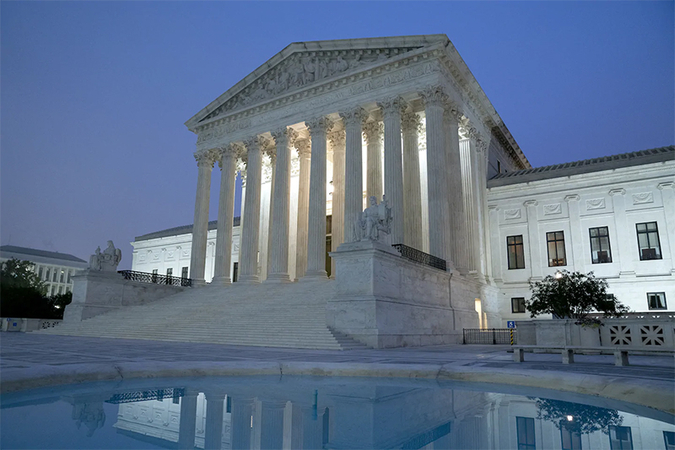
Lights illuminate the Supreme Court building in Washington last week. (Stefani Reynolds/ Bloomberg News)

Lights illuminate the Supreme Court building in Washington last week. (Stefani Reynolds/ Bloomberg News)

By The Washington Post
Robert Barnes

WASHINGTON – The Supreme Court on Monday night rejected a pandemic-related request from Democrats and civil rights groups to extend the deadline for counting mail-in ballots received after Election Day in the key battleground state of Wisconsin.

The vote was 5-3, with the Republican-nominated conservatives in the majority and the Democratic-nominated liberals in dissent. The court’s order showed the deep division within the court about the series of pandemic-related election cases that have come to dominate its agenda.

The court’s conservatives say they must defer to state officials on election decisions made in the largely Republican-run states, and the liberal justices say there is a need for dramatic action by judges to ensure the franchise for endangered voters during an unprecedented time.

“On the scales of both constitutional justice and electoral accuracy, protecting the right to vote in a health crisis outweighs conforming to a deadline created in safer days,” liberal Justice Elena Kagan wrote in dissent.

Conservative Justice Brett Kavanaugh answered that Kagan’s “green light to federal courts to rewrite dozens of state election laws around the country over the next two weeks seems to be rooted in a belief that federal judges know better than state legislators about how to run elections during a pandemic.”

The decision was a victory for Republicans and President Donald Trump in a state where he narrowly won in 2016 and polls show him behind this year. While Democrats have embraced mail-in voting, Trump has railed against it.

“The most powerful rebuke to Republican judicial activism is to defeat Trump and elect Joe Biden and Kamala Harris in a landslide,” Wisconsin Democratic Party Chairman Ben Wikler said in a statement after the Supreme Court’s ruling was announced. “The Democratic Party of Wisconsin will double down on making sure that every Wisconsin voter knows how to exercise their right to vote in the final eight days of this election.”

Wisconsin Republican Party Chairman Andrew Hitt said: “Democrats’ attempts to get the courts to rewrite Wisconsin’s election laws on the eve of an election have failed.”

The court in coming days will consider a similar issue in other battleground states. Republicans in North Carolina are challenging an extension for ballots postmarked before and on Election Day but received afterward. And the Pennsylvania GOP has again asked the court to overturn an extension granted there by the state Supreme Court.

The court just last week allowed that decision to stand on a 4-4 vote, with Chief Justice John Roberts siding with the liberals. But new Justice Amy Coney Barrett begins work Tuesday, and that could shift the court’s balance yet again.

In Wisconsin, a district judge had ruled with the plaintiffs, and extended by six days the deadline to receive ballots postmarked by Election Day. He accepted the argument that the coronavirus pandemic and the accompanying surge in mail voting demand changes to accommodate voters and ensure ballots are counted.

But the Republican National Committee, the Wisconsin Republican Party and the state’s majority-GOP legislature intervened to defend the existing deadline, and earlier this month a divided panel of the U.S. Court of Appeals for the 7th Circuit reinstated the requirement that mail ballots be returned by 8 p.m. on Election Day.

Judges Frank Easterbrook and Amy St. Eve – appointees of Presidents Ronald Reagan and Donald Trump, respectively – wrote that decisions about how to cope with the effects of the pandemic are “principally a task for the elected branches of government.”

Judge Ilana Diamond Rovner issued a sharp dissent, calling the situation facing Wisconsin voters “a travesty.”

“We cannot turn a blind eye to the present circumstances and treat this as an ordinary election,” wrote Rovner, an appointee of President George H.W. Bush. “Today, in the midst of a pandemic and significantly slowed mail delivery, this court leaves voters to their own devices. Good luck and G-d bless, Wisconsin. You are going to need it.”

The civil rights groups and Democrats say they were seeking only similar accommodations to those the Supreme Court approved in April during the state’s primary. Faced with a crush of requests for mail-in ballots the week before the primary, the court agreed that ballots postmarked by the primary date but received days afterward should be counted.

That action “resulted in approximately 80,000 ballots being counted that would have otherwise been rejected as untimely,” said a brief for the groups, which included Black Leaders Organizing for Communities.

The Supreme Court has been refereeing similar fights in emergency requests, and rarely explaining its decision-making. But the order in the Wisconsin case was different, with four justices writing.

Roberts was the justice in the middle.

He said that, in general, he opposed federal judges intervening in the “thick of election season to enjoin enforcement of a State’s laws.” But the Pennsylvania case involved the authority of state courts to interpret their own constitutions.

“Different bodies of law and different precedents govern these two situations and require, in these particular circumstances, that we allow the modification of election rules in Pennsylvania but not Wisconsin,” he wrote.

Kavanaugh and Justice Neil Gorsuch opposed the extensions in both cases. Both said that it is up to state legislatures to make decisions, not courts.

“It’s indisputable that Wisconsin has made considerable efforts to accommodate early voting and respond to COVID,” wrote Justice Neil Gorsuch, referring to the disease caused by the novel coronavirus. “The district court’s only possible complaint is that the state hasn’t done enough. But how much is enough? . . . The Constitution provides that state legislatures – not federal judges, not state judges, not state governors, not other state officials – bear primary responsibility for setting election rules.”

Kavanaugh agreed with Wisconsin officials that they had already done plenty to make voting easier during the pandemic, with early voting and fewer restrictions on absentee voting.

“The Wisconsin Elections Commission has mailed 1,706,771 absentee ballots to Wisconsin voters. And it has already received back from voters 1,344,535 completed absentee ballots,” he wrote. “As those statistics suggest, the dissent’s charge that Wisconsin has disenfranchised absentee voters is not tenable.”

He added: “Wisconsin’s deadline is the same as that in 30 other States and is a reasonable deadline given all the circumstances.”

The other justices in the majority, Clarence Thomas and Samuel Alito, did not state the reasons for their votes.

Kagan, joined by Justices Stephen Breyer and Sonia Sotomayor, said it was unreasonable for the court not to extend the same extension it granted during Wisconsin’s April primary.

“Because of the court’s ruling, state officials counted 80,000 ballots – about five percent of the total cast – that were postmarked by Election Day but would have been discarded for arriving a few days later,” she wrote.

“Today, millions of Wisconsin citizens are preparing to vote in the November election. But COVID is not over. In Wisconsin, the pandemic is much worse – more than 20 times worse, by one measure – than it was in the spring.”

She said the state legislature has “not for a moment” considered whether new accommodations are needed to ensure voters can cast ballots safely, and that the majority did not dispute the lower court’s finding that as many as 100,000 ballots might arrive too late to be counted.

Kagan said that the court’s usual reason for not agreeing to election changes is that it could confuse voters. But she said that could not be the case here.

“To the contrary, it would prevent the state from throwing away the votes of people actively participating in the democratic process,” she wrote. “And what will undermine the ‘integrity’ of that process is not the counting but instead the discarding of timely cast ballots that, because of pandemic conditions, arrive a bit after Election Day.”

– – –

The Washington Post’s Elise Viebeck and Rosalind S. Helderman contributed to this report.
Trump plans to remove Sudan from terror list #SootinClaimon.Com

#SootinClaimon.Com : ขอบคุณแหล่งข้อมูล : หนังสือพิมพ์ The Nation.

Trump plans to remove Sudan from terror list

InternationalOct 27. 2020

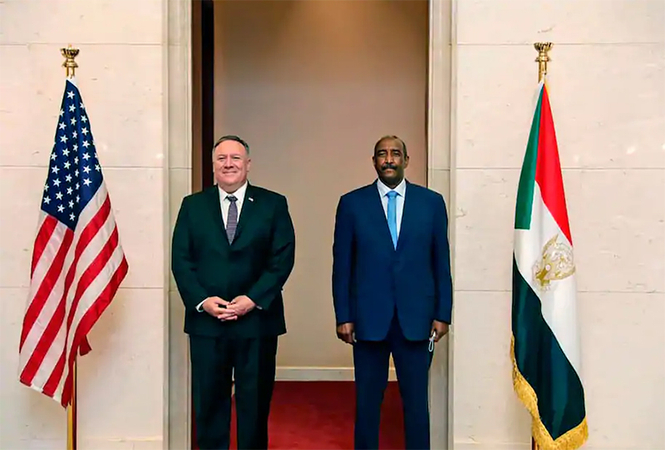
Secretary of State Mike Pompeo, left, stands with Sudanese Gen. Abdel-Fattah al-Burhan, head of the transitional military government, in Khartoum on Aug.
25. (Sudanese Cabinet/ AP)

Secretary of State Mike Pompeo, left, stands with Sudanese Gen. Abdel-Fattah al-Burhan, head of the transitional military government, in Khartoum on Aug. 25. (Sudanese Cabinet/ AP)

By The Washington Post
John Hudson, Max Bearak

WASHINGTON – President Donald Trump announced Monday his intention to remove Sudan from a list of state sponsors of terrorism in a pre-election gambit that U.S. officials expect will lead to the country’s recognition of Israel and payment of millions of dollars to the families of terrorism victims.

“GREAT news! New government of Sudan, which is making great progress, agreed to pay $335 MILLION to U.S. terror victims and families,” Trump said in a tweet as he traveled to Arizona for a campaign event. “Once deposited, I will lift Sudan from the State Sponsors of Terrorism list.”

In a response to the tweet, Sudanese Prime Minister Abdalla Hamdok thanked Trump and underscored that the designation had caused serious “harm” to Sudan.

Removing Sudan from the list is expected to provide a significant economic boost to the country. Since 1993, the designation has barred the government from international dollar transactions and thwarted investments in the country and its ability to pay off interest-laden loans totaling tens of billions of dollars.

The expected move comes as Sudan faces chronic food and gasoline shortages, but it also carries risks for the fledging government in Khartoum.

The deal nearly faltered in the past several weeks as Sudanese officials feared that a rushed recognition of Israel, without a large-enough economic relief package to sweeten the deal, could turn popular support against Sudan’s precarious, unelected transitional government, which took power after the country’s longtime autocratic ruler was overthrown last year.

As a result, the Monday announcement did not include any mention of Israel, which is unpopular in Sudan.

“At long last, JUSTICE for the American people and BIG step for Sudan!” Trump tweeted.

The president added that for the agreement to take place, Sudan would need to deposit the funds first.

Officials expect Sudanese officials to announce the recognition of Israel at a later date.

Still, analysts described it as a watershed moment for a fragile government seeking to overcome its pariah status.

“This announcement has both huge symbolic and practical meaning to Sudan,” said Cameron Hudson, a senior fellow at the Atlantic Council and former chief of staff to the State Department’s special envoy to Sudan. “Practically, it removes a stigma that has deterred outside investment. It also frees up the international financial institutions and other commercial banks to reenter the country. This will move Sudan away from cash-based financing and through more diverse and reputable banking partners in the U.S. and Europe.”

Some in Congress have worried that a deal would jeopardize compensation funds for the families of American victims of the terrorist attacks targeting the U.S. embassies in Kenya and Tanzania in 1998 and the USS Cole Navy destroyer in 2000. The victims’ families are seeking a $335 million settlement from Sudan because of its role in harboring the men who carried out the plots.

Democrats in Congress are holding up legislation that would restore Sudan’s sovereign immunity, the legal doctrine that makes governments immune to civil suits or criminal prosecution. Sudan lost that immunity when it was put on the U.S. terrorism-sponsor list.

The delisting comes at a crucial moment of economic vulnerability for Sudan. Inflation has risen past 200%, and basic items including wheat and gas are in short supply. In some cases, lines at food stores and gas stations stretch for miles. Meanwhile, the worst flooding in a century has left more than half a million people homeless and destroyed a season of harvest. Pandemic-related border closures have dramatically reduced exports and driven up unemployment.

Much of Sudan’s hinterland remains in low-level conflict, suppressing regional economies, and the country has still barely recovered from the economic shock of South Sudan’s secession in 2011, which caused a sudden decline in oil revenue for the government in Khartoum.

Economic troubles, and bread lines in particular, served as the spark for street protests that swept Sudan in early 2019 and precipitated the military’s ouster of Omar al-Bashir, an autocrat who had led the country for 30 years and stands accused of war crimes and genocide by the International Criminal Court in addition to claims by his critics of ruinous economic mismanagement. (ICC representatives were in Sudan this week to discuss the possibility of trying Bashir without removing him from prison in Khartoum.)

Sudan’s prime minister, formerly an economist and now head of a transitional civilian government that shares power with a council of generals, had been pushing through economic reforms. Last month, the International Monetary Fund announced a key step forward in that process: a year-long monitoring program that, once complete, could couple with the terrorism delisting as the basis for clearing all of Sudan’s arrears to international lending institutions if the country’s reforms were found to be sincere and fully implemented.

“Sudan’s external debt is high and with long-standing arrears which severely limit access to external borrowing,” Antoinette Sayeh, deputy managing director and acting chair of the IMF’s executive board, said in a statement. “A strong track record of macroeconomic performance and implementation of reforms, together with a comprehensive strategy of arrears clearance and debt relief supported by Sudan’s development partners, is required for addressing Sudan’s high debt overhang.”

The upcoming rapprochement with Israel represents a major reversal from the Bashir era. For decades, Sudan was one of Israel’s staunchest opponents, and Bashir offered funding and arms to the Palestine Liberation Organization, Hamas and Hezbollah – part of the United States’ reasoning for designating Sudan as a state sponsor of terrorism. Sudan also harbored Osama bin Laden until 1996, though it denies any role in the Sept. 11 attacks. Many Sudanese say that now that Bashir has been removed from office, their country should already have been taken off the terrorism list.

While both governments have sought to portray the two issues as separate, the normalization of ties with Israel had not been part of Hamdok’s plan until American negotiators introduced it as part of a delisting deal. The issue remains hugely contentious in Sudan, where pro-Palestinian sentiment is strong, and groups from across the political spectrum have expressed displeasure, if not anger, with the unelected transitional government for allowing it into the delisting process.

For that reason, some analysts criticized the Trump administration effort as self-serving and potentially reckless.

“Washington should already have delivered the kind of political and economic relief necessary for Sudan’s make-or-break transition to succeed,” said Zach Vertin, a nonresident fellow at the Brookings Institution. “Instead, the Trump administration held out, extorting a fragile democracy in the service of its own domestic political ends.”

[Bangladesh] Vaccine for all, free of cost #SootinClaimon.Com

#SootinClaimon.Com : ขอบคุณแหล่งข้อมูล : หนังสือพิมพ์ The Nation.

[Bangladesh] Vaccine for all, free of cost

InternationalOct 27. 2020

By Rejaul Karim Byron and Wasim Bin Habib
The Daily Star/ANN

Govt decides to make coronavirus vaccines available for all citizens once those are procured.

The government has decided to administer Covid-19 vaccines to all the citizens free of cost once those are procured.

As per the decision at a high-level meeting recently, the government will purchase vaccines as soon as those are out in the market and administer those to all like it does under the existing immunisation programmes, said finance ministry officials.

The finance ministry has already sought $2 billion in financial assistance from four development partners to purchase, store, transport and administer the vaccines.

It has written to the World Bank, the Asian Development Bank, the Asian Infrastructure Investment Bank, and the Japan International Cooperation Agency, seeking from them $500 million each. 

In the letters to the multilateral lenders, the ministry said the government decided to procure and administer the vaccines at its own cost.

It also mentioned that large-scale commercial production of the vaccine is expected by the end of this year.

“In this context, a major initiative is afoot to import vaccines to Bangladesh in order to make the vaccines available for all the citizens,” the ministry wrote.

Seeking anonymity, a top official of the finance ministry, told The Daily Star, “We have already sent letters to the development partners, seeking $2 billion in financial assistance. We are still not sure how much we will get. Whatever amount we get, the rest will be managed from government funds.”

A special allocation of Tk 12,000 crore was made in this year’s budget for procuring medical supplies for emergency response to Covid-19, the official mentioned.

Once procured, the vaccines will be administered to people as it’s done under the existing vaccination programmes to prevent diseases like measles, polio and diphtheria, the official added.

Finance ministry officials said a rough estimate shows that Bangladesh will require $1.65 billion to $2 billion to bring its population of 165 million under the Covid-19 vaccination coverage. Each person is likely to need two shots which may cost $10-12.

They further said the government is asking for low-interest soft loans from the development partners.

Contacted, Md Abdul Mannan, secretary at the Health Services Division of the health ministry, said, “The vaccines should be given to all free of cost.”

He, however, said those would be given as per the government’s policy guidelines which are yet to be finalised.

At a virtual meeting with the WB vice president for the South Asia region on Thursday, Finance Minister AHM Mustafa Kamal urged the global lender to take necessary steps to expedite the disbursement of assistance on the basis of population.

“Bangladesh ranks third among the International Development Association (IDA) countries in terms of population,” the minister noted.

The coronavirus pandemic is taking a heavy toll on human lives and businesses across the globe. Rapid access to vaccine doses can bring outbreaks under control and also help avert economic shocks that may send more people back into poverty.

The World Health Organization has said that a vaccine against the novel coronavirus will be ready for registration by the end of this year or early next year at the earliest.

Vaccines typically require years of research and testing before reaching clinics, but scientists are racing to produce a safe and effective coronavirus vaccine by next year.

The first vaccine safety trial for humans began in March and six vaccine candidates have so far been approved for limited use. At least 12 more have reached the final stages of testing as of October 24, according to the New York Times Coronavirus Vaccine Tracker.

Though the government has not made a deal with any country to get a Covid-19 vaccine at the early stage, health ministry officials insist that they are in talks with the makers of five front-running vaccine candidates.

On September 26, Prime Minister Sheikh Hasina asked the world community to treat the Covid-19 vaccine as a “global public good” and urged the United Nations to ensure its timely availability to all countries at the same time.

Bangladesh also could get 20 percent of the vaccines it needs from the WHO and the Global Alliance for Vaccines and Immunisation under the COVAX Facility, a mechanism designed to guarantee rapid, fair and equitable access to Covid-19 vaccines worldwide.

COVAX currently covers nine vaccine candidates, and its aim is to secure supply and delivery of two billion shots by the end of 2021 to over 170 countries that have signed up for vaccines.

Asia’s largest single data center opens in Shanxi #SootinClaimon.Com

#SootinClaimon.Com : ขอบคุณแหล่งข้อมูล : หนังสือพิมพ์ The Nation.

Asia’s largest single data center opens in Shanxi

InternationalOct 27. 2020Zhang Jifu (right), secretary of the Datong Municipal Committee of the Communist Party of China, congratulates the opening of the largest single data center in Asia on Oct 25, 2020. [Photo provided to China Daily]Zhang Jifu (right), secretary of the Datong Municipal Committee of the Communist Party of China, congratulates the opening of the largest single data center in Asia on Oct 25, 2020. [Photo provided to China Daily] 

By ZHENG YIRAN
China Daily/ANN

The largest single data center in Asia, located in Datong, North China’s Shanxi province, went into operation on Sunday, marking China’s latest achievement in information technology.

The center, built by Chindata Group, supports artificial intelligence-based computing power basic services. It is based in Chindata’s energy data industrial base in Datong, namely Taihang Mountain Energy and Information Technology Industrial Campus of the Pan-Beijing Area, and has an IT volume of 50 megawatts – Asia’s highest level for a single data center.

Zhang Jifu, secretary of the Datong municipal Committee of the Communist Party of China, said: “The opening of the data center is of great importance to boosting Datong’s energy information technology development. Chindata’s energy data industrial base, where the data center is based, is a strategic project in Datong. Currently, the industrial base is taking shape. It is injecting strong impetus to the city’s development of new infrastructure, new technology, new material and new equipment.”

“The company should seize opportunities to make full use of the integration of data center and renewable energy, to turn Datong’s advantage in energy to the advantage in strategic newly emerged industries,” he added.

On the same day, Chindata and the Datong government signed an investment agreement of another data center in Chindata’s energy data industrial base. With a total investment of 15 billion yuan ($2.2 billion), the next-generation hyperscale data center, which covers 500 mu (33.3 hectares), will be further expanded, to support the tremendous computing power demand in AI, automatic drive and quantum communication.

Chindata’s energy data industrial base in Datong was established in 2018. According to the company, the planning area of the industrial base is 2,500 mu, and there are a total of seven phases of the construction project. The first and second phases of the project were put into operation in 2019. The third and fourth phases will come into service by the end of this year.

The company said when the seven phases are all put into operation, the industrial base in Datong, together with the company’s hyperscale data zones in Beijing and Hebei, will form an integrated data aggregation. The aggregation will effectively meet the digital demands from Beijing and Tianjin as well as the Xiong’an New Area in Hebei province.

Under late tycoon’s 27-year leadership, Samsung market cap grew 350 times #SootinClaimon.Com

#SootinClaimon.Com : ขอบคุณแหล่งข้อมูล : หนังสือพิมพ์ The Nation.

Under late tycoon’s 27-year leadership, Samsung market cap grew 350 times

InternationalOct 27. 2020The photo shows late Samsung Group Chairman Lee Kun-hee shaking hands with Samsung Electronics` employees in 2011. (Samsung Group)The photo shows late Samsung Group Chairman Lee Kun-hee shaking hands with Samsung Electronics` employees in 2011. (Samsung Group) 

By Kim Young-won
The Korea Herald/ANN

Death of Samsung chairman likely to have limited impact on Samsung stocks, analysts say.

The market capitalization of Samsung Group under the late Chairman Lee Kun-hee’s leadership of 27 years grew nearly 350 times, as the corporate empire he built turned into a global information technology powerhouse from a mere home appliance maker.

The combined market value of the conglomerate’s affiliates — including crown jewel Samsung Electronics and construction firm Samsung C&T — reached 318.7 trillion won ($282.4 billion) in 2014, when the late chairman had a heart attack and became incapacitated. That figure was 348 times higher than Samsung’s 1987 market value, which stood at 900 billion won. Lee took the chairmanship from his father, Samsung founder Lee Byung-chull, that year.

As Samsung’s stock value surged over the years, the value of Lee’s personal ownership in Samsung affiliates also grew dramatically, making the second-generation chaebol scion South Korea’s richest man. As of Friday, Lee held 18.22 trillion won in Samsung stocks, according to the Korea Exchange.

The death of Samsung’s leader will likely have a limited impact on the stocks of Samsung subsidiaries and affiliates, according to some market analysts, since the group has long prepared for the leadership transition.

“Since Lee’s son and Vice Chairman Jae-yong has been at the helm of Samsung Electronics for years, the tech giant’s stock price will less likely be affected by the passing of the chairman,” said Kim Ji-san, an analyst from Kiwoom Securities.

Inheritance taxes, involving the late chairman’s shares in companies that include Samsung Life Insurance, Samsung C&T and Samsung Electronics, could become a critical issue down the road, according to other analysts.

“The conglomerate has not yet announced measures to solve the inheritance issues, but many eyes will be on how the vice chairman prepares for money to pay for inheritance tax,” said Kim Yang-jae, an analyst at KTB Investment & Securities.

It is estimated that the bereaved family members will have to pay more than 10 trillion won in inheritance taxes.

Lee Jae-yong was the second-richest man in Korea as of last week, with the value of his stocks in Samsung affiliates reaching 7.2 trillion won.

The Samsung Group chairman died in a hospital in Seoul on Sunday at age 78, having been bedridden since his heart attack in 2014.

Based on a survey by Forbes earlier this year, the Samsung chairman was one of the 100 richest people in the world and his assets were worth $20.9 billion.

S. Korea’s economy returns to growth in Q3 as pandemic-caused trade slump eases #SootinClaimon.Com

#SootinClaimon.Com : ขอบคุณแหล่งข้อมูล : หนังสือพิมพ์ The Nation.

S. Korea’s economy returns to growth in Q3 as pandemic-caused trade slump eases

InternationalOct 27. 2020(Yonhap)(Yonhap) 

By The Korea Herald/ANN

South Korea’s economy returned to modest growth in the third quarter, marking the first quarterly expansion since the coronavirus pandemic began, as exports showed signs of improvement, the Bank of Korea (BOK) said Tuesday.

In the July-September period, the nation’s real gross domestic product (GDP) grew 1.9 percent from the previous quarter, when it shrank 3.2 percent, according to the BOK data.

The third-quarter reading marked the fastest expansion since the first quarter of 2010.

Compared with a year ago, however, the economy, Asia’s fourth largest, contracted 1.3 percent, the BOK said.

In August, the BOK expected South Korea’s economy to contract 1.3 percent this year.

If the nation meets the target, the economy should grow around 1.5 percent in the third and fourth quarters.

Park Yang-su, head of the BOK’s economic statistics department, told a media briefing that the nation could meet this year’s growth target, as the third-quarter results were better than expected.

Also, the economy could contract less than predicted this year if it expands by at least 0.4 percent in the fourth quarter, Park said.

However, the pace of recovery may be moderate for the trade-driven economy because new waves of coronavirus infections recently gripped the United States and European nations, Park said.

“Given the risk factors, annual growth rates are still in the range of previous projections,” Park said. 

Shortly after the data was released, Finance Minister Hong Nam-ki said the nation’s economy is on the road to recovery, helped by robust growth in exports.

“The economy entered a recovery path for normalization of the economy,” Hong told a policy meeting.

The economy is also expected to report an expansion in the fourth quarter, as advanced nations eased restrictions against the pandemic, Hong said.

Hong said the government will take measures to boost local consumption in the fourth quarter.

During the third quarter, exports grew by 15.6 percent, as overseas shipments of automobiles and semiconductors expanded, the BOK said.

Although the pandemic-caused trade slump eased as advanced nations lifted lockdown measures, domestic spending was still weak because of a resurgence of the new coronavirus in mid-August.

Last month, South Korea saw exports rebound for the first time in seven months as major trade partners gradually resumed their business activities amid the pandemic.

Outbound shipments came to $48 billion last month, up 7.7 percent from $44.6 billion posted a year earlier.

Facility investment rose 6.7 percent on-quarter in the third quarter, the BOK said.

Private spending edged down 0.1 percent in the quarter, while government spending inched up 0.1 percent.

The government has so far boosted its budget spending by at least 67 trillion won ($59.3 billion) with four batches of supplementary budgets to boost the virus-hit economy.

By sector, output by the manufacturing industry gained 7.6 percent on-quarter in the third quarter, a turnaround from a 8.9 percent plunge in the second quarter.

Output by the construction sector dipped 5.5 percent in the third quarter, while that of the service sector grew 0.7 percent. (Yonhap)

AirAsia’s regional passenger volume takes off again #SootinClaimon.Com

#SootinClaimon.Com : ขอบคุณแหล่งข้อมูล : หนังสือพิมพ์ The Nation.

AirAsia’s regional passenger volume takes off again

InternationalOct 27. 2020Consolidated aircraft operating certificate recorded 1.91 million passengers from July to September, representing a load factor of 66% compared with 204,082 passengers for the second quarter from April to June, which was a load factor of 59%.Consolidated aircraft operating certificate recorded 1.91 million passengers from July to September, representing a load factor of 66% compared with 204,082 passengers for the second quarter from April to June, which was a load factor of 59%. 

By The Star/ANN

PETALING JAYA: AirAsia Group Bhd maintained its recovery momentum into the third quarter of 2020 with almost a 10-fold increase quarter-on-quarter (q-o-q) in its passenger volume for Malaysia, Indonesia and the Philippines.

Its consolidated aircraft operating certificate recorded 1.91 million passengers from July to September, representing a load factor of 66% compared with 204,082 passengers for the second quarter from April to June, which was a load factor of 59%.

In a year-on-year (y-o-y) comparison, however, the low-cost airline’s number of passengers carried for the quarter was 85% lower, compared with 12.84 million passengers in the same period last year, according to its preliminary operating statistics released yesterday.

Of the 1.91 million passengers, AirAsia Malaysia carried 1.77 million, with a load factor of 68%.

It operated 52% of its domestic capacity in September, in comparison to 40% in July 2020 as travel demand has been on an upward trajectory since the second quarter with the easing of restrictions on interstate travel.

The group said AirAsia Malaysia was striving to recover to 60% of its pre-Covid domestic capacity by the fourth quarter.

AirAsia Indonesia’s 73,905 passengers were only 4% of the quarterly total but it was already an improvement of 18 times q-o-q.

AirAsia Philippines operated only 5% of last year’s capacity in the third quarter, but passenger numbers more than doubled q-o-q to 67,880.

Meanwhile, AirAsia Thailand posted a strong rebound, operating 96% of its pre-Covid domestic capacity, as compared to 59% in July 2020.

It carried 1.86 million passengers during the quarter, with a load factor of 65%. AirAsia India carried 590,873 passengers, equalling 25% of last year’s passengers in the third quarter.

It operated 36% of its capacity with a 62% load factor.

AirAsia said the improvements highlighted a strong upward rebound trend for air travel demand across key markets for the group.

Suga vows zero greenhouse gas emissions by 2050 in 1st policy speech #SootinClaimon.Com

#SootinClaimon.Com : ขอบคุณแหล่งข้อมูล : หนังสือพิมพ์ The Nation.

Suga vows zero greenhouse gas emissions by 2050 in 1st policy speech

InternationalOct 27. 2020Prime Minister Yoshihide Suga delivers his first policy speech at a House of Representatives plenary session in the Diet on Monday. (The Yomiuri Shimbun)Prime Minister Yoshihide Suga delivers his first policy speech at a House of Representatives plenary session in the Diet on Monday. (The Yomiuri Shimbun) 
By The Japan News/ANN

Prime Minister Yoshihide Suga delivered his first policy speech since taking office at plenary sessions of both Diet chambers on Monday, saying Japan will aim to reduce its greenhouse gas emissions to net zero by 2050 and realize a “green society.”

Suga also expressed his willingness to resume social and economic activities while preventing the resurgence of the novel coronavirus. He stressed that the government will aim to kickstart an economic recovery by appropriately implementing “Go To” stimulus measures, while securing the ability of local medical institutions to conduct an average of 200,000 coronavirus tests a day.

“I intend to take necessary measures without hesitation while paying attention to the impact of the novel coronavirus on the economy and economic trends in Japan and abroad,” Suga said.

The prime minister said his administration will carry on the Abenomics policy package launched by his predecessor Shinzo Abe, declaring that a virtuous cycle between the economy and the environment would be a pillar of his growth strategy.

He also unveiled a plan to create a new forum for national and local discussions to decarbonize society, while at the same time promoting nuclear energy policy to maintain a stable energy supply, with the highest priority on safety.

“I declare that our country will aim to realize a carbon-neutral society by 2050 by reducing greenhouse gas emissions to zero by 2050,” the prime minister said.

“Measures to cope with global warming no longer restrict the economy,” he added. “We need a shift in thinking that carrying out measures against global warming actively will bring about changes in industrial structures and economic and social systems and result in major growth.”

Suga also mentioned the establishment of a “digital agency” to digitize administrative procedures, insurance coverage for infertility treatment and the reduction of mobile phone fees, all of which are among his key policies.

To make Japan an international financial center, the prime minister announced plans to swiftly study ways to provide administrative services in English and ease visa requirements, among other measures.

“As the Cabinet working for the people, I’ll work to build a new era by realizing reforms,” Suga said.

Meanwhile, Suga called on the ruling and opposition parties to present their proposals for constitutional amendment at both Diet chambers’ commissions on the Constitution and hold constructive discussions. He expressed hopes that such discussions would lead to a national debate.

As for the Tokyo Olympics and Paralympics that have been postponed to next summer, Suga expressed his determination to hold the Games safely.

On foreign policy, Suga said the issue of the abduction of Japanese nationals by North Korea will remain at the top of his agenda. He expressed his determination to face Kim Jong Un, the chairman of the Workers’ Party of Korea, directly without attaching any conditions to achieve the return of the abductees.

Suga called South Korea an “extremely important neighboring country.” Toward restoring a strong bilateral relationship, he said his administration will maintain its stance and urge Seoul to make “appropriate responses.”

The extraordinary Diet session is scheduled to last for 41 days through Dec. 5.

The opposition camp is expected to challenge the prime minister over his rejection of six candidates for the Science Council of Japan.

ANA plans to transfer employees to Toyota Motor #SootinClaimon.Com

#SootinClaimon.Com : ขอบคุณแหล่งข้อมูล : หนังสือพิมพ์ The Nation.

ANA plans to transfer employees to Toyota Motor

InternationalOct 26. 2020

By The Japan News

ANA Holdings will ask several companies, including Toyota Motor Corp., to accept the secondment of employees, it has been learned.

The contents of a business restructuring plan, set to be announced Tuesday by ANA Holdings Inc., the holding company of All Nippon Airways Co. (ANA), have been revealed. By fiscal 2022, it plans to reduce the number of its employees by about 3,500.

The company faces an urgent need to cut personnel costs, which account for 30% of its fixed costs. At the same time, it must also secure employees in anticipation of the end of the novel coronavirus pandemic. ANA Holdings is believed to have concluded that Toyota Motor is able to accept secondment because of its financial scale and its capacity to take in employees.

For the 2020 fiscal year ending in March 2021, ANA Holdings is expected to post a record net loss of about ¥500 billion, as opposed to a net profit of ¥27.6 billion in the previous fiscal year. The company will carry out structural reforms to prepare for a prolonged slump in aviation demand.

In fiscal 2021, the company expects to cut costs by ¥80 billion through measures such as reducing the number of employees and selling aircraft.

The reduction of about 3,500 jobs will be realized through natural retirement, support for job changes and a freeze on hiring. According to the securities report of ANA Holdings, the entire group employed 46,000 people as of the end of March.

The company also plans to sell about 30 aircraft, mainly large models. As many as 59 large aircraft, such as the Boeing 777, have low fuel efficiency and are expensive to maintain.

ANA Holdings also plans to speed up the creation of other revenue sources. It plans to expand its so-called platform business to provide financial services by using customer data collected through its travel and financial operations.

Regarding international flights, which have seen a sharp drop in passengers, the company plans to prioritize resuming flights to and from Haneda Airport, due to high profit margins and high demand for international flights there.

Some flights from Narita Airport to Europe and Asia will be suspended for the time being.

Domestic flights will be concentrated at Haneda and Itami airports. ANA Holdings will also use Peach Aviation Ltd., a low-cost carrier under its wing, to promote joint operations with ANA.

China to share Mekong data with MRC countries #SootinClaimon.Com

#SootinClaimon.Com : ขอบคุณแหล่งข้อมูล : หนังสือพิมพ์ The Nation.

China to share Mekong data with MRC countries

InternationalOct 26. 2020China's Ministry of Water Resources signed an agreement with the Mekong River Commission (MRC) on October 22. MRC
China’s Ministry of Water Resources signed an agreement with the Mekong River Commission (MRC) on October 22. MRC 

By Phnom Penh Post

China’s Ministry of Water Resources signed an agreement with the Mekong River Commission (MRC) on October 22 which stated China would share more hydrological data with Mekong countries to ensure they can prepare for potential floods and droughts.

In an MRC press release, the commission’s secretariat CEO An Pich Hatda said infrastructure operations in the basin and tributaries were contributing to river flow changes and fluctuations which can impact communities on the river. More operational data sharing would be vital to better managing the river.

“The increased regulation of the basin and the opportunities and challenges it brings calls for greater data and information sharing, improved water release notifications, coordination of operations, and enhanced early warning systems,” Pich Hatda said.

The MRC said China has shared its water level and rainfall data from June to October during the rainy season for the last 18 years. The information the country shared was recorded at two hydrological stations located on the Upper Mekong at Yunjinghong and on a tributary at Manan, both in China’s Yunnan province.

Under the new agreement, China will extend its current data-sharing schedule to provide year-round data from the two stations. The data will be shared twice daily and include rainfall and river level data, the MRC said.

“China has also agreed to share urgent information on any unusual rise or fall in water levels and discharges, as well as other relevant information on factors that might lead to sudden flooding in the lower reaches of the basin,” the press release said.

The MRC said it had worked with China since 1996 on a number of collaborative initiatives, including annual meetings, data and information sharing, joint symposiums and technical exchanges on water resource development, environmental protection and hydropower development.

Mak Bunthoeun, a coordinator of River Coalition Cambodia at the NGO Forum on Cambodia, said the sharing of this data was one of the goals that the Mekong countries had been trying to achieve.

He said the Mekong countries tried to make it compulsory for China to share the information, rather than sharing it upon request.

“This is good news because we need transparent information about the water flow from upstream. This can avoid suspicion on China. Recently, a US-based organisation said China hid information and stored water upstream.

“They did not let the water flow, which meant countries downstream lacked water. This cooperation will clear this suspicion,” he said.