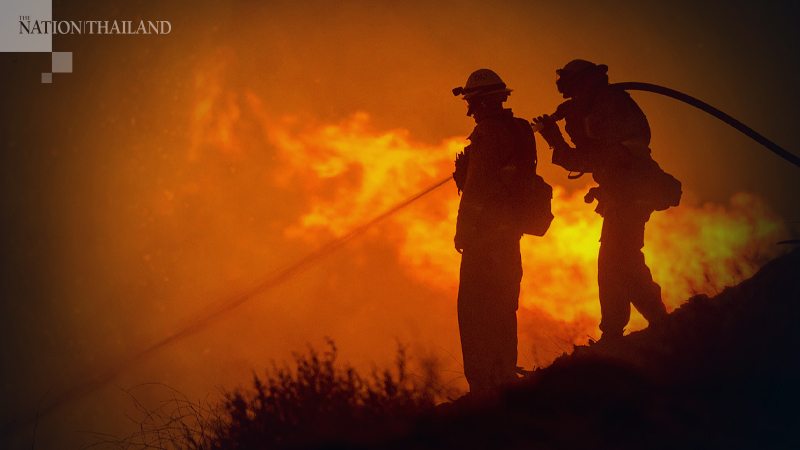
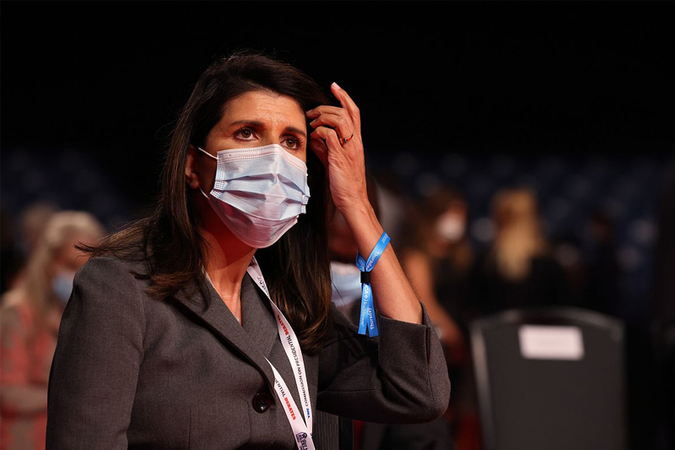
Former South Carolina Governor and former Ambassador to United Nations Nikki Haley. (Photo: Justin Sullivan/Getty Images/AFP)
By The Statesman
Ms Haley, who went on to become one of the most successful US Ambassador to the UN, is now campaigning in support of Trump’s re-election bid.
Popular Indian-American Republican politician Nikki Haley has revealed that Donald Trump, soon after winning the November 2016 US presidential election, had offered her the position of Secretary of State which she politely refused.
However, the 48-year-old Haley, who at that time was the South Carolina Governor, said she could not refuse the second offer of the post of US Ambassador to the United Nations as Trump had met all the conditions she had set for accepting the position.
Ms Haley, who went on to become one of the most successful US Ambassador to the UN, is now campaigning in support of Trump’s re-election bid.
“There is a stark contrast” between President Trump and his Democratic challenger Joe Biden, she said at a fireside chat event organised by the Indian Voices for Trump in the battleground state of Philadelphia on Saturday.
“There is a lot at stake with this election,” she said.
Responding to a question from Dr Merlynn Carson, co-chair of Indian Voices for Trump, Ms Haley, for the first time, revealed that Trump, soon after winning the November 2016 presidential elections, offered her the position of Secretary of State. Trump sent a plane to fly her to New York.
However, Ms Haley said, she politely refused the offer, noting that she was not the right fit for the post as she had no experience.
Days later, after she returned from New York, Trump through his chief of staff offered her the position of US Ambassador to the United Nations.
Responding to the offer, she set three conditions — the position should be of Cabinet rank, the envoy should be a member of the national security council and that she will not be a yes-woman, Haley said.
To all the conditions, Trump”s response was: “Done. What next?”, leaving her with no option but to accept the position, she recalled.
Haley has been one of the most successful US Ambassadors to the UN, a position in which she served for nearly two years.
Ms Haley said Trump has stopped giving aids to countries like Pakistan, which harbour terrorists.
“The relationship (of US) with India (under Trump administration) has never been stronger,” she said, adding that President Trump and Prime Minister Narendra Modi get along very well.
Under Trump administration, the US is partnering with India on various issues, including defence, Haley said.
In the aftermath of the coronavirus, there is a far greater need to collaborate between India and the US, she said, referring to the increased co-operation between India and US along with Japan and Australia.
China, she said, is the number one national security threat to the US.
President Trump has “put China on notice,” Haley told the audience.
Trump is “not very much a politician”, “what you see, what he is,” she said when asked about the president. She referred to a conversation that she had with Trump, before he was scheduled a deliver an address at the United Nations and asked her opinion on calling the North Korean leader as the “Rocket Man”.
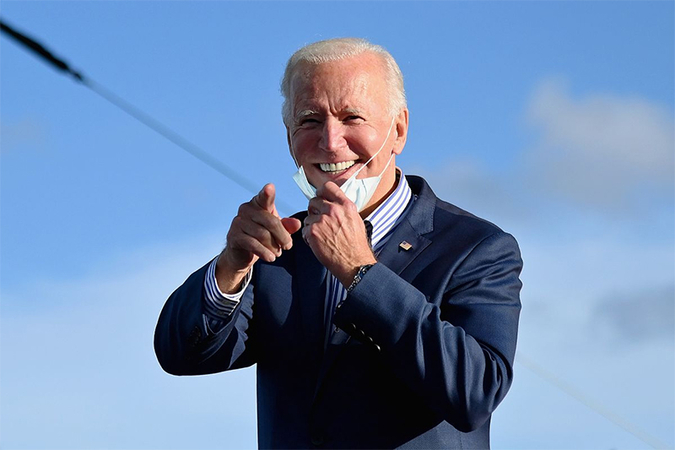
Democratic presidential candidate Joe Biden. (Photo by Angela Weiss / AFP)
By The Statesman
‘Kamala Harris and I deeply value our partnership-and will put respect back at the center of our foreign policy,’ he said.
US President Donald Trump’s opponent Joe Biden launched a scathing attack on him for his “filthy” remark for India over the climate situation.
Biden said that it was not the way how you talk about “friends”.
In a tweet, Biden said, “President Trump called India “filthy.” It’s not how you talk about friends-and it’s not how you solve global challenges like climate change.”
“@KamalaHarris and I deeply value our partnership-and will put respect back at the center of our foreign policy,” he further added.
President Trump called India “filthy.”
It’s not how you talk about friends—and it’s not how you solve global challenges like climate change.@KamalaHarris and I deeply value our partnership—and will put respect back at the center of our foreign policy. https://t.co/TKcyZiNwY6— Joe Biden (@JoeBiden) October 24, 2020
US President Donald Trump on Friday had described the air in India as “filthy” and shifts the climate change blame to India along with China and Russia.
Trump’s remarks come at a time when he was explaining his move to withdrew from the Paris climate accord. He had said that the move would have made America a non-competitive nation.
“Look at China, how filthy it is. Look at Russia. Look at India. The air is filthy. I walked out of the Paris Accord as we had to take out trillions of dollars and we were treated very unfairly,” he said during a debate with Democratic White House challenger Joe Biden.
The relations between US and India have been strengthening in last few months as the Quadrilateral grouping of US, Japan, India and Australia are sending their warships for the Malabar Exercise next month.
Quadrilateral grouping, which experts say is to be mirroring NATO, has already been criticized by China many times.
In another major development in direction of strengthening the ties, New Delhi and Washington are also stepping up efforts to conclude the Basic Exchange and Cooperation Agreement (BECA) ahead of the Indo-US 2+2 ministerial meeting on October 26-27.
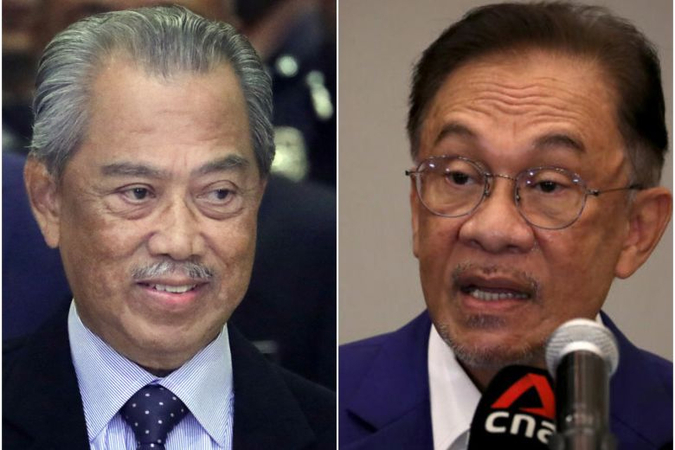
Opposition leader Anwar Ibrahim (right) could finally prove that he has the majority support over PM Muhyiddin Yassin.PHOTOS: REUTERS
By Straits Times
Malaysia’s King surprisingly rejected a controversial plan proposed by Prime Minister Muhyiddin Yassin to impose emergency measures on the country, after discussing the matter with other state monarchs on Sunday (Oct 25).
With the royal decree, Mr Muhyiddin’s embattled leadership now faces the prospect of defeat when Parliament reconvenes on Nov 2.
Here is how the power play could pan out:
1. Minority government
Tan Sri Muhyiddin Yassin can still soldier on with a doubtful majority if he can strike confidence and supply agreements with his political rivals.
Some opposition figures – including Senator Liew Chin Tong from the Democratic Action Party and MP Syed Saddiq Syed Abdul Rahman from the Malaysian United Democratic Alliance – have mooted the idea of supporting the government on some issues – for example, to pass the Budget and its expenditure to tackle the Covid-19 pandemic – as long as their views are taken into account.
“This is a set of legitimate open deals, without having to resort to buying off individual MPs,” said Mr Liew.
Referring to bipartisan support for a constitutional amendment to lower Malaysia’s voting age to 18, Mr Syed Saddiq said he worked on the proposal with rival politicians to further “the national agenda”.
“We did it before, we can do it again for Malaysia,” he said.
2. New prime minister
Opposition leader Anwar Ibrahim could finally prove that he has the majority support that he claims to command and take over as prime minister in a peaceful transition, without having to call a general election.
Datuk Seri Anwar’s Pakatan Harapan coalition has 91 MPs, and he has said he has the backing of over 120 lawmakers.
Speculation was rife that the additional numbers would come from Mr Muhyiddin’s current ally Umno, which has 39 MPs.
Mr Anwar’s appointment will still need to get the blessing of the King. The opposition leader has said that he presented documents in support of his claim during his audience with the King on Oct 13, although the palace said Mr Anwar did not provide it with a list of names.
Other prime ministerial candidates who have been floated include Umno veteran Tengku Razaleigh Hamzah, Datuk Seri Shafie Apdal and Tun Dr Mahathir Mohamad.
If Mr Muhyiddin loses the Budget vote, there will be calls for Parliament to be dissolved and for voters to go back to the ballot box.
Politicians from both sides of the divide, as well as the public, have aired their objections to holding polls, after several new coronavirus clusters emerged from the state election in Sabah last month.
The emergency measures were proposed in part to avoid this scenario and allow government spending on Covid-19 measures to continue.
The King, who in his statement yesterday stressed that lawmakers should stop politicking and that the Budget was crucial in combating the pandemic, could yet be implored again to reconsider an emergency declaration if a general election during the pandemic is on the cards.
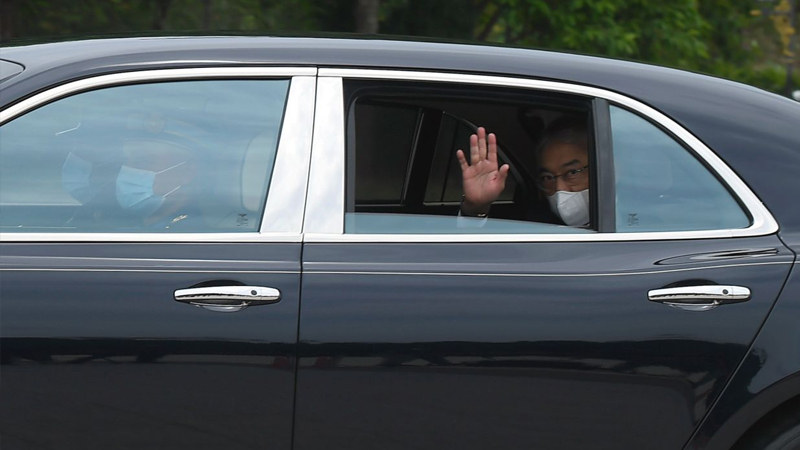
PETALING JAYA: Yang di-Pertuan Agong Al-Sultan Abdullah Ri’ayatuddin Al-Mustafa Billah Shah has decided that there is no need for a proclamation of an Emergency in the country at this point of time.
Comptroller of the Royal Household of Istana Negara Datuk Ahmad Fadil Shamsuddin said that Sultan Abdullah also reminded all politicians to immediately stop all forms of politicking that could disrupt the stability of the country’s administration.
“Sultan Abdullah is of the opinion that there was no need for Members of Parliament to continue with their irresponsible actions that could disrupt the stability of the existing Comptroller, ” he said in a statement yesterday.
Ahmad Fadil said that after Sultan Abdullah and the Malay rulers had gone through a proposal by the government to declare a state of emergency, the King felt that the government had successfully contained the pandemic well and effectively.
He said the Prime Minister Tan Sri Muhyiddin Yassin on Friday requested the proclamation of Emergency under Article 150(1) and proclamation of Emergency (Essential Powers 2020) Ordinance pursuant to Article 150 (2B) of the Federal Constitution to combat the threat of the Covid-19 pandemic in the country.
“The King strongly believes in the ability of the government under the leadership of the Prime Minister to continue implementing policies and enforcement to curb the Covid-19 pandemic from spreading, ” he said.
Ahmad Fadil added that the Ruler stressed that the 2021 Budget to be tabled in Parliament was very important to the people in combating Covid-19 and restoring the nation’s economy.
“As such, the financial allocation is much needed by the frontliners to ensure the smoothness of their job and responsibilities, ” he said, adding that the King was very concerned about the people’s worry due to the emergence of several new Covid-19 clusters and the spike in daily positive cases.
Ahmad Fadil said that the King urged everyone, regardless of their background and their political leanings, to set aside all their differences to unite and play their respective roles in helping the government and the authorities to curb the spread of the disease.
The Malay Rulers had, at around 2.30pm yesterday, held a special meeting at Istana Negara in Kuala Lumpur to discuss the government’s plan to declare a state of emergency to tackle the worsening Covid-19 situation.
On Friday, the Prime Minister and several ministers presented the King with the Emergency plan at Istana Abdul Aziz Indera Mahkota in Kuantan.
They were accompanied by the Inspector-General of Police Tan Sri Abdul Hamid Bador, Attorney-General Tan Sri Idrus Harun and Health Ministry director-general Tan Sri Dr Noor Hisham Abdullah.
Commerce chief: New initiatives to revive HK tourism sector
InternationalOct 25. 2020A woman poses for photos in from of Victoria Harbour while attending the opening ceremony of Hong Kong Wine and Dine Festival at Central Harbourfront, Hong Kong, Jan 4, 2019. Photo Credit: China Daily
By China Daily
HONG KONG – In launching new tourism initiatives, the Hong Kong government shows its determination in overcoming the difficulties brought about by the epidemic, said the city’s commerce chief.
Secretary for Commerce and Economic Development Edward Yau Tang-wah made the remarks on Friday after attending a press conference of the 2020 Wine and Dine Festival. The exemption for licensed travel agents to organize local group tours of not more than 30 people under the group gathering restrictions also came into effect on Friday.
We cannot have a total lockdown. It will bring a detrimental effect to the economy both locally and globally. But at the same time, we cannot open our gate indiscriminately.
Edward Yau, Secretary for Commerce and Economic Development, HKSAR govt
He expected this year’s Wine and Dine Festival will reach out to more people as it will be conducted in a hybrid online and offline mode.
He said the launch of the festival amid the epidemic this year would be a good demonstration that Hong Kong can retain this brand name, “Wine and Dine – Best in Hong Kong”, Tang said.
On easing restrictions on local tours, he said the government aimed to strike a balance for all.
“As regards the local tourism arrangement, we are finding all ways and means to bring back the space and opportunity for business to resume under the premise of safe and healthy arrangements, as well as to allow some normalcy in business,” Tang said.
“We cannot have a total lockdown. It will bring a detrimental effect to the economy both locally and globally. But at the same time, we cannot open our gate indiscriminately.”
In addition to the local tour arrangement, Hong Kong has reached an agreement with Singapore to establish a travel bubble with a view to reviving air travel between the two places in a safe and progressive way.
“We emphasize a very strong COVID-19 polymerase chain reaction test to be conducted before and after departure. In place of that, we hope that we can do away with the more restrictive quarantine arrangements, allowing people to have more freedom in going around the city in a safe manner,” Tang said.
He added that in launching the new initiatives, the government shows Hong Kong’s determination in overcoming the difficulties brought about by the epidemic.
“We will build on these travel bubbles, local tour exemptions and events like this (2020 Wine & Dine Festival) to demonstrate to the world that if there is a will, there is a way,” he said.
“In that regard, we need cooperation from both people in the trade, like the travel trade as well as the public who will continue to observe social distancing and maintain public health.”
The US said it welcomes increased Indian involvement in Southeast Asia including its military presence in the South China Sea.
A day after the US President Donald Trump’s “filthy” remark on India accusing it to be a major contributor in air pollution, the country delivers a friendly statement by saying that it is watching the India-China standoff in Ladakh closely
The US is sharing information with New Delhi and wants to ensure the situation does not escalate, senior officials of the Trump administration said on Saturday.
The US said it welcomes increased Indian involvement in Southeast Asia including its military presence in the South China Sea and has been working with like-minded partners to counter “China’s aggressive behaviour” from the Himalayas to the disputed oceanic region.
‘We have had an ongoing dialogue with the Indians about the increased cooperation in Southeast Asia, not just the South China Sea. And we encourage their involvement and that cuts across development investments, that cuts across security cooperation and that also involves presence and so, we welcome greater Indian participation across Southeast Asia in all three of those areas,” US officials said in an online news briefing.
“Given China’s increasingly aggressive behaviour across the Indo-Pacific from the Himalayas to the South China Sea, it is more important than ever that we work with like-minded partners such as India. We were pleased to see India’s recent announcement regarding Australia joining the Malabar Naval exercise,” they said.
Trump’s remarks had come at a time when he was explaining his move to withdrew from the Paris climate accord. He had said that the move would have made America a non-competitive nation.
“Look at China, how filthy it is. Look at Russia. Look at India. The air is filthy. I walked out of the Paris Accord as we had to take out trillions of dollars and we were treated very unfairly,” he said during a debate with Democratic White House challenger Joe Biden.
The relations between US and India have been strengthening in last few months as the Quadrilateral grouping of US, Japan, India and Australia are sending their warships for the Malabar Exercise next month.
Quadrilateral grouping, which experts say is to be mirroring NATO, has already been criticized by China many times.
In another major development in direction of strengthening the ties, New Delhi and Washington are also stepping up efforts to conclude the Basic Exchange and Cooperation Agreement (BECA) ahead of the Indo-US 2+2 ministerial meeting on October 26-27.
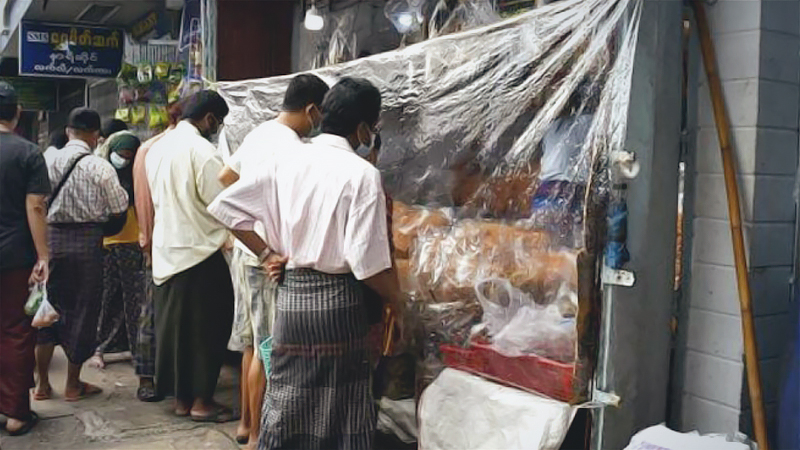
Yangon Region is currently seeing clusters of Covid-19 cases in monasteries, homes for the aged and factories, said Dr Than Naing Soe, spokesperson of the Ministry of Health and Sports.
“Each and every number has their background history. Looking back to the number of cases, we have found clusters. Speaking epidemiologically, it is a cluster. As we have found clusters here and there, the World Health Organization has recognized that our country is seeing clusters of cases rather than seeing cases across the country. We conduct contact tracing. If we found a confirmed case, we traced contacts with that patient. Then we found many contacts. There were about 30 or 40. In some cluster cases, there were up to 70 or 80 contacts,” Dr Than Naing Soe said.
More than half of the number of Covid-19 cases are contact persons, and Yangon has around 40,000 people in quarantine including overseas returnees, according to the Yangon Region Public Health Department.
“Reviewing positive cases, we came to know the point. First, it is markets. We have found many infections coming from markets. Second is monasteries and third is places like homes for the aged. By nature, those places have clusters of people living together. People from those places need to take care of themselves and follow the prevention guidelines,” the spokesperson commented.
Lower House MP Dr Saw Naing from South Oakkalapa Township said 14 monks and three laypersons from Ngwekyaryan Pariyatti Monastery in the township had tested positive for Covid-19.
“Eighty monks and 25 laypersons from the monastery had Covid tests under the arrangement of the township health department. Then, 14 monks and 3 laypersons were infected,” the parliamentarian said.
Recently also, over 300 student monks from a monastery in Insein Township tested positive for the coronavirus. They have now reportedly recovered from the illness.
Labor union plans more protests against omnibus Indonesian law, to prepare legal challenge
InternationalOct 25. 2020Dissent: Workers rally in opposition to the Job Creation Law in Jakarta on Oct. 16, part of a series of protests that began after the House of Representatives and the government enacted the law on Oct. 5. Critics say the law favors investors at the expense of workers and the environment. (JP/Wendra Ajistyatama)
By The Jakarta Post
The Confederation of Indonesian Trade Unions (KSPI) is planning to stage more protests against the recently passed Job Creation Law, or omnibus law, throughout November if President Joko “Jokowi” Widodo decides to sign the law.
KSPI chairman Said Iqbal said on Saturday that members of the union, which are estimated to exceed 800,000 across the nation, would hit the streets on Nov. 1 if President Jokowi decided to sign the law on Oct. 28.
The House of Representatives passed the bill on Oct. 5, giving the President 30 days until at least Nov. 5 to give his approval. The State Palace said on Friday that the State Secretariat had completed the review on the law and it was ready to be signed by Jokowi.
Said added that the union would also file a judicial review against the omnibus law to the Constitutional Court should the President went on to sign the law.
“We will [focus] our protests on the State Palace and the Constitutional Court building [in Central Jakarta], and at the same time, submit a petition for a judicial review,” he said during a press briefing on Saturday.
“[We will continue] our protests until we win and the Constitutional Court issues its ruling,” Said went on to say.
The KSPI will also urge the House to conduct a legislative review on the recently passed law by sending letters to every party faction at the legislative body. The union pinned its hopes on the Democratic Party and the Prosperous Justice Party (PKS) to initiate the review during the House’s plenary meeting on Nov. 9, according to Said.
The two parties opposed the bill in a House plenary session on Oct. 5. The former walked out of the session after engaging in a verbal squabble with House leadership.
The PKS, however, seems pessimistic about the prospects of a legislative review because of its lengthy process.
In order to increase pressure on the House, KSPI members will stage protests on Nov. 9 at the Senayan Parliament Complex in Jakarta as well as in 10 other provinces.
According to the KSPI, several provisions in the Job Creation Law pertaining to labor issues were problematic. They argued that the new regulation, among other issues, removed the previously regulated maximum term for contract-based employment of five years, diminishing hopes for contract workers to be promoted as permanent employees.
Officials stress security of election systems after U.S. reveals new Iranian and Russian operations
InternationalOct 25. 2020Deputy clerk Rachel Quayle tests a voter assist terminal device at a polling station inside Marquette City Hall in Michigan on Tuesday. MUST CREDIT: Washington Post photo by Salwan Georges
By The Washington Post · Amy Gardner, Isaac Stanley-Becker, Elise Viebeck · NATIONAL, POLITICS
WASHINGTON – State and local officials hastened to reassure Americans this week that the nation’s election systems are secure after the country’s top intelligence official accused Iran of sending threatening emails to voters in several states and the United States said Russia obtained voter information from at least one county.
U.S. officials and cybersecurity experts said the activity did not appear to include penetration of voting systems or access to voter registration databases, or the hacking of equipment that could be tampered with to alter election results.
“Arizona’s voter registration database remains secure,” said Murphy Hebert, a spokeswoman for the secretary of state’s office in Arizona, one of the states where Democratic voters reported receiving the threatening emails. “Some information in the voter record is publicly available in Arizona through a public record request, including party registration and, up until recently, emails. We are vigilantly monitoring all election systems.”
Federal and state officials said they have fortified election systems since 2016, when Russian hackers scanned election-related websites and software nationwide for vulnerabilities.
Multiple investigations found that no votes or voting machines were compromised by the Russians four years ago, and election administrators said that even more safeguards are in place now to prevent such an occurrence.
In addition, the threat has further declined this year with the surge of mail voting brought on by the coronavirus pandemic, because the vast majority of Americans are expected to cast paper ballots, which are harder to tamper with and easier to audit and recount, cybersecurity experts said.
Some experts and security advocates, however, said measures implemented since 2016 are insufficient and point to lingering risks such as poorly secured voting equipment and, in some states, the reporting of results from precincts and counties over phone lines. Congressional Democrats have called for hundreds of millions of dollars more for election security, but Senate Republicans have refused.
Election officials also worry that the recent interference by Iran and Russia could create a perception that U.S. elections are not secure, shaking the public’s faith in the outcome, even though no voting systems have been compromised.
In recent days, officials have sought to dispel that notion by publicly detailing descriptions of how votes are counted, how registration lists are maintained, and how federal, state and local officials are on constant alert for attempted intrusions.
“There are groups that are trying to confuse and mislead voters, to sow doubt about the process, and we all have a duty to check our facts,” Meagan Wolf, the Wisconsin elections chief, said during a virtual news conference Thursday.
Fake, menacing emails claiming to be from the Proud Boys, a far-right group in support of President Donald Trump, reached hundreds of Democrats this week, with the bulk of the reports concentrated in Florida and Alaska. They instructed voters to cast their ballots for Trump or “we will come after you.”
U.S. officials quickly attributed the activity to Iran, saying the messages were part of a bid to shake confidence in American democracy, while a spokesman for the Iranian mission to the United Nations called the U.S. allegations “malign and dangerous.”
Jennifer Edwards, supervisor of elections in Collier County, Fla., said her office received about 100 reports from voters about the threatening emails starting Tuesday afternoon, prompting her to contact the FBI. But she emphasized that the senders “did not get into any of our systems.”
“We have done everything that we’ve been advised to do to protect our security infrastructure” since 2016, Edwards said, adding that the Department of Homeland Security as well as state officials have helped inspect the county’s technology.
In addition, federal security officials warned this week that a Russian hacking group known as Berserk Bear, which works for the KGB successor agency FSB, compromised the networks of two U.S. counties. One county was in California and one in Indiana, officials told The Washington Post.
At the same time, federal law enforcement officials urged state and local officials to remain vigilant to the risk of real data breaches.
“We have multiple state and federal partners monitoring our website and all of the voting systems on a routine basis,” said Patrick Gannon, spokesman for the State Board of Elections in North Carolina.
The activity by Iran and Russia pales in comparison with 2016, when Russia spectacularly hacked and leaked Democratic emails, disrupting the party’s national convention and Hillary Clinton’s presidential campaign, and mounted an ambitious effort on social media to try to stoke discord in the United States. In this year’s campaign, major technology companies say they have stopped similar activity emanating from Russia and other countries before the efforts gained significant traction.
The Senate Intelligence Committee concluded last year that Russia probably targeted election systems in all 50 states in 2016, identifying malicious activity more extensive than officials originally acknowledged. The closest hackers came in many states, investigators found, was in probing voter registration databases.
For instance, the FBI investigated a hack of the Illinois Board of Elections in which up to 200,000 personal voter records were compromised, as well as an instance in which a credible threat prompted the Arizona Department of Administration to take its statewide voter registration system offline.
Also in 2016, Logan Lamb, a security researcher in Georgia, claimed to have conducted a so-called do-gooder hack, identifying a vulnerability that enabled him to download the state’s entire voter database and potentially alter registration information. Lamb said in an interview this week that the specific server he identified has since been taken offline.
Intelligence officials and security experts remain concerned that the Kremlin poses the greatest threat of election interference this year, and they fear that Moscow may still try to pull off a surprise.
A breach of voter databases could sow significant chaos, said Theodore Allen, an associate professor of integrated systems engineering at Ohio State University. Changing registration details could throw hurdles in front of certain voters, possibly forcing them to cast provisional ballots.
Still, safeguards are in place to ensure that such ballots are ultimately counted, he said, a point stressed by U.S. officials, who sought to reassure the public that the Nov. 3 vote will not been compromised.
“We’ve been working for years as a community to build resilience in our election infrastructure – and today that infrastructure remains resilient,” FBI Director Christopher A. Wray said at a news conference on Wednesday evening announcing Iran’s and Russia’s activity. “You should be confident that your vote counts. Early, unverified claims to the contrary should be viewed with a healthy dose of skepticism.”
Election administrators also emphasized the many layers of security in place to prevent the ultimate breach of an election system – an attempt to tamper with results.
In North Carolina, all voters will cast ballots on paper, and those ballots will be fed into scanners that are not connected to the Internet, Gannon said.
Once polls are closed on Election Day, memory cards in the scanners are physically transported to county election headquarters, where tabulation results are uploaded to a computer that is also not connected to the Internet. The results are then transferred to another memory card, and uploaded to a different computer that is connected to the county and state systems.
In addition, voting machines and scanners are tested ahead of the election to make sure they have been programmed to record voters’ choices correctly, he said. Poll books used to check voters in at polling locations are not connected to the Internet while in use.
Vote tallies will be audited after the election in several ways, Gannon said. For instance, the number of voters who check into a particular voting location will be matched against the number of votes tallied at that location. In addition, election officials in every county must hand-count the ballots in two randomly selected precincts to ensure that vote totals match the tabulation results from the digital scanners. Any irregularities would prompt an investigation and a delay in election certification.
Similar procedures are in place in Georgia, said Gabriel Sterling, the statewide voting system implementation manager for the Georgia secretary of state’s office. Unofficial results are compiled at counties’ election headquarters and then sent to the state’s election night reporting – via Internet connection – but official results are hand-delivered in a padlocked bag via a memory card that has never been connected to the Internet, he said. “We have chain of custody on all this stuff,” he said.
Experts say that the biggest vulnerability lies in paperless voting machines, which are used in a handful of states. Jurisdictions that use hand-marked paper ballots have the greatest level of protection against malicious activity, said David Jefferson, a computer scientist at the Lawrence Livermore National Laboratory and a board chairman for Verified Voting.
“Wherever there are machines in the system, we worry about the software, even if it’s not hooked up to the Internet during the election,” he said, noting that some states, including South Carolina, have shunned paper ballots in favor of voting machines.
Some government websites that display public information lack sufficient security, some experts say.
For instance, recent research by McAfee, a cybersecurity company, found that “significant majorities” of county government websites use web addresses that do not use the “.gov” domain-naming system, which adds an extra layer of protection against efforts to trick voters into visiting inauthentic sites.
In addition, at least nine states, including battleground Michigan, do not conduct post-election audits, according to the National Conference of State Legislatures.
“Unfortunately, we did not adopt much-needed minimum election safeguards nationwide following the revelations of 2016,” said Susan Greenhalgh, a senior adviser on election security for Free Speech for People, a nonprofit organization that advocates against special interests in politics and has been critical of the voting-machine industry. “Significant gaps remain in the security of our election infrastructure, largely because many election officials may not have a clear understanding of the inherent security risks of the technology and the threats we face.”
An additional factor this year is the diversion of millions of federal dollars directed to states to shore up election security. With the onset of the coronavirus pandemic, the U.S. Election Assistance Commission (EAC) authorized states to spend some of that money on measures meant to prevent the spread of the virus, such as protective equipment and sanitizing supplies.
It’s not known how much of the $800 million in election-security funding was diverted to coronavirus protections, said Benjamin Hovland, a member of the EAC.
Election officials as well as cybersecurity experts said the greater risk this year is disinformation involving claims of a hack, rather than a hack itself. “Telling people votes can be hacked is a disinformation tactic we saw from the Russians in 2016 and feeds into its own type of election hack,” said Maggie MacAlpine, co-founder of Nordic Innovation Labs, a cybersecurity consultancy.
Although one in five voters in 2016 used paperless machines to cast their ballots, Larry Norden, director of the Election Reform Program at the Brennan Center for Justice, estimated that 96 percent of people this year will use paper ballots, whether by mail or in person.
Online systems for registering to vote, as well as requesting and tracking mail ballots, also give voters a chance to monitor their own records. And election officials are creating more regular offline backups of voter registration data and public information websites, he said.
“There may well be more intense efforts over the next couple of weeks to push disinformation, to sow doubt about the system,” Norden said. “My best advice to the public and to voters is to tune it out.”
Joanna Lydgate, the national director of the Voter Protection Program, said during an online panel discussion on Thursday: “We want to be really clear that voting is safe. It’s secure. Your vote is private. No one, not even election officials, can see who you vote for. And the best way to defeat misinformation like this is to vote.”
By The Washington Post · Andrew Freedman · NATIONAL, SCIENCE-ENVIRONMENT
Colorado’s East Troublesome Fire, the second-largest fire in state history, is roaring amid high winds Saturday through timber stands and rugged terrain in Rocky Mountain National Park, threatening the community of Estes Park to the east. The fire has killed two, with the confirmation that an elderly couple was killed while trying to ride out the blaze at their home near Grand Lake.
The fate of Estes Park is now a race between fire and ice, as a snowstorm is due to hit Saturday night and last into Sunday, and is likely to halt the fire’s spread. In anticipation of continued fire growth before then, however, eastern areas of Estes Park have been added to mandatory evacuation orders – the western side of town had been evacuated Thursday – and firefighters were taking steps to defend the town.
Some reports show the fire may have moved significantly closer to Estes Park overnight – perhaps as close as one mile, with firefighters calling in more resources Saturday. In a morning video briefing Saturday, Paul Delmerico, operations section chief on the fire, said the fire is “just west” of the Bear Lake area in Estes Park.
The high winds are preventing fire suppression aircraft from flying, and firefighters are using satellite imagery to locate the blaze. He cited “Very dynamic extreme conditions that we’re working with” as a reason for concern.
“We’ve got a heck of a day ahead of us,” Delmerico said. “We’re going to do everything we can with our folks to try to deflect the fire from Estes Park.”
Winds in Estes Park on Saturday morning were gusting to about 50 mph out of the west, with temperatures that are expected to climb into the 60s with extremely low relative humidity. Even stronger winds are in the vicinity of the fire at higher altitudes.
Red flag warnings are in effect for the Rockies as low humidity combines with high winds to create “critical” fire weather, the second-most severe category on the fire risk scale. The Cameron Peak blaze, located just a few miles from the East Troublesome fire and the state’s largest on record, is also expanding Saturday, satellite heat detections show. There is even a possibility the two fires could merge before the cold front settles the blazes Saturday night.
At higher elevations where the fire is especially active, snowfall amounts later this weekend are forecast to exceed a foot, which will lead to the odd juxtaposition of a flame-filled surface and snow-covered trees and ground areas.
“Imagine a foot of snow over those hot fires!” wrote the National Weather Service forecast office in Denver in a forecast discussion posted Saturday morning. By Monday, temperatures in the fire area are expected to be in the single digits to below zero Fahrenheit, though it’s not clear if this will be enough to completely extinguish the blaze.
The dual threats from fire and snow point to the rarity of high altitude blazes at this time of year in Colorado, when winter typically settles in. No fire on record in Colorado that has started this late in the season has become nearly as large, putting the blaze in uncharted territory and showing all the signs of climate change.
The fire has been so severe it jumped the continental divide, a span of two miles that contains mainly rocky terrain. The fire grew an astonishing 140,000 acres in size between Wednesday afternoon and Thursday.
According to Nick Nauslar, a predictive services meteorologist with the National Interagency Fire Center (NIFC) in Boise, Idaho, having a wildfire jump the divide has happened in other fires before but is an extremely rare occurrence.
The fire is largely burning at an elevation of 9,000 feet at a time of year when snow should be falling. The fire is raging during a severe drought, aggravated by record heat, through stands of trees killed or weakened by a years of a bark beetle infestation. The harmful beetles are a phenomena linked to climate change that is occurring across vast stretches of the West and into Canada.
As temperatures have increased in Colorado, it has given once-scarce pests, formerly held in check by extremely cold winter temperatures, an opportunity to spread and damage or destroy trees. Studies have shown that in some ecosystems, these dead or weakened trees can accelerate blazes, while in others they may actually slow down some wildfires.
In 2020, the Colorado fire season has been especially severe and has stretched longer than in modern memory. The three largest fires on record in Colorado have all occurred this year, with the top two, East Troublesome and the Cameron Peak Fire, still burning.

 A woman poses for photos in from of Victoria Harbour while attending the opening ceremony of Hong Kong Wine and Dine Festival at Central Harbourfront, Hong Kong, Jan 4, 2019. Photo Credit: China Daily
 Dissent: Workers rally in opposition to the Job Creation Law in Jakarta on Oct. 16, part of a series of protests that began after the House of Representatives and the government enacted the law on Oct. 5. Critics say the law favors investors at the expense of workers and the environment. (JP/Wendra Ajistyatama)
  Deputy clerk Rachel Quayle tests a voter assist terminal device at a polling station inside Marquette City Hall in Michigan on Tuesday. MUST CREDIT: Washington Post photo by Salwan Georges