Biden rises in popularity despite doubt and attacks #SootinClaimon.Com

#SootinClaimon.Com : ขอบคุณแหล่งข้อมูล : หนังสือพิมพ์ The Nation.

Biden rises in popularity despite doubt and attacks

InternationalOct 25. 2020Supporters listen to former vice president Joe Biden during a drive-in event at Dallas High School in Dallas, Pa. MUST CREDIT: Washington Post photo by Demetrius FreemanSupporters listen to former vice president Joe Biden during a drive-in event at Dallas High School in Dallas, Pa. MUST CREDIT: Washington Post photo by Demetrius Freeman 

By The Washington Post · Matt Viser · NATIONAL, POLITICS

Democratic presidential nominee Joe Biden has endured a long and bruising campaign, with repeated attacks on his policies, his family, his mental faculties – and, often, sustained doubts even from those inside his own party.
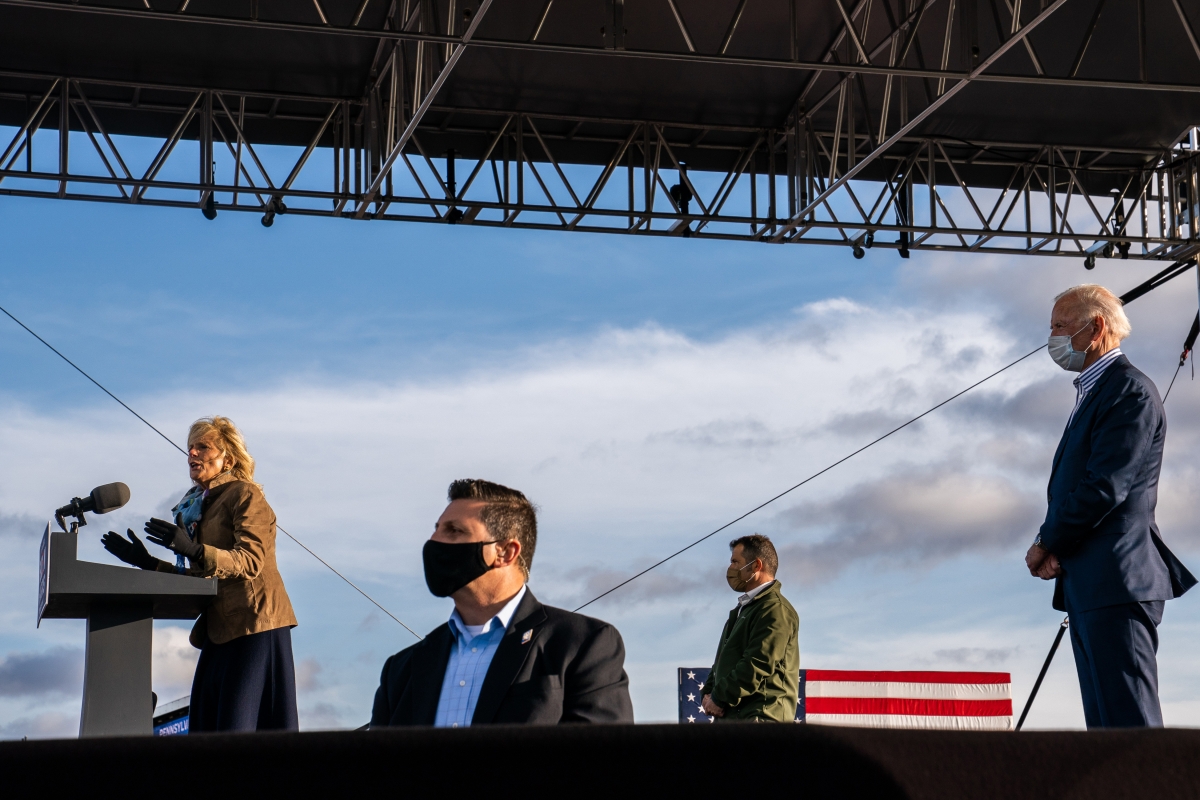
Jill Biden delivers remarks during a drive-in event for her husband, presidential nominee Joe Biden, at Dallas High School in Dallas, Pa. Jon Bon Jovi took part in the event. MUST CREDIT: Washington Post photo by Demetrius Freeman

Jill Biden delivers remarks during a drive-in event for her husband, presidential nominee Joe Biden, at Dallas High School in Dallas, Pa. Jon Bon Jovi took part in the event. MUST CREDIT: Washington Post photo by Demetrius Freeman

Democrats spurned him in the early primary season contests and worried throughout the fall in a general election that began with Biden under fire for campaigning mostly from his basement. Party factions feared Biden would fail to shore up the Democratic base or that he had lost a step due to his age. Allies fretted he would stumble in debates with President Donald Trump and his gaffes would give ample material to his tenacious opponent.

But the circumstances of this campaign – a pandemic and an economic collapse costing millions of jobs and making even the still-employed feel vulnerable – have pushed the race in the direction of Biden’s strong suits and against his deficits, shining a bright light on his empathy and sober experience and casting his flaws into the shadows.

He has emerged with more Americans viewing him favorably now than at this time last year, the opposite of the usual trajectory of a campaign and far different from the circumstances that faced Hillary Clinton in 2016. He holds a national lead approaching double digits and narrower but stable leads in many battleground states. He enters the final stretch with far more money to spend than Trump as he reaches for the pinnacle of a political career, one that has eluded him twice before.

The closing days of one of the most unusual presidential campaigns in history conclude years of Democratic anger and angst over how to defeat the man they view as a historically damaging figure in American politics. Biden’s approach, however, has relied on the same traits and tactics he has utilized over the past half-century in politics.

He has tried to exude hope and optimism despite the raw and painful circumstances enveloping the country. He has clung to bipartisanship despite the country’s deep polarization, ignoring raised Democratic eyebrows when he tells his donors, as he did two weeks ago, “For those of you who are Republicans, I promise I’m not going to embarrass you.”

The remarkably consistent approach has gotten Biden to the cusp of election, but with almost a week until Election Day, even some of his closest allies remain deeply anxious about a single question: Can he actually pull it off?

“I was always in love with the guy, but I don’t know that it was clear this was the match for who this guy is – the character, personal tragedies . . . his inclination to find common ground – even when folks in his own party pooh-poohed that,” said Gov. Phil Murphy, D-N.J. “But you could not construct a better candidate, a better match for this country.”

“I think we underestimated him. As a party, we underestimated him,” Murphy said. “There was just a maturity, a moment when our party – for better or worse – looked in the mirror and said, ‘Wait a minute. We must come together at all costs; we must nominate a responsible leader who will be professional, who will put partisanship aside when need be.'”

Biden has brought into public view an existing chip on his shoulder but always directed it at Trump. He has contrasted his lack of relative wealth when compared to the president as “Scranton versus Park Avenue.” He has touted his degree from a public college, saying those with Ivy League degrees have looked down on people like him. But he has not let slip any consternation toward members of his own party, save for noting when attacked by Trump as a socialist that he defeated the more liberal elements of the Democratic coalition.

“People working on this campaign two years ago said the party had passed Biden by,” said one person close to Biden, speaking on the condition of anonymity to be candid. “He will never say this, but there’s got to be some, ‘I told you so.’ People say he’s this blue-collar, retail politician. But he also got 100 percent exactly where the country was and the party was.”

Biden has tinkered with some surface factors. In Thursday’s final debate, he seemed to smile and laugh more often than previously, attempting a more dramatic contrast with the often dour Trump. But Biden’s message was the same as when he was finishing in a distant fifth place in February’s New Hampshire primary, before a predominantly Black electorate in South Carolina resurrected his candidacy.

“He feels good,” said Christopher Dodd, the former Connecticut senator and one of Biden’s veteran confidants. “He’s not overconfident. But he feels he has done what he needs to do against an extraordinary opponent – and extraordinary is meant negatively.”

“Joe believes, and his staff does, that it’s going to be close. That’s not just campaign hype,” he added. “They’re worried because they see the country divided. I think he’s spending as much time thinking about that and how do we solve that problem than he is anything else. But he’s cautiously optimistic.”

Biden’s closing message has centered on unity as much as it has a rejection of the incumbent. His campaign aired, during the World Series and elsewhere, a 60-second ad featuring iconic images of America as deep-voiced Sam Elliott, the actor known for gunslinging roles as the quintessential cowboy, talked about dignity, a fresh start and common agreement.

“This is an overused term, but he’s a happy warrior. He’s always been the same. He feels comfortable who he is and doesn’t try to be anybody he’s not,” said Harry Reid, the former Senate majority leader. “He tries really hard, works hard. And you don’t find him often depressed or disgruntled or angry. That’s not who he is.”

If campaigns draw out generalizations, Biden has been steady and plodding to Trump’s erratic and sensational. Trump can feel like a speedy train on the verge of flying off the tracks; Biden is a less remarkable ride in the quiet car. While Trump refuses to cede the spotlight, Biden has grown comfortable at times fading to the background and yielding to others in his party.

Biden has placed a big bet that most of the country shares his optimism and will cast aside a president whose first speech in office centered on “American carnage,” who tried to fan fears of minorities, cast urban centers as hellscapes and called his political opponents criminals.

Biden’s positioning carried risk, not the least in the Democratic primaries. He was not the candidate riding the left’s energy and vowing to start a revolution like his chief rival, Sen. Bernie Sanders, I-Vt., or the one who would make history like his former partner, Barack Obama, or the several female candidates Biden vanquished this year, including eventual running mate Sen. Kamala Harris, D-Calif. His wife, Jill Biden, regularly pitches her husband’s ticket by promising that under a Biden administration Americans will be able to read the newspaper and not get upset.

As the campaign reaches its final stretch, Biden’s campaign and his allies have cast him more and more as an empathetic grandfatherly figure, one who his opponents derisively compared to Mister Rogers. When a Trump campaign official made the comparison during a Biden town hall, Biden and his campaign welcomed it.

“A few weeks ago, I spoke to Mr. Rogers’ wife Joanne when I was in her neighborhood in Pittsburgh. It was a great conversation,” Biden wrote on Twitter. “Friendship, empathy, kindness, and compassion – I think we could all learn a thing or two from her and her husband’s example.”

Biden has benefited from his upswing in personal popularity. A Fox News survey this month had Biden with a net positive favorability rating of 16 points – with 57 viewing him favorability and 41 viewing him unfavorably – compared with negative 10 points for Trump.

By any number of polls, that made him far more popular than Clinton was four years ago – giving Biden a cushion Democrats did not have in 2016. At the end of the 2016 campaign, Clinton was viewed unfavorably by 52% of Americans, according to a Gallup survey, which was the second worst in history behind Trump, who was viewed unfavorably by 61%.

“I didn’t realize until after the votes were counted that a lot of people did not like her,” said former North Carolina governor Jim Hunt, a Democrat who supports Biden. “They just didn’t like her. A lot of women. A lot of White women. And Blacks weren’t enthusiastic about the ticket.”

“That’s different now,” Hunt continued. “There’s not anybody who doesn’t like ol’ Biden . . . Maybe they don’t love him, but they like him.”

The contrast with Trump has fueled another necessity – keeping his party united around him or at least united around opposition to the president. The major intraparty fights that were on full display four years ago have receded, which his campaign credits in part to Biden’s personal relationship with Sanders.

“They say in life timing is everything. This is the perfect time for Joe Biden to be running for president, as himself,” said Ted Kaufman, who has been one of Biden’s closest advisers dating back to his first Senate race in 1972. “That’s what wins people over. That’s who he is. What makes it more powerful in this race is it happens to be the total opposite of President Trump. So the contrast is really, really stark.”

“He is the total opposite of President Trump. That’s his message,” Kaufman said. “All the things he’s been known as for years – concern about family, concern about religion, about being honest with people reaching out to people – all go back to 1972. He’s had this constant optimism.”

But while shared animosity toward Trump has allowed Democrats to paper over very real policy differences between the party’s wings, those disputes are likely to flare anew, should he win. All sides expect fights over health care and climate policy, and disagreements over court restructuring and infrastructure spending.

“We have got to win this election,” Murphy said. “Let’s worry about differences after the election; let’s not litigate them before the election. There are proud factions, folks proud of their principals in our party. But everybody – everybody – is checking that at the door right now. They are doing everything they can to get this guy elected . . . Will there be debates post-election? Yes.”

As the election verdict nears, this campaign increasingly echoes Biden’s past efforts, whether his seven successful Senate races or his two failed presidential attempts. The sons who defined Biden’s first entry into big time politics – he was sworn in as a senator at their hospital beds, after a car crash that killed his first wife and daughter – are still central to his campaign nearly half a century later. His late son Beau, who died of brain cancer in 2015, remains his father’s stated inspiration. His son Hunter has made almost no public appearances on behalf of his father but has become the face of Trump’s attempt to cast the Bidens as a family willing to trade political influence for personal profit. Biden’s emotional response to Trump’s mockery of his son made it one of the key moments of the first debate.

The Trump campaign has pointed to emails Hunter Biden purportedly exchanged with business partners at a Ukrainian gas company, including one in which a colleague thanked Hunter for “an opportunity” to meet his father. The Biden campaign said the vice president’s schedule indicated no such meeting took place.

The Washington Post has not been able to independently verify the emails. The Post has on multiple occasions asked presidential attorney Rudy Giuliani and former adviser Stephen Bannon, who helped make the materials public, for copies of what they allege is Hunter Biden’s hard drive but has received no response.

Biden allies say he expected such criticism from Trump and it weighed on him before entering the race.

“I looked him in the eyes and said, ‘You’ve got to be prepared for the near certainty that Donald Trump will make stuff up and throw it at you over and over and over. And it will be unpleasant and it will be difficult,'” said Sen. Christopher Coons, D-Del. “‘But you can bring us together. This guy is dividing us and pouring fuels on the fires.’ And he ended up saying, ‘You’re right. I’m the person who can beat this guy. And he can be beaten.'”

During an ABC town hall, Biden was asked what it would say about the country if he were to lose.

“Well, it could say that I’m a lousy candidate, and I didn’t do a good job,” Biden said. Then he continued on.

“But I think – I hope that it doesn’t say that we are as racially, ethnically and religiously at odds with one another as it appears the president wants us to be. Usually, you know, the president, in my view, with all due respect, it’s been divide and conquer, the way he does better if he splits us and where there’s division. And I think people need hope.”

Trump bets on a 2016 replay, but faces a changed landscape #SootinClaimon.Com

#SootinClaimon.Com : ขอบคุณแหล่งข้อมูล : หนังสือพิมพ์ The Nation.

Trump bets on a 2016 replay, but faces a changed landscape

InternationalOct 25. 2020Supporters of President Trump were on hand for a rally on Friday in Florida. MUST CREDIT: Photo by Evelyn Hockstein for The Washington PostSupporters of President Trump were on hand for a rally on Friday in Florida. MUST CREDIT: Photo by Evelyn Hockstein for The Washington Post 

By The Washington Post · Michael Scherer, Josh Dawsey · NATIONAL, POLITICS

WASHINGTON – President Donald Trump and his advisers are betting on a high-octane replay of the closing two weeks of his 2016 campaign, with nonstop travel for packed rallies filled with attacks on alleged Democratic corruption in a bid to reignite the outsider spirit that defied the polls once before.

Despite health authorities discouraging his largely maskless outdoor events and an opponent who has maintained strong favorability ratings, Trump is urgently trying to reassemble the core elements of his 2016 upset win: news coverage of red-hatted spectacles, calls for a criminal investigation of his rival and the mischaracterization of allegedly leaked documents in the final stretch of the campaign.

A Trump rally in Ohio on Saturday showed how much he is reaching back to 2016. He told the crowd, apparently referring to wrongdoing by his opponents, “there’s something going on. It happened this time four years ago. This time more.”

The crowd began a “lock him up” chant – an echo of the “lock her up” calls against Hillary Clinton – after Trump described alleged spying on his campaign by Joe Biden and former president Barack Obama. Trump then pretended to tell the crowd to stop, saying mockingly: “It’s much better if I say, ‘No, no, no, please.’ “

Trump advisers say data from the rallies and fundraising indicate a late surge in support is again possible, despite polls that show the president trailing. “There are striking similarities to the president’s campaign in 2016 – a tight race, an enthusiasm advantage and clear momentum down the stretch for Donald Trump,” campaign manager Bill Stepien said between stops Saturday, as Trump attended three events. “It just feels right again.”

Democrats dismiss the narrative that conditions are coalescing for a repeat of 2016 as wishful thinking on the part of a president who is clearly losing. Beyond the specter of a devastating pandemic that he has failed to contain, they say, Trump is now the incumbent, with a record that has energized Democrats in an almost unprecedented way.

Voters four years ago may have been unsure what a Trump presidency would look like, and many were willing to gamble. This time, the Biden team argues, voters are looking for calm and competence, not braggadocio and chaos.

Indeed, for most of this year, Trump’s attempts to draw parallels to his first campaign ran headlong into harsh epidemiological realities. The coronavirus pandemic forced him to scale back and cancel events, including two versions of his nominating convention, and his handling of the issue has alienated key segments of the electorate. Most strikingly, Trump’s own bout with the novel coronavirus forced him off the campaign trail for several days.

Trump continues to dismiss coverage of the health crisis as a political tactic by his opponents to scare the American people.

“Turn on television, ‘covid-19, covid-19, covid-19, covid-19, covid-19, covid-19.’ A plane goes down, 500 people dead, they don’t talk about it,” Trump said at an event in Lumberton, N.C., on Saturday. “By the way, on November 4th, you won’t hear about it anymore. It’s true.”

Federal officials announced Friday that more than 80,000 Americans had tested positive for the coronavirus, the highest daily number this year of positive tests in a pandemic that has already killed at least 224,000 people in the United States and at least 1.15 million people worldwide. The airplane crash Trump described was apocryphal.

In Trump’s tight circle, the priority is re-creating the campaign spirit that won Trump the White House in the first place. Large gatherings give Trump a personal morale boost; his aides have been joking on Air Force One about the relatively quiet optics of Biden’s drive-in events.

They also point to a $26 million fundraising haul this past week in a 24-hour period after the debate.

“In 2016, we saw a similar surge in grass-roots donations after the last debate,” said Trump campaign spokesman Tim Murtaugh. “The surge in grass-roots support has now happened, and last time was followed by movement in the polls.”

Trump is one of the few political figures to reach the presidency without having run any previous political races. Most presidents have not only won several earlier campaigns, but have also generally lost at least one, giving them a sense of how a shifting political landscape can dictate varying tactics and different strategies.

Beyond that, Trump’s first run was marked by improbable events and repeated warnings that he could not win, only to have him score one of the biggest upsets in presidential history, a dynamic that gives his allies hope this time around.

Yet Trump is facing a very different kind of opponent than Clinton, who was broadly unpopular. Biden’s favorability has increased slightly since his August convention, according to multiple polls, while Trump’s lower favorability remains basically unchanged. Biden is viewed far more positively than Clinton, despite the tens of millions of dollars that have recently been spent to sully his reputation.

“In 2016, you had the unprecedented situation with both major-party nominees having a favorable rating that was significantly underwater,” said Democratic pollster Joel Benenson. “You also had an open seat. This is a referendum on Trump.”

Yet nostalgia for the last campaign remains a throughline of Trump’s stump speech. As he did with Clinton in 2016, Trump has argued that his opponent should be investigated and imprisoned. He compares the alleged laptop of Biden’s son Hunter to a laptop owned by the husband of a Clinton 2016 aide, which led to a late-campaign announcement by the FBI that some emails of the Democratic candidate had been uncovered.

“This is called the laptop from hell,” Trump said in a riff at a recent event in Arizona, discussing the device allegedly owned by Hunter, a fact that has not been confirmed by The Washington Post. “The only laptop that was almost as good, maybe worse, was the laptop of Anthony Weiner. Do you remember that? Ding, ding, ding, ding.”

Aides even sought to replicate the 2016 surprise of bringing accusers of Bill Clinton to meet the press before one of his debates with Hillary Clinton. But this time, the guest, Hunter Biden’s former business partner, did not attract as much attention, and Trump himself did not join the business partner for the appearance.

The Trump campaign is being run and advised almost entirely by people who went through the 2016 campaign with him. They say they have the same sense of a scrappy underdog campaign, with a money disadvantage, an overconfident opponent who travels less and polls that say they are going to lose.

But those same aides express frustration at the seismic shift in press coverage. In smaller local media, Trump’s rallies continue to get enormous attention, amounting to tens of millions of free advertising a week, according to internal campaign analyses.

But the national media has shifted its approach to both Trump’s rallies and his accusations of corruption against the Biden family, treating documents that allegedly surfaced on a laptop once owned by Biden’s son with marked skepticism.

“The biggest difference between ’16 and ’20 is the coverage of what I will call corruption; other people might call it something else,” said a campaign official who spoke on the condition of anonymity to speak more frankly. “People paid attention to it in 2016. People reported on it. But they are not this time around.”

Cable news networks in 2016 carried Trump rallies with a certain breathlessness, sometimes showing the empty stage as the crowd awaited the candidate’s arrival. This time, they often decline to cover the spectacles live, while interviews, a key way for Trump to broadcast his message in 2016, have become far more confrontational as journalists pick through his record. Trump prematurely ended an interview this past week for CBS News’s “60 Minutes” after objecting to questions from reporter Lesley Stahl.

More broadly, Democratic voters in 2016 were badly divided, and many were complacent, with little doubt that Clinton would prevail. In contrast, Trump’s first term has largely unified the American left.

Aides have pushed Trump to return to the 2016 outsider theme, and the president himself has said he fares better as an “outsider.” In recent days, several aides have said he’s in the best mood in months now that he’s going on the road and basking in the adulation of crowds. In addition, some of the president’s closest advisers work to show him positive polls to keep him happy.

Trump’s political advisers met two weeks ago to reassess their advertising strategy, worried about viewing the election as an up-or-down question about Trump’s performance. They recently shifted their advertising spending away from defending Trump’s record toward attempts to scare people about Biden’s policy priorities.

A new Trump ad this past week – which was run more than any other spot during the week, according to Advertising Analytics – makes no mention of Trump’s record, the coronavirus or crime. It asks instead what a Biden victory would “mean for you,” and it then predicts higher taxes, higher gas prices, higher utility bills, lower income and fewer jobs.

A concurrent new $25 million television push by the Republican National Committee features a direct-to-camera ad not from the president, but from a gray-haired actor playing a senior concerned about Biden changing Medicare in a way that would purportedly close hospitals and separate voters from their doctors.

The campaign has also begun playing a video at the start of rallies that cuts between a tense Democratic primary debate exchange that Biden had about cutting entitlements such as Social Security and Medicare, as well as decades-old comments he made when he was open to entitlement cuts as part of larger budget revision. Biden’s campaign has promised not to cut either program if he is elected.

The overall goal is to argue to traditional Republicans who may have doubts about Trump that whatever the president’s flaws, Biden is a tax-and-spend liberal who would make life worse for many Americans.

The Biden campaign argues that Biden has been a moderate for a half-century in politics, and that voters will not buy into Trump’s portrait of him as a socialist.

“He has been forced to divest from making a case for himself and is instead resorting to even more wild-eyed, projection-based lies about Joe Biden that have failed him for months and that fact-checkers have already carved to pieces,” Biden campaign spokesman Andrew Bates said in response to the ads.

The Trump campaign is also in an even weaker relative position than in 2016 when it comes to money available for television ads. Over the four weeks ending Oct. 24, 2016, the Trump and Clinton campaigns were evenly matched on television, with Clinton spending about 8% more in total, according to Advertising Analytics.

This time, the two campaigns are much farther apart, with Biden’s campaign spending 2.3 times what Trump has spent over the past four weeks.

None of this has stopped Trump from claiming that he’s in a stronger position than he was in 2016, an assertion that has been encouraged by Trump’s advisers who believe he is a more effective salesman for himself when his spirits are high.

At a private fundraiser in Nashville before Thursday’s debate, Trump said he felt like he could drive a golf ball 50 yards farther than retired golfer John Daly, who was known in his day as one of the longest drivers in the game.

“We have the strongest base, probably ever in politics. Our people are coming out. Whether it’s rain or snow or sleet, our people are coming out,” Trump said, predicting record turnout.

He returned repeatedly to reliving the glory of the 2016 campaign, recounting at one point watching CNN’s John King narrate election returns with a digital map.

“Everything’s red, the whole thing is red,” Trump said, recalling the moment. “And I would say – and it’s very early yet – and I would say we are much stronger right now than four years ago.”

Home tests could help in the fight against the coronavirus. So where are they? #SootinClaimon.Com

#SootinClaimon.Com : ขอบคุณแหล่งข้อมูล : หนังสือพิมพ์ The Nation.

Home tests could help in the fight against the coronavirus. So where are they?

InternationalOct 25. 2020Adm. Brett Giroir, assistant secretary of Health and Human Services, swabs his nose to demonstrate a rapid-result covid-19 test at the White House Rose Garden on Sept. 28, 2020 in Washington, D.C. MUST CREDIT: Photo for The Washington Post by Oliver ContrerasAdm. Brett Giroir, assistant secretary of Health and Human Services, swabs his nose to demonstrate a rapid-result covid-19 test at the White House Rose Garden on Sept. 28, 2020 in Washington, D.C. MUST CREDIT: Photo for The Washington Post by Oliver Contreras 

By The Washington Post · William Wan · NATIONAL, HEALTH, SCIENCE-ENVIRONMENT, HEALTH-NEWS

WASHINGTON – Ten months into the coronavirus pandemic, the promise of a rapid and inexpensive at-home test for the virus remains unfulfilled as companies struggle to overcome final regulatory hurdles.

The technology for such tests exists, and early versions are being used in nursing homes and schools. But companies racing to bring the tests to the wider U.S. market must make them more accurate and easier to use before they can meet federal guidelines that would allow sales directly to consumers.

Although no single test will end the pandemic in the United States, experts say the ability for people to take a test at home and know within minutes whether they’re infected could be an important component in stanching the spread of the virus.

Such a test could be taken several days ahead of a visit with grandparents, for example. Or before heading into work. And if a local outbreak occurs, officials could hand out hundreds of at-home rapid tests to find and stop viral transmission.

“At a time when so many people feel like they’ve lost control of so much of their lives, it would put power back in their hands,” said Mara Aspinall, a biomedical diagnostics professor at Arizona State University “That’s no small thing.”

Some retailers, including Costco, have begun selling home tests to consumers, but they are costly – about $130 – and require people to mail their sample to a lab and wait 24 to 48 hours for results. The rapid tests now being developed could cost as little as $5 and take 15 minutes for results.

At least two dozen companies are trying to develop home tests, most of them antigen tests that detect proteins on the surface of the virus. Some companies are tantalizingly close to clearing final barriers.

In July, the Food and Drug Administration issued guidelines making clear that any home test needs to be accurate and easy enough for untrained people to use without confusion.

Since then, the agency has not received any applications from companies for home tests, the agency said.

“It is hard to do. There’s a reason no one has gotten FDA approval yet,” said James Li, founder and chief executive of Cellex, a biotechnology company that has been working for months on an at-home test. The FDA is requiring that antigen tests sold directly to consumers be more accurate than most antigen tests to date, because consumers at home will be left to interpret the results on their own.

Li said the challenges to developing home tests are significant but not insurmountable. He would not say how close his company is to meeting those requirements but said his firm and others recognize that with cases rising, such a test could prove useful this winter.

“You don’t want people who are possibly infected going into clinics and hospitals to get tested,” Li said. “A home test addresses that problem.”

Fearing their stringent guidelines may seem onerous to companies, FDA officials wrote an op-ed last month clarifying their expectations.

The officials said that if some home tests fall short on accuracy, one option might be to sell them but require a doctor’s prescription or consultation. Or they could be sold in packs of two or three, using multiple tests to compensate for loss of accuracy.

“Our recommendations are just that — recommendations,” the officials wrote. “We welcome developers with alternative proposals to come talk with us.”

Experts, however, have expressed skepticism and concern about widespread use of such tests. More evidence is needed, they say, pointing to the false results that rapid antigen tests sometimes generate and the logistical problems associated with collecting data on their results — data that are invaluable to public-health officials responsible for tracking the pandemic and attempting to slow it.

Because antigen tests are less sensitive, they can produce false negatives – causing people to think they’re fine when they are in fact infectious. In recent weeks, there also have been increasing incidences of false positives – when people are identified as being infected but aren’t.

Health officials in Nevada ordered nursing homes to stop using antigen tests but reversed course when Trump administration officials threatened to take action against them. Officials in Maine and Vermont and National Football League teams also have encountered recent instances of false positives.

“We don’t want to overpromise. Home tests are not going to solve all the problems. They are just one piece of the puzzle,” Li said.

People screening positive on the home antigen tests could have their status confirmed with polymerase chain reaction (PCR) tests – a molecular process that is more precise but more expensive and takes longer.

Experts said home tests could make an outsize difference in areas at high risk for outbreaks and in rural areas.

“Imagine at the very beginning of an outbreak if you could arm contact tracers with these rapid antigen tests,” said Yuka Manabe, an expert in infectious-disease diagnostics at the Johns Hopkins Bloomberg School of Public Health.

One of the newest antigen tests, the Abbott BinaxNOW, uses a small paper card, costs $5 and can yield results in 15 minutes. Using a shallow nasal swab, the test yields results that can be read from the card like a pregnancy test – a color-coded line indicates testing positive. The test has been deployed mainly in nursing homes and schools, and administered by health professionals.

Some experts argue that the less sensitive nature of antigen tests could actually be an advantage, because they could be effective at catching those with the most viral load when they are most contagious.

The main advantage, however, is their speed and low cost, making them easier to scale up to meet the demand for more testing. The molecular PCR tests that are most commonly used can cost upward of $100 each. It remains unclear whether home tests would be covered by private health insurance plans and the nation’s major government health plans, Medicare and Medicaid, because they would often be used to test people who do not have symptoms.

About 30 million coronavirus tests a month are being conducted in the United States, according to the Covid Tracking Project, a volunteer initiative chronicling the pandemic. But the country needs about 193 million tests a month just to address outbreaks in nursing homes and to reopen schools, according to a recent Rockefeller Foundation report. Other experts have argued that even larger-scale testing is needed.

One reason antigen tests are a powerful tool for screening large numbers of people is they don’t require a large lab to produce results. They can be performed wherever needed at points of care, including nursing homes, schools and clinics.

By January, U.S. companies may be able to produce almost 200 million such point-of-care tests a month, said Aspinall, who researched industry production capacity for the recent Rockefeller Foundation report. By April, they may be able produce almost 230 million a month.

Increasing U.S. testing on such a scale could bring a sea change to the country’s pandemic response. “But it all depends how we use them,” Manabe said.

One significant problem looms with home tests: collecting the results.

Because labs are not involved in such tests, there is no way to report the results. Without that data, the country would be flying blind as it navigates later stages of the pandemic, experts fear.

“It’s not an insurmountable problem, but we need to think big to tackle it,” said Michael Mina, an infectious-disease expert at the Harvard School of Public Health. “The federal government should be working with companies like AT&T, Apple and Verizon to tackle it. Why not make it reportable via a text message? ‘Did you take a rapid test? If positive, press 1.’ “

Another fear is that rapid home tests could give people a false sense of security.

“There’s a misperception that one negative test means you’re not at risk,” said Mark McClellan, FDA commissioner during the George W. Bush administration and now director of the Duke-Margolis Center for Health Policy.

Although many have compared the design and ease of future home tests to pregnancy tests, he said, “the difference is you can test negative in the morning and be positive by night. It’s likely to work best when done on a repeated, ongoing basis. We don’t have the capacity quite yet to do that.”

It also remains unclear how willing people will be to adopt frequent, widespread home testing.

“It can’t be the only thing we’re doing,” said Gigi Kwik Gronvall, a testing expert at the Johns Hopkins Center for Health Security. “Because it depends on collective planning and action. We can’t even get our act together on masks. It’s unclear whether we would be able to do so on home testing.”

Polish President Andrzej Duda tests positive for coronavirus #SootinClaimon.Com

#SootinClaimon.Com : ขอบคุณแหล่งข้อมูล : หนังสือพิมพ์ The Nation.

Polish President Andrzej Duda tests positive for coronavirus

InternationalOct 25. 2020Polish President Andrzej Duda speaks as exit polls are announced near Pultusk Castle in Pultusk, Poland, on July 12, 2020. MUST CREDIT: Bloomberg photo by Piotr MaleckiPolish President Andrzej Duda speaks as exit polls are announced near Pultusk Castle in Pultusk, Poland, on July 12, 2020. MUST CREDIT: Bloomberg photo by Piotr Malecki 
By Syndication Washington Post, Bloomberg · Adrian Krajewski · WORLD, HEALTH, EUROPE, HEALTH-NEWS

Polish President Andrzej Duda tested positive for coronavirus, his spokesman Blazej Spychalski wrote on Twitter on Saturday, as the chancellery goes into quarantine.

The president, who on Friday visited the National Stadium in Warsaw, where Poland is putting together a special covid-19 hospital, and also met with French Open winner Iga Swiatek, is feeling well, the spokesman said.

The news came as Poland registered a record number of covid-19 cases in four of the last seven days, prompting the government to announce new limits on gatherings, closures of bars and restaurants, mandatory online classes for some elementary school students and restrictions on movements.

Poland reported 13,628 new coronavirus cases on Saturday, slightly less than Friday’s record. The number of deaths hit a record 179, and almost 479,000 people are now in quarantine in the country.

Police brace for potential Election Day unrest in a year when ‘everything is uncertain’ #SootinClaimon.Com

#SootinClaimon.Com : ขอบคุณแหล่งข้อมูล : หนังสือพิมพ์ The Nation.

Police brace for potential Election Day unrest in a year when ‘everything is uncertain’

InternationalOct 25. 2020 As campaign season heads into its fraught, final days, police departments across the country are bracing for Election Day, mobilizing officers as they prepare for the possibility of voter intimidation, unrest or violence. 
 As campaign season heads into its fraught, final days, police departments across the country are bracing for Election Day, mobilizing officers as they prepare for the possibility of voter intimidation, unrest or violence.  

By The Washington Post · Mark Berman · NATIONAL, POLITICS 
 As campaign season heads into its fraught, final days, police departments across the country are bracing for Election Day, mobilizing officers as they prepare for the possibility of voter intimidation, unrest or violence. 

 As campaign season heads into its fraught, final days, police departments across the country are bracing for Election Day, mobilizing officers as they prepare for the possibility of voter intimidation, unrest or violence. 

These preparations include extensive planning exercises, efforts to monitor early-voting sites and concerns about how long any unrest could last if the election results are not immediately known or challenged in court. 

While law enforcement agencies routinely plan for elections, officials say this year’s preparations are unusually extensive because of the sheer levels of anxiety and toxicity across the country – with fears that a modern American election could give way to potential violence.

“I don’t think we’ve seen anything like this in modern times,” said Andrew Walsh, a deputy chief with the Las Vegas Metropolitan Police Department. 

Tens of millions of Americans have cast ballots at early-voting sites, and tensions and accusations of voter intimidation have already flared up during this process. 

Many Americans still plan to turn out on Election Day, so law enforcement officials have conducted drills involving multiple agencies to try to game out what could happen. Police officials in multiple cities stressed that they have no information about specific threats relating to the election, but are instead preparing to make sure they are ready. 

“When you look at previous elections, there’s always been the concern when you have large crowds . . . we know [that] can be a target for someone who has an agenda,” Walsh, who runs the Las Vegas police’s homeland security division, said in an interview. The difference, he said, is the “magnitude” of the election and the weight people are attaching to it. 

Walsh said law enforcement officials have to consider three distinct periods around the election. First is early voting period, which offers an extended stretch of public gatherings and possible friction, followed by Election Day itself, which could offer much the same in a concentrated single period. 

Then comes the third, most uncertain period: however long it might take for an outcome to be declared. That window, experts say, could offer the greatest risk for potential danger. 

“We just don’t know how long this is going to take, or what this is going to look like, once this is over . . . and no matter who wins, somebody’s not going to be happy,” Walsh said. 

David Brown, the Chicago police superintendent, said at a news conference that city officials have held three tabletop exercises and plan at least one more “so we can have the best response regardless of whatever scenario happens on Election Day.”

He said many other cities are doing the same. 

“We are all in conversations with our counterparts across the country about what we might expect. But everything is uncertain. And so we’re trying as best we can to anticipate any hazard that might happen,” he said. 

Those potential hazards, Brown said, range from bad weather to large protests to gatherings that could include “embedded agitators that might loot or cause violence or destroy property.” 

In New York, authorities conducted a tabletop exercise in recent weeks looking at the time leading up to Election Day and the following day, according to John Miller, the NYPD’s deputy commissioner of intelligence and counterterrorism. 

The exercise included “natural disasters, protests, violence, suspicious packages, explosive devices” among the litany of scenarios the department contemplated. He emphasized at a briefing this week that there is no credible threat to New York City or Election Day. 

President Donald Trump repeatedly has attacked the integrity of the election, making false claims about voter fraud and urging his supporters to monitor activity at the polls, while his administration has warned about the danger posed by extremists who could target election-related events.

The Department of Homeland Security said in a threat assessment released earlier this month that domestic violent extremists could target events connected with the presidential campaigns, the election or the post-election period. It wrote that “campaign-associated mass gatherings, polling places, and voter registration events, would be the most likely flash points for potential violence.”

As part of their preparations to protect such gatherings, police have begun shifting personnel to ensure larger numbers of officers are deployed or available. 

Police in Madison, Wis., are planning on having significantly more staffing for this election than previous ones, and they are also undergoing greater preparations, Victor Wahl, the acting police chief, said in an interview. 

In prior years, Wahl said, officers might get reminders before elections about things like electioneering and polling places, just because that was not something they dealt with every day. 

“Certainly this year, what we’ve gone through the last few months, the national climate and things like that, we’re spending a lot more time on it,” Wahl said.

Police across the country have limited time off around Election Day to keep officers around. In Dallas, all sworn personnel must wear uniforms in case they need to be deployed, a spokesman said. 

Officials in Phoenix and Portland, Ore., said they would increase staffing, while the Los Angeles Police Department also said they were prepared to deploy more officers as they anticipate possible protests. Some departments said they were ready to shift deployments as needed by circumstances on the ground, while others declined to detail their staffing or operational plans.

D.C. Police Chief Peter Newsham told local lawmakers that within law enforcement, “it is widely believed that there will be civil unrest after the November election regardless of who wins,” as well as during the inauguration in January.

Preparations are also extending to polling locations and early voting. Police in Charlotte said they would check on polling areas there, while the Miami-Dade police – who noted they are only allowed in polling locations to vote or if allowed by precinct clerks – said they would add early-voting sites to patrol routes to keep an eye for any issues. 

In New York, where early voting begins Saturday, Terence Monahan, chief of department for the NYPD, said at a news conference that his force would have “a presence everywhere people come to vote” to make sure everyone can safely cast their ballot. 

When asked if police could remain impartial there after the largest New York City police union endorsed Trump, he said his officers would take no side while on the job.

“When we put on this uniform, we are apolitical,” Monahan said. “We have no stance one way or the other.”

Trump also sparked criticism with his call over the summer to have law enforcement officials patrol voting sites, a tactic that historically was used to scare voters of color. 

“There are many folks who are rightly triggered and intimidated by just the sight of armed police in and around the polls,” said Craig B. Futterman, a law professor at the University of Chicago and director of the Civil Rights and Police Accountability Project.

Police and law enforcement officials often spent recent elections trying to stay away from polling sites specifically to avoid giving the impression of any voter intimidation, said Gregory Shaffer, a former FBI agent. 

This year, Shaffer said, he thinks police will likely need to be more focused on the streets, particularly given the potential for clashes between opposing groups. Police will likely be on standby, he said, and may do things including pre-staging riot police on buses near possible protest sites.

The most worrisome time frame heading into November is likely not the election itself but the post-election period, said Irfan Nooruddin, a Georgetown University professor and an expert in democratization and international politics.

When violence happens in other countries around an election, he said, it is usually after the vote, “in which the losing side, or the side that expects to lose, doubles down using violence to delegitimize the process.”

Shaffer, the ex-FBI agent, said this year is the first time “that police are really, I think, in fear of what may happen on Election Day.” Shaffer also said he believes police officers hope the election is not drawn out or close, regardless of who wins.

“They’re all hoping for a landslide for one of the candidates and so a decision can be made quickly, so the country can move forward and their city can move forward,” he said.

Trump’s historic assault on the civil service was four years in the making #SootinClaimon.Com

#SootinClaimon.Com : ขอบคุณแหล่งข้อมูล : หนังสือพิมพ์ The Nation.

Trump’s historic assault on the civil service was four years in the making

InternationalOct 24. 2020President TrumpPresident Trump 

By The Washington Post · Lisa Rein, Josh Dawsey, Toluse Olorunnipa · NATIONAL, BUSINESS, POLITICS, WHITEHOUSE· 
WASHINGTON – President Donald Trump’s extraordinary directive allowing his administration to weed out career federal employees viewed as disloyal in a second term is the product of a four-year campaign by conservatives working from a little-known West Wing policy shop. 

Soon after Trump took office, a young aide hired from the Heritage Foundation with bold ideas for reining in the sprawling bureaucracy of 2.1 million came up with a blueprint. Trump would hold employees accountable, sideline their labor unions and give the president more power to hire and fire them, much like political appointees. 

The plan was a counterweight to the “deep state” Trump believed was out to disrupt his agenda. Coordinating labor policy for the White House’s Domestic Policy Council, James Sherk presented his bosses with a 19-page to-do list titled “Proposed Labor Reforms.” A top category was “Creating a government that serves the people.” 

The result this week threatens to be the most significant assault on the nonpartisan civil service in its 137-year history: a sweeping executive order that strips job protections from employees in policy roles across the government. Exactly which roles would be affected will be up to personnel officials at federal agencies, who were tasked on Friday with reviewing all of their jobs and deciding who would qualify.

The order, a year in the making after delays caused by the coronavirus pandemic, came less than two weeks before Trump will ask voters for a second term. Still, it was not a last-minute idea or presidential whim. Rather, the wonky-sounding “Executive Order on Creating Schedule F in the Excepted Service” is a crowning achievement of conservative policy on the civil service. 

Civil service experts and union leaders have assailed the order as an effort to impose political loyalty tests on a nonpartisan workforce. The directive likely would not survive if Joe Biden is elected president. 

A day after issuing a directive crafted in such secrecy that senior officials across the government had no idea it was coming, Trump railed to donors that he presides over a government of miscreants. 

“Somebody said, President, what’s the toughest country to deal with? Is it Russia? Is it China? Is it North Korea?” Trump told attendees at a fundraiser before Thursday’s debate in Nashville, saying it was harder to deal with officials inside his own government than with North Korea or Russia, according to one person who was there.

“No, the toughest country by far is dealing with the United States,” Trump said. “It’s true. These people are sick.” 

The president went on to denigrate civil servants who served in government before his election. 

“Well, you have a lot of people from past administrations, and they’re civil service. I fired some,” he said, referring to his efforts to purge several career diplomats and others who testified against him during last year’s impeachment hearings.

“I say some, just get rid of them,” the president continued. “We had a lot of them come to the floor during the impeachment hoax. You see them coming in with their bow ties and everything. It’s a weird deal,” Trump said. “We have some pretty deep-set, deep-seated people – we got a lot of them, and we got rid of a lot of them.”

Trump’s obsession with government employees he believes are against him has grown in recent months after his impeachment trial and the publication of the anonymous book “A Warning,” said four officials who spoke on the condition of anonymity because they were not authorized to speak publicly. The book is a critical account of the Trump administration written by an unnamed person described as a senior administration official.

Trump has dispatched Johnny McEntee, a 30-year-old aide viewed as deeply loyal to the president, to cull disloyal employees from agencies, vet potential hires and report back on his findings. McEntee has frustrated a range of Cabinet secretaries and administration officials with his moves. But McEntee has told others he is sniffing out perceived disloyalty, making personnel moves and questioning aides for the president because too many officials have had their own agendas for too long.

The White House has declined to say how many jobs would be swept into a class of employees with fewer civil service rights, but civil service experts and union leaders estimated anywhere from tens of thousands to hundreds of thousands in the 2.1 million-strong workforce. Each administration names about 4,000 political appointees, who typically change with each administration.

On Friday, civil servants and their allies in Congress agonized over the possibility of being reclassified into a new job category that gives them no recourse to fight actions their supervisors take against them. Union leaders met with their attorneys to review their legal options. Experts on the civil service opined that the Trump White House had pushed yet another boundary in its expansive interpretation of a president’s power.

The White House began crafting the order a year ago, consulting with its attorneys and concluding that federal personnel laws give the president latitude to shift employees among different groups. 

“This was the fruit of a lot of hard work and due diligence to determine who could be considered a policymaking employee who was exempt from protections,” said Joe Grogan, the former Domestic Policy Council chief, who left the White House in May. 

The pandemic delayed the rollout, along with other planned initiatives, he said. But even if Trump loses the election and a Biden administration rescinds the order, “There’s a marker around this.”

The directive was so controversial that only a handful of senior administration officials were involved in putting it together. On a call among chiefs of staff across the government Wednesday morning, the order did not come up, according to one official on the call, who spoke on the condition of anonymity because the person was not authorized to discuss internal meetings.

On a separate call with about two dozen congressional aides Friday morning to discuss the executive order, officials with the Office of Personnel Management were unable to answer basic questions, several people on the call said.

“They kept falling back on, ‘We’ve had 48 hours to digest this,’ ” said Rep. Gerald Connolly, D-Va., whose district includes thousands of federal employees. “This is a remarkable statement to make when you’re the government’s personnel operation.” 

He says he is drafting legislation to overturn the order and hopes to insert language doing the same in a government spending bill Congress is expected to approve in December. 

“We will stop this one way or another,” said Connolly, calling the order “an enormous abuse of presidential power.”

Sherk, in his 2017 memo, asserted that the Constitution gives the president virtually unlimited authority over the executive branch, including to hire and fire employees. His vision forms the backbone of Wednesday’s executive order. 

Sherk, who is now special assistant to the president for domestic policy, began by advancing an antilabor agenda for both the private sector and the government. In 2018, he was the power behind a set of executive orders that weakened collective bargaining rights, cleared a faster path to firing poor performers and blocked unions from working on matters involving employee representation on work time. The orders survived numerous court challenges.

Other proposals to reduce pay and benefits and hold the line on raises were less successful. 

Sherk declined to comment. But current and former administration officials described a frustration in the Trump White House that agencies often fail to address poor performers in government because the process is prolonged and does not always result in discipline or dismissal. The officials point to critical policymaking employees with high-profile roles that, when carried out poorly, can lead to widespread dysfunction at an agency.

“James’s frustration and that of a lot of people was ‘Pick up the damn pen and do what we told you to do so a year doesn’t go by and we don’t have anything,’ ” Grogan said. He referred to a “permanent class of civil servants that have protections that no other group of employees in America enjoys.”

Heritage alumni have played a role in shaping the White House’s policy on federal workers, making moves that have earned the full-throated support of the conservative group.

In addition to Sherk – who worked as a research fellow at Heritage beginning in 2006 – Heritage alum Michael Rigas has also worked to implement Trump’s push to overhaul federal workforce policy. Rigas, currently serving as the interim deputy director for management at the White House Budget office, has said publicly that the federal government needs to have more authority to take action against poor performers.

Rachel Greszler, a Heritage researcher, said the president’s executive order would help rectify a situation in which a president has less power than a private-sector chief executive to discipline or fire “managers who refused to carry out her directives or who took actions to thwart her initiative.”

“Federal workers who hold critical policy-related positions, with the power to significantly impact Americans’ lives, should not be immune from accountability,” she said. “This change is long overdue. It will result in better stewardship of taxpayers’ money, and could improve morale as federal workers show high levels of dissatisfaction with a lack of accountability.”

Some conservatives called the order an ineffective strategy to achieve their goal of reining in the federal workforce and making its hiring and discipline practices more reflective of the private sector.

Robert Shea, former associate director in the George W. Bush budget office, said the Bush administration never considered such a move in part because it may run aground of civil service laws passed by Congress. Shea said the advice of expert career employees would likely be ignored if the order took place. 

“And if the motive is something more sinister, then I think it does real damage to the civil service,” he said. “It would convert a swath of people into pretty much political appointee status. They would not enjoy the protections that career civil servants enjoy and therefore they would be at the behest of political appointees. ” 

Fearful calls flood election offices as Trump attacks mail-in voting, threatening participation in GOP strongholds #SootinClaimon.Com

#SootinClaimon.Com : ขอบคุณแหล่งข้อมูล : หนังสือพิมพ์ The Nation.

Fearful calls flood election offices as Trump attacks mail-in voting, threatening participation in GOP strongholds

InternationalOct 24. 2020Weber County Clerk/Auditor Ricky Hatch helps organize mail-in ballots at the Weber County Clerk's Office in Ogden, Utah, on Oct. 23, 2020. MUST CREDIT: Photo for The Washington Post by Kim RaffWeber County Clerk/Auditor Ricky Hatch helps organize mail-in ballots at the Weber County Clerk’s Office in Ogden, Utah, on Oct. 23, 2020. MUST CREDIT: Photo for The Washington Post by Kim Raff 

By The Washington Post · Isaac Stanley-Becker, Tony Romm · NATIONAL, POLITICS, WHITEHOUSE 
Weber County, a majority-Republican community of 260,000 on the eastern shores of Utah’s Great Salt Lake, held its first by-mail election in 2013. The process gained such widespread confidence that by June of this year, more than 99% of ballots cast in the primary were placed in the mail or deposited in a drop box.

But something has changed in Weber County, which now requires three full-time phone operators to field calls from residents “suddenly worried about voting by mail,” said Ricky Hatch, the county clerk and auditor. 

“Voters refer to ballots being thrown in a ditch, a river and dumpsters,” said Hatch, a Republican. They mention “dogs receiving ballots” and worry about things such as foreign interference and “rogue postal workers.” Some ask about dead people voting, he said.

Similar questions are flooding county offices nationwide, including many where residents have routinely voted by mail, said Hatch, who also chairs the election committee for the National Association of Counties. In many cases, the worries can be traced to baseless or alarmist statements by President Trump and posts on his Twitter feed. Others have been fed by headlines stripped of context and misleading reporting in the mainstream media, according to election administrators, voting rights advocates and experts in online communication.

The confusion and chaos follow a months-long campaign by Trump and his allies to sow doubt about voting by mail, a method of casting ballots that has been embraced in Democratic- and Republican-leaning states and has grown more popular this year because of the coronavirus pandemic.

Yet recent mail delays have contributed to unease about whether ballots will arrive on time and be counted. Mistrust on the left is also rooted in Republican efforts to curtail some voting options. Democrats appear to have channeled their fears into overwhelming turnout for early voting, while Republicans insist that they will make up ground on Election Day.

Trump in recent weeks has shifted his focus, tweeting less often about faulty ballots. But the partisan battle lines he drew on the issue seem to have had lingering effects in some places, and election officials say the controversy could depress turnout among Republicans. 

In a statement, Trump campaign spokeswoman Thea McDonald said the president “has been fighting for months” to stop what she described as “last-minute election rule changes.” The campaign, she said, wants “every voter who can vote in person to do so, and for those who cannot to get their absentee ballot in early.”

Intensifying the mistrust, experts said, is the power and reach of social media. They said the quest to turn minor irregularities into signs of political malintent – enabled by an information ecosystem that rewards outrage and partisan groupthink – poses among the greatest threats to the integrity of the Nov. 3 election.

“The amplification of these kinds of stories can have, in and of itself, a suppressive effect,” said Vanita Gupta, president of the Leadership Conference on Civil and Human Rights. The events in Utah, she said, show the ripple effects of attacks by Trump and his allies on “legal, safe, secure voting methods.”

Conflict over whether to expand opportunities to vote by mail has unfolded in battleground states from Wisconsin to North Carolina. But the most lasting consequence of the false and misleading narratives coursing through the Internet, often using real examples but exaggerating them to create the appearance of an alarming trend, could be a form of democratic backsliding in parts of the country where the widespread adoption of mail balloting has been shown to expand electoral participation.

“Obviously, the effort to question and undermine vote by mail has worked very well,” said Justin Lee, Utah’s director of elections, faulting the “national discussion” for what he and others described as an unprecedented level of confusion threatening to derail a well-functioning system in a Republican-controlled state.

Jason Stevenson, a spokesman for the American Civil Liberties Union of Utah, said even states with long histories of voting by mail were unable to insulate themselves from narratives about mail balloting emanating this summer from Washington. “I don’t post national stories about the election,” he said.

But a powerful feedback loop has made it impossible to tune out these national controversies. One-off incidents documented by local media are flowing to partisan voices, who use their online megaphones to reframe the details as indictments of the entire balloting process. The misleading narrative applied at the national level then filters back down to voters, causing them to distrust a system they have used for years. 

In Utah, details about a mishap began to emerge earlier this month. Local CBS and Fox affiliates quoted residents of Sanpete County – 150 miles south of Weber County – who said they were confused to find missing signature lines on their ballots.

The county clerk’s office sought to assuage voters, advising them of an easy fix: merely signing in a different location. Officials also promised to send postcards to residents informing them of how to remedy the oversight. County leaders did not respond to a request for comment.

The ballot printing error, caused by a vendor, illustrated the benefits of a by-mail system, not its drawbacks, said Lee, the state elections director. Faulty ballots distributed in person on Election Day may have been more difficult to remedy, he said. 

But the story quickly reverberated, amplified by conservative outlets and by pundits questioning the merits of voting by mail. The far-right website Breitbart cited the story from local Fox 13 – as well as a tweet from a reporter at KSL, an NBC affiliate – in an Oct. 14 story. The Breitbart piece positioned the glitch in Utah as part of an alarming pattern of election security issues affecting numerous states, including Ohio and Pennsylvania.

A day later, Breitbart’s reporting gained the notice of the Dan Bongino Show, hosted by the former Secret Service agent and former congressional candidate. “It seems that almost daily we find stories about problems with mail-in voting,” an Oct. 15 story on the show’s website began, citing Breitbart. 

Bongino, an influential conservative pundit closely aligned with Trump, shared the piece on Twitter to his nearly 2.5 million followers. “It’s only going to get worse,” he wrote on Facebook. 

The story gained more than 35,000 interactions on Facebook, according to data from the digital analysis tool CrowdTangle, 35 times the number of likes, comments and shares amassed by the local CBS and Fox stories combined. It was shared in pro-Trump Facebook groups from Maine to Virginia to California, as well as by conservative-leaning marketing pages and communities with such titles as “Tea Party for Election Integrity.” Bongino’s show did not respond to a request for comment. 

The transformation of the Utah story – from a small-town technical mishap into purported proof of widespread voter fraud – illustrated to some experts the extent to which mainstream news reporting collides with the reach of social media sites and the agenda of influential political figures to stoke fear and reinforce the misconceptions of nervous voters.

A study released this month by Harvard University’s Berkman Klein Center for Internet and Society offered fresh evidence of the dangers posed by homegrown misinformation. For months, Trump has generated entire news cycles that serve to cast doubt about mail-in voting, which mainstream outlets have at times covered uncritically, the report found. The president’s influential allies have eagerly shared these and other stories with their vast online audiences, enhancing their reach and fomenting fresh doubt about the legitimacy of the 2020 vote. 

“With respect to mail-in voter fraud, the driver of the disinformation campaign has been Trump, as president, supported by his campaign and Republican elites,” said Yochai Benkler, who leads the center and co-wrote the report.

In these and other cases, Benkler said, misconceptions and hoaxes that take root in the White House come to frame reporting in mainstream and partisan news sources alike. Any development related to the process of voting becomes fodder in a competition for narrative control.

“The question is who picks up that formal announcement and reframes it, or retells it, as a narrative of rampant fraud,” he said.

Printing errors are not the only problems that have spooked voters throughout Utah, including Weber County, where Trump bested his Democrat Hillary Clinton by 20 percentage points in 2016. In a Facebook group hosting conversations for residents of Ogden, the county seat, comments from a right-wing YouTuber about the rejection of mail-in ballots in California led one user to doubt that the process was safe. 

Another resident asked whether the removal of mail-sorting machines, decried by Democrats, also worried any conservatives in the group. “If they can lose my package, they can easily lose my ballot,” a user commented. “See the issue here?” The Postal Service maintains that it has “ample capacity” to handle the increased volume of mail-in ballots anticipated this cycle.

Trust in reliable mail delivery once united the parties in places such as Weber County. 

“In the past, voting in person was something you did if you spilled coffee on your ballot,” said Lacy Richards, the county’s Republican chairwoman. 

Now, insistence by some on casting a ballot in person – inspired by the president’s call to his supporters to doubt the existing system, even to test it by voting twice – threatens to overwhelm voting-day infrastructure, some fear. 

Across Utah, concerns about mail balloting have grown so severe that as many as 22% of likely voters plan to vote in person, according to a Y2 Analytics survey earlier this month. That would represent double the share of voters who normally participate in person, Hatch said, warning that the state, ordinarily equipped for a fully mail-in system, “does not have enough equipment in place to handle that many voters on one day.” He envisioned long lines and health risks, as well as the possibility that “voters who can’t wait that long to vote will be disenfranchised simply because they won’t return their ballots the same way they’ve been returning them for years.”

“If they come in person at that rate, our system will be overwhelmed, and those who have aggressively expressed concerns about voting will have needlessly fulfilled their own prophecy,” Hatch said.

5 crucial questions with 10 days to go until Election Day #SootinClaimon.Com

#SootinClaimon.Com : ขอบคุณแหล่งข้อมูล : หนังสือพิมพ์ The Nation.

5 crucial questions with 10 days to go until Election Day

InternationalOct 24. 2020President Donald Trump, left, speaks during the final presidential debate with former Vice President Joe Biden on Oct. 22, 2020, in Nashville, Tenn. MUST CREDIT: Washington Post photo by Jabin BotsfordPresident Donald Trump, left, speaks during the final presidential debate with former Vice President Joe Biden on Oct. 22, 2020, in Nashville, Tenn. MUST CREDIT: Washington Post photo by Jabin Botsford 

By The Washington Post · Aaron Blake · NATIONAL, POLITICS 
The final 2020 presidential debate is officially in the books, which means we’re now in the home stretch of the campaign. With 10 days to go, as of Saturday morning, the race appears to be Joe Biden’s to lose.

But as 2016 showed, the closing days of a campaign can be a feast of the unexpected. It was about at this point, for instance, that then-FBI Director James Comey injected a late disclosure about Hillary Clinton’s emails that Democrats to this day (rightly or wrongly) blame for her loss.

Given the stage we now find ourselves in, it’s worth a reset. Below are some key questions for the week and a half ahead.

1. Are the polls off – and by enough?

This is the biggest question of all – not necessarily because of how likely it is, but because of how necessary it is for the result to be in doubt.

President Donald Trump’s deficit, which is about eight to 10 points in national polling averages, is without precedent in the 21st century. The last time a candidate was trailing by this much this late, in fact, was in the 1980s. There were no surprises back then, but what about now?

A few things: The first is that the polls can be off, especially in key states where methods are less refined, surveys less frequent and voters more unpredictable. But as The Washington Post’s Philip Bump wrote earlier this month, they’d need to be even more wrong than in 2016, by virtue of Trump’s larger deficit. What’s more, the polls were arguably even more flawed in 2012, but in the opposite direction. We don’t really talk about that because the shift was toward a bigger win for the expected winner (Barack Obama) rather than swinging the race, but it’s still significant.

So surprises are clearly possible.

The second point is that we’re holding this election in circumstances with no precedent in the past 100 years. The continued coronavirus pandemic has pushed more voters (many more of them Democratic-leaning ones) to mail-in voting. When it comes to in-person voting on Election Day, though, it stands to reason that voters who haven’t already voted could tilt more Republican, by virtue of their lower level of concern about the virus.

There’s also the fact that, whatever advantage Democrats might glean from early voting (which we’ll get to shortly), there are issues about how promptly mail-in votes will be delivered by overburdened mail carriers and about ongoing legal issues surrounding how strict the rules will be for accepting them, including if they arrive after Election Day.

Will it be nearly enough to change the outcome? It seems doubtful. But surprises do happen, and everyone needs to anticipate the unexpected in the current climate.

2. How much does early voting help Democrats?

What has become abundantly clear in recent days is that, whatever happens from here on out, Democrats probably have built an unprecedented early advantage in the votes cast before Election Day – both via mail and in-person early voting.

According to early voting data collected by The Post, turnout in most states has already eclipsed the final early-voting tallies in 2016, and in several states, early-voting turnout is already more than half of total 2016 turnout. In Texas, 71 percent of all ballots cast in 2016 have been cast in 2020. In North Carolina, 56 percent. In Georgia, 55 percent. In Florida, 50 percent. And that’s just the competitive states.

Data nationally and in some of these states indicate that these early votes have a significant and in some cases very strong Democratic lean, given that Democrats have embraced mail-in voting much more than Republicans. In North Carolina, the ballots cast are 42 percent Democratic and 29 percent Republican. In Florida, the Democrats’ edge is 44 percent to 35 percent. In Arizona, it’s 41 percent to 35 percent. In Iowa, it’s 51 percent to 31 percent, according to data from the United States Election Project. And in Pennsylvania, it’s a stunning 71 percent to 20 percent.

Early turnout is also especially striking amount young voters, who commonly vote at lower levels and may be unregistered with a party, but lean significantly toward Democrats when voting. 

There is a school of thought that early voting doesn’t necessarily favor one party over another – that often voters who take advantage of it would otherwise be very likely to vote on Election Day. What we’ve seen from these numbers, though, suggests record turnout ahead. And higher turnout generally favors Democrats, given that people who are infrequent voters tend to tilt toward the Democrats. (Trump has warned about higher turnout from mail-in voting making it impossible for Republicans to win elections.)

And again, unprecedented circumstances leading to unprecedented results.

3. Are there even enough votes for Trump to win over?

One very important way in which the 2020 election is different from Trump’s come-from-behind win in 2016 is this: Fewer voters are up for grabs.

Trump made his comeback four years ago in large part because he won over voters who were undecided or flirting with third-party candidates. The RealClearPolitics polling average at this point had Clinton ahead 44.9 percent to 41 percent when third-party candidates were included and 47.2 percent to 42.5 percent they were excluded. That’s as much as 14 percent of voters who hadn’t fully committed to either major-party candidate who could be swayed in the final days.

By contrast, Biden’s edge today in the RCP average is 50.8 percent to 42.8 percent when third-party candidates are included and about the same – 50.7 percent to 42.8 percent – when they are excluded. That leaves only about 6 percent of voters who are truly up for grabs.

Trump in 2016 won late-deciding voters by double digits in all the key states decided by about one point or less: Florida, Michigan, Pennsylvania and Wisconsin. But apparently fewer of them are even available this time. His surprising win owed in part to flawed polls, but also to these late deciders, and there are apparently far fewer of them this time to help him overcome an even bigger polling deficit.

4. Can Trump overcome Biden’s huge likability edge?

And to the extent that these voters are available, are they actually going to go with the incumbent? That’s a major question for one big reason: Biden is nowhere near Clinton’s unpopularity.

Another big reason Trump won in 2016 was that voters who disliked both candidates tilted strongly toward him – and they were a significant chunk of the electorate, about one in five nationally.

One of the undersold aspects of the 2020 race is that Biden is nowhere near Clinton’s level of unpopularity, which by Election Day 2016 rivaled Trump’s. And in fact, he actually has become more popular as the race has worn on – something that would’ve seemed pretty inconceivable early on and especially in our current political climate.

Is it possible that enough voters are available to change the race, especially if the polls are wrong? Sure. But unlike in 2016, many of them will also need to be voting for a candidate they dislike over a candidate they like.

5. How decisive is it?

This one is more about the aftermath than the actual result, but it’s increasingly relevant as we head into the final days.

Trump has made it clear that he’s raring to go when it comes to questioning the legitimacy of the election – particularly when it comes to mail-in votes, which he has baselessly claimed are prone to widespread fraud. He has gone so far as to also baselessly claim that there’s no way he can lose without such fraud.

Trump made similar allegations in 2016, possibly setting the stage to be a thorn in the side of a President-elect Clinton if he lost.

The question is why he’s doing it now and how much it takes hold. Does Trump truly just believe this stuff, or is he looking for a way to explain his loss and rally a movement around him after the election? There are even suggestions that he might resist leaving office, which he has fomented by declining to commit to a peaceful transfer of power.

Democrats want to win, first and foremost. But Trump’s comments have created a premium on Biden winning decisively and erasing virtually any doubt – however ill-founded – about the legitimacy of his win. It’s an impossibly ugly and regrettable situation, but it has real implications for how the country will move forward and just how much Trump’s movement might matter in the months and years after the election.

And if Biden truly is the favorite that he appears to be, it may be the most significant question come next month.

Mastercard, MatchMove and Idemia to pilot fingerprint biometric card in Asia #SootinClaimon.Com

#SootinClaimon.Com : ขอบคุณแหล่งข้อมูล : หนังสือพิมพ์ The Nation.

Mastercard, MatchMove and Idemia to pilot fingerprint biometric card in Asia

InternationalOct 24. 2020The F.Code Easy card will make transactions more convenient and secure. PHOTO: MASTERCARDThe F.Code Easy card will make transactions more convenient and secure. PHOTO: MASTERCARD 

By Prisca Ang
The Straits Times/ANN

SINGAPORE – Keying in a personal identification numbers (PIN) or signing a credit card bill may be a thing of the past if consumers take to a biometric card that uses fingerprint authorisation instead.

Mastercard has partnered augmented identity firm Idemia and Singapore-based fintech startup MatchMove to pilot this card in Asia.

The F.Code Easy card will make transactions more convenient and secure, and reduce touch points in public places, said the companies on Wednesday (Oct 21).

Biometric credentials are stored on a chip on the card, and not a central database, for improved privacy and security.

The battery-free card harvests energy from payment terminals to power its fingerprint sensor and is ISO-certified by Mastercard for security and compliance. It was developed by Idemia in line with Mastercard’s specifications.

Digital payments start-up MatchMove will issue 200 to 500 biometric cards to employees of Mastercard, Idemia and MatchMove in the fourth quarter of this year. They will use the cards for transactions and live demonstrations during the pilot run.

MatchMove told The Straits Times that it is targeting a take-up of 2,000 to 3,000 F.Code Easy cards in Singapore next year. The firm is part of a consortium that has submitted an application for a digital full bank licence to the Monetary Authority of Singapore.

Mastercard said the pilot will involve prepaid cards, but F.Code Easy could be used for any credit, debit or prepaid programme.

The biometric card can also be used at ATMs outside Singapore. It can be used at all point-of-sale terminals that accept Mastercard-branded cards.

A Mastercard spokesman said: “For merchants, no hardware changes are necessary and the POS terminal infrastructure does not require any modifications or upgrades.”

Cardholders receive their cards together with a battery-operated enrolment device, which securely and conveniently stores their fingerprint templates on the card. Once this is done, the card is biometrically activated.

When shopping and paying in-store, the cardholder simply taps or inserts the card at the retailer’s payment terminal while placing a finger on the embedded sensor. The fingerprint is verified against the stored fingerprint template on the card and if the biometrics match, the cardholder can be successfully authenticated and the transaction approved.

Huawei reports 9.9% rise in first three quarters’ revenue #SootinClaimon.Com

#SootinClaimon.Com : ขอบคุณแหล่งข้อมูล : หนังสือพิมพ์ The Nation.

Huawei reports 9.9% rise in first three quarters’ revenue

InternationalOct 24. 2020Yu Chengdong, CEO of Huawei's consumer business group, unveiled the company's Mate 40 series 5G smartphones. [Photo provided to chinadaily.com.cn]Yu Chengdong, CEO of Huawei’s consumer business group, unveiled the company’s Mate 40 series 5G smartphones. [Photo provided to chinadaily.com.cn] 

By Ma Si
China Daily/ANN

Huawei Technologies Co said on Friday that it recorded 671.3 billion yuan ($98.7 billion) in revenue in the first three quarters of this year, marking an increase of 9.9 percent over the same period last year despite the US government’s intensified crackdown on the company.

Huawei said its net profit margin in this period was 8.0 percent, and its business results basically met expectations.

“As the world grapples with COVID-19, Huawei’s global supply chain is under intense pressure and its production and operations face significant challenges. The company continues to do its best to find solutions, survive and forge forward, and fulfill its obligations to customers and suppliers,” Huawei said in a statement.

The company added that information communications technology, or ICT, has become a cornerstone of modern society and the main driver behind sustainable social, economic, and environmental development.

“Huawei believes that rapid and healthy development within the ICT industry will rely on open collaboration and mutual trust across the global industry, so it will continue working closely with its global partners and using its innovative ICT technologies to create greater value for customers despite the complex situation it is currently facing. The company will continue contributing to pandemic responses, economic growth, and social progress,” the company added.