[China] Outbound investment limits to be eased further
InternationalOct 23. 2020Aerial photo taken on March 18, 2020 shows a container dock of Yangshan Port of Shanghai, East China. [Photo/Xinhua]
By CHEN JIA China Daily/ANN
China will further ease outbound investment limits and allow more domestic institutional investors to purchase financial assets in the global market as part of its financial market reform and opening-up, according to an official announcement.
A senior official from the State Administration of Foreign Exchange said on Wednesday that fresh quotas worth $10 billion will be issued in several batches under the outbound Qualified Domestic Institutional Investor or QDII scheme.
China will also expand the outbound schemes Qualified Domestic Limited Partner or QDLP and Qualified Domestic Investment Enterprise or QDIE, which are being piloted in Beijing, Shanghai and Shenzhen.
The measures, which will be announced in a short period, will better satisfy the demands of domestic investors for financial assets in the global market, according to the SAFE.
The above three schemes are designed for outbound investment as China has yet to fully liberalize its capital account, which records the cross-border capital flows mainly for investing in financial assets. These programs provide financial institutions with quotas to invest in bonds and stocks overseas, which come at a time when the country is stepping up efforts to open its financial market.
Experts said that increasing the quota and expanding the pilot programs show the regulator’s confidence in further opening the capital account, which will help raise demand for foreign exchange and make the renminbi exchange rate regime more balanced and market-oriented.
Recently, financial experts stressed that the opening up of the financial sector should go hand in hand with reforms in exchange rate formation mechanism and the process of advancing capital account convertibility.
Wang Yiming, former deputy director of the Development Research Center of the State Council, said that with the continuous improvement in China’s opening-up, RMB capital account convertibility is inevitable, and China has made significant progress in promoting the convertibility of capital and financial accounts.
“Considering the rising financial risks in the post-COVID period, it is not a good time to fully open the RMB capital account,” said Wang.”The financial derivatives market for risk prevention is imperfect. Risks in the international financial market may be exposed in the future given the impact of the pandemic.”
Wang said that China will promote RMB capital account convertibility in some pilot areas, including Shanghai, Shenzhen and Hainan province, and strengthen the interaction between the pilot free trade zones and offshore RMB centers.
Data from the SAFE indicated that, by Sept 23, the foreign exchange regulator had approved $107.34 billion total quota of QDII, and $3.36 billion quota was already allocated to 18 institutions, including fund management, securities and wealth management companies.
The QDLP program was launched in Shanghai in 2013 while QDIE was launched in Shenzhen in 2014. Both schemes offer channels for qualified domestic institutions to invest overseas. The quota for the QDLP program in Shanghai and the quota for the QDIE program in Shenzhen were expanded to $5 billion each in April 2018, according to the SAFE.
Job seekers wait to be called into a workforce office in Omaha in July- (Nati Harnik/ AP)
By The Washington Post · Eli Rosenberg · NATIONAL, BUSINESS, US-GLOBAL-MARKETS
WASHINGTON – Another 787,000 people filed new unemployment claims last week, according to data released Thursday from the Department of Labor, as the number remains stubbornly high more than six months into the pandemic.
Claims for Pandemic Unemployment Assistance, for gig and self-employed workers, also fell slightly, to 345,440.
The total number of people on all unemployment programs dropped by about 1 million to 23.1 million by early October.
The data is being watched closely with the presidential election less than two weeks away. Economists say they have been concerned by the continued high level of new unemployment claims so far into the pandemic, saying that these layoffs are more likely to be permanent than those that occurred early in the crisis.
The length and severity of the crisis can be measured in the growing number of people who have been on unemployment insurance for more than 26 weeks.
“The ranks of people applying for extended unemployment are starting to [make] it look like a traditional recession,” said Diane Swonk, chief economist at Grant Thornton. “This leaves scars in the labor force, is demoralizing and increases health risks for workers. . . . We’re not calling people back fast enough at a time that we know many households are running on fumes, unable to pay for food for the week and rent.”
Benefits for the unemployed have fallen sharply since the $600 benefit expired at the end of July. About 32% of Americans reported difficulty paying for basic expenses, according to a recent Census Bureau survey.
And the new rise in coronavirus cases remains another threat to the recovery.
The weekly number of new initial claims, considered a bellwether for the health of the labor market, has remained above the pre-pandemic record of 695,000 for more than 30 weeks.
The unemployment rate has dropped from its peak in April but remains at nearly 8%. Due to the date of the election, that monthly data, released the first Friday of every month, will not be released for the month of October until after the contest.
Still there have been a few encouraging signs. Retail sales grew 1.6% in September, powered in part by purchases of cars, outdoor gear and exercise equipment. The third-quarter gross domestic product is supposed to show significant growth when the statistics are released next week.
But it’s not enough to get us out of what remains a very deep hole, Swonk said.
“It bolsters the case for stimulus and aid, now,” she said. “I feel like a broken record.”
House Democrats, Senate Republicans and the White House continue to wrangle over a package of financial stimulus that would boost weekly unemployment checks once again.
Amid economic downturn, Biden sticks by proposed tax hikes on businesses and wealthy Americans
InternationalOct 23. 2020Democratic presidential nominee Joe Biden speaks at the Little Haiti Cultural Complex in Florida on Oct. 5. MUST CREDIT: Washington Post photo by Demetrius Freeman
By The Washington Post · Jeff Stein · NATIONAL, POLITICS, COURTSLAW
Democratic presidential nominee Joe Biden is sticking by his campaign proposals to raise taxes on certain groups despite the economic crisis caused by the coronavirus, breaking with some economists’ aversion toward increasing government revenue during a downturn.
Biden has faced fierce criticism from President Donald Trump and conservative economists over his proposals to raise trillions in new taxes on investors, businesses and wealthy Americans. Larry Kudlow, the president’s chief economist, has repeatedly asserted that even Democratic economists are often wary of raising taxes in a recession. “A self-respecting Keynesian would say: ‘Spend more, and tax less,'” Kudlow said in August.
Biden is not likely to pursue tax hikes as part of short-term stimulus programs designed to help the nation’s economic recovery, according to two people familiar with the campaign’s thinking. However, the former vice president would likely aim to include his tax increases if Congress approves his proposed permanent spending plans, such as expansions in child care, health care or education, these people said. The people, who spoke on the condition of anonymity to share internal deliberations, stressed that planning was fluid and subject to changes based on economic conditions, as well as the makeup of Congress should Biden win. A Biden campaign aide confirmed that his commitment to paying for spending priorities did not include short-term stimulus measures.
Asked during an ABC town hall last week about whether it was appropriate to raise taxes despite the struggling economy, Biden said: “Absolutely.”
Biden has proposed increasing the corporate tax rate from 21% to 28%; taxing investors’ capital gains at normal income rates for those earning more than $1 million; raising the top rate from 37% to 39.6%; and lifting the cap on Social Security payroll taxes, among other changes his campaign says are designed to insulate Americans earning less than $400,000 a year from new tax hikes.
The proposals mark a stark contrast with Trump, who slashed federal taxes by more than $2 trillion in 2017 and is vowing a second round of tax cuts if elected. The president has overseen a massive increase in debt, with the federal government recording a record-high $3.1 trillion deficit in fiscal 2020 because of the government’s extraordinary response to the coronavirus pandemic. Biden’s proposals, however, do not go nearly as far as the approximately $30 trillion in taxes pushed by Sen. Bernie Sanders, I-Vt., and liberal Democrats to fund universal health care and other social programs.
Biden’s allies maintain his tax plans are targeted at affluent Americans and businesses that have quickly rebounded from the coronavirus downturn, arguing they can absorb the impact of a bigger tax burden without hurting economic growth. The current recovery is the most uneven in U.S. history, with the fortunes of the top 25% largely recovering to precrisis levels despite ongoing economic devastation at the bottom of the distribution – a disparity Biden has taken pains to emphasize on the campaign trail.
“In previous recessions, the investor class got hit along with the working class. But if you’re in the investor class, there’s no recession at all right now,” said Jim Kessler, executive vice president for policy at Third Way, a Democratic-leaning centrist think tank. “Raising taxes on very wealthy people will not have any negative effect on this particular recovery.”
This spring, Biden’s tax proposals were estimated to bring as much as $4 trillion into federal coffers, according to the Tax Policy Center, a nonpartisan think tank. Earlier this month, the Tax Policy Center significantly revised that estimate downward to $2.4 trillion, as Biden incorporated Democratic calls for expanding low-income tax credits and the think tank accounted for other changes due to the pandemic.
Several nonpartisan think tanks have found that Biden’s tax cuts would be overwhelmingly paid by wealthier Americans. About 80 to 90% of the total proposed increases would fall on the richest 5%, according to the Committee for a Responsible Federal Budget, a nonpartisan think tank.
Conservatives have argued that Biden’s tax plan would lead to lower investment and drive firms out of business, which would lead to lower wages because of a decrease in labor demand for poorer workers as well. Kevin Hassett and Casey Mulligan, who served as senior economists in the Trump White House, released a study last week that found Biden’s agenda would cost America roughly 5 million jobs and about $2.6 trillion in gross domestic product. They also found it would cost the median family about $6,500 by 2030. The paper included Biden’s tax policies as well as his health and climate plans. Senate Finance Committee Chairman Chuck Grassley, R-Iowa, pointed Wednesday to a study by the nonpartisan Joint Committee on Taxation finding that as much as 25% of corporate tax increases fall on workers.
“Remember, BIDEN is going to raise your taxes at a level never seen before. This will not only be very costly for you, it will destroy our economy, which is coming back very rapidly,” Trump tweeted Wednesday.
Budget experts and Wall Street analysts have disputed that line of attack. Biden’s proposed corporate tax rate of 28% would still be far below the 35% it was before the 2017 GOP tax law. His proposed 39.6% tax rate on top earners would still be well below the top marginal rate from 1932 to 1986. Moody’s Analytics estimated stronger GDP growth under Biden’s economic plans than Trump’s.
Also, the parts of the 2017 Trump tax cuts for households and many small businesses are scheduled to expire in a few years. If Biden is elected, that could give him an opportunity to make changes because Congress will likely look to act in some way ahead of the expiration. Biden has not said whether he would seek the extend the expiring tax cuts, though he could try to extend the cuts for middle-class households and let them lapse for upper-income earners.
Sen. Ron Wyden, D-Ore., who would become chairman of the Finance Committee if Democrats flip the Senate, said in an interview that his staff has begun sharing their ideas on tax and other economic policy matters. There is broad overlap between the Biden and Wyden tax proposals, and Wyden said cracking down on wealthy tax cheats would be a top priority of his in a Democratic-controlled Congress.
“If I have the opportunity as chairman of the Finance Committee, I’m going to be focused on immediate economic relief and building a recovery that works for workers and the middle class and that makes it clear for the wealthiest that the tax system isn’t voluntary,” Wyden said. “Joe Biden and I are very much on the same page on taxes – there cannot be one tax code for the firefighter, and one for the wealthy person with an accountant.”
Although broadly popular among congressional Democrats, Biden may still face significant political obstacles in securing passage of his various tax hike proposals even if his party controls both the House and the Senate.
Biden’s plan to raise the corporate tax rate flies against the last 60 years of U.S. history, throughout which that levy has fallen steadily, alongside a broader international trend of plummeting corporate taxes.
The vice president’s plan to crack down on foreign tax evasion relies on a complicated design that some tax experts and firms warn will encourage corporations to move their headquarters abroad, said Kyle Pomerleau, a tax expert formerly at the conservative-leaning Tax Foundation and now at the American Enterprise Institute. Some congressional Democrats have voiced concerns over similar designs in the past.
Most of Biden’s tax plans can be approved with 51 votes in the Senate through a budget procedure known as reconciliation. But one of his plans that would raise the most revenue – lifting the cap on Social Security payroll taxes on high earners – could require 60 votes in the Senate because it involves federal entitlement programs, creating a steep hurdle to passage of that provision.
“Biden has taken strong positions on raising taxes on corporations and the wealthy. If he wins, he will have a mandate,” said Frank Clemente, executive director of Americans for Tax Fairness, a left-leaning tax group. “Moderate Democrats on the Hill will need to follow his lead and not cower from corporate lobbyists.”
Signs for President Trump and former vice president Joe Biden stand outside the Fairfax County Government Center, an early-voting site. Polling shows likely voters in Virginia favoring Biden over Trump. (Alexander Drago/ Reuters)
By The Washington Post · Gregory S. Schneider, Laura Vozzella, Scott Clement · NATIONAL, POLITICS
RICHMOND, Va. – Former vice president Joe Biden leads President Donald Trump 52% to 41% among likely Virginia voters, according to a new Washington Post-Schar School poll – roughly double Hillary Clinton’s margin of victory in the state in 2016.
Biden’s advantage cuts across most demographic groups, with regional strength in the northern Virginia suburbs and the Richmond area.
Even many of the bright spots for Trump are dimmer this time around. The president’s 10 percentage-point lead in the solidly red southwest portion of the state is down from the 33-point advantage he held there over Clinton in 2016. White women are split almost evenly between Trump and Biden; four years ago, exit polls showed they favored Trump by 13 points.
And one of Trump’s strongest groups – White men – favor him by 21 points, compared with 36 points in his race against Clinton.
Virginia voters are roughly split on which candidate can better manage the economy, but Biden holds an 18-point lead on trust to handle the coronavirus outbreak, 54% to 36%.
“It looks like Biden is running away with it,” said Mark Rozell, dean of the Schar School of Policy and Government at George Mason University, adding that the Democrat’s strength in this former swing state could be a harbinger of the national race.
“If Biden can win by double digits in Virginia, I think this election is over,” Rozell said.
Democratic U.S. Sen. Mark Warner outperforms the top of the ticket, with likely voters favoring him 57% to 39% over Republican challenger Daniel Gade. Warner’s bigger margin than Biden’s owes principally to his 25-point lead with political independents, more than twice as large as Biden’s 11-point edge with this group.
When asked about congressional races, 50% of likely voters say they prefer the Democratic candidate in their district, while 42% prefer the Republican. In three competitive congressional districts – the 2nd, 5th and 7th – the split is closer, at 50% for Democrats and 45% for Republicans, which is not statistically significant, given the four-percentage-point margin of sampling error that applies to each party’s support.
But until recently, all three of those districts were solidly Republican.
Suburban swing voter Susan Cortese mostly favors Democrats but has been open to Republican candidates at times. Socially liberal but fiscally moderate, Cortese said she has become increasingly turned off by the GOP.
“My dissatisfaction started before Trump,” said Cortese, 60, a sales and marketing professional who lives outside Charlottesville and cast her ballot early for Biden. “It just accelerated and amplified once he got there. And I haven’t seen many profiles in courage . . . in terms of standing up to the more egregious activities and policies of the Trump administration.”
The survey was conducted Oct. 13 through Monday, and it found that more than 1 in 5 likely voters said they had already cast their ballot, or 22%. Of that group, 69% say they voted for Biden, compared with 24% who voted for Trump. Biden also leads among Virginians who still plan to vote early, by 65% to 25%.
Trump leads by 24 points among likely voters who plan to vote on Election Day (59% to 35%).
Despite his deficit to Biden, Trump’s 41% approval rating among Virginia registered voters is his best standing in Washington Post-Schar School polls since he took office. In his first year, Trump ranged from 34% to 36% approval, which grew to 40% in late 2019.
Strong disapproval of Trump has stayed fairly consistent, though – 50% of Virginia voters say they strongly disapprove of Trump’s performance, and that has ranged from 50% to 53% since 2017. A larger 57% majority currently either strongly or somewhat disapprove.
Regionally, the northern Virginia suburbs of D.C. continue to be the biggest blue stronghold in the state, with Biden leading there by 44 points among likely voters, similar to Clinton’s 41-point margin in 2016. Biden’s 23-point lead in the Richmond area and Central Virginia is up sharply from Clinton’s six-point margin there.
Biden has a slightly smaller edge in the Tidewater region than Clinton had four years ago – a statistically insignificant three points, compared with 11 for Clinton. And the northern Virginia exurbs could be a significant battleground, splitting 50 to 47 for Trump after backing Clinton by two points in 2016.
Beth Povlsen said she will cast her ballot for Trump in person on Nov. 3 in Bealeton, a northern Virginia exurb in Fauquier County.
“I’m waiting to vote on the day. I’m a die-hard,” said Povlsen, 54, who works as a personal shopper at Harris Teeter. “There’s no reason to vote early. We’re going to grocery stores, we’re going to Walmarts, we’re going everywhere.”
She thinks both parties have “mishandled the pandemic tremendously.”
“They’re using it as a political pawn,” she said. “I don’t think the pandemic is political. It’s a virus just like anything else, and you’re either going to get it or you’re not. . . . Is it going to kill people? Yes, but the flu does, too. Get over it and move on.”
She voted for Trump four years ago and says Biden would push the country too far to the left.
“I’m not a communist or a socialist,” she said. “I work too hard for my money. The government doesn’t need to give it to somebody else.”
In the foothills of the Blue Ridge Mountains in Henry County, on the North Carolina line, Sabrina Brooks voted for Trump four years ago and will do so again.
“He did everything he promised,” said Brooks, a 36-year-old computer processor. “The only time we had downfalls was once the coronavirus hit.”
But Brooks does not blame Trump for the virus’s spread, saying calls for greater mask usage are misplaced and contrary to personal liberty.
“If you’re sick, you need to wear a mask if you go out,” she said. “I don’t care what you have. But if you’re not sick, you shouldn’t be restricted.”
She likes Trump’s efforts to roll back the Affordable Care Act, saying the changes eased restrictions on businesses in ways that allowed them to do more hiring. She also says Trump has strengthened the military and taken a strong stand against domestic terrorism, which she linked to vandalism that erupted over the summer at some racial-justice protests.
“I’m all for protesting,” she said. “When you bring violence into it, you’ve crossed the line, and no one should protect criminals.”
Black voters heavily favor Biden, by 84% to 8% for Trump, though that’s down slightly from the 88% who preferred Clinton in 2016 exit polls, with 9% for Trump that year.
“If you’re going to be my president, then represent all people, not just some people,” said Emma White, 73, an African American homemaker in Hampton who added that she believes Trump has been dismissive of racial equity issues.
“I think Biden is more for the people of all races,” she said. “I’ve seen him reach out to us when he was with President Obama.”
White said she likes Trump’s position on some issues, such as his opposition to abortion. But she voted early for Biden because she finds him more trustworthy.
“I feel good about Biden as a candidate, because he has proven himself to be so far a man of his word,” she said. “I’ve seen him be a father, I’ve seen him be a husband – I just like who he is.”
Ambrosio Daniel, 40, a systems analyst who lives in the Burke area of Fairfax County, voted four years ago for Green Party nominee Jill Stein. This time he intends to cast his ballot on Election Day for Biden.
“I don’t like the way that this administration has been handling the covid-19 response,” he said, adding that he also opposes Trump’s efforts to undermine the ACA.
Daniel called Trump “idiotic” for his resistance to wearing face masks and holding “superspreader” political rallies during the pandemic. Instead of conveying the advice of his own scientific advisers, Trump is modeling bad behavior, Daniel said.
“It’s sad for him to do the things he does,” Daniel said. “It’s unfortunate, and it’s a lack of leadership.”
Voters for both major candidates expressed concern about the outcome of the election. Roughly two-thirds of Trump and Biden supporters are willing to accept the result as legitimate, even if their candidate loses. But 26% of Trump supporters and 31% of Biden supporters say they would not be willing to accept the other candidate winning.
“I’m nervous about the election,” said James Cauthen, 63, a college professor in Charlottesville. “I’m concerned about the direction the country is going in now and extremely concerned . . . about the future of the country as a republic under President Trump.”
But Cauthen, who plans to vote early for Biden, said he has faith that the outcome will be legitimate, no matter who wins.
“I think overall most states and localities are doing a good job in trying to get the vote in,” he said. “They could do better, but I think I could accept the results if [Trump] wins.”
Or as Trump-supporter Brooks put it: “I’m not a crybaby liberal, so, yeah, I’ll accept it no matter who they are. I mean, it’s your president.”
The Post-Schar School poll was conducted Oct. 13 to 19 among a random sample of 1,001 registered voters in Virginia, including 908 likely voters. The error margin among registered voters is plus or minus 3.5 percentage points, and among likely voters it is four points. Overall, 71% of respondents were reached on cellphones and 29% on landlines.
Europe facing dearth of medical staff in test of virus readiness
InternationalOct 23. 2020A member of Germany’s Red Cross stands near a Covid-19 mobile testing unit as travelers are tested in Berlin, Germany, on Oct. 12, 2020. MUST CREDIT: Bloomberg photo by Liesa Johannssen-Koppitz.
By Syndication Washington Post, Bloomberg · Chris Reiter, Lenka Ponikelska, John Ainger · WORLD, HEALTH, EUROPE, HEALTH-NEWS
Europe is preparing for a surge in coronavirus cases to hit hospitals, and authorities are acutely worried about a key resource: trained medical staff.
During the initial wave of the pandemic, clinics scoured basements for spare beds and governments pushed manufacturers to churn out ventilators and face masks. Equipment is now at hand, but a shortage of doctors, nurses and medical technicians is putting health-care services to the test, as record infections hit across the region simultaneously.
Europe has re-emerged as a global hot spot for the virus, which has infected more than 5 million people and caused over 200,000 fatalities on the continent. Germany and the Czech Republic recorded record numbers of new cases Thursday, a day after Italy also had the most in a single day since the start of the pandemic and Spain became the first Western European nation to top 1 million infections.
With fewer severe cases currently, hospitals are coping, but signs of strain are multiplying.
In the Czech Republic — the hardest-hit European country — Prime Minister Andrej Babis on Wednesday imposed a partial shutdown, and warned that the hospital system may collapse by early next month.
The government has already enlisted medical students and asked doctors working abroad to come home, and hospitals are calling for volunteers and offering part-time jobs for medical, cleaning and maintenance staff.
The armed forces are setting up a field hospital in Prague, while the U.S. ambassador announced Wednesday military medical personnel would be sent over to help.
“I cannot even imagine what will happen if the number of patients that need intensive care continues to rise,” Petr Sladek, head of the hospital in the hard-hit Moravian town of Uherske Hradiste, told website Seznam Zpravy. “It will be like doing battlefield medicine.”
While Eastern Europe is particularly exposed because of chronic underfunding of health care — Poland is establishing temporary hospitals at stadiums and conference centers — it’s a similar situation in Belgium.
In Europe’s second-worst outbreak, authorities are looking at recruiting out-of-work restaurant staff, pensioners and refugees to fill in. With so many Belgians currently in quarantine, there’s fewer people available to treat the sick than during the initial wave in the spring.
“We have less workers now in the field, and that’s a real problem,” Jan-Piet Bauwens, vice president at the Setca trade union.
Belgian medical facilities are currently reserving 50% of their available ICU beds for Covid-19 patients. Some clinics in Brussels and the province of Liege have transferred patients to other hospitals as they reach limits.
To be sure, the situation isn’t as severe everywhere. The U.K. has so-called Nightingale hospitals designed to cope with a sudden spike in virus patients. Named after Florence Nightingale, some of them weren’t used during the first wave of infections, and the ones that were in operation only treated a handful of people.
The Nightingale hospitals in Manchester, Sunderland and Harrogate are currently preparing to accept patients in upcoming weeks, according to an NHS spokesperson who cited last week’s Downing Street coronavirus press briefing. Those in London, Birmingham, Exeter and Bristol remain on standby.
The chances of a critically-ill patient hospitalized with Covid-19 surviving at least 28 days has risen to 72% for those admitted since September, compared with 61% previously, according to a report by the Intensive Care National Audit & Research Centre. Survival rates have improved across age groups, gender and race, the data show.
But even in Germany, which has experienced lower infection rates than most of its neighbors, concern is growing. With more than 70% of intensive-care beds filled, a spike in severe Covid-19 cases could quickly force other patients aside.
“We’re looking ahead to the coming weeks with concern if we can’t slow the exponential growth in infections,” Susanne Herold, a professor of pulmonary infections at the University of Giessen near Frankfurt, said on broadcaster ZDF.
In France, the jump in virus cases is putting pressure on ICUs and already exhausted staff.
Health Minister Olivier Veran said Tuesday that an additional 2.5 billion euros ($3 billion) would be spent on the country’s hospitals, adding to the extra 10 billion euros earmarked for health care in the 2020 budget.
“Public authorities haven’t learned the lessons from the first wave,” said Benoit Labenne, a general practitioner in Le Raincy in the Paris suburbs, who helps local emergency services a few times a week.
Italian authorities are preparing to expand coronavirus wards. New facilities built earlier this year at exhibition centers in Milan and Bergamo will open in the coming days, with an initial capacity of 200 beds.
The situation is worse in Campania. The region around Naples, which largely escaped the first wave, has more than 1,000 hospitalized Covid patients, above the April peak of around 700.
Even as hospitals convert wings for intensive care and equipment stands ready, staffing is in issue.
“It’s like having a Ferrari Testarossa in the garage and no driver,” Bruno Zuccarelli, vice president of Naples’ doctors’ association, said. “There are not enough specialists.”
In Getafe, a town in the south of Madrid, hospitals started to fill up again with coronavirus patients at the beginning of September.
By the middle of the month the local clinic was already overrun, says Yolanda Cabrero, an anesthetist who has worked there for 25 years and herself became infected with coronavirus while on the job in March.
“In Madrid, there has been a brutal pressure to come out of confinement fast, to prioritize the economy over the criteria of health are professionals and epidemiologists,” she said. “Time and time again we have seen how that’s a mistake because you can’t have an economy without health.”
By Syndication Washington Post, Bloomberg · Siddhartha Singh · WORLD, ASIA-PACIFIC
India’s government has set aside about $7 billion (500 billion rupees) to vaccinate the world’s most populous country after China against the coronavirus, according to people with knowledge of the matter.
Prime Minister Narendra Modi’s administration estimates an all-in cost of $6 to $7 per person in the nation of 1.3 billion, the people said, asking not to be identified as the details are private. The money provisioned so far is for the current financial year ending March 31 and there will be no shortage of further funds for this purpose, they added.
A Finance Ministry spokesman couldn’t immediately be reached.
Adar Poonawalla, head of the Serum Institute of India Pvt., the world’s largest manufacturer of vaccines, has predicted the nation would need about 800 billion rupees to procure and inoculate people living everywhere from the Himalayas to the remote Andaman & Nicobar islands. Apart from buying the treatment, transporting them from manufacturing sites would be a massive undertaking.
Delivering a vaccine across India “will be a gigantic task,” Mahesh Devnani, an associate professor at the Post Graduate Institute of Medical Education and Research in Chandigarh, said Wednesday on a webinar. “We need a prioritization plan, everyone cannot have it initially.”
By one estimate, airlifting single-dose regimens to protect the world’s population would require space in about 8,000 cargo planes.
The biggest challenge for India will be building up cold-chain logistics to distribute vaccines across India in a short period of time, Kiran Mazumdar-Shaw, the founder and chairman of Biocon Ltd., said at the Bloomberg India Economic Forum last week.
“I do hope by the end of November that we are able to say we have a plan” and digital platforms to help roll out vaccines, she said.
While a government-backed panel predicts that India is past the peak of infections and may contain the spread by February, the nation has taken a massive blow to economic growth and Modi has been reopening the economy. Starting this weekend, Indians will be celebrating several festivals that could lead to a sharp jump in daily virus infections.
Modi on Tuesday said his government will ensure all Indians have access to a covid-19 vaccine as soon it is ready.
International travelers can now use options including flights under a government repatriation program. Photographer: Dhiraj Singh/Bloomberg
By Syndication Washington Post, Bloomberg · Sudhi Ranjan Sen, Anurag Kotoky · WORLD, ASIA-PACIFIC
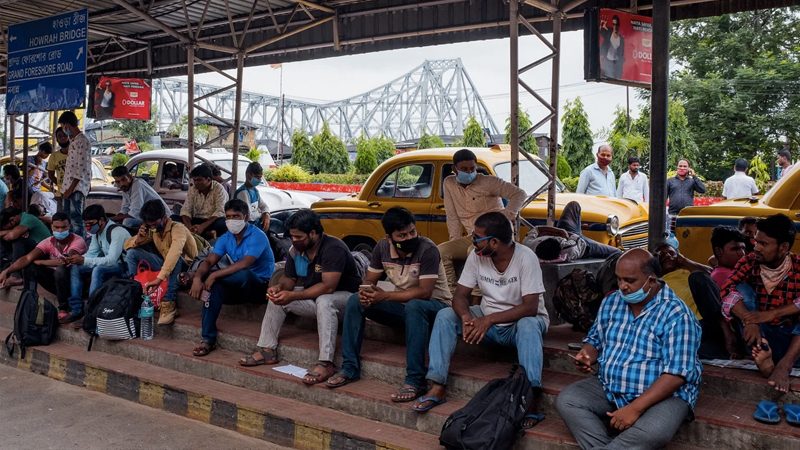
India is reopening its borders to international visitors in a bid to revive economic growth even as the South Asian nation battles the world’s second-worst coronavirus outbreak.
Prime Minister Narendra Modi is using a dip in new Covid-19 infections to prise open the economy from a strict lockdown, welcoming foreigners on business trips, but not tourists.
While regular scheduled commercial flights remain off limits for the time being, overseas travelers can use other options, including flights under a government repatriation program, so-called air-bubble agreements, and private charters, the Ministry of Home Affairs said in a statement Thursday. Ships will also be permitted. All travelers must “strictly adhere” to the guidelines on quarantine and other rules.
The surprise decision comes after the number of daily infections in India dropped to around 55,000 versus almost 100,000 last month. A government panel of scientists said this week the nation may have seen a peak in new infections and could contain the outbreak by February. But critics have attributed that decline to lower rates of testing as the disease spreads to the country’s vast hinterland.
All existing visas — except electronic, tourist and medical ones — will be restored immediately, the government said. People holding expired visas can apply again and foreigners wishing to visit for business, conferences, work, study, research or medical reasons will be allowed to apply, the government said.
India may not be alone in welcoming foreigners amid a worsening outbreak. Indonesia, Southeast Asia’s largest economy and the nation with that region’s worst outbreak, is also considering reopening borders, Foreign Minister Retno Marsudi said in a Thursday briefing.
Indonesia reported 4,432 new cases in the 24 hours through midday Thursday, the most since Oct. 11, bringing the total to 377,541.
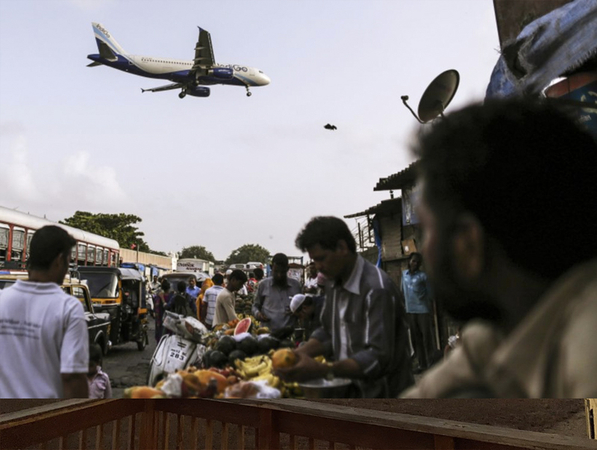
India has extended a government repatriation program to allow private carriers including InterGlobe Aviation Ltd.’s IndiGo and SpiceJet Ltd. to operate such flights with special permission. The nation has also struck air-bubble agreements with 18 countries, including the U.S., U.K., Germany, Afghanistan and Canada.
India’s lockdown at the end of March was the world’s largest and one of its most severe, causing the economy to contract about 24% in the quarter ended June from a year earlier as businesses and jobs were demolished. Once restrictions were eased, authorities struggled to get the pandemic under control with the number of infections now second only to the U.S.
India has also been allowing local airlines to fly a limited schedule since May. But most carriers failed to fill even 70% of their seats last month as passengers remained wary about catching the deadly virus. Modi’s administration has set aside about 500 billion rupees ($7 billion) to vaccinate the world’s most populous nation after China, Bloomberg News reported Thursday.
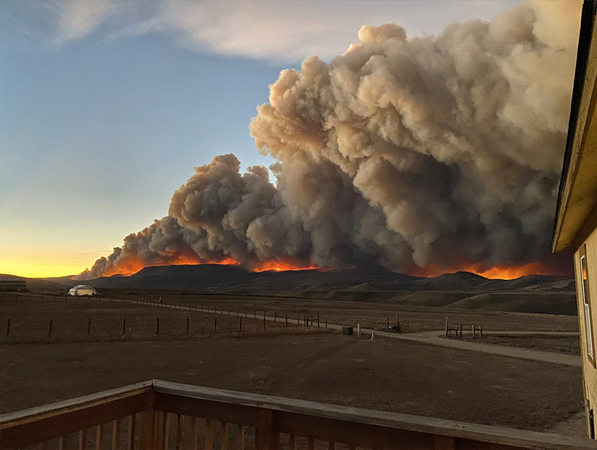
Jessy Ellenberger made this photo from the deck of her home north of Granby, Colo., just before sunset on Wednesday. (Jessy Ellenberger via AP)
By The Washington Post · Andrew Freedman · NATIONAL, SCIENCE-ENVIRONMENT
A dire wildfire crisis is unfolding in Colorado after a blaze exploded sixfold in size in just 24 hours, growing to about 125,600 acres on Thursday morning. The East Troublesome Fire, burning in Grand County and extending now into Rocky Mountain National Park, forced hundreds to quickly evacuate from Grand Lake and Granby overnight, with more evacuations likely Thursday and an unknown number of structures reportedly destroyed.
The blaze has all the hallmarks of climate change. It’s burning at an elevation of 9,000 feet at a time of year when snow should be falling. The fire is also raging during a severe drought, aggravated by record heat, through stands of trees killed or weakened by a bark beetle infestation.
The East Troublesome Fire is now the fourth-largest wildfire in Colorado history. Three of the state’s five largest wildfires on record have now occurred in 2020. The largest, the Cameron Peak Fire, is still burning just west of Fort Collins.
Noel Livingston, who leads the team of firefighters tackling this blaze as incident commander for Pacific Northwest Team Three, said that crews saw an “amazing amount of fire spread yesterday.”
At times, National Weather Service Doppler radar showed the smoke plume from the blaze towering almost 40,000 feet above the surface, a sign of extreme fire behavior. Typically, at such a high elevation in the state, the weather at this time of year would not result in such a high wildfire danger. Instead, a red flag warning for “critical” fire weather risk is in effect through 7 p.m. Mountain time Thursday, with winds forecast to gust up to 50 mph, making efforts to increase fire containment difficult.
“We saw about 20 miles of fire growth throughout the day and throughout the night, which equated to about 100,000 acres of additional fire activity,” Livingston said.
Livingston said the fire burned quickly through heavily forested areas north of Granby and Grand Lake. A pre-evacuation notice was issued for Granby on Thursday.
There are indications via satellite imagery and ground observations from park rangers that the fire jumped the continental divide in Rocky Mountain National Park, despite being areas that are above the tree line. That is an extremely rare occurrence and may put new downwind areas to the east, such as Estes Park, at risk. A merging of this fire with the Cameron Peak Fire is even possible, Livingston said during a news conference Thursday.
Evacuation orders for the national park and parts of Estes Park have been issued, with traffic backups reported Thursday afternoon for people leaving Estes Park.
The ingredients for the massive, rapid growth of this fire, Livingston said, were the thick stands of trees, many of which had been weakened or killed by beetle invasions in recent years, a phenomena linked to climate change that is occurring across vast stretches of the West and into Canada.
As temperatures have increased in Colorado, it has given once-scarce pests, including mountain bark beetles, that were held in check by extremely cold winter temperatures, an opportunity to spread and damage or destroy trees. Studies have shown that in some ecosystems, these dead or weakened trees can accelerate blazes, while in others they may actually slow down some wildfires.
Livingston also pointed to extremely dry conditions and strong winds that pushed the fire through the timbered areas. Winds near the fire were gusting to 60 mph at times on Wednesday.
Winds are predicted to remain strong for the rest of the week, said Nick Nauslar, a predictive-services meteorologist with the National Interagency Fire Center in Boise, Idaho. He noted in an interview that at 9 p.m. on Wednesday night, near the fire at 8,500 feet in elevation, the air temperature was 70 degrees and winds were gusting to 68 mph.
“That’s pretty rare just in the summer for 8,500 feet, let alone late October,” Nauslar said, since normally it would be colder at that height. “I’ve used the word ‘unprecedented’ before and I’m starting to run out of adjectives to describe what’s happening this fire season,” he said.
Grand County Sheriff Brett Schroetlin published a Facebook video Thursday explaining how tough the night had been.
“I have a message,” he said. “I’m not even sure what those words are. Today [Wednesday] has been an extremely, extremely challenging day for our community. We knew this fire was here. We knew the impacts of it. We looked at every possible potential for this fire. We never, ever expected 6,000 acres per hour to come upon our community.”
The winds were strong and, as a result, the fire’s behavior was as well.
“As we drive around this northern part of Grand County, I don’t know what we’ll see in the morning, to be honest,” he said. “But you know what? Together, as a community, we’re going to get through this.”
The forecast for Thursday calls for more high winds and low relative humidity in the region of the fire.
“Unfortunately, today is another fire day,” Livingston said. “We have forecasted high winds coming in this afternoon with a cold front passage. We have again forecasted dry conditions. And we obviously have a lot of available fuel this fire could continue to spread in.
“We anticipate another day of large fire growth,” Livingston said.
Colorado is under drought conditions for the first time since 2013. Human-caused climate change is sparking more frequent and intense wildfires in much of the West, along with an extension of the wildfire season, studies show. Higher air temperatures are worsening droughts as well.
California is also experiencing a record wildfire season. More than 4.1 million acres have burned, and more than 9,200 homes and other structures destroyed since Jan. 1. California wildfires have killed 31 people this year, with more high winds in the forecast for the next week, which could spread any new blazes that ignite.
By The Washington Post · Elizabeth Chang · FEATURES, HEALTH, HEALTH-NEWS
Although studies continue to show that the novel coronavirus can be detected on contaminated objects after days or weeks, a consensus has emerged among scientists that the virus is rarely transmitted through contact with tainted surfaces and that it’s safe to stop taking such extreme measures as quarantining your mail and wiping down your groceries.
“To the best of my knowledge, in real life, scientists like me – an epidemiologist and a physician – and virologists basically don’t worry too much about these things,” said David Morens, a senior adviser to the director of the National Institute of Allergy and Infectious Diseases, Anthony Fauci.
That’s in line with advice from the Centers for Disease Control and Prevention, which has updated its “How Covid-19 Spreads” Web page to say that “spread from touching surfaces is not thought to be a common way” the virus is transmitted.
Although ongoing research can sound alarming – such as an Australian study published Oct. 7, which found that SARS-CoV-2 could be detected on surfaces such as glass and stainless steel after 28 days – Morens said the public should not be concerned.
Such studies “basically tend to show that under experimental conditions, which are not real-world conditions, you can get virus to persist and you can detect that persistence,” he said. But, he added, that doesn’t mean the virus could infect anyone. “The amount of virus that can persist might not be the amount of virus that can affect you in a real-world environment.” In the real world, airflow, sunlight and heat all act quickly to weaken the coronavirus.
Stefan Baral, an associate professor in the department of epidemiology at the Johns Hopkins Bloomberg School of Public Health, said there’s a big difference between a single viral particle being able to survive on a particular surface and the ability of a virus to enter a mucus membrane, cross that mucus membrane and successfully replicate and infect someone. “A single viral particle is exquisitely unlikely to cause serious effect,” he said.
But public confusion about the coronavirus and surfaces is understandable, said Angela Rasmussen, a virologist at the Center for Infection and Immunity at Columbia University’s Mailman School of Public Health. “Scientists really haven’t really done a very good job of explaining how you get evidence for different types of transmission or different transmission routes.”
Rasmussen said epidemiologists can have a difficult time finding real-word evidence of a virus’s transmission via contaminated objects or surfaces, which are called fomites. In the case of the coronavirus, this is partly because transmission often occurs in the context of large, superspreader events, leaving researchers struggling to determine who talked to whom, and who touched what surface. “It’s not at all uncommon to not have strong epidemiological evidence for fomite transmission,” she said, “but that doesn’t mean that fomite transmission doesn’t happen.”
In fact, Rasmussen added, because we know that other respiratory viruses that are transmitted by inhalation, such as the flu and rhinovirus, are also transmitted by fomites, it stands to reason that coronavirus is likely transmitted by fomites as well. “It just may be that that’s not necessarily the dominant mode of transmission,” she said. And although it may be important for researchers to determine how long the virus remains infectious in various environments, when it comes to daily life, “I don’t think that it’s necessarily wise to be wiping groceries down.”
Morens agrees. “There’s just a lot of unnecessary worry about these things,” he said. “It’s like standing in the middle of a busy freeway with traffic all around you and asking, ‘What’s the chance I’m going to get hit by a meteor?’ Now there’s a chance, but it’s pretty low, and don’t you have other better things to worry about?”
Although no environment can be determined to be totally safe, Morens says we need to think about actions as low-, medium- or high-risk. The times to worry about contaminated surfaces would be when you are in a crowded public place where many people are touching the same surfaces. As an illustration of an area that poses high risk, he cited a public restroom next to a crowded airport lounge, where possibly contaminated people might touch the door handle, light switch, towel dispenser and faucet. That’s a situation where you should be super-alert; if you wash your hands and then touch the faucet or door handle again, for example, you’ve just possibly contaminated yourself.
Protection is not gained by washing down everything in the environment, Morens said. “It’s the behaviors you do to make sure that nothing in the environment, including your own hands, gets into your mouth, nose or eyes.”
Those behaviors include never touching yourself above the neck, wearing a mask (which also helps remind you not to touch your face), social distancing and making sure your hands are as clean as possible. In that case, you could even go into a restaurant and touch objects there – the chair, the menu – without wiping them down first, and “if the very last thing you touch is soap and water or hand sanitizer . . . you’re okay,” said Morens.
Baral, who has been pushing for the reopening of playgrounds, said that one of the factors he considers when deciding whether a situation is high-risk is the environment the virus might find itself in. “These viruses do not survive well outdoors,” he said. Coronaviruses like to be surrounded by fluid to protect them, and fluid evaporates pretty quickly outside – leaving the virus vulnerable to the elements. He noted that outdoor playgrounds, which have not historically been known as high-risk settings for other viruses, have not been identified as areas of common exposure for the coronavirus, months into the pandemic, which he finds “striking.”
However, Baral doesn’t feel the same way about indoor environments. There may be environments in people’s homes where the virus does well and lives on surfaces, he said. For that reason, people should immediately wash their hands as soon as they enter their home from the outside and frequently disinfect common surfaces, such as doorknobs and faucets.
But could all the sanitizer and disinfectant being used to clean hands and high-touch surfaces be paving the way for antibiotic-resistant “superbugs?” Not if you’re using soap and water or the products recommended by the World Health Organization and the CDC, which are alcohol or bleach-based – and not those labeled antibacterial, says Rasmussen. Antibacterial products are the ones that can encourage the development of drug-resistant germs – and they don’t kill viruses, anyway.
Soap and water, alcohol and bleach, on the other hand, work in a broad-spectrum way, Rasmussen said, and kill many bacteria as well as viruses. She believes there’s really no need for antibacterial cleaners in the household. “It’s unfortunate that for a while they were very popular on the consumer market,” she said. “But you can use soap and these other types of disinfectants that are more general and that won’t select for resistance.”
Finally, she said, it’s important to remember that “viruses have to have a host and they can’t replicate without one. So . . . the main place that’s going to be the source of virus in anybody’s household is going to be the people in it and not the surfaces or the physical environment.”
“Even if there’s virus kicking around on certain things,” she said, “that risk can really be mitigated practically by washing your hands.”
By The Washington Post · Carol Morello · NATIONAL, POLITICS
WASHINGTON – As the eyes of the world focus on the U.S. election, teams of international observers are heading out across the United States amid concerns about the vote’s integrity.
For the ninth time, observers affiliated with the Organization for Security and Cooperation in Europe (OSCE) have come to the United States to watch over an election and recommend improvements, a mission little-noticed by most Americans.
But the 2020 campaign is different.
As fears rise about voter suppression, violence and a potentially contested outcome in the United States, the Europeans say they hope their efforts will help assure Americans that the vote is legitimate.
“This is one of the most important elections we have ever observed as the OSCE Parliamentary Assembly,” said Roberto Montella, secretary general of the group, which will dispatch 59 lawmakers and a staff of 16 to monitor voting in 10 states and the District of Columbia.
“One of the reasons is that this is the first time in my recollection that the incumbent cries foul before the competition actually takes place and before the outcome is known,” Montella added.
OSCE officials note that no election anywhere is perfect, and that many nations are undergoing a period of strident political divisiveness. But rarely have so many questions arisen about the validity of American elections, which are often considered as the epitome of fair and free voting.
In part to address the concerns, the OSCE’s Office for Democratic Institutions and Human Rights (ODIHR) has sent a pared-down group of 30 observers who will fan out to 28 states, aided by 15 electoral experts who will operate from Washington. That is far fewer than the 500 observers they initially recommended. But the raging coronavirus pandemic and travel restrictions made it difficult to recruit more people.
The two OSCE observer groups will coordinate their efforts and announce their preliminary findings the day after the election, then issue a complete report two months later.
In an interim report released Thursday, ODIHR observers outlined their concerns that the election will be hampered by the impact of the coronavirus and diminished voter confidence in its fairness.
The report said that $400 million in federal funds given to states to address health and safety issues stemming from the pandemic may not be enough to guarantee safe and well-organized elections.
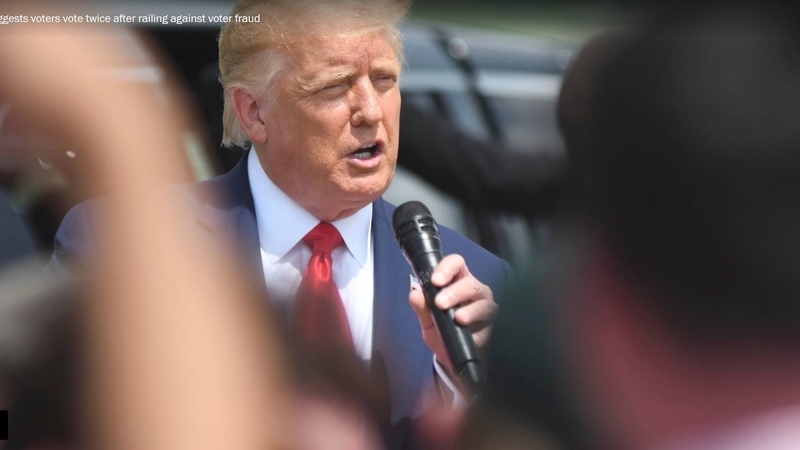
In an unusually blunt warning, they worried that President Donald Trump’s unsupported assertions of widespread voter fraud could undermine trust in the election itself.
“Throughout the campaign, President Trump has repeatedly claimed that the elections would be marred by fraud, especially in relation to absentee and particularly postal voting,” the report said.
Many observers, it added, “expressed grave concerns about allegations from a sitting president casting doubt on the democratic process without presenting any evidence that the integrity of the election process could be systematically jeopardized. On a number of occasions, President Trump refused to commit to a peaceful transition of power if he lost the elections, using this stance to reaffirm his lack of trust in the process.”
In such a polarized political environment, the report said, the observers fear for “the potential for political violence in the aftermath of the elections.”
With their numbers so depleted, the observations this year will be more anecdotal than usual, as the smaller teams look for impediments to voting, such as long lines outside polling stations and signs of voter intimidation.
But OSCE officials are confident they can produce an accurate and credible report because the observers will have spent six weeks preceding Nov. 3 talking to local election officials. In previous elections, their recommendations have included restoring voting rights to felons who have completed their sentences and making more accommodations for voters with disabilities and other hindrances.
But some Europeans worry that the number of observers will be insufficient in a country as vast as the United States.
That prompted Martin Schirdewan, a German member of the European Parliament from a left-leaning party, to urge three European multilateral organizations to send more observers.
Schirdewan said he has grown increasingly alarmed by reports of voter suppression and intimidation, armed groups formed by white supremacists and Trump’s refusal to commit to a peaceful transition of power if he loses.
“I’m really a friend of the United States,” he said, noting that the U.S. Army liberated his grandfather from a concentration camp during World War II. “I see a real danger of the United States falling into a state of authoritarianism and anti-democratic rule. European institutions need to step up. We have to take a stand, as responsible Europeans, before the election, and make clear we expect nothing less than a democratic vote.”
Countries and organizations that want to send monitors to the United States must be invited by the State Department, a formality always granted the OSCE because the United States is a member. All visa requirements are waived. In 2018, the OSCE even included two Russian observers for the midterm elections.
This year, the State Department also invited observers from the Organization of American States, which represents countries in North and South America. But the OAS has not yet announced whetherit will send anyone, and a spokesman for OAS headquarters in Washington said more information was not immediately available.
A European diplomat, speaking on the condition of anonymity to be frank about the concerns, said many governments are watching from afar with a sense of “befuddlement, wonder and deep worry as well.” Another described the mood as “apprehensive.”
But others in the European Union are confident that the United States will live up to its ideals.
“The E.U. is following the U.S. presidential elections with great interest,” David McAllister, a German Christian Democrat who is chairman of the European Parliament’s Committee on Foreign Affairs, said in an emailed statement. “I strongly believe in the U.S. democratic and constitutional system of checks and balances.”

![Aerial photo taken on March 18, 2020 shows a container dock of Yangshan Port of Shanghai, East China. [Photo/Xinhua]](https://media.nationthailand.com/images/news/2020/10/23/30396650/800_85270b7a515a1d4.jpeg?v=1603421160) Aerial photo taken on March 18, 2020 shows a container dock of Yangshan Port of Shanghai, East China. [Photo/Xinhua]
Aerial photo taken on March 18, 2020 shows a container dock of Yangshan Port of Shanghai, East China. [Photo/Xinhua] 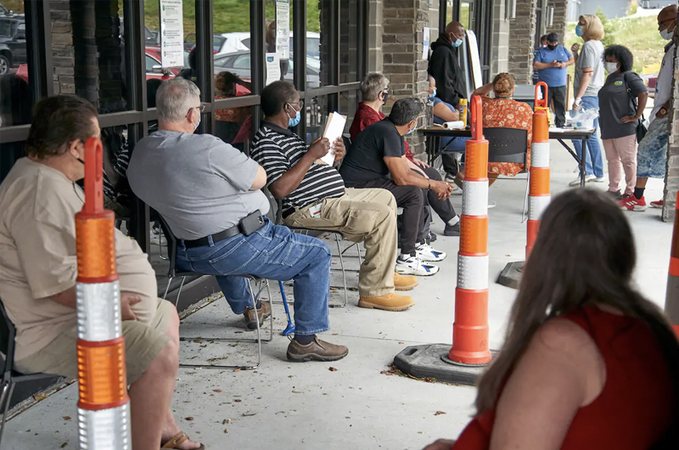
 Democratic presidential nominee Joe Biden speaks at the Little Haiti Cultural Complex in Florida on Oct. 5. MUST CREDIT: Washington Post photo by Demetrius Freeman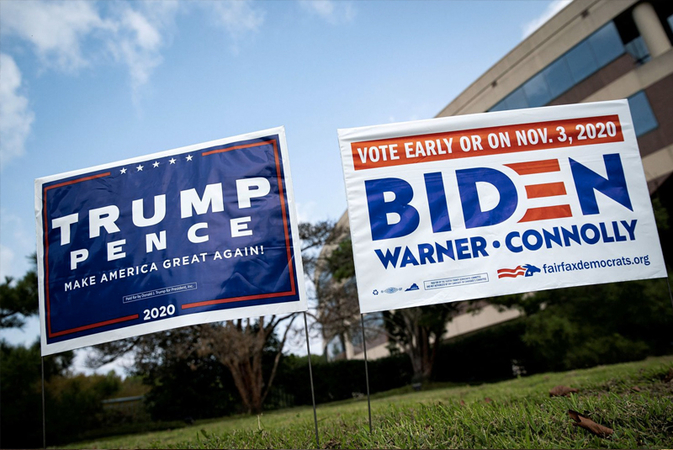

 A member of Germany’s Red Cross stands near a Covid-19 mobile testing unit as travelers are tested in Berlin, Germany, on Oct. 12, 2020. MUST CREDIT: Bloomberg photo by Liesa Johannssen-Koppitz.