In 2020, back-to-school shopping means frantically searching for other families to ‘bubble up’ with #ศาสตร์เกษตรดินปุ๋ย

#ศาสตร์เกษตรดินปุ๋ย : ขอบคุณแหล่งข้อมูล : หนังสือพิมพ์ The Nation.

In 2020, back-to-school shopping means frantically searching for other families to ‘bubble up’ with

Aug 09. 2020The Henrys of Cedar Hill, Texas, are one of many young families who are trying to join forces - and quarantine bubbles - as the school year approaches.  CREDIT: Photo for The Washington Post by Ralph LauerThe Henrys of Cedar Hill, Texas, are one of many young families who are trying to join forces – and quarantine bubbles – as the school year approaches. CREDIT: Photo for The Washington Post by Ralph Lauer

By The Washington Post · Ellen McCarthy · FEATURES, EDUCATION, PARENTING 
It’s August, and America’s parents are the prowl. They’re posting personals ads online and having awkward Zoom dates with near-strangers. They’re scouring message boards for potential matches and asking friends and family members if they know anyone who might be available, interested and – this is the hardest one – compatible. 

There’s nothing thrilling or romantic about it. This is about the kids, and the challenge of surviving this nuclear winter of a school year. Quaran-teams, double bubbles, pandemic pods, micro-schools – whatever you want to call them, young families are seeking some friends for the end of the world as they knew it. 
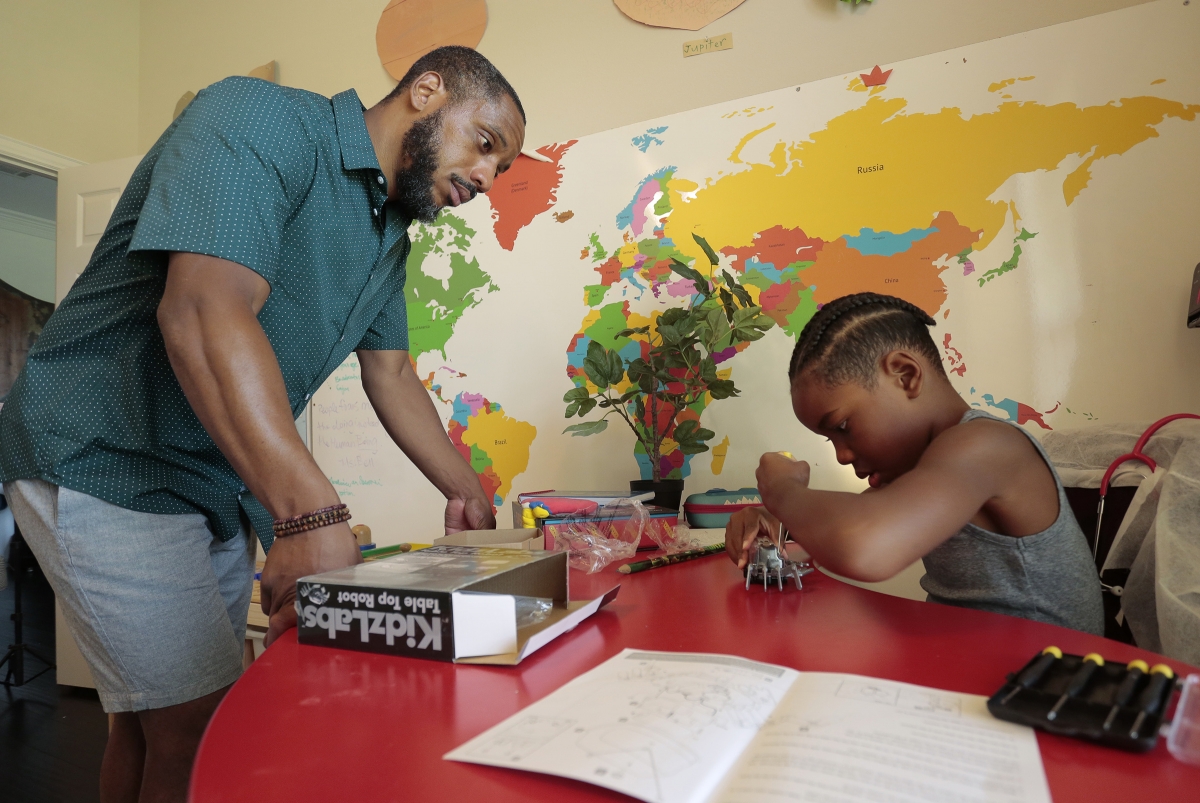
Jeffrey Henry, left, watches his son, Jackson, assemble a desktop crab robot in his learning area. MUST CREDIT: Photo for The Washington Post by Ralph Lauer

Jeffrey Henry, left, watches his son, Jackson, assemble a desktop crab robot in his learning area. MUST CREDIT: Photo for The Washington Post by Ralph Lauer

Desperation? Palpable. Hurt feelings? Inevitable. 

“It feels like speed dating/Match.com but with much more high stakes,” says Elizabeth Morin Burns, a D.C. mother of a 6-year-old son and 3-year-old daughter. “And it’s emotionally taxing. The timelines are starting to catch up. It’s like, ‘I need to find my partner. I need to find my soul mate, fast, and figure out how we’re going to manage it.’ “

When schools first shuttered in March, the move was presented as a short pause to suppress the spread of the novel coronavirus. The closure continued through the end of the school year; families muddled through. Now, as the virus has eluded containment and worsened in many states, parents are waking up to the idea that they will be more or less on their own for another six to nine months. Improvising won’t cut it any longer. It’s time to Figure Something Out.

Burns, who works for the Navy, is spending her days mentally rotating through the array of potential survival tactics she and her husband could pursue. Move to Florida to be close to family? Take a leave of absence from her job? Come up with the money to pay for private school?

Forming a team with nearby families in the same situation seemed like the best solution, so Burns set up a Facebook page for Capitol Hill parents looking to create pods. But so far, the process has proven more frustrating than fruitful. 

She posted a notice that she was looking for parents of other rising first-graders who might want to form some sort of cohort. Burns connected with five other families who seemed like good potential matches – until they started talking or texting. Some were uncomfortable with the fact that Burns and her husband occasionally have to work outside the home. Others were looking to spend exorbitant amounts on private tutors. 

Online daters can at least lay out some basic specifications: desired age range, religious preferences. But the quest for perfect pod partners is more chaotic.

“It’s so overwhelming,” Burns says. “I just feel like I’m trapped on my laptop all day trying to hunt some kind of unicorn solution.”

She, like almost every parent interviewed for this story, acknowledged how lucky her family is to have options – and expressed concern about how their choices could affect less privileged children and kids with special needs, an issue that has caused contentious debate in parenting circles. 

Randi Braun, an executive coach who works primarily with women – moms seem to be doing the vast majority of online diplomacy around pandemic school planning, based on the posts showing up on parenting message boards and Facebook pages – says the search for solutions is “all-consuming” for most of her clients. 

“That’s the thing keeping parents up right now: thinking about not just Plan A, but Plan B and Plan C,” she says. “We used to talk about the mental load before the pandemic. This is next level.”

Braun has two kids under 4. Her family has spent much of the summer in Long Island with her parents, discussing their strategy for the fall, when they’ll return to D.C. They have decided to send both kids to the preschool they had originally signed up for, even though she knows it will probably face interruptions or closure if positive coronavirus cases pop up. And by choosing that option, they are cutting themselves off from in-person visits with the grandparents, out of concern for their health. 

“When we say goodbye here, it’s goodbye for a really long time,” she says. And once that happens, Braun is counting on a village of people she has never met to be their pandemic companions: the families of her kids’ upcoming classmates. 

“That’s going to be our orbit for the foreseeable future until there’s a vaccine,” she says. “I feel like I’m taking a trust fall into this idea of community.”

Ebony Scott is doing her own trust fall with a woman whom she has never met in person. Scott, a single mom outside of Chicago who works for a nonprofit, connected through a local Facebook page with another woman looking for a pod. They live in the same town, and both have boys going into the third grade, though at different elementary schools. In their first conversation, conducted via video chat last week, the moms delved headlong into intimate details about their home lives, their kids’ personalities and learning styles and their priorities for the year – which, for Scott, meant making sure the curriculum includes lessons on social justice and racial inequity.

“I don’t know this woman. I’m telling her, ‘We are a Black family. You are a White family. When it comes time for Black history, we are going to really talk about things,’ ” Scott says.

The women’s desires meshed well enough to move forward with a plan to have their sons become a cohort of two and hope they happen to like each other – at least well enough to coexist. “We’re not shopping for best friends,” Scott says. “We’re looking for kids who are going to be compatible in a learning environment.”

Julia and Greg McLawsen of Bellevue, Wash., have so far struck out in their search for compatibility. Their son, Kai, is the type of kid who woke up early on school days, excited to learn and see friends. “Weekends were crushing for him,” says Julia, a forensic psychologist. 

The McLawsens can’t imagine Kai, who is supposed to be entering kindergarten, going many more months without structured social interaction. But finding a pod has proved difficult. Because Julia sometimes has to go out for work, some prospective families considered the McLawsens to be undesirable bubble buddies. (“It cast a pall on our entire family,” she says.) Others had different philosophies around learning or how often to be together. And, though they have yet to find a willing cohort, they’ve begun to worry about how fragile a pod setup could be. 

“In addition to the matchmaking problem, one thing we’re worried about is having a single point of failure,” says Greg, an attorney. “If you have one person teaching the pod and they get sick or get sick of us or get a better offer, the whole thing crumbles.”

“And that pulls the rug out of the stability we’re seeking,” Julia adds.

So, even as they continue searching for potential matches, the McLawsens, who also have a 20-month-old daughter, are pursuing alternatives, including the possibility of relocating to Vancouver or even Thailand, where rates of coronavirus infections have been kept low. The couple has gone as far as putting down a deposit at a Montessori school in Chiang Mai, though moving there would mean Julia would have to stop working. 

They’re trying to remain flexible, but they know they need to make a decision soon. “If we’re going to Vancouver, we need to walk out the door in two weeks,” Greg says. “If we’re going to Thailand, we need to get visas going.”

“The logistics are formidable and overwhelming,” Julia says. “And the logistics for keeping our son home for a whole academic year are even worse.”

Finding pandemic pod-mates may be the first challenge for parents, but Jennifer Henry can attest that it won’t be the last. As an educational consultant with several years of home-schooling experience under her belt, Henry is steps ahead of most parents. When it became apparent that schools couldn’t safely open in their Dallas suburb, several friends and relatives asked Henry to set up a pod. 

Her son, Jackson, 9, named a few boys he would like to learn with, and they ended up with a four-family pod that includes one of Jackson’s previous classmates, a cousin and a family friend. Then came questions of how they would operate. Henry’s husband, Jeffrey, wanted the boys to be together in person every day, but that wouldn’t work for the other families, so they compromised on meeting once a week, with virtual learning the four other days. 

Next came touchy conversations around socializing outside of the pod, how they’ll evaluate and pay teachers and what each family would do if schools reopen. One family is adamant that if schools do reopen, they’ll send their son back, which could leave the rest of the pod in the lurch, and potentially on the hook for a greater portion of teachers’ salaries.

“You’re in each other’s personal business,” Henry says. “You’re sharing responsibility for each other’s kids. I feel like it’s some sort of polygamist community. It’s a level of forced intimacy.”

For several weeks, the parents have been meeting online for post-bedtime strategy sessions. And every time they reach consensus on one issue, it seems like another one pops up. (They just plotted out the school calendar, but now there are concerns about how to address learning differences.)

Think building a plane in midair is difficult? Try creating a miniature school in a month. And doing it by committee – one made up of deeply impassioned parents. 

As many hurdles as they’ve faced, Henry still believes the pod offers an opportunity to “outsmart the oppression” by developing a curriculum that more deeply reflects African American history and experiences than public elementary schools typically offer. She’s also hoping to recruit volunteer teachers to help form similar pods for underserved children that could take place in churches and other community spaces around Dallas. 

Emily Oster, an economist at Brown University and the author of two books on parenting, argues against pandemic pods in general because of the likelihood that they’ll exacerbate inequalities. And because they’re social minefields: “It’s fraught on a bunch of dimensions,” she says. “Like, ‘Oh, can I be in your pod?’ ‘No, we already have our pod.’ The opportunity to shun people is so great.”

If parents do attempt to form some kind of micro-school, Oster says, they should put their expectations in writing. “This is not a set of relationships we’re used to navigating,” she says. A contract, even if it’s nonbinding, gives parents “something to refer back to later. And the bigger thing is that it reveals potential sources of conflicts you weren’t thinking about.”

Robin Watkins isn’t looking for anything nearly so formal. She just wants some buddies. Her parents came to visit just after she gave birth to her second child at the end of February. Then the world froze, and her parents hunkered down in D.C. with Watkins, her husband, their toddler and their newborn. Because of her parents’ advanced ages, the family has kept to themselves – exclusively.

“It just turns out that even with my best friends, we’re not exactly aligned around the choices we’re making around risk to covid.”

Watkins sent a note to a local mom mailing list with the subject line: “ISO family to form bubble.”

“This is certainly the oddest email I’ve ever written,” she wrote. She included sections labeled “About us” (“local beer lovers, Nationals fans, and Jeopardy! Nerds”) and “About you” (“Also social distancing, ideally have kids around the same age and interested in a socially distant meetup to find out if we are a good fit for a bubble.”) Half a dozen women responded, and Watkins chatted with each of them online. They were all nearby and had kids of similar ages. Alas, none seemed like a perfect match.

The sticking point? Social distancing. Some had in-home child care, which meant their bubbles were already exponentially expanded in a way that feels too risky to Watkins and her family.

Oh well. “I put it out there into the world, and if nothing comes of it, we’ll be OK,” Watkins says. “It’s what we’ve been doing.”

What they’ve been doing. What they’ll keep doing. 

What else can you do? 
TikTok’s fate was shaped by ‘knockdown, drag-out’ Oval Office brawl #ศาสตร์เกษตรดินปุ๋ย

#ศาสตร์เกษตรดินปุ๋ย : ขอบคุณแหล่งข้อมูล : หนังสือพิมพ์ The Nation.

TikTok’s fate was shaped by ‘knockdown, drag-out’ Oval Office brawl

Aug 09. 2020

By The Washington Post · Ellen Nakashima, Elizabeth Dwoskin, Jeff Stein, Jay Greene · NATIONAL, BUSINESS, TECHNOLOGY, POLITICS 

WASHINGTON – Last week, as leaders in Silicon Valley, China and Washington raced to seal the fate of one of the world’s fastest-growing social media companies, a shouting match broke out in the Oval Office between two of President Donald Trump’s top advisers.

In front of Trump, trade adviser Peter Navarro and other aides, Treasury Secretary Steven Mnuchin began arguing that the Chinese-owned video-sharing service TikTok should be sold to a U.S. company. Mnuchin had talked several times to Microsoft’s senior leaders and was confident that he had rallied support within the administration for a sale to the tech giant on national security grounds.

Navarro pushed back, demanding an outright ban of TikTok, while accusing Mnuchin of being soft on China, the people said, speaking on the condition of anonymity to discuss private discussions freely. The treasury secretary appeared taken aback, they said.

The ensuing argument – which was described by one of the people as a “knockdown, drag-out” brawl – was preceded by months of backroom dealings among investors, lobbyists and executives. Many of these stakeholders long understood the critical nature of establishing close connections with key figures in the Trump administration.

But over the past few weeks, they also were reminded of the unpredictable and precarious nature of business dealings under a Trump-led government – and how the winner of a heated debate in front of the president could help decide the fate of a multibillion-dollar deal that may reshape the technology business landscape for years to come.

Over the past two weeks, TikTok’s future has been publicly tossed about, first as it appeared that the president would agree to a sale, then that he would ban it outright, then that he would allow a sale again – but only if a fee were paid to the U.S. Treasury.

Behind the scenes, an enormous amount of scrambling has happened in response to each twist and turn. And an executive order signed by the president Thursday night while on Air Force One – which would essentially shutter the U.S. operation of TikTok in 45 days unless it were sold – has sown more confusion about the future of one of the fastest-growing social media start-ups in the world. Few on the East or West coasts knew the order was coming.

The chaotic approach dates back to Trump’s days as a business executive, said Douglas Holtz-Eakin, president of the American Action Forum, a nonprofit, conservative issue advocacy group.

“It’s only effective in the moment, and it wears off in the long term,” said the former director of the Congressional Budget Office and former economic policy adviser to John McCain’s presidential campaign. “It’s hard for the business community to figure out the direction of our policies.”

White House spokesperson Judd Deere said in a statement that the administration “is committed to protecting the American people from all cyber-related threats to critical infrastructure, public health and safety, and our economic and national security.”

Treasury Department spokesperson Monica Crowley said in a statement that the department does not comment on the specifics of meetings with the president, though she confirmed that the secretary did participate in a meeting with the president to update him on national security recommendations.

“One of the great strengths of the Trump administration is the president’s reliance on strong, often opposing views, to reach decisions which are invariably in the best interests of the American people,” Navarro said in a statement. “Because this is true, it is critical for a strong America that ‘what happens in the Oval Office, should stay in the Oval Office’ so I have no comment on what is clearly a malicious leak riddled with hyperbole and misinformation.”

https://www.washingtonpost.com/video/c/embed/ddcd96ac-1794-470a-b4a2-38d1a5f28aa6?ptvads=block&playthrough=false

– – –

TikTok is considered one of the biggest technological success stories to come out of China. People around the world use the app to make short videos about their lives, pets and dance moves. Parent company ByteDance CEO Zhang Yiming calls it a “window” into the world.

TikTok has 100 million U.S. users, many of whom are under 25 years old. Its success has drawn interest from prominent investors, including Sequoia Capital, a leading Silicon Valley venture capital firm. In 2014, its China arm made a prescient $35 million investment in TikTok’s parent company, giving it a stake that today is reportedly valued at more than $800 million. TikTok’s owner also acquired Musical.ly in 2017 for $1 billion, making it even more attractive to young users.

But with that success came scrutiny. TikTok was first identified as a potential national security threat in summer 2019, when U.S. officials approached ByteDance about concerns regarding its acquisition.

That turned into a formal national security investigation this year. It was led by the Committee on Foreign Investment in the United States (CFIUS), an interagency body that screens foreign investment transactions for national security risks and recommends to the president on security grounds whether certain proposed acquisitions should be rejected, as well as completed acquisitions reversed.

In TikTok’s case, the app has been downloaded more than 175 million times in the United States, and like other apps accesses copious amounts of sensitive personal data, including Internet and browsing activity, location data and search histories. That information is potentially available to the Chinese government under a national intelligence law that requires any Chinese company to “support, assist and cooperate with state intelligence work.”

The news of the investigation sent shudders through the halls of Sequoia Capital. Global managing partner Doug Leone took the lead on advocating for TikTok with the Trump administration, telling people he could use his influence with Trump to help the company, according to a person familiar with the discussions who spoke on the condition of anonymity to describe a private conversation. Leone and his wife have given $100,000 to Trump’s reelection bid, and Leone sits on the president’s task force for reopening the economy, according to public records.

Leone also cultivated his relationship with Mnuchin and the president’s senior adviser and son-in-law Jared Kushner, the person said. Sequoia is a co-investor in a health-care company with Kushner’s brother Josh.

Sequoia remains supportive of TikTok and the service it provides for millions of people, spokesperson Natalie Miyake said in a statement, and looks forward to the company reaching “a win-win solution for all parties” involved that is acceptable to the U.S. government.

Meanwhile, TikTok hired about a dozen lobbyists this year, one of whom ran Trump’s campaign in Pennsylvania and has been described by the president as a good friend, according to a person familiar with the company who spoke on the condition of anonymity to discuss company matters. The lobbyist was a U.S. Military Academy classmate of Secretary of State Mike Pompeo, who is also seen as a China hawk.

Publicly, TikTok started a campaign to convince the U.S. government that it was not a threat. The company has said that its app is mostly used for entertainment and that the app’s software code does not contain a back door that could be used for government surveillance. It began issuing transparency reports showing law enforcement requests for data and published the company’s source code. In May, Zhang hired Disney streaming chief Kevin Mayer as TikTok’s new CEO.

Zhang also began trying to decouple the company’s technology from China, and has pointed out that all the data on U.S. TikTok users is stored in the United States and backed up in Singapore. He has worked to separate TikTok’s software code and algorithms from the larger ByteDance conglomerate, which owns several apps in China.

Throughout this year, Zhang and his investors were confident that the concerns of the U.S. federal government could be resolved without ByteDance having to spin off TikTok. But things changed quickly after India outright banned the app at the end of June. At that point, the company and investors started hearing a different message from the White House, and it seemed increasingly possible that the anti-China members of the administration would prevail in breaking up the company.

Throughout July, investors and TikTok’s lobbyists, working privately with the administration, scrambled to come up with other plans, and numerous ideas were floated in what one person familiar with the discussions called an “iterative process.”

One plan involved bringing in a third-party U.S. company with knowledge of technology as a contractor to assure the security of TikTok. In another plan, investors proposed spinning off TikTok from ByteDance, with the investors buying a large share of the new independent company but allowing Zhang to maintain control through a minority stake. That plan involved bringing in another technology company as an investor to ensure security, the people said.

Zhang at one point considered relocating ByteDance’s headquarters to London, and moving there personally, to showcase ByteDance as a global company that was not controlled by Beijing, according to another person.

But this summer, as it became increasingly possible that administration hard-liners could prevail in breaking up the company, Zhang grew disappointed with how the process was playing out and approached Microsoft about a sale, according to the people. Zhang had previously worked at Microsoft’s offices in China in 2008 for six months, and maintained an admiration for the company. Earlier this year, he hired 24-year Microsoft veteran Erich Andersen to be ByteDance’s general counsel.

Other tech giants that have the financial wherewithal to buy the company have regulatory challenges that could make an acquisition more complex. The chief executives of Amazon, Apple, Facebook and Google appeared last week before a House subcommittee investigating tech giants’ abuse of their power. (Amazon founder and chief executive Jeff Bezos owns The Washington Post.)

That gives Microsoft significant leverage. TikTok could help the 45-year-old software giant expand into social media, as well as bolster its ambitions to develop artificial intelligence systems, but the company has thrived financially in recent years on the strength of its business selling cloud computing services. That strengthens its hand as it negotiates to acquire TikTok.

Feeling increasingly boxed in, Zhang offered to sell to Microsoft.

– – –

As the election approaches, Trump has increasingly lashed out at China, blaming it for the novel coronavirus and national security issues. Over the past few months, he has deployed a rarely used order to require the divestment of acquisitions from Chinese firms, as well as issuing executive orders to limit business dealings.

“I think Trump’s instincts are to be aggressive toward China,” said one former U.S. official. “Navarro’s like the devil on his shoulder, saying, ‘Do it, do it.’ Mnuchin is more like a governor, trying to slow everything down – ‘What about Wall Street? What about Phase 2 [of the trade deal]?’ “

During the Oval Office meeting, the debate turned into a “vicious” fight, with Trump looking on, one of the people said. They noted that the two advisers have a contentious history: They got into an expletive-filled shouting match during a May 2018 trip to Beijing.

As of last week, the CFIUS agencies were unanimous that TikTok needed an American partner, according to a person familiar with the matter who spoke on the condition of anonymity to discuss internal negotiations. TikTok lawyers were working with the administration team on an orderly transition, according to the person. “The expectation at Microsoft and at TikTok was the president was going to sign off on what CFIUS said, and off we go,” the person said. “Instead, it’s just been this roller coaster.”

As Trump went to board the helicopter before flying to Tampa just over a week ago on July 31, he sounded unsure of his plans. “We may be banning TikTok,” Trump told reporters before leaving for Florida. “We may be doing some other things. There are a couple of options. But a lot of things are happening, so we’ll see what happens. But we are looking at a lot of alternatives with respect to TikTok.”

Later that evening, as he flew back aboard Air Force One to Washington, he told reporters that he had made a decision to ban it, and that he was not in favor of a deal. By Sunday, Microsoft announced that it had persuaded the president and would continue talks with a deadline of Sept. 15.

“Microsoft fully appreciates the importance of addressing the President’s concerns,” the company wrote in a blog post.

On Monday, Trump reiterated while speaking to reporters at the White House that he wants TikTok to be forced to cease operations in the United States by about Sept. 15 if it is not sold to Microsoft or another U.S.-based company. If that sale goes through, the president said, part of the proceeds should be paid to U.S. taxpayers as compensation for operating in America.

“A very substantial portion of that price is going to have to come into the treasury of the United States,” Trump said of the potential TikTok sale. “The United States should be reimbursed or paid because without the United States they don’t have anything.”

Tax experts say there is no legal way to take “a substantial portion” for the Treasury. But the vague threat allowed him to appear to be imposing a punitive measure on China and TikTok – which some of his aides have pushed for fervently – without taking action so dramatic that it would cause a dangerous escalation.

Lawyers familiar with CFIUS reviews said the treasury does typically collect money during the process, because companies are required to pay modest fees to cover the cost of the review. The fees are based on the size of the proposed transaction and cannot exceed $300,000.

After Trump changed his mind to support a sale to Microsoft, Navarro on Monday accused the tech giant in a CNN interview of being too close to China, citing its prior cooperation with the government and the use of Bing and Skype in the country. He suggested Microsoft could divest its Chinese holdings.

“The question is, is Microsoft going to be compromised?” he asked.

With the clock ticking, analysts expect the purchase price to run into the tens of billions of dollars, a price only a few companies can afford. Microsoft had $136.5 billion in cash and easy-to-access funds at the end of June.

But those involved in a potential deal were again thrown off balance again late Thursday, left in the dark about the president’s plans.

While flying on Air Force One on Thursday, Trump issued two executive orders effectively banning U.S. transactions for TikTok parent ByteDance, citing national security concerns. An acquisition by Microsoft of TikTok during that period would still be allowed.

TikTok said in a statement it posted online Friday that it may take legal action to challenge the order.

“We are shocked by the recent Executive Order, which was issued without any due process,” the company said. “For nearly a year, we have sought to engage with the U.S. government in good faith to provide a constructive solution to the concerns that have been expressed. What we encountered instead was that the administration paid no attention to facts, dictated terms of an agreement without going through standard legal processes, and tried to insert itself into negotiations between private businesses.”

Galaxy Note 20, Z Fold 2 unveiled at first-ever online Galaxy Unpacked show #ศาสตร์เกษตรดินปุ๋ย

#ศาสตร์เกษตรดินปุ๋ย : ขอบคุณแหล่งข้อมูล : หนังสือพิมพ์ The Nation.

Galaxy Note 20, Z Fold 2 unveiled at first-ever online Galaxy Unpacked show

Aug 06. 2020Samsung President Roh Tae-moon introduces Galaxy Note 20 lineup on Wednesday. (Samsung Electronics)Samsung President Roh Tae-moon introduces Galaxy Note 20 lineup on Wednesday. (Samsung Electronics)

By Song Su-hyun
The Korea Herald/ANN

GOYANG, Gyeonggi Province  — Defining the current COVID-19 pandemic crisis as the “new normal,” Samsung Electronics, the world’s largest smartphone provider, unveiled its second flagship model for the year Galaxy Note 20 and four new upgraded mobile gadgets during its first-ever online showcase event, streamed live from a studio in Goyang, Gyeonggi Province, Wednesday night.

Held at the heavily guarded CJ ENM Studio in the planned new city of Ilsan, the noncontact version of the Samsung Galaxy Unpacked show was strictly blocked from any access attempted by those other than Samsung officials, to keep the company’s most crucial mobile event away from any virus infection risks.

“Never before have we relied on technology like we are today. It’s how we are staying connected as we navigate the extraordinary challenges faced around the world,” said Roh Tae-moon, president of Samsung’s mobile business. “Technology must make life easier, not more complex. That’s why we have introduced five new power devices.”

“Alone, these devices are powerful tools to help you maximize work and play,” he said. “Together, as part of the Galaxy ecosystem, they work together seamlessly so you can spend your time focused on what matters most.”

Through the event, Samsung introduced the Korean tech giant’s highest-level technological improvements made for mobile products: the Galaxy Note 20 phablet, Galaxy Z Fold 2 foldable smartphone, Galaxy Tab S7 tablet, Galaxy Buds Live wireless noise-canceling earbuds and the Galaxy Watch 3 smartwatch.

Samsung poured out the five new gadgets at the same time during the show that was streamed for over one and a half hours starting from 11 p.m. here, but the tech titan had planned to shine a spotlight on the Galaxy Note 20 series, the 11th edition of the phablet-like device with a stylus pen.

Among others, President Roh highlighted that the Galaxy Note 20 will be as productive as a computer, while providing a strong gaming performance like a console. 

Galaxy Note 20 (Samsung Electronics)Galaxy Note 20 (Samsung Electronics)

Samsung will roll out two new Note models — the 6.7-inch Galaxy Note 20 and 6.9-inch Galaxy Note 20 Ultra — starting from Aug. 21 globally.

Rather than fresh features, the Note 20 models boast enhanced S Pen functions and gaming quality.

The newest S Pen for Note 20 offers the fastest response speed among existing S Pens, 80 percent faster than Note 10’s S Pen, providing users with an almost-real handwriting experience, Samsung said.

Its Air Actions function has also been improved, as it can recognize a greater variety of movements, allowing the pen to remotely control the smartphone in any display environment.

Samsung has also strengthened the Note 20’s connection with the Windows 10 operating system, allowing users to jump from their smartphones to PCs or vice versa, more freely.

Microsoft’s Your Phone app with Link to Windows integration will enable Note 20 users to easily access their mobile apps directly from a Windows 10 PC without disrupting flow.

It will be simpler and more convenient to send messages, manage notifications, sync photos and make and receive calls from Windows 10 PCs, the company said.

Users can also add their favorite mobile apps to the taskbar or start menu on Windows 10-based PCs to access social networking apps or the gallery on a smartphone.

And for the first time in the Note series, the Galaxy Note 20 Ultra offers a vivid and bright Dynamic AMOLED 2X display and 120-hertz refresh rate, delivering buttery smooth visuals on its best screen yet, which automatically adjusts to the content users are viewing to optimize battery life.

Sporting an all-day intelligent battery and Super Fast Charging capabilities, users can get more than 50 percent charge in just 30 minutes.

Samsung also unveiled the much anticipated Galaxy Z Fold 2, the second edition of the Galaxy Fold, during the event.

The tablet PC-like foldable smartphone sports a 6.2-inch cover display and a 7.6-inch main display that can be described as almost bezel-less.

Samsung described the Galaxy Z Fold 2 as bringing meaningful innovations to offer users enhanced refinements and unique foldable user experiences.

The Galaxy Z Fold 2 comes in either mystic black or mystic bronze that is the signature color for the newset lineup.

For users who seek a unique premium design, Samsung is again partnering with iconic New York fashion house Thom Browne to deliver a limited Galaxy Z Fold 2 Thom Browne Edition.

The foldable gadget is expected to hit the market next month. 

New Galaxy products (Samsung Electronics)New Galaxy products (Samsung Electronics)

As much as for the smartphones, expectations are also running high for Samsung’s new wireless earbuds, the Galaxy Buds Live. As widely rumored, the earbuds have adopted a new design like a bean for a more comfortable fit.

Combining AKG’s sound expertise with a bigger, 12-millimeter speakers compared to the previous Galaxy Buds+, along with a bass duct, the Galaxy Buds Live offer audio sounds that are deeper and richer, Samsung said.

Like their rival Apple’s AirPods, the latest Samsung earbuds finally feature active noise cancellation for more live and spacious sound quality, with the ability for users to tune in or out of the world surrounding them.

The Galaxy Buds Live come with three microphones and the Voice Pickup Unit that enables users to feel like they are in the same room as others.

Samsung also showcased the Galaxy Watch 3 with advanced health features and Tab S7 series with greater portability, forming a stronger Galaxy ecosystem, during the online show.

Facebook, Twitter penalize Trump for posts containing coronavirus misinformation #ศาสตร์เกษตรดินปุ๋ย

#ศาสตร์เกษตรดินปุ๋ย : ขอบคุณแหล่งข้อมูล : หนังสือพิมพ์ The Nation.

Facebook, Twitter penalize Trump for posts containing coronavirus misinformation

Aug 06. 2020

By The Washington Post · Heather Kelly · NATIONAL, BUSINESS, TECHNOLOGY, HEALTH, POLITICS 

Facebook and Twitter on Wednesday took extraordinary action against President Donald Trump for spreading coronavirus misinformation after his official and campaign accounts broke their rules, respectively.

Facebook removed from Trump’s official account the post of a video clip from a Fox News interview in which he said that children are “almost immune” from covid-19. Twitter required his Team Trump campaign account to delete a tweet with the same video, blocking it from tweeting in the interim. 

In the removed video, president Trump can be heard in a phone interview saying schools should open. He goes on to say, “If you look at children, children are almost – and I would almost say definitely – but almost immune from this disease,” and that they have stronger immune systems.

The twin actions came three months before the elections in which Trump’s performance on coronavirus is a key issue, and the social media companies have made it clear in recent months that they will not tolerate misinformation on the global pandemic.

The decision represents something of an about face for Facebook, whose chief executive Mark Zuckerberg has long been a proponent of free speech on his site. Zuckerberg under pressure in late June said the company will remove posts that incite violence or attempt to suppress voting – even from political leaders – and that the company will affix labels on posts that violate hate speech or other policies.

Twitter, meanwhile, has taken a more aggressive stance, flagging several of Trump’s tweets for misinformation and even blocking his son, Donald Trump Jr., from tweeting for 12 hours for breaking its coronavirus misinformation rules. 

Twitter said it hid the campaign’s post and said the account wouldn’t be able to tweet again until it’s deleted, although it can appeal the decision. The Trump campaign account was active again late Wednesday night. Trump’s personal account also reshared the video originally posted by Team Trump, but it was removed after the original tweet was blocked.

Twitter spokeswoman Liz Kelley said the tweet “is in violation of the Twitter Rules on covid-19 misinformation. The account owner will be required to remove the Tweet before they can Tweet again.” 

Facebook spokesman Andy Stone said, “This video includes false claims that a group of people is immune from covid-19 which is a violation of our policies around harmful COVID misinformation.”

A Trump campaign spokesman did not immediately respond to a request for comment.

While many children have had milder symptoms from the virus, researchers have found they are still able to catch and spread it to other people, including adults at home and in school settings, such as teachers.

“They get it and can transmit it, but they get it less and transmit it less than adults,” said Dr. Theodore Ruel, chief of the Division of Pediatric Infectious Diseases and Global Health at UCSF. He says the word “immunity” is incorrect in this context but that children, especially younger ones, are less of a risk than adults.

More than 240,000 children in the U.S. have been documented to have Covid-19, according to the CDC. Around 300 children have contracted a rare inflammatory diseases due to Covid called multi-system inflammatory syndrome, and six have died.

Ruel says that with proper protocols, including masking and social distancing, and a working testing and contact tracing program, schools for younger children could be safe enough to reopen.

“A well run school is going to be just as safe if not safer than a grocery store,” said Ruel. “But we have to make it safe for both [teachers and kids], and we have to recognize it is a risk for both if we want to reopen schools.”

As the start of the school year rolls around, school districts across the country have been torn on how to proceed. With rising covid-19 case numbers across the country, many large districts have decided to start the year virtually, with online classes. Other’s have opted to go ahead with in-person classes, like in Georgia. Gwinnett County Public Schools, the state’s largest school district, reported 260 district employees had tested positive for the virus or been exposed to someone who had.

Facebook previously deactivated dozens of ads placed by President Trump’s reelection campaign that included a symbol once used by the Nazis to designate political prisoners in concentration camps.

Facebook has faced increasing pressure to better moderate its site. More than 1,000 advertisers have joined a boycott regarding its civil rights record, including Disney and Verizon. And nearly two dozen state attorneys general sent a letter criticizing the company earlier Wednesday.

The shifts are at least a partial retreat from the company’s traditional deference to speech it deems “newsworthy.” That includes Facebook’s decision to not label or remove a post by Trump that said, “when the looting starts, the shooting starts.” 

Twitter, which affixed a warning label on a similar post, has been more forceful at responding to what they deemed to be policy violations, including from politicians.

Twitter has labeled several tweets from the president for being misleading, including on fraudulent mail-in ballots. Twitter late last month ordered the president’s son to delete a misleading tweet with hydroxychloroquine misinformation and limited the account for 12 hours.

Zuckerberg faced tough questions from lawmakers a week ago while testifying on Capitol Hill along with other big tech CEOs on antitrust issues. Several Republicans asked him pointed questions regarding whether the company censors conservative voices.

Rep. Matt Gaetz, R-Fla., asked Zuckerberg about specific incidents in which the lawmaker alleged that Facebook executives may have used the service to downplay disadvantage conservative viewpoints.

Zuckerberg said that the company aims “to be a platform for all ideas” and that he does not want Facebook to be ideologically biased.

President’s son Donald Jr. on Twitter calls for blocking Alaska mine in sensitive fishing area #ศาสตร์เกษตรดินปุ๋ย

#ศาสตร์เกษตรดินปุ๋ย : ขอบคุณแหล่งข้อมูล : หนังสือพิมพ์ The Nation.

President’s son Donald Jr. on Twitter calls for blocking Alaska mine in sensitive fishing area

Aug 05. 2020

By The Washington Post · Steven Mufson, Brady Dennis, Ashley Parker · NATIONAL, BUSINESS, POLITICS, SCIENCE-ENVIRONMENT 

WASHINGTON – The president’s namesake and the vice president’s former top staffer both tweeted Tuesday asking President Donald Trump to block a giant gold and copper mine from being built at the head waters of the world’s greatest sockeye salmon fishery in Alaska.

Just last month, the U.S. Army Corps of Engineers issued a final environmental analysis allowing a small Canadian firm to go ahead with its Pebble Mine near Bristol Bay. The Army Corps in its new report said the project would not cause grave harm to the region’s watershed.

But Nick Ayers, Vice President Mike Pence’s former chief of staff, said in a tweet that “Like millions of conservationists and sportsmen, I am hoping @realDonaldTrump will direct @EPA to block the Pebble mine in Bristol Bay. A Canadian company will unnecessarily mine the USA’s greatest fishery at a severe cost. This should be stopped and I believe @POTUS will do so!”

Shortly afterwards, Donald Trump Jr. retweeted Ayers’ comment and said: “As a sportsman who has spent plenty of time in the area I agree 100%. The headwaters of Bristol Bay and the surrounding fishery are too unique and fragile to take any chances with. #PebbleMine”

In an interview, Ayers said “one of my greatest memories as a child was with my father either fishing or hunting and I think one of the things that every outdoorsman and hunter and fisherman thinks about is how he could leave that to their kids or grandkids.”

Ayers, who has been to Alaska’s salmon fishing grounds, which he called “truly one of the greatest places on the planet,” added, “It would be unspeakable to let a foreign company mine an ecosystem important for the food supply chain.”

Donald Jr. declined to comment, but a person familiar with his thinking said that the tweet reflected his own personal views as a sportsman. The president’s son has vacationed and fished in Alaska’s Bristol Bay for years and has been following the debate over building the gold and copper mine. Although generally supportive of drilling and energy expansion, Trump’s son believes that Alaska’s Bristol Bay is a risky place to put a mine because one misstep could be devastating.

The person familiar with his thinking, however, did not say whether Donald Jr. had discussed it recently with the president, but noted that Donald Jr. had raised the issue with his father as far back as the presidential transition.

The tweets breathed a bit of hope into anxious environmental and conservation groups.

“His personal engagement reflects the unique diversity of opposition across the political spectrum to the Pebble Mine, including among conservatives who appreciate the need to protect the extraordinary Bristol Bay wild salmon fishery,” said Joel Reynolds, a senior attorney for the Natural Resources Defense Council, about the tweet from Trump, Jr.

Reynolds pointed to the range of opponents – a group that includes salmon fishermen, Alaska native tribes, environmental groups and even mining-friendly lawmakers such as Sen. Joe Manchin, D-W.Va. – who have fought to kill the project during the nearly two-decade fight over whether to allow it. NRDC is also among the groups that have opposed the project.

“It just shows how broad the opposition is to this particular project,” said Reynolds. He too hopes that the Trump administration will intervene to stop it, though it has shown no inclination to do so.

Asked about the president’s son, Pebble Partnership, the Canadian mining company behind the project, referred to the finding issued just days ago by the Army Corps of Engineers, which found that the mine would not post serious environmental risks. That marked a sharp reversal from a finding by the Obama administration that it would permanently harm the region’s unique sockeye salmon fishery.

The final environmental impact statement issued in late July by the Army Corp “shows that both Donald Trump, Jr., and Nick Ayers are wrong,” a company spokesman said in an emailed statement. “The EIS concludes that the Pebble mine will not harm the Bristol Bay salmon fishery. We remain confident that the [Army Corps] will issue a [record of decision] in the next few months. We do not believe that the President will interfere with this statutory process.”

Much is at stake. The gold and copper mine would transform an area that is now dominated by a $1.4 billion commercial, recreational and subsistence salmon fishery. Pebble Partnership is planning a mine that will span more than 13 miles and require the construction of a 270-megawatt power plant, a natural gas pipeline, an 82-mile double-lane road, elaborate storage facilities and the dredging of a port at Iliamna Bay. Trucks would make more than a dozen round trips a day to transport the minerals.

The ultimate decision on the Alaskan mine is with President Trump, who is trying to polish his environmental bona fides ahead of Election Day after his administration spent years rolling back environmental rules.

Trump spent Tuesday morning comparing himself to President Theodore Roosevelt, the Republican Party’s best known conservationist, while signing a bipartisan bill called the Great American Outdoors Act. The law expands funding to fix the crumbling roads, trails and other infrastructure in national parks and other outdoor areas.

“This is a very big deal,” Trump said at the White House signing ceremony. “And from an environmental standpoint and from just the beauty of our country standpoint, there hasn’t been anything like this since Teddy Roosevelt, I suspect.”

Pence’s former chief of staff Ayers, now a private equity investor, said he also admired Roosevelt. “It just boils down to this,” he said of the Pebble mine. “I love the outdoors and conservation and this would be a tragedy and travesty for this project to move forward.”

Elon Musk’s spacecraft roared like ‘an animal.’ But astronauts say the SpaceX Dragon flew flawlessly. #ศาสตร์เกษตรดินปุ๋ย

#ศาสตร์เกษตรดินปุ๋ย : ขอบคุณแหล่งข้อมูล : หนังสือพิมพ์ The Nation.

Elon Musk’s spacecraft roared like ‘an animal.’ But astronauts say the SpaceX Dragon flew flawlessly.

Aug 05. 2020

By The Washington Post · Christian Davenport · NATIONAL, BUSINESS, TECHNOLOGY, SCIENCE-ENVIRONMENT 
Dragon roared on the way down.

As it plunged into the atmosphere Sunday on its way back to Earth from the International Space Station, the spacecraft “really came alive,” NASA astronaut Bob Behnken said. “It doesn’t sound like a machine; it sounds like an animal.”

The thrusters were firing. Heat was building up outside the capsule, eventually rising to 3,500 degrees, engulfing the spacecraft in flames that quickly charred the once pearly white exterior, and clouded the windows.

But inside the capsule, Behnken and his fellow astronaut Doug Hurley were calm and comfortable, during what was a “flawless” mission, they said Tuesday during their first news conference since they completed their test flight.

“The atmosphere starts to make noise you can you can hear that rumble outside the vehicle and as the vehicle tries to control you feel a little bit of that shimmy in your body,” Behnken said.

Still, the pair, were “really, really comfortable coming through the atmosphere, even though it felt like we were inside of an animal,” he said.

“The vehicle was rock solid,” Hurley said.

The landing in the Gulf of Mexico, 39 miles southeast of Pensacola, Fla., was the dramatic end to a historic mission that had begun two months earlier, when Behnken and Hurley launched from the Kennedy Space Center to the space station. It was the first launch of NASA astronauts from United States soil since the space shuttle was returned in 2011. It was also the first time a private company flew humans to orbit.

Along with Boeing, SpaceX, the California company founded by Elon Musk, is under contract to design spacecraft capable of flying astronauts to the station.

According to Hurley and Behken, SpaceX’s Dragon is a heck of a vehicle that endured a fiery, high-stakes ride that went from 17,500 m.p.h. some 240 miles high in orbit to bobbing in the sea within about an hour.

One of the most significant events of the return came when the trunk, the unpressurized module that is covered on one half by solar arrays, separated from the capsule. Then it fired its thrusters for the “de-orbit” burn, which put the spacecraft on a trajectory to land. And finally the parachute deployments, culminating a series of events that came with surprising speed. And some force.

“All the separation events, from the trunk separation through the parachute firings were very much like getting hit in the back of a chair with a baseball bat, you know just a crack,” Behnken said.

Once they were safely in the water, recovery crews descended quickly on the vehicle to make sure it was safe. But so did a flotilla of civilian boaters, who came uncomfortably close to the spacecraft, which was still loaded with propellant.

SpaceX and NASA said they need to do a better job of keeping people at bay next time.

But inside the spacecraft, Behnken and Hurley had no idea that they had been greeted by a small navy of gawkers because their windows were so charred. “You could basically tell that it was daylight but very little else,” Hurley said. “So we didn’t really see anything clearly out the windows.”

Instead, they pulled out the satellite phone they had on board and tested it to make sure it worked.

The first call was to the flight director console at NASA’s mission control center in Houston.

“Hi, this is Bob and Doug,” they said. “We’re in the ocean.”

“Yeah, I can see that,” Anthony Vareha, the flight director recalled on Twitter. After the call ended, his colleague suggested he should have said, “Oh, crap, was splashdown supposed to be today?”

By then, Hurley and Behnken were calling their wives, both of whom are also astronauts.

“As all folks know that have gone through this, as a family member, you’re kind of helpless, until you hear the voice of your loved one on the other end,” Hurley said. “And this was a great chance to reassure them that we were in the water. We were OK.”

Within about 30 minutes they were on the deck of the recovery ship. They were helicoptered to shore, where an airplane, and a pizza dinner, were waiting for them.

Soon, they were home in Houston, ready to resume life on Earth as husbands and fathers. For Behnken that includes getting his 6-year-old son the puppy he promised him.

But first they have to have a little heart-to-heart chat about the duties involved.

His son has to “show me that he’s ready to take on that responsibility,” Behnken said. “Otherwise it’ll be my dog instead of his.”

Congressional leaders urge Trump administration to release funds to Internet freedom organization #ศาสตร์เกษตรดินปุ๋ย

#ศาสตร์เกษตรดินปุ๋ย : ขอบคุณแหล่งข้อมูล : หนังสือพิมพ์ The Nation.

Congressional leaders urge Trump administration to release funds to Internet freedom organization

Aug 04. 2020

By The Washington Post · Spencer S. Hsu · NATIONAL, CONGRESS 
WASHINGTON – Senior Republican and Democratic lawmakers on Monday urged the Trump administration to release $20 million approved by Congress for a U.S. Internet freedom organization, saying a funding hold has pushed to the “brink of collapse” anti-censorship and surveillance technologies used by activists in China, Iran and countries worldwide.

Rep. Michael McCaul of Texas, the ranking Republican on the House Foreign Affairs Committee, issued a statement after the head of the Washington-based Open Technology Fund said last week that it has been forced to cut off tools used by tens of millions to access the Internet and uncensored news through Voice of America (VOA). 

Places affected include Hong Kong, where online freedom has become a flash point between the United States and China. The Chinese government “could move any day” to shut down Internet communications for the territory’s 7 million residents, cutting off political opponents from the free world, McCaul said, yet the United States has frozen the fund’s efforts to protect that access for weeks. 

“The Open Technology Fund provides a lifeline for people living under oppressive regimes, including citizens of China, Hong Kong, and Iran, by allowing them to safely communicate with the outside world and each other,” said McCaul, who also serves as the chairman of the House GOP’s China Task Force.

“Unfortunately, this critical programming is on the brink of collapse. I ask that [U.S. Agency for Global Media] live up to its grant agreements and release these funds as soon as possible.”

Separately, Sen. Marsha Blackburn, R-Tenn., chair of the Senate Judiciary Committee’s technology task force, said, “Any interruption of OTF’s work would strengthen these adversaries’ efforts to undermine free speech and limit access to information – and even endanger activists and journalists working on-the-ground to advance freedom in their societies.” 

The warnings from lawmakers come amid a deepening power struggle between the Open Technology Fund and Michael Pack, President Donald Trump’s newly appointed director of the U.S. Agency for Global Media. The agency oversees U.S. government-funded news outlets including the fund, VOA, Radio Free Europe, Radio Free Asia and Middle East Broadcast Networks.

After his confirmation in June, Pack moved to fire the fund’s board and officers, before being blocked by a federal appeals court from doing so in early July.

Critics say the moves by Pack, a conservative filmmaker and ally of former Trump aide Steve Bannon, have helped religious freedom advocates supporting the use of censorship circumvention software developed by Falun Gong, a banned religious group in China that supports Trump.

But fund supporters and critics of the Falun Gong software, Ultrasurf, say that its promoters are misguided and that its adoption would set back by years the fund’s effort to develop and support free, open-source tools such as Signal and Tor, which permit users to encrypt communications and anonymously access the Internet despite government controls. 

The agency has withheld $10.7 million of the fund’s $20 million allocation for 2020 and $9 million of prior-year allocations that it has promised to release as part of a transfer of contracts from Radio Free Asia, where the fund began as a pilot project in 2012, its leaders said.

In response, the fund on Friday halted 49 of its 60 Internet freedom projects, affecting about 80% of the its services for human rights and pro-democracy advocates, journalists and others in 200 countries.

The agency has called the Open Technology Fund’s accusations meritless and not based on fact. In a statement Monday, it said unspecified security and compliance failures “jeopardize not only its mission – and, indeed, internet freedom efforts on the whole – but also the personal safety of many individuals around the world striving to advance freedom of expression and other human rights. USAGM is committed to telling America’s story, advancing internet freedom, making proper use of taxpayer funded projects, and ensuring adherence to U.S. national security interests.”

However, in her comments, Blackburn cited the Open Technology Fund’s work in Hong Kong in particular as part of its existing, “critical” efforts to provide access to firewall circumvention tools, secure hosting and censorship and cyberattack detection and response technologies.

“OTF has been working with local partners to respond to Beijing’s so-called National Security Law in Hong Kong . . . and preparing for China’s Great Firewall to descend onto the territory,” Blackburn said, noting that 85% of the USAGM’s audience in Iran and 40% of its audience in China rely on Open Technology Fund-supported tools to access U.S.-sponsored free and fair reporting. 

Sen. Robert Menendez of New Jersey, the top Democrat on the Senate Foreign Relations Committee, called the funding hold “a gift to repressive governments in China, Iran and elsewhere” and surveillance state tactics. He added that “cutting off this funding directly contradicts the USAGM’s mission to inform, engage and connect people around the world in support of freedom and democracy.”

FTC investigating Twitter for alleged misuse of user data #ศาสตร์เกษตรดินปุ๋ย

#ศาสตร์เกษตรดินปุ๋ย : ขอบคุณแหล่งข้อมูล : หนังสือพิมพ์ The Nation.

FTC investigating Twitter for alleged misuse of user data

Aug 04. 2020A laptop screen shows the Twitter logo. CREDIT: Bloomberg photo by Chris RatcliffeA laptop screen shows the Twitter logo. CREDIT: Bloomberg photo by Chris Ratcliffe
By Syndication Washington Post, Bloomberg · Kurt Wagner, Ben Brody · NATIONAL, BUSINESS, TECHNOLOGY, COURTSLAW 

Twitter is being investigated by the Federal Trade Commission for alleged privacy violations, another setback for a company that has struggled in recent years to protect private user data and account security.

The FTC is probing the company for using phone numbers uploaded for security purposes to target people with advertising – a potential violation of a 2011 consent decree in which Twitter agreed to better protect personal data, the company said Monday in a regulatory filing. The probe may lead to a “probable loss” of $150 million to $250 million, the San Francisco-based company said.

“The matter remains unresolved and there can be no assurance as to the timing or the terms of any final outcome,” Twitter said.

Twitter’s 2011 settlement with the FTC barred the company for 20 years from “misleading consumers about the extent to which it protects the security, privacy, and confidentiality of nonpublic consumer information.” The agreement sprang from a 2009 hack of the social media platform that allowed intruders to send out phony messages from any account, among other issues. Under the settlement, the company also had to honor users’ privacy choices and faced fines of as much as $16,000 per violation of the order in the future, the FTC said at the time.

A spokeswoman for the FTC declined to comment.

Twitter’s shares fell about 1% in extended trading after closing at $36.39 in New York. The stock has gained 14% this year.

“Following the announcement of our Q2 financial results, we received a draft complaint from the FTC alleging violations of our 2011 consent order,” a Twitter spokesperson said. “Following standard accounting rules we included an estimated range for settlement.”

The FTC has been fining big tech platforms in recent years for data lapses, including the recent record $5 billion fine against Facebook and a settlement with Google’s YouTube over alleged collection of children’s data that included a $170 million fine.

Twitter confirmed in 2019 that it was using phone numbers provided to the company for security purposes to target those users with advertising. At the time, Twitter said those numbers were used “inadvertently,” and added that it did not know how many people were affected. The current complaint says the company violated the terms of the agreement by misusing phone numbers or emails “during periods between 2013 and 2019,” according to the filing.

It’s unknown whether Twitter will face a similar investigation for a high-profile incident last month in which hackers took control of the accounts of some of the service’s most famous users as part of a Bitcoin scam. That attackers gained access to 130 Twitter accounts, including those of former president Barack Obama, current Democratic presidential candidate Joe Biden and Tesla CEO Elon Musk. Hackers accessed the direct messages linked to 36 of those accounts, and downloaded the personal data from seven of them, Twitter said.

Twitter said a hacker gained access to the accounts in part by tricking some employees over the phone. Three people were charged last week in the attack.

Trump says U.S. Treasury should collect ‘very substantial’ portion of TikTok sale to American firm #ศาสตร์เกษตรดินปุ๋ย

#ศาสตร์เกษตรดินปุ๋ย : ขอบคุณแหล่งข้อมูล : หนังสือพิมพ์ The Nation.

Trump says U.S. Treasury should collect ‘very substantial’ portion of TikTok sale to American firm

Aug 04. 2020

By The Washington Post · Jeff Stein, Rachel Lerman, Jay Greene, Jeanne Whalen · NATIONAL, BUSINESS, WHITEHOUSE · 

WASHINGTON – President Donald Trump on Monday suggested that the U.S. Treasury should collect a portion of a sale of the social media company TikTok, though it was unclear under what authority the White House could demand such a payment.

ภาพนี้ไม่ได้ระบุแอตทริบิวต์ alt, ชื่อไฟล์ของไฟล์นี้คือ 800_d4ca32c16f04d6a.png

https://www.washingtonpost.com/video/c/embed/8dc657e7-a998-4270-8d79-15e9a9ee341d?ptvads=block&playthrough=false

Speaking to reporters at the White House, Trump reiterated that he wants TikTok to be forced to cease operations in the U.S. by about Sept. 15 if it is not sold to Microsoft or another U.S.-based company. If such a sale goes through, the president said, part of the proceeds should be paid to U.S. taxpayers as compensation for operating in America.

“A very substantial portion of that price is going to have to come into the Treasury of the United States,” Trump said of the potential TikTok sale. “The United States should be reimbursed or paid because without the United States they don’t have anything.” The president added: “It’s a little bit like the landlord tenant. Without a lease, the tenant has nothing. So they pay what’s called key money or they pay something.”

A Treasury Department spokesperson did not immediately respond to a request for comment. A White House spokesman also did not immediately return a request for an explanation.

The comments come as the president seeks to amplify pressure on TikTok. On Friday, Trump said he plans to ban the Chinese-owned company from the United States because of national security concerns. Peter Navarro, Trump’s senior economic official, told Fox News on Monday that he was not sure whether it was “prudent” to allow Microsoft to make the deal with TikTok.

“The question is, given China’s civil-military infusion . . . can we trust any company that operates in China, has servers in China, has software in China, to protect your children?” Navarro told Fox News.

Microsoft confirmed in a blog post Sunday that it is pursuing the acquisition of the U.S. division of TikTok after chief executive Satya Nadella spoke with Trump.

Trump appeared to be open to Microsoft making the purchase, despite Navarro’s comments, though he raised questions about the logistics of doing so.

“The name is hot; the brand is hot – how do you do that if it’s owned by two different companies?” Trump said.

The U.S. government’s Committee on Foreign Investment (CFIUS) began investigating an acquisition by Beijing-based ByteDance last year, after lawmakers asked the government to step in over national security concerns. ByteDance bought karaoke app Musical.ly in 2017 and merged it with TikTok, launching the app to mass popularity in the United States.

The CFIUS is an interagency committee that reviews proposed takeovers involving a foreign buyer – and sometimes already completed takeovers – for national security risks. It ultimately recommends to the president whether deals should be blocked or unwound.

Lawyers familiar with CFIUS reviews said the Treasury does typically collect money during the process, because companies are required to pay modest fees to cover the cost of the review. The fees are based on the size of the proposed transaction and cannot exceed $300,000. 

In its blog post this weekend, Microsoft said it had made a joint filing with ByteDance to the CFIUS outlining their deal talks. The CFIUS would need to sign off on the details of any transaction before it could go through.

Microsoft and Trump have mentioned Sept. 15 as a deadline for concluding the talks. That probably stems from the 45-day clock the CFIUS typically sets to vet transactions, lawyers said.

TikTok has confirmed the it is in preliminary conversations to sell the U.S. portion of the application. Microsoft also issued a statement about the importance of the sale of TikTok “providing proper economic benefits” to the U.S. and U.S. Treasury, comments that could be interpreted to mean future tax revenue.

“Microsoft fully appreciates the importance of addressing the President’s concerns,” the company said in a statement. “It is committed to acquiring TikTok subject to a complete security review and providing proper economic benefits to the United States, including the United States Treasury.”

Trump has targeted TikTok for many months, and the president has intensified his attacks against the company this summer as he continues to blame China for its role in the novel coronavirus pandemic. Trump suggested in a television interview last month that a potential ban of TikTok would be in retaliation to the virus’s spread.

Lawmakers from both sides of the aisle have supported a government crackdown on TikTok, though not everyone agrees on the best way to move forward.

“A US company should buy TikTok so everyone can keep using it and your data is safe,” Sen. Chuck Schumer, D-N.Y., tweeted Monday.

Banning TikTok in the U.S. – similar to what happened in India – would spark an uproar among its young American fans, who have already been posting videos for weeks urging the government to keep the app online and offering tips on how to access it even if it does get blocked. TikTok says it has 100 million U.S. users, and the app has been downloaded 2 billion times across the world, according to data from market research firm Sensor Tower.

TikTok spokesperson Hilary McQuaide said in a statement Monday that the app is still focused on the long-term.

“TikTok will be here for many years to come,” she said. She did not comment specifically on the potential Microsoft deal or Trump’s recent comments.

The company has been positioning itself as a friend to the U.S. this year, emphasizing that it has 1,500 employees in the country and even hiring former Disney executive Kevin Mayer to serve as its U.S. chief executive. It continues to assert that it keeps all U.S. user data stored in the country and does not share customer information with the Chinese government, but its insistence has so far not convinced Trump or lawmakers that China could not get access to Americans’ information if it tried.

Microsoft said it would ensure that any private data about American users was transferred and stored in the U.S. if it takes over the company.

On Saturday, after Trump told reporters again that he would work to ban the app, TikTok’s general manager for the U.S. posted a video assuring users that TikTok is “here for the long run.”

“We’re not planning on going anywhere,” Vanessa Pappas said.

Microsoft emerged as a suitor for TikTok, in part because it’s one of the few tech giants that is not in the crosshairs of Trump, Congress or regulators. When a House subcommittee summoned top tech CEOs to a hearing last week to grill them on abusing their power to quash rivals, Microsoft was conspicuous by its absence. Other tech companies with large social-media business that might seem complementary to TikTok, such as Facebook or Google, could be hard-pressed to complete a deal because of that government scrutiny.

And while TikTok may seem an unlikely acquisition target for Microsoft, whose core business is producing software and services for corporate customers, the start-up could benefit some of its businesses. TikTok has an emerging advertising business that could boost the multibillion-dollar ad operation that Microsoft runs through its Bing search service. Microsoft’s Xbox gaming business is its largest consumer offering, and TikTok could fit as an adjacent business to that.

Like three previous Microsoft acquisitions, Minecraft game maker Mojang, professional social network LinkedIn and software developer service GitHub, TikTok has developed a platform that used by a deeply engaged community. Microsoft has largely allowed each of those businesses to operate independently, something that seems likely if it ultimately acquires TikTok.

And maybe most compelling for Microsoft is the massive trove of data that TikTok produces daily about which videos get shared by its users. That data could help inform artificial-intelligence technology that Microsoft is developing to train it to anticipate what might become popular.

“This information is going to be useful to them. But the question is how are they going to use it responsibly,” said Victoria Petrock, an analyst with the research firm eMarketer.

Microsoft confirms talks to buy TikTok’s U.S. operation #ศาสตร์เกษตรดินปุ๋ย

#ศาสตร์เกษตรดินปุ๋ย : ขอบคุณแหล่งข้อมูล : หนังสือพิมพ์ The Nation.

Microsoft confirms talks to buy TikTok’s U.S. operation

Aug 03. 2020Microsoft said it will continue talks to buy video app TikTok.  CREDIT: Bloomberg photo by Lam YikMicrosoft said it will continue talks to buy video app TikTok. CREDIT: Bloomberg photo by Lam Yik

By Syndication Washington Post, Bloomberg · Linus Chua, Shelly Banjo, Dina Bass · BUSINESS, TECHNOLOGY 

Microsoft confirmed that it is in talks to buy TikTok’s operations in the U.S. and several other countries after a discussion between CEO Satya Nadella and President Donald Trump.

Talks will move quickly “in a matter of weeks” and are expected to be completed no later than Sept. 15, it said in a statement. The company will continue to engage Trump and the U.S. government.

The purchase would result in Microsoft owning and operating TikTok in the U.S., Canada, Australia and New Zealand. Microsoft said it may invite other American investors to take minority stakes in the company, which is owned by one of China’s largest tech companies, ByteDance.

Microsoft also pledged to add more security, privacy and digital safety protections and ensure that all private data of Americans be transferred back to the U.S. and deleted from servers outside the country.

“Microsoft fully appreciates the importance of addressing the President’s concerns,” the company said. “It is committed to acquiring TikTok subject to a complete security review and providing proper economic benefits to the United States, including the United States Treasury.”

TikTok did not immediately respond to a request for comment.

ByteDance, the Chinese parent of the popular short-video app, has been racing to address Trump administration concerns that the service presents a security threat. Trump and his advisers have said they plan to ban TikTok in the U.S., prompting negotiations with potential buyers.

Over the weekend, Secretary of State Michael Pompeo said the Trump administration will announce measures shortly against “a broad array” of Chinese-owned software deemed to pose national-security risks, suggesting the actions may go beyond the one Chinese app.

TikTok has become one of the world’s most popular apps. It’s been downloaded more than 2 billion times globally and more than 165 million times in the U.S. ByteDance is prepared to sell 100% of TikTok’s U.S. operations as a way to head off a ban by Trump, two people with knowledge of the situation said earlier.

TikTok has hired almost 1,000 people in the U.S. this year and will be employing another 10,000 into “great paying jobs” in the U.S., a company spokeswoman said in a statement. The business’s $1 billion creator fund also supports people in the country who are building livelihoods from the platform, she added.

“TikTok U.S. user data is stored in the U.S., with strict controls on employee access,” she said. “TikTok’s biggest investors come from the U.S. We are committed to protecting our users’ privacy and safety.”