IPhone maker Foxconn warns staff to keep away from Shenzhen base #ศาสตร์เกษตรดินปุ๋ย

#ศาสตร์เกษตรดินปุ๋ย : ขอบคุณแหล่งข้อมูล : หนังสือพิมพ์ The Nation

https://www.nationthailand.com/edandtech/30381803?utm_source=category&utm_medium=internal_referral

IPhone maker Foxconn warns staff to keep away from Shenzhen base

Feb 08. 2020
By Syndication Washington Post, Bloomberg · No Author 
Hon Hai Precision Industry Co. told employees at its Shenzhen facility not to return to work when the extended Lunar New Year break ends Feb. 10, according to a memo obtained by Bloomberg News.

The moratorium represents an extreme effort by Apple Inc.’s most important partner to curb the spread of the novel coronavirus that’s paralyzed much of China’s manufacturing. Foxconn’s main iPhone-making base is farther north in Zhengzhou but coastal Shenzhen serves as its Chinese headquarters and the majority of the tens of thousands employed there are out-of-towners. The company also assembles a small portion of iPhones there.

“To safeguard everyone’s health and safety and comply with government virus prevention measures, we urge you not to return to Shenzhen,” Foxconn wrote in a text message sent to employees. “We’ll update you on the situation in the city. The company will protect everyone’s work-related rights and interests in the duration. As for the happy reunion date in Shenzhen, please wait for further notice.”

Apple and Foxconn were among the first corporations to try and quantify the epidemic’s impact. Hon Hai slashed its 2020 outlook this week, anticipating disruptions to Apple’s carefully calibrated production chain as well as weaker consumer demand and overall economic growth. As China’s largest private employer and a key partner to many of the world’s most recognizable consumer brands, Foxconn has become a high-profile symbol of how the outbreak could disrupt Chinese manufacturing and hence the world’s supply of made-in-China electronics.

It’s unclear whether the Shenzhen policy extends to all employees or to Foxconn’s other facilities. Hon Hai, which makes the vast majority of the world’s iPhones from the central Chinese city of Zhengzhou in Henan province, officially resumes production on Feb. 10. But the company has said in a statement that workers returning to Zhengzhou from outside the province will be sequestered for 14 days, Bloomberg News has reported.

“As a matter of policy and for reasons of commercial sensitivity, we do not comment on our specific production facilities,” Foxconn said in a statement in response to Bloomberg’s queries. “We have been closely monitoring the current public health challenge linked to the coronavirus and we are applying all recommended health and hygiene practices to all aspects of our operations in the affected markets.”

Antarctica just hit 65 degrees, its warmest temperature ever recorded #ศาสตร์เกษตรดินปุ๋ย

#ศาสตร์เกษตรดินปุ๋ย : ขอบคุณแหล่งข้อมูล : หนังสือพิมพ์ The Nation

https://www.nationthailand.com/edandtech/30381799?utm_source=category&utm_medium=internal_referral

Antarctica just hit 65 degrees, its warmest temperature ever recorded

Feb 08. 2020
By The Washington Post · Matthew Cappucci 
Just days after the earth saw its warmest January on record, Antarctica has broken its warmest temperature ever recorded. A reading of 65 degrees was taken at Esperanza Base along Antarctica’s Trinity Peninsula on Thursday, making it the ordinarily frigid contingent’s highest measured temperature in history.

The Argentine research base is on the northern tip of the Antarctic peninsula. Randy Cerveny, who tracks extremes for the World Meteorological Organization, calls Thursday’s reading a “likely record,” although the mark will still have to be officially reviewed and certified.

The balmy reading beats out the previous record of 63.5 degrees, which occurred on March 24, 2015.

The Antarctic peninsula, on which Thursday’s anomaly was recorded, is one of the fastest-warming regions in the world. In just the past 50 years, temperatures have surged a staggering 5 degrees in response to earth’s swiftly warming climate. Around 87% of glaciers along the peninsula’s west coast have retreated in that time, the majority doing so at an accelerated pace since 2008.

The WMO notes that cracks in the Pine Island Glacier “have been growing rapidly” in the past several days according to satellite imagery.

The recent spate of warmth owes to a ridge of high pressure that has lingered over the region for several days. High-pressure systems feature sinking air, which favors milder temperatures.

This effect was amplified on a local level due to a “foehn” wind, characterized by air sweeping down a mountain that begins compressing as air pressures rise near the Earth’s surface. That causes additional warming.

Moreover, a look at simulated atmospheric profiles around the time it hit the record indicated warmer air aloft than at the surface – meaning any air that mixed down to ground level could have had an additional leg up in warming.

It’s been a monumental year for climate extremes, and we’re only on day 38 of 2020. January was the warmest on record globally according to atmospheric monitoring group Copernicus, with records shattered in Europe and Asia. A number of locales in Eastern Europe and particularly Russia wound up more than 12-13 degrees above average.

“[This record] doesn’t come as any surprise,” wrote Eric Steig, a glaciologist studying climate change at the University of Washington. “Although there is decade-to-decade variability, the underlying trend across most of the continent is warming.”

He says this record will likely broken again in the not-so-distant future.

“That warming has been particularly fast on the Antarctic Peninsula – where Esperanza is – in summer (the season [they’re] now in). So we can expect these sorts of records to be set again and again, even if they aren’t set every single year.”

Additional extreme warmth is likely in the Antarctic Peninsula in the coming days. Temperatures some 50 to 60 degrees above normal are expected.

Twitter beats revenue, user growth estimates; shares rally #ศาสตร์เกษตรดินปุ๋ย

#ศาสตร์เกษตรดินปุ๋ย : ขอบคุณแหล่งข้อมูล : หนังสือพิมพ์ The Nation

https://www.nationthailand.com/edandtech/30381719?utm_source=category&utm_medium=internal_referral

Twitter beats revenue, user growth estimates; shares rally

Feb 07. 2020
The Twitter app on April 20, 2019. MUST CREDIT: Bloomberg photo by Gabby Jones.

The Twitter app on April 20, 2019. MUST CREDIT: Bloomberg photo by Gabby Jones.
By Syndication Washington Post, Bloomberg · Kurt Wagner 

Twitter topped analysts’ projections for fourth-quarter revenue and added more new daily users than expected, citing product improvements and more personalized content on its social network. The shares rose the most in almost a year.

Revenue rose 11% to $1.01 billion, slightly higher than the $994.5 million predicted in a Bloomberg analyst survey. Twitter’s user growth was a bigger surprise. The company added 7 million daily active users in the period, and now has 152 million people logging in daily on average, up 21% from the same period a year earlier. Bloomberg Consensus estimates were for the company to finish 2019 with just 148.1 million total users.

In a statement Thursday, Twitter said that more than half of the 26 million daily users it added in 2019 were “directly driven by product improvements,” and its daily user base grew by “double-digit increases in all of our top 10 markets” in the fourth quarter. The company has made a public effort to improve user interactions on its service, and make it easier for users to find posts about topics they care about.

On a call with analysts, Chief Executive Officer Jack Dorsey said that he sees Twitter “more as an interest network than a social network,” and plans to push deeper into products that highlight that distinction. That includes products like curated lists of followers, which Dorsey likened to a music playlist, and the ability to follow interests, not just other people.

The stock rose as much as 15%, the most intraday since April 23. That brings gains in the last 12 months to 11%.

Despite the positive numbers, Dorsey told analysts that Twitter needs to work faster. The company is notoriously slow when it comes to shipping new products and features. “The time it takes to go from an idea to shipping something wonderful to customers still takes too long,” he said.

The fourth quarter numbers provide a stark contrast to Twitter’s third-quarter earnings report, in which the company missed its revenue projections, and the stock fell by more than 20%. At the time, Twitter also lowered its fourth-quarter outlook, and Thursday’s revenue total was at the high end of that revised guidance, but still lower than what analysts had initially projected heading into the quarter.

Last quarter, Twitter blamed some of its business challenges on a “bug” that enabled the company to mistakenly target people with ads using personal data uploaded for security purposes. Removing that data from its targeting arsenal hurt the company in the third quarter, and was still a problem for Twitter in the fourth quarter, according to the company’s shareholder letter, which said that revenue growth was down “four or more points” as a result of the bug.

Still, Twitter beat estimates and said it plans to post $825 million to $885 million in revenue in the first quarter. Analysts on average are predicting sales of $868.9 million.

Things are going well enough that Twitter said it plans to increase spending by 20% in 2020, including a plan to increase headcount by 20% and build a new data center. Dorsey said Twitter plans to grow its workforce globally, and emphasized the need to add employees outside of San Francisco, where the company has its headquarters. It was just three years ago that Twitter was headed in the opposite direction, cutting staff and selling off assets to other tech giants like Google in an effort to reach profitability.

The company posted net income of $1.47 billion for 2019, its second straight year of profitability after nearly 12 years of losses. Profit excluding certain items in the fourth quarter was $135 million, or 17 cents a share.

Questions remain as Twitter heads into a year featuring the Olympics and a U.S. presidential election. Twitter often cites major worldwide events as an advertising and user-growth opportunity, though the company has also said that it will not sell political ads ahead of the 2020 U.S. election. Dorsey has also announced plans to work for at least three months in Africa this year, a decision that promises to test Twitter’s corporate structure. Dorsey already has two jobs — he’s also CEO of Square Inc.

Boeing fixing new software bug on 737 Max; key test flight nears #ศาสตร์เกษตรดินปุ๋ย

#ศาสตร์เกษตรดินปุ๋ย : ขอบคุณแหล่งข้อมูล : หนังสือพิมพ์ The Nation

https://www.nationthailand.com/edandtech/30381739?utm_source=category&utm_medium=internal_referral

Boeing fixing new software bug on 737 Max; key test flight nears

Feb 07. 2020
The Boeing logo hangs from an entrance to its factory in Sheffield, England, on Oct. 25, 2018. MUST CREDIT: Bloomberg photo by Matthew Lloyd.

The Boeing logo hangs from an entrance to its factory in Sheffield, England, on Oct. 25, 2018. MUST CREDIT: Bloomberg photo by Matthew Lloyd.
By Syndication Washington Post, Bloomberg · Alan Levin, Siddharth Philip, Christopher Jasper 

Boeing has discovered a new software problem on the grounded 737 Max, but the company said the flaw won’t set back the goal of returning the plane to service in mid-2020.

The planemaker identified the issue during flight testing and notified the Federal Aviation Administration last month, according to an email Thursday from Boeing. The problem was that an indicator light, designed to warn of a malfunction by a system that helps raise and lower the plane’s nose, was turning on when it wasn’t supposed to, the company said.

“We are incorporating a change to the 737 Max software prior to the fleet returning to service to ensure that this indicator light only illuminates as intended,” the company said.

The new software problem complicates Boeing’s efforts to return the Max to service by mid-2020, even if it doesn’t derail the recently extended timetable. FAA chief Steve Dickson, told reporters in London that a certification flight for the grounded jet could occur in the next few weeks — a key regulatory step in allowing the aircraft to start flying passengers again.

Dickson said the FAA is evaluating the latest software issue.

The stabilizer trim warning light “had been staying on for longer than a desired period,” he said without providing more detail.

Boeing shares seesawed during Dickson’s remarks. They rose after Dickson’s comments on the timing of the certification flight, then pared gains following the disclosure by Bloomberg News of the new software problem. The stock then recovered, climbing 3.6% to $341.41 at 1:55 p.m. in New York — the most on the Dow Jones Industrial Average.

Aviation regulators are closely aligned on design requirements for the Max, but may differ country-by-country on when the jet returns, Dickson said.

The divergence is likely even though authorities agree more than they disagree on the measures needed for Boeing’s best-selling plane to resume flying after two fatal crashes, Dickson said.

The FAA has retained a strong working relationship with the European Union Aviation Safety Agency and other regulators during the Max crisis, Dickson said. The debacle has spurred questions about whether the FAA’s oversight was too lax when it approved the plane’s software design, which has been linked to both crashes.

The U.S agency will consult with other regulators on how to handle future approvals for enhancements to existing aircraft under the so-called changed-product rule, Dickson said. Updating an existing model, such as the 737, currently can be done without extensive scrutiny of aspects that don’t change. But following the crashes, critics have said regulators should conduct more thorough reviews.

Any shift could affect certification of 777X, a re-engined, re-winged update of Boeing’s twin-aisle plane. The 777X, which has folding wing tips, took its first flight last month and is expected to debut commercially next year.

Asked about a likely date for a return to service for the Max, Dickson said it isn’t helpful to talk about timelines. Boeing needs to concentrate on making complete, quality submissions on its fixes for the plane, he said.

The former Delta Air Lines pilot reiterated that he plans to fly the Max himself before it returns to the skies.

The FAA may need to expand its budget to improve its capabilities to assess aircraft designs in the wake of missing safety issues on the Max, Dickson said. But he said the agency doesn’t need much to enhance its existing resources.

The new software issue on the Max resulted from Boeing’s redesign of the two flight computers that control the 737 Max to make them more resilient to failure, according to people familiar with the matter.

The problem involves an alert designed to warn when the so-called trim system, which helps raise and lower the plane’s nose, isn’t working properly, said the people, who asked not be named because they weren’t authorized to comment on it.

One of the people confirmed Boeing’s assessment that the new flaw isn’t likely to change the plane’s projected return to service because the company had built padding into its schedule.

Boeing last month announced it doesn’t expect the plane to fly again until the middle of the year. After months of missed deadlines and growing tension with the FAA, the Chicago-based company said it was estimating a timeline that included extra room in case new issues arose.

Separately, the manufacturer was already at work on a software system called the Maneuvering Characteristics Augmentation System. The MCAS system was involved in the two fatal crashes, which killed 346 people and led to the grounding on March 13.

Musk’s SpaceX plans a spinoff, IPO for Starlink business #ศาสตร์เกษตรดินปุ๋ย

#ศาสตร์เกษตรดินปุ๋ย : ขอบคุณแหล่งข้อมูล : หนังสือพิมพ์ The Nation

https://www.nationthailand.com/edandtech/30381732?utm_source=category&utm_medium=internal_referral

Musk’s SpaceX plans a spinoff, IPO for Starlink business

Feb 07. 2020
Elon Musk, chief executive officer of Space Exploration Technologies Corp. (SpaceX) and Tesla Inc., speaks at the SpaceX headquarters in Hawthorne, Calif., on Oct. 10, 2019. MUST CREDIT: Bloomberg photo by Patrick T. Fallon.

Elon Musk, chief executive officer of Space Exploration Technologies Corp. (SpaceX) and Tesla Inc., speaks at the SpaceX headquarters in Hawthorne, Calif., on Oct. 10, 2019. MUST CREDIT: Bloomberg photo by Patrick T. Fallon.
By Syndication Washington Post, Bloomberg · Ashlee Vance, Dana Hull 

Elon Musk’s Space Exploration Technologies Corp. plans to spin out its budding space internet system Starlink and pursue an initial public offering.

SpaceX has already launched more than 240 satellites to build out Starlink, which will start delivering internet services to customers from space this summer, President Gwynne Shotwell said Thursday at a private investor event hosted by JPMorgan Chase in Miami.

“Right now, we are a private company, but Starlink is the right kind of business that we can go ahead and take public,” said Shotwell, SpaceX’s chief operating officer. “That particular piece is an element of the business that we are likely to spin out and go public.”

Founded in 2002, SpaceX has grown to dominate the commercial rocket industry through its work flying satellites into orbit for customers including the U.S. military, as well carrying cargo to the International Space Station. It is aiming to start flying humans, as well, both for NASA and high-paying tourists.

But the rocket launch business remains competitive and tough. Starlink and its ability to provide high-speed internet across the globe has helped private investors justify a roughly $33 billion valuation of the closely held company. Musk has long maintained that SpaceX itself is unlikely to go public until it is regularly ferrying people to Mars.

SpaceX is one of a handful of players that wants to build out a space internet system that can serve people who struggle to access the web today via fiber optic and cellular connections. Starlink would beam down relatively high-speed data from its network of satellites orbiting the Earth.

Right now, SpaceX can only cover higher latitudes, but by the end of the year, it expects to have global coverage, Shotwell said at the conference. Such a service would, in effect, turn SpaceX into a telecommunications company that also has a rocket business.

“This is going to turn SpaceX into a company that is providing service to consumers, which we are excited about,” Shotwell said. The company has been launching roughly 60 satellites at a time into orbit, and with another four launches expects to have global coverage. Shotwell said that service will be “less than what you are paying now for about five to 10 times the speed you are getting.”

An IPO likely would be welcomed by some SpaceX employees and investors. Musk has been reluctant to force SpaceX to endure the scrutiny that comes with being a public company and to reveal the details of SpaceX’s financials. This has left employees sitting on valuable stock, which they’re typically only able to sell during a limited number of private transactions. An IPO for Starlink might also allow its longtime backers to register gains on their high-risk investment.

There have been attempts to build similar space internet services in the past, and no company has figured out how to turn such a system into a huge, global business. Starlink dwarfs all these previous attempts in terms of the size and scope of its ambition.

Over the coming years, SpaceX intends to place thousands of satellites into orbit and will increase the bandwidth of its service with each launch. Exactly how many people will be willing to pay for this service remains an open question.

Google’s Cash Cow Search Business Is Being ‘Hollowed Out’ #ศาสตร์เกษตรดินปุ๋ย

#ศาสตร์เกษตรดินปุ๋ย : ขอบคุณแหล่งข้อมูล : หนังสือพิมพ์ The Nation

https://www.nationthailand.com/edandtech/30381721?utm_source=category&utm_medium=internal_referral

Google’s Cash Cow Search Business Is Being ‘Hollowed Out’

Feb 06. 2020
The Google logo displayed at the Google Playspace at CES 2020 in Las Vegas on Jan. 7, 2020. MUST CREDIT: Bloomberg photo by David Paul Morris.

The Google logo displayed at the Google Playspace at CES 2020 in Las Vegas on Jan. 7, 2020. MUST CREDIT: Bloomberg photo by David Paul Morris.
By Syndication Washington Post,  Bloomberg · Gerrit De Vynck 

New numbers from Alphabet Inc. this week confirmed a major fear that has lingered around the internet giant for years: the Google online search business is slowing.

In its 2019 financial report, Alphabet split its advertising revenue into three buckets for the first time: Search, YouTube and a network business that runs marketing spots on other websites. Search sales rose 15% in 2019, a slower pace than the 22% in 2018.

“This hollowing out of search is real,” Mark Shmulik, an analyst at Sanford C. Bernstein, wrote in a note to investors after the results. To maintain growth at even this lower level, Google will have to generate more revenue from its Maps service, image search and shopping search ads, he said.

Google search is one of the most profitable businesses ever created, helping the company amass a cash hoard of more than $100 billion. It took Google from a garage in Silicon Valley to a trillion-dollar giant that dominates digital advertising, online video, maps and email.

Search grew rapidly as more people got online looking for information. Smartphones also boosted usage and revenue climbed after Google loaded more ads into the top of mobile search results. But there are limits to the growth of such a large business.

Google can only stuff so many ads onto its website without lowering the quality of search results. On mobile phones, ads often fill the entire screen, forcing users to scroll down if they want to see free listings. Over the years, Google has used various tweaks to wring more clicks out of search ads. But there may be limits to that, too. Recently, it changed the way ads are labeled, causing some people to say it was trying to blur the line between ads and free results. The company quickly backtracked.

And fewer people are joining the internet in the most lucrative search ad markets. From 2017 to 2019, the number of internet users in Europe grew 10%, while in North America growth was only 2%. In Asia, the online population jumped 19%, according to data aggregation company Statista. Google worked on a censored search service for China, the world’s largest internet market, but scrapped the project after some employees and U.S. politicians criticized the effort.

Some of the most valuable search ads — those for specific products that people can buy — face competition, especially from Amazon.com Inc. About half of product searches start on Amazon now, Bernstein’s Shmulik wrote in a research note earlier this year. That’s spurred Google to build new kinds of shopping ads, but it hasn’t reversed the growth slowdown. Searches for decorating ideas and clothing are also increasingly happening on social networks such as Pinterest and Instagram. And millions of people look for music on Spotify’s mobile app, not Google.

“This hollowing out of search has been underway for many years and is not well understood,” Shmulik wrote.

Google is working hard to scoop up many of these more-specialized searches. However, the Bernstein analyst still expects revenue growth to slowly subside. After increasing 19% a year from 2015 through 2019, Shmulik estimates Google search revenue will climb 13% to 15% annually in coming years.

A man walked down a street with 99 phones in a wagon. Google Maps thought it was a traffic jam. #ศาสตร์เกษตรดินปุ๋ย

#ศาสตร์เกษตรดินปุ๋ย : ขอบคุณแหล่งข้อมูล : หนังสือพิมพ์ The Nation

https://www.nationthailand.com/edandtech/30381661?utm_source=category&utm_medium=internal_referral

A man walked down a street with 99 phones in a wagon. Google Maps thought it was a traffic jam.

Feb 05. 2020
By The Washington Post · Brittany Shammas · BUSINESS, TECHNOLOGY

The streets were shaded the dreaded dark red on Google Maps, warning drivers of a traffic nightmare. In reality, though, almost no one was on the road – except for a lone man pulling a little red wagon packed with 99 smartphones.

Apps such as Google Maps provide real-time traffic data through crowdsourcing, monitoring the location and speed of phones traveling along on a roadway. The assumption, as noted by Ars Technica, is that the phones are there because they’re being carried by drivers inside cars. Usually, a bunch of slow-moving phones could be safely interpreted to mean gridlock.

But in this case, the traffic jam was apparently the work of Simon Weckert, a Berlin-based artist. He calls it “Google Maps Hacks” – performance art meant to demonstrate the pervasive, real-life influence of modern technology.

“People are trying to think about, and start to talk about, what does it mean to use those services in everyday life?” Weckert, 30, told The Washington Post. “And how they shape our everyday life and how, more generally, they shape our everyday society.”

Google Maps, Apple Maps and Waze have done their share of shaping society since coming to smartphones in the early 2000s. In trying to help drivers get around faster, they’ve transformed once-quiet residential streets into bustling cut-through routes. They also may have made overall traffic worse, burdening some routes with congestion they weren’t built to support, some researchers say.

Many people have tried to game the system. The Post reported on one of them in 2016: A Takoma Park, Maryland, man named Timothy Connor who grew frustrated by app-armed commuters cutting through his neighborhood. In a “guerrilla counterattack,” he hopped onto Waze every day at rush hour, making false reports of wrecks and speed traps to try to steer drivers away.

His war on Waze was short-lived: The app eventually kicked him off.

“It didn’t do much and within two weeks they stopped showing up on the map all together,” Connor said at the time. “They were on to me.”

If such stunts are not exactly uncommon, Weckert is unique in pulling his for the sake of art. He got the idea after going to a May Day demonstration in Berlin and noticing that Google Maps portrayed the gathering of people as a traffic jam.

He decided to replicate the anomaly himself, he said, borrowing 99 phones from friends and suppliers online. Ninety-nine, of course, because of the Jay-Z song.

“It’s basically 99 problems for Uber,” Weckert said. “Or, let’s say, 99 problems for technology services.”

An assistant wandered the streets of Berlin with the wagon in tow, smartphones piled inside. As he made his way down a given street, according to a video Weckert shared on his website, it would go from green to orange to red on Google Maps. All the while, the streets were mostly empty.

It’s a striking contrast, Weckert said. “The guy with the handcart with 99 smartphones in it trying to fight against, trying to interrupt, a system run by a huge tech giant.”

In a statement responding to questions about the stunt, Google spokeswoman Ivy Hunt noted that traffic data is “refreshed continuously” from multiple sources – including phones that have location services turned on.

“We’ve launched the ability to distinguish between cars and motorcycles in several countries including India, Indonesia and Egypt, though we haven’t quite cracked traveling by wagon,” she wrote. “We appreciate seeing creative uses of Google Maps like this as it helps us make maps work better over time.”

On his website, Weckert noted that the app has “fundamentally changed our understanding of what a map is, how we interact with maps, their technological limitations and how they look aesthetically.” In this way, he wrote, they “make virtual changes to the real city.”

He said “Google Maps Hacks” is meant to raise questions about the level of trust people have put in technology, as well as the ways society has adapted to it. The project has indeed drawn attention: Weckert’s tweet sharing his work garnered more than 15,000 retweets and almost 35,000 likes, a mix of skepticism, irritation and praise. It’s resonating with people for a reason, he said.

“I would say it’s related to like the time we are living in right now,” he said, “talking about the technological revolution and the influence of each of these tools.”

Analysis: Trump makes clear his aversion to public schools #ศาสตร์เกษตรดินปุ๋ย

#ศาสตร์เกษตรดินปุ๋ย : ขอบคุณแหล่งข้อมูล : หนังสือพิมพ์ The Nation

https://www.nationthailand.com/edandtech/30381636?utm_source=category&utm_medium=internal_referral

Analysis: Trump makes clear his aversion to public schools

Feb 05. 2020
By The Washington Post · Valerie Strauss · NATIONAL, POLITICS, EDUCATION

If for some reason you haven’t been clear about what President Donald Trump thinks about traditional public schools, consider what he said about them in his State of the Union address Tuesday night.

There was this: “For too long, countless American children have been trapped in failing government schools.”

What’s a “government school” to Trump? A public school in a traditional public school district.

Then there was this, with a reference to a student in the audience: “Now, I call on the Congress to give 1 million American children the same opportunity Janiyah has just received. Pass the Education Freedom Scholarships and Opportunity Act – because no parent should be forced to send their child to a failing government school.”

Trump urged Congress to pass that legislation, which would create a $5 billion federal tax credit program that would fund scholarships to private and religious schools. The scholarships would be funded by individuals and businesses who want to privately donate but who would then receive a federal tax credit on a dollar-for-dollar basis.

Trump spent most of his education-related comments on the subject of “school choice,” which he and Education Secretary Betsy DeVos have put at the top of their schools agenda. DeVos has said her chief priority was to expand alternatives to traditional public schools, which she once called “a dead end.”

DeVos and like-minded school-choice supporters have long disparaged public schools as “government schools,” and they have been attempting to redefine “public education” to mean any school that receives any public funding. In this framework, a religious school that discriminates against LGBTQ students but accepts students who pay tuition with help from a program that uses public money would be considered “public.”

Much of the research on vouchers shows that private schools do no better and often worse in terms of student academic achievement than public schools. But DeVos has said her priority is in expanding school choice, not holding private schools to account for providing an excellent education.

Critics who oppose the privatization of public education slammed Trump’s education comments even before he finished delivering his speech Tuesday night.

Lily Eskelsen García, president of the National Education Association, the largest labor union in the United States, said in a statement: “Tonight, Donald Trump once again put the agenda of Betsy DeVos, the least qualified Secretary of Education in U.S. history, front and center in his State of the Union by renewing his push to divert scarce funding from the public schools that 90 percent of students attend into private school voucher programs.”

Randi Weingarten, president of the American Federation of Teachers, the second-largest teachers union, said in a statement: “Donald Trump and Betsy DeVos have made no secret of their antipathy for public education. Rather than strengthen the cornerstone of our democracy and the chief enabler of pluralism and opportunity, they choose to defund and destabilize it. No amount of rebranding vouchers and privatization as ‘choice’ and ‘freedom’ changes that.”

In his State of the Union address, Trump also called for more vocational and technical education in high school and mentioned the importance of the constitutional right for prayer in schools.

While his education comments were a small part of his speech, they were significantly more than he offered in his 2019 State of the Union, which mentioned education policy in a single sentence.

YouTube’s sales shock leaves Wall Street demanding growth #ศาสตร์เกษตรดินปุ๋ย

#ศาสตร์เกษตรดินปุ๋ย : ขอบคุณแหล่งข้อมูล : หนังสือพิมพ์ The Nation

https://www.nationthailand.com/edandtech/30381613?utm_source=category&utm_medium=internal_referral

YouTube’s sales shock leaves Wall Street demanding growth

Feb 05. 2020
By Syndication Washington Post, Bloomberg · Mark Bergen · BUSINESS

For years, analysts had to guess blindly at YouTube’s size. When the official numbers finally emerged this week, they were underwhelming. Now Google must persuade Wall Street it has a viable plan to keep YouTube growing.

On Monday, Google parent Alphabet disclosed YouTube sales for the first time. At $15.1 billion last year, that was well below most analysts’ projections, even including extra subscription revenue. Needham & Co., in an October report, put it at $30 billion.

“We believe buy-side estimates for YouTube ad revenue were higher than ours,” Jason Bazinet, an analyst at Citigroup, wrote in a research note. He thought the video service generated about $19 billion in sales last year. YouTube’s figures fell 30% short of Morgan Stanley’s estimates. Google “must continue to innovate to drive engagement and monetization,” Morgan Stanley analyst Brian Nowak wrote.

While most other stocks jumped on Tuesday, Alphabet shares dropped more than 3%, partly on disappointment with YouTube’s results.

The world’s largest online video service has been considered one of Google’s most exciting growth stories for years, giving the internet giant exposure to the buzzy trends of social media, user-generated content and TV cord-cutting.

But YouTube has spent the past three years struggling to limit the spread of toxic videos upsetting to regulators and advertisers, which has often meant restricting commercial messages. Unlike Google search, YouTube has a more complex business model, sharing more than half its ad sales with video creators. In social media, Instagram now rivals YouTube, with $15 billion in 2019 ad revenue, according to a recent estimate from research firm EMarketer. And the Facebook Inc. service is half a decade younger than YouTube.

“We were too optimistic on our YouTube revenue estimates,” Mark Shmulik, an analyst at Sanford C. Bernstein, wrote in a research note Tuesday. “We must ask some tough questions – especially given that the 31% 4Q growth rate is lower than the annual revenue growth rate of 36%.”

YouTube’s average revenue per user, a closely followed metric across the internet industry, is only about a third of Facebook’s, and is also lower than other competitors, Shmulik noted.

During a conference call late Monday, some analysts asked how Google will improve YouTube’s results. Executives gave a strong hint — and it’s a departure from the current approach.

“Try searching for Puma shoes review on YouTube,” Sundar Pichai, chief executive officer of Alphabet and Google, said. He outlined a strategy to turn YouTube into an e-commerce hub where video creators hawk merchandise and advertisers entice viewers into more valuable activities than just clicking.

“People can now easily buy products in YouTube’s home feed and in search results making it possible for advertisers to reach even more audiences,” Pichai said. “With all the related content on YouTube like unboxing and beauty videos — this is a format people love and it delivers a simple in video buying experience.”

A search for “Puma shoes review” inside YouTube’s mobile app late Monday showed a swipe-able carousel of 40 ads with photos, prices and “Shop Now” buttons that linked to Puma’s website and other merchant sites.

These types of ads aim to get people to download an app, purchase a ticket or buy something else. In the past, YouTube has mostly relied on more general branding-style commercials from the traditional TV industry.

Ruth Porat, Alphabet’s chief financial officer, said the new formats are growing at a “very substantial” rate, without sharing specific numbers.

That gave some analysts hope that YouTube can still turn its giant audience into an equally huge business.

“When you see that YouTube is only a $15 billion revenue business — despite touching over 2 billion users globally each month that collectively watch over a billion minutes daily — you realize just how large the long-term opportunity is,” said Richard Greenfield, an analyst at Lightshed Partners.

Wall Street has been so starved of real statistics to crunch from Google over the years, that many analysts were simply happy to have any new numbers at all.

“Delighted they disclosed for the first time!” Needham analyst Laura Martin wrote in an email.

UK most popular educational destination for Thai students, says British Council, points out Thai teachers are poor in English #ศาสตร์เกษตรดินปุ๋ย

#ศาสตร์เกษตรดินปุ๋ย : ขอบคุณแหล่งข้อมูล : หนังสือพิมพ์ The Nation

https://www.nationthailand.com/edandtech/30381591?utm_source=category&utm_medium=internal_referral

UK most popular educational destination for Thai students, says British Council, points out Thai teachers are poor in English

Feb 04. 2020
By The Nation

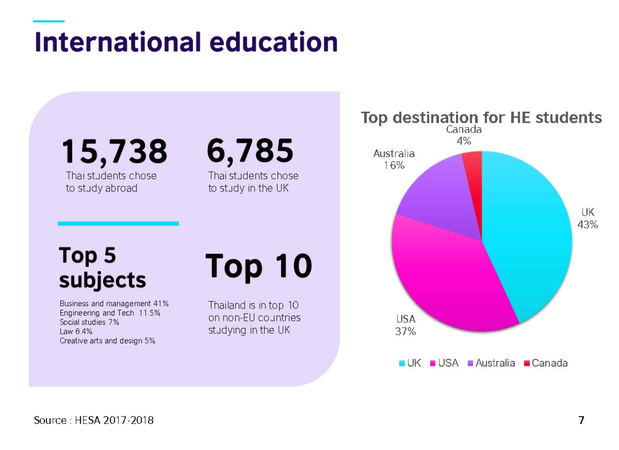
The United Kingdom is the number one destination for Thai higher education students, representing 6,785 or 43 per cent of the total Thai students choosing to study abroad, with the top five subjects being business and management, engineering and technology, social studies, law, and creative arts and design, the British Council said today (February 4).

The United States follows closely behind with 37 per cent, Australia 16 per cent and Canada 4 per cent. The number of postgraduate qualifications obtained the highest reach at 68 per cent, followed by undergraduate at 31 per cent.

The top five subjects Thai students choose to study in the UK are business and management at 41 per cent, engineering and technology 11.5 per cent, social studies 7 per cent, law 6.4 per cent, and creative arts and design 5 per cent, the council added.

“The British Council is an international organisation for cultural relations and educational opportunity,” said director Andrew Glass OBE. “By the end of 2020, two billion people are expected to be using or learning to use English. Our mission in 2020 is stronger than ever. We will continue to bring people together to change the world for the better and deepen relations between the UK and Thailand through our work in English, higher education and science, and creative industries.

“According to the report ‘Asean Youth Technology, Skills and the Future of Work’ from the World Economic Forum, Asean youth see language skills as one of the most valuable for the future. The challenges we face with English learning in Thailand mainly derive from inequality in education, teaching methodology, and assessment,” he said.

“From our experience, the challenges we face with English in Thailand can be divided into four areas: inequality, insufficient levels of English among teachers, teaching methodology, and testing and assessment. Digital disruption also changes the way people learn English. In 2020, the British Council is providing an end-to-end solution for teaching and testing English to support the needs of students and respond to digital changes.

“We are also introducing a new product for English learners in partnership with Academy Award-winning Aardman animation studios – Learning Time with Timmy – to Thailand. This innovative learning experience includes courses, apps, and a video series to help children aged from four to six learn English through play-based methodology. Using simple words, young learners will develop their English skills in a natural way, building strong fundamental skills in preparation to become global citizens,” Glass added.

The British Council continues to promote UK education through the Study UK Fair and launch of the GREAT scholarships and IELTS prize. Helped by the introduction of the New Graduate Route by the UK government, the UK aims to welcome 600,000 international students globally by 2030.

“There are more than 300,000 people in the crafts sector in Thailand. If we could bridge the skill gaps and change the perception of the craft sector in Thailand, this would not only help to drive the Thai economy but also sustain local wisdom and heritage,” he said.

“The British Council has been working with more than 3,000 crafts entrepreneurs and over 200 brands to enhance their design and social entrepreneurial skills. Building on this success, we will support a growing network of craft communities by strengthening social entrepreneurial skills and promoting the role of hubs and cities through creative economy partnerships,” Glass said.

“Today, the role of the university has changed from lectures in classrooms to becoming the forefront of research and innovation. The government has underlined the importance of collaboration and priorities with BCG; the bio-economy, circular economy, and green economy. There is a strong need for universities to reinvent themselves and reskill the Thai markets amidst the disruption in technology and growing global competition.

“In the last three to four years, the British Council has enabled 55 research collaborations and academic partnerships. The majority of research collaborations are in the areas of medical engineering, biological science, food and agriculture, and energy and engineering. In 2020, we aim to continue to internationalise higher education and science by enabling collaboration between universities and industry, developing research ecosystems and making science more accessible among the public through projects such as FameLab and Researcher Connect,” Glass added.