วันที่ 16 มิ.ย. 2563 เวลา 19:00 น.ศูนย์การค้าเซ็นทรัลเวิลด์ ตอกย้ำความเป็น World Social Destination ระดับโลก ฉลองเดือนแห่งภาคภูมิใจ หรือ Pride Month ดึงแบรนด์ชั้นนำเปิดตัว Pride Collection สินค้าดีไซน์พิเศษ เพื่อความเท่าเทียมทางเพศ LGBTQIA+
ตลอดเดือนมิถุนายน ศูนย์การค้าเซ็นทรัลเวิลด์ ตอกย้ำความเป็น World Social Destination ระดับโลก ร่วมฉลองเดือนแห่งภาคภูมิใจ หรือ Pride Month ดึงแบรนด์ชั้นนำ อาทิ CALVIN KLEIN, adidas, SWATCH, GUESS, Levi’s, I Wanna Bangkok และ Guss Damn Good เปิดตัว Pride Collection สินค้าคอลเลคชั่นดีไซน์พิเศษ
adidas คอลใหม่แห่งปี 2020 สี PRIDE รวมมิตรสีสัน ซึ่งถือเป็นสีที่เปิดเผยเสน่ห์ของความหลากหลายทางเพศ (LGBTQIA+)
Guss Damn Good ไอศกรีมรส Equality จากจุดเริ่มต้นที่เกิดขึ้นกับ co-founder Guss Damn Good ความตั้งใจ support LGBTQ+ community จนเกิดมาเป็น workshop ตอนบ่ายเดือนเมษายนปีที่ผ่านมา โดยได้ลูกค้าและแฟนคลับร่วมกันออกไอเดียทำ story to flavor จนออกมาเป็นไอศกรีมรสชาติใหม่ Equality และ Love is love อย่างสมบูรณ์
SWATCH ฉลอง Pride Month ด้วย #OPENSUMMER นาฬิกาสีรุ้งสัญลักษณ์แห่งความรักและความหวังมาตอกย้ำแนวคิดของ Swatch ว่านาฬิกาสะท้อนตัวตนของผู้สวมใส่ได้อย่างเปิดเผยและน่าภูมิใจ
GUESS จับมือกับซูเปอร์สตาร์ระดับโลก J BALVIN รังสรรค์เอ็กซ์คลูซีฟคอลเลคชั่นพิเศษ GUESS x J BALVIN ‘COLORES’ ซึ่งได้แรงบันดาลใจมาจากอัลบั้มล่าสุดของ Balvin ผสมผสานระหว่างท่วงทำนองแห่งเสียงเพลง สู่สีสันแห่งเสื้อผ้าคอลเลคชั่น เริ่มวางจำหน่าย 12 มิถุนายน 2020 นี้ ที่ร้าน GUESS และผ่านช่องทางออนไลน์ที่ Central Online และ LINE Official @guessthailand
Levi’s ดีไซน์ที่เป็นมากกว่าแฟชั่น Levi’s® Pride 2020: USE YOUR VOICE คอลฯ ที่เป็นพลังเสียง พลังในการสนับสนุนให้คนมีสิทธิเท่าเทียมกัน และรายได้ร่วมสนับสนุนให้กับองค์กร OutRight Action International
Jun 19. 2020An employee checks the temperature of a customer at the reception counter of Tsuki no Yu in Tokyo. MUST CREDIT: Japan News-Yomiuri photo
By Syndication The Washington Post, The Japan News-Yomiuri · Saki Sakamoto
TOKYO — The coronavirus epidemic has plunged Japan’s public bathhouses into a serious situation.
In Tokyo, public bathhouses continued to operate during the state of emergency as they were regarded as a “lifeline” from the viewpoint of maintaining livelihoods. However, the number of public bath users fell amid calls to avoid the so-called “Three Cs” – closed spaces, crowded places and close-contact settings – and some public bathhouses have decided to close down.
Some public bathhouses, known as sento in Japanese, had looked forward to promoting “sento culture” to the world on the occasion of the Tokyo Olympics and Paralympics, but the future of such a movement is now bleak.
Tsuki no Yu, a public bath in the capital’s Kita Ward, had 50 to 60 customers a day before the outbreak, but the number of users has recently dropped by about 10%.
The bathhouse continues to run but it’s in the red. “I pride myself on being a lifeline for neighbors,” said Tsuki no Yu President Ichiro Fukushima, 48. “I can’t take holidays.”
The appealing point of Fukushima’s bathhouse is the good quality underground water that is boiled for use in the bath. Another key feature at the bathhouse is a service to wash customers’ backs, a service that has now become rare.
“[Tsuki no Yu] helps me a lot because I don’t have a bath at home,” said regular user Hisako Saito, 70. “My friends gather here and it’s a fun place to exchange information.”
Fukushima is determined to keep his bathhouse. “I don’t want to give up this place of relaxation and refreshment,” he said. But he is worried that customers will lose interest in his establishment amid increased concern about sanitation due to the pandemic.
Earlier this month, the bathhouse began using a noncontact thermometer to measure customers’ temperatures. A transparent acrylic barrier has been set up across the reception counter and face shields are prepared. The dressing rooms have been thoroughly disinfected with alcohol and are well-ventilated.
“With apologies to my customers, I ask them to refrain from talking as much as possible,” Fukushima said.
Meanwhile, Ichi no Yu, a public bathhouse in Adachi Ward, Tokyo, quietly closed down at the end of May. “The novel coronavirus may have pushed me [to make the decision],” said Nobuyuki Saigan, 51, who ran the facility.
The bathhouse was opened in the booming decade of the Showa 30s (1955-1964), after Saigan’s grandfather moved to Tokyo from Ishikawa Prefecture. Traditional Mt. Fuji paintings on the walls and firewood-heated water reputed to have a “comfortable texture” had been loved by people in the community for about 60 years. Before the coronavirus, as many as 100 customers immersed themselves every day.
However, Saigan’s business had seen tough times due to such factors as a rise in fuel costs, and the pandemic worsened the situation. Since March, the number of daily visitors had dropped to about 30, and Saigan decided to shut down.
“I have no one to succeed me in my business. I have no leeway to continue the business with new capital investment,” Saigan said bitterly.
Jun 18. 2020The families of Matt and Liz Peters stand at the U.S.-Canada border to celebrate the couple’s marriage. MUST CREDIT: Photo courtesy of Ron Peters Photography Photo by: Photo courtesy of Ron Peters Photography — Photo courtesy of Ron Peters Photography
By Special to The Washington Post · Sydney Page · FEATURES
Nick Smith and Leah Bosello were desperate to see each other.
Ever since the border between the United States and Canada closed to nonessential travel in mid-March because of the novel coronavirus, cross-border couples like them were blocked from being together.
So the pair found a workaround: They started meeting at a ditch just off 0 Avenue, a heavily patrolled road in British Columbia that divides the two countries.
Ryan Hamilton and Savannah Koop canceled their May wedding because of the pandemic. Once Peace Arch Park reopened, they decided to get married there in a small ceremony. MUST CREDIT: Photo courtesy of Jordana Krahn
They would talk from several feet apart – Smith, 27, firmly planted on the U.S. side in Washington state and Bosello, 31, on the Canadian side. Border officers eavesdropped, and trucks sped by, drowning out their already muffled conversations, they said.
Other couples and families started showing up at the 0 Avenue ditch, too. For months, it was a strange and dusty meetup spot where couples would go to see each other and would often notice others doing the same.
Meeting this way was painful, Bosello said, “but it was still better than nothing.”
As the weather warmed and shutdowns lifted, a superior reunion spot emerged in mid-May: Peace Arch Park. There, cross-national couples and families could actually embrace – at long last.
The recently reopened park is situated between Blaine, Wash., and Surrey, B.C.
“When I finally hugged him again, it felt like it was the first time I ever did,” Bosello said.
In fact, the couple, who has been together for five years, was so ecstatic to reunite, they took a huge relationship leap. On June 6, they gathered a small group of family and friends and got married.
“Being separated made us realize what’s truly important to us,” Smith said. “The circumstances we found ourselves in really highlighted that we wanted to make it official.”
The couple ordered silicone rings online to use as temporary wedding bands, and Bosello wore a navy dress she had ordered for a friend’s wedding – paired with sneakers.
“It was all very casual and improvised,” Bosello said. “But it was such a wonderful day, and so nice to just turn off everything else going on in the world.”
The couple, who meet at the park daily, is hoping their marriage will speed up the process of Smith becoming a permanent Canadian resident, for which he submitted an application nearly two years ago.
Smith is originally from Beltsville, Md., and was serving in the military in South Korea when he met Bosello, who was temporarily working abroad as a teacher.
Bosello moved home to Canada three weeks after the couple hit it off at a bar in Seoul, and they’ve been in a long-distance relationship ever since. She stayed in Vancouver while Smith moved to Seattle and finally to Blaine.
The couple would see each other regularly because the drive between their respective homes is only about 40 minutes.
“For a while, the distance was very manageable,” Bosello said. “Then the pandemic hit.”
They are not the only couple who had the idea to tie the knot at the border.
Before the park reopened, Liz Peters’ parents drove seven hours from Portland, Oregon, to celebrate her wedding along 0 Avenue, while still standing on American soil. The couple married nearby and met her parents right after to celebrate because they couldn’t be at the ceremony.
“I’m very close with my parents and could never imagine them not being there on my wedding day,” said Peters, 27, who lives in Abbotsford, B.C.
But as word started getting out about the lucky loophole at Peace Arch Park, lovesick Americans and Canadians began showing up there to be together.
The day after Smith and Bosello tied the knot, Ryan Hamilton, 26, and Savannah Koop, 25, did, too.
Koop, a Canadian, and her American husband also met regularly along 0 Avenue before the park reopened, each with their own coffee and snacks, for weekly date nights.
“It was so hard to be so close yet so far,” Koop said.
When the couple heard the park reopened, they also decided to make their love official in the only place they could be together, after their original wedding was canceled because of the pandemic.
This spontaneous ceremony, they said, was even more special after their time apart.
The park is considered equal parts American and Canadian – a shared territory for citizens of both countries to visit. The southern half is owned by Washington State Parks, while the northern half is owned by British Columbia Provincial Parks.
Entryways from both the American and Canadian sides are patrolled, and the park itself is surveilled to ensure no one exits the wrong side. But as long as visitors stay within the 42-acre area, they are permitted to roam freely throughout the grounds. According to the park’s website, it is a space that is “devoted to peace and serenity.”
Chelsea Horner, 30, who is in the midst of an American immigration process, took a ferry with her two kids from Canada to meet her husband, who is based on Whidbey Island, Wash.
“Anything is worth it to be able to see the person you love and unite your family,” she said.
The couple, who normally commute back and forth, have plans to meet at the park again for Father’s Day this weekend.
In addition to couples, it’s been an important meeting spot for other loved ones.
Kylie Hults, 34, visits with her parents at the park. She drives two hours from Brenton, Wash., while her folks travel 10 minutes from the Canadian border.
Hults, who is an only child, said this time together has been very important for her parents during the pandemic.
For them, and many others, Peace Arch Park is “the happiest place on earth.”
“It is the Disneyland of the Pacific Northwest,” said Erik Buddingh, 33.
The Canadian man ventured to the park to reunite with his American girlfriend, who flew from Indiana to Seattle and then drove to the border for a few stolen hours with him.
“The park is filled with grandparents meeting their grandchildren for the first time, families reuniting after being divided by the border closure, couples coming together and even old friends meeting just to catch up,” Buddingh said.
Time apart from his long-distance love has taught him to appreciate the little things, he said.
Above all, though, “this park shows that love knows no borders.”
Jun 17. 2020Eduardo Cojuangco speaks to reporters after being re-elected as chairman of San Miguel, the Philippines’ largest food and beverage business empirem in Manila on April 20, 2004. MUST CREDIT: Bloomberg photo by Jose Reinares
By Syndication Washington Post, Bloomberg · Ian Sayson, Cecilia Yap · BUSINESS, WORLD, US-GLOBAL-MARKETS, ASIA-PACIFIC
San Miguel Chairman Eduardo Cojuangco, who many called “the Boss” and “Pac-Man” for his knack for acquiring businesses, has died at 85.
San Miguel President Ramon Ang, in a mobile-phone text message on Wednesday, said Cojuangco died Tuesday.
The former chairman and CEO helped expand San Miguel as the Philippines’ dominant beer and food company, then later helped with its diversification into energy and infrastructure that made it the country’s largest company by revenue. The executive led San Miguel twice, relinquishing the job once in the 1980s after going into exile in Australia in the late 1980s as an ally of Ferdinand Marcos. He returned to San Miguel in 1998.
“Cojuangco was a strong manager, but wasn’t rigid with his vision,” said Alex Pomento, who covered San Miguel and Cojuangco in the 25 years he was an equities analyst before joining SM Prime Holdings in 2014. “It would have been easier to just stay in food and drinks and tell shareholders the low returns are such because of the nature of the industry. Obviously, Cojuangco’s style is not just sitting down.”
Ang, who won the trust of Cojuangco in the early 1980s, has led the diversification of the century-old brewer since the late 2000s as Cojuangco took a back seat in overseeing the group’s expansion. In 2012, Cojuangco sold his remaining 14.7% stake in San Miguel to Ang and its majority shareholder Top Frontier Investment Holdings, raising 37 billion pesos ($737 million).
Eduardo Murphy Cojuangco Jr., known as “Danding,” was born in Manila on June 10, 1935, to a family that controlled business and politics in Tarlac province, north of the capital. He too sought office.
In 1965, while losing a bid for a congressional seat, he cemented his ties to Marcos, his party’s successful presidential candidate at the time, according to “Boss Danding,” a 2003 biography. Seven years later, he was part of the inner circle that helped Marcos plan the imposition of martial law, according to the book and other accounts.
“Cojuangco’s relationship with Marcos was like that of a son and father,” said Earl Parreno, author of the biography. “Cojuangco’s ties with Marcos were beneficial and opened opportunities.”
By the early 1980s, local media had nicknamed Cojuangco “Pac-Man” as he took over the country’s coconut industry, San Miguel and other companies. After Marcos was ousted by Corazon Aquino — a cousin of Cojuangco — the government seized San Miguel and other assets and alleged in court that Cojuangco acquired them by illegally using taxes collected from coconut farmers.
Cojuangco spent most of his exile in Australia, where he bred and raced horses. In 1992, three years after returning to the Philippines, he ran for president, placing third. In 1998, he backed Joseph Estrada’s successful presidential bid. Days after the inauguration, San Miguel’s mostly government-appointed board returned Cojuangco to the chairmanship even as the state continued to dispute his ownership in court.
“I will never deny that I was close to Marcos,” Cojuangco told reporters in 1998. “It is the connotation that a crony is a crook that hurts.”
Within months after retaking the chairman’s seat, he ended an almost 30-year venture with Nestle to help raise $1.3 billion. He started picking up local food and beverage companies, and bought a brewer and juice maker in Australia. He also acquired the local Coca-Cola franchise and Australia’s National Foods. In 2002, Cojuangco sold a 15% stake to a unit of Japan-based beer maker Kirin.
Cojuangco, along with Ang, began investing in the energy sector in 2008 and later added infrastructure, saying there was more growth potential there. To raise money and shift the company’s footprint toward the new businesses, San Miguel sold National Foods, the Coca-Cola franchise and its stake in Del Monte.
“There is no other person deserving of this opportunity to control a significant stake in the company that is close to my heart, than Ramon,” Cojuangco said in 2012 statement when he sold his stake in the Philippines’ largest company.
เพราะเราไม่สามารถจัดการกับปัญหาได้ด้วยระดับความคิดตอนที่เราสร้างมันขึ้นมา We cannot solve our problems with the same thinking we used when we created them – (Einstein)
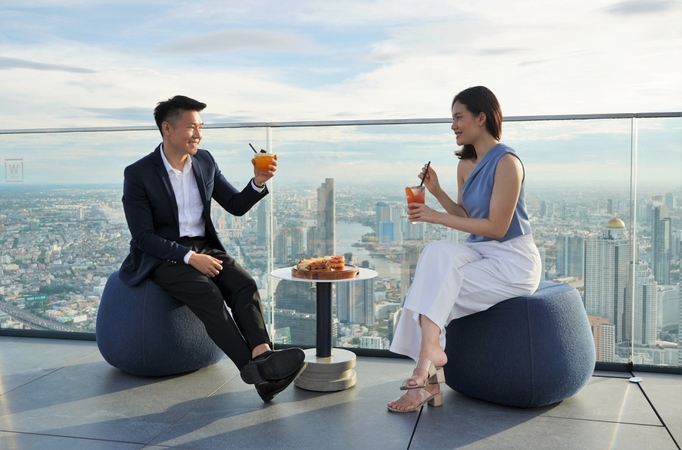
Thailand’s highest observation deck has reopened to the public after more than two months in lockdown.
Mahanakhon SkyWalk, located on the 78th floor of the pixelated King Power Mahanakhon building in the heart of Sathorn, is welcoming visitors back to its panoramic indoor and outdoor viewing decks.
New social distancing measures offer a touchless and hygienic experience with social distancing, a “Screen & Scan” process, and cashless payment options.
Open daily from 10am-8pm, the attraction is highlighted by the glass floor, which overlooks the entire city and provides stunning selfie opportunities.
New protocols at King Power Mahanakhon include visitor registration at the entrance, real-time monitoring of visitor numbers, temperature scans and a UV-scan security screening process.
Food and drinks are also available at the rooftop, including a newly launched “Picnic in the Sky” service from 4pm.
Other food options include an all-day Bar Bites menu.

 ศูนย์การค้าเซ็นทรัลเวิลด์ ตอกย้ำความเป็น World Social Destination ระดับโลก ฉลองเดือนแห่งภาคภูมิใจ หรือ Pride Month ดึงแบรนด์ชั้นนำเปิดตัว Pride Collection สินค้าดีไซน์พิเศษ เพื่อความเท่าเทียมทางเพศ LGBTQIA+


 An employee checks the temperature of a customer at the reception counter of Tsuki no Yu in Tokyo. MUST CREDIT: Japan News-Yomiuri photo
 The families of Matt and Liz Peters stand at the U.S.-Canada border to celebrate the couple’s marriage. MUST CREDIT: Photo courtesy of Ron Peters Photography Photo by: Photo courtesy of Ron Peters Photography — Photo courtesy of Ron Peters Photography
 Eduardo Cojuangco speaks to reporters after being re-elected as chairman of San Miguel, the Philippines’ largest food and beverage business empirem in Manila on April 20, 2004. MUST CREDIT: Bloomberg photo by Jose Reinares
 5 ลุค 5 สไตล์ by ญาญ่า กับคอลเลคชั่นใหม่ลิมิเต็ดเอดิชัน จาก UNIQLO x Marimekko ที่ไม่ว่าใครๆ ก็อัพลุคมิกซ์แอนด์แมทช์แต่งตามได้


 VERSACE X PRIDE 2020 คอลเลคชั่นแห่งความภาคภูมิใจ ร่วมสนับสนุนชาว LGBTQ+ สังคมแห่งความหลากหลาย มุ่งสร้างความเท่าเทียมในโลกปัจจุบัน


 การรับมือกับปัญหาไวรัสโควิด 19 เชิงองค์รวม : การแก้ปัญหาเชิงระบบที่ซับซ้อนเชิงรุก


 โปรเจกต์พิเศษส่งต่อการให้ ทีเอ็มบี และธนชาต เนรมิตศูนย์เรียนรู้ไฟ-ฟ้า มาเป็น “ศูนย์แบ่งปัน” ปรับตัวรับกระแสโควิด สนับสนุนเด็กใช้เวลาว่างให้เกิดประโยชน์ พร้อมแบ่งเบาภาระผู้ปกครอง




 SootinClaimon.Com