SpaceX capsule on its way to its historic rendezvous with the space station #ศาสตร์เกษตรดินปุ๋ย

#ศาสตร์เกษตรดินปุ๋ย : ขอบคุณแหล่งข้อมูล : หนังสือพิมพ์ The Nation.

https://www.nationthailand.com/edandtech/30388833?utm_source=category&utm_medium=internal_referral

SpaceX capsule on its way to its historic rendezvous with the space station

May 31. 2020
The NASA commercial crew with astronauts Doug Hurley and Bob Behnken blast off from Launch Complex 39A aboard the SpaceX Falcon 9 rocket in the Crew Dragon capsule bound for the International Space Station on Saturday. MUST CREDIT: Washington Post photo by Jonathan Newton

The NASA commercial crew with astronauts Doug Hurley and Bob Behnken blast off from Launch Complex 39A aboard the SpaceX Falcon 9 rocket in the Crew Dragon capsule bound for the International Space Station on Saturday. MUST CREDIT: Washington Post photo by Jonathan Newton
By The Washington Post · Christian Davenport, Jacob Bogage · NATIONAL, WORLD, TECHNOLOGY, SCIENCE-ENVIRONMENT

With the country wracked by the coronavirus and racial strife, the United States opened a new chapter in space exploration Saturday when a SpaceX rocket blasted off from the Kennedy Space Center in Florida, carrying two astronauts to orbit from American soil for the first time in nearly a decade.

It was a historic moment for SpaceX, which became the first private corporation to launch people into orbit, and for NASA, which has struggled to regain its footing after retiring the space shuttle in 2011, leaving the U.S. no option but to rely on Russia to ferry its astronauts to space for as much as $90 million a seat.

Crowds make their way off the A. Max Brewer Bridge over the Indian River after watching the SpaceX-manned flight take off on Saturday. MUST CREDIT: Washington Post photo by John McDonnell

Crowds make their way off the A. Max Brewer Bridge over the Indian River after watching the SpaceX-manned flight take off on Saturday. MUST CREDIT: Washington Post photo by John McDonnell

But it also comes at the end of a historic and tragic week in America. Fatalities from the coronavirus pandemic passed 100,000 in the recent days and sometimes-violent protests and looting erupted overnight in major cities, including New York, Los Angeles and Washington, D.C., over the Minneapolis police slaying of George Floyd, another unarmed black man killed by law enforcement.

Both President Donald Trump and Vice President Mike Pence made mention of those demonstrations in speeches to mark the new era of space travel. Trump called the launch a unifying moment for the country, even as he called protesters “criminals” and “thugs.”

“Moments ago as we witnessed the launch of two great American astronauts into space, we were filled with the sense of pride and unity that brings us together as Americans,” Trump said, reading from a teleprompter. “That same spirit which powered our astronauts to the moon has also helped lift our country to ever-greater heights of justice and opportunity throughout our history.

“So today as we mark a renewed commitment to America’s leadership in space – a tremendous commitment it is – let us also commit to a brighter future for all of our citizens right here on Earth.”

Both Trump and Pence praised Elon Musk, the controversial entrepreneur whose vision of flying to Mars led him to found SpaceX nearly two decades ago. Musk himself was ecstatic with the flight’s success. “I’m really overcome with emotion and it’s really hard to talk frankly,” he said. “We haven’t quite yet docked and of course we need to bring them back safely, so it’s a lot of work to do. But it’s just incredible.”

Saturday’s launch was the second attempt to begin the mission. It was originally scheduled for Wednesday, but that was scrapped because of bad weather in the area.

Crowds watch the SpaceX-manned flight take off in Titusville, Fla., on Saturday. MUST CREDIT: Washington Post photo by John McDonnell

Crowds watch the SpaceX-manned flight take off in Titusville, Fla., on Saturday. MUST CREDIT: Washington Post photo by John McDonnell

More bad weather threatened to jeopardize Saturday’s launch, too. The Air Force’s 45th Weather Squadron, charged with monitoring conditions for NASA flights, predicted a 50 percent chance of prohibitive weather, including isolated thunderstorms in the area and anvil and cumulus cloud cover.

For much of the morning and early afternoon, those conditions persisted. Showers rolled over Kennedy Space Center just after astronauts Doug Hurley and Bob Behnken walked out of the Neil Armstrong Operations and Checkout Building in their custom-fitted spacesuits. Standing beside two Tesla Model X SUVs, the astronauts exchanged final goodbyes – “virtual hugs,” air-kisses and thumbs up – with their families.

Astronauts Doug Hurley and Bob Behnken get ready to launch the SpaceX Falcon 9 on Saturday. MUST CREDIT: Washington Post photo by Jonathan Newton

Astronauts Doug Hurley and Bob Behnken get ready to launch the SpaceX Falcon 9 on Saturday. MUST CREDIT: Washington Post photo by Jonathan Newton

“Are you going to be on good behavior?” Behnken asked his son, who nodded in return. “Are you going to listen to Mommy and make her life easy?” His son nodded again.

“Let’s light the candle!” his son shouted.

Flight technicians drove Behnken and Hurley nine miles to launchpad 39A, the historic site from which the crew of Apollo 11 left for the moon, listening to a playlist that included AC/DC’s “Back in Black,” bossa nova standard “The Girl from Ipanema” and, finally, “The Star-Spangled Banner.”

They boarded the Dragon capsule at 12:35 p.m., as it began raining at the launch site. Those conditions passed, though, at around 2:35 p.m., and flight engineers signaled a go for launch.

As the flight countdown clock continued to tick, technicians fueled the two boosters of the Falcon 9 rocket and armed Dragon’s emergency abort system. Less than an hour later, SpaceX Flight Director Mike Taylor declared the mission go for launch, and at 3:22 p.m. – precisely on time – the Falcon 9′s first-stage engines ignited, shoving the spacecraft away from its support beams and into the air.

Accelerating rapidly at more than twice the speed of a gunshot, Falcon 9 tore through the humid Space Coast sky, leaving a blazing fireball and smoky trail in its wake, shaking the Earth and unleashing a deafening roar audible for dozens of miles.

Two and a half minutes after liftoff, Falcon 9’s first booster stopped firing and separated from the second stage, landing seven minutes later on a barge floating in the Atlantic Ocean named “Of Course I Still Love You.”

The second stage ignited and shot the Dragon capsule toward orbit. Twelve minutes after launch, it two dropped away – the signal that the Dragon capsule was on its way to orbit. Raucous applause erupted from space officials at NASA facilities in Florida and Texas, and at SpaceX’s mission control offices in Hawthorne, Calif.

“We have done it,” NASA Administrator Jim Bridenstein declared on NASA’s live-stream broadcast.

Despite repeated warnings by NASA to stay home because of the coronavirus, fans lined the beaches to watch a historic moment, but the space agency drastically limited attendance at the Kennedy Space Center.

The flight was the fulfillment of a risky bet by NASA under the Obama administration to entrust the private sector to fly astronauts, and Trump’s administration has made human space exploration a priority.

Trump turned Air Force’s Space Command into the Space Force, its own branch of the military, and named Pence the chairman of the National Space Council. He has pushed NASA to conduct a lunar landing mission by 2024 as a steppingstone for a mission to Mars.

Pence has said the U.S. will return to the moon “by any means necessary.”

For SpaceX, it was the climax of an improbable odyssey that began in 2002. Musk continues to speak frequently of his goal to establish a colony on Mars and humanity’s need to be a “multi-planetary species.”

“We cannot be complacent about technology development,” he told The Washington Post in a preflight interview. “We have to really drive innovation hard and say, ‘Okay, let us go as fast and as hard as possible to get humanity back to the moon and there to stay and have a base on the moon, maybe [a] city on the moon, to have a base on Mars, a city on Mars to . . . make life multi-planetary.'”

“I think this is very important to secure the future of life as we know it to ensure that the light of consciousness does not go out.”

Trump called Musk “one of our great brains,” and “a friend of mine for a very long time.”

“Congratulations, Elon,” Trump said, stepping away from the lectern to offer his own applause while the crowd at Kennedy Space Center whooped and hollered.

The Crew Dragon capsule is expected to dock with the International Space Station at approximately 10:30 a.m. Sunday.

Sunday’s docking will be handled autonomously by the spacecraft, though Hurley and Behnken have the ability to take over the controls manually if needed.

In 2014, NASA awarded contracts to Boeing and SpaceX, with $6.8 billion combined, to design and build spacecraft capable of flying astronauts to the station. Previously, it had hired the private sector to fly cargo and supplies there. But outsourcing human space flight to companies was considered a risky and even reckless move in some quarters, even among NASA’s leadership. Along the way there had been a number of stumbles that delayed the first flights from 2017.

Boeing, the aerospace behemoth that had been by NASA’s side since the dawn of the Space Age, was considered the favorite to fly first. But it stumbled when the test flight of its Starliner spacecraft encountered software problems almost immediately upon reaching orbit. Boeing has pledged to redo the test sometime later this year.

Twitter flags Trump for ‘glorifying violence’ after he says Minneapolis looting will lead to ‘shooting’ #ศาสตร์เกษตรดินปุ๋ย

#ศาสตร์เกษตรดินปุ๋ย : ขอบคุณแหล่งข้อมูล : หนังสือพิมพ์ The Nation.

https://www.nationthailand.com/edandtech/30388748?utm_source=category&utm_medium=internal_referral

Twitter flags Trump for ‘glorifying violence’ after he says Minneapolis looting will lead to ‘shooting’

May 29. 2020
By The Washington Post · Tony Romm, Allyson Chiu · NATIONAL, TECHNOLOGY, POLITICS

President Donald Trump took to Twitter early Friday to condemn Minneapolis demonstrators as “THUGS,” threaten military intervention and suggest it could lead to “shooting,” prompting the social-media company to take the unprecedented step of limiting the public’s ability to view his tweet.

The label appended by Twitter marks the second time in a week the tech giant has taken action in response to Trump’s controversial remarks. Trump and his allies again decried the move as censorship, promising to regulate the company a day after he signed an executive order that could open the door for the U.S. government to punish social-media sites for their handling of political speech online.

Trump fired off his early morning comment as protests over the death of George Floyd intensified in Minneapolis. Fires raged across the city Thursday night as demonstrators took to the streets because Floyd, who was black, died in police custody. The unrest has reverberated nationwide, including in Louisville, where Breonna Taylor, a black woman and aspiring nurse, was killed by police earlier this month.

“These THUGS are dishonoring the memory of George Floyd, and I won’t let that happen,” Trump tweeted shortly before 1 a.m. Friday, adding, “Any difficulty and we will assume control but, when the looting starts, the shooting starts.”

Critics immediately condemned Trump’s tweet, asserting that he was promoting violent retaliation against protesters, and Twitter took swift action. “This Tweet violated the Twitter Rules about glorifying violence,” read a gray box that now hides Trump’s tweet from public view unless a user clicks to see it. In doing so, Twitter also prevented other users from liking the president’s tweet or sharing it without appending comment.

“We’ve taken action in the interest of preventing others from being inspired to commit violent acts, but have kept the Tweet on Twitter because it is important that the public still be able to see the Tweet given its relevance to ongoing matters of public importance,” said Trenton Kennedy, a spokesman for the company.

The move immediately exacerbated tensions between the Silicon Valley company and Trump, who tweeted later Friday morning that he had been unfairly targeted. For years, Trump has maintained Twitter and other tech companies exhibit bias against conservatives, systematically limiting their posts and quietly banning right-leaning users – a charge for which he has provided little evidence, and one that the industry strongly denies.

“Twitter is doing nothing about all of the lies & propaganda being put out by China or the Radical Left Democrat Party,” Trump said in a later tweet. “They have targeted Republicans, Conservatives & the President of the United States. Section 230 should be revoked by Congress. Until then, it will be regulated!”

In an act of defiance, however, the White House hours later reposted the president’s controversial comment about shootings on its account. A spokesman did not respond to a request for comment.

Trump’s late-night tweet about Minneapolis, which was paired with another blistering post targeting Mayor Jacob Frey (D), came after protesters in the city breached a police precinct that had been evacuated and set fire to the building. The chaotic scenes marked the latest escalation of the widespread unrest that has plagued Minneapolis for three straight days following a fatal incident in which Floyd, an unarmed black man, died after a white police officer knelt on his neck for minutes as he was handcuffed on the ground.

On Thursday, amid reports of fires, looting and vandalism that had begun the night before, Frey declared an emergency, which was soon followed by Democratic Gov. Tim Walz’s order to call in the National Guard. By nightfall, more than 500 soldiers had been deployed to Minneapolis, St. Paul and surrounding communities, the Guard confirmed.

But protesters continued wreaking havoc in the city Thursday night – much to Trump’s dismay.

“I can’t stand back & watch this happen to a great American City, Minneapolis,” Trump tweeted early Friday, before taking aim at Frey.

“A total lack of leadership,” the president continued. “Either the very weak Radical Left Mayor, Jacob Frey, get his act together and bring the City under control, or I will send in the National Guard & get the job done right.”

Then, Trump called the demonstrators, many of whom are people of color, “THUGS” before parroting the words of former Miami police chief Walter Headley, who was known for his controversial “stop and frisk” policies.

The looting and shooting quote was first said by Headley during a December 1967 news conference addressing efforts by authorities to carry out what United Press International described at the time as a “crackdown on . . . slum hoodlums.” According to UPI, “Headley said Miami hasn’t been troubled with racial disturbances and looting because he let the word filter down, ‘When the looting starts, the shooting starts.’ ”

The moment has since been cited as a prime factor in the discontent that contributed to the race riots that broke out in Miami in the late 1960s, The Washington Post’s Terence McArdle reported.

On Thursday, many accused Trump of making a racist threat of violence against the protesters.

Even the Oath Keepers, a right-wing militia group, urged Trump to retract his statement, citing concerns that the tweet could be seen as encouraging the National Guard to “shoot people for stealing.”

“This is a disaster,” the group tweeted from their official account. “President Trump needs to retract that statement ASAP, stating that he misspoke & did not mean to say that National Guard should shoot people for stealing.”

Meanwhile, Frey hit back at the president during a news briefing early Friday.

“Donald Trump knows nothing about the strength of Minneapolis. We are strong as hell,” Frey said. “Is this a difficult time period? Yes. But you better be damn sure we’re going to get through this.”

City hospital piloting ‘ER new normal’ with 5G tech #ศาสตร์เกษตรดินปุ๋ย

#ศาสตร์เกษตรดินปุ๋ย : ขอบคุณแหล่งข้อมูล : หนังสือพิมพ์ The Nation.

https://www.nationthailand.com/edandtech/30388681?utm_source=category&utm_medium=internal_referral

City hospital piloting ‘ER new normal’ with 5G tech

May 28. 2020
By THE NATION

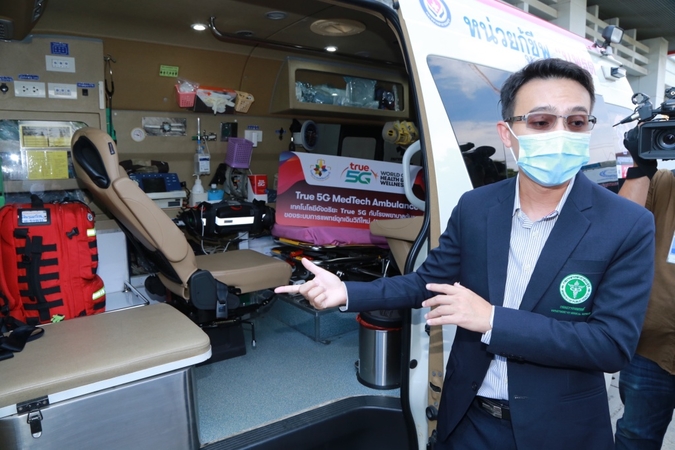
Bangkok’s Nopparat Rajathanee Hospital has collaborated with True Corp to develop a 5G-powered medical service dubbed the “ER new normal”.

Medical innovations offered by the government hospital via True 5G network include:

• MedTech ambulance equipment that improves communication with hospitals so that doctors can prepare treatment for ER patients with greater efficiency, accuracy and timeliness.

• A virtual smart communication system that enables ER doctors to transmit video of patients to specialist doctors for faster treatment.

• Temi Connect & CareBot that allows remote consultation of doctors and patients to minimise direct physical contact and also delivery of medical resources and documents.

• The Nopparat Teleclinic, an application to screen, give advice, and diagnose minor symptoms so that patients do not have visit hospital. If a hospital visit is necessary, the app allows patients to make appointments with doctors immediately based on the symptoms described.

A 5G mobile cell on wheels (COW) has also been provided to boost the signal.

Nopparat Rajathanee is a state hospital that offers both general and specialised medical services, with a high daily volume of patients, especially on weekends, said Somboon Tosborvorn (MD), the hospital’s director.

During the Covid-19 crisis, the government has adopted a “new normal” for emergency care, using technology to ease hospital crowding and boost safety for medics, patients and their relatives, he added.

The ER “new normal” at Nopparat Rajathanee will be the model for other Thai hospitals to follow, he said.

TU Hospital launches online consultations with telemedicine app #ศาสตร์เกษตรดินปุ๋ย

#ศาสตร์เกษตรดินปุ๋ย : ขอบคุณแหล่งข้อมูล : หนังสือพิมพ์ The Nation.

https://www.nationthailand.com/edandtech/30388680?utm_source=category&utm_medium=internal_referral

TU Hospital launches online consultations with telemedicine app

May 28. 2020
By THE NATION

Kasikornbank (KBank) has teamed with Bangkok’s Thammasat University Hospital (TUH) to launch the TUH for All app, upgrading healthcare services and preparing Thailand for the new era of “smart hospitals”.

The innovative app allows patients to make appointments, check queue availability, and review their medical benefits and treatment history, as well as providing relevant news and information.

Its key service is TUH OPD Online, offering patients online consultations with medics without the need to visit a hospital.

With its various services – from seeing physicians to making payments and medicine delivery – the all-in-one app should help patients avoid crowded waiting rooms in line with the “new normal” pandemic environment.

Assoc Professor Pharuhat Tor-Udom, director of TUH, said the hospital serves more than 4,000 outpatients every day, with over 800 beds available for inpatients.

The TUH OPD Online service not only helps reduce crowding at the hospital, but also prevents the spread of Covid-19 by allowing social distancing, as well as saving waiting and travel time for patients.

It will be piloted at the TUH surgery department before being rolled out to 14 other departments of the hospital by the end of 2020. Its developers expect the app will reduce hospital congestion by up to 30 per cent.

The TUH OPD Online service is aimed at outpatients who need continuous monitoring for conditions such as diabetes, high blood pressure and cardiovascular diseases, or those with minor illnesses who are simply seeking medical advice.

The service can also assist patients with chronic diseases, the bedridden, and the terminally ill, since it holds records of patients, their diseases and treatment history, which can be retrieved to decide the best course of treatment.

Once the patients have registered at the hospital, they will be able to access the app from their homes.

This service covers the following areas:

1. Appointment with the doctor: Patients can check their doctors’ availability and receive appointment confirmation via the application.

2. Consultation with doctors online via video call.

3. Checking medical cover, such as the Social Security Scheme, the Universal Health Coverage (Gold Card) and the Civil Servant Medical Benefit Scheme (CSMBS).

4. Payment with credit card, or cash via the K PLUS app which should be available by July 2020.

5. Getting prescriptions: The hospital will dispense medicines to patients by taxi and postal mail.

Patients of Thammasat University Hospital can download the TUH for All application from today for Android or iOS mobile operating systems.

The hospital is also introducing other new features, including a Medical Drive-Thru, a Doctor’s Appointment App for check-ins and prescriptions, injections and blood tests, and the Telepharmacy feature whereby an experienced pharmacist will offer advice on the safe and appropriate usage of prescribed drugs.

Canadian court rules extradition case against Huawei executive Meng can proceed #ศาสตร์เกษตรดินปุ๋ย

#ศาสตร์เกษตรดินปุ๋ย : ขอบคุณแหล่งข้อมูล : หนังสือพิมพ์ The Nation.

https://www.nationthailand.com/edandtech/30388657?utm_source=category&utm_medium=internal_referral

Canadian court rules extradition case against Huawei executive Meng can proceed

May 28. 2020
By The Washington Post · Amanda Coletta · BUSINESS, WORLD, TECHNOLOGY, COURTSLAW 

A Canadian court ruled Wednesday that the charges the United States has filed against Huawei’s chief financial officer are also crimes in Canada, a decision that keeps her under house arrest in an extradition case that has ensnared Ottawa in a dispute between Beijing and Washington.

Heather Holmes, associate chief justice of the Supreme Court of British Columbia, wrote that Meng Wanzhou’s case could meet the threshold of “double criminality” – a prerequisite for extradition under Canadian law.

The U.S. Justice Department alleges that Meng made “numerous misrepresentations” to banks, including HSBC, about the telecom giant’s relationship with Skycom, an Iranian-based subsidiary, effectively tricking them into clearing hundreds of millions of dollars in transactions in violation of U.S. sanctions on Iran and exposing them to reputational and economic risk.

Meng, the 48-year-old daughter of billionaire Huawei founder Ren Zhengfei, was arrested by Canadian authorities in Vancouver in December 2018 at the behest of the United States. She denies any wrongdoing.

The case against the Huawei “princess” has severely strained ties between Canada and China. After Meng’s arrest, China detained two Canadians, former diplomat Michael Kovrig and businessman Michael Spavor, and charged them with violating state secrets laws in a move widely seen as retaliation. China also blocked some agricultural imports from Canada.

China has cast Meng’s arrest as a U.S. plot to cripple the country’s economic rise. Chinese officials have also cast the prosecution as political; they point to statements by President Trump that he might intercede in her case in exchange for concessions on trade.

After the ruling Wednesday, the Chinese Embassy in Ottawa declared “the whole case” a “grave political incident.”

“The purpose of the United States is to bring down Huawei and other Chinese high-tech companies, and Canada has been acting in the process as an accomplice,” the embassy said in a statement. “We once again urge Canada to take China’s solemn position and concerns seriously, immediately release Ms. Meng Wanzhou to allow her to return safely to China, and not to go further down the wrong path.”

Canadian Prime Minister Justin Trudeau has described Meng’s extradition as a law enforcement matter that will be settled by a justice system whose independence from political interference is “deeply dear to Canadians.”

“China doesn’t work quite the same way, and [doesn’t] seem to understand that we do,” he said last week.

Justice Department spokeswoman Natalie Navas Oxman said the United States “thanks the Government of Canada for its continued assistance pursuant to the U.S./Canada Extradition Treaty in this ongoing matter.”

Huawei expressed disappointment.

“We have repeatedly expressed confidence in Ms. Meng’s innocence,” the company said in a statement. “Huawei continues to stand with Ms. Meng in her pursuit for justice and freedom.

“We expect the Canada’s judicial system will ultimately prove Ms. Meng’s innocence.”

Meng’s lawyers argued in January that the case is a U.S. sanctions violations complaint framed as a fraud case. Since Canada lifted its sanctions against Iran in 2016, they argued, the transactions wouldn’t have violated any Canadian law.

“Fraud is a facade,” Richard Peck, the head of Meng’s defense team, told a packed courtroom in Vancouver.

Canadian prosecutors, arguing the United States’ case, dismissed that argument. They said the essence of the alleged offense – allegedly lying to a bank to obtain financial services – is fraud.

Holmes appeared to agree. In a 23-page ruling issued Wednesday, she wrote that the interpretation argued by Meng’s defense team’s approach would “give fraud an artificially narrow scope in the extradition context,” limiting Canada’s “ability to fulfill its international obligations.”

“The essence of the alleged wrongful conduct in this case in the making of intentionally false statements in the banker client relationship that put HSBC at risk,” Holmes wrote. “The U.S. sanctions are part of the state of affairs necessary to explain how HSBC was at risk, but they are not themselves an intrinsic part of the conduct.”

Meng has been under house arrest in the slightly larger of her two Vancouver mansions. She has a curfew and wears a GPS monitor on her left ankle. Last weekend, she and an entourage visited the courthouse and posed for photos making thumbs-up signs – an outing interpreted by some to mean she was expecting good news in Wednesday’s decision.

Kovrig and Spavor have been barred from seeing their families during the more than 530 days they’ve been detained. They are being kept in facilities with 24-hour lighting; monthly visits by Canadian consular officials have been canceled during the pandemic.

Canada has asked allies, including the United States, to press China to free the two men, so far without success. Canadian Foreign Minister François-Philippe Champagne said Wednesday that securing their release is Canada’s “top priority.”

The Global Times, a newspaper affiliated with the Chinese Communist Party, said “Canada has completely surrendered its self-proclaimed judicial and diplomatic independence to U.S. bullying.”

The next phase of the extradition hearing will center on Meng’s claims that Canadian authorities abused the process when they detained her at Vancouver International Airport and that her extradition is politically motivated.

Canada’s justice minister will have the final say on whether to “commit” her for extradition.

Preston Burton, a criminal defense lawyer who has handled extradition cases, said Meng’s extradition could be tied up for years.

“She could still make claims that her surrender would be unjust or discriminatory,” he said. “And I think in this case the dual-criminality issue presents a real question that her counsel could revisit on appeal.”

Ultimately, he said, “extradition is a political decision guided by the treaty. I wouldn’t presume to know what pressure the United States is putting on Canada in this case.”

The United States has pressed Canada to ban Huawei from building its 5G networks over concerns the Chinese government could use the equipment to conduct surveillance or cyberattacks. Canada is conducting a security review of the company and has not yet announced a decision.

Huawei, the world’s largest manufacturer of telecom equipment, has repeatedly denied the U.S. accusations.

The U.S. Commerce Department intensified its pressure on the Shenzhen-based firm by implementing a rule that will require overseas manufacturers of semiconductors using American equipment to get a license from the United States before selling them to Huawei.

Facebook renames blockchain division after Libra confusion #ศาสตร์เกษตรดินปุ๋ย

#ศาสตร์เกษตรดินปุ๋ย : ขอบคุณแหล่งข้อมูล : หนังสือพิมพ์ The Nation.

https://www.nationthailand.com/edandtech/30388568?utm_source=category&utm_medium=internal_referral

Facebook renames blockchain division after Libra confusion

May 27. 2020
By Syndication Washington Post, Bloomberg · Kurt Wagner · BUSINESS, US-GLOBAL-MARKETS 

Facebook has renamed its blockchain division, called Calibra, to distance it from the Libra digital currency that Facebook created. The blockchain team is building a digital wallet for Facebook’s apps, which will eventually hold the Libra digital currency, but Facebook won’t control the coin.

“People were confusing Libra and Calibra all the time,” said David Marcus, Facebook’s head of blockchain. “In hindsight it’s hard to blame them.”

The blockchain division is now called Novi — a combination of two Latin words: novus, meaning “new,” and via, meaning “way,” Facebook said in a blog post Tuesday. Facebook’s digital wallet will also be called Novi.

Facebook first announced the Libra digital currency in June 2019 alongside a number of tech and finance partners. The company’s vision was to create a global currency that would be nearly free and instantaneous to send across borders, but the project has faced many hurdles, including push-back from politicians.

Libra is governed by an association of 27 companies and nonprofit organizations of which Facebook is a member. But the currency is often described as a Facebook coin, even though the company has argued that it doesn’t control decisions for Libra. Politicians in the U.S. and Europe are skeptical of a Facebook-controlled global currency.

Renaming Facebook’s blockchain division, which is building products to complement the coin, could alleviate some confusion, Marcus said in an interview. Specifically, some people thought that Facebook’s Calibra wallet was the only way to hold or spend the Libra digital currency, which is not the case. The coin is designed so that anyone can build a digital wallet to hold Libra. Others were concerned that Facebook’s wallet would have an undue advantage given the similarity in names.

Libra Association members “want to be on equal footing with everyone else,” Marcus said.

Marcus said the decision wasn’t driven by regulatory concerns, though acknowledged the name change could change some perceptions.

“Public opinion of how they see those two things interacting definitely influences the environment in which we operate, so I think it’s important,” he added.

The Libra Association was founded last October to govern the coin, and recently redesigned the currency to better appease regulators. It also named its first chief executive officer earlier this month. The group hopes to launch the Libra currency by the end of the year.

The next Americans in space #ศาสตร์เกษตรดินปุ๋ย

#ศาสตร์เกษตรดินปุ๋ย : ขอบคุณแหล่งข้อมูล : หนังสือพิมพ์ The Nation.

https://www.nationthailand.com/edandtech/30388517?utm_source=category&utm_medium=internal_referral

The next Americans in space

May 26. 2020
NASA astronauts Doug Hurley (right) and Bob Behnken arrive at Kennedy Space Center. They're scheduled to blast off May 27 atop a SpaceX Falcon 9 rocket, bound for the International Space Station. MUST CREDIT: Washington Post photo by Jonathan Newton

NASA astronauts Doug Hurley (right) and Bob Behnken arrive at Kennedy Space Center. They’re scheduled to blast off May 27 atop a SpaceX Falcon 9 rocket, bound for the International Space Station. MUST CREDIT: Washington Post photo by Jonathan Newton
By The Washington Post · Christian Davenport · NATIONAL, SCIENCE-ENVIRONMENT

The arcs of their careers and personal lives have for years run on parallel tracks, like twin strands of DNA, winding from the military to test pilot school to the same NASA astronaut class, where both met their wives.

Now Bob Behnken and Doug Hurley are about to fly together in one of the most important launches NASA has attempted in years: a crewed test flight of SpaceX’s Dragon spacecraft to the International Space Station, set for Wednesday, if the weather cooperates.

On Monday, the Space Force’s weather office at Cape Canaveral predicted a 60% chance weather would prevent a launch.

The mission would be the first launch of NASA astronauts from U.S. soil since the space shuttle was retired in 2011, and the first by a private company of people to orbit. Scheduled for Wednesday at the Kennedy Space Center in Florida, it would be the culmination of a long journey – for NASA, for SpaceX and for a pair of the agency’s most seasoned astronauts, who have marched together in unusual lockstep to get to this point.

Both are former military pilots who achieved the rank of colonel – Hurley in the Marine Corps, Behnken in the Air Force. Both were accepted to the NASA astronaut class of 2000 on their first try. Both have been to space twice before. Both are fathers to a young boy.

Behnken is married to Megan McArthur, a NASA astronaut and oceanographer; Hurley is married to Karen Nyberg, who recently retired from the NASA astronaut corps.

The couples joke that they often thank the head of the astronaut selection committee “for doing a great job of selecting spouses for us,” McArthur said.

In the past, NASA’s astronauts may have been pitted against each other in ruthless competition for flight assignments, preening for the cameras and strutting their ego-fueled “Right Stuff” to orbit and back, always eager to get ahead.

But Behnken and Hurley – Bob and Doug, as most everyone calls them – are more like a couple of self-effacing old pals, with an easygoing relationship shaped by a shared history that includes serving in each other’s weddings and having trained side by side for this mission for five years.

Their rapport, in the cockpit and in training, is fueled by trust and an intimate sense of each other, people who know them say, a sort of fraternal bond that allows them to tease each other as well as finish each other’s sentences. It gives them a late-night-talk-show kind of chemistry, at turns goofy and sincere.

Hurley is the obsessive-compulsive Marine, with a crisp flat-top, a penchant for order and a “repository” of “useless information,” Behnken said. “He’s the trivia master between the two of us.”

“Doug’s worst habits?” Behnken said during a NASA promo video. “He’s got a tighter sense of hygiene than I do.”

Their bond was evident earlier this month, when the pair, having finished yet another news conference, were sitting through questions asked through NASA’s Instagram account, moving from ribbing to supporting each other in the span of a couple of minutes

Hurley held his phone, scrolling.

“How long did it take you to become an astronaut, Bob?” he asked, reading one of the questions.

“Well, I was born in 1970, and I became an astronaut in 2000, so it took about 30 years,” Behnken deadpanned. It was a wisecrack of an answer, a flair of wit after a long day of meetings and a news conference and now this social media hit.

Hurley couldn’t help himself from cracking up in laughter.

“It took Doug longer,” Behnken said, teasing his friend, still straight-faced.

“No!” Hurley said. Then conceded: “Like, two years longer.”

“Yeah, two years is two years.”

Finally serious, Behnken traced his career: test pilot school at Edwards Air Force Base, “I got an engineering education,” he said, “and a degree in physics – ”

“You got a PhD from Caltech!” Hurley interrupted.

“I did.”

That kind of connection will serve them well on the upcoming mission, a risky test flight NASA officials say they were made for. The Crew Dragon spacecraft has flown just once before, in an uncrewed mission last year that officials from NASA and SpaceX said went flawlessly.

But then the same spacecraft that flew to the space station and back exploded during a test of its emergency abort engines. It was a fiery setback that drove home the dangers of the mission to NASA as well as SpaceX.

“I wanted to make sure everyone at SpaceX understood and knew Bob and Doug as astronauts, as test pilots – badass – but also as dads and husbands,” said Gwynne Shotwell, SpaceX’s president and chief operating officer. “I wanted to bring some humanity to this very deeply technical effort as well.”

One of the ways the company has done that, she said, was an idea that came from a technician, who “wanted to make sure that we had pictures of Bob and Doug on the work orders.”

Behnken has said his 6-year-old son, Theo, was nervous about him flying, and his astronaut parents have worked to make their extraordinary lives seem regular.

“We try to make it as normal-seeming as possible,” McArthur said in an interview. “We just talk about it as something that Mommy and Daddy do. This is our job. We’ve shown him videos of people living aboard the space station. We’ve taken him to see rockets launch from the Kennedy Space Center.”

It’s still not clear how long the astronauts will be on the station. NASA has said the mission will last roughly between one month and four. Behnken flew on the space shuttle twice, once in 2008 and again two years later, spending a total of more than 708 hours in space and performing six spacewalks. In the Air Force, he flew more than 25 different kinds of aircraft, including as a test engineer for the F-22 Raptor.

When he arrived at the Kennedy Space Center last week, he said he was excited by the mission, not just because of its historic significance, but also because it is the first flight of the spacecraft with crews.

“As graduates of military test pilot schools, if you gave us one thing that we could have put on our list of dream jobs that we would have gotten to have someday, it would have been to be aboard a new spacecraft and conduct a test mission” Behnken said.

Being on the ground, however, watching while the engines ignite and fire comes blasting out, will be far more difficult.

“One of the hardest things to do is watch the person that you love launch into space,” McArthur said. “It’s much harder than actually doing it yourself when you’re in the rocket. You have the training. You’re prepared for the mission.

“When you’re watching, you’re just a spectator. And no matter what happens, there’s nothing you can do to contribute to the situation.”

Hurley is also a veteran of two shuttle missions, including the very last one, which brought a 30-year era to an end and signified a moment of transition for NASA. The day after the shuttle landed, hundreds lost their jobs, and NASA was suddenly unable to fly astronauts anywhere.

“I remember when we landed just before dawn, but we were still in the vehicle as the sun came up,” Hurley recalled. “People were walking up to the vehicle, and it was their last day, in many cases, of work. You felt like you had to honor those people.”

Asked on NASA’s promo video what they were looking forward to most, Behnken said he expected the crescendo of their mission to end with a bit of seasickness christening once it’s over and they splash down into the ocean.

“I’m expecting a little bit of vomiting maybe to happen in the end,” Behnken said, “so when we get to do that in the water together – it’s kind of a weird thing to say – but I’m looking for that kind of celebratory event.”

Hurley said he was looking forward to just being there in the spacecraft, sitting next to Behnken.

“We’ve been close friends since we started as astronauts almost 20 years ago,” he said, “so being lucky enough to get to fly with your best friend is kind of a – I think there’s a lot of people that wish they could do that, and we’re lucky enough to do it.

“We spent a ton of time together. We could have gone two directions with that. We could have gotten to the point where we didn’t want to be around each other, or we’re closer. So I think just the whole experience for me is what we’re looking for.

“And then, yes, the celebratory vomiting at the end of the mission.”

AIS unveils “GOMO” 100% Online SIM to bring new generation users ultimate online experience during Covid-19 pandemic #ศาสตร์เกษตรดินปุ๋ย

#ศาสตร์เกษตรดินปุ๋ย : ขอบคุณแหล่งข้อมูล : หนังสือพิมพ์ The Nation.

https://www.nationthailand.com/recommended/922?utm_source=category&utm_medium=internal_referral

AIS unveils “GOMO” 100% Online SIM to bring new generation users ultimate online experience during Covid-19 pandemic

May 26. 2020
Enjoy the most value-for-money package with full-speed 50 GB internet at just 299 baht/month, plus unlimited internet connection

AIS is committed to creating new solutions and services to better satisfy the lifestyle of the new generation during the Covid-19 pandemic by offering more convenient, safer and more reliable services. With adoption of the New Normal where internet usage demand has significantly increased in daily life, AIS has come up with its newly-developed product.

  • To best answer the need of ‘Generation C’ online users who seek freedom, convenience and simplicity, and are looking for a heavy-duty internet package that’s light on the pocket, enabling them to enjoy easier life via the online system on their mobile phones.
  • AIS has launched the new innovative GOMO 100% online SIM, allowing users to easily manage their digital life 100% online, anywhere and anytime, throughout 24 hours, via GOMO Thailand application. Users can simply buy a SIM, choose their preferred package and number, and make payment online before waiting for SIM delivery at their home. To activate the SIM, they have to identify themselves via the application, where the Chat Team is always ready to give advice to the users to ensure they will get fast, high-speed and full performance internet services through the AIS’s best network.
  • AIS offers a value-for-money and one-price promotion of only 299 baht/month, providing full-speed internet of 50 GB and unlimited internet of 512Kbps speed, unlimited AIS SUPER WiFi and free 100-minute calls to all mobile phone networks. Moreover, the users will receive
    1. FREE! YouTube Premium viewing, with no interruption of ads for 3 months.
    2. FREE! Unlimited Work Anywhere package (Free Net for Office 365 & Zoom) for 3 months
    3. FREE! Covid-19 life insurance policy, valid for 45 days.(This promotion is available from now until 30 June 2020)

Both AIS’s new customers and MNP (Mobile Number Portability) customers can easily buy and activate the GOMO SIM by following the following steps:

  1. Log on to www. gomo.th and select the main one-price 299 baht package.
  2. Choose your preferred number and fill out your address for SIM delivery.
  3. Link your debit/credit card or Rabbit LINE Pay Wallet, fill out information completely and wait for SIM delivery right to your doorstep.
  4. After receiving a SIM, make a VDO Call to identify yourself with your identity card via the GOMO Thailand application, which can be available for download at App Store and Play Store.

Learn more details about GOMO Thailand application at www.gomo.th

For more details, log on to https://www.facebook.com/GOMOAIS

Twitter, WhatsApp sanctions loom in EU privacy crackdown #ศาสตร์เกษตรดินปุ๋ย

#ศาสตร์เกษตรดินปุ๋ย : ขอบคุณแหล่งข้อมูล : หนังสือพิมพ์ The Nation.

https://www.nationthailand.com/edandtech/30388396?utm_source=category&utm_medium=internal_referral

Twitter, WhatsApp sanctions loom in EU privacy crackdown

May 24. 2020
By Syndication Washington Post, Bloomberg · Stephanie Bodoni, Daniel Stoller · WORLD, TECHNOLOGY, EUROPE 

Twitter and Facebook’s WhatsApp are in the firing line as Europe’s leading privacy watchdog for U.S. tech giants edges closer to delivering its first major sanctions under the region’s tough data-protection rules.

The Irish Data Protection Commission said on May 22 that it finalized a draft decision linked to a data breach at Twitter and has asked its peers across the European Union for their sign-off.

The regulator said it’s also completed a draft decision in a probe of WhatsApp’s transparency around data sharing. The Facebook service will be asked to give its comments on any proposed sanctions before EU counterparts can weigh in.

The Irish authority’s probes have been piling up since the bloc’s tough General Data Protection Regulation took effect in May 2018 — but with no final decisions to date. The regulator is the lead data protection authority for some of the biggest U.S. tech companies, including Twitter, Facebook, Google and Apple Inc.

GDPR empowered regulators to levy penalties of as much as 4% of a company’s annual revenue for the most serious violations. The biggest fine to date was a 50 million-euro ($54.5 million) penalty for Google by France’s watchdog CNIL.

The Irish regulator said it has also made progress in a number of its other pending cases, including an investigation into obligations of Facebook’s local unit “to establish a lawful basis for personal data processing,” adding that this “inquiry is now in the decision-making phase.”

Twitter and WhatsApp representatives declined to comment on the Irish probes.

While sanctions in the two cases wouldn’t be the first under the new GDPR rules, they will be the first to test the cooperation between all 27 EU data authorities. Due to the EU-wide effects of the alleged violations in the two cases, the Irish regulator has to share its draft decisions with other regulators, allowing them to weigh in and either approve or object to its findings.

For Trump and NASA, the stakes are enormous for upcoming flight with crew #ศาสตร์เกษตรดินปุ๋ย

#ศาสตร์เกษตรดินปุ๋ย : ขอบคุณแหล่งข้อมูล : หนังสือพิมพ์ The Nation.

https://www.nationthailand.com/edandtech/30388394?utm_source=category&utm_medium=internal_referral

For Trump and NASA, the stakes are enormous for upcoming flight with crew

May 24. 2020
Photo credit: PxHere

Photo credit: PxHere
By The Washington Post · Christian Davenport · NATIONAL, SCIENCE-ENVIRONMENT, NATIONAL-SECURITY, WHITEHOUSE 
The upcoming launch of NASA astronauts will be a historic mission – the first launch of humans to orbit from United States soil since the space shuttle retired almost a decade ago.

It’s also a make or break moment for the Trump administration.

If it goes well, it would be a moment of triumph for an administration that boasts it is “renewing American leadership in space” and would no doubt end up in election-year campaign ads. If something goes wrong, it would be a staggering blow that could send the space agency reeling and jeopardize the White House’s signature mission to return astronauts to the moon by 2024.

NASA administrator Jim Bridenstine came to the agency knowing the first flight of astronauts from U.S. soil would likely happen on his watch and that the stakes would be enormous. During one of his very first news conferences, he addressed the risks, recalling the national devastation after the failures of the Space Shuttles Challenger and Columbia, which together cost 14 lives.

NASA wants to have “the absolute safest program we possibly can have. The reason for that, of course, is because if we lose an astronaut, the whole world stops,” he said in 2018. “It doesn’t just mean that NASA stops doing human exploration for the next three years or more, as we saw after Columbia and Challenger. It means the president of the United States stops what he’s doing. . . . And presidents and prime ministers around the world stop what they’re doing. That’s how important this is to the entire world.”

To this White House, space holds a special place – at once a frontier to explore, a domain that’s been militarized and an opportunity for economic expansion. It has moved aggressively on all fronts, reconstituting the National Space Council, chaired by Vice President Mike Pence, speeding up efforts to return to the moon, standing up a new military branch, Space Force, and slashing regulations while promoting the growth of a commercial space industry.

Even some Democrats have praised the administration for making space a priority, and Bridenstine, a former Republican congressman from Oklahoma who was confirmed by a narrow party-line vote, has earned admiration and respect from across the aisle.

So far, however, it remains to be seen whether any of the administration’s efforts will achieve the kind of success the Trump administration envisions. Despite the full force of the White House, and a pledge by Pence to get to the lunar surface “by any means necessary,” the Artemis lunar program is struggling to find support in Congress. Some Democrats have accused the White House of playing politics with the nation’s space program, by attempting to speed up a landing so that it would fall in Trump’s second term.

Critics say the Space Force is little more than a pointless exercise in bureaucratic reshuffling. And NASA’s effort to restore human spaceflight to United States soil, under NASA’s Commercial Crew program, has suffered years of delays and setbacks.

Trump has shown interest in space and said he’s “thinking about going” to the SpaceX launch. He’s praised the high-profile “space barons” like Elon Musk and Jeff Bezos who have started space companies. “Rich guys, they love rocket ships,” he said in 2018. “That’s good. That’s better than us paying for them.” (Bezos owns The Washington Post.)

But he’s also sent confusing signs on his administration’s goals, tweeting last year that “NASA should NOT be talking about going to the Moon – We did that 50 years ago.” Officials later clarified that the statement that seemed to undercut his own administration’s plans to return to the lunar surface was really intended to push the idea of using the moon as a steppingstone to Mars.

But before it does any of that, NASA must show it can fly astronauts reliably to a much closer target – the International Space Station, in orbit some 240 miles high. A successful launch would be the culmination of a program launched by President Barack Obama.

The commercial crew program, as it is called, was a risky proposition from the start – a bold experiment by NASA to outsource human space flight to the private sector that has led to an improbable moment in the history of America’s space program: two NASA astronauts strapping into SpaceX’s Dragon capsule, a spacecraft that has never before flown humans.

Now the stakes for the May 27 mission are even higher. On Monday, NASA’s head of human exploration, Douglas Loverro, abruptly resigned, a shocking development that has raised questions about the agency’s position to pull it off safely with yet another glaring vacancy at the top of its bureaucracy.

Rep. Kendra Horn, D-Okla., the chair of the House space subcommittee, wrote on Twitter that she “was deeply concerned about this sudden resignation, especially eight days before the first scheduled launch of US astronauts on US soil in almost a decade.”

She added that under “this Administration, we’ve seen a pattern of abrupt departures that have disrupted our efforts at human space flight.” Loverro’s resignation came after William Gerstenmaier, the longtime head of human spaceflight, was demoted last year.

Rep. Eddie Bernice Johnson, D-Texas, chair of the House Science Committee, said in a statement she trusts Bridenstine “will ensure that the right decision is made as to whether or not to delay the launch attempt.”

The shake-up at NASA’s highest ranks was not the distraction NASA or the White House wanted as it looks to celebrate what would be a huge moment for the country. In the days leading up to the flight, the White House has talked in lofty terms about the significance of the flight and how it could help unify a country riven by a divisive election campaign and reeling from the pandemic.

At a meeting Tuesday of the reconstituted National Space Council, Pence said the launch would play a key part in “renewing American leadership in space.”

The mission represents “exactly the kind of leadership that has inspired our nation throughout my lifetime, and I know it is going to be a great inspiration to the American people when we see those rockets fire next week.”

President Donald Trump even bragged recently that his administration has “reinvigorated” NASA, which he wrongly said “was dead as a door nail, but now it’s very much alive.”

Inside NASA, officials are cautiously optimistic about the test flight for its “Commercial Crew” program that would propel two veteran NASA astronauts, Bob Behnken and Doug Hurley, to the International Space Station. But they also are keenly aware of the risks inherent in human spaceflight – especially on a spacecraft that has never before flown humans.

Should anything go wrong, it would not only be a blow to NASA’s Commercial Crew program, but to the White House’s plan to win congressional support to increase funding so NASA could return astronauts to the lunar surface on an accelerated schedule that moved up the landing by four years to 2024.

“I’m excited to see an American rocket launch from American soil,” Horn said in an interview before Loverro’s resignation. “But I recognize there is a lot at stake here.”

It’s been a long, difficult road to get to the point of launching humans again.

In 2014, the Obama administration awarded contracts to SpaceX and Boeing to fly astronauts to the International Space Station, following a program from the George W. Bush White House that hired private companies to fly cargo and supplies there.

Flying astronauts is a far more difficult task, and both Boeing and SpaceX have had to overcome challenges that delayed the first launches from 2017.

The program took an especially embarrassing hit late last year when the maiden launch of a Boeing spacecraft, which had no crews on board, went awry as soon as it reached orbit.

It was a wake-up call for NASA to better police the companies it had entrusted with flying its astronauts.

“NASA oversight was insufficient – that’s obvious,” Loverro said earlier this year.

The mishap puts even more pressure on the upcoming launch of SpaceX’s Dragon spacecraft.

“It’s been a complex journey for SpaceX to get the mission to this level of readiness, and they are to be commended” said Paul Hill, a member of NASA’s safety advisory panel and the former director of mission operations at NASA’s Johnson Space Center.

Still, he urged against what he called “go fever” and to remain vigilant in the days leading up to the launch.

But despite all the high-profile attention – Pence is expected to be at the launch – Kathy Lueders, NASA’s commercial crew program manager, told the safety panel its decisions would all be made with safety in mind.

“We’re not going to rush,” she said. “And we’ll launch when we’re ready.”