Filipino ‘anti-cheating’ helmets go viral as students take inspiration from Thailand
FRIDAY, OCTOBER 21, 2022
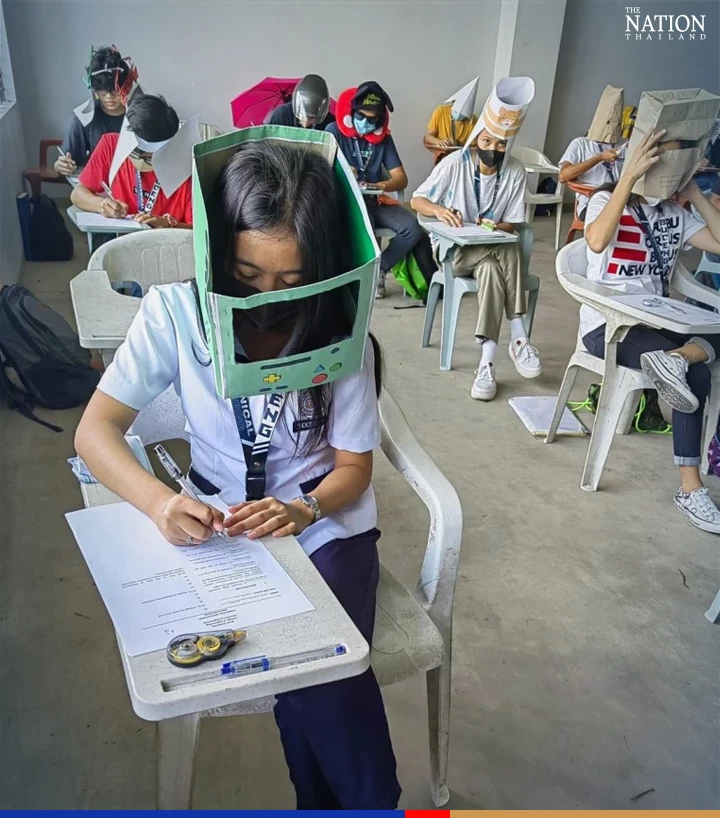
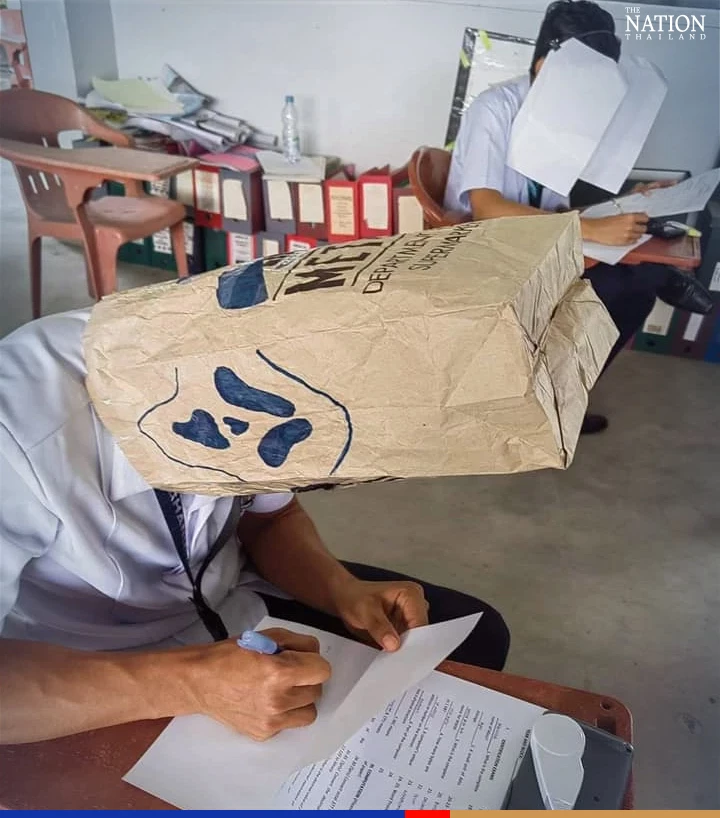
“Anti-cheating headgear” designed by Filipino students for their exams has gone viral as social media users marvel at their ingenuity.
Prof Mary Joy Mandane-Ortiz from Bicol University College of Engineering asked the students to prepare protective headwear for the mid-term exams on Monday and Tuesday.
She gave full clearance for students to go wild, and her students duly complied with some outrageous concoctions. Photos of the kids wearing their outlandish designs as they took the exam went viral on Filipino and international social media.
Each student sported a unique contraption displaying creativity and humour in designs made from leftover materials including a motorcycle helmet, egg carton, and clothes hanger complete with a drawing of underpants.
“I really love and [I’m] proud of my students because their engineering midterm exams can be pressuring and stressful, yet they managed to add some colour and fun. Thank you very much, students. You make me proud,” Prof Mandane-Ortiz wrote on Facebook.
The professor took inspiration from a Thai university that required students to wear bizarre horse blinker-like gear to keep eyes from wandering, according to Coconuts website on Tuesday.
Earlier, photos of Kasetsart University Faculty of Agro-Industry students wearing anti-cheating headgear made of paper sheets went viral. The photos earned heavy criticism from Thai netizens citizens and the idea was quickly scrapped despite having been originally proposed by the students.
British Prime Minister Liz Truss announced on Thursday she would step down. Given the divisions in the ruling Conservative Party, there is no obvious candidate and her replacement would face a country likely heading into a recession. Leading names are below:
RISHI SUNAK
Britain’s former finance minister was the most popular candidate among Conservative lawmakers at Westminster but, after getting through to a run-off against Truss, he lost out in a vote involving some 170,000 party members who make the final decision.
Many members were angry when Sunak quit in July, helping to trigger a rebellion that eventually brought down Johnson. They also ignored his warning that markets could lose confidence in Britain if Truss delivered her unfunded tax cuts.
Betting exchange Betfair puts Sunak as the favourite to replace Truss, but those lawmakers who remain loyal to Johnson would likely oppose that move.
JEREMY HUNT
With Truss’s economic programme collapsing, the prime minister fired her finance minister and turned to Hunt, a former health and foreign minister, to put things right.
A series of confident performances on television and in the House of Commons, as he ripped up Truss’s economic manifesto, have already led to some Conservative lawmakers referring to Hunt as the “real prime minister”.
He has insisted he does not want the top job, despite entering two previous races to become prime minister, including in 2019 when he lost out in the final round to Johnson. Hunt does not have the obvious support of a large group of lawmakers in parliament.
BEN WALLACE
Britain’s defence secretary is one of the few ministers to have emerged from recent political turmoil with his credibility enhanced. Wallace, a former soldier, was defence minister for both Johnson and Truss, leading Britain’s response to Russia’s invasion of Ukraine.
Popular with party members, he surprised many earlier this year when he said he wouldn’t run for the leadership, saying he wanted to focus on his current job. He told the Times newspaper this week that he still wanted to stay as defence secretary.
PENNY MORDAUNT
A former defence secretary, Mordaunt was a passionate supporter of leaving the EU who only just missed out on the final two-place run off in the recent leadership challenge.
Mordaunt won plaudits for her performance in parliament on Monday, when she defended the government even as it reversed most of its policies.
One lawmaker has described Mordaunt as having “broad appeal”, referring to her ability to find friends in the various tribes of the party.
BORIS JOHNSON
Former prime minister Boris Johnson, a journalist, has loomed large over British politics ever since he became London Mayor in 2008. After causing trouble for leaders such as David Cameron and Theresa May, he finally became prime minister in 2019 and went on to win a landslide election victory.
Johnson was the face of the Brexit vote and won votes in parts of the country that had never voted Conservative before. But he was forced out by a string of scandals.
Some closest to him say at the moment he is more interested in making money on the speech circuit than returning to frontline politics.
Liz Truss resigns after six weeks as UK prime minister
THURSDAY, OCTOBER 20, 2022
Liz Truss said on Thursday she would resign as British prime minister, brought down just six weeks into the job by an economic programme that shattered investor confidence and enraged much of her Conservative Party.
Speaking outside the door of her Number 10 Downing Street office, Truss accepted that she had lost the faith of her party and said she would step down next week, becoming the shortest-serving prime minister in British history.
Truss, who had said on Wednesday she was a “fighter and not a quitter”, told the mass of journalists gathered in Downing Street that she realised she could no longer deliver on the promises that won her the Conservative leadership.
“I have therefore spoken to His Majesty the King to notify him that I am resigning as leader of the Conservative Party,” said Truss, who was supported only by her husband with her aides and loyal ministers noticeably absent.
Britons in the midlands welcomed the news that Liz Truss would resign as British prime minister.
Those in Knutsford, part of the traditionally conservative constituency of Tatton, were in favour of Truss’s resignation, though were at a loss as to who was fit to replace her. Tatton has delivered a conservative MP in all but one election since 1983.
No confirmation from White House on Harris attending Apec Summit instead of Biden
THURSDAY, OCTOBER 20, 2022
The White House has refused to confirm whether US Vice President Kamala Harris will be attending the Apec Summit in Bangkok next month in place of President Joe Biden, as had been reported earlier by Thai media.
White House press secretary Karine Jean-Pierre said in Washington on Wednesday [today Thailand time] that, “We don’t have any travel announcement … at this time.”
Responding to a media question during her press briefing, she dismissed criticism that the US appeared to view the Asia-Pacific Economic Cooperation forum as “not important enough”.
“We consider the forum important. That is why the United States will be the host of the Apec in 2023. So clearly, that is important to the president; that is important to us,” the White House spokesperson said.
“It is a top priority for the Biden-Harris administration to serve as a strong, reliable partner to Apec economies and identify common ways to replenish — to unleash economic opportunity, prosperity, and growth for us all,” she added.
The US Embassy in Bangkok, when approached for an answer on the matter, said on Thursday (Oct 20) that the White House has not made any official announcement regarding Harris taking Biden’s place at the Apec Summit.
Thailand will be hosting this year’s Apec Summit at Queen Sirikit National Convention Centre on November 18-19.
It was reported earlier that Biden would be at the White House on November 19 to attend the wedding reception of his eldest granddaughter Naomi Biden.
In a related development, Thai Foreign Ministry spokesman Tanee Sangrat said on Wednesday that Thailand had already received written confirmation from six economies to attend the summit — Chile, Hong Kong, Taiwan, New Zealand, Peru and Singapore.
“Three countries have said their leaders would attend the summit, while two will send representatives to attend the meeting,” Tanee said, adding that Thailand is currently waiting for a response from four nations.
According to him, leaders from three countries will attend the Apec Summit as observers and special guests of the chair.
A complete list of Apec economies attending the summit will be announced during the October 31 meeting of the national committee tasked with preparation, to be chaired by Prime Minister Prayut Chan-o-cha, according to the Foreign Ministry’s spokesman.
Growing of Prachak trees emerging as an alternative to rice in some Cambodian villages
THURSDAY, OCTOBER 20, 2022
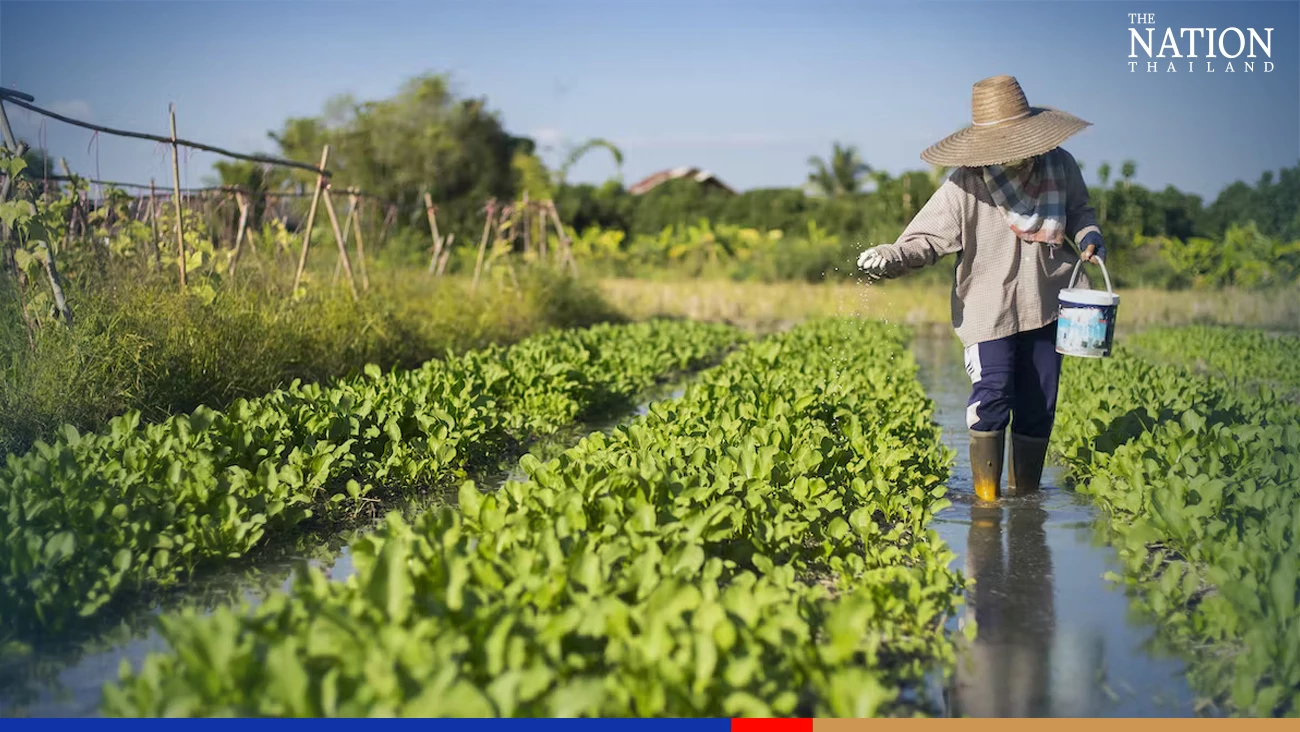
Many Cambodian farmers in the Svay Rieng province have given up on rice to plant Prachak trees, so they can refine their oil and earn more.
In the past, this plant was unpopular, and many were felled by farmers to create more land for other crops.
Su Kea, who refines oil in Samlei Khang Tbong village, Kampong Ro district, said until a decade ago he had never been interested in the plant, and ironically had cut many of them down and thrown them away.
“Now everyone has realised that they are useful. Almost half of the villagers here have given up other crops and are planting these trees, as they see the profits that some people have made,” he added.
He explained that the business was now declining as more and more people were producing oil.
When compared to traditional rice farming, oil refining remains a better source of income. Rice generally yields about US$1,000 per hectare, whereas Prachak oil can generate up to twice that, he added.
Prachak is most likely a melaleuca tree, possibly Melaleuca cajuputi.
“People are planting more and more of the trees – they used to buy them cheaply from other farmers, but now they are considered valuable. Farmers who only have half a hectare of land cannot grow enough trees to refine enough oil, so they have to pay others for trees. Most people are now planting two or three hectares at a time, which gives a good yield.
“Rice is worth less when it reaches the market, and has more costs – we have to pay to get the fields ploughed, for example,” he said.
In the past, brokers were prepared to pay 150,000 riel (1,380) per kilo of oil. Lately, that sum has declined to 75,000.
Like the people of Samlei Khang Tbong, the people of Samlei Khang Choeung village are also switching to oil production. Local farmer Sok Savon said that one driving factor behind the change was the high cost of fertiliser which rice production requires.
He echoed Kea’s assertion that up to $2,000 per hectare could still be earned if the villagers were prepared to refine their own oil. If they were not, they could sell a hectare of plants for up to $250. The trees can be ready for harvesting in as little as six months. Only older plants should be used, as they produced a higher quality of oil.
He said that his family has three hectares of farmland, all of which was planted with Prachak.
The oil is used as liniment or sometimes mixed with other medicines. It is an effective coagulant and is used to stop cuts from bleeding, and is also excellent for sprains, he added.
“Thanks to the oil, we can support our families. As far as I am aware, almost all of the villagers are considering giving up rice production,” he said.
The plants are as simple to grow as cassava, with pieces of root used to start new plants. If farmers want to accelerate their growth, they can use fertiliser, much as they do with rice, he added.
Phin Chantha, chief of Samlei commune, said that more than 200 families in the two villages are refining the oil. The profitability of the product has led to increased prices for farmland in the area.
Previously, villagers could sell farmland for just $4,000 per hectare, but now they would not accept offers as high as $10,000, he added.
“They have much better lives than they did when they were growing rice. In the past, many people sold their land and gave up farming. Now, families are staying,” he said.
Freebies not the solution to challenges faced by Thai farmers, says World Bank
FRIDAY, OCTOBER 21, 2022
Nongluck Ajanapanya
World Bank experts are urging the Thai government to stop free subsidies to help farmers and instead implement more conditional assistance measures that would directly improve production efficiency.
The statement was made at a seminar co-hosted by the World Bank and Kasetsart University on Friday to launch their joint study, “Ending Poverty in Thailand: Rural Income Diagnostic – Challenges and Opportunities for Rural Farmers”.
Nadia Belhaj Hassine Belghith, poverty economist at the World Bank, noted that rural Thailand continues to face the most severe poverty challenges, with high-income inequality.
Though it is commendable that the Thai government provides many freebies, this type of assistance will have a negative impact in the long run.
Witsanu Attavanich, a professor at Kasetsart University’s Faculty of Economics who participated in this study, elaborated that gratuitous measures only help Thai farmers in the short term, while what they really need is to learn how to increase their productivity in order to sustain their income.
Wisanu called it a “waste of time and money”. He said that the government should use the budget to improve irrigation systems and agricultural technology, as well as to educate more farmers on current farming practices instead.
Belghith added that the right assistance would help Thailand overcome its persistent poverty.
“Cross-cutting policy measures related to skill development will also be important in order to support rural households,” Belghith said. “With low levels of education and digital literacy, combined with an ageing farmer population, it is critical to develop the skills of farmers, young and old, to enable them to adapt to the changing context of climate change and benefit from new technologies.”
The World Bank Rural Income Diagnostic for Thailand aims to examine the challenges and opportunities to improve income and productivity in the rural sector.
The diagnostic also examines how to facilitate income growth in the short to medium term and places particular focus on farming households given their higher poverty and vulnerability.
The report found that Thailand’s poverty rate in rural areas was more than three percentage points higher than in urban areas in 2020. Furthermore, the rural poor outnumbered the urban poor by nearly 2.3 million. The majority of them make a living by farming.
Fabrizio Zarcone, World Bank country manager for Thailand, pointed out that Thailand has the potential to support faster and more sustained rural household income growth.
“As Thailand’s economy adjusts to a new normal post-Covid, policy measures that boost agricultural productivity, encourage crop diversification to higher-value crops, and improve access to markets through improved rural connectivity and digital technology adoption can help overcome the constraints faced by the rural poor,” Zarcone suggested.
According to the study, the Covid-19 pandemic has had a significant impact on the urban sector, resulting in strict mobility measures, business closures, and job layoffs.
However, the urban sector is expected to recover faster, while the rural economy will be hit harder by the crisis. The World Bank Thailand Covid-19 monitoring phone survey results also found that 70 per cent of rural households reported a decrease in income since March 2020.
The analysis also shows that Thailand has the highest income inequality rate in East Asia and the Pacific region, with a Gini coefficient of 43.3 per cent in 2019.
The average monthly income for rural households was only about 68 per cent of that of urban households. Rural households continue to face challenges, such as low education, a high number of dependents, and difficult living conditions.
In her closing remarks, Dina Umali-Deininger, regional manager of Agriculture and Food Global Practice at World Bank, urged the Thai government to reduce the disparity between urban and rural households.
She advocated increased agricultural productivity, added value in agricultural products, and more investments to improve the agricultural sector and prepare for the effects of climate change.
NBTC finally gives True-Dtac merger ‘conditional’ approval after 9 months
FRIDAY, OCTOBER 21, 2022
At a meeting that lasted for more than 11 hours, the Thai telecoms watchdog voted 3:2 to “conditionally acknowledge” a proposed merger between True Corporation and Total Access Communications (Dtac).
The decision was made on Thursday night, many months after True and Dtac – the country’s second and third-largest mobile network operators, respectively – filed their business merger report with the National Broadcasting and Telecommunications Commission (NBTC) in January.
However, this decision was a huge disappointment for consumer protection and civic society groups that have been against the merger, saying it would lead to market control and unfair competition.
Meanwhile, the opposition Move Forward Party has threatened to take legal action against NBTC for alleged dereliction of duty.
Deputy party leader Sirikanya Tansakul said on Friday that the agency failed to perform its constitutional duty to protect the interest of consumers.
In its resolution, the NBTC appeared to avoid using the term “approve”, though the minority commissioners maintained the regulator is empowered to decide whether to give the green light to such a business merger.
In a statement released on Thursday night, the NBTC admitted that the True-Dtac merger “is a sensitive matter that has impacts on the public”.
Prof Pirongrong Ramasoota, one of the two commissioners who voted against, dubbed the lengthy discussion between the five NBTC members as “the longest meeting in my life”.
In her Facebook post, Pirongrong apologised to reporters waiting outside the meeting room for declining an interview. “I was totally exhausted. My battery was depleted,” she wrote.
Pirongrong and her fellow minority commissioner, Assoc Prof Suphat Suphachalasai, reserved their rights not to permit a business merger between True and Dtac.
In her written statement, Pirongrong said she viewed such a merger as ownership of the same business type, which could severely affect the mobile network market and the national economic development.
She said the telecoms law and NBTC rules empower the regulator to prevent monopoly or unfair competition.
In her seven-point arguments, Pirongrong cited constitutional clauses that prohibit business domination and competition restriction. She also mentioned the findings of a study by the NBTC’s independent foreign advisers SCF Associates Ltd that pointed to the negative impacts of the merger on consumers.
In his written statement, Suphat said the True-Dtac merger would have severe consequences on the country’s economy and society, with reduced service quality and obstruction to new players in the market. There is a high likelihood of market collusion that would discourage new competitors, he said.
Before reaching their final decision, the five NBTC commissioners were evenly split. Suphat and Pirongrong viewed that the NBTC should not allow the merger as it would lead to a duopoly of the telecom business and unfair competition. But NBTC president Dr Sarana Boonbaichaiyapruck and Torpong Selanont disagreed, saying the regulator should acknowledge the merger with conditions.
The fifth commissioner, Air Marshal Thanapant Raicharoen, abstained explaining that there were some legal issues that need to be further considered.
The NBTC president cast the deciding vote, making it 3:2 in favour of the proposed merger, which was in line with the NBTC rules.
The conditions set for the merged entity include service fee controls and ceilings, independent verification of cost structures and service pricing by experts to be hired by the operators at their expense, for at least five years after the merger, space to be provided for the operation of mobile virtual network operators (MVNO) and separate rates to be charged for voice, data and messaging services.
Under the NBTC’s conditions, True and Dtac will use their existing brand names, True Move H Universal Communications (TUC) and Dtac TriNet (DTN), for three years after the merger, before they can adopt a new brand name.
They are also required to install a 5G network to cover 75 per cent of the Thai population within three years of the merger and 90 per cent coverage within five years.
Thailand, Cambodia to reach deal on disputed oil field by March: Energy minister
FRIDAY, OCTOBER 21, 2022
Thailand’s Foreign and Energy ministries are making progress in talks with Cambodia to relieve the fuel crisis by tapping disputed oil resources in the Gulf of Thailand. The 26,000-square-kilometre overlapping claims area (OCA) in the upper Gulf is estimated to hold up to 500 million barrels of oil, plus gas deposits.
Deputy PM and Foreign Minister Don Pramudwinai said on Friday that his ministry’s legal team and Energy Ministry representatives are studying details of the disputed areas in the upper Gulf.
“Right now, we cannot tell when the negotiations will conclude. Agencies involved are gathering information to determine what we can do about the OCA,” Don said.
Energy Minister Supattanapong Punmeechaow said that a Thai-Cambodian joint technical committee (JTC) will meet again within three months to finalise details of joint development oil project in the OCA.
The JTC met for the first time in October last year. The meeting, led by Deputy Prime Minister Gen Prawit Wongsuwan, set a framework for negotiations over the OCA and appointed two special committees, one for maritime zoning and the other for joint oil extraction.
“The ministry will try to conclude issue before the current Parliament’s term ends,” said Supattanapong, who doubles as deputy prime minister.
The House of Representatives’ four-year term will end on March 23, next year.
The baht opened at 38.23 to the US dollar on Friday, weakening from Thursday’s close of 38.12.
The Thai currency will likely move between 38.15 and 38.45 against the greenback during the day, Krungthai market strategist Poon Panichpibool predicted.
Poon said that the baht may weaken further if the currency market remains risk-off, adding that it could test the resistance level of 38.50 to the dollar.
He said the baht is being pressured by mass selloffs of long-term Thai bonds by foreign investors as yields on the US 10-year bond continue to rise.
Gold purchases as the price drops are adding to downside pressure on the baht. Meanwhile, investors are also purchasing yen after the Japanese currency weakened to 25.28 baht per 100 yen.
However, Poon did not think that the baht would breach its resistance level of 38.50 to the dollar since exporters were waiting to sell the greenback at this level and foreign investors shorting the baht may also sell for profit.
He added that foreign outflows from the Thai stock market were decreasing while signs of net buying from investors abroad would slow any weakening of the baht.
Poon advised investors to use hedging tools such as options to manage risks in a highly volatile currency market.
From the theme of “Open. Connect. Balance.” chosen to frame Thailand’s hosting of APEC 2022, the thrust of “Balance in All Aspects” has been given importance as a pathway beyond recovering from the COVID-19 pandemic to long- term and sustainable prosperity.
Pointing out that “sustainability starts with how the region fuels its growth” under the topic of balance, APEC host Thailand indicates that while APEC is on the right track, having set energy intensity reduction and renewable energy- doubling goals, it needs to “accelerate energy transition efforts.”
Stating “APEC should explore how advanced technology can be utilized to produce clean and renewable energy,” Thailand has been emphasizing the application of the circular economy, in which value is created at all levels of production and consumption, throughout the past year.
The emphasis has included Thailand’s proposing the “Bangkok Goals on BCG Economy” as a key deliverable.
First introduced at the Informal Senior Officials’ Meeting (ISOM) in late 2021 and discussed extensively at both the second and third Senior Officials’ Meetings, the document seeks to “advance APEC’s sustainability agenda in a more holistic and integrated manner by emphasizing the whole-of-society and whole-of-APEC-system approach to achieve four goals.”
The four goals are: climate action, including net zero greenhouse gas emissions; sustainable trade and investment; sustainable management of resources and conservation of the environment and biodiversity; and resource efficiency and sustainable waste management.
Energy production and consumption are relevant to three of these goals, with Thailand working to lead APEC towards power that does not generate greenhouse gas emissions, is environmentally sustainable and is produced through the efficient use of resources, resulting in minimal waste.
The BCG Economy concept, placed at the center of the Bangkok Goals, or Bio-Circular-Green Economy Model, complements circular economy concepts with the bio and green approaches to provide a path to transforming current aspects of the economy into sustainable, environmentally-friendly forms.
Through the application of BCG in Thailand and the economies of APEC, the entire region is moving to realize the aspiration of “advance the transition to clean and renewable energy.”








 The report found that Thailand’s poverty rate in rural areas was more than three percentage points higher than in urban areas in 2020. Furthermore, the rural poor outnumbered the urban poor by nearly 2.3 million. The majority of them make a living by farming.
 The analysis also shows that Thailand has the highest income inequality rate in East Asia and the Pacific region, with a Gini coefficient of 43.3 per cent in 2019.