Fake house, room ads dupe students in Philippine university town

#SootinClaimon.Com : ขอบคุณแหล่งข้อมูล : หนังสือพิมพ์ The Nation.

https://www.nationthailand.com/international/ann/40018993


False advertisements on social media for rooms and spaces in boarding and transient houses have been victimizing students who are returning to Baguio City for the new school term after spending two years attending online classes because of restrictions due to the Covid-19 pandemic.

Fake house, room ads dupe students in Philippine university town

The police are looking into two complaints sent last week to the mayor’s office and the city council’s public information office.

On Aug. 8, a resident alerted Philip Puzon, executive assistant at the mayor’s office, that photographs of their family home were used to solicit down payments from students who were searching for accommodation in the city, according to Aileen Refuerzo, city information officer.

Stolen identity
The family did not reveal how much money may have been taken, but they said they learned about the scam when students began turning up at their doorsteps.

Refuerzo said the family reported that one student showed up with the mother.

On Sunday, the owner of a boarding house complained to the city council that his establishment was also used to get money from students through the stolen identity of a woman who lost her wallet in 2016, said the council’s information officer, Jordan Habbiling, on Tuesday.

The woman’s identity was used to fabricate the fake boarding house’s registration with the Department of Trade and Industry, Habbiling said in a separate interview.

He said he could not post the alert immediately on Aug. 13 as they were waiting for the Bureau of Internal Revenue to confirm that the registration was false.

The fake boarding house used several online payment accounts with identities that needed to be verified by authorities, Habbiling said.

This same scheme had plagued hotels and transient homes before the pandemic broke out, said Aloysius Mapalo, city tourism operations supervisor.

University town
It happened again when restrictions were eased and tourists flooded the summer capital this year.

Baguio is a university town, with 21 tertiary institutions catering to about 60,000 students at a given year, many of them from provinces in the Cordillera and northern Luzon, and even from Central Luzon and Metro Manila.

Among these are the state-run Philippine Military Academy and the University of the Philippines Baguio, which have designated student housing facilities.

The city government’s licensing office has not released the latest number of transient and student lodging facilities in Baguio, although estimates range between 200 and 400, including houses or apartment units used for student housing but have not been issued permits.

On Monday, the city government worked out a new traffic routing scheme in anticipation of a deluge of transient students, given the weekend gridlocks that already plague Baguio when tourists come.

Vincent Cabreza

Philippine Daily Inquirer

Asia News Network

Asia News Network: The Nation (Thailand), The Korea Herald, The Straits Times (Singapore), China Daily,  Jakarta Post, The Star and Sin Chew Daily (Malaysia), The Statesman (India), Philippine Daily Inquirer, Yomiuri Shimbun and The Japan News, Gogo Mongolia,  Dawn (Pakistan),  The Island (Sri Lanka), Kuensel (Bhutan), Kathmandu Post (Nepal), Daily Star (Bangladesh), Eleven Media (Myanmar), The Phnom Penh Post and Rasmei Kampuchea (Cambodia), The Borneo Bulletin (Brunei), Vietnam News, and Vientiane Times (Laos).

Published : August 17, 2022

By : Philippine Daily Inquirer
Distance-learning high school in Japan holds classes in metaverse

#SootinClaimon.Com : ขอบคุณแหล่งข้อมูล : หนังสือพิมพ์ The Nation.

https://www.nationthailand.com/international/ann/40018990


A distance-learning high school based in Obama, Fukui Prefecture, has started holding classes in the metaverse, a virtual environment where users in different locations can interact with each other.

Distance-learning high school in Japan holds classes in metaverse

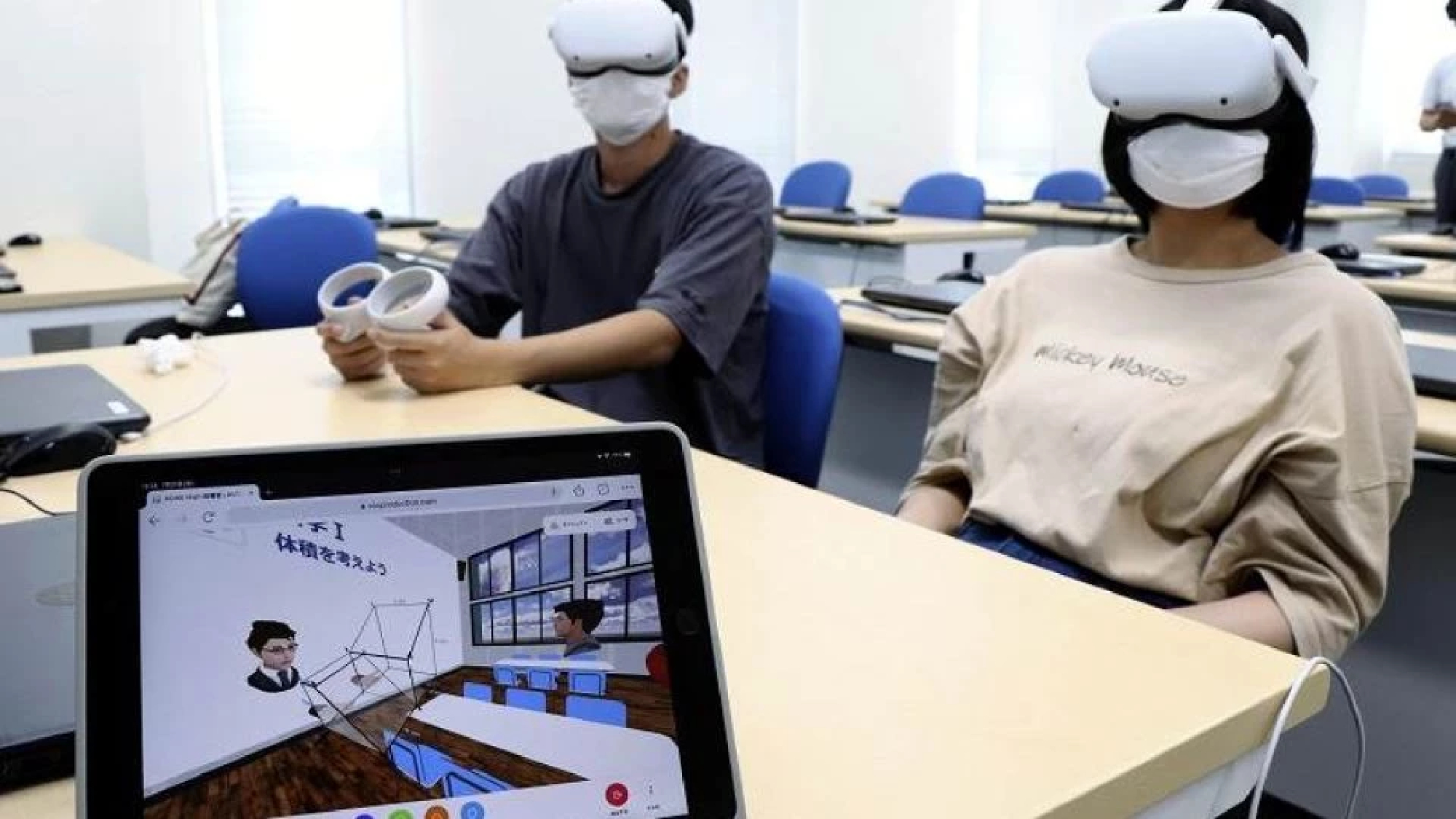
Since spring, Aoike High School students have been able to communicate with their teachers and classmates in the form of avatars, digital depictions of users that appear as bodiless heads in the metaverse platform utilized by the school.

On July 21, first-year students were taking a math lesson in a virtual classroom. The users’ names were displayed above the head of each avatar.

“This solid is in a shape like this. Let’s confirm it with a three-dimensional model,” the teacher said, after which the students manipulated virtual models in the metaverse to understand the shape of the object.

Back in the real world, the teacher and some students were wearing virtual reality googles, controlling their respective avatars while seated in a classroom at Aoike High School’s Toyama campus.

According to officials of the school, about 30 students attend classes in the metaverse up to three times a week, studying subjects including mathematics and biology.

“In the metaverse, you don’t feel far from the other participants,” said first-year student Ruiji Takashima, 18. “It was easier to visualize and understand three-dimensional shapes than it would’ve been in a face-to-face class.”

The school used to have a catchment area that only covered the six prefectures in the Hokuriku region, but since April it has accepted students from across Japan, which prompted the move into the metaverse.

Distance-learning high school in Japan holds classes in metaverse

Although one of the goals is to make classes available throughout Japan, another is to help students attend face-to-face classes without feeling pressure. About half of the school’s students have had problems with school attendance in the past. Aoike High School hopes that holding classes in the metaverse improves the school experience for such students.

The design of each user’s avatar is based on a headshot taken at the school, but it’s possible for the students to modify their avatars with different hairstyle options and the possibility of adding eyeglasses, among other things.

Naoki Yamagishi of Aoike Gakuen, which operates the school, said students can also interact with students in the metaverse outside of class hours. “Even students who can’t go to school are able to have conversations with classmates and enjoy an experience similar to that of attending a conventional school,” Yamagishi said.

Takanobu Fuji, chief analyst of the Hokuriku Economic Research Institute, thinks metaverse schooling will change the way students communicate in the future.

“Videoconference tools have proliferated amid the coronavirus pandemic, and many schools and offices have shifted online. But it’s easier to have casual chats in the metaverse than on videoconference calls,” Fuji said.

Metaverse platforms offer virtual environments in which users can socialize, study, work, and perhaps even shop in the future, by controlling their respective avatars. Concerts, museums and tourist spots are among some of the applications that have taken advantage of the new technology.

Asaki Ogawa

The Japan News

Asia News Network

Asia News Network: The Nation (Thailand), The Korea Herald, The Straits Times (Singapore), China Daily,  Jakarta Post, The Star and Sin Chew Daily (Malaysia), The Statesman (India), Philippine Daily Inquirer, Yomiuri Shimbun and The Japan News, Gogo Mongolia,  Dawn (Pakistan),  The Island (Sri Lanka), Kuensel (Bhutan), Kathmandu Post (Nepal), Daily Star (Bangladesh), Eleven Media (Myanmar), The Phnom Penh Post and Rasmei Kampuchea (Cambodia), The Borneo Bulletin (Brunei), Vietnam News, and Vientiane Times (Laos).

Published : August 17, 2022

By : The Japan News

Malaysia’s Najib loses appeal to nullify 1MDB trial

#SootinClaimon.Com : ขอบคุณแหล่งข้อมูล : หนังสือพิมพ์ The Nation.

https://www.nationthailand.com/international/ann/40018967


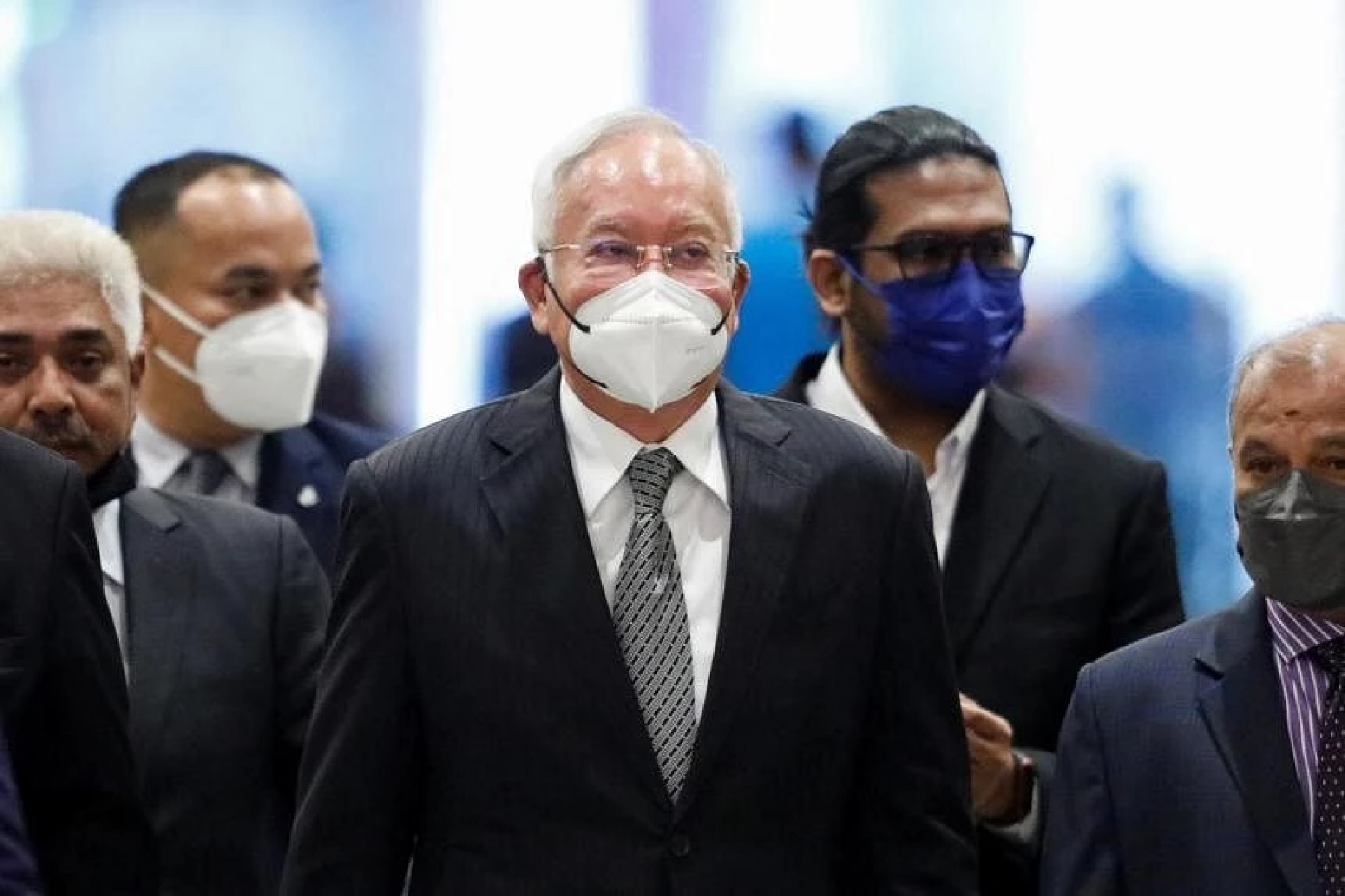
Malaysia’s former prime minister Najib Razak on Tuesday failed in his bid to nullify the 1Malaysia Development Berhad (1MDB)-linked graft trial that resulted in his conviction.

Malaysia's Najib loses appeal to nullify 1MDB trial

Malaysia’s highest court ruled to push ahead with hearing the 69-year-old’s final appeal against his conviction and 12-year jail sentence.

Najib had wanted to push for a retrial by regarding an alleged conflict of interest involving High Court Judge Nazlan Ghazali. Nazlan had convicted the former premier of misappropriating 42 million ringgit (95.1 million baht) from SRC International, a former subsidiary of 1MDB.

The defence sought to cast doubt on Justice Nazlan’s credibility, saying that the verdict was compromised by his prior employment at Maybank, one of Malaysia’s largest lenders.

The judge was Maybank’s general counsel and company secretary during the time the bank advised 1MDB on the formation of SRC, and Najib’s lawyers have said that the judge should have recused himself as he is “too close for comfort to be the judge trying the SRC case”.

But on Tuesday, a five-member bench at the Federal Court led by Malaysia’s Chief Justice Tengku Maimun Tuan Mat unanimously threw out the motion to introduce new evidence, forcing Najib and his newly appointed defence lawyers to proceed with arguing his final appeal.

Should Najib fail in his appeal, he faces 12 years in jail and 210 million ringgit in fines.

Failing to overturn his conviction would also disqualify him as a candidate in Malaysia’s next general election, which must be held by September next year.

While Najib’s appeal is scheduled to run until August 26, the outcome is expected to be made known only at a later date, as the court usually sets another date to deliver a decision.

The Straits Times

Asia News Network

Asia News Network: The Nation (Thailand), The Korea Herald, The Straits Times (Singapore), China Daily,  Jakarta Post, The Star and Sin Chew Daily (Malaysia), The Statesman (India), Philippine Daily Inquirer, Yomiuri Shimbun and The Japan News, Gogo Mongolia,  Dawn (Pakistan),  The Island (Sri Lanka), Kuensel (Bhutan), Kathmandu Post (Nepal), Daily Star (Bangladesh), Eleven Media (Myanmar), The Phnom Penh Post and Rasmei Kampuchea (Cambodia), The Borneo Bulletin (Brunei), Vietnam News, and Vientiane Times (Laos).

Published : August 16, 2022

By : The Straits Times

Lost pup reunited with owner after pitch incursion during Chilean league game

#SootinClaimon.Com : ขอบคุณแหล่งข้อมูล : หนังสือพิมพ์ The Nation.

https://www.nationthailand.com/international/international-news/40019001


An adopted puppy which breached security and darted on to the pitch during a clash between two Chilean Premier League football teams has finally been reunited with its owner.

Lost pup reunited with owner after pitch incursion during Chilean league game

Matias Gayozo had almost lost all hope of finding his missing Beagle called Toby when he received a call from animal group Huellitas de Collao, which said Toby had been found 20 kilometres away.

During the 20th minute of Sunday’s league clash between Fernandez Vial and Universidad de Concepcion, several football players tried to stop Toby from causing havoc, but they failed.

The little canine made its way to the 12-yard line, stopping to defecate on the goal line. Universidad goalkeeper Manuel García decided to take his gloves off and clean up the mess.

The dog was successfully caught after several minutes of mayhem.

On Monday, Huellitas de Collao gave Toby’s owner the good news that the dog was discovered 20km away from the stadium in Concepcion.

Gayozo told Chilean publication Sabes that the puppy just loves to run, as tens of thousands witnessed on television when the little creature invaded the pitch.

“We were very happy to get him back to Villa Montahue. He is already at home, warm, without going through all the cold that we imagine he would find himself in on the streets,” Gayozo added gleefully.

Published : August 17, 2022

By : THE NATION

Asean Trial Centre of CIETAC Official Inaugurates in Nanning

#SootinClaimon.Com : ขอบคุณแหล่งข้อมูล : หนังสือพิมพ์ The Nation.

https://www.nationthailand.com/international/international-news/40018996


On August 16, the RCEP and Asean International Arbitration Summit themed “Sharing Opportunities, Creating Prosperity-Innovation and Development of International Arbitration in the light of RCEP” was successfully held in Nanning.

Asean Trial Centre of CIETAC Official Inaugurates in Nanning

The Forum focuses on the hot issues of international arbitration, and it allows the participants to exchange and discuss the international arbitration experiences and results to promote the high-quality implementation of RCEP and to deepen the economic and trade relations between China and Asean as well as other RCEP member states, facilitating regional connectivity and economic integration.

The Unveiling Ceremony for the Nameplate of the Asean Trial Center of China International Economic and Trade Arbitration Commission (CIETAC) was held during the Forum, marking the official inauguration of the Center in Nanning.

The working pattern and mechanism of the Trial Center are:

1. If the agreed arbitration clauses set Nanning, Guangxi, as the place of arbitration, CIETAC may hear the case at the Asean Trial Center;

2. If there is no specified place of arbitration in the arbitration clauses, the CIETAC may, upon consultation and agreement of both parties, choose to hear the case at the AseanTrial Center;

3. Depending on the situation of the COVID-19 pandemic, if one of the parties is from an Asean country, CIETAC may hear the case in the Asean Trial Center to resolve the dispute upon consultation and agreement of both parties;

4. The Asean Trial Center will provide court facilities for the international arbitration institutions cooperating with CIETAC to hear a case if needed.

Established by CIETAC, the Asean Trial Center is an Asean -oriented institution that provides arbitration services. It will help Guangxi build a regional arbitration hub for RCEP member states, especially the Asean countries, aiming to create a rule-based and internationalized business environment.

It also seeks to provide an expeditious arbitration environment for Chinese and Asean parties’ disputes to encourage the use of arbitration among foreign traders and investors, offering legal measures for China-Asean economic and trade development.

InfoQuest

Published : August 17, 2022

China unexpectedly cuts key rates to propel economic rebound

#SootinClaimon.Com : ขอบคุณแหล่งข้อมูล : หนังสือพิมพ์ The Nation.

https://www.nationthailand.com/international/international-news/40018989


China’s central bank has leveraged its policy toolkit, cutting the interest rates of its medium-term lending facility (MLF) loans and reverse repos by 10 basis points for the second time this year, to further consolidate economic growth.

China unexpectedly cuts key rates to propel economic rebound

Specifically, the People’s Bank of China lowered the rate of 400 billion yuan (about 59 billion U.S. dollars) worth of one-year MLF to financial institutions to 2.75 per cent from the 2.85-per cent rate it opted for on the previous occasion.

It also injected 2 billion yuan of funds into the market via seven-day reverse repos at an interest rate of 2 per cent, down from 2.1 per cent.

The MLF tool was introduced in 2014 to help commercial and policy banks maintain liquidity by allowing them to borrow from the central bank using securities as collateral.

A reverse repo is a process in which the central bank purchases securities from commercial banks through bidding, with an agreement to sell them back in the future.

Analysts saw the move as the central bank’s quick response to changes in economic and financial situations, which will further lower financing costs for the real economy, expand domestic demand, and consolidate the momentum of economic recovery.

The central bank’s data showed that the M2, a broad measure of money supply that covers cash in circulation and all deposits, increased 12 per cent year on year to 257.81 trillion yuan at the end of last month.

Newly added social financing, a measurement of funds that individuals and non-financial firms receive from the financial system, came in at 756.1 billion yuan last month, down 319.1 billion yuan from the same period last year.

The July data suggested that while the money supply was sufficient, the financing demand from the real economy was still weak, said Zhou Maohua, an analyst with the China Everbright Bank.

Zhong Zhengsheng, chief economist with Pingan Securities, said lowering policy interest rates is the most direct way to drive down financing costs.

Zhong said more convenient financing for companies that contribute to the new drivers of the economy, as well as decreased financing costs, will be conducive to structural optimization and high-quality development of China’s economy.

Chinese leadership emphasized at a high-profile meeting in late July that the monetary policy should help maintain a proper and adequate liquidity supply, increase credit support for enterprises, and make good use of new loans from policy banks, as well as their funding for infrastructure projects.

The China Banking and Insurance Regulatory Commission said Friday that more efforts will be made to provide more credit to the real economy, including infrastructure and manufacturing, to improve services for new urban residents and bolster support for education, healthcare and elderly care.

Published : August 17, 2022

By : Xinhua

UN special envoy arrives in Myanmar amid ‘deteriorating situation’

#SootinClaimon.Com : ขอบคุณแหล่งข้อมูล : หนังสือพิมพ์ The Nation.

https://www.nationthailand.com/international/international-news/40018987


A senior UN official arrived in Myanmar on a rare visit on Tuesday that comes amid domestic political turmoil and fraying ties between Myanmar and its Southeast Asian neighbours.

UN special envoy arrives in Myanmar amid 'deteriorating situation'

Noeleen Heyzer, the U.N. secretary-general’s special envoy to Myanmar, is visiting after “extensive consultations with actors from across the political spectrum, civil society as well as communities affected by the ongoing conflict,” the United Nations said in a statement dated Monday.

Referring to a U.N. Security Council call for an immediate cessation of all forms of violence and unimpeded humanitarian access, the United Nations said Heyzer would “focus on addressing the deteriorating situation and immediate concerns.” It gave no more details of her visit.

Myanmar has been in chaos since the military overthrew an elected government led by Nobel laureate Aung San Suu Kyi early last year and launched a bloody crackdown on protests that followed.

The junta has not allowed an envoy from the ASEAN regional bloc to meet her.

A Myanmar court on Monday sentenced Suu Kyi to six years in prison after finding her guilty in four corruption cases.

The 77-year-old veteran leader of Myanmar’s opposition to military rule has been charged with at least 18 offences ranging from graft to election violations, carrying a combined maximum jail term of nearly 190 years.

Suu Kyi has called the accusations absurd and denies all charges against her. She is being held in solitary confinement and had already been jailed for 11 years in other cases.

Published : August 17, 2022

By : Reuters

To rescue 10 trapped miners, Mexico turns to German, US companies

#SootinClaimon.Com : ขอบคุณแหล่งข้อมูล : หนังสือพิมพ์ The Nation.

https://www.nationthailand.com/international/international-news/40018984


Mexico will ask both a German and a US company to help rescue 10 miners who have been trapped in a coal mine for nearly two weeks, officials said on Tuesday, as families urged quicker action to save the trapped men.

To rescue 10 trapped miners, Mexico turns to German, US companies

The Foreign Ministry did not immediately respond when asked which two companies it contacted.

The miners became confined underground at the Pinabete mine in the northern border state of Coahuila on August 3 when a tunnel wall collapsed, triggering flooding throughout the mine.

Water surged more than halfway up the 60-meter (197-foot) mine shafts, and officials have struggled to extract enough water and debris such as piping and wooden planks to be able to safely send rescue teams into the mine.

Laura Velazquez, head of Mexico’s civil protection agency, said Mexican officials, including the Foreign Ministry, would speak with the companies on Tuesday.

Engineers meanwhile are pumping water out of Pinabete while working on sealing off the nearby Conchas Norte mine – where water that has accumulated for more than 25 years is now rushing into Pinabete due to the underground tunnel collapse.

Relatives of the trapped miners said their frustration has mounted with each delay and blamed the government for not acting faster.

Darkness and debris impede rescue efforts at the flooded Mexico mine.

Published : August 17, 2022

By : Reuters

Australian engineers create smart textile which acts like biological muscle

#SootinClaimon.Com : ขอบคุณแหล่งข้อมูล : หนังสือพิมพ์ The Nation.

https://www.nationthailand.com/international/international-news/40018983


A team of biomedical engineers in Australia have developed a smart textile which incorporates artificial ‘muscles’, in the hopes that it will revolutionise the future of soft robotics and wearable exoskeletons.

Australian engineers create smart textile which acts like biological muscle

The team demonstrated the shape-morphing flexibility of the material to Reuters, with models of a butterfly and flower made from the textile, performing complex motions in their lab.

Team leader Thanh Nho Do is thinking bigger and believes that he and his team could even use the material to create a human smart suit.

“Like the Iron Man suit or Spiderman suit,” said Do, who is also Director of the University of New South Wales Medical Robotics Lab. “It’s very flexible and has a very high conformability to the bodies.”

The programmable smart textiles were created by weaving or knitting fabric together with artificial muscle fibres. The resultant material has the ability to shape-shift and can lift objects up to 192 times their weight, according to the team in their academic paper published in June. The ‘muscle fibres’ were constructed from long silicon tubes filled with fluid, and then manipulated hydraulically using a syringe, as detailed in the academic paper.

Do say that the material has a wide range of potential applications.

“We can use our technology to make a soft wearable device for human augmentation or we can support disabled people to walk again,” he said.

One potential use is in compression garments. The team showcased prototypes pulsing over a finger and forearm, which could provide massage therapy to relieve pain or improve blood circulation.

Another potential use is through the creation of shape-shifting robots to assist search-and-rescue teams in accessing hard-to-reach locations, said the bioengineers.

The team illustrated this by curling the material around a much larger screw, lifting it out of a narrow tube with ease.

The soft material presents an improvement upon many existing technologies in this field, which are often rigid or heavy and limit usability in changing environments like a bushfire or collapsed building, according to the team’s research.

The team is also working on creating a non-invasive device that can wrap around the heart and assist it to pump blood around the body, to help people with cardiovascular problems, thanks to funding from the National Heart Foundation of Australia.

“The way our artificial (muscle) works is similar to the human’s biological motions… we can control the muscle have elongation or expansion or contraction on demand,” explained Do.

However, the team currently has to manually control the hydraulic pressure through syringe outlets connected to the material. They envision that in around two years the material can be controlled wirelessly and it will be ready for commercialisation.

Published : August 17, 2022

By : Reuters

Apec officials seek to address uncertainties, improve resiliency

#SootinClaimon.Com : ขอบคุณแหล่งข้อมูล : หนังสือพิมพ์ The Nation.

https://www.nationthailand.com/international/international-news/40018975


Apec officials are meeting now against a backdrop of economic and geopolitical challenges to collaborate and focus on building a more resilient and inclusive future for the region. 

Apec officials seek to address uncertainties, improve resiliency

The third Apec technical meeting cluster is now underway in Chiang Mai, a city around 700 kilometres north of Bangkok, involving close to 2,000 policymakers, officials and private-sector representatives from 21 economies.

The meeting cluster will culminate in a two-day plenary session of senior officials on 30–31 August, chaired by Thani Thongphakdi, Permanent Secretary for Foreign Affairs of Thailand and 2022 Chair of the Apec  Senior Officials. This will be the last meeting of the year before Apec Senior Officials prepare for Leaders’ Week on 14–19 November.

The International Monetary Fund projects the world economy to decelerate to 3.4 per cent before slowing further to a 2.9 per cent gross domestic product (GDP) rate in 2023. The same scenario is expected in APEC, where a recent report projected the region’s economy to grow slower than expected at 2.5 per cent this year and 3.4 per cent next year.

“It is a particularly challenging time to be a policymaker. We need to keep our focus on building a more resilient, inclusive and sustainable future because this is the key to future-proofing the region from crises,” said Rebecca Sta Maria, Executive Director of the Apec Secretariat. 

“The intensified uncertainty brought about by recent events brings along the risk of distrust in globalization, multilateral institutions and in each other,” she said. 

“While there’s no denying that disagreements have spilled into multilateral forums and are of significance, they should not keep Apec member economies from banding together to prevent something as existentially damning, as climate change, which will not be fixed, or even managed, by a world divided into distinct blocs.”

Ahead of the technical meeting cluster and Apec Economic Leaders’ Week in November, Sta Maria reiterated that organizations like Apec will play a big part in building back the world’s economy by strengthening policy coordination and regional cooperation when adopting economic resiliency policies as well as ensuring transparency and predictability of trade.

Several ministerial meetings and high-level meetings will also take place alongside the technical meeting cluster:

The Apec Tourism Ministerial Meeting will be held in Bangkok on 19 August and will be chaired by Phiphat Ratchakitprakarn, Thailand’s Minister of Tourism and Sports. Reflecting on the severe impact of the pandemic on the travel and tourism industry, the meeting will focus on rebuilding and rethinking tourism for the future, making it more inclusive and sustainable and paying more attention to the domestic well-being of tourism destinations.

The Apec Meeting of Ministers Responsible for Forestry will take place in Chiang Mai on 24 August. It will focus on tackling forest-related issues such as combatting illegal logging and associated trade, promoting trade in illegally harvested forest products, strengthening forestry cooperation in the region as well as advancing work on sustainable forest management, conservation and restoration.

The Apec High-Level Meeting on Health and the Economy will be held in Bangkok on 25–26 August. It will focus on bolstering economies’ pandemic preparedness and response to future health threats holistically—through investments in global health security—while fostering the application of new technology and continuing the sharing of experiences and best practices.

The Food Security Ministerial Meeting will be held virtually on 26 August and chaired by Chalermchai Sri-on, Thailand’s Minister of Agriculture and Cooperatives. Countering a food crisis and ensuring the region’s food security is also high on the agenda for Apec. Last year, ministers agreed on a 10-year food security roadmap. This year, Thailand will lead discussions to implement the roadmap and build resiliency against the risk of international food trade disruption.

“In today’s challenging environment,” Sta Maria continued, “there is the role for multilateral institutions like Apec to help us confront these challenges in a coordinated, integrated and cohesive manner, and ensure that our work ultimately work brings benefits to people in the region.” 

“We will continue to emphasize effective partnerships and cooperation across our region, including between the public and private sectors, specifically, the Apec Business Advisory Council, and other regional fora and key stakeholders, including the youth of our region,” she concluded.

Published : August 16, 2022